anaheim-gazette 1876-07-22
Scanned page
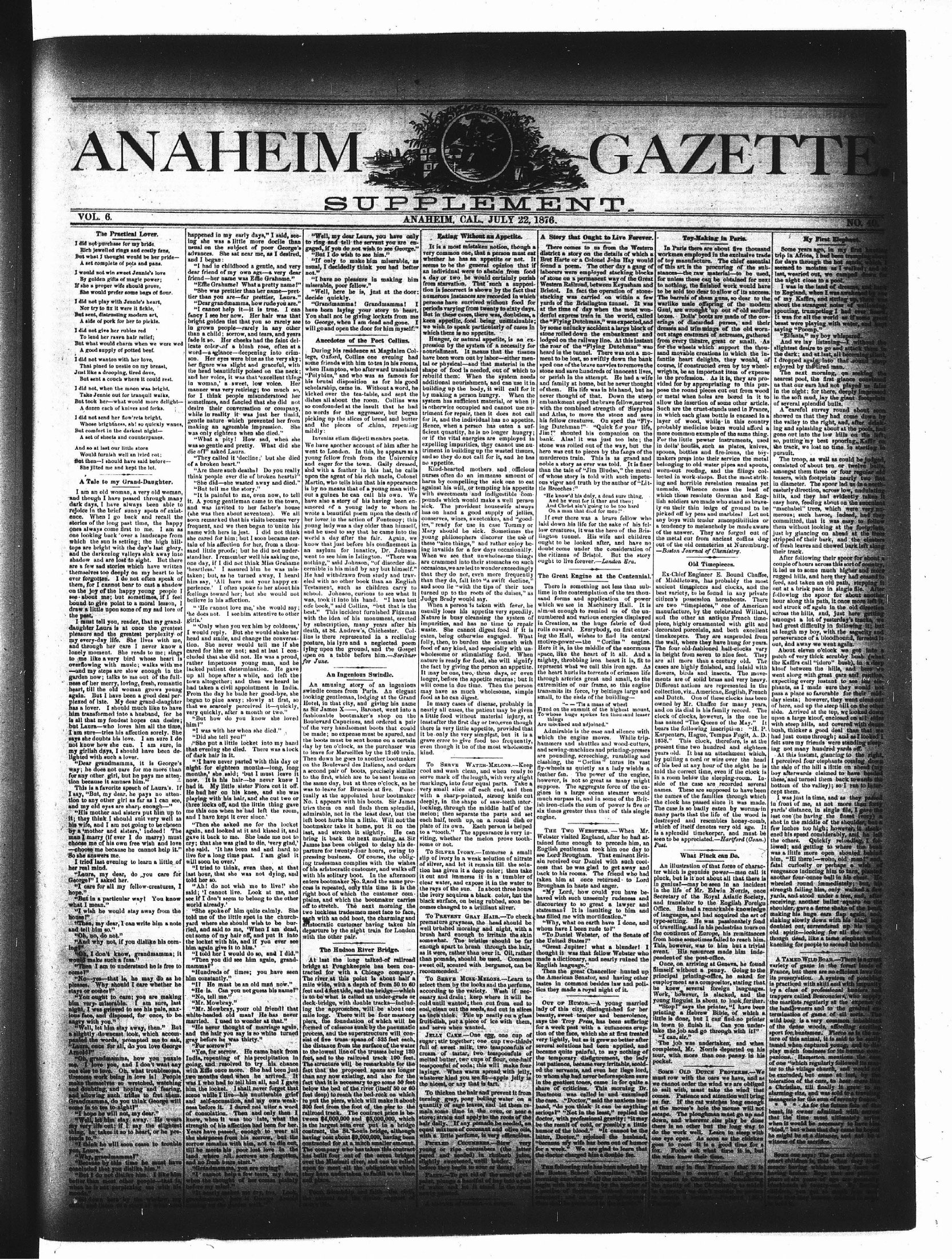
Searchable text
The Practical Lover.
I did not purchase for my bride.
Rich jewelled rings and costly fans,
But what I thought would be her pride—
A set complete of pots and pans.
I would not win sweet Jennie's love
By golden gifts of magic power;
If she a proper wife should prove,
She would prefer some bags of flour.
I did not play with Jennie's heart,
Nor try to fix it were it fickle,
But sent, distrusting modern art,
A side of pork for her to pickle.
I did not give her rubies red
To lend her raven hair relief;
But what would charm when we were wed
A good supply of potted beef.
I did not wanton with her love,
That plined to nestle on my breast,
Just like a drooping, tired dove,
But sent a couch where it could rest.
I did not, when the moon was bright,
Take Jennie out for tranquil walks,
But took her—what would more delight—
A dozen each of knives and forks.
I did not send her flow'reta bright,
Whose brightness, ah! so quickly wanes,
But comfort in the darkest night—
A set of sheets and counterpanes.
And so at last our little store
Would furnish well an ivied cot;
But then—I should have said before—
She lilted me and kept the lot.
happened in my early days," I said, seeing she was a little more docile than usual on the subject of poor George's advances. She sat near me, as I desired, and I began:
"I had in childhood a gentle, and very dear friend of my own age—a very dear friend—her name was Effie Grahame."
"Effie Grahame? What a pretty name!"
"She was prettier than her name—pretier than you are—far prettier, Laura."
"Dear grandmamma, how rude you are."
"I cannot help it—it is true. I can fancy I see her now. Her hair was that bright golden tint that you so rarely see in grown people—rarely in any other than a child; sorrow, and tears, and years fade it so. Her cheeks had the faint delicate color of a blush rose, often at a word—a glance—deepening into crimson. Her eyes were blue as the very sky; her figure was slight and graceful, with the head beautifully poised on the neck; and her voice, it was that 'excellent thing in woman,' a sweet, low voice. Her manner was very retiring; too much so, for I think people misunderstood her sometimes, and fancied that she did not desire their conversation or company, while in reality it was just her timid, gentle nature which prevented her from making an agreeable impression. She was only eighteen when she died."
"What a pity! How sad, when she was so gentle and pretty. What did she die off?" asked Laura.
"They called it 'decline'; but she died of a broken heart."
Just like a drooping, tired dove,
But sent a couch where it could rest.
I did not, when the moon was bright,
Take Jennie out for tranquil walks,
But took her—what would more delight—
A dozen each of knives and forks.
I did not send her flow'rets bright,
Whose brightness, ah! so quickly wanes,
But comfort in the darkest night—
A set of sheets and counterpanes.
And so at last our little store
Would furnish well an ivied cot;
But then—I should have said before—
She jilted me and kept the lot.
A Tale to my Grand-Daughter.
I am an old woman, a very old woman,
and though I have passed through many dark days, I have always been able to rejoice in the brief sunny spots of existence. When I go back and recall the stories of the long past time, the happy ones always come first to me. I am as one looking back over a landscape from which the sun is setting; the high hill-tops are bright with the day's last glory, and the darkening valleys sink away into shadow and are lost to sight. But there are a few sad stories which have written themselves too deeply on my heart to be ever forgotten. I do not often speak of them, for I cannot bear to cast a shadow on the joy of the happy young people I see about me; but sometimes, if I feel bound to give point to a moral lesson, I draw a little upon some of my sad lore of the past.
I must tell you, reader, that my grand-daughter Laura is at once the greatest pleasure and the greatest perplexity of my every-day life. She lives with me, and through her care I never know a lonely moment. She reads to me; sings to me like a very bird whose heart is overflowing with music; walks with me—and my steps are slow enough in the garden now; talks to me out of the fullness of her merry, loving, fresh, romantic heart, till the old woman grows young again. But I have been a good deal perplexed of late. My dear grand-daughter has a lover. I should much like to have him transformed into a husband, for he is all that my fondest hopes can desire; but Laura—who loves him all the time, I am sure—tries his affection sorely. She says she doubts his love. I am sure I do not know how she can. I am sure, in my girlish days, I should have been delighted with such a lover.
"Dear grandmamma, it is George's way; he does not care for me more than for any other girl, but he pays me attention because it amuses him."
This is a favorite speech of Laura's. If I say, "But, my dear, he pays no attention to any other girl as far as I can see, and my old eyes are sharp enough—"
"His mother and sisters put him up to it; they think I should suit very well as his wife, and I am not going to be chosen by a 'mother and sisters,' indeed! The man I marry (if ever I do marry) must choose me of his own free wish and love—choose me because he cannot help it." So she answers me.
I tried last evening to learn a little of her real mind.
"Laura, my dear, do you care for George!" I asked her.
"I care for all my fellow-creatures, I
the head beautifully poised on the neck; and her voice, it was that 'excellent thing in woman,' a sweet, low voice. Her manner was very retiring; too much so, for I think people misunderstood her sometimes, and fancied that she did not desire their conversation or company, while in reality it was just her timid, gentle nature which prevented her from making an agreeable impression. She was only eighteen when she died."
"What a pity! How sad, when she was so gentle and pretty. What did she die off?" asked Laura.
"They called it 'decline'; but she died of a broken heart."
"Are there such deaths? Do you really think people ever die of broken hearts?" "She did—she wasted away and died." "But tell me the story."
"It is painful to me, even now, to tell it. A young gentleman came to the town, and was invited to her father's house (she was then about seventeen). We all soon remarked that his visits became very frequent, and we then began to unite his name with hers in jest. I did not think she cared for him; but I soon became certain of his affection for her, from a thousand little proofs; but he did not understand her. I remember well his asking me, one day, if I did not think Miss Grahame 'heartless.' I assured him he was mistaken; but, as he turned away, I heard him say, 'All have not your happy experience.' I often spoke to her about his feelings toward her; but she would not believe in his affection.
"'He cannot love me,' she would say; 'he does not. I see him attentive to other girls.'"
"Only when you vex him by coldness," I would reply. But she would shake her head and smile, and change the conversation. She never would tell me if she cared for him or not; and at last I concluded that she did not. He was a proud, rather impetuous young man, and he lacked patient determination. He gave up all hope after a while, and left the town altogether; and then we heard he had taken a civil appointment in India. From the day he bade her good-bye, she began to pine away; slowly at first, so that we scarcely perceived it—quickly, very quickly, after a month or two."
"But how do you know she loved him?" "I was with her when she died." "Did she tell you!" "She put a littleocket into my hand that evening she died. There was a lock of dark hair in it."
"I have never parted with this day or night for eighteen months—long, long months,' she said; 'but I must leave it now. It is his hair—he never knew I had it. My little sister Flora cut it off. He had her on his knee, and she was playing with his hair, and she cut two or three looks off, and the little thing gave me this one when he had left the room, and I have kept it ever since.'"
"Then she asked me for the locket again, and looked at it and kissed it, and gave it back to me. She bade me not to cry; that she was glad to die, 'very glad,' she said. 'It has been sad and hard to live for a long time past. I am glad it will soon be over.'"
"I tried to think, even then, at that last hour, that she was not dying, and told her so." "Ah! do not wish me to live!' she heads beautifully poised on the neck; and her voice, it was that 'excellent thing in woman,' a sweet, low voice. Her manner was very retiring; too much so, for I think people misunderstood her sometimes, and fancied that she did not desire their conversation or company, while in reality it was just her timid, gentle nature which prevented her from making an agreeable impression. She was only eighteen when she died."
"What a pity! How sad, when she was so gentle and pretty. What did she die off?" asked Laura.
"They called it 'decline'; but she died of a broken heart."
"Are there such deaths? Do you really think people ever die of broken hearts?" "She did—she wasted away and died." "But tell me the story."
"It is painful to me, even now, to tell it. A young gentleman came to the town, and was invited to her father's house (she was then about seventeen). We all soon remarked that his visits became very frequent, and we then began to unite his name with hers in jest. I did not think she cared for him; but I soon became certain of his affection for her, from a thousand little proofs; but he did not understand her. I remember well his asking me, one day, if I did not think Miss Grahame 'heartless.' I assured him he was mistaken; but as he turned away, I heard him say, 'All have not your happy experience.' I often spoke to her about his feelings toward her; but she would not believe in his affection.
"'He cannot love me,' she would say; 'he does not. I see him attentive to other girls.'"
"Only when you vex him by coldness," I would reply. But she would shake her head and smile, and change the conversation. She never would tell me if she cared for him or not; and at last I concluded that she did not. He was a proud, rather impetuous young man, and he lacked patient determination. He gave up all hope after a while, and left the town altogether; and then we heard he had taken a civil appointment in India. From the day he bade her good-bye, she began to pine away; slowly at first, so that we scarcely perceived it—quickly, very quickly, after a month or two."
"But how do you know she loved him?" "I was with her when she died." "Did she tell you!" "She put a littleocket into my hand that evening she died. There was a lock of dark hair in it."
"I have never parted with this day or night for eighteen months—long, long months,' she said; 'but I must leave it now. It is his hair—he never knew I had it. My little sister Flora cut it off. He had her on his knee, and she was playing with his hair, and she cut two or three looks off, and the little thing gave me this one when he had left the room, and I have kept it ever since.'"
"Then she asked me for the locket again, and looked at it and kissed it, and gave it back to me. She bade me not to cry; that she was glad to die, 'very glad,' she said. 'It has been sad and hard to live for a long time past. I am glad it will soon be over.'"
"I tried to think, even then, at that last hour, that she was not dying,and told her so." "Ah! do not wish me to live!' she heads beautifully poised on the neck; and her voice,it was that 'excellent thing in woman,’a sweet,low voice.Her manner was very retiring;too much so,for I think people misunderstood her sometimes,and fancied that she did not desire their conversation or company,while in reality it was just her timid,gentle nature which prevented her from making an agreeable impression.She was only eighteen when she died."
"What a pity!How sad,when she was so gentle和pretty,came in kicked over the tiles all about tha no confounded at tha no words for the picking up the slice和the mildly:
Invenias etiam diu We have another arrow went to London.young fellow freshand eager for theand with a feathertupon the agent off Martin,who tells hsisby no means thasout a guinea he canhave also a storyofamoredofayouwrotea beautifulpierloverin theactyoung ladywasa coidandhe usedto sayworlda dayafterthatknowthatjustbeforanasylumforlwenttoseehiminthenothing," saidJohncerribernibleinhisminceHehadwithdrawnedeidedwithnootherTestament,suchschool.Johnson,was,tookitintoihotbook,"saidCourbett.” This inciderwiththeideaofhbysubscription,rdeath.atSt.Andre linisthererepresst posture,his lyreandlyingupthegropeopenonattablebforJune.
An Ingenient An amusing stewindle comes fromlooking gentleman,Hotel.inthatcity.asSirJamesX——fashionablebootmaBoulevardCapucinooftheveryhandsonbemade;noexpensethebootsmustbesaiddaybytenoclock.toleaveforMarseille Then down he goesontheBoulevarddacapucinosecondpairofboattothefirstwhichatthesameday,buttheraswallowedforBrutallyattheappointNo.Iappearswithtries them onandadmirable,nothinletboothurtshimbootmakertakeitlast,andstretchbringitbacktheJameshasbeenobligatedpartfortwenty-pressingbusiness ingtradesmancomofhisaristocraticcowwithhis solitaryboontersbootmakerNessisrepeated.on
I say, "But, my dear, he pays no attention to any other girl as far as I can see, and my old eyes are sharp enough."
"His mother and sisters put him up to it; they think I should suit very well as his wife, and I am not going to be chosen by a 'mother and sisters,' indeed! The man I marry (if ever I do marry) must choose me of his own free wish and love—choose me because he cannot help it." So she answers me.
I tried last evening to learn a little of her real mind.
"Laura, my dear, do you care for George!" I asked her.
"I care for all my fellow-creatures, I hope."
"But in a particular way? You know what I mean."
"I wish he would stay away from the house!"
Then, my dear, I can write him a note and tell him so.
"Oh, no, do not."
And why not, if you dislike his coming?
"Oh, I don't know, grandmamma; it would make such a fuss."
Then I am to understand he is free to come!
"No—yes—that is, he may do as he please. Why should I care whether he stays or comes!"
You ought to care; you are making him very miserable. I am sure, last night, I was grieved to see his pale, anxious face, and disposed, for once, to be angry with you.
"Well, let him stay away, then." But a slightly downcast look, which accompanied the words, prompted me to ask, "Laura, once for all, do you love George Arnold!"
"Oh, grandmamma, how you puzzle me, I love you, and I don't want any one else to love. Oh, what troublesome times work being in love! People make themselves so wretched, watching and doubting, and hoping and fearing, and allowing such trifles to frust them. Grandmamma, do you think George will come in to tea to-night!"
"I hope he will not, my dear."
Well, let him stay away. He wears my very life out; if I say the slightest thing, he takes it so to heart, or he pre-tends to.
"I think he will soon cease to trouble you, Laura."
"Why, grandmamma?"
Because by this time he must have concluded that you dislike him.
But I do not dislike him. I like him better than most other people—that is, when he is not perplexing me with his moanies."
He had her on his knee, and she was playing with his hair, and she cut two or three looks off, and the little thing gave me this one when he had left the room, and I have kept it ever since.
"Then she asked me for the locket again, and looked at it and kissed it, and gave it back to me. She bade me not to cry; that she was glad to die, 'very glad,' she said. 'It has been sad and hard to live for a long time past. I am glad it will soon be over.'"
"I tried to think, even then, at that last hour, that she was not dying, and told her so.
"Ah! do not wish me to live!" she said; "I cannot live. Look at me, and see if I don't seem to belong to the other world already."
"She spoke of him quite calmly. She told me of the little spot in the churchyard where she should wish to be buried, and said to me, 'When I am dead, cut some of my hair off, and put it into the locket with his, and if you ever see him again give it to him.'"
"I told her I would do so, and I did."
"Then you did see him again, grandmamma!"
"Hundreds of times; you have seen him constantly."
"I? He must be an old man now."
"He is. Can you not guess his name?" "No, tell me." "Mr. Mowbray."
"Mr. Mowbray, your old friend? that white-headed old man? He has never married. I used to wonder at that."
"He never thought of marriage again, and the hair you say is so white turned gray before he was thirty."
"For sorrow!"
"Yes, for sorrow. He came back from India, repenting of his precipitation in going, and resolved to try his chance with Effle once more. She had just two months dead when he arrived. It was I who had to tell him all, and I gave him the locket. I shall never forget that scene while I live—his unutterable grief and self-accusation, and my own weakness before it. I dared not utter a word of consolation. Then and only then I knew, when it was too late, what the strength of his affection had been for her. Years have passed, enough to wear all the sharpness from his sorrow, but the sorrow remains with him, not to die out till he meets his poor lost love in the land where all sorrows are forgotten, and no fresh tears start."
"Grandmamma, you are saying!"
"I cannot help a few tears; my dear, when the thought of her comes plaintly before my mind."
"It surely makes me cry too." Luckily grandmamma knew it.
At last the long bridge at Poughkeepsie traced for with her The river at this point mile wide, with a d feet and 4 feet tide; it is to be what is called deck-bridge, with doing the approach mile long. There were piers, the foundations formed of caissons on process, and the surplus of five trusses spanning the distance from the lowest line of feet, and to the railway structure will fact that the property than any now exist below the bed of the feet deep) to reach the piers, which 300 feet from the foot railroad track. The tween $4,000,000 is the largest sum contracted for at a cost having cost about $200 for four out over the Missouri river upon to meet all they have undertaken and placed.
CIM GA
SUPPLEMENT.
ANAHEIM, CAL., JULY 22, 1876.
"Well, my dear Laura, you have only to ring and tell the servant you are engaged, if you do not wish to see George."
"But I do wish to see him."
"If only to make him miserable, as usual, I decidedly think you had better not."
"I have no pleasure in making him miserable, poor fellow."
"Well, here he is, just at the door; decide quickly."
"Grandmamma! Grandmamma! I have been laying your story to heart. You shall not be giving lockets from me to George, when I am dead and gone. I will go and open the door for him myself."
Anecdotes of the Poet Collins.
During his residence at Magdalen College, Oxford, Collins one evening had some friends with him to tea in his rooms, when Hampton, who afterward translated "Polybius," and who was as famous for his brutal disposition as for his good scholarship, came in. Without a word, he kicked over the tea-table, and sent the dishes all about the room. Collins was so confounded at the insult that he had no words for the aggressor, but began picking up the slices of bread and butter and the pieces of china, repeating mildly:
Invenias etiam disjecti membra poeta.
We have another account of him after he went to London. In this, he appears as a young fellow fresh from the University and eager for the town. Gaily dressed, and with a further in his hand calls
Eating Without an Appetite.
It is a most mistaken notion, though a very common one, that a person must eat whether he has an appetite or not. It seems to be the general opinion that if an individual were to abstain from food a day or two he would certainly perish from starvation. That such a supposition is incorrect is shown by the fact that numerous instances are recorded in which persons have survived without food for periods varying from twenty to sixty days. But in these cases, there was, doubtless, a keen appetite, food being unattainable; we wish to speak particularly of cases in which there is no appetite.
Hunger, or natural appetite, is an expression by the system of a necessity for nourishment. It means that the tissues have been worn out by labor—either mental or physical—and that material in the shape of food is needed, out of which to rebuild them: When the system needs additional nourishment, and can use it in building up the body, it will call for it by making a person hungry. When the system has sufficient material, or when it is otherwise occupied and cannot use nutrition for repair, then it does not call for it, and the individual has no appetite. Hence, when a person has eaten a sufficient quantity, he is no longer hungry; or if the vital energies are employed in expelling impurities, they cannot use nutrition in building up the wasted tissues, and so they do not call for it, and he has no appetite.
A Story that Ought to Live Forever.
There comes to us from the Western district a story on the details of which a Bret Harte or a Colonel John Hay would found a poem. The other day a gang of laborers were employed stacking blocks of stone on a permanent way of the Great Western Railroad, between Keynsham and Bristol. In fact the operation of stone-stacking was carried on within a few yards of the Brislington tunnel. It was at the time of day when the most wonderful express train in the world, called the "Flying Dutchman," was expected,and by some unlucky accident a large block of stone rolled down the embankment and lodged on the railway line. At this instant the roar of the "Flying Dutchman" was heard in the tunnel. There was not a moment to be lost, so swiftly down the bank sped one of the brave navies to remove the stone and save hundreds of innocent lives, or perish in the attempt. He had a wife and family at home, but he never thought of them. His life was in his hand, but he never thought of that. Down the steep embankment sped the brave fellow,nerved with the combined strength of Sisyphus and Atlas, to move the stone and save his fellow creatures. On sped the "Flying Dutchman!" "Quick for your life, Jim!" shouted his companion on the bank. Alas! it was just too late; the stone was rolled out of the way, but the hero was cut to pieces by the fangs of the murderous train. This is as grand and noble a story as ever was told. It is finer than the tale of it Him Bindou.
In this work of toy of this stance for us to not be The best warrior Ganil boxer eringer dressed out at from for this sand fantile course wrighted in the vided pose or met allow Such in whih layer probable more For tha in dolls spoons make belong
When she did she really hearts it died.
Invenias etiam disjecti membra poeta. We have another account of him after he went to London. In this, he appears as a young fellow fresh from the University and eager for the town. Gaily dressed, and with a feather in his hat, he calls upon the agent of his rich uncle, Colonel Martin, who tells him that his appearance is by no means that of a young man without a guinea he can call his own. We have also a story of his having been enamored of a young lady to whom he wrote a beautiful poem upon the death of her lover in the action of Fontenoy; this young lady was a day older than himself, and he used to say that he came into the world a day after the fair. Again, we know that just before his confinement in an asylum for lunatics, Dr. Johnson went to see him in Islington. "There was nothing," said Johnson, "of disorder discernible in his mind by any but himself." He had withdrawn from study and traveled with no other book than an English Testament, such as children carry to school. Johnson, curious to see what it was, took it into his hand. "I have but one book," said Collins, "but that is the best."
This incident furnished Flexman with the idea of his monument, erected by subscription, many years after his death, at St. Andrew's, Chichester. Collins is there represented in a reclining posture, his lyre and a neglected poem lying upon the ground, and the Gospel open on a table before him.—Soribner for June.
An Ingenious Swindle.
An amusing story of an ingenious swindle comes from Paris. An elegant looking gentleman, lodging at the Grand Hotel, in that city, and giving his name as Sir James X——Baronet, went into a fashionable bootmaker's shop on the Boulevard Capucines, and ordered a pair of the very handsomest boots that could be made; no expense must be spared, and the boots must be sent home on a certain day by ten o'clock, as the purchaser was to leave for Marseilles by the 13:40 train. Then down he goes to another bootmaker on the Boulevard des Italiens, and orders a second pair of boots, precisely similar to the first, which are to be sent home on the same day, but at three o'clock, as he was to leave for Brussels at five. Punctually at the appointed bootmaker No. 1 appears with his boots. Sir James tries them on and finds them splendid, admirable, not in the least dear, but the left boot hurts him a little. Will not the bootmaker take it home, put it on the last, and stretch it slightly. He can bring it back the next morning, as Sir James has been obliged to delay his departure for twenty-four hours, owing to pressing business. Of course, the obliging tradesman complies with the wishes of his aristocratic customer, and walks off with his solitary boot. In the afternoon enters bootmaker No. 2, and the same process is repeated, only this time it is the shape of food is needed, out or which to rebuild them. When the system needs additional nourishment, and can use it in building up the body, it will call for it by making a person hungry. When the system has sufficient material, or when it is otherwise occupied and cannot use nutriment for repair, then it does not call for it, and the individual has no appetite. Hence, when a person has eaten a sufficient quantity, he is no longer hungry; or if the vital energies are employed in expelling impurities, they cannot use nutriment in building up the wasted tissues, and so they do not call for it, and he has no appetite.
Kind-hearted mothers and officious nurses often do an immense amount of harm by compelling the sick one to eat against their will, or tempting their appetite with sweetmeats and indigestible compounds which would make a well person sick. The provident housewife always has on hand a good supply of jellies, conserves wines, sweetcakes, and "goodies," ready for use in case Tommy or Mary should be sick. Sometimes the young philosophers discover the use of these "nice things," and rather enjoy being invalids for a few days occasionally. When we see that unwholesome things are crammed into their stomachs on such occasions, we are led to wonder exceedingly that they do not, even more frequently than they do, fall into "a swift decline," and soon lie "with the tips of their toes turned up to the roots of the daises," as Judge Brady would say.
When a person is taken with fever, he usually loses his appetite very speedily. Nature is busy cleansing the system of impurities, and has no time to repair waste. She cannot digest food if it is eaten, being otherwise engaged. What folly, then, to burden the stomach with food of any kind, and especially with unwholesome or stimulating food. When nature is ready for food, she will signify the fact by giving the person an appetite.
It may be one, two, three days, or even longer, before the appetite returns; but it will come in due time. Then the person may have as much wholesome, simple food as he can digest.
In many cases of disease, probably in nearly all cases, the patient may be given a little food without material injury, at least after the first day or two,even though there is very little appetite provided that it be only the very simplest, but it is a grave error to give food too frequently, even though it be of the most wholesome kind.
To SERVE WATER-MELONS.-Keep cool and wash clean, and when ready to serve mark off the length, with very slight markings into four equal parts. Take a very small slice off each end, and then with a sharp-pointed, strong knife cut deeply, in the shape of saw-teeth interlocking through the middle half of the melon; then separate the parts and set each half, teeth up, on a round dish or plate of its own. Each person is helped to a "tooth." The appearance is very inviting, whether the melon prove toothsome or not.
To SILVER IVORY.-Immerse a small slip of ivory in a weak solution of nitrate of silver, and let it remain till the solution has given it a deep color; then take out and immerse it in a tumbler of clear water, and expose it in the water to the rays of sun. In about three hours stone and save hundreds of innocent lives, or perish in the attempt. He had a wife and family at home, but he never thought of them. His life was in his hand, but he never thought of that. Down the steep embankment sped the brave fellow,nerved with the combined strength of Sisyphus and Atlas, to move his fellow creatures. On sped the Flying Dutchman!" "Quick for your life, Jim!" hissed his companion on the bank. Alas! it was just too late; the stone was rolled out of the way, but the hero was cut to pieces by the fangs of the murderous train. This is as grand and noble a story as ever was told. It is finer than the tale of "Jim Bludso," the moral of whose story is told with such impetuous vigor and truth by the author of "Little Breeches:"
"He know'd his daily,a dead sure thing,
And he went for it thar and then;
And Christ ain't going to be too hard
On a man that died for men."
If ever there was a brave fellow who laid down his life for the sake of his fellow creatures, it was the hero of the Brislington tunnel. His wife and children ought to be looked after,and have no doubt come under the consideration of the citizens of Bristol. But the story ought to live forever.-London Era.
The Great Engine at the Centennial.
There is something not less than sublime in the contemplation of the ten thousand forms and application of power which we see in Machinery Hall. It is almost enough to remind us of the unnumbered and various energies displayed in Creation, as the huge fabric of God rolls onward. Everybody on first entering the Hall, wishes to find its central motive-power—the "Corliss" engine. Here it is, in the middle of the enormous space like the heart of it all. And a mighty, throbbing iron heart it is,fit to represent what we call this iron age.As the heart hurls its torrents of crimson life through arteries great and small,the extremities of our frame,sby beltings large and small,tothe ends ofthe building—
-"Tis a mass of wheel
Fixed on the summit of the highest mount,
To whose huge spokes ten thousand lesser things
Are moistised and adjoined."
Admirable is the ease and silence with which the engine moves. While trippingammers and shuttles and wood-cutters,and sewing-machines and printing-presses are pounding,screeching,rumblingand clashing,the "Corliss" turms its vast fly-wheels as quietly as a lady wields a feather fan.The power of the engine,however,是not so great as many might suppose.The aggregate force of the engines in a large ocean steamer would much surpass it,and in some ofthe British iron-clads the sum of power is five or six times greater than that of this single engine.
The Two Websters.-When Mr.Webster visited England,after he had attained fame enough to precede him,nan English gentleman took him one day to see Lord Brougham.That eminent Britain received our Daniel with such coolness that he was glad to get away and back to his rooms.The friend who had taken him at once returned to Lord Brougham in haste and anger.
An ill-used whip plucked,intgen in
The Hudson River Bridge.
At last the long talked-of railroad bridge at Poughkeepsie has been contracted for with a Chicago company. The river at this point is about half a mile wide, with a depth of 50 to 60 feet and 4 feet tide, and the bridge—which is to be what is called an under-grade or deck-bridge, with double tracks—including the approaches, will be about one mile long. There will be four masonry piers, the foundation of which will be formed of caissons sunk by the pneumatic process, and the superstructure will consist of five trusses spans of 525 feet each, the distance from the surface of the water to the lowest line of the trusses being 130 feet, and to the railroad track 190 feet. The structure will be remarkable for the fact that the proposed spans are longer than any now existing, and also for the fact that it is necessary to go some 50 feet below the bed of the river (itself 50 or 60 feet deep) to reach the bed-rock on which to put the pier, which will make it about 300 feet from the foot of the pier to the railroad track. The contract price is between $4,000,000 and $5,000,000, which is the largest sum ever put in a bridge contract, the St. Louis bridge, although having cost about $9,000,000, having been contracted for at a much smaller amount. The company who has taken this contract has built four out of the seven bridges over the Missouri river, and can be rolled upon to meet all the obligations which they have undertaken to fulfill us to time and place.
To silver ivory.—Immerse a small slip of ivory in a weak solution of nitrate of silver, and let it remain till the solution has given it a deep color; then take it out and immerse it in a tumbler of clear water, and expose it in the water to the rays of the sun. In about three hours the ivory acquires a black color, but the black surface, on being rubbed, soon becomes changed to a brilliant silver.
To prevent gray hair.—To check premature grayness, the head should be well brushed morning and night, with a brush hard enough to irritate the skin somewhat. The bristles should be far enough apart to brush through the hair, as it were, rather than over it. Oil, rather than pomade, should be used. Common sweet oil, scented with bergamot, can be recommended.
To serve musk melons.—Learn to select them by the looks and perfume, according to the variety. Wash if necessary and drain; keep where it will be cold until wanted; then cut from end to end, clean out the seeds, and cut in slices an inch thick. Pile up neatly on a glass fruit-dish, put a piece of ice with them, and serve when wanted.
Jelly cake.—One egg, one cup of sugar; stir together; one cup two-thirds full of sweet milk, two teaspoonfuls of cream of tartar, two teaspoonfuls of melted butter, two cups of flour, one-half teaspoonful of soda; this will make four layings. When warm spread with jelly, whatever kind you see fit—apple jelly is the nicest, or any that is tart.
To thicken the hair and prevent it from turning gray, pour boiling water on a quantity of sage leaves, and let them remain some time in the oven, or near a store; strain and apply to the roots of the hair daily. If any pomade be needed, an equal mixture of cacao and olive oils, with a little perfume, is very efficacious.
Pickled cucumbers.—Saw very young or ripe cucumbers (the latter pared and seeded) in rhubarb juice, slightly sweetened, until tender. Serve before they begin to sour or feces.
Farmer.—To get rid of the smell of off paint, plums a handful of hay into a small room and let it stand in there until it is clear.
The Two Websters.—When Mr. Webster visited England, after he had attained fame enough to precede him, an English gentleman took him one day to see Lord Brougham. That eminent Britain received our Daniel with such coolness that he was glad to get away and back to his rooms. The friend who had taken him at once returned to Lord Brougham in haste and anger.
"My Lord, how could you have behaved with such unseemly rudeness and discourtesy to so great a lawyer and statesman? It is insulting to him and has filled me with mortification."
"Why, what on earth have I done, and whom have I been rude to?"
"To Daniel Webster, of the Senate of the United States!"
"Great Jupiter! what a blunder! I thought it was that fellow Webster who made a dictionary, and nearly ruined the English language."
Then the great Chancellor hunted up the American Senator, and having other tastes in common besides law and politics they made a royal night of it.
Out of Humor.—A young married lady of this city, distinguished for her beauty, sweet temper and benevolence, says the Troy Press, has been suffering for a week past with a cutaneous eruption of the face, which she at first treated very lightly, but as it grew no better after several solutions had been applied, and became quite painful, to say nothing of the temporary disfigurement, the lady lost patience, became very irritable, scolded the servants, and even her lige lord, to whom she had never before spoken save in the gentlest tones, came in for quite a share of criticism. This morning Dr. Bontecon was called in and examined the case. "Doctor," said the anxious husband, "do you think it can be anything serious?" "Not in the least," replied the doctor, with professional gravity; "it may be the result of cold, or possibly a little humor of the blood." "It cannot be the latter," Doctor," rejoined the husband," because my wife has been out of humor for a week." We are glad to learn that the doctor charged him a double fee.
The following rule has been adopted by the Boston School Committee: "The morning exercise of all the schools shall begin with the reading by the number of students."
GAZETTE.
NO. 40
t to Live Forever.
is from the Western
the details of which a
annel John Hay would
o other day a gang of
layed stacking blocks
ment way of the Great
between Keynsham and
operation of stoneon within a few
ington tunnel. It was
when the most wonthe world, called
was expected, and
ident a large block of
the embankment and
line. At this instant
ing Dutchman" was
There was not a morifly down the bank
navvies to remove the
eds of innocent lives,
empt. He had a wife
but he never thought
as in his hand, but he
at. Down the steep
brave fellow,nerved
strength of Sisyphus
the stone and save
On sped the "FlyQuick for your life,
companion on the
just too late; the
of the way, but the
is by the fangs of the
his is as grand and
was told. It is finer
Toy-Making in Paris.
In Paris there are about five thousand workmen employed in the exclusive trade of toy manufacture. The chief essential of this art is the procuring of the substances—the raw material—to be used, for unless these can be obtained for next to nothing, the finished work would have to be sold too dear to allow of its success. The barrels of sham guns, so dear to the warlike male offspring of the modern Ganl, are wrought 'up out of old sardine boxes. Dolls' boots are made of the coverings of discarded purses, and their dresses and trimmings of the old worn-out stage costumes of actresses, gathered from every theatre, great or small. As for the wheels which support the thousand movable creations in which the infantile heart delights, they would, of course, if constructed even by toy wheel-wrights, be an important item of expense in the profession. As it is, they are provided for by appropriating to this purpose the round pieces cut out from wood or metal when holes are bored in it to allow the insertion of some other article. Such are the crutest stands used in France, in which each glass bottle is encased in a layer of wood, while in this country probably medicine boxes would afford a more common example of the same thing. For the little pewter instruments, used in dolls' houses, such as plates, knives, spoons, bottles and fire-irons, the toy-makers press into their service the metal belonging to old water pipes and spouts,
My First Elephant.
Some years ago, in my first hour trip in Africa, I had been trampling about for days through the hot sand, which I seemed to moisten as I walked; and at last, we camped down for the night close to a pool.
I was in the land of dreams, and hung to England, when I was awakened by one of my Kaffirs, and sitting up there about the strangest noises of wallstoning, spouting, trumpeting I had ever heard. It was for all the world as if some great beast were playing with water, and laughing "Poomp."
"Ellanta," my boy whispered.
And we lay listening—I without the slightest desire to go and attack them in the dark; and at last, all becoming silent; I dropped again into that sound sleep enjoyed by the tired man.
The next morning, on seeking the nearest pool, the first glance confirmed us that our ears had not played us false in the night; for there, deeply impressed in the soft mud, lay the giant footprints of several splendid bulls.
A careful survey round about soon showed us that they had come down by the valley to the right, and, after drinking and splashing about at the pools, had gone out into the low hills on the left; so, putting my best spooring-Kaffir on the track, we lost no time in starting in pursuit.
The troop, as well as could be judged, consisted of about ten or twelve bulls.
At the Centennial.
It is not less than subtraction of the ten thousandth of power machinery Hall. It is bound us of the unseen energies displayed huge fabric of God body, on first enter to find its central "Cordias" engine. Alle of the enormous cost of it all. And a iron heart it is, fit to ful this iron age. As events of crimson life and small, to the same, so this engine belltings large and the building—of the highest mount, ten thousand and lesser.
Case and silence with moves. While tripods and wood-cutters, and printing-presses being, rummbling and criss turns its vast as a lady wields a power of the engine, neat as many mightitate force of the enman steamer would in some of the Brittany of power is five or that of this single
When Mr. Bond, after he had attained precede him, an took him one day to That eminent Brittany with such cooll to get away and the friend who had returned to Lord Edinger.
What Pluck can Do.
An illustration of that force of character which is genuine power—men call it pluck, but is it not about all that there is in genius? may be seen in an incident in the life of Mr. Edinger.
The next morning, on seeking the nearest pool, the first glance continued us that our ears had not played us false in the night: for there, deeply impressed in the soft mud, lay the giant footprints of several splendid bulls.
A careful survey round about soon showed us that they had come down by the valley to the right, and after drinking and splashing about at the pools, had gone out into the low hills on the left; so putting my best sporing. Kaffir on the track, we lost no time in starting in pursuit.
The troop, as well as could be judged, consisted of about ten or twelve bulls, amongst them three or four regular old teasers, with footprints nearly two feet in diameter. The spoor led us in a north-easterly direction, across low, undulating hills, and they had evidently taken it easy here, feeding about on the succulent "machabel" trees, which were very numerous; such havoc, indeed, had they committed, that it was easy to follow them without looking at the footplate, just by glancing on ahead at the tree stripped of their bark, and the clusters of fresh leaves and chewed bark last along their track.
After following their spoor for about a couple of hours across this sort of country, it led us to some much higher and more rugged hills, and here they had ceased to feed, and taken an old path, stepping it out at a brisk pace in single file. After following the spoor for another hour along this path, it once more left it, and struck off again in the old direction across the hills, and just here getting amongst a lot of yesterday's tracks, we had great difficulty in following it; but at length my boy, with the sagacity and perseverance of a bloodhound, ferreted it out, and away we went again.
About eleven o'clock we got into a patch of very thick scrubby bush (what the Kaffirs call "idoro" bush), in a deep knot between the hills, and here we went along with great care and caution expecting every instant to see few elephants, as I made sure they would not pass a place so favorable for their midday siesta; however, they went clean out of here, and up the steep hill on the other side. Arrived at the top, we looked down upon a large knot, enclosed on all sides with steep hills, and covered with dense bush, thicker a good deal than that we had just come through; and as I looked I felt sure my friends were standing sleeping not many hundred yards off.
At this instant, glancing to the right, I perceived four elephants coming down the slope of the hill a little on ahead (my boy afterwards claimed to have headed these, and turned them back towards the bottom of the valley); so I ran to intercept them.
I was just in time, and as they passed in front of me, at not more than forty yards' distance, in single file, I gave the last one (he having the finest feathers) a shot in the middle of the shoulder; but a few inches too high; however it shackened his speed considerably, and he halted others. Quickly reloading, I followed; and getting to where this bush was a little more open shouted behind him, "Hi there!—woho, old man!" and fatal curiosity or perhaps a wish of vengeance inducing him to turn, planted another four ounces ball in his chest. He wheeled round immediately; but his strength failing him only waited a few minutes.
Ex-Chief Engineer E. Bound Chaffee, of Middletown, has probably the most ancient timpieces and clocks, and the best variety, to be found in any private citizen's possession hereabouts. There are two "timpieces," one of American manufacture, by the celebrated Willard, and the other an antique French timepiece, highly ornamented with gilt and decorated porcelain, and both excellent timekeepers. They are suspended from the wall, where they have hung for years. The four old-fashioned hall-clocks vary in height from seven to nine feet. They are all more than a century old. The cases are highly finished, and inlaid with flowers, birds and insects. The movements are of solid brass and very heavy. Different nations are represented in the collection, viz., American, English, French and Dutch. One of these clocks has been owned by Mr. Chaffee for many years, and on its dial is his family record. The clock of clocks, however, is the one he has named "The Queen of the May." It bears the following inscription: "H. P. Karpenters, Hague, Tempus Fugit, A. D. 1658." This clock, therefore, is at the present time two hundred and eighteen years old. It has an attachment which, by pulling a cord or wire over the head of his bed at any hour of the night he is told the correct time, even if the clock is in a room below the sleeping-room. Inside of the case are recorded several names. These are supposed to have been the names of the families through which the clock has passed since it was made. The case is so badly eaten by worms in many parts that the life of the wood is destroyed and resembles honey-comb, which of itself denotes very old age. It is a splendid timekeeper, and must be seen to be appreciated.—Hartford (Conn.) Post.
What Pluck can Do.
An illustration of that force of character which is genuine power—men call it pluck, but is it not about all that there is in genius? may be seen in an incident in the life of Mr. Edinger.
The next morning, on seaking the nearest pool, the first glaze contained us that our ears had not played us false in the night: for there, deeply impressed in the soft mud, lay the giant footprints of several splendid bulls.
A careful survey round about soon showed us that they had come down by the valley to the right, and after drinking and splashing about at the pools, had gone out into the low hills on the left; so putting my best spooring. Kaffir on she track, we lost no time in starting in pursuit.
The troop, as well as could be judged consisted of about ten or twelve bulls amongst them three or four regular old teasers with footprints nearly two feet in diameter. The spoor led us in a north-easterly direction across low, undulating hills,and they had evidently taken it easy here, feeding about on the succulent "machabel" trees which were very numerous; such havoc , indeed,had they committed that it was easy to follow them without looking at the footplate; just by glancing on ahead at the树 stripped of their bark,and the clusters of fresh leaves and chewed bark last along their track.
After following their spoor for about a couple of hours across this sort of country,它 led us to some much higher and more rugged hills,and here they had ceased to feed,and taken an old path,stepping it out at a brisk pace in single file.After following the spoor for about another hour along this path,它 once more left it,and struck off again in the old direction across the hills,and just here getting amongst a lot of yesterday's tracks,我们 had great difficulty in following it;但 at length my boy,with the sagacity and perseverance of a bloodhound,ferreted it out,and away we went again.
About eleven o'clock we got into a patch of very thick scrubby bush (what the Kaffirs call "idoro" bush),in a deep knot between the hills,and here we went along with great care and caution expecting every instant to see few elephants,as I made sure they would not pass a place so favorable for their midday siesta;however,they went clean out of here,and up the steep hill onthe other side。Arrived atthetop,thelookdownupalargeknotenclosedonallsidewithsteephills,andcoveredwithdensebush,thethickeragooddealthanthatwehadjustcomethrough;andasIlookedIfelt suremyfriendswerestandingsleepingnotmanyhundredyardsoff.
Atthisinstant,glancingtotheright.Iperceivedfourelephantscomingdowntheslopeofthehilla littleonhead(myboyafterwardsclaimedtohaveheadedthese,andturntedthembekindtowardsthebottomofthevalley);soIrantocinterceptthem.
Iwasjustintime,andastheypassedinfrontofme.atnotmorethanfortyyardsdistance.insinglefile.Igavethelastone(hehavingthefinestfever)ashotinthemiddleofthes肩derbutafewinchestohigh;however,theishackenedhispeedconsiderably,andhailtheothers.Quiplashreloading.Ifollowed;andgettingtowherethisbushwasalittlemoreopenshoutedbehindhim,"Hithere!—woho,oldman!"andfatalcuriosityorperhapsawishofvengeanceinducinghimtoturn.plantedanotherfourouncesballinhisclost.Hwheeldoundimmediately;but,hisstrengthfallinghimonlywaitedaforeightminutes.
When Mr. and after he had atto precede him, an took him one day to That eminent Britel with such cooll to get away and the friend who had returned to Lord anger.
Would you have been rudeness and beat a lawyer and putting to him and titification."
I have I done, and to?
of the Senate of what a blunder! I follow Webster who nearly ruined the cancellor hunted up and having other besides law and poli-night of it.
A young married linguished for her and benevolence, has been suffering a cutaneous erup- she at first treated grew no better after been applied, and to say nothing of enmenment, the lady very irritable, scold-ven her liege lord, before spoken save name in for quite a this morning Dr. in and examined old the anxious hun- can be anything least," replied the real gravity; "it may or possibly a little"It cannot be the husband, been out of humor glad to learn that is a double fee.
has been adopted by committees: "The the schools shall by the tender of the Senate of some of the families through which the clock has passed since it was made. The case is so badly eaten by worms in many parts that the life of the wood is destroyed and resembles honey-comb, which of itself denotes very old age. It is a splendid timekeeper, and must be seen to be appreciated.—Hartford (Conn.) Post.
What Pluck can Do.
An illustration of that force of character which is genuine power—men call it pluck, but is it not about all that there is in genius?—may be seen in an incident in the life of Mr. Edwin Norris, once Secretary of the Royal Asiatic Society, and translator to the English Foreign Office. He had a remarkable knowledge of languages, and had acquired the art of type-setting. He was passionately fond of travelling, and in his pedestrian tours on the continent of Europe, his remittances from home sometimes failed to reach him. This, however, was to him but a trivial event. His resources made him independent of the post-office.
Once, on arriving at Geneva, he found himself without a penny. Going to the principal printing-office, he asked for employment as a compositor, stating that he knew several foreign languages. Work, however, is slackened, and the young linguist is about to look further. "Stop!" says the printer, "I have been printing a Hebrew Bible, of which a little is done, but I can find no printer in town to finish it." Can you undertake the job and go through with it?
"I can, air."
The job was undertaken, and when completed, Mr. Norris departed on his tour, with more than one penny in his pocket.
Some Old Dutch Proverbs.—We must row with the oars we have, and as we cannot order the wind we are obliged to sail with, must take the wind that comes. Patience and attention will bring us far. If the cat watches long enough at the mouse's hole the mouse will not escape. The ploughman must go up and down, and wherever else play be done there is no other but the long way to do the work well. Learn to sleep with one eye open. As soon as the chicken goes to roost it is a good time for a fox. Fools ask what time it is, but the wise know their time.
They say in San Francisco that it is impossible to convert a full-grown Christian to Christianity. Considering the quality of the Christianity in which he lives as that of a non-christian child, how that are philological dates of 40 years of men are presumed blacklands at twenty-one.
A TAMED WILD BOAR—There is a great variety of game in the forest lands of France, but there are no efficient laws for its preservation. A system of punishing is practiced with skill and with impunity by a class of professional hunters and trappers called Breconians, who supply the markets regularly at the expense of the landowners and to the gradual termination of game of all sorts. The wild boar is a very common inhabitant of the dense woods, affording exciting sport for hunters. Pierce as in the nature of this animal, it is said to be easily tamed when captured young, and to display much fondness for its human companions. Hammerton mentions the case of one "which regularly followed its master to the village church, and would not be excluded, but came at last, by the toleration of the cure, to hear more than a Christian, till finally it grew to an alarming size, and was sold to a traveling managerie for the sum of seventy francs.
As for the future fate of this bear, its owner admitted that the time must ultimately arrive when it would be necessary to have him "blad," but when that day came he might be at a distance, and not be witness of the sacrifices.
Seems one says: The great objection to smart children in that when they have mance having withkers they have no hearing loader. How that are philological dates of 40 years of men are presumed blacklands at twenty-one.