anaheim-gazette 1876-04-29
Scanned page
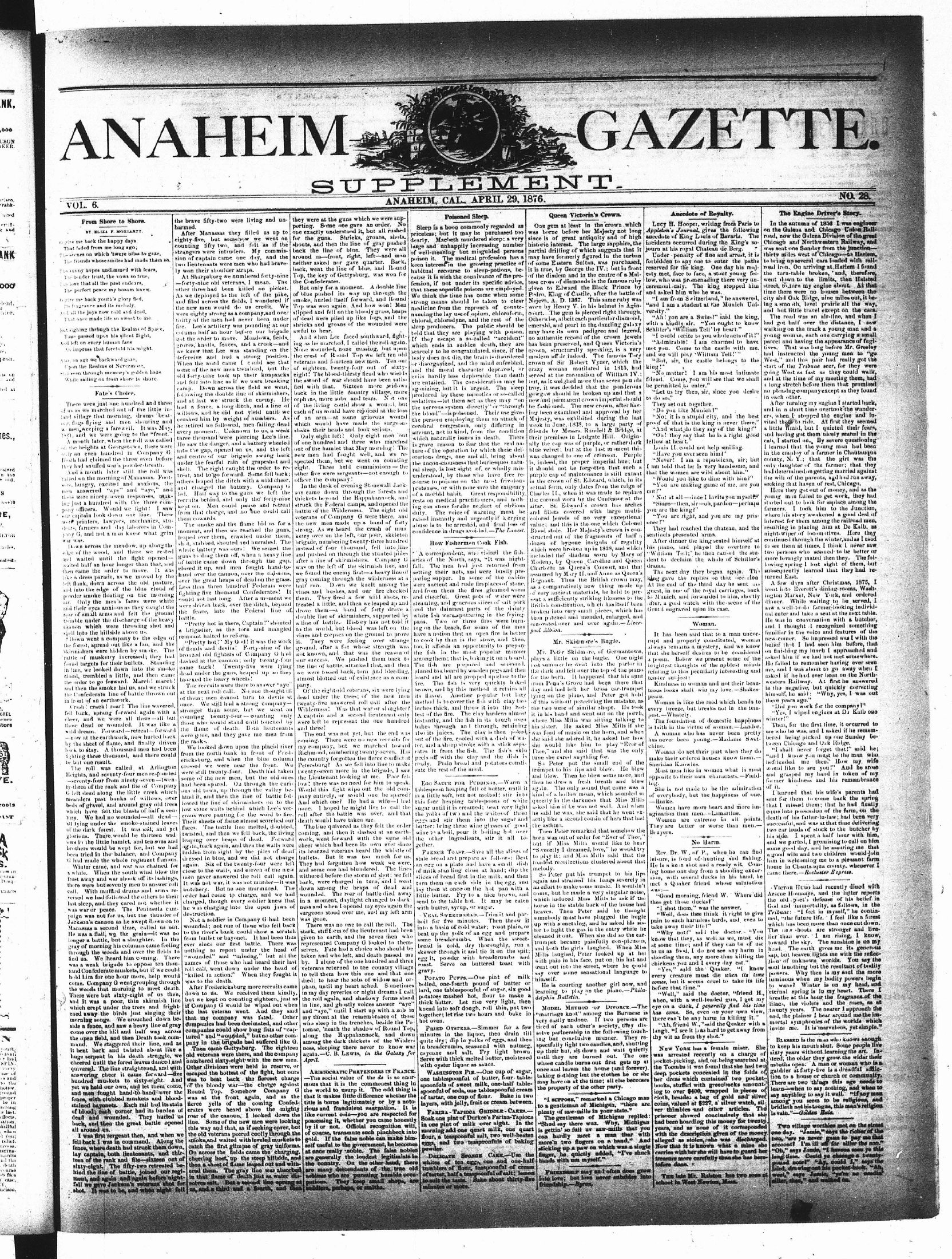
Searchable text
ANAHEIM
VOL. 6.
From Shore to Shore.
BY ELIZA P. MORIARTY.
O give me back the happy days
That faded from me long ago;
The scenes on which 'twere bliss to gaze,
The friends whose smiles had made them so.
The sunny hopes undimmed with fears,
The tender trust, the vows so true,
The love that all the past endears,
The perfect peace my bosom knew.
O give me back youth's glory fled,
His fragrance and its melody.
And all the joys now cold and dead,
That once made life so sweet to me.
But sighing through the Realms of Space,
Time passed upon his silent flight,
And left on every human face
An impress that foretold his might.
Alas, an age we backward gaze,
Upon the Realms of Nevermore,
Still seen through memory's golden haze
While sailing on from shore to shore.
Fate's Choice.
There were just one hundred and three
of us as we marched out of the little inland village that morning, drums beating,
flags flying and men shouting and
women weeping a farewell. It was May,
1861, and we were going to the "front."
A month later, when the roll was called
on the heights at Georgetown, there were
only an even hundred in Company G.
Death had claimed the three even before
they had snuffed war's powder-breath.
the brave fifty-two were living and unharmed.
After Manaasas they filled us up to
eighty-five, but somehow we went on
counting fifty two, and felt as if the
strangers were intruders. My commission
of captain came one day, and the
two lieutenants were men who had bravely won their shoulder straps.
At Sharpsburg we numbered forty-nine
—forty-nine old veterans, I mean. The other three had been killed on picket.
As we deployed to the left of the pike,
and filed across the fields, I wondered if
the new men would do us credit. We
were eighty strong as a company, and over thirty of the men had never been under fire. Lee's artillery was pounding at our column half an hour before our brigade got the order to move. Meadows, fields, groves, knolls, fences, and a creek—and we knew that Lee was standing on the defensive and had a strong position. When the word came I could see that some of the new men trembled, but the old forty-nine took up their knapsacks and fell into line as if we were breaking camp. Down across the field we went,
following the double line of skirmishers,
and at last we struck the enemy. He had a fence, a long ditch, and a line of willows, and he did not yield until we crushed him by weight of numbers. As he retired we followed, men falling dead every moment. Unknown to us, a weak three thousand were piercing Lee's line.
He saw the danger, and a battery wheeled into the gap, opened on us, and the left and centre of our brigade swung back under the fearful rain of grapeshot and shell. The right caught the order to re-
they were at the guns waving. Some one gave one exactly understood for the guns. Shrieks shouts, and then the line back the line of blue around us—front, right neither asked nor gave back, went the line of Top, the key of Getty's Confederates.
But only for a moment of blue pushed its way smoke, hurled itself for Top was won again. A slipped and fell on the dead were piled up shrieks and groans of awful to hear.
And when Lee faced ing as he marched, I call None wounded, none the crest of Round T veterans and fourteen of eighteen, twenty-four! The blood-thirsty sword of war shouted with that. Sixteen back in the little orphans, more sobs are of the living could shave each of us would have of an arm—at some which would have no shake their heads and only eight left! Of one hundred and thirteen out of the hamlet that new men had fought specced them, but we eight. Three held.
There were just one hundred and three of us as we marched out of the little inland village that morning, drums beating, flags flying and men shouting and women weeping a farewell. It was May, 1861, and we were going to the "front." A month later, when the roll was called on the heights at Georgetown, there were only an even hundred in Company G. Death had claimed the three even before they had snuffed war's powder-breath.
And a month later still the roll was called on the morning of Manassas. Foot-sore, hungry, excited, and anxious, the men answered "aye" and "aye," and there were ninety-seven responses, making just a hundred with the three company officers. Would we fight? I saw our captain look down our line. There were printers, lawyers, mechanics, students, farmers and clay laborers in Company G, and not a man knew what grim war was.
Down across the meadow, up along the edge of the wood, and there we rested and waited until the fight opened; waited half an hour longer than that, and then came the order to move. It was like a dress parade, as we moved by the left flank, down across the old pasture, and into the edge of the blue cloud of powder smoke floating on the morning air. Only the men's faces were white and their eyes anxious as they caught the rear of small arms and felt the ground tremble under the discharge of the heavy cannon which were throwing shot and shell into the hillside above us.
Down went a company to the edge of the forest, spread out like a fan, and the skirmishers were hidden by smoke. The rattle of musketry increased; they had found targets for their bullets. Standing in line, we looked down into the smoke cloud, trembled a little, and then came the order to go forward. March! march! and then the smoke hid us, and we struck the Confederate line of battle thrown out in front of an earthwork.
Crash! crack! roar! The line wavered, fell back, sprang forward again with a cheer, and we were all there—all but those dead or wounded. It was like a wild dream. Forward—retreat—forward—now at the earthwork, now hurled back by the sheet of flame, and finally driven back to stay. A thousand men had been fighting three thousand, and there could be but one result.
The roll was called at Arlington Heights, and seventy-four men responded—seventy-four from ninety-seven—twenty-three of the rank and life of Company G left dead along the little creek which meanders past banks of willows, over beds of gravel, and around gray old trees which have felt the blasts of half a century. We had no wounded—all dead—all lying under the smoke-stained leaves of the dark forest. It was said, and yet glorious. There would be thirteen widows in the little hamlet, and ten sons and brothers would be wept for, but we had been tried in the balance, and Company G had made the whole regiment famous.
Winter came, and war was chained for a while. When the south wind blew the frost away and war shook off its hashes, there were but seventy men to answer roll some of the new men trembled and fell into line as if we were breaking camp. Down across the field we went following the double line of skirmishers, and at last we struck the enemy. He had a fence, a long ditch, and a line of willows, and he did not yield until we crushed him by weight of numbers. As he retired we followed, men failing dead every moment. Unknown to us, a weak three thousand were piercing Lee's line. He saw the danger, and a battery wheeled into the gap, opened on us, and the left and centre of our brigade swung back under the fearful rain of grapeshot and shell. The right caught the order to retreat, and to go forward. Some fell back; others leaped the ditch with a wild cheer, and charged the battery. Company G led. Half way to the guns we left the recruits behind, and only the forty-nine kept on. Men could pause and retreat from that charge, and no one could call them cowards.
The smoke and the flame hid us for a moment, and then we reached the guns, leaped over them, crawled under them, shot, stabbed, shouted and hurried. The whole lottery was ours! We seized the guns to drag them off, when a heavy line of battle came down through the gap. closed it up, and men fought hand-to-hand over the cannon, over the caissons, over the great heaps of dead on the grass. Less than three hundred Federals were fighting five thousand Confederates! It could not last long. After a moment we were driven back, over the ditch, beyond the feace, into the Federal line of battle.
"Pretty hot in there, Captain!" shouted a brigadier, as the torn and mangled remnant halted to reform.
"Pretty hot!" My Gail! it was the work of fiends and devils! Forty-nine of the bronzeed old fighters of Company G had dashed at the cannon; only twenty-four came back! Twenty-five were lying dead under the guns, heaped up so they broke the heavy wheels!
The recruits were there to answer "aye" at the next roll call. No one thought till of them; men cannot turn to devils at once. We still had a strong company—stronger than some, but we went on counting twenty-four—counting only those who would stand until touched by the flame of death. Both lieutenants were gone, and they gave me men from the ranks.
We looked down upon the placid river from the north bank in front of Fredericksburg, and when the blue columna crossed we were near the front. We were still twenty-four. Death had taken some of the new men, but the old ones had been spared. On through the curious old town, up through the valley behind it, and then the line of battle followed the fine of skirmishers on to low stone walls behind which Lee's veterans were panting for the word to fire. Their sheets of flame almost scorched our faces. The battle线 melted, doubled, twisted, and then we fell back, the living leaping over heaps of dead. Forward again, back again, and then the walls were hidden from sight by the piles of dead dressed in blue, and we did not charge again. Six of the twenty-four were left close to the walls, and eleven of the new men never answered the roll call again. It was not war; it was not murder—it was torture. But no one murmured.
Some of these new men trembled and fell into line as if we were breaking camp. Down across the field we went following the double line of skirmishers, and at last we struck the enemy. He had a fence, a long ditch, and a line of willows, and he did not yield until we crushed him by weight of numbers. As he retired we followed, men failing dead every moment. Unknown to us, a weak three thousand were piercing Lee's line. He saw the danger, and a battery wheeled into the gap, opened on us, and the left and centre of our brigade swung back under the fearful rain of grapeshot and shell.
The right caught the order to retreat, and to go forward. Some fell back; others leaped the ditch with a wild cheer, and charged the battery. Company G led. Half way to the guns we left the recruits behind, and only the forty-nine kept on. Men could pause and retreat from that charge, and no one could call them cowards.
The smoke and the flame hid us for a moment, and then we reached the guns, leaped over them, crawled under them, shot, stabbed,shouted和hurried.The whole lottery was ours! We seizedthe guns to drag them off,when a heavy lineof battle came down throughthe gap.closed it up,andmen foughthand-to-handleoverthecannon,overthecaissons,overthegreatheapsofdeadonthegrass.LessthanthreehundredFederalswerefightingfivethousandConfederates!Itcouldnotlastlong.Aftera momentwewerdrivenback,overtheditch,beyondthefeace,intotheFederallineoffbattle.
"Prettyhotinthere,Captain!"shoutedabrigadier,asthetornandmangledremnanthaltedto reform.
"Prettyhot!"MyGail!itwastheworkoffiendsanddevils!Forty-nineofthebronzedoldfightersOfCompanyGhaddashedatthecannon;onlytwentyfifewentback!Twenty-fivewerelyingdeadundertheguns,heapedupsotheybroketheheavywheels!
The recruitswerethere toranswer"aye"atnextrollcall.Noonethoughttilofthemen;mencannotturntodevilsatonce.Wewillhadafstrongcompany—strongerthansome,但wewentoncountingtwenty-four—countingonlythosewhowouldstanduntouchedbytheflameofdeath.Bothlieutenantsweregone,andtheygavememenfromtheranks.
WelookeddownupontheplacidriverfromthenorthbankinfrontofFredericksburg,andwhenthebluecolumnacrossedwewerenearthefront.Weweresttwenty-four.Deathhadtakensomeofthenewmen,但theoldoneshadbeenspared.Onthroughthecuriousoldtown.upthroughthevalleybehindit,andthenthelineofbattlefollowedthelineofskirmishersonto-thelowstonewallsbehindwhichLeesvetraurswerepantingforwordtofire.Theirsheetsfolamscorrectedoursfaces.Thebattle线meltted,doubled,twisted,andthenwefellback,thelivengleapingoverheapsofdead.Fowardagain,backagain,andthenthelineofbattleswerehiddenfromsightbythepilesofdeaddressedinblue,andwe didnotchargeagain.Sixofthetwenty-fourwereleftclosetothewalls,andelevenofthenewmenneveransweredtherollcallagain。它wasnotwar,它wasnotmurder——itwasbotterhybridwholeheadamongthebanksofwarshootingwiththat.Sixteenthackinthelittlecoupsansmoresobsandofthelivingcouldshalfeachofuswouldhaveoftenwhichwouldhavemakenight.eight!Theblood-thirstiestheworldofwarshootingwiththat.IntheduskofevensoncamedownthroughticketsbeyondthebattlesthroughtheFederalcanvaleftheWildernetveteransofCompanyYewmewomefiedwiththatTheyfireda treateda little,andth drovethem—anddoublelinestofskirmisha线ofbattle.Histotheworld,bbutloveyearsandcorpusesontoitTheywerefeeground,afterafoewewtknown,andthatoursuccess.Wepullthelineofbattle,attaiwewere tossedback,almostblottedoutofthepany.Oftheeight-oldveteradecidedunderthetreeworktwenty-fiveansweredWilderness!WasthisAcaptainandaseeledwelttoleftrepresentandthree!
The end was not yet coming. There were my company,ButwithRichmond,numberingthecountryforgottent Petersburg!Aswefwenty-sevenmoreintheLieutenantlookinglow!therewasnonewWouldthislightwipeanypartiallyorworAndwhichone?He none.I hoped he mightrollafterthebattledeathwouldhave takethelinequiveredacoming,andsomeonehadblessedandsomeonehadblessedandsomeonehadblessedandsomeonehadblessedandsomeonehadblessedandsomeonehadblessedandsomeonehadblessedandsomeonehadblessedandsomeonehadblessedandsomeonehadblessedandsomeonehadblessedandsomeonehadblessedandsomeonehadblessedandsomeonehadblessedandsomeonehadblessedandsomeonehadblessedandsomeonehadblessedandsomeonehadblessedandsomeonehadblessedandsomeonehadblessedandsomeonehadblessedandsomeonehadblessedandsomeonehadblessedandsomeonehadblessedandsomeonehadblessedandsomeonehadblessedandsomeonehadblessedandsomeonehadblessedandsomeonehadblessenhadblessenhadblessenhadblessenhadblessenhadblessenhadblessenhadblessenhadblessenhadblessen Hadblessenhadblessen Hadblessen Hadblessen Hadblessen Hadblessen Hadblessen Hadblesen Hadblesen Hadblesen Hadblesen Hadblesen Hadblesen Hadblesen Hadblesen Hadblesen Hadblesen Hadblelsen Hadblelsen Hadblelsen Hadblelsen Hadblelsen Hadblelsen Hadblelsen Hadblelsen Hadblelsen Hadblelsen Hadblelsen Hadblelsen Hadblelsen Hadblelsen Hadblelsen Hadblelsen Hadblelsen Hadblelsen Had blelen Had blelen Had blelen Had blelen Had blelen Had blelen Had blelen Had blelen Had blelen Had blelen Had blelen Had blelen Had blelen Had blelen Had blelen Had blelen Had blelen Had blelen Had blelen Had blelen Had blelen Had blelen Had blelen Had blelen Had blelen Had blelen Had blelen Had blelen Had blelen Had blelen Had blelen Had blelen Had blelen Had blelenHad blelenHad blelenHad blelenHad blelenHad blelenHad blelenHad blelenHad blelenHad blelenHad blelenHad blelenHad blelenHad blelenHad blilenHad blilenHad blilenHad blilenHad blilenHad blilenHad blilenHad blilenHad blilenHad blilenHad blilenHad blolenHad blolenHad blolenHad blolenHad blolenHad blolenHad blolenHad blolenHad blolenHad blolenHad blolenHad blolenHad blolenHad blolenHad blolenHad blolenHad blolenHad blolenHad blolenHad blolenHad blolenHad blolenHad blolenHad blolenHad blolenHad blen Haden BlEN Haden BlEN Haden BlEN Haden BlEN Haden BlEN Haden BlEN Haden BlEN Haden BlEN Haden BlEN Haden BlEN Haden BlEN Haden BlEN Haden BlEN Haden BlEN Haden BlEN Haden BlEN Haden BlEN Haden BlEN Haden BlEN Haden BlEN Haden BlEN Haden BlEN Haden BlEN Haden BlEN Haden BlEN Haden BlEN Haden BlEN Haden BlEN Haden BlEN Haden BlEN Haden BlEN Haden BlEN Haden BlEN Haden BlEN Haden BlEN Haden BlEN Haden BlEN Haden BlEN Haden BlEN Haden BlEN Haden BlEN Haden BlEN Haden BlEN Haden BlEN Haden BlEN Haden BlEN Haden BlEN Haden BlEN Haden BlEN HadenBlEN HadenBlEN HadenBlEN HadenBlEN HadenBlEN HudenBlENudenBlENudenBlENudenBlENudenBlENudenBlENudenBlENudenBlENudenBlENudenBlЕНudenBlЕНudenBlЕНudenBlЕНudenBlЕНudenBlЕНudenBlЕНudenBlЕНudenBlЕНudenBlЕНudenBlЕНudenBlЕНudenBlЕНudenBlЕНudenBlЕНudenBlЕНudenBlЕНudenBlЕНudenBlЕНudenBlЕНudenBlЕНudenBlЕНudenBlЕНudenBlЕНudenBlЕНudenBlЕНudenBlЕНudenBlЕНudenBlЕНudenBlЕНudenBlЕНudenBlЕНudenBlЕНudenBlЕНudenBl_ENенDenBl_ENенDenBl_ENенDenBl_ENенDenBl_ENенDenBl_ENенDenBl_ENенDenBl_ENенDenBl_ENенDenBl_ENенDenBl_ENенDenBl_ENенDenBl_ENенDenBl_ENенDenBl_ENенDenBl_ENенDenBl_ENенDenBl_ENенDenBl_ENенDenBl_ENенDenBl_ENенDenBl_ENенDenBl_ENенDenBl_ENенDenBl_ENенDenBL_ENенDenBL_ENенDenBL_ENенDenBL_ENenDenBL_ENenDenBL_ENenDenBL_ENenDenBL_ENenDenBL_ENenDenBL_ENenDenBL_ENenDenBL_ENenDenBL_ENenDenBL_ENenDenBL_ENenDenBL_ENenDenBL_ENenDenBL_ENenDenBL_ENenDenBL_ENenDenBL_ENenDenBL_ENenDenBL_ENenDenBL_ENenDenBL_ENen DenBL_ENen DenBL_ENen DenBL_ENen DenBL_ENen DenBL_ENen DenBL_ENen DenBL_ENen DenBL_ENen DenBL_ENen DenBL_ENen DenBL_ENen DenBL_ENen DenBL_ENen DenBL_ENen DenBL_ENen DenBL ENen DenBL ENen DenBL ENen DenBL ENen DenBL ENen DenBL ENen DenBL ENen DenBL ENen DenBL ENen DenBL ENen DenBL ENen DenBL ENen DenBL ENen DenBL ENen DenBL ENen DenBL ENen DenBL ENen DenBL ENen DenBL ENen DenBL ENen DenBL ENen DenBL ENen Den BL ENen Den BL ENen Den BL ENen Den BL ENen Den BL ENen Den BL ENen Den BL ENen Den BL ENen Den BL ENen Den BL ENen Den BL ENen Den BL ENen Den BL ENen Den BL ENen Den BL ENen Den BL ENen Den BL ENen Den BL ENen Den BL ENen Den BL ENen Den BL ENen Den BL ENen Den BL ENen Den BL EN en den BL en den BL en den BL en den BL en den BL en den BL en den BL en den BL en den BL en den BL en den BL en den BL en den BL en den BL en den BL en den BL en den BL en den BL en den BL en den BL en den BL en den BL en den BL en den BL en den BL en den BL en den BL en den BL en den BL en den BL en den BL en den BL en den BL enden BL enden BL enden BL enden BL enden BL enden BL enden BL enden BL enden BL enden BL enden BL enden BL enden BL enden BL enden BL enden BL enden BL enden BL enden BL enden BL enden BL enden Blue enden Blue enden Blue enden Blue enden Blue enden Blue enden Blue enden Blue enden Blue enden Blue enden Blue enden Blue enden Blue enden Blue enden Blue enden Blue enden Blue enden Blue enden Blue enden Blue enden Blue enden Blue enden Blue enden Blue enden Blue enden Blue enden Blue enden Blue enden Blue enden Blue enden Blue endenBlue endenBlue endenBlue endenBlue endenBlue endenBlue endenBlue endenBlue endenBlue endenBlue endenBlue endemBlue endemBlue endemBlue endemBlue endemBlue entemBlue entemBlue entemBlue entemBlue entemBlue entemBlue entemBlue entemBlue entemBlue entemBlue entemBlue entemBlue entemBlue entemBlue entemBlue entemBlue entemBlue entemBlue entemBlue entemBlue entemBlue entemBlue entemBlue entemBlue entemBlue entemBlue entemBlue entemBlue entemBlue entemBlue entemBlue entemBlue entemBlue entemnBlue entnemBlue entnemBlue entnemBlue entnemBlue entnemBlue entnemBlue entnemBlue entnemBlue entnemBlue entnemBlue entnemBlue entnemBlue entnemBlue entnemBlue entnemBlue entnemBlue entnemBlue entnemBlue entnemBlue entnemBlue entnemBlue entnemBlue entnemBlue entnemBlue entnemBlue entnemBlue entnemBlue entnemBlue entnemBlue entnemBlue entermentnelblue entermentnelblue entermentnelblue entermentnelblue entermentnelblue entermentnelblue entermentnelblue entermentnelblue entermentnelblue entermentnelblue entermentnelblue entermentnelblue entermentnelblue entermentnelblue entermentnelblue entermentnelblue entermentnelblue entermentnelblue entermentnelblue entermentnelblue entermentnelblue entermentnelblue entermentnelblue entermentnelblue entermentnelblueentermentnelblue entermentnelblue entermentnelblue entermentnel蓝色 entermentnelle蓝色 entermentnelle蓝色 entermentnelle蓝色 entermentnelle蓝色 entermentnelle蓝色 entermentnelle蓝色 entermentnelle蓝色 entermentnelle蓝色 entermentnelle蓝色 entermentnelle蓝色 enteredlle蓝色 enteredlle蓝色 enteredlle蓝色 enteredlle蓝色 enteredlle蓝色 enteredlle蓝色 enteredlle蓝色 enteredlle蓝色 enteredlle蓝色 enteredlle蓝色 enteredlle蓝色 enteredlle蓝色 enteredlle蓝色 enteredlle蓝色 enteredlle蓝色 enteredlle蓝色 enteredlle蓝色 enteredlle蓝色 enteredlle蓝色 enteredlle蓝色 enteredlle蓝色 enteredlle蓝色 enteredlle蓝色 enteredlle蓝色 enteredlle蓝色 enteredlle蓝色 enteredlle蓝色 enteredlle蓝色 enteredlle蓝色 enteredlle蓝色 enteredlle蓝色 enteredlle蓝色 enteredllle蓝色 enteredlle蓝色 enteredlle蓝色 enteredlle蓝色 enteredlle蓝色 enteredlle蓝色 enteredlle蓝色 enteredlle蓝色 enteredlle蓝色 enteredlle蓝色进入了elle蓝色进入了elle蓝色入了elle蓝色入了elle蓝色入了elle蓝色入了elle蓝色入了elle蓝色入了elle蓝色入了elle蓝色入了elle蓝色入了elle蓝色入了elle蓝色入了elle蓝色入了elle蓝色入了elle蓝色入了elle蓝色入了elle蓝色入了elle蓝色入了elle蓝色入了elle蓝色入了elle蓝色入了elle蓝色入了elle蓝色入了elle蓝色入了elle蓝色的入了elle蓝色的入了elle蓝色的入了elle蓝色的入了elle蓝色的入了elle蓝色的入了elle蓝色的入了elle蓝色的入了elle蓝色的入了elle蓝色的入了elle蓝色的入了elle蓝色的入了elle蓝色的入了elle蓝色的入了elles蓝色的入了elles蓝色的入了elles蓝色的入了elles蓝色的入了elles蓝色的入了elles蓝色的人了elles蓝色的去了elles蓝色的去了elles蓝色的去了elles蓝色的去了elles蓝色的去了elles蓝色的去了elles蓝色的去了elles蓝色的去了elles蓝色的去了elles蓝色的去了elles蓝色的去了elles蓝色的去了elles蓝色的去了elles蓝色的去了elles蓝色的去了elles蓝色的去了elles蓝色的去了elles蓝色的去了elles蓝色的去了elles蓝色的去了elles蓝色的去了elles蓝色的去了elles蓝色的去了elles蓝色的去了elles蓝色去了elles蓝色去了elles蓝色去了elles蓝色去了elles蓝色去了elles蓝色去了elles蓝色去了elles蓝色去了elles蓝色去了elles蓝色去了elles蓝色去了elles蓝色去了elles蓝色去了elles蓝色去了elles蓝色去了elles蓝色去了elles蓝色去了elles蓝色去了elles蓝色去了elles蓝色去了elles蓝色去了elles蓝色去了elles蓝色去了elles蓝色去了elles篮色去了elles篮色去了elles篮色去了elles篮色去了elles篮色去了elles篮色去了elles篮色去了elles篮色去了elles篮色去了elles篮色去了elles篮色没了elles篮色没了eles篮色没了eles篮色没了eles篮色没了eles篮色没了eles篮色没了eles篮色没了eles篮色没了eles篮色没了eles篮色没了eles篮色没了eles篮色没了eles篮色没了eles篮色没了eles篮色没了eles篮色没了eles篮色没了eles篮色没了eles篮色没了eles篮色没了eles篮色没了eles篮色没了eles篮色没了eles篮色没了eles篮色素没了eles篮色素没了eles篮色素没了eles篮色素没了eles篮色素没了eles篮色素没了eles篮色素没了eles篮色素没了eles篮色素没了eles篮色素没了eles篮色素没了eles篮色素没了eles篮色素没了eles篮色素没了eles篮球色素没有了eles篮球色素没有了eles篮球色素没有了eles篮球色素没有了eles篮球色素没有了eles篮球色素没有了eles篮球色素没有了eles篮球色素没有了eles篮球色素没有了eles篮球色素没有了eles篮球色素没有了eles篮球色素没有了eles篮球色素没有了eles篮球色素没有了eles篮球色素没有了eles篮球色素没有了eles篮球色素没有了eles篮球色素没有了eles篮球色素没有了eles篮球色素没有了eles篮球色素没有了elerbs篮球色素没有了elerbs篮球色素没有了elerbs篮球色素没有了elerbs篮球色素没有了elerbs篮球色素没有了elerbs篮球色素没有了elerbs篮球色素没有了elerbs篮球色素没有了elerbs篮球色素没有了elerbs篮球色素没有了elerbs篮球色素没有了elerbs篮球色素没有了elerbs篮球色素没有了elerbs篮球色素没有了elerbs篮球色素没有了elerbs篮球色素没有了elerbs篮球色素没有了elerbs篮球色素没有了elerbs篮球色素没有了elerbs篮球色素有了elerbs篮球色素有了elerbs篮球化学品有了elerbs化学品有了elerbs化学品有了elerbs化学品有了elerbs化学品有了elerbs化学品有了elerbs化学品有了elerbs化学品有了elerbs化学品有了elerbs化学品有了elerbs化学品有了elerbs化学品有了elerbs化学品有了elerbs化学品有了elerbs化学品有了elerbs化学品有了elerbs化学品有了elerbs化学品有了elerbs化学品有了elersbal化学品有了elersbal化学品有了elersbal化学品有了elersbal化学品有了elersbal化学品有了elersbal化学品有了elersbal化学品有了elersbal化学品有了elersbal化学品有了elersbal化学品有了elersbal化学品有了elersbal化学品有了elersbal化学品有了elersbal化学品有了elersbal化学品有了elersbal化学品有了elersbal化学品有了elersbal化学品有了elersbal化学品有了elersbal化学品有了elersbal化学品有了elersbal化学品有了elersbal化学品有了elersbal化学品有了elersbal化学品有了elersbal化学品有了elersbal化学品有了elersbal化学品了elersbal化学品了elersbal化学品了elersbal化学品了elersbal化学品了elersbal化学品了elersbal化学品了elersbal化学品了elersbal化学品了elersbal化学品了elersbal化学品了elersbal化学品了elersbal化学品了elersbal化学品了elersbal化学品了elersbal化学品了elersbal化学品了elersbal化学品了elersbal化学品了elersbal化学品了celerbs化学化了celerbs化学化了celerbs化学化了celerbs化学化了celerbs化学化了celerbs化学化了celerbs化学化了celerbs化学化了celerbs化学化了celerbs化学化了celerbs化学化了celerbs化学化了celerbs化学化了celerbs化学化了celerbs化学化了celerbs化学化了celerbs化学化了celerbs化学化了celerBS化学化了celerBS化学化了celerBS化学化了celerBS化学化了celerBS化学化了celerBS化学化了celerBS化学化了celerBS化学化了celerBS化学化了celerBS化学化了celerBS化学化了celerBS化学化了celerBS化学化了celerBS化学化了celerBS化学化了celerBS化学化了celerBS化学化了celeBRS化学化了celeBRS化学化了celeBRS化学化了celeBRS化学化了celeBRS化学化了celeBRS化学化了
G left dead along the little creek which meanders past banks of willows, over beds of gravel, and around gray old trees which have felt the blasts of half a century. We had no wounded—all dead—all lying under the smoke-stained leaves of the dark forest. It was sad, and yet glorious. There would be thirteen widows in the little hamlet, and ten sons and brothers would be wept for, but we had been tried in the balance, and Company G had made the whole regiment famous.
Winter came, and war was chained for a white. When the south wind blew the frost away and war shook off its bashings, there were but seventy men to answer roll call. With murmured drums and arms reversed we had followed the others to their last sleep, and they cared not whether it was war or peace. The Peninsula campaign was not for us, but the thunder of Jackson's cannon as he swept down on to Manassas a second time, called us out. He was a flail, we the grain—it was no longer a battle, but a slaughter. In the gray of morning his columns came feeling through the woods and over the fields to find us. We heard him coming. There was a weak brigade to oppose ten thousand Confederate muskets, but if we could hold him for one hour more, help would come. Company G went grouping through the woods that morning to meet death. There were but sixty-eight of us then, and it was a poor, thin skirmish line which crept under the trees and frightened away the birds just singing their morning songs. We crouched down beside a fence, and saw a heavy line of gray come over the hill and half way across the open field, and then Death took command. We staggered their line, and as it bent back and twisted about like a huge serpent in his death struggle, we cheered until the forest leaves danced and quivered. The line straightened, and with answering cheer it came forward—five hundred muskets to sixty-eight. And yet we held our own, and let them come, and men fought hand-to-hand over the fence, with clubbed muskets and blood-stained bayonets. Each rail had its stain of blood; each corner had its burden of dead and wounded. They hurled us back, and then the great battle opened all around us.
I was first sergeant then, and when we fell back I was in command. Along the fence, where death had struck them down, lay captain, both lieutenants, and thirteen of the rank and file—sixty-eight out of sixty-eight. The fifty-two retreated behind the line of battle, joined our regiment, and again and again before nightfall we gave Jackson's veterans shot for shot. It was to be, and when night fall up through the valley behind it, and then the line of battle followed the fine of skirmishers on to the low stone walls behind which Lee's veterans were panting for the word to fire. Their sheets of flame almost scorched our faces. The battle line melted, doubled, twisted, and then we fell back, the living leaping over heaps of dead. Forward again, back again, and then the walls were hidden from sight by the piles of dead dressed in blue, and we did not charge again. Six of the twenty-four were left close to the walls, and eleven of the new men never answered the roll call again. It was not war, it was not murder—it was butchery. But no one murmured. The order had come to charge, and we had charged, though every soldier knew that he was charging into the open jaws of destruction.
Not a soldier in Company G had been wounded; not one of those who fell back to the river's bank could show a scratch from bullet or bayonet. It had been thus ever since our first battle. There was nothing to report under the head of "wounded" and "missing," but all the names of those who had heard their last roll call, went down under the head of "killed in action." When they fought it was to the death.
After Fredericksburg more recruits came down to us. We received them kindly, but we kept on counting eighteen, just as if Company G would be wiped out when the last veteran went. And they said that my company was fated. Other companies had been decimated, and other companies could show long lists of "captured" and "wounded," but no other company in the brigade had suffered like G.
Then came Gettysburg. The eighteen old veterans were there, and the company numbered sixty-eight with the new men. Other divisions were held in reserve, or escaped the hottest of the fight, but ours was to beat back the fiercest charge of the bloody war—the charge against Round Top. Somehow Company G was at the front again, and as the fierce yells of the coming Confederates were heard above the mighty roar of the cannon. I looked down the line. Some of the new men were looking this way and that, as if seeking cover, but the old veterans peered coolly through the smoke, and waited with leveled muskets to catch the first glimpse of gray uniforms. On across the fields came the charging cheering host, up the steep hillside, and then a sheet of flame leaped out and withered them. The gray line was absorbed in that flame of death just as water dissolved salt. But a second line spring at us, and a third and a fourth, and then would this light well pany entirely, or wipe away? And which one? He none. I hoped he might roll after the battle death would have taken.
The line quivered as coming, and then it work, went forward which had been its bronzeed veterans' bullets. But it was they had forgotten and some one had blown withered before the sack back, were charged down among the bountied. The roar in a moment, daylightness and when I open surgeons stood over was gone.
There was no one stark, stiff form of that given to earth, and represented Company selves. Fate had taken and who left by. I alone of the o Veterans returned to tell them how they died; to hear the sophan, until my heart in my day reveries on the roll again, and in line, and ghostly and "aye," until I say my throat at the rear who sleep in the treetomac 'neath the sack along the Rappa among the dark thieves, sleeping there again.-C.B.Lewis April.
ARISTOCRATIC PRESS —The social value of mouss that it is that the world to usurp that it makes little title is borne legitimate and fraudulent like current coin—possessing it, whetting by it or not. Offence of course, transmute gold. If the false self useful to the gale at once really not are generally true country. One are many descendants who are people.
They have sold lots perhaps...
IM GAZE
SUPPLEMENT.
ANAHEIM, CAL., APRIL 29, 1876.
they were at the guns which we were supporting. Some one gave an order. No one exactly understood it, but all rushed for the guns. Shrieks, groans, shots, shouts, and then the line of gray pushed back the line of blue. They were all around us—front, right, left—and man neither asked nor gave quarter. Back, back, went the line of blue, and Round Top, the key of Gettysburg, was won for the Confederates.
But only for a moment. A double line of blue pushed its way up through the smoke, hurled itself forward, and Round Top was won again. And how won! Men slipped and fell on the bloody grass, heaps of dead were piled up like logs, and the shrieks and groans of the wounded were awful to hear.
And when Lee faced southward, fighting as he marched, I called the roll again. None wounded, none missing, but upon the crest of Round Top we left ten old veterans and fourteen new men. Ten out of eighteen, twenty-four out of sixty-eight! The blood-thirsty fiend who wields the sword of war should have been satisfied with that. Sixteen more widows back in the little country village, more orphans, more sobs and tears. Not one of the living could show a wound, but each of us would have rejoiced at the loss of an arm—at some grievous wound which would have made the surgeon shake their heads and look serious.
Only eight left! Only eight men out of one hundred and three who marched out of the hamlet that May morning! The new men had fought well, and we respected them, but we went on counting eight. Three held commissions—the
Poisoned Sleep.
Sleep is a boon commonly regarded as priceless; but it may be purchased too dearly. Macbeth murdered sleep: a very large and unhappily increasing number of well-meaning but misguided persons poison it. The medical profession has a keen interest in the growing practice of habitual recourse to sleep-potions, because it is with the connivance of the profession, if not under its specific advice, that these soporific poisons are employed. We think the time has come when some strong means should be taken to clear medicine from the reproach of countenancing the lay use of opium, chloroform, chloral, chlorodyne, and the rest of the sleep producers. The public should be told that they are playing with poison. If they escape a so-called "accident" which ends in sudden death, they are scarcely to be congratulated, since, if the body does not die, the brain is disordered or disorganized, and the mind enfeebled, and the moral character depraved, or evils hardly less deplorable than death are entailed. The consideration may be agonizing, but it is urgent. The sleep produced by these narcotics or so-called sedatives—let them act as they may "on the nervous system directly" or "through the blood"—is poisoned. Their use gives the persons employing them an attack of cerebral congestion, only differing in amount, not in kind, from the condition which naturally issues in death. There is grave reason to fear that the real nature of the operation by which these deleterious drugs, one and all, bring about the unconsciousness that burlesques natural sleep is lost sight of or wholly mis-
Queen Victoria's Crown.
One gem at least in the crown which was borne before her Majesty not long since is of great antiquity and of high historic interest. The large sapphire, the partial drilling of which suggests that it may have formerly figured in the turban of some Eastern Sultan, was purchased, it is true, by George the IV.; but in front of the diadem and in the centre of a Maltese cross of diamonds is the famous ruby given to Edward the Black Prince by Pedro, King of Castile, after the battle of Nejeva, A. D. 1367. This same ruby was worn by Henry V. in his helmet in Agincourt. The gem is pierced right through. Otherwise, albeit each particular diamond, emerald, and pearl in the dazzling galaxy may have its own pedigree and legend, no authentic record of the crown jewels has been preserved, and Queen Victoria's crown, structurally speaking, is a very modern affair indeed. The famous Tory crown of Sir Robert Vynner, which the crazy woman mutilated in 1315, had served at the coronation of William IV.; but as it weighed more than seven pouls troy, it was decided that the ponderous gewgaw should be broken up and that a new and permanent crown imperial should be fashioned. The new crown, after having been examined and approved by her Majesty, was exhibited during the last week in June, 1838, to a large party of friends by Messrs. Randell & Bridge, at their premises in Ludgate Hill. Originally the cap was of purple, or rather dark blue velvet; but at the last moment this was changed to one of crimson. Purple is indeed, the proper imperial hue; but it should not be forgotten that such a
eight! The blood-thirsty fiend who wield the sword of war should have been satisfied with that. Sixteen more widows back in the little country village, more orphans, more sobs and tears. Not one of the living could show a wound, but each of us would have rejoiced at the loss of an arm—at some grievous wound which would have made the surgeon shake their heads and look serious.
Only eight left! Only eight men out of one hundred and three who marched out of the hamlet that May morning! The new men had fought well, and we respected them, but we went on counting eight. Three held commissions—the other five were sergeants—not enough to officer the company!
In the dusk of evening Stonewall Jackson came down through the forests and thickets beyond the Rappahannock, and struck the Federal camps, and opened the battle of the Wilderness. The eight old veterans of Company G were there, and the new men made up a band of forty strong. As we heard the crash of musket over on the left, our poor skeleton brigade, numbering twenty-three hundred instead of four thousand, fell into line and pushed on through the stunted pines after a line of skirmishers. Company G was on the left of the skirmish line, and we found the enemy first—a heavy line of gray coming through the wilderness at a half run. Down we knelt among the vines and bushes, and our fire checked them. They fired a few wild shots, treated a little, and then we leaped up and drove them—a band of forty drove a double line of skirmishers, supported by a line of battles. History has not told it to the world, but blood was left on the vines and corpses on the ground to prove it. They were feeling over strange ground, after a foe whose strength was not known, and that was the reason of our success. We pushed them back to the line of battle, attacked that, and then we were tossed back, torn and bleeding, almost blotted out of existence as a company.
Of the eight old veterans, six were lying dead under the trees; of the new men twenty-five answered roll call after the Wilderness! Was that war or slaughter? A captain and a second lieutenant only were left to represent the one hundred and three!
The end was not yet, but the end was coming. There were no new recruits for my company, but we marched toward Richmond, numbering twenty-seven. Has the country forgotten the fierce conflict at Petersburg? As we fell into line to make twenty-seven more in the brigade, I saw the Lieutenant looking at me. Poor fellow! there was no need for him to speak. Would this fight wipe out the old company entirely, or would one be spared? And which one? He had a wife—I had none. I hoped he might live to call the roll after the battle was over, and that death would have taken me.
The line quivered as they felt the order coming, and then it dashed at an earthwork, went forward with the same old cheer which had been its own ever since its bronze veterans heard the whistle of bullets. But it was too much for us. They had forgotten how weak we were, and some one had blundered. The lines withered before the storm of shot; we fell back, were charged in turn, and I went down among the heaps of dead and eighteen! The blood-thirsty fiend who wields the sword of war should have been satisfied with that. Sixteen more widows back in the little country village, more orphans, more sobs and tears. Not one of the living could show a wound, but each of us would have rejoiced at the loss of an arm—at some grievous wound which would have made the surgeons shake their heads and look serious.
Only eight left! Only eight men out of one hundred and three who marched out of the hamlet that May morning! The new men had fought well, and we respected them, but we went on counting eight. Three held commissions—the other five were sergeants—not enough to officer the company!
In the dusk of evening Stonewall Jackson came down through the forests and thickets beyond the Rappahannock, and struck the Federal camps, and opened the battle of the Wilderness. The eight old veterans of Company G were there, and the new men made up a band of forty strong. As we heard the crash of musky over on the left, our poor skeleton brigade, numbering twenty-three hundred instead of four thousand, fell into line and pushed on through the stunted pines after a line of skirmishers. Company G was on the left of the skirmish line, and we found the enemy first—a heavy line of gray coming through the wilderness at a half run. Down we knelt among the vines and bushes, and our fire checked them. They fired a few wild shots, treated a little, and then we leaped up and drove them—a band of forty drove a double line of skirmishers, supported by a line of battles. History has not told it to the world, but blood was left on the vines and corpses on the ground to prove it. They were feeling over strange ground, after a foe whose strength was not known, and that was the reason of our success. We pushed them back to the line of battle, attacked that, and then we were tossed back, torn and bleeding, almost blotted out of existence as a company.
Of the eight old veterans, six were lying dead under the trees; of the new men twenty-five answered roll call after the Wilderness! Was that war or slaughter? A captain and a second lieutenant only were left to represent the one hundred and three!
The end was not yet, but the end was coming. There were no new recruits for my company, but we marched toward Richmond, numbering twenty-seven. Has the country forgotten the fierce conflict at Petersburg? As we fell into line to make twenty-seven more in the brigade, I saw the Lieutenant looking at me. Poor fellow! there was no need for him to speak. Would this fight wipe out the old company entirely, or would one be spared? And which one? He had a wife—I had none. I hoped he might live to call the roll after the battle was over, and that death would have taken me.
The line quivered as they felt the order coming, and then it dashed at an earthwork, went forward with the same old cheer which had been its own ever since its bronze veterans heard the whistle of bullets. But it was too much for us. They had forgotten how weak we were, and some one had blundered. The lines withered before the storm of shot; we fell back, were charged in turn, and I went down among the heaps of dead and eighteen! The blood-thirsty fiend who wields the sword of war should have been satisfied with that. Sixteen more widows back in the little country village, more orphans, more sobs and tears. Not one of the living could show a wound, but each of us would have rejoiced at the loss of an arm—at some grievous wound which would have made the surgeons shake their heads and look serious.
In the dusk of evening Stonewall Jackson came down through the forests and thickets beyond the Rappahannock, and struck the Federal camps, and opened the battle of the Wilderness. The eight old veterans of Company G were there, and the new men made up a band of forty strong. As we heard the crash of musky over on the left, our poor skeleton brigade, numbering twenty-three hundred instead of four thousand, fell into line and pushed on through the stunted pines after a line of skirmishers. Company G was on the left of the skirmish line, and we found the enemy first—a heavy line of gray coming through the wilderness at a half run. Down we knelt among the vines and bushes, and our fire checked them. They fired a few wild shots, treated a little, and then we leaped up and drove them—a band of forty drove a double line of skirmishers, supported by a line of battles. History has not told it to the world, but blood was left on the vines and corpses on the ground to prove it. They were feeling over strange ground, after a foe whose strength was not known, and that was the reason of our success. We pushed them back to the line of battle, attacked that, and then we were tossed back, torn and bleeding, almost blotted out of existence as a company.
Of the eight old veterans, six were lying dead under the trees; of the new men twenty-five answered roll call after the Wilderness! Was that war or slaughter? A captain and a second lieutenant only were left to represent the one hundred和three!
The end was not yet, but the end was coming. There were no new recruits for my company, but we marched toward Richmond, numbering twenty-seven. Has the country forgottenthe fierce conflict at Petersburg? As we fell into line to make twenty-seven more inthe brigade,I sawthe Lieutenantlookingatme.Poorfellow!therewasnoneedforhimtospeak.Wouldthisfigtwipeouttheoldcompanyentirely,或wouldonebespared!Andwhichone?Hehadawife-Ihadnone.Ihopedhemightlivetocalltherollafterthebattlewasover,andthatdeathwouldhavetakenme.
Thelinequiveredastheyfelttheordercoming,andthenitdashedattanearthwork,wentforwardwiththesameoldcheerwhichhadbeenitsowneversinceitsbronzeveteransheardthewhistleofbullets.Butitwastoomuchforus.Theyhadforgottenhowweakwewere,andsomeonehadblundered.Thelineswitheredbeforethestormofshot;wefelback,werechargedinturn,andIwentdownamongtheheapsofdeadandeighteen!Theblood-thirstyfiendwhowieldstheswordofwarshouldhavebeensatisfiedwiththat.Sixteenmorewidowsbackinthelittlecountryvillage,moreorphans,moresobsandtears.Notoneofthe Livingcouldshowaweightofwarshouldhavebeensatisfiedwiththat.Sixteenmorewidowsbackinthelittlecountryvillage,moreorphans,moresobsandtears.Notoneofthe Livingcouldshowaweightofwarshouldhavebeensatisfiedwiththat.Sixteenmorewidowsbackinthelittlecountryvillage,moreorphans,moresobsandtears.Notoneofthe Livingcouldshowaweightofwarshouldhavebeensatisfiedwiththat.Sixteenmorewidowsbackinthelittlecountryvillage,moreorphans,moresobsandtears.Notoneofthe Livingcouldshowaweightofwarshouldhavebeensatisfiedwiththat.Sixteenmorewidowsbackinthelittlecountryvillage,moreorphans,moresobsandtears.Notoneofthe Livingcouldshowaweightofwarshouldhavebeensatisfiedwiththat.Sixteenmorewidowsbackinthelittlecountryvillage,moreorphans,moresobsandtears.Notoneofthe Livingcouldshowaweightofwarshouldhavebeensatisfiedwiththat.Sixteenmorewidowsbackinthelittlecountryvillage,moreorphans,moresobsandtears.Notoneofthe Livingcouldshowaweightofwarshouldhavebeensatisfiedwiththat.Sixteenmorewidowsbackinthelittlecountryvillage,moreorphans,moresobsandtears.Notoneofthe Livingcouldshowaweightofwarshouldhavebeensatisfiedwiththat.Sixteenmorewidowsbackinthelittlecountryvillage,moreorphans,moresobsandtears.Notoneofthe Livingcouldshowaweightofwarshouldhavebeensatisfiedwiththat.Sixteenmorewidowsbackinthelittlecountryvillage,moreorphans,moresobsandtears.Notoneofthe Livingcouldshowaweightofwarshouldhavebeensatisfiedwiththat.Sixteenmorewidowsbackinthelittlecountryvillage,moreorphans,moresobsandtears.Notoneofthe Livingcouldshowaweightofwarshould havebeensatisfiedwiththat.Sixteenmorewidowsbackinthelittlecountryvillage,moreorphans,moresobsandtears.Notoneofthe Livingcouldshowaweightofwarshould havebeensatisfiedwiththat.Sixteenmorewidowsbackinthelittlecountryvillage,moreorphans,moresobsandtears.Notoneofthe Livingcouldshowaweightofwarshould havebeensatisfiedwiththat.Sixteenmorewidowsbackinthelittlecountryvillage,moreorphans,moresobsandtears.Notoneofthe Livingcouldshowaweightofwarshould havebeensatisfiedwiththat.Sixteenmorewidowsbackinthelittlecountryvillage,moreorphans,moreobscobsworldwideuseofthebrigade,thelieutenantlookingatme.Poorfellow!therewasnoneedforhimtospeak.Wouldthisfigtwipeouttheoldcompanyentirely,或wouldonebespared!Andwhichone?Hehadawife-Ihadnone.Ihopedhemightlivetocalltherollafterthebattlewasover,andthatdeathwouldhavetakenme.
Thelinequiveredastheyfelttheordercoming,andthenitdashedattanearthwork,wentforwardwiththesameoldcheerwhichhadbeenitsowneversinceitsbronzeveteranshearedthewhistleofbullets.Butitwastoomuchforus.Theyhadforgottenhowweakwewere,andsomeonehadblundered.Thelineswitheredbeforethestormofshot;wefelback,werechargedinturn,andIwentdownamongtheheapsofdeadandeighteen!Theblood-thirstyfiendwhowieldstheswordofwarshouldhavebeensatisfiedwiththat.Sixteenmorewidowsbackinthelittlecountryvillage,moreorphans,moresobsandtrees.Notoneofthe Livingcouldshowaweightofwarshould havebeensatisfiedwiththat.Sixteenmorewidowsbackinthelittlecountryvillage,moreorphans,moresobsandtrees.Notoneofthe Livingcouldshowaweightofwarshould havebeensatisfiedwiththat.Sixteenmorewidowsbackinthelittlecountryvillage,moreorphans,moreobscobsworldwideuseofthebrigade,thelieutenantlookingatme.Poorfellow!therewasnoneedforhimtospeak.Wouldthisfigtwipeouttheoldcompanyentirely,或wouldonebespared!Andwhichone?Hehadawife-Ihadnone.Ihopedhemightlivetocalltherollafterthebattlewasover,andthatdeathwouldhavetakenme.
Thelinequiveredastheyfelttheordercoming,andthenitdashedattanearthwork,wentforwardwiththesameoldcheerwhichhadbeenitsowneversinceitsbronzeveteranshearedthewhistleofbullets.Butitwastoomuchforus.Theyhadforgottenhowweakwewere,andsomeonehadblundered.Thelineswitheredbeforethestormofshot;wefelback,werechargedinturn,andIwentdownamongtheheapsofdeadandeighteen!Theblood-thirstyfiendwhowieldstheswordofwarshould havebeensatisfiedwiththat.Sixteenmorewidowsbackinthelittlecountryvillage,MORETOWN,numberingtwenty-seven seven.His country forgottenhe fierce conflict at Petersburg?As we fell into line to make twenty-seven more inthe brigade,I sawthe Lieutenantlookingatme.Poorfellow!therewasnoneedforhimto speak.Wouldthisfigtwipeouttheoldcompanyentirely,或wouldonebespared!Andwhichone?Hehadawife-Ihadnone.Ihopedhemightlivetocalltherollafterthebattlewasover,andthatdeathwouldhavetakenme.
Thelinequiveredastheyfelttheordercoming,andthenitdashedattanearthwork,wentforwardwiththesameoldcheerwhichhadbeenitsowneversinceitsbronzeveteranshearedthewhistleofbullets.Butitwastoomuchforus.Theyhadforgottenhowweakwewere,andsomeonehadblundered.Thelineswitheredbeforethestormofshot;wefelback,werechargedinturn,andIwentdownamongtheheapsofdeadandeighteen!Theblood-thirstyfiendwhowieldstheswordofwarshould havebeensatisfiedwiththat.Sixteenmorewidowsbackin-the littlecountryville,numberingtwenty-seven seven.His country forgottenhe fierce conflict at Petersburg?As we fell into line to make twenty-seven more inthe brigade,I sawthe Lieutenantlookingatme.Poorfellow!therewasnoneedforhimto speak.Wouldthisfigtwipeouttheoldcompanyentirely,或wouldonebespared!Andwhichone?Hehadawife-Ihadnone.Ihopedhemightlivetocalltherollafterthebattlewasover,andthatdeathwouldhavetakenme.
Thelinequiveredastheyfelttheordercoming,andthenitdashedattanearthwork,wentforwardwiththesameoldcheerwhichhadbeenitsowneversinceitsbronzeveteranshearedthewhistleofbullets.Butitwastoomuchforus.Theyhadforgottenhowweakwewere,andsomeonehadblundered.Thelineswitheredbeforethestormofshot;wefelback,werechargedinturn,andIwentdownamongtheheapsofdeadandeighteen!Theblood-thirstyfiendwhowieldstheswordofwarshould havebeensatisfiedwiththat.Sixteenmorewidowsbackin-the littlecountryville,numberingtwenty-seven seven.His country forgottenhe fierce conflict at Petersburg?As we fell into line to make twenty-seven more inthe brigade,I sawthe Lieutenantlookingatme.Poorfellow!therewasnoneedforhimto speak.Wouldthisfigtwipeouttheoldcompanyentirely,或wouldonebespared!Andwhichone?Hehadawife-Ihadnone.Ihopedhemightlivetocalltherollafterthebattlewasover,andthatdeathwouldhavetakenme.
Thelinequiveredastheyfelttheordercoming,andthenitdashedattanearthwork,wentforwardwiththesameoldcheerwhichhadbeenitsowneversinceitsbronzeveteransshearedthewhistleofbullets.Butitwastoomuchforus.Theyhadforgottenhowweakwewere,andsomeonehadblundered.Thelineswitheredbeforethestormofshot;wefelback,werechargedinturn,andIwentdownamongtheheapsofdeadandeighteen!Theblood-thirstyfiendwhowields_the sword_of war,sought to kill them if they got hurt by their own mind or power so they could be sufficiently striking likeness to their British constitution which has itself been broken into very small pieces which has been patched and mended; enlarged; and renovated over and again again.
So Peter put small end of trumpet to his lips and bleed. He blewed and bleed. Then he blewed some more,and then he drew a fresh breath and bleed again.
Kindness teems low peep.
Woman every day bites pest.
The foil is faith in her.
A woman has never chained.
Woman makes her Siberian album most appropriate.
Most nobilious look.
She is always right when she hires her own guest in an event.
Middle age gives her best response.
She is always brightest relating to tender sense.
Kindness gave her best response.
She is always brightest relating to tender sense.
Kindness gave her best response.
She is always brightest relating to tender sense.
Kindness gave her best response.
She is always brightest relating to tender sense.
Kindness gave her best response.
She is always brightest relating to tender sense.
Kindness gave her best response.
She is always brightest relating to tender sense.
Kindness gave her best response.
She is always brightest relating to tender sense.
Kindness gave her best response.
She is always brightest relating to tender sense.
Kindness gave her best response.
She is always brightest relating to tender sense.
Kindness gave her best response.
She is always brightest relating to tender sense.
Kindness gave her best response.
She is always brightest relating to tender sense.
Kindness gave her best response.
She is always brightest relating to tender sense.
Kindness gave her best response.
She is always brightest relating to tender sense.
Kindness gave her best response.
She is always brightest relating to tender sense.
Kindness gave her best response.
She is always brightest relating to tender sense.
Kindness gave her best response.
She is always brightest relating to tender sense.
Kindness gave her best response.
She is always brightest relating to tender sense.
Kindness gave her best response.
She is always brightest relating to tender sense.
Kindness gives her best response.
She is always brightest relating to tender sense.
Kindness gives her best response.
She is always brightest relating to tender sense.
Kindness gives her best response.
She is always brightest relating to tender sense.
Kindness gives her best response.
She is always brightest relating to tender sense.
Kindness gives her best response.
She is always brightest relating to tender sense.
Kindness gives her best response.
She is always brightest relating to tender sense.
Kindness gives her best response.
She is always brightest relating to tender sense.
Kindness gives her best response.
She is always brightest relating to tender sense.
Kindness gives her best response.
She is always brightest relating to tender sense.
Kindness gives her best response.
She is always brightest relating to tender sense.
Kindness gives her best response.
She is always brightest relating to tender sense.
Kindness gives her best response.
She is always brightest relating to tender sense.
Kindness gives her best response.
She is always brightest relating to tender sense.
Kindness gives her best response.
She is always brightest relating to tender sense.
Kindness gives her best response.
She is always brightest relating to tender sense.
Kindness gives her best response.
She is always brightest relating to tender sense.
Kindness gives her best response.
She is always brightest relating to tender sense.
Kindness gives her best response.
She is always brightest relating to tender sense.
Kindness gives her best response.
She is always brightest relating to tender sense.
Kindness gives her best response。
Kindness gives her best response。
Kindness gives her best response。
Kindness gives her best response。
Kindness gives her best response。
Kindness gives her best response。
Kindness gives her best response。
Kindness gives her best response。
Kindness gives her best response。
Kindness gives her best response。
Kindness gives her best response。
Kindness gives her best response。
Kindness gives her best response。
Kindness gives her best response。
Kindness gives her best response。
Kindness gives her best response。
Kindness gives her best response。
Kindness gives her Best Response。
Kindness gives her Best Response。
Kindness gives her Best Response。
Kindness gives her Best Response。
Kindness gives her Best Response。
Kindness gives her Best Response。
Kindness gives her Best Response。
Kindness gives her Best Response。
Kindness gives her Best Response。
Kindness gives her Best Response。
Kindness gives her Best Response。
Kindness gives her Best Response。
Kindness gives her Best Response。
Kindness gives her Best Response。
Kindness gives her Best Response。
Kindness gives her Best Response。
Kindness gives her Best Response。
Kindness gives her Best Response。
Kindness gives her Best Response。
Kindness gives her Best Response。
Kindness gives her Best Response。
Kindness gives her Best Response。
Kindness gives her Best Response。
Kindness gives her Best Response。
Kindness gives her Best Response。
Kindness gives her Best Response)。
Kindiness given by all women,
Numbering twelve times,
Holding two hands,
Writing two letters,
Numbering twelve times,
Holding two hands,
Writing two letters,
Numbering twelve times,
Holding two hands,
Writing two letters,
Numbering twelve times,
Holding two hands,
Writing two letters,
Numbering twelve times,
Holding two hands,
Writing two letters,
Numbering twelve times,
Holding two hands,
Writing two letters,
Numbering twelve times,
Holding two hands,
Writing two letters,
Numbering twelve times,
Holding two hands,
Writing two letters,
Numbering twelve times,
Holding two hands,
Writing two letters,
Numbering twelve times,
Holding two hands,
Writing two letters,
Numbering twelve times,
Holding two hands,
Writing two letters,
Numbering twelve times,
Holding two hands,
Writing two letters,
Numbering twelve times,
Holding two hands,
Writing two letters,
Numbering twelve times,
Holding two hands,
Writing two letters,
Numbering twelve times,
Holding two hands,
Writing two letters,
Numbering twelve times,
Holding two hands,
Writing two letters,
Numbering twelve times,
Holding two hands,
Writing two letters,
Numbering twelve times,
Holding two hands,
Writing two letters,
Numbering twelve times,
Holding two hands,
Writing two letters,
Numbering twelve times,
Holding two hands,
Writing two letters,
Numbering twelve times,
Holding two hands,
Writing two letters,
Numbering twelve times,
Holding two hands,
Writing two letters,
Numbering twelve times,
Holding two hands,
Writing two letters,
Numbering twelve times,
Holding two hands,
Writing two letters,
Numbering twelve times,
Holding two hands,
Writing two letters,
Numbering twelve times,
Holding two hands,
Writing two letters,
Numbering twelve times,
Holding two hands,
Writing two letters,
Numbering十二 times,
Holding two hands,
Writing two letters,
Numbering十二 times,
Holding two hands,
Writing two letters,
Numbering十二 times,
Holding two hands,
Writing two letters,
Numbering十二 times,
Holding two hands,
Writing two letters,
Numbering十二 times,
Holding两个手
Writing两个手
Writing两个手
Writing两个手
Writing两个手
Writing两个手
Writing两个手
Writing两个手
Writing两个手
Writing两个手
Writing两个手
Writing两个手
Writing两个手
Writing四个手
Writing四个手
Writing四个手
W writing四个手
writing四个手
writing四个手
writing四个手
writing四个手
writing四个手
writing四个手
writing四个手
writing四个手
writing四个手
writing四个手
writing四个手
writing四个手
writing四个手
writing四个手
writing四个手
writing四个手
writing四个手
writing四个手
writing四个手
writing四个手
writing四个手
writing四个手
writing四个手
writing四个手
writing四个手
writing四个手
writing四个手
Would this night wipe out the old pany entirely, or would one be spared? And which one? He had a wife—I had none. I hoped he might live to call the roll after the battle was over, and that death would have taken me.
The line quivered as they felt the order coming, and then it dashed at an earthwork, went forward with the same old cheer which had been its own ever since its bronzeed veterans heard the whistle of bullets. But it was too much for us. They had forgotten how weak we were, and some one had blundered. The lines withered before the storm of shot; we fell back, were charged in turn, and I went down among the heaps of dead and wounded. The roar of battle died away in a moment, daylight changed to darkness and when I opened my eyes again the surgeons stood over me, and my left arm was gone.
There was no one to call the roll. The stark, stiff form of the lieutenant had been given to earth, and the seven men who represented Company G looked to themselves. Fate had a choice who should be taken and who left, and death passed me by. I alone of the one hundred and three veterans returned to the country village to tell them how this one and that one died; to hear the sobs of widow and orphan, until my heart ached. Sometimes in my day reveries or night dreams I call the roll again, and shadowy forms stand in line, and ghostly voices answer "aye" and "aye," until I start up with a sob in my throat at the remembrance of those who sleep in the trenches, beside the Potomac, 'neath the shadow of Round Top, along the Rappahannock, and down among the dark thickets of the Wilderness, sleeping there never to know war again.—C. B. Lewis, in the Galaxy for April.
ARISTOCRATIC PRETENDERS IN FRANCE.
The social value of the de is so enormous that it is the commonest thing in the world to usurp it. The odd thing is that it makes little difference whether the title is borne legitimately or by a notorious and fraudulent usurpation. It is like current coin—you are respected for possessing it, whether you came honestly by it or not. Official recognition will, of course, transmute such pinchbeck into gold. If the false noble can make himself useful to the government, he becomes at once really noble. This false nobles are generally the loudest legitimate in the country. On the other hand, there are many descendants of the true old noble who are pursuing humble occupations. They keep small shops, are soldiers, perhaps, or smiths.
FRENCH TOAST.—Save all the slices of stale bread and prepare as follows: Beat an egg on a plate and have a small dish of milk stan ling close at hand; dip the slices of bread first in the milk, and then turn them on each side in the egg, and lay them at once on the hot pan with a little butter. Fry to a nice brown, and send to the table hot. It may be eaten with butter, syrup, or sugar.
VEAL SWEETBREAD.—Trim it and par boil for five minutes. Then throw it into a basin of cold water; roast plain, or beat up the yolk of an egg and prepare some breadcrumbs. When the sweetbread is cold, dry thoroughly, run a skewer through it and tie it on the spit; egg it, powder with breadcrumbs and roast. Serve on buttered toast with gravy.
POTATO PUPPS.—One pint of milk boiled, one-fourth pound of butter or lard, one tablespoonful of sugar, six good potatoes mashed hot, flour to make a thick batter. Let rise very light, then knead into soft dough, roll thin, put two together; let rise two hours and bake in hot oven.
FRIED OYSTERS.—Simmer for a few minutes in the liquor, then drain till quite dry; dip in yolks of eggs, and then in breadcrumbs, seasoned with nutmeg, cayenne and salt. Fry light brown. Serve with thick melted butter, moistened with oyster liquor as sauce.
WASHINGTON PIE.—One cup of sugar, one tablespoonful of butter, four tablespoonsful of sweet milk, one-half tablespoonful of soda, one tablespoonful cream of tartar, one cup of flour. Bake in two layers, with jelly, fruit or cream between.
FARINA-TAPIoca GRIDDLE-CAKES.—Soak one pint of Durkee's Farina-Tapioca in one pint of milk over night. In the morning add one quart milk, one quart flour, a teaspoonful salt, two well-beaten eggs, and two teaspoonfuls of baking powder.
DELICATE SMOKE CAKE.—Use the whites of ten eggs, one and one-half tumblers of flour, teaspoonful of cream of tartar; half a teaspoonful of salt; lemon to suit the taste. Bake about thirty-five minutes or more.
THEN Peter remarked that somehow the horn was out of order for "Ever Of Thee," but if Miss Mills would like to hear "Sweetet I dreamed," love,” he would try to play it; and Miss Mills said that the tondest recollections clustered about that melody.
So Peter put his trumpet to his lips again and strained his lungs severely in an effort to make some music. It wouldn't come, but he made a very singular noise, which induced Miss Mills to ask if the horse in the stable back of the house had heaves. Then Peter said he thought somebody must have plugged the bug up with something, and he asked his sister to light the gas in the entry white he cleaned it out. When she did so the earlump became painfully conpicuous, and both girls laughed. When Miss Mills laughed, Peter looked up at her with pain in his face, put on his hat and went out into the street, where he could say over some sensational language to hinasef.
He is courting another girl now, and learning to play on the piano.—Philadelphia Bulletin.
MODEL METHOD OF DIVORCE.—The "marriage knot" among the Burmese is very easily undone. If two persons are tired of each other's society, they dissolve partnership in the following touching but conclusive manner. They respectfully light two candles,and shutting up their hut,sit down and wait quietly until they are burned out. The one whose candle burns out first gets up at once and leaves the house (and forever). taking nothing but the clothes he or she may have on at the time; all else becomes the property of the other party.
"I support," remarked a Chicago man to a gentleman of Michigan,"there are plenty of saw-mills in your state."
The gentleman of Michigan replied: "Shud say there wuz. Why Michigan is gettin' so full uv saw-mills that you can hardly meet a man thar with more'n two fingers on a hand." And sticking up a paw on which was a single finger, he quietly added,"I've shuck hands with um myself."
FRIEDMARK may and often does grow into love; but love never subsides into friendship—Byron.
GAZETTE.
NO. 28
A Crown.
The crown which Majesty not long ago and of high importance was purchased, IV.; but in front centre of a Maltese famous ruby black Prince by after the battle of this same ruby was helmet in Aginied right through, ticular diamond, dazzling galaxy tree and legend, the crown jewels Queen Victoria's making, is a very famous Tory wyner, which the lil in 1315, had of William IV.; man seven pounds the ponderous pen up and that a imperial should crown, after having approved by her during the last large party of Bell & Bridge, at the Hill. Originate, or rather dark moment this Primson. Purple imperial hue; but often that such a
Anecdote of Royalty.
Lucy H. Hooper, writing from Paris to Appleton's Journal, gives the following anecdote of King Louis of Bavaria. The incidents occurred during the King's sojourn at his royal Chateau de Berg.
Under penalty of fine and arrest, it is forbidden to any one to enter the paths reserved for the king. One day his majesty met, face to face, a stout young fellow, who was promenading there very unceremoniously. The king stopped him and asked him who he was.
"I am from Switzerland," he answered, "and I am a student at the Munich University."
"Ah! you are a Swiss!" said the king, with a kindly air. "You ought to know Schiller's 'William Tell' by heart."
"I could recite to you whole acts of it!"
"Admirable! I am charmed to have met you. Come to the castle with me, and we will play 'William Tell.'"
"But, sir, the castle belongs to the king!"
"No matter! I am his most intimate friend. Come, you will see that we shall be permitted to enter."
"Let us try then, sir, since you desire to do so."
They set out together.
"Do you like Munich?"
"No; it is a stupid city, and the best proof of that is the king is never there."
"And what do they say of the king?"
"On! they say that he is a right good fellow at heart."
Louis H. could not help smiling.
"Have you ever seen him?"
"Never! I am a republican, sir; but I told that he is very handsome, and
The Engine Driver's Story.
In the autumn of 1856 I was engineer on the Galena and Chicago Union Railroad, now the Galena Division of the great Chicago and Northwestern Railway, and was sent one Sunday from the junction—thirty miles west of Chicago—to Harlem, to bring up several cars loaded with railroad iron. On arriving at Harlem I found the turn-table broken, and therefore went down to the limits, then Halated street, to turn my engine about. At that time there were no houses between the city and Oak Ridge, nine miles out, it being a smooth, level prairie all the way, and but little travel except on the car.
The road was an air-tine, and when I had got half over the distance, I saw walking on the track a young man and a young woman, each one carrying a small parcel and having the appearance of fugitives. That was long before Mr. Greeley had instructed the young men to "go West," and this pair had really got the start of the Tribune seer, for they were going West as fast as they could walk, and at the time of my meeting them, had a long stretch before them that promised no pleasing company except as they found in each other.
After turning my engine I started back, and in a short time overtook the wanderers, when I stopped the engine and invited them to ride. At first they seemed a little timid, but I quieted their fears, and having got them nicely seated in the cab, I started on. By severe questioning I learned that the young man had been in the employ of a farmer in Chautauqua county, N.Y.; that the girl was the only daughter of the farmer; that they
No matter! I am his most intimate friend. Come, you will see that we shall be permitted to enter.
"Let us try then, sir, since you desire to do so."
They set out together.
"Do you like Munich?"
"No; it is a stupid city, and the best proof of that is the king is never there."
"And what do they say of the king?"
"On! they say that he is a right good fellow at heart."
Louis II. could not help smiling.
"Have you ever seen him!"
Never! I am a republican, sir; but I am told that he is very handsome, and that the women are wild about him."
"Would you like to dine with him?"
"You are making game of me, are you not?"
Not at all—since I invite you myself!
"Sing—then, sir—oh, pardon—perhaps you are the king?"
You are right, and you are my prisoner!
They had reached the chateau, and the sentinels presented arms.
After dinner the king seated himself at his piano, and played the overture to "William Tell;" he then caused the student to declaim the whole of Schiller's drama.
The next day they began again. The king gave the replies on that occasion.
At the end of the third day he sent us guest, in one of the royal carriages, back to Munich, and forwarded to him, shortly after, a gold watch with the scene of the Grutti engraved upon its case.
Woman.
It has been said that to a man uncorrupt and properly constituted, woman always remains a mystery, and we know that she herself desires to be considered a poem. Below we present some of the brightest thoughts of the noblest minds relating to this peculiarly interesting and tender subject:
Kindness in woman and not their beautiful looks shall win my love.—Shakespeare.
Woman is like the reed which bends to every breeze, but breaks not in the tempest.—Whately.
The foundation of domestic happiness is faith in the virtue of woman.—Landor.
A woman who has never been pretty has never been young.—Madame Swetchine.
Woman do act their part when they do make their ordered houses know them.—Sheridan Knowles.
Most men like in women what is most opposite to their own characters.—Fielding.
She is not made to be the admiration of everybody, but the happiness of one.—Burke.
Women have more heart and more imagination than men.—Lamartine.
Women are extreme in all points. They are better or worse than men.—Bruyere.
No Harm.
Rev. Dr. W., of P., when he can find leisure, is fond of hunting and fishing. He is a keen shot and a ready wit. Coming home one day from a shooting excursion, with several ducks in his hand, he met a Quaker friend whose salutation going West as fast as they could walk, and at the time of my meeting them, had a long stretch before them that promised no pleasing company except as they found in each other.
After turning my engine I started back, and in a short time overtook the wanderers, when I stopped the engine and invited them to ride. At first they seemed a little timid, but I quieted their fears, and having got them nicely seated in the cab, I started on. By severe questioning I learned that the young man had been in the employ of a farmer in Chautauqua county. No Y.; that the girl was the only daughter of the farmer; that they had determined on getting married against the will of the parents, and had run away, seeking that haven of rest, Chicago.
Here they got out of money, and as the young man failed to get work, they had started out to look for place among the farmers. I took him to the Junction, where his story awakened a good deal of interest for them among the railroad men, resulting in placing him at De Kalb, as night-wiper of locomotives. Here they continued through the winter, and as I used to see them at times, I think I never saw two persons who seemed to be better or more lovingly mated then they. The following spring I lost sight of them, but subsequently learned that they had returned East.
A few days after Christmas, 1875, I went into Everett's dining-rooms, Washington Market, New York, and ordered dinner. While waiting to be served, I saw a well-to-do farmer-looking individual enter and take a seat at the next table. He was in conversation with a butcher, and I thought I recognized something familiar in the voice and features of the new-comer. So impressed was I with the belief that I had seen him before, that on finishing my lunch I approached and asked him if we had not met somewhere. He failed to remember having ever seen me, and I was about to go away when I asked if he had ever been on the Northwestern Railway. At first he answered in the negative, but quickly correcting himself, he said: "Why, yes, I was out there years ago."
"Did you work for the company?"
"Yes, I wiped engines at De Kalb once winter."
Then, for the first time, it occurred to me who he was, and I asked if he remembered being picked up one Sunday between Chicago and Oak Ridge.
"I shall never forget that!" said he; "and I know you must be the man who befriended me then." How my wife would like to see you!" And he rose and grasped my hand in token of my former kindness and his remembrance of it.
I learned that his wife's parents had sent for them to come back the spring that I missed them; that he had finally come into possession of the farm, on the death of his father-in-law; had been very successful, and was at that time delivering two car loads of stock to the butcher by his side. I spent a half hour with him, and we parted. I promising to call on him some good day, and he assuring me that a good wife and two children would join him in welcoming me to a pleasant farm home in Chautauqua county, whenever I came there.—Rochester Express.
which sounded so that Miss Mills well. And when that he went excimin of hers that had that somehow the or "Ever of Thee," would like to hear love," he would try mills said that the mastered about that impet to his lips lungs severely in music. It wouldn't very singular noise, mills to ask if the k of the house had said he thought bugged the bugle and he asked his sister the entry while he she did so the earfully conspicuous,ighed. When Miss looked up at her out on his hat and it, where he could national language to other girl now, and the piano.—Phila-
PER DIVORCE.—The king of the Barmese is if two persons are society, they dis- the following touch-manner. They re- tendles, and, shutting and wait quietly out. The one but first gets up at house (and forever). He clothes he or she; all else becomes other party.
kled a Chicago man michigan, "there are your state."
Michigan replied: Why, Michigan saw-mills that you a man thar with on a hand." And which was a single added, "I've shuck self."
and often does grow never subside into
New York has a female miser. She was arrested recently on a charge of pocket-picking, and on being searched at the Toombs it was found that she had two deep pockets concealed in the folds of her dress which contained two pocket-books, stuffed with greenbacks amounting to over $400, wrapped in pieces of cloth, besides a bag of gold and silver coins, valued at $227, a silver watch, silver thimbles and other articles. The prisoner showed conclusively that she had been hoarding this money for twenty years, and as none of it corresponded with the description given of the money alleged as stolen, she was discharged. Now that it is known what a mina she carries with her she will have to guard her treasure more carefully than she has here-tofen done.
The late Mr. Ralston has two sons at school in West Newton, Mass.
I learned that his wife's parents had sent for them to come back the spring that I missed them; that he had finally come into possession of the farm, on the death of his father-in-law; had been very successful, and was at that time delivering two car loads of stock to the butcher by his side. I spent a half hour with him, and we parted, I promising to call on him some good day, and he assuring me that a good wife and two children would join him in welcoming me to a pleasant farm home in Chautauqua county, whenever I came there.—Rochester Express.
VICTOR HUGO had recently dined with Arsene Houssaye, and the latter reports the old poet's defense of his belief in God and immortality, as follows, in the Tribune: "I feel in myself," he continued, "the future life. I feel like a forest which has been more than once cut down. The new shoots are stronger and liveier than ever. I am rising, I know, toward the sky. The sunshine is on my head. The earth gives me its generous sap, but heaven lights me with the reflection of unknown worlds. You say the soul is nothing but the resultant of bodily powers. Why then is my soul the more luminous when my bodily powers begin to wane? Winter is on my head, and eternal spring is in my heart. There I breathe at this hour the fragrance of the lilac, the violets and the roses, as at twenty years. The nearer I approach the end, the plainer I hear around me the immortal symphonies of the worlds which invite me. It is marvelous, yet simple."
BLESSED is the man who knows enough to keep his mouth shut. Some people live sixty years without learning the art. Indeed, the older they grow, the wider their mouths open. A man or woman who is a gambler at forty-five is a dreadful affliction to a house or church or community. There are two things this age needs to learn—when to say nothing, and when to say anything to say it well. If any man among you seem to be religious, and bridleth not his tongue, this man's religion is vain."—Golden Rule.
Two village worthless met on the street one day. "Jamie," says the richer of the two,"are ye never gonna to pay me that account! I'm ill off for allerl the non." "Oh," says Jamie,"I have seen ya this langtime. Could ye change a twenty-sound note?" "As could I," says the third drawing out his pocket-book. "Ah, well," says Jamie,"you no needin' miler, then," and walked on.