anaheim-gazette 1876-04-22
Scanned page
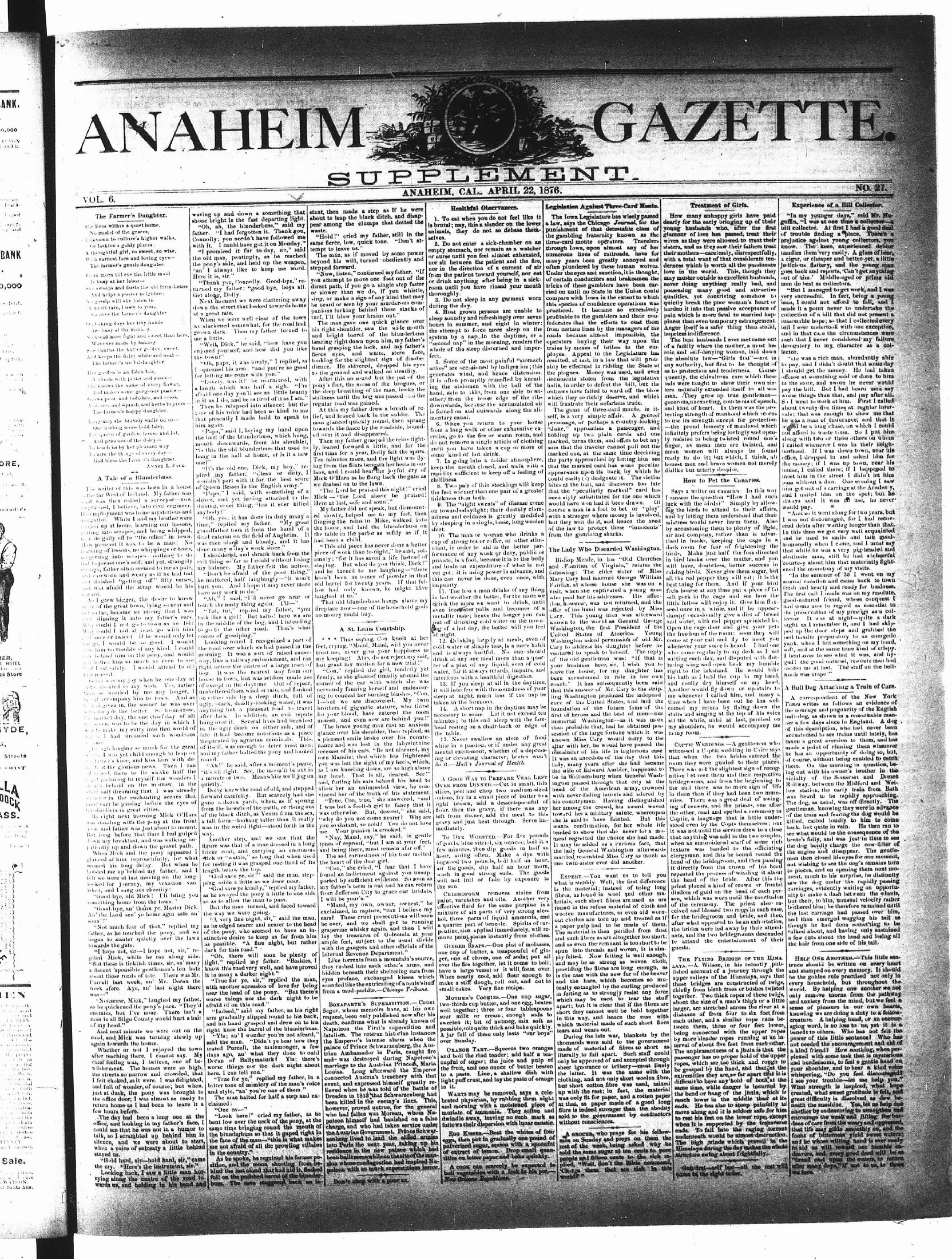
Searchable text
ANAHEIM
VOL. 6.
The Farmer's Daughter.
She lives within a quiet home,
No model of the graces,
Unknown to culture's higher walks,
Or fashion's giddy places;
A thoughtful girl, so sweet, so wise,
With earnest face and loving eyes—
The farmer's gentle daughter.
From morn till eve the little maid
Is busy at her labor—
She sweeps and dusts the old farm-house
And helps a poorer neighbor;
No guest will she listen to
A merit rare, I own to you,
So gives the farmer's daughter.
On baking days her tiny hands
Are busy at the making;
No bread more light and sweet than hers,
Was ever made by baking.
She churns the butter golden sweet,
And keeps the dairy white and neat—
The farmer's useful daughter.
Her garden is an Eden fair,
A bloom with pinks and roses—
She knows the name of every flower,
And makes some gorgeous peaches—
Grows peas, and radishes, and cress,
Ambroma, and squash, and herbs to press—
The farmer's happy daughter.
Long may she bravely smile on us—
Our darling household fairy,
The queen of garden, house and lot,
And princess of the dairy—
To teach us by her pleasant way
To have the things of every day—
God bless the farmer's daughter.
ANNIE L. JACK.
waving up and down a something that shone bright in the fast departing light.
"Oh, ah, the blunderbuss," said my father. "I had forgotten it. Thank you, Connolly; you needn't have followed me with it. I could have got it on Monday."
"I promised it fur to-day, sir," said the old man, pantingly, as he reached the pony's side, and held up the weapon, "an' I always like to keep me word. Here it is, sir."
"Thank you, Connolly. Good-bye," returned my father; "good-bye, boys all. Get along, Dolly.
Next moment we were clattering away down the street that looked towards home at a great rate.
When we were well clear of the town we slackened somewhat, for the road had grown dark. Then my father turned to me a little.
"Weik, Dick," he said, "how have you enjoyed yourself, and how did you like the town?"
"Oh, papa, it was lovely," I replied, as I squeezed his arm; "and you're so good for letting me come with you."
"Lovely, was it?" he murmured, with a laugh which was half a sigh. "I'm afraid one day you'll see as little beauty in it as I do, and be as tired of it as I am."
Then he relapsed into silence; but the tone of his voice had been so kind to me that presently I made bold to speak to him again.
"Papa," said I, laying my hand upon the butt of the blunderbuss, which hung, mouth downwards, from his shoulder, "is this the old blunderbuss that used to hang in the hall at home, or is it a new one?"
"It's the old one, Dick, my boy," stant, then made about to leap through a pear among the waste.
"Hold!" cried same fierce, low, tempt to leave us.
The man, as if beyond his will stepped forward.
"Now, listen," you attempt to reach direct path, if you or slower than sing, or make a be heard or seen panions lurking turf. I'll blow your ear.
The man gave his right shoulder and bright back bearing right door hand grasping the fierce eyes, aiming for the audience. He shipper to the ground again.
After this nopony's feet, the deep breath stillness until the regular road waits.
At this my father laid, and leaned man glanced quizzes towards the fence over it and owed it first time for a Ten minutes making from the flinch.
A Tale of a Blunderbuss.
The writer of this was born in a house on the far West of Ireland. My father was what was then called a surveyor—now an engineer. I believe, into civil engineer, his employment was to me mysterious and thoughtful. While I and my brother were scraped up at home, learning our lessons, getting into scrapes, and being whipped, he made a guilty off to "the office" in town. How pleasant it was to be a man! No learning of lessons, no whippings or tears, no getting into scrapes—nothing to do but to please one's self; and yet, strangely enough, father often seemed to me as pale, and care worn and weary as if he had but just finished "getting off" fifty verses, and was afraid the strap would be his reward.
As I grew bigger, the desire to know more of the great town, lying so near and yet so fat, became so strong that I was diving it into my father's ears. Why could I not go to town as he halfway could I not at least go with him at once or twice? If he would only let me go, I would be so good. I would never have no trouble of any kind. I could be behind him on the pony, and would not bother him so much as even to see that I sat safely. I would attend to all that newsel.
Great was my joy when he one day at age sixteen to my wish. Yes, rather than be worried by me any longer, I must accompany him to town. And as he had given in, the sooner he was over with the job the better. So to-morrow, the market day, the one chief day of all the seven, was to be the day in which I was to make my entry into that world of wealth. I had dreamed such wondrous dreams.
Through longing so much for the great world, I was yet child enough to leap on my father's knee, and kiss him with delight at the glorious news. Then I ran off to cool, there to lie awake half the night picturing to myself the wonders I should behold on the morrow, in the other half dreaming that I was already an actor in the enchanting scenes that must ever be passing before the eyes of the dwellers in great cities.
By eight next morning Mick O'Hara was standing with the pony at the front door, and father was just about to mount. But long before that time I had gulped down my breakfast, and was walking impatiently up and down the gravel path.
When Mick and the pony appeared I glanced at him reproachfully, for what seemed his long delay. But when he hoisted me up behind my father, and I felt we were at last moving on the long-booked for journey, my vexation vanished and I came out cheerily.
I queued his name with you."
"Lovely, was it!" he murmured, with a laugh which was half a sigh. "I'm afraid one day you'll see as little beauty in it as I do, and be as tired of it as I am."
Then he relapsed into silence; but the tone of his voice had been so kind to me that presently I made bold to speak to him again.
"Papa," said I, laying my hand upon the butt of the blunderbuss, which hung, mouth downwards, from his shoulder, "is this the old blunderbuss that used to hang in the hall at home, or is it a new one?
"It's the old one, Dick, my boy," replied my father: "Clean or dirty, I wouldn't part with it for the best score of Queen Besses in the English army."
"Papa," I said, with something of a shiver, and yet feeling attached to the shining cruel thing, "has it ever killed anybody?"
"Oh, yes; it has done its duty many a time," replied my father. "My great grandfather took it from the hand of a dead cateran on the field of Aughrim. It was then black and bloody, and it has done many a day's work since."
I shuddered, and shrank back from the evil thing so far as I could without losing my balance. My father felt the action. "Don't be afraid of the poor thing," he muttered, half laughingly—"it won't hurt you. And I hope it may never more have any work to do."
"Ah," I said, "I'll never go near or touch the nasty thing again. I'll—"
"Iut, tut," replied my father, "you talk like a girl! But halo! here we are in the middle of the bog, and I intending to go to the other road. That's what comes of gossiping."
Looking round I recognized a part of the road over which we had passed in the morning. It was a sort of raised causeway, like a railway embankment, and ran right across the centre of a large tract of bog. It was the nearest way from our house to town, but was seldom made use of except in the daytime. Out of repair, unsheltered from wind or rain, flanked on either side by a deep ditch, full of ugly, black, deadly-looking water, it was anything but a pleasant road to travel after dark. In addition, an evil repute hung over it. Several lives had been lost in the ugly ditch on either side, and of late it had become notorious as a place frequented by agrarian criminals. This, of itself, was enough to deter most men; and my father halted the pony and looked round.
"Ah!" he said, after a moment's pause, "it's all right. See, the moon we'll be out in a minute or two. Meanwhile we'll jog on quietly."
Dolly knew the road of old, and stopped forward carefully. But scarcely had she gone a dozen yards when, as if sprung from the bowels of the earth, or rising out of the black ditch, as Venus from the sea, a tall form—looking taller than it really was in the weird light—stood forth in the way.
Another step, and we saw that the figure was that of a man dressed in a long frieze coat, and carrying an enormous sick or "wattle," so long that when used for resting it was grasped one-third of its length below the top.
"God save ye, sir!" said the man, stepping aside a little as we drew near.
"God save ye kindly," replied my father,
I queued his name with you."
"Lovely, was it!" he mournred, with a laugh which was half a sigh. "I'm afraid one day you'll see as little beauty in it as I do, and be as tired of it as I am."
Then he relapsed into silence; but the tone of his voice had been so kind to me that presently I made bold to speak to him again.
"Papa," said I, laying my hand upon the butt of the blunderbuss, which hung, mouth downwards, from his shoulder, "is this the old blunderbuss that used to hang in the hall at home, or is it a new one?"
It's the old one, Dick, my boy," replied my father: "Clean or dirty, I wouldn't part with it for the best score of Queen Besses in the English army."
"Papa," I said, with something of a shiver, and yet feeling attached to the shining, cruel thing, "has it ever killed anybody?"
"Oh yes; it has done its duty many a time," replied my father. "My great grandfather took it from the hand of a dead cateran on the field of Aughrim. It was then black and bloody, and it has done many a day's work since."
I shuddered, and shrank back from the evil thing so far as I could without losing my balance. My father felt the action. "Don't be afraid of the poor thing," he muttered, half laughingly—"it won't hurt you. And I hope it may never more have any work to do."
"Ah," I said, "I'll never go near or touch the nasty thing again. I'll—"
"Iut, tut," replied my father, "you talk like a girl! But halo! here we are in the middle of the bog, and I intending to go to the other road. That’s what comes of gossiping."
Looking round I recognized a part of the road over which we had passed in the morning. It was a sort of raised causeway, like a railway embankment, and ran right across the centre of a large tract of bog. It was the nearest way from our house to town, but was seldom made use of except in the daytime. Out of repair, unsheltered from wind or rain, flanked on either side by a deep ditch, full of ugly, black, deadly-looking water, it was anything but a pleasant road to travel after dark. In addition,an evil repute hung over it. Several lives had been lost in the ugly ditch on either side,and of late it had become notorious as a place frequented by agrarian criminals. This,of itself,was enough to deter most men; and my father halted the pony and looked round.
"Ah!" he said,after a moment's pause,"it's all right. See,the moon we'll be out in a minute or two. Meanwhile we'll jog on quietly."
Dolly knew the road of old,and stopped forward carefully. But scarcely had she gone a dozen yards when,as if sprung from the bowels of the earth,or rising out of the black ditch,as Venus from the sea,a tall form—looking taller than it really was in the weird light—stood forth in the way.
Another step,and we saw that the figure was that of a man dressed in a long frieze coat,and carrying an enormous sick or "wattle," so long that when used for resting it was grasped one-third of its length below the top.
"God save ye,sir!" said the man,stepping aside a little as we drew near.
"God save ye kindly," replied my father,
I queued his name with you."
"Lovely,was it!" he mournred,with a laugh which was half a sigh. "I'm afraid one day you'll see as little beauty in it as I do,and be as tired of it as I am."
Then he relapsed into silence; but the tone of his voice had been so kind to me that presently I made bold to speak to him again.
"Papa," said I,laying my hand upon the butt of the blunderbuss,which hung,mouth downwards,from his shoulder,"is this the old blunderbuss that used to hang in the hall at home,or is it a new one?"
It's the old one,Dick,我来名我来名我来名我来名我来名我来名我来名我来名我来名我来名我来名我来名我来名我来名我来名我来名我来名我来名我来名我来名我来名我来名我来名我来名我来名我来名我来名我来名我来名我来名我来名我来名我来名我来名我来名我来名我来名我来名我来名我来名我来名我来名我来名我来名我来名我来名我来名我来名我来名我来名我来名我来名我来名我来名我来名我来名我来名我来名我来名我来名我来名我来名我来名我来名我来名我来名我来名我来名我来名我来名我来名我来名我来名我来名我来名我来名我来名我来名我来名我来名我来名我来名我来名我来名我来名我来名我来名我来名我来名我来名我来名我来源,名来源,名来源,名来源,名来源,名来源,名来源,名来源,名来源,名来源,名来源,名来源,名来源,名来源,名来源,名来源,名来源,名来源,名来源,名来源,名来源,名来源,名来源,名来源,名来源,名来源,名来源,名来源,名来源,名来源,名来源,名来源,名来源,名来源,名来源,名来源,名来源,名来源,名来源,名来源,名来源,名来源,名来源,名来源,名来源,名来源,名来源,名来源,名来源,名来源,名来源,名来源,名来源,名来源,名来源,名来源,名来源,名来源,名来源,名来源,名来源,名来源,名来源,名来源,名来源,名来源,名来源,名来源,名来源,名来源,名来源,名来源,名来源,名来源,名来源,名来源于 名来源于 名来源于 名来源于 名来源于 名来源于 名来源于 名来源于 名来源于 名来源于 名来源于 名来源于 名来源于 名来源于 名来源于 名来源于 名来源于 名来源于 名来源于 名来源于 名来源于 名来源于 名来源于 名来源于 名来源于 名来源于 名来源于 名源于 名来源于 名源于 名源于 名源于 名源于 名源于 名源于 名源于 名源于 名源于 名源于 名源于 名源于 名源于 名源于 名源于 名源于 名源于 名源于 名源于 名源于 名来源于 名源的名源的名源的名源的名源的名源的名源的名源的名源的名源的名源的名源的名源的名源的名源的名源的名源的名源的名源的名源的名源的名源的名源的名源的名源的名源的名源的名源的名源的名源的名源的名源的名源的名源的名源的名源的名源的名源的名源的名源的名源的名源的名源的名源的名源的名源的名源的名源的名源的名源有名源有名源有名源有名源有名源有名源有名源有名源有名源有名源有名源有名源有名源有名源有名源有名源有名源有名源有名源有名源有名源有名源有名源有名源有名源有名源有名源有名源有名源有名源有名源有名源有名源有名源有名源有名源有名源有名源有名源有名源有名源有名源有名源有名源有名源有名源自 NAME源自 NAME源自 NAME源自 NAME源自 NAME源自 NAME源自 NAME源自 NAME源自 NAME源自 NAME源自 NAME源自 NAME源自 NAME源自 NAME源自 NAME源自 NAME源自 NAME源自 NAME源自 NAME源自 NAME源自 NAME源自 NAME源自 NAME源自 NAME源自 NAME源自NAME源自NAME源自NAME源自NAME源自NAME源自NAME源自NAME源自NAME源自NAME源自NAME源自NAME源自NAME源自NAME源自NAME源自NAME自巴巴巴巴巴巴巴巴巴巴巴巴巴巴巴巴巴巴巴巴巴巴巴巴巴巴巴巴巴巴巴巴巴巴巴巴巴巴巴巴巴巴巴巴巴巴巴巴巴巴巴巴巴巴巴巴巴巴巴巴巴巴巴巴巴巴巴巴巴巴巴巴巴巴巴巴巴巴巴巴巴巴巴巴巴巴巴巴巴巴巴巴巴巴巴巴巴巴巴巴巴
A St.
** * Thus feet,crying,"My trust me,never my keeping!but grant my
* Con,"repli firmly,sas she corner of th e nervously fanning to conceal.I—but we ar brothers of gir for your blood unseen,and c
* The brave y glance over h e pleasant smi nce and wae recesses of his own Mandie;you was but t h as i am kneel edmy head.T h ad,and furling hy allow her an avinced her o f
* True.Con.Iwas but a f otherwise'why do you you so distant me.Your pr
* Nay,Mau tones over h e pleasant smile and being th e
* The sad eat th e heart ot t
* The Lord b Mane —at last,saw
* My father'the
* ** * Thus feet,crying,"My trust me,never mykeeping!but grant my
* Con,"repli firmly,sas she corner of th e nervously fanning to conceal.I—but we ar brothers of gir for your blood unseen,and c
* The brave y glance over h e pleasant smi nce and wae recesses of his own Mandie;you was but t h as i am kneel edmy head.T h ad,and furling hy allow her an avinced her o f
* True.Con.Iwas but a f otherwise'why do you you so distant me.Your pr
* Nay,Mau tones over h e pleasant smile and wae recesses of his own Mandie;you was但t h as i am kneel edmy head.T h ad,and furling hy allow her an avinced her o f
* True.Con.Iwas但t h as i am kneel edmy head.T h ad,and furling hy allow her an avinced her o f
* True.Con.Iwas但t h as i am kneel edmy head.T h ad,and furling hy allow her an avinced her o f
* True.Con.Iwas但t h as i am kneel edmy head.T h ad,and furling hy allow her an avinced her o f
* True.Con.Iwas但t h as i am kneel edmy head.T h ad,and furling hy allow her an avinced her o f
* True.Con.Iwas但t h as i am kneel edmy head.T h ad,and furling hy allow her an avinced her o f
* True.Con.Iwas但t h as i am kneel edmy head.T h ad,and furling hy allow her an avinced her o f
* True.Con.Iwas但t h as i am kneel edmy head.T h ad,and furling hy allow her an avinced her o f
* True.Con.Iwas但t h as i am kneel edmy head.T h ad,and furling hy allow her an avinced her o f
* True.Con.Iwas但t h as i am kneel edmy head.T h ad,and furling hy allow her an avinced her o f
* True.Con.Iwas但t h as i am kneel edmy head.T h ad,and furling hy allow her an avinced her o f
* True.Con.Iwas但t h as i am kneel edmy head.T h ad,and furling hy allow her an avinced her o f
* True.Con.Iwas但t h as i am kneel edmy head.T h ad,and furling hy allow her an avinced her o f
* TrueCon.Iwas但t h as i am kneel edmy head.T h ad,and furling hy allow her an avinced her o f
* TrueCon.Iwas但t h as i am kneel edmy head.T h ad,and furling hy allow her an avinced her o f
* TrueCon.Iwas但t h as i am kneel edmy head.T h ad,and furling hy allow her an avinced her o f
* TrueCon.Iwas但t h as i am kneel edmy head.T h ad,and furling hy allow her an avinced her o f
* TrueCon.Iwas但t h as i am kneel edmy head.T h ad,and furling hy allow her an avinced her o f
* TrueCon.Iwas但t h as i am kneel edmy head.T h ad,and furling hy allow her an avinced her o f
* TrueCon.Iwas但t h as i am kneel edmy head.T h ad,and furling hy allow her an avinced her o f
* TrueCon.Iwas但t h as i am kneel edmy head.T h ad,and furling hy allow her an avinced her o f
* TrueCon.Iwas但t h as i am kneel edmy head.T h ad,and furling hy allow her an avinced her o f
* TrueCon.Iwas但t h as i am kneel edmy head.T h ad,and furling hy allow her an avinced her o f
* TrueCon.Iwas但t h as i am kneel edmy head.T h ad,and furling hy allow her an avinced her o f
* TrueCon.Iwas但t h as i am kneel edmy head.T h ad,and furling hy allow her an avinced her o f
* TrueCon.Iwas但t h as i am kneel edmy head.T h ad,and furling hy allow her an avinced her o f
* TrueCon.Iwas但t h as i am kneel edmy head.T h ad,and furling hy allow她 an avinced她 o f
* TrueCon.Iwas但t h as i am kneel edmy头T.had,and furling hy allow她 an avinced她 o f
* TrueCon.Iwas但t h as i am kneel edmy头T.had,and furling hy allow她 an avinced她 o f
* TrueCon.Iwas但t h as i am kneel edmy头T.had,and furling hy allow她 an avinced她 o f
* TrueCon.Iwas但t h as i am kneel edmy头T.had,and furling hy allow她 an avinced她 o f
* TrueCon.Iwas但t h as i am kneel edmy头T.had,$and furling hy allow她 an avinced她 o f
* TrueCon.Iwas但t h as i am kneel edmy头T.had,$and furling hy allow她 an avinced她 o f
* TrueCon.Iwas但t h as i am kneel edmy头T.had,$and furling hy allow她 an avincd她 o f
* TrueCon.Iwas但t h as i am kneel edmy头T.had,$and furling hyallow她 an avincd她 o f
* TrueCon.Iwas但t h as i am kneel edmy头T.had,$and furling hyallow她 an avincd她 o f
* TrueCon.Iwas但t h as i am kneel edmy头T.had,$and furling hyallow她 an avincd她 o f
* TrueCon.Iwas但t h as i am kneel edmy头T.had,$and furling hyallow她 an avincd她 o f
* TrueCon.Iwas但t h as i am kneel edmy头T.had,$and furling hyallow她 an avincd她 o f
* TrueCon.Iwas但t h as i am kneel edmy头T.had,$and furling hyallow她 an avincd她 o f
* TrueCon.Iwas但t h as i AM knellel edemy头T.had,$and furling hyallow她 an avincd她 o f
* TrueCon.Iwas但t h AS knellel edemy头T.had,$and furlingHyallow她 an avincd她 o f
* TrueCon.Iwas但t H AS knellel edemy头T.had,$and furringHyallow她 an avincd她 o f
* TrueCon.Iwas但t H AS knellel edemy头T.had,$and furringHyallow她 an avincd她 o f
* TrueCon.Iwas但t H AS knellel edemy头T.had,$and furringHyallow她 an avincd她 o f
* TrueCon.Iwas但t H AS knellel edemy头T.had,$and furringHyallow她 an avincd她 o f
* TrueCon.Iwas但t H AS knellel edemy头T.had,$and furringHyallow她 an avincd她 o f
* TrueCon.Iwas但t H AS knellel edemy头T.had,$and furringHyallow她 an avincd她 o f
* TrueCon.Iwas但t H AS knellel edemy头T.had,$and furringHyallow她 an avincd她 o f
* TrueCon.Iwas但t H AS knellel edemy头T.had,$and furringHyallow她 an avincd她 o f
*TrueCon.Iwas但t H AS knellel edemy头T.had,$and furringHyallow她 an avincd她 o f
* TrueCon.Iwas但t H AS knellel edemy头T.had,$and furringHyallow她 an avincd她 o f
* TrueCon.Iwas但t H AS knellel edemy头T.had,$and furringHyallow她 an avincd她 o f
* TrueCon.Iwas但t H AS knellel edemy头T.had,$and furringHyallow她 an avincd她 o f
* TrueCon.Iwas但t H AS knellel edemy头T.had,$and furringHyallow她们 An AVINCDY WHERE THE SAD EAT THE FOOT OF T
** Con:**
she found an insul ported by su lf 'mys father's t
By eight next morning Mick O'Hara was standing with the pony at the front door, and father was just about to mount. But long before that time I had gulped down my breakfast, and was walking impatiently up and down the gravel path.
When Mick and the pony appeared I glanced at him reproachfully, for what seemed his long delay. But when he hoisted me up behind my father, and I felt we were at last moving on the long-looked for journey, my vexation vanished, and I sang out cheerily:
"Good-bye, old Mick! I'll bring you something home from the town."
"Good-bye, an' thank ye, Master Dick. An' the Lord sen' ye home agin safe an' soon!"
"Not much fear of that," replied my father, as he touched the pony, and we began to cauter quietly over the lawn towards the gate.
"I hope not, sir—I hope not, sir," replied Mick, while he ran along side. "But these is ticklish times, sir, an' many a dacent 'sponsible gentleman's bin bate about these roads of late. There was Mr. Purcell last week, an' Mr. Doran the week afore. Aye, an' last night there was—"
"Nonsense, Mick," laughed my father, as he quickened the pony's pace. "They'd enemies, but I've none. There isn't a man in all Sligo County would hurt a hair of my head."
And next minute we were out on the road, and Mick was turning slowly up again towards the house.
Whether or not I enjoyed the town after reaching there, I cannot say. My chief feeling was, I believe, one of bewilderment. The houses were so high, the streets so narrow and crowded, that I felt choked, as it were. I was delighted, and full of wonder, of course; but when just at dusk, the pony was brought to the office door; I was almost as ready to return home as I had been to leave it a few hours before.
The day had been a long one at the office, and looking in my father's face, I could see that he was not in a humor to talk, so I scrambled up behind him in silence, and we were about to start, when a voice of entreaty a little behind stayed us.
"Hold hard, air—hold hard, sir," came the cry. "Here's the instrument, sir."
Looking back, I saw a little man hurrying along the centre of the road towards us, and holding in his hand and Donly knew the road of old, and stopped forward carefully. But scarcely had she gone a dozen yards, when, as if sprung from the bowels of the earth, or rising out of the black ditch, as Venus from the sea, a tall form—looking taller than it really was in the weird light—stood forth in the way.
Another step, and we saw that the figure was that of a man dressed in a long frieze coat, and carrying an enormous Mick or "wattle," so long that when used for resting it was grasped one-third of its length below the top.
"God save ye, sir," said the man, stepping aside a little as we drew near.
"God save ye kindly," replied my father, as he swayed the pony a little to one side so as to allow the man to pass.
But the man turned, and faced toward the way we were going.
"A very fine night, sir," said the man, as he edged nearer and nearer to the head of the pony, who seemed to have an instinctive desire to keep as far from him as possible. "A flue night, but rather dark for this road."
"Oh, there will soon be plenty of light," replied my father. "Besides, I know this road very well, and have proved it in many a darker night."
"True for ye, sir," replied the man, with another accession of love for being near the head of the pony. "But there's worse things nor the dark night to be afraid of on this road."
"Indeed," said my father, as his right arm gradually slipped round to his back, and his hand grasped and drew on to his right knee the barrel of the blunderbuss.
"Yis; an' I wonder you're not afeard," said the man. "Didn't ye hear how they trated Purcell, the malemonger, a few days ago, an' what they done to ould Doran of Ballymaturk? Yis; there's worse things nor the dark night about here, I can tell you."
"True for ye," replied my father, in a bitter tone of mimicry of the man's voice and style, "an' you're one of them."
The man halted for half a step and explained:
"One ov—"
"Look here!" cried my father, as he bent low over the neck of the pony, at the same time bringing round the mouth of the blunderbuss so that it gaped right in the face of the man—"this is what makes me not afraid of all the prowling villains in the country."
As he spoke, he regained his former position, and the moon shooting from behind the last cloud that had hid it, flashed full on the polished barrel of the blunderbuss. The man staggered back an in-
CIM GA
SUPPLEMENT.
ANAHEIM, CAL., APRIL 22, 1876.
thing that being light. said my thank you. bowed me Monday." sir," said he reached the weapon, some word.
-bye," re-boy's all.
ring away cards home
the town road had turned to have you you like
replied, as are so good
cured, with high. "I'm the beauty it as I am."
e; but the mind to me speak to stand upon which hung, shoulder, that used to is it a new boy."
stant, then made a step as if he were about to leap the black ditch, and disappear among the clumps that dotted the waste.
"Hold!" cried my father, still in the same fierce, low, quick tone. "Don't attempt to leave us."
The man, as if moved by some power beyond his will, turned obediently and stepped forward.
"Now, listen," continued my father. "If you attempt to move one foot out of the direct path, if you go a single step faster or slower than we do, if you whistle, sing, or make a sign of any kind that may be heard or seen by your murderous companions lurking behind those stacks of turf, I'll blow your brains out."
The man gave one quick glance over his right shoulder, saw the wide mouth and bright barrel of the blunderbuss bearing right down upon him, my father's hand grasping the lock, and my father's fierce eyes, and white, stern face, looking for the slightest sign of disobedience. He shivered, dropped his eyes to the ground and walked on steadily.
After this no sound but the pat of the pony's feet, the nose of the brogues, or the deep breathing of the man, broke the stillness until the bog was passed and the regular road was gained.
At this my father drew a breath of relief, and leaned back in the saddle. The man glanced quickly round, then sprang towards the fence by the roadside, bounded over it and disappeared.
Then my father grasped the reins tightly, leaned forward a little, and for the first time for a year, Dolly felt the spurs. Ten minutes more, and the light was flying from the flints beneath her heels in our stomach Observances.
1. To eat when you do not feel like it is brutal; nay, this a slander on the lower animals, they do not so debase themselves.
2. Do not enter a sick-chamber on an empty stomach, nor remain as a watcher or nurse until you feel almost exhausted, nor sit between the patient and the fire, nor in the direction of a current of air from the patient toward yourself, nor eat or drink anything after being in a sick-room until you have rinsed your mouth thoroughly.
3. Do not sleep in any garment worn during the day.
4. Most grown persons are unable to sleep soundly and refreshingly over seven hours in summer, and eight in winter: the attempt to force more sleep on the system by a nap in the daytime, or a "second nap" in the morning, renders the whole of the sleep disturbed and imperfect.
5. Some of the most painful "stomachaches" are occasioned by indigestion; this generates wind, and hence distension. It is often promptly remedied by kneading the abdomen with the ball of the hand, skin to skin, from one side to another; from the lower edge of the ribs-downwards, because the accumulated air is forced on and outwards along the alimentary canal.
6. When you return to your house from a long walk or other exhaustive exercise, go to the fire or warm room, and do not remove a single article of clothing until you have taken a cup or more of some kind of hot drink.
7. In going into a colder atmosphere, keep the mouth closed, and walk with a Legislation Against Three-Card Monte.
The Iowa Legislature has wisely passed a law, says the Chicago Journal, for the punishment of that detestable class of the gambling fraternity known as the three-card monte operators. Travelers through Iowa, upon almost any of her numerous lines of railroads, have for many years been greatly annoyed and often plundered by these human wolves. Under the eyes and sanction, it is thought, of certain conductors and brakesmen the tricks of these gamblers have been carried on until no State in the Union could compare with Iowa in the extent to which this species of confidence operations was practiced. It became so excessively profitable to the gamblers and their confederates that the efforts to oust them from certain lines by the managers of the roads became almost impossible, the operators buying their way upon the trains by means of bribes to the employes. Appeal to the Legislature has resulted, at last, in a law that will probably be effectual in ridling the State of the plagues. Money was used, and even documents stolen from the legislative halls, in order to defeat the bill, but the outlaws have failed to ward off the blow which they so richly deserve, and which will frustrate their nefarious trade.
The game of three-card monte, in itself, is a very simple affair. A genteel personage, or perhaps a country-looking "Jake," approaches a passenger, and holding up two plain cards and one marked, turns them, and offers to bet any sum that the traveler cannot pull out the marked one, at the same time deceiving the party approached by letting him see that the marked card has some peculiar
After this no sound but the pat of the pony's feet, the nose of the brogues, or the deep breathing of the man, broke the stillness until the bog was passed and the regular road was gained.
At this my father drew a breath of relief, and leaned back in the saddle. The man glanced quickly round, then sprang towards the fence by the roadside, bounded over it and disappeared.
Then my father grasped the reins tightly, leaned forward a little, and for the first time for a year, Dolly felt the spurs. Ten minutes more, and the light was flying from the flints beneath her heels in our lane, and I could hear the joyful cry of Mick O'Hara as he flung back the gate as we dashed on to the lawn.
"The Lord be praised this night!" cried Mick—"the Lord above be praised! Here at last, safe and sound."
My father did not speak, but dismounted slowly, helped me to my feet, then flinging the reins to Mike, walked into the house, and laid the blunderbuss on the table in the parlor as softly as if it had been a child.
“This old piece has never done a better piece of work than to-night,” he said, solemnly; “for it has saved a life instead of slaying. But what do you think, Dick?” and he turned to me laughing—“there hasn’t been an ounce of powder in that old barrel for twenty years. If that fellow had only known, he might have laughed at us.”
That old blunderbuss hangs above my fireplace now—one of the household goals no money could buy.
A St. Louis Courtship.
Thus saying, Con knelt at her feet, crying, "Maud, Maud, will you never trust me, never give your happiness to my keeping? Alas, do not reject my suit, but grant my motion for a new trial." "Con," replied the girl, tenderly yet firmly, as she glanced timidly around the corner of the ear with which she was nervously fanning herself and endeavoring to conceal her burning blushes. "Con, I—but we are discovered. My twin brothers of gigantic stature, who thirst for your blood, have entered the room unseen, and even now are behind you!" The brave young man cast an anxious glance over his shoulder, then replied, as a pleasant smile broke over his counterance and was lost in the labyrinthine recesses of his ears. "Be not alarmed, my own Mandie; that which has frightened you was but the sight of my heels, which, as I am kneeling down, are so high above my head. That is all, dearest. See" and, furling his ears behind his head to allow her an unimpeded view, he convinced her of the truth of his statement.
"True, Con, true," she answered, and I was but a foolish girl to fancy that it was otherwise. But, dearest," she said, "why do you not come nearer? Why are you so distant, so cold? You do not love me. Your passion is crooked."
"Nay, Maud, nay," he said, in gentle tones of reproof, "but I am at your feet, and being there, must remain afar off."
The sad earnestness of his tone melted the heart of the dear girl.
"Con," she cried, "I fear that I have found an indictment against you unsupported by sufficient evidence. So soon as my father’s term is out and he can return generates wind, and hence distension. It is often promptly remedied by kneading the abdomen with the ball of the hand, skin to skin, from one side to another; from the lower edge of the ribs downwards, because the accumulated air is forced on and outwards along the alimentary canal.
6. When you return to your house from a long walk or other exhaustive exercise, go to the fire or warm room, and do not remove a single article of clothing until you have taken a cup or more of some kind of hot drink.
7. In going into a colder atmosphere, keep the mouth closed, and walk with a rapidity sufficient to keep off a feeling of chilliness.
8. Two pair of thin stockings will keep the feet warmer than one pair of a greater thickness than both.
9. The "night sweats" of disease come on towards daylight; their deathly clamminess and coldness is greatly modified by sleeping in a single, loose, long woolen shirt.
10. The man or woman who drinks a cup of strong tea or coffee, or other stimulant, in order to aid in the better performance of any work or duty, public or private, is a fool, because it is to the body and brain an expenditure of what is not vet got; it is using power in advance, and this can never be done, even once, with impunity.
11. The less a man drinks of anything in hot weather the better; for the more we drink the more we want to drink until even ice water palls and becomes of a metallic taste; hence the longer you can put off drinking cold water on the morning of a hot day, the better will you feel at night.
12. Drinking largely at meals, even of cold water or simple teas, is a mere habit and is always hurtful. No one should drink at any one meal more than a quarter of a pint of any liquid, even of cold water; for it always retards, impairs, and interferes with a healthful digestion.
13. If you sleep at all in the daytime, it will interfere with the soundness of your sleep at night; much less if the nap be taken in the foremoon.
14. A short nap in the daytime may be necessary to some. Let it not exceed ten minutes; to this end sleep with the forehead resting on a chair-back or edge of the table.
15. Never swallow an atom of food while in a passion, or if under any great mental excitement, whether of a depressing or elevating character; brutes won't do it.—Hall’s Journal of Health.
A Good Way to Prepare Veal LeFT Over From Dinner.—Cut in small, thin slices, peel and chop two medium-sized onions, fry in a small piece of butter to a light brown, add a dessert-poisonful of flour, then the gravy, if there was any left from dinner, add the meat to this gravy and just heat through. Serve immediately.
To Dye Worsted.—For five pounds of goods, blue vitriol, six ounces; boil it a few minutes; then dip goods in half an hour, airing often. Make a dye with logwood two pouns., boil half an hour, air the goods, dip half an hour more, wash in good strong suds. The goods will not full or fade by exposure to the sun.
Money was used, and even documents stolen from the legislative halls, in order to defeat the bill; but the outlaws have failed to ward off the blow which they so richly deserve, and which will frustrate their nefarious trade.
The game of three-card mouse, in itself is a very simple affair. A genteel personage, or perhaps a country-looking Jake,” approaches a passenger, and holding up two plain cards and one marked, turns them, and offers to bet any sum that the traveler cannot pull out the marked one at the same time deceiving that party approached by letting him see that the marked card has some peculiar appearance upon its back; by which he could easily (1) designate it. The victim bites at the bait, and discovers too late that the “peculiarly marked” card has been slyly substituted for the one which would have won had it been drawn. Of course a man is a fool to bet or “play” with a stranger where money is involved; but they will do it, and hence the need of the law to protect those “innocents” from the gambling sharks.
The Lady Who Discarded Washington.
Bishop Meade, in his “Old Churches and Families of Virginia,” relates the following: The elder sister of Miss Mary Cary had married George William Fairfax; at whose house she was on a visit when she captivated a young man who paid her his addresses. His affection however was not returned; and the offer of his hand was rejected by Miss Cary. This young man was afterward known to the world as General George Washington; the first President of the United States of America. Young Washington asked permission of old Mr. Cary to address his daughter before he ventured to speak to herself. The reply of the old gentleman was: “If that is your business here, sir, I wish you to leave the house; for my daughter has been accustomed to ride in her own coach.” It has subsequently been said that this answer of Mr. Cary to the striping Washington produced the independence of the United States; and laid the foundation of the future fame of the first of heroes and the best of men—our immortal Washington—as it was more than probable that had obtained possession of the large fortune which it was known Miss Cary would carry to the altar with her; he would have passed the remainder of his life in inglorious ease. It was an anecdote of the day that this lady, many years after she had became wife of Edward Ambler, happened to be in Williamsburg when General Washington passed through that city at the head of the American army; crowned with never-fading hairstreets and adored by his countrymen. Having distinguished her among the crowd,his sword waved toward her a military salute; whereupon she is said to have fainted. But this wants confirmation for her whole life tended to show that she never for a moment regretted the choice she had made. It may be added as a curious fact, that the lady General Washington afterwards married resembled Miss Cary as much as one twin-sister ever did another.
EXPERT.—You want us to tell you what is shoddy. Well,the first difference is the material; instead of using long
The image contains a newspaper article with several columns of text. The headline is "Bonaparte's Superstition." Below the headline, there is a subheading that reads "Count Segur, whose memoirs have, at his own request, been only published now after his death, confirms what is already known of Napoleon the First's superstition and fatalism. The veteran historian instances the Emperor's intense alarm when the palace of Prince Schwarzenberg, the Austrian Ambassador in Paris, caught fire and was destroyed during Napoleon's marriage to the Austrian Princess, Maria Louisa. Long afterward the Emperor connected Austria's treachery with that event, and expressed himself greatly relieved when he was told of the battle of Dresden in 1813 that Schwarzenberg had been killed in the enemy's lines. This, however, proved untrue, for the general who had fallen was Moreau, whom Napoleon himself had banished on a false charge, and who had taken service under the Austrian Government. Prince Schwarzenberg lived to lead the allied armies into Park the next year, taking up his residence in the new palace which had been built meanwhile on the site of the mausoleum whose conflagration had inspired Napoleon with so much superstitious horror."
The text continues with various paragraphs discussing historical events related to Bonaparte's superstition. It mentions Segur's memoirs, Napoleon's superstition, and the Emperor's actions during the Battle of Dresden.
At the end of the page, there is a footer that says "Don't chop with a poor ax."
The document appears to be a newspaper article from a historical period, likely from the 19th century, given the style of font and layout.
MAGAZETTE.
NO. 27.
First Three-Card Monte.
Feature has wisely passed in Chicago Journal, for the most detestable class of eternity known as the operators. Travelers on almost any of her railroads, have for greatly annoyed and by these human wolves sanction, it is thought, morsels and brakesmen theammbers have been carate in the Union could be in the extent to which incidence operations was became so excessively gamblers and their counsellors to oust them by the managers of the most impossible, the their way upon the of bribes to the emperor the Legislature has a law that will probin ridding the State of money was used, and even from the legislative defeat the bill, but the had to ward off the blow fully deserve, and which or nefarious trade.
Three-card monte, in itiple affair. A genteel shap a country-looking uses a passenger, and explain cards and one man, and offers to bet any other cannot pull out the same time deceiving by letting him see card has some peculiar treatment of Girls.
How many unhappy girls have paid dearly for the early bringing up of their young husbands who, after the first glamour of love has passed, treat their wives as they were allowed to treat their sisters, and as they saw their fathers treat their mothers—carelessly, disrespectfully, with a total want of that considerate tenderness which is worth all the passionate love in 'the world. This, though they may muster outside as excellent husbands, never doing anything really bad, and possessing many good and attractive qualities, yet contriving somehow to quietly break the poor woman's heart or harden it into that passive acceptance of pain which is more fatal to married happiness than even temporary estrangement. Anger itself is a safer thing than stoid, hopeless indifference.
The best husbands I ever met came out of a family where the mother, a most heroic and self-denying woman, laid down the absolute law—"Girls first"—not in any authority, but first to be thought of as to protection and tenderness. Consequently, the chivalrous care which these ladies were taught to show their own sisters naturally extended itself to all women. They grew up true gentlemen—generous, unexacting, courteous of speech, and kind of heart. In them was the protecting strength of manhood which comes to use its strength except for protection—the proud honesty of manhood which infinitely prefers being lovingly and openly resisted to being twisted round one's finger, as mean men are twisted, and mean women will always be found ready to do it; but which, I think, all honest men and brave women not merely dislike but utterly despise.
Experience of a Bill Collector.
"In my younger days," said Mr. Maguffin, "I was at one time a collector—a bill collector. At first I had a good deal of trouble finding a place. There's a prejudice against young collectors, you know. The keen, experienced debtor handles them very easily. A glass of beer, a cigar, or cheaper and better yet, a little judicious flattery, and the young man goes back and reports, 'Can't get anything out of him.' Middle-aged or prime old men do best as collectors.
"But I managed to get work, and I was very successful. In fact, being a young man, I could not afford to fall, and I made it a point never to undertake the collection of a bill that did not present a reasonable hope; so that I collected every bill I ever undertook with one exception, and in that case the circumstances were such that I never considered my failure derogatory to my character as a collector.
"I was a rich man, abundantly able to pay, and I didn't doubt that some day I should get the money. He had taken offense at something said or done to him in the store, and swore he never would pay the bill. But I had heard men say worse things than that, and pay after all. So I went to work at him. First I called about twenty-five times at regular intervals; that was enough to show me that he was a man of endurance, and that it would be a long chase, on which I could not afford to waste time. So I put him along with two or three others on whom I called whenever I was in their neighborhood. If I was down town, near his office, I dropped in and asked him for the money; if I was up town, near his house. I called there; if I happened to
Discarded Washington.
In his "Old Churches of Virginia," relates the elder sister of Miss Barnard George William house she was on a captivated a young man addresses. His affection is not returned, and the was rejected by Miss King man was afterward world as General George first President of the of America. Young had permission of old Mr. his daughter before he took herself. The reply man was: "If that is there, sir, I wish you to for my daughter has led to ride in her own subsequently been said of Mr. Cary to the strip-produced the independent States, and laid the future fame of the best of men—ourington—as it was more than had he obtained postage fortune which it was very would carry to the life in inglorious case sorts of the day that this after she had became Lord Ambler, happened to bring when General Wash-rough that city at the American army, crowned laurels and adored by Having distinguished crowd, his sword waved military salute, whereupon have fainted. But this intention, for her whole life that she never for a month choice she had made, as a curious fact, that Washington afterwards Miss Cary as much as ever did another.
Well, the first difference; instead of using long consequent, the chivalrous care which these lads were taught to show their own sisters naturally extended itself to all women. They grew up true gentlemen—generous, unexacting, courteous of speech, and kind of heart. In them was the protecting strength of manhood which seems to use its strength except for protection—the proud honesty of manhood which infinitely prefers being lovingly and openly resisted to being twisted round one's finger, as mean men are twisted, and mean women will always be found ready to do it; but which, I think, all honest men and brave women not merely dialike but utterly despise.
How to Pet the Canaries.
Says a writer on canaries: In this way I answer the question "How I had such luck with the birds?" Simply by allowing the birds to attend to their affairs, and by letting them understand that their mistress would never harm them. Also by accustoming them to plenty of light, air and company, rather than is advertised in books, keeping in a dark room for fear of frightening the birds. Make just half the fuss directed in bird books over the matter, and you will have, doubtless, better success in raising birds. Never give them sugar, but all the red pepper will eat; it is the best thing for them. And if your bird feels houri at any time put a piece of fat salt pork in the cage and see how the little fellow will enjoy it. Give him flaxseed once in a white, and if he appears dummy occasionally give a diet of bread and water, with red pepper sprinkled in. Open the cage door and give your pets the freedom of the room; soon they will come at your call and fly to meet you whenever your voice is heard. I had one who came regularly to my desk as I sat writing each day, and disputed with fluttering wing and open beak my humble right to the inkstand. He would take his bath as I held the cup in my hand, and coolly dry himself on my head. Another would fly down or up-stairs to me whenever I called him, and many a time when I have been out he has welcomed my return by flying down the stairs and singing at the top of his voice all the while, until at last, perched on my shoulders, he would accompany me to my room.
Coptic Weddings — A gentleman who witnessed a Coptic wedding in Cairo says that when the two brides entered the room they were guided to their places. There was not the slightest sign of recognition between them and their respective bridegrooms, and from the beginning to the end there was no more sign of life in them than if they had been two mummies. There was a great deal of swinging of censors, and the priests, one after other, read and spelled a ceremony in Coptic, a language that is little understood even by the Coptics themselves; but it was not until the service drew to a close that anything was said to the two couples, when an embroidered scarf of some rich texture was handed to the officiating clergyman, and this he bound round the head of the bridegroom, and then passing it directly from the crown of his head repeated the process of winding it about the head of the bride. After this the priest placed a kind of crown or frontal
A Bull Dog Attacking a Train of Cars.
A correspondent of the New York Times writes as follows an evidence of the courage and pugnacity of the English bull-dog, as shown in a remarkable manner a few days since in England. A dog of this description, who had never been accustomed to see trains until lately, has taken a great aversion to them, and has made a point of chasing them whenever he has an opportunity of doing so, but, of course, without being enabled to catch them. On the morning in question, being out with his owner's brother in the vicinity of the Somerset and Dorset Railway, between Midford and Wellow station, the early train from Bath was heard to be rapidly approaching. The dog, as usual, was off directly. The gentleman knowing they were in advance of the train and fearing the dog would be killed, called loudly to him to come back, but quite in vain. He then ran to see what would be the consequence of the brute's folly, and was just-in-time to see the dog boldly charge the cow-litter of the engine and disappear. The gentleman then closed his eyes for one moment, not wishing to see the dog's remains torn to pieces, and on opening them next moment, much to his surprise, he distinctly saw the dog under the rapidly passing carriages, evidently waiting an opportun-
You want us to tell you about Well, the first difference is that instead of using long wool and other material fibres are used as are those material of cloth and structures, or even old worn torn up and treated as if used to be made of them, then purified from dust was altogether too short; our remnant is too short to be made and woven, it is simply felting is well enough, strong as woven cloth, fibres are long enough, as is the new fur of the beaver which becomes so muscular by the curling produced strongly resist any force we used to tear the stuff clear that if the fibres are not well be held together and hence the ease with handmade of such short fibre is out.
State war, blankets by the sold to the government material of fibres so short as well apart. Such stuff could need of and accepted through face or bribery—most likely was the same with the not only short woolen fibre, cotton fibre was used, mixed in fact, the material paper, and a rotten paper made of a good long stronger than the shoddy government by contractors sciences.
Who prays for his fellow-day and preys on them the week being asked why he sugar at ten cents to poor men cents to the rich man's the Bible command that are rich in this
The flying bridges of the Himalaya. — A. Wilson, in his recently published account of a journey through the upper valleys of the Himalaya, says that these bridges are constructed of twigs, chiefly from birch trees or bushes twisted together. Two thick ropes of these twigs, about the size of a man's thigh or a little larger, are stretched across the river at a distance of from four to six feet from each other, and a similar rope runs between them, three or four feet lower, being connected with the upper ropes by more slender ropes running at an interval of about five feet from each other. The unpleasantness of a jhula is that the passenger has no proper hold of the upper ropes, which are too thick and rough to be grasped by the hand, and that at the extremities they are so far apart that it is difficult to have any hold of both at the same time, while danger is incurred by the bend or hang of the jhula, which is much lower in the middle than at its ends. He has also to stoop painfully to move along and it is seldom safe for him to rest his feet on the lower rope except when it is supported by the transverse ends. To fail into the raging torrent underneath would be almost destruction. The high winds which prevail in the Himalaya during the day makes the whole structure swing about frightfully.
Gone last—self last—all the rest will come in the right order.
Help One Another. — This little sentence should be written on every heart and stamped on every memory. It should be the golden rule practised not only in every household, but throughout the world. By helping one another we not only remove thorns from the pathway and anxiety from the mind, but we feel a sense of pleasure in our own hearts, knowing we are doing a duty to a fellow-creature. A helping hand, or an encouraging word, is no loss to us, yet it is a benefit to others. Who has not felt the power of this little sentence? Who has not needed the encouragement and aid of a kind friend? How soothing, when perplexed with some task that is mysterious and burdensome, to feel a gentle hand on your shoulder, and to hear a kind voice whispering, "Do you feel discouraged? I see your trouble—let me help you." What strength is inspired, what hope created, what sweet gratitude is felt, and great difficulty is dissolved as dew beneath the sunshine. Yes, let us help one another by endeavoring to strengthen and encourage the weak and lifting the burdens of care from the weary and oppressed, that life may glide smoothly on, and the fount of bitterness yield sweet waters; and he whose willing hand is ever ready to aid us will reward our humble endeavors, and every good deed will be an "bread cast upon the waters," to return after many days." If not to us, to those we love.