anaheim-gazette 1876-02-12
Scanned page
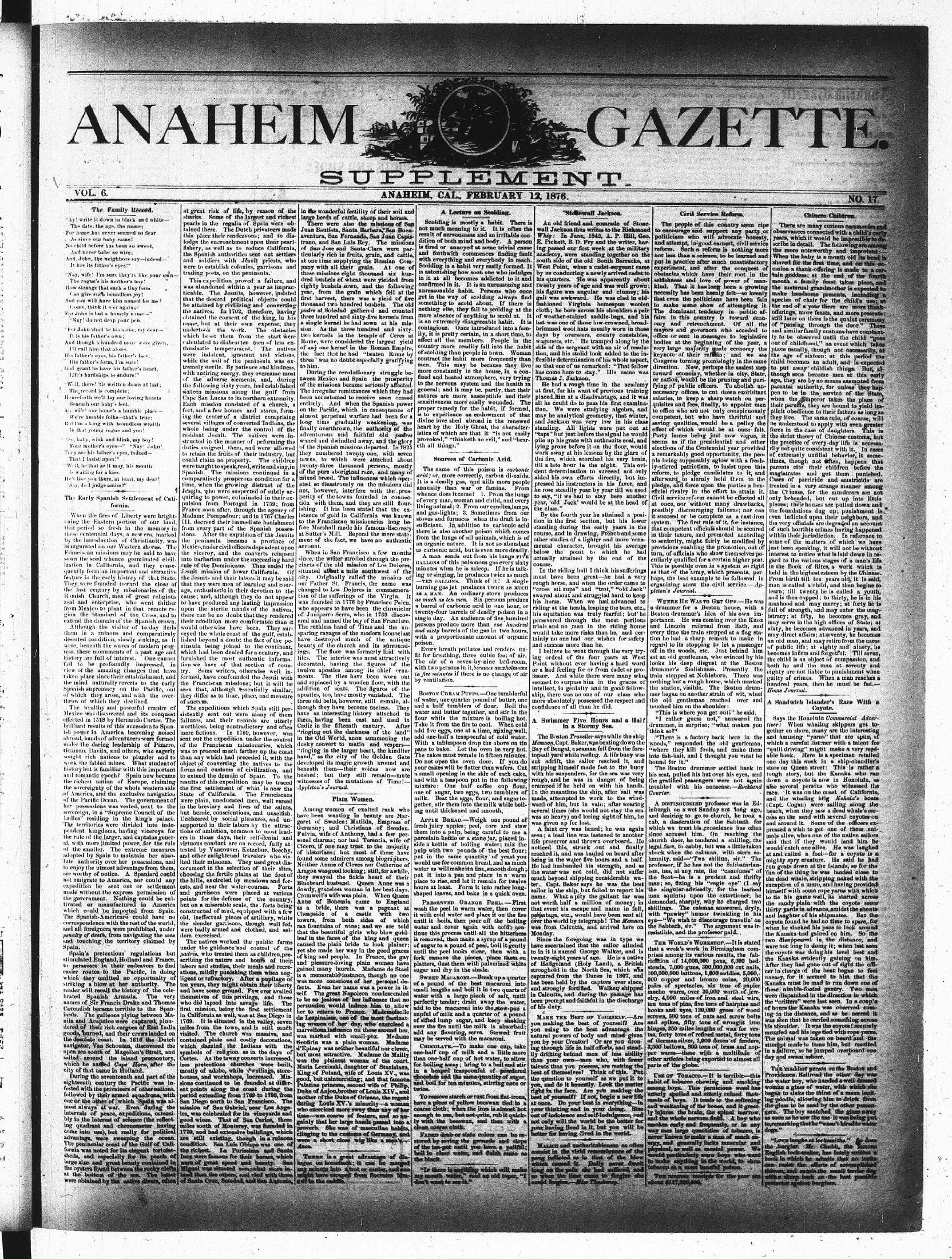
Searchable text
The Family Record.
"Ay! write it down in black and white—
The date, the age, the name;
For home has never seemed so dear
As since our baby came!
No child before has been so sweet,
And never babe so wise;
And John, the neighbors say—indeed—
It has its father's eyes."
"Nay, wife! I'm sure they're like your own—
The rogue's his mother's boy!
How strange that such a tiny form
Can give such boundless joy!
And you will have him named for me!
Come, think it o'er again;
For John is but a homely name—"
"Nay! do not drop your pen."
"For John shall be his name, my dear—
It is his father's own;
And though a hundred more were given,
I'll call him that alone.
His father's eyes, his father's face,
His father's form, I'm sure!
God grant he have his father's heart,
Life's hardships to endure."
"Well, there! 'tis written down at last;
The record is complete;
Henceforth we'll lay our loving hearts
Beneath our baby's feet.
Ah, wife! our home's a humble place—
We're humble folks—that's true;
But I'm a king with boundless wealth
In that young rogue and you!
"No, baby, wink and blink, my boy!
Your mother's eyes—"
"Nay! John!
They are his father's eyes, indeed—
That I insist upon!"
"Well, be that as it may, his mouth"
at great risk of life, by reason of the sharks. Some of the largest and richest pearls in the regalia of Spain were obtained there. The Dutch privateers made this place their rendezvous; and to dislodge the encroachment upon their pearl-fishery, as well as to reduce California, the Spanish authorities sent out settlers and soldiers with Jesuit priests, who were to establish colonies, garrisons and trading posts, on the peninsula.
This expedition proved a failure, and was abandoned within a year as impracticable. The Jesuits, however, insisted that the desired political objects could be attained by civilizing and converting the natives. In 1702, therefore, having obtained the consent of the king, in his name, but at their own expense, they undertook the work. The obstacles which beset them from the start were calculated to dishearten men of less enthusiastic temperament. The natives were indolent, ignorant and vicious, while the soil of the peninsula was extremely sterile. By patience and kindness, with untiring energy, they overcame most of the adverse elements, and, during the following sixty years, had established sixteen missions along the gulf from Cape San Lucas to its northern extremity. Each mission consisted of a church, a fort, and a few houses and stores, forming the center of a district comprising several villages of converted Indians, the whole being under the control of the resident Jesuit. The natives were instructed in the manner of performing the duties assigned them, and were allowed to retain the fruits of their industry, but could claim no property. The children were taught to speak, read, write and sing,
in the wonderful fertile large herds of cattle.
There were also Juan Bautista, Santa aventura, San Fernando trano, and San Lulas of San Jose and San ticularly rich in fruit at one time supplying pany with all their these missions eight dred bushels sow year, from the graft first harvest, there thousand two hundred padre at Solledad got three hundred and sixty a single kernel he hauion. As the three two kernels in the Rome, were considered of any one kernel in the fact that he had three" was no doubt to him.
During the revolution between Mexico and Sue of the missions became The irregular remittance been accustomed to entirely. And when on the Pacific, which almost perpetual was long time gradually finally overthrown, the adventurous and fawned and dwindled of the Spanish mission they numbered twenty towns, to which we twenty-three thousands
The Early Spanish Settlement of California.
When the fires of Liberty were brightening the Eastern portion of our land, that period so fresh in the memory in these centennial days, a new era, marked by the introduction of Christianity, was inaugurated on our Western shores. The Franciscan missions may be said to have sown the seed whence germinated civilization in California, and they consequently form an important and attractive feature in the early history of that State. They were founded toward the close of the last century by missionaries of the Romish Church, men of great religious zeal and enterprise, who went thither from Mexico to plant in that remote region the standard of the Cross, and to extend the domain of the Spanish crown.
Although the visitor of to-day finds them in a ruinous and comparatively deserted condition, slowly sinking, as it were, beneath the waves of modern progress, these monuments of a past age and history are full of interest. One cannot fail to be profoundly impressed, in view of the amazing changes that have taken place since their establishment, and the mind naturally reverts to the early Spanish supremacy on the Pacific, out of which they arose, and with the overthrow of which they declined.
The wealthy and powerful empire of Mexico was discovered and its conquest effected in 1518 by Hernando Cortes. The brilliant results of this accession to Spanish power in America becoming noised abroad, bands of adventurers were formed under the daring leadership of Pizarro, Guzman, Davila, and others, who eagerly sought rich nations to plunder and to work the fabled mines. What student of history but is familiar with this important and romantic epoch! Spain now became the richest nation of Europe, claiming the sovereignty of the whole western side of America, and the exclusive navigation of the Pacific Ocean. The government of her possessions was vested, next to the sovereign, in a "Supreme Council of the Indies" residing in the king's palace. The territories were divided into independent kingdoms, having viceroys for the rule of the larger, and captains general, with more limited power, for the rule of the smaller. The extreme measures adopted by Spain to maintain her absolute authority over her possessions, and to enjoy the utmost advantage from them, are worthy of notice. A Spaniard could not emigrate to America, nor could any expedition be sent out or settlement with untiring energy, they overcame most of the adverse elements, and, during the following sixty years, had established sixteen missions along the gulf from Cape San Lucas to its northern extremity. Each mission consisted of a church, a fort, and a few houses and stores, forming the center of a district comprising several villages of converted Indians, the whole being under the control of the resident Jesuit. The natives were instructed in the manner of performing the duties assigned them, and were allowed to retain the fruits of their industry, but could claim no property. The children were taught to speak, read, write and sing in Spanish. The missions continued in a comparatively prosperous condition for a time, when the growing distrust of the Jesuits, who were suspected of subtly acquiring to power, culminated in their expulsion from Portugal in 1759; from France soon after, through the agency of Madame Pompadour; and in 1767 Charles III decreed their immediate banishment from every part of the Spanish possessions. After the expulsion of the Jesuits the peninsula became a province of Mexico, under civil officers dependent upon the viceroy, and the converts relapsed into barbarism under the succeeding hard rule of the Dominicans. Thus ended the Jesuit mission of lower California. Of the Jesuits and their labors it may be said that they were men of learning and courage, enthusiastic in their devotion to the cause; and although they do not appear to have produced any lasting impression upon the sterile minds of the natives, there can be no doubt that they rendered their condition more comfortable than it would otherwise have been. They surveyed the whole coast of the gulf, established beyond a doubt the fact of the peninsula being joined to the continent, which had been denied for a century, and furnished the most authentic information we have of that section of country. Some writers, otherwise well informed, have confounded the Jesuit with the Franciscan missions; but it will be seen that, although essentially similar, they differ as to time, place, and measure of success.
The expeditions which Spain still persistently sent out were many of them failures, and their records are utterly worthless, being contradictory and often mere fictions. In 1709, however, was sent out the expedition under the control of the Franciscan missionaries, which was to proceed much farther up the const than any which had preceded it, with the object of converting the natives to the forms and customs of civilization, and to extend the domain of Spain. To the results of this expedition may be traced first settlement of what is now the State of California. The Francisans were plain, uneducated men, well versed in the breviary and lives of the saints, but heroic, conscientious, and unselfish. Uncheered by social pleasures, and unsupported in their labors by the attractions of ambition, common to most leaders in those days, their self-denial and virtuous conduct are on record, fully attested by Vancouver, Kotzebue, Beechy, and other enlightened travelers who visited their missions. They used great discernment in the selection of their sites, choosing the fertile plains at the foot of the hills, encircled by meadows and forests, and near the water-courses. Forts During the revolution between Mexico and Santo Domingo of the missions because The irregular remittance been accustomed to entirely. And while on the Pacific, which almost perpetual was long time gradual finally overthrown, they adventurous and fear waned and dwindled of the Spanish mission they numbered two towns, to which we twenty-three thousand of the pure aboriginal mixed breed. The imitation so disastrously not however, interrupted perity of the towns with them, and ishing. It has been instance of gold in Cádiz to the Franciscan mansion Marshall made at Sutter's Mill. Benefitment of the fact, we account.
When in San Francisco since, the writer strove cincts of old miscellain situated about a mile city. Originally called our Father St. Frank changed to Los Dolores tion of the sufferings was founded in 1776 who appears to have been oofered and named the bury The ruthless hand off sparing ravages of them have destroyed much beauty of the churchings. The floor was tiles. The interior was decorated having twelve apostles amongments. The tiles has had replaced by a woman addition of seats. apostles too have moved three old bells; however though they have been have an interesting lion them having been Cadiz in the fifteenth "ringing out the dark in the Old World,and dusky convert to ma "ringing in the larger hand," as the city oi developed its magic garden beneath them—their hushed; but they witnesses of the mutu Appleton's Journal.
Plain W
Among women of have been wanting in garret of Sweden; M Germany; and Christ Fulvia, wife of Antho sonal charma; nor hase Cicero, if one may try historians; but he found some admirers N Neither Annie of Clever Aragon was good looke they swayedthe fiick Bluebeard husband. slowly gracious wor
Spain's pretentious regulations but stimulated England, Holland and France, to persevere in their endeavors to find easier routes to the Pacific, in doing which they omitted no opportunity of striking a blow at her authority. The reader will recall the history of the celebrated Spanish Armada. The very names of Sir Francis Drake and Thomas Cavendish became terrible to the Spaniards. The galleons plying between Manila and Acapulco were captured, plundered of their rich cargoes of East India goods, burned, and their crews landed on the desolate coast. In 1616 the Dutch navigator, Van Schouten, discovered the open sea south of Magellon's Strait, and sailed around the island promontory, which he named Cape Horn, after the city of that name in Holland.
During the seventeenth and part of the eighteenth century the Pacific was infested with the privateers of other nations, followed by their armed squadrons, with one or the other of which Spain was almost always at war. Even during the interruals of peace, expeditions, oceansibly in the interest of science (the reflecting quadrant and chronometer having come into use), but really for political advantage, were sweeping the ocean. The peninsular coast of the Gulf of California was noted for its elegant tortoiseshells, and especially for its pearls of large size and great beauty contained in the oysters found between the rocky cliffs at the bottom of the sea. The latter were obtained by the native divers, often
State of California. The Franciscans were plain, uneducated men, well versed in the breviary and lives of the saints, but heroic, conscientious, and unselfish. Uncheered by social pleasures, and unsupported in their labors by the attractions of ambition, common to most leaders in those days, their self-denial and virtuous conduct are on record, fully attested by Vancouver, Kotzebue, Beechy, and other enlightened travelers who visited their missions. They used great discernment in the selection of their sites, choosing the fertile plains at the foot of the hills, encircled by meadows and forests, and near the water-courses. Forts and garrisons were placed at various points for the defense of the country, but on a miserable scale, the forts being constructed of mud, equipped with a few old, ineffectual pieces of artillery, while the slender garisons, though well fed, were badly armed and clothed, and seldom exercised.
The natives worked the public farms under the guidance and control of the padre, who treated them as children, prescribing the nature and hours of their labors and studies, their meals and recreations, mildly punishing them when negligent or refractory. After a pupillage of ten years, they might obtain their liberty and have some ground. Few ever availed themselves of this privilege, and those who did lapsed into savage life. The first mission, being the first settlement in California as well, was at San Diego in 1769. It is situated in the valley, seven miles from the town, and is still much visited. The church was massive, and contained plate and costly decorations, which dazzled the Indians with the symbols of religion as in the days of Cortes. As the tawny converts increased, less pretensions churches were built, mostly of adobe, while dwellings, storehouses, and workshops increased. Missions continued to be founded at different points along the coast during the period extending from 1789 to 1798, from San Diego north to San Francisco. The mission of San Gabriel, near Los Angeles, was celebrated for its vineyards and good wines. That of San Carlos, three miles south of Monterey, was founded in 1770, and had extensive buildings, which are still existing, though in a ruinous condition. San Luis Obispo was one of the richest. La Purísima and Santa Ines were famous for their homes, which wars of great speed and beauty. San Miguel was situated somewhat more inland than the others, and vied with those of Santa Cruz, Soladad, and San Antonio.
Among women of all garet of Sweden; M Germany; and Christ Fulvia, wife of Anthus sonal charma; nor has Cicero; if one may trace of historians; but not found some admirers Neither Annie of Clever Aragon was good looking they swayed the fice Bluebeard husband. Dowdy, graceless woman Cromwell's wife was pra Anne of Bohemia as a bride; there Cheapside of a tower, from both ran fountains of wine that the beautiful girl leaf in the faces of tha caused the plain bridge yet she made her way of king and people. And pleasure-loving gained many laurels. Is a memorable instance was more conscious effects. Even her name self. The great Napoleon to be so jealous of his persuasion would insure her to return to France De Lepinaisse, one of ing women of her day marvellous influence that was marked with sn Geofrin was a plainer d'Epinay was neither but most attractive. Was the plainest woman Maria Leczinski, dang King of Poland, wife good but uninteresting Palatine princess, second Duke of Anjon,brother mother of the Duke of during Louis XV.'s who exercised more time—was coarse of gainly that her large proverb. She was on clinging to the custom wore a short close Aasa.
Tunnax is a great loggas on horseback; say minutes into a frost might have escaped self in the saddle.
CIM GA
SUPPLEMENT.
ANAHEIM, CAL., FEBRUARY 12, 1876.
of the richest
are obmade to dispearlcalifornia,
settlers,
who
and
upraccsisted
could
terrifying
having
in his
ties,
they
attaches
were
less ennatives
jucious,
was expressed,
most
buring
published
from
unity.
March, a
form-rising
issue, the
reveal.
In the wonderful fertility of their soil and large herds of cattle, sheep and horses.
There were also the missions of San Juan Bantista, Santa Barbara, San Buenaventura, San Fernando, San Juan Capistrano, and San Luis Rey. The missions of San Jose and Santa Clara were particularly rich in fruits, grain, and cattle, at one time supplying the Russian Company with all their grain. At one of these missions eight thousand six hundred bushels of wheat were yielded from eighty bushels sown, and the following year, from the grain which fell at the first harvest, there was a yield of five thousand two hundred bushels. The old padre at Soledad gathered and counted three hundred and sixty-five kernels from a single kernel he had sown at his mission. As the three hundred and sixty-two kernels in the temple of Ceres at Rome, were considered the largest yield of any one kernel in the Roman Empire, the fact that he had "beaten Rome by three" was no doubt especially gratifying to him.
During the revolutionary struggle between Mexico and Spain the prosperity of the missions became seriously affected. The irregular remittances which they had been accustomed to receive soon ceased entirely. And when the Spanish power on the Pacific, which in consequence of almost perpetual warfare had been for a long time gradually weakening, was finally overthrown, the authority of the adventurous and faithful old padres waned and dwindled away, and the glory of the Spanish missions departed. In 1825 they numbered twenty-one, with seven towns, to which were attached about twenty-three thousand persons, mostly in the wonderful fertility of their soil and large herds of cattle, sheep and horses.
Scolding is mostly a habit. There is not much meaning to it. It is often the result of nervousness and an irritable condition of both mind and body. A person is tired or annoyed at some trivial cause and forthwith commences finding fault with everything and everybody in reach. Scolding is a habit very easily formed. It is astonishing how soon one who indulges in it at all becomes addicted to it and confirmed in it. It is an unreasoning and unreasonable habit. Persons who once get in the way of scolding always find something to scold about. If there is nothing else, they fall to scolding at the mere absence of anything to scold at. It is an extremely disagreeable habit. It is contagious. Once introduced into a family, it is pretty certain, in a short time, to affect all the members. People in the country more readily fall into the habit of scolding than people in town. Women contract the habit more frequently than men. This may be because they live more constantly in the house, in a confined and heated atmosphere, very trying to the nervous system and the health in general; and it may be, partly, that their natures are more susceptible and their sensitiveness more easily wounded. The proper remedy for the habit, if formed, is to experience an endowment of that divine love shed abroad in the renewed heart by the Holy Ghost, the characteristics of which are that it "is not easily provoked," "thinketh no evil," and "beareth all things."
Sources of Carbonic Acid.
The name of this poison is carbonic acid.
During the revolutionary struggle between Mexico and Spain the prosperity of the missions became seriously affected. The irregular remittances which they had been accustomed to receive soon ceased entirely. And when the Spanish power on the Pacific, which in consequence of almost perpetual warfare had been for a long time gradually weakening, was finally overthrown, the authority of the adventurous and faithful old padres waned and dwindled away, and the glory of the Spanish missions departed. In 1825 they numbered twenty-one, with seven towns, to which were attached about twenty-three thousand persons, mostly of the pure aboriginal race, and many of mixed breed. The influences which operated so disastrously on the missions did not, however, interfere with the prosperity of the towns founded in connection with them, and they are still flourishing. It has been stated that the existence of gold in California was known to the Franciscan missionaries long before Marshall made his famous discovery at Sutter's Mill. Beyond the mere statement of the fact, we have no authentic account.
When in San Francisco a few months since, the writer strolled through the precincts of the old mission of Los Dolores, situated about a mile southwest of the city. Originally called the mission of our Father St. Francis, the name was changed to Los Dolores in commemoration of the sufferings of the Virgin. It was founded in 1776 by Francisco Palen, who appears to have been the chronicler of Juniperro Serro, who in 1760 discovered and named the bay of San Francisco. The ruthless hand of Time and the unsparing ravages of the modern iconoclast have destroyed much of the antique beauty of the church and its surroundings. The floor was formerly laid with tiles. The interior was most attractively decorated, having the figures of the twelve apostles among its chief ornaments. The tiles have been worn out and replaced by a wooden floor, with the addition of seats. The figures of the apostles, too, have mostly vanished. The three old bells, however, still remain, although they have become useless. They have an interesting history attached to them, having been cast and used in Cadiz in the fifteenth century.
After "ringing out the darkness of the land" in the Old World, anon summoning the dusky convert to matin and vespers—"ringing in the larger heart, the kindlier hand," as the city of the Golden Gate developed its magic growth around and beneath them—their voices now are hushed; but they still remain—mute witnesses of the mutations of Time!—Appleton's Journal.
Plain Women.
Among women of exalted rank who have been wanting in beauty are Margaret of Sweden; Matilda, Empress of Germany; and Christiana of Sweden. Fulvia, wife of Anthony, had a few personal charms; nor had Terentia, wife of Cicero, if one may trust to the majority of historians; but most of these have found some admirers among biographers. Neither Annie of Cleves nor Catherine of Aragon was good looking; still, for awhile, they swayed the fickle heart of their Bluebeard husband. Queen Anne was a dowdy graceless woman in her best daze.
During the revolutionary struggle between Mexico and Spain the prosperity of the missions became seriously affected. The irregular remittances which they had been accustomed to receive soon ceased entirely. And when the Spanish power on the Pacific, which in consequence of almost perpetual warfare had been for a long time gradually weakening, was finally overthrown, the authority of the adventurous and faithful old padres waned and dwindled away, and the glory of the Spanish missions departed. In 1825 they numbered twenty-one, with seven towns, to which were attached about twenty-three thousand persons, mostly of the pure aboriginal race, and many of mixed breed. The influences which operated so disastrously on the missions did not, however, interfere with the prosperity of the towns founded in connection with them, and they are still flourishing. It has been stated that the existence of gold in California was known to the Franciscan missionaries long before Marshall made his famous discovery at Sutter's Mill. Beyond the mere statement of the fact, we have no authentic account.
When in San Francisco a few months since, the writer strolled through the precincts of the old mission of Los Dolores, situated about a mile southwest of the city. Originally called the mission of our Father St. Francis, the name was changed to Los Dolores in commemoration of the sufferings of the Virgin. It was founded in 1776 by Francisco Palen, who appears to have been the chronicler of Juniperro Serro, who in 1760 discovered and named the bay of San Francisco. The ruthless hand of Time and the unsparing ravages of the modern iconoclast have destroyed much of the antique beauty of the church and its surroundings. The floor was formerly laid with tiles. The interior was most attractively decorated, having the figures of the twelve apostles among its chief ornaments. The tiles have been worn out and replaced by a wooden floor, with the addition of seats. The figures of the apostles, too, have mostly vanished. The three old bells, however, still remain, although they have become useless. They have an interesting history attached to them, having been cast and used in Cadiz in the fifteenth century.
After "ringing out the darkness of the land" in the Old World, anon summoning the dusky convert to matin and vespers—"ringing in the larger heart, the kindlier hand," as the city of the Golden Gate developed its magic growth around and beneath them—their voices now are hushed; but they still remain—mute witnesses of the mutations of Time!—Appleton's Journal.
Plain Women.
Among women of exalted rank who have been wanting in beauty are Margaret of Sweden; Matilda, Empress of Germany; and Christiana of Sweden. Fulvia, wife of Anthony, had a few personal charms; nor had Terentia, wife of Cicero, if one may trust to the majority of historians; but most of these have found some admirers among biographers. Neither Annie of Cleves nor Catherine of Aragon was good looking; still, for awhile, they swayed the fickle heart of their Bluebeard husband. Queen Anne was a dowdy graceless woman in her best daze.
During the revolutionary struggle between Mexico and Spain the prosperity of the missions became seriously affected. The irregular remittances which they had been accustomed to receive soon ceased entirely. And when the Spanish power on the Pacific, which in consequence of almost perpetual warfare had been for a long time gradually weakening, was finally overthrown, the authority of the adventurous and faithful old padres waned and dwindled away, and the glory of the Spanish missions departed. In 1825 they numbered twenty-one, with seven towns, to which were attached about twenty-three thousand persons, mostly of the pure aboriginal race, and many of mixed breed. The influences which operated so disastrously on the missions did not, however, interfere with the prosperity of the towns founded in connection with them, and they are still flourishing. It has been stated that the existence of gold in California was known to the Franciscan missionaries long before Marshall made his famous discovery at Sutter's Mill. Beyond the mere statement of the fact, we have no authentic account.
When in San Francisco a few months since, the writer strolled through the precincts of the old mission of Los Dolores, situated about a mile southwest of the city. Originally called the mission of our Father St. Francis, the name was changed to Los Dolores in commemoration of the sufferings of the Virgin. It was founded in 1776 by Francisco Palen, who appears to have beenthe chroniclerof Juniperro Serro,who in 1760 discoveredandnamedthebayofSanFrancisco.TheruthlesshandofTimeandtheunsparingravagesofthemoderniconoclasthavedestroyedmuchoftheantiquebeautyofthechurchanditssurroundings.
The floor was formerly laid with tiles. The interior was most attractively decorated, havingthefiguresamichieforornaments.beneaththem—theirvoicesnowarehushed;buttheystillremain—mutewitnessesofthemutationsOfTime!—Appleton'sJournal.
Plain Women.
Among women of exalted rank who have been wanting in beauty are Margaret of Sweden; Matilda, Empress of Germany; and Christiana of Sweden. Fulvia, wife of Anthony,had a few personal charms;norhadTerentia,wifeofCicero,ifonemaytrusttoothemajorityofhistorians;butmostofthesehavefoundsomeadmirersamibiographers.NeitherAnnieofClevesnorCatherineofAragonwasgoodlooking;stillforawhile,theyswayedthefickleheartoftheBluebeardhusband.QuenAnnewasa dowdygracelesswomaninherbestdaize
DuringtherevolutionarystrugglebetweenMexicoandSpaintheprosperityofthemissionsbecameseriouslyaffected.Theirregularremittanceswhichtheyhadbeacustometowereaccustomedtocreceivesobadlyonthemissionsdidnothoweverinterferewiththeprosperityofthemissionsdidnothoweverinterferewiththeprosperityofthemissionsdidnothoweverinterferewiththeprosperityofthemissionsdidnothoweverinterferewiththeprosperityofthemissionsdidnothoweverinterferewiththeprosperityofthemissionsdidnothoweverinterferewiththeprosperityofthemissionsdidnothoweverinterferewiththeprosperityofthemissionsdidnothoweverinterferewiththeprosperityofthemissionsdidnothoweverinterferewiththeprosperityofthemissionsdidnothoweverinterferewiththeprosperityofthemissionsdidnothoweverinterferewiththeprosperityofthemissionsdidnothoweverinterferewiththeprosperityofthemissionsdidnothoweverinterferewiththeprosperityofthemissionsdidnothoweverinterferewiththeprosperityofthemissionsdidnothoweverinterferewiththeprosperityofthemissionsdidnothoweverinterferewiththeprosperityofthemissionsdidnothoweverinterferewiththeprosperityofthemissionsdidnothoweverinterferewiththeprosperityofthemissionsdidnothoweverinterferewiththeprosperityofthemissionsdidnothoweverinterferewiththeprosperityofthemissionsdidnothoweverinterferewiththeprosperityofthemissionsdidnothoweverinterferewiththeprosperityofthemissionsdidnothoweverinterferewiththeprosperityofthemissionsdidnothoweverinterferewiththeprosperityofthemissionsdidnothoweverinterferewiththeprosperityofthemissionsdidnothoweverinterferewiththeprosperityofthemissionsdidnothoweverinterferewiththeprosperityofthemissionsdidnothoweverinterferewiththeprosperityofthemissionsdidnothoweverinterferewiththeprosperityofthemissionsdidnothoweverinterferewiththeprosperityofthemissionsdidnothoweverinterferewiththeprosperityofthemissionsdidnothoweverinterferewiththeprosperityofthemissionsdidnothoweverinterferewiththeprosperityofthemissionsdidnothoweverinterferewiththeprosperityofthemissionsdidnothoweverinterferewiththeprosperityofthemissionsdidnothoweverinterferewiththeprosperityofthemissionsdidnothoweverinterferewiththeprosperityofthemissionsdidnothoweverinterferewiththeprosperityofthemissionsdidnothoweverinterferewiththeprosperityofthemissionsdidnothoweverinterferewiththeprosperityofthemissionsdidnothoweverinterferewiththeprosperityofthemisationsdidnothoweverinterferewiththeprosperityofthemisationsdidnothoweverinterferewiththeprosperity oft hemisationsdidnothoweverinterferewiththeprosperity oft hemisationsdidnothoweverinterferewiththeprosperity oft hemisationsdidnothoweverinterferewiththeprosperity oft hemisationsdidnothoweverinterferewiththeprosperity oft hemisationsdidnothoweverinterferewiththeprosperity oft hemisationsdidnothoweverinterferewiththeprosperity oft hemisationsdidnothoweverinterferewiththeprosperity oft hemisationsdidnothoweverinterferewiththeprosperity oft hemisationsdidnothowver interferewiththeprosperity oft hemisationsdidnothowver interferewiththeprosperity oft hemisationsdidnothowver interfеревщентофемисядопустимнофемисядопустимнофемисядопустимнофемисядопустимнофемисядопустимнофемисядопустимнофемисядопустимнофемисядопустимнофемисядопустимнофемисядопустимнофемисядопустимнофемисядопустимнофемисядопустимнофемисядопустимнофемисядопустимнофемисядопустимнофемисядопустимнофемисядопустимнофемисядопустимнофемисядопустимнофемисядопустимнофемисядопустимнофемисядопустимнофемисядопустимнофемисядопустимнофемисядопустимнофемисядопустимнофемисядопустимнофемисядопустимнофемисядопустимнофемисядопустимнофемисядопустимнофемисядопустимнофемисядопустимнофемисядопустимнофемисядопустимнофеми稼дополучитьоформлениемалышитоформлениемалышитоформлениемалышитоформлениемалышитоформлениемалышитоформлениемалышитоформлениемалышитоформлениемалышитоформлениемалышитоформлениемалышитоформлениемалышитоформлениемалышитоформлениемалышитоформлениемалышитоформлениемалышитоформлениемалышитоформлениемалышитоформлениемалышитоформениемалышитоформлениемалышитоформлениемалышитоформлениемалышитоформлениемалышитмоформлениемалышитмо formulazioneмо formulazioneмо formulazioneмо formulazioneмо formulazioneмо formulazioneмо formulazioneмо formulazioneмо formulazioneмо formulazioneмо formulazioneмо formulazioneмо formulazioneмо formulazioneмо formulazioneмо formulazioneмо formulazioneмо formulazioneмо formulazioneмо formulazioneмо formulazioneмо formulazioneмо formulazioneмо formulazioneмо formulazioneмо formulazioneмо formulazioneмо formulazioneмо formulazioneмо formulazioneмо formulazioneмо formulazioneмо formulazioneмо formulazioneмо formulazioneмо formulazioneмо formulazioneмо formulazione мо formulazione мо formulazione мо formulazione мо formulazione мо formulazione мо formulazione мо formulazione мо formulazione мо formulazione мо formulazione мо formulazione мо formulazione мо formulazione мо formulazione мо formulazione мо formulazione мо formulazione мо formulazione мо formulazione мо formulazione мо formulazine мо formulazine мо formulazine мо formulazine мо formulazine мо formulazine мо formulazine мо formulazine мо formulazine мо formulazine мо formulazine мо formulazine мо formulazine мо formulazine мо formulazine мо formulazine мо formulazine мо formulazine мо formulazine мо formulazine мо formulazine мо formulazine мо formulazine мо formulazine мо formulazine мо formulazine мо formulazine мо formulazine модуляцию модуляцию модуляцию модуляцию модуляцию модуляцию модуляцию модуляцию модуляцию модуляцию модуляцию модуляцию модуляцию модуляцию модуляцию модуляцию модуляцию модуляцию модуляцию модуляцию модуляцию модуляцию модуляцию модуляцию модуляцию модуляцию модуляцию модуляцию модуляцию модуляцию модуляцию модуляцию модуляцию модуляцию модуляцию м寝ляницу м寝ляницу м寝ляницу м寝яницу м寝яницу м寝яницу м寝яницу м寝яницу м寝яницу м寝яницу м寝яницу м寝яницу м寝яницу м寝яницу м寝яницу м寝яницу м寝яницу м寝яницу м寝яницу м寝яницу м寝яницу м寝яницу м寝яницу м寝яницу м寝яницу м寝яницу м寝яницу м寝яницу м寝яницу м寝яницу м寝яницу мн寝яницу мн寝я完整性 мн寝я完整性 мн寝я完整性 мн寝я完整性 мн寝я完整性 мн寝я完整性 мн寝я完整性 мн寝я完整性 мн寝я完整性 мн寝я完整性 мн寝я完整性 мн寝я完整性 мн寝я完整性 мн寝я完整性 мн寝я完整性 мн寝я完整性 мн寝я完整性 мн寝я完整性 множестве множество множестве множестве множестве множестве множестве множестве множестве множестве множестве множестве множестве множестве множестве множестве множестве множестве множестве множество множестве множество множестве множество множестве множество множестве множество множестве множество множестве множество множестве множество множестве множество множестве множество множестве множество множестве множество множестве множество множестве множество множестве множество множестве множество множестве множество множестве万余倔ные倔ные倔ные倔ные倔ные倔ные倔ные倔ные倔ные倔ные倔ные倔ные倔ные倔ные倔ные倔ные倔ные倔ные倔ные倔ные倔ные倔ные倔ные倔ные倔ные倔ные倔ные倔ные倔ные倔ные倔ные倔ные倔ные倔ные倔ные倔ные倔ные倔ные倔ные倔ые倔ие倔ие倔ие倔ие倔ие倔ие倔ие倔ие倔ие倔ие倄ие倔ие倄ие倄ие倄ие倄ие倄ие倄ие倄ие倄ие倄ие倄ие倄ие倄ие倄ие倄е倄ие倄е倄е倄е倄е倄е倄е倄е伶е伶е伶е伶е伶е伶е伶е伶е伶е伶е伶е伶е伶е伶е伶е伶е伶е伶е伶е伶е伶е伶е伶е伶е伶е伶е伶е伶е伶е伶е伶е伶е伶е侩侩侩侩侩侩侩侩侩侩侩侩侩侩侩侩侩侩侩侩侩侩侩侩侩侩侩侩侩侩侩侩侩侩侬侩侩侩侥侬侬侬侬侬侬侬侬侬侬侬侬侬侬侬侬侬侬侬侬侬侬侬侬侬侬侬侬侬侬侬侬侬侬侬侬侬侬侬侬恫恫恫恫恫恫恫恫恫恫恫恫恫恫恫恫恫恫恫恫恫恫恫恫恫恫恫恫恫恫恫恫恫恫恫恫恫恫恫恫恫恫恫恪恫恫恪恁恪恁恪恪恪恪恪恪恪恪恪恪恪恪恪恪恪恪恪恪恪恪恪恪恪恪恪恪怂怂怂怂怂怂怂怂怂怂怂怂怂怂怂怂怂怂怂怂怂怂怂怂怂怂怂怂怂怂怂怂怂怂怂怂怂怂怂怂怂怂怂怂怂怤怂怤怤怤怤怤怤怤怤怤怤怤怤怤怤怤怤怤怤怤怤怤怤怤怤怤怤怤怤怤怤怤怤怤怤怤怤怤怤怤怤怤怤怤怤怤怤怤怤怤怤怤怤怤怤佷佷佷佷佷佷佷佷佷佷佷佷佷佷佷佷佷佷佷佷佷佷佷佷佷佷佷佷佷佷佷佷佷佷佷佷佷佷佷佷佷佷佷佷佷佷佷佷佷佷佷佷佷佷佷佷佷佷佷佷佷佹佻佹佹佹佹佹佹佹佹佹佹佹佹佹佹佹佹佹佹佹佹佹佹佹佹佹佹佹佹佹佹佹佹佹佹佹佹佹佹佹佹佹佹佹佹佹佹佹佹佹佹佹佹佹佹佹佹佻佻佻佻佻仈仟仟仟仟仟仟仟仟仟仟仟仟仟仟仟仟仟仟仟仟仟仟仟仟仟仟仟仟仟仟仟仟仟仟仟仟仟仟仟仟仟仟仟什什什什什什什什什什什什什什什什什什什什什什什什什什什什什什什什什什什什什什什什什什什什什什闰闰闰闰闰闰闰闰闰闰闰闰闰闰闰闰闰闰闰闰闰闰闰闰闰闰闰闰闰闰闰闰闰闰闰闰闰闰闰闰闰闰闰闰闰闰闰闰闰闰闰闰闰闰闰闵闵闵闵闵闵闵闵闵闵闵闵闵闵闵闵闵闵闵闵闵闵闵闵闵闵闵闵闵闵闵闵闵闵闵闵闵闵闵闵閉閉閉閉閉閉閉閉閉閉閉閉閉閉閉閉閉閉閉閉閉閉閉閉閉閉閉閉閉閉閉閉閉閉閉閉閉閉閉閉閉閉閉閉閉閉閉閉閉閉閉閉閉閉閉閉閉閉閉閉閉開開開開開開開開開開開開開開開開開開開開開開開開開開開開開開開開開開開開開開開開開开開开開开開开開开開开開始开始开始开始开始开始开始开始开始开始开始开始开始开始开始开始开始开始开始开始开始开始开始开始开始开始开始开始开始开始开始开始开始开始开始开始开始开始开始开始开始开始开始开始开始开始开始开始开始开始开始开始开始开始开始开始开始开始开始开始开始开始开始开始开始开始开始结束结束结束结束结束结束结束结束结束结束结束结束结束结束结束结束结束结束结束结束结束结束结束结束结束结束结束结束结束结束结束结束结束结束结束结束结束结束结束结束结束结束结束结束结束结束结束结束结束结束结束结束结束结束结束结束后结尾结尾结尾结尾结尾结尾结尾结尾结尾结尾结尾结尾结尾结尾结尾结尾结尾结尾结尾结尾结尾结尾结尾结尾结尾终点终点终点终点终点终点终点终点终点终点终点终点终点终点终点终点终点终点终点终点终点终点终点终点终点终点终点终点终点终点终点终点终点终点终点终点终点终点终点终点终点终点终点终点终点终点终点终点终点终点终点终点终点终点终点终点终点终点终点终点终点终点终点终点终点终点终点终点终点终点终点终点终点终点起点起点起点起点起点起点起点起点起点起点起点起点起点起点起点起点起点起点起点起点起点起点起点起点起点起点起点起点起点起点起点起点起点起点起点起点起点起点起点起点起点起点起点起点起点起点起点起点起点起点起点起点起点起点起点起点起点起点起点起点起点点点点点点点点点点点点点点点点点点点点点点点点点点点点点点点点点点点点点点点点点点点点点点点点点点点点点点点点点点点点点点点点点
Plain Women.
Among women of exalted rank who have been wanting in beauty are Margaret of Sweden; Matilda, Empress of Germany; and Christiana of Sweden. Fulvia, wife of Anthony, had a few personal charms; nor had Terentia, wife of Cicero, if one may trust to the majority of historians; but most of these have found some admirers among biographers. Neither Annie of Cloves nor Catherine of Aragon was good looking; still, for awhile, they swayed the fickle heart of their Bluebeard husband. Queen Anne was a dowdy, graceless woman in her best days. Cromwell's wife was plain. When Queen Anne of Bohemia came to England as a bride, there was a pageant at Cheapside of a castle with two towers, from both sides of which ran fountains of wine; and we are told that the beautiful girls who blew gold-leaf in the faces of the king and queen caused the plain bride to look plainer; yet she made her way in the good graces of king and people. In France, the gay and pleasure-loving plain women have gained many laurels. Madame de Stael is a memorable instance, though no one was more conscious of her personal defects. Even her name was a power in itself. The great Napoleon condescended to be so jealous of her influence that no persuasion would induce him to allow her to return to France. Mademoiselle de Lespinales, one of the most fascinating women of her day, who exercised a marvellous influence on those around her, was marked with small-pox. Madame Geofirin was a plain woman. Madame d'Epinay was neither beautiful nor clever, but most attractive. Madame de Mailly was the plainest woman of the court. Maria Loczinski, daughter of Stanislaws, King of Poland, wife of Louis XV., was good, but uninteresting; and that famous Palatine princess, second wife of Philip, Duke of Anjou, brother of Louis XIV., and mother of the Duke of Orleans, the regent during Louis XV.'s minority—a woman who exercised more sway than any of her time—was coarse of feature, and so naggily that her large hands passed into a proverb. She was of masculine habits, clinging to the customs of Germany, and wore a short close wig like a man's—Anna.
Theresa is a great advantage of dialogue on horseback; it can be mangled any minute into a trot or center, and one might have escaped from Socrates himself in the middle.
APPLE BREAD. Weigh one pound of fresh juicy apples; peel, core and stew them into a pulp, being careful to use a porcelain kettle or a stone jar, placed inside a kettle of boiling water; mix the pulp with two pounds of the best flour; put in the same quantity of yeast you would use for common bread, and as much water as will make it fine, smooth dough; put it into a pan and place in a warm place to rise, and let it remain for twelve hours at least. Form it into rather long-shaped leaves, and bake in a quick oven.
PRESERVED ORANGE PEEL. First wash the peel in warm water, then cover it with cold water and place it on the fire until it boils, then pour off the boiling water and cover again with cold; continue this process until all the bitterness is removed, then make a syrup of a pound of sugar to a pound of peel, boil it gently until the peel looks clear, then with a fork remove the pieces, place them on platters, dust them with pulverized white sugar and dry in the shade.
SWEET MACARONI. Break up a quarter of a pound of the best macaroni into small lengths and boil it in two quarts of water with a large pinch of salt, until perfectly tender: drain away the water, add to the macaroni into the stew-pan a cupful of milk and a quarter of a pound of sifted lump sugar, and keep shaking over the fire until the milk is absorbed; add any flavoring, serve. Stewed fruit may be served with the macaroni.
CHOCOLATE. To make one cup, take one-half cup of milk and a little more than one-half cup of hot water, to allow for boiling away; bring to a boil and stir in a heaped teaspoonful of powdered chocolate and the same quantity of sugar, and boil for ten minutes, stirring once or twice.
To remove starch or rust from flat-irons, have a piece of yellow beeswax tied in a coarse cloth; when the iron is almost hot enough to melt, but not quite rub it quickly with the beeswax, and then with a clean course cloth.
FADEN drab or slate colors can be restored by mixing the grounds and slops of the tea-pot until you have a painful; boil in cold water; and finish same as the black.
"In there is anything which will make my mouth water," said an old torer, "I don't want to see it."
In the meantime the ship, after sail was made, attempted to work to the windward of him, but in vain; after wearing several times (she would not stay the sea was so heavy) and losing sight of him, he was given up for lost.
A faint cry was heard; he was again seen; a lead line was fastened to another life preserver and thrown overboard. He noticed this, struck out and finally reached it, and was hauled on board after being in the water five hours and a half. He had husbanded his strength, and as the water was not cold, did not suffer much beyond shipping considerable water. Capt. Baker says he was the best sailor in the ship, but failed to report his name. What a pity the gallant tar was not worth half a million of money; in that event his escape and name in full, patigature, etc., would have been sent all over the world by telegraph! The Memnon was from Calcutta, and arrived here on Monday.
Since the foregoing was in type we have ascertained that the sailor alluded to in it is named George Walker, and is twenty-eight years of age. He is a native of Heliogoland (Holy Land), a British stronghold in the North Sea, which was captured from the Danes in 1807, and has been held by the captors ever since, and strongly fortified. Walker shipped in Calcutta, and during the passage has been prompt and faithful in the discharge of his duty.
MAKE THE BEST OF YOURSELF. Are you making the best of yourself? Are you using to the best advantage the natural powers of body and mind given you by your Creator? Or are you droning through life in half efforts, and steadily drifting behind men of less ability than your own—men who, with fewer talents than you possess, are making the best of themselves? Think of this. Put the question to yourself as we put it to you, and do it honestly. Look the matter right in the face. Are you making the best of yourself? If not, begin a new life at once. Do your best in everything—in your thinking and in your doing. Rise out of indolence and self-indulgence, and not only will the world be the better for your having lived in it, but you will be better for having lived in the world.
MALACHS and uncharitableness as often consist in the virid remembrance of the pang inflicted as in that of the blow which caused it. Daily never dwelt long on the pain she had suffered, and so when the time came to forgive she could forgive—Miss Thadaway.
GAZETTE.
NO. 17.
Jackson.
The comrade of Stoneeles to the Richmond
12, A. P. Hill, Geo.
and the writer, haveek at the military
being together on the
South Barracks, at
adet-sergeant came
newly arrived cadet to
apparently about
was well grown;
and clumay; his
hide was eld in oldhomespun woolen
his shoulders a pair
middle-bags, and his
now-crowned, broadually worn in those
county constables,
amped along by the
with an air of resolution added to the inof his whole aspect,
worked: "That fellow"
His name was
in the academy
of previous training
avantage, and it was
his first examinaning algebra, and
geometry, that winter,
low in his class
were put out at
the signal he would
authracite coal, and
on the floor, would
beams by the glare of
used his very brain,
the night. This evi-
Civil Service Reform.
The people of this country seem ripe
to encourage and support any party or
politicians who will advocate honesty,
and attempt, in good earnest, civil service reform.
Such a reform is nothing more nor less than a science, to be learned and put in practice after much unsatisfactory experiment, and after the conquest of obstacles which have their root in the selfishness and love of power of mankind.
That it has long been a growing necessity has been keenly felt—so keenly that even the politicians have been fain to make some show of attempting it.
The dominant tendency in public affairs in this country is toward economy and retrenchment. Of all the mayors and governors who acceded to office or sent in messages to legislative bodies at the beginning of the year, a very large majority made economy the keynote of their refrain; and we see Congress turning promisingly in the same direction.
Now, perhaps the easiest step toward economy, whether in city, State, or nation, would be the pruning and purifying of public officers. To abolish unnecessary offices, to cut down exorbitant salaries, to keep a sharp watch onquisites and fees, finally, to appoint men to office who are not only conspicuously competent, but who have thriftful and saving qualities, would be a policy the effect of which would be at once felt.
Party issues being just now vague, it seems as if the presidential and other elections of the Centennial year provided a remarkably good opportunity, the people being supposedly aglow with a freshly-stirred patriotism, to insist upon this
Chinese Children.
There are many curious ceremonies and observances connected with a child's early years, which it would be impossible to describe in detail. The following are among the more noteworthy and important:
When the baby is a month old its head is shaved for the first time, and on this occasion a thank-offering is made to a certain goddess; at the end of the fourth month a family feast takes place, and the maternal grandmother is expected to make handsome presents, including a species of chair for the child's use; at the end of a year there are more thank-offerings, more feasts, and more presents; still later on there is the quaint ceremony of "passing through the door." These and similar family customs have constantly to be observed until the child "grows out of childhood," an event which takes place usually, though not necessarily, at the age of sixteen; at this period the child becomes an adult, and is expected to put away childish things. But although sons become men at this early age, they are by no means exempted from parental authority, for unless they happen to be in the service of the State, when the Emperor takes the place of their parents, they are bound to yield implicit obedience to their fathers as long as they live. The same rule, of course, will be understood to apply with even greater force in the case of daughters. This is the strict theory of Chinese customs, but the practice of every-day life is necessarily not quite consistent with it. In cases of extremely unflillal behavior, it sometimes, though not often, happens that parents cite their children before the
He had a very order came to trot," old Jack" jugged hard to keep advanced tooping the bars, etc., very fearful; but he the most perilous the riding house than he, and certain wishes for safety one.
The very tryer years at West driving a hard word from cadet or pro were many who in the graces of and in good fellowship of our class who need the respect and did.
Hours and a Half by Sea.
Says while the ship beating down the fell from the foreground. A life buoy was reached it, and fast to the buoy the sea was very danger of being with his hands. After sail was rocked to the windmind; after wearing not stay the sea sight of him, he died; he was again restened to another on overboard. He out and finally led on board after hours and a half. Strength, and as did not suffer considerable wear was the best suited to report his toward economy, whether in city, State, or nation, would be the pruning and purifying of public officers. To abolish unnecessary offices, to cut down exorbitant salaries, to keep a sharp watch on perquisites and fees, finally, to appoint men to office who are not only conspicuously competent, but who have thriftful and saving qualities, would be a policy the effect of which would be at once felt. Party issues being just now vague, it seems as if the presidential and other elections of the Centennial year provided a remarkably good opportunity, the people being supposably aglow with a freshly-stirred patriotism, to insist upon this reform, to pledge candidates to it, and afterward to sternly hold them to the pledge, and force upon the parties a beneficial rivalry in the effort to attain it. Civil service reform cannot be effected all at once, nor without many drawbacks, possibly discouraging failures; nor can it succeed or be complete as a cast-iron system. The first rule of it, for instance, that competent officials should be secured in their tenure, and promoted according to seniority, might fairly be modified by provisions enabling the promotion, out of turn, of officials who show themselves peculiarly qualified for a certain higher post. This is possible even in a system so rigid as that of the army, which presents, perhaps, the best example to be followed in organizing anew the civil service.—Appleton's Journal.
Where He Was To Get Off.—He was a drummer for a Boston house, with a Boston drummer's idea of his own importance. He was coming over the Knox and Lincoln railroad from Bath, and every time the train stopped at a flag station he had a sharp remark to make in regard to its stopping to let a passenger off in the woods, etc. Just behind him sat an old gentleman, who evinced by his looks his deep disgust at the Boston drummer's foolishness. Presently the train stopped at Nobleboro. There was nothing but a rough house, which marked the station, visible. The Boston drummer began on another strain of wit, when the old gentleman reached over and touched him on the shoulder:
“This is where you get out!” he said.
“I rather guess not,” answered the drummer, in surprise; “what makes you think so?”
“There is a factory back here in the woods,” responded the old gentleman, “where they kill fools, and make them into fish-bait, and I thought you must be bound for it.”
The Boston drummer settled back in his seat, pulled his hat over his eyes, and the gratified passengers were not again troubled with his nonsense.—Rockland Courier.
A distinguished professor was in Edinburgh on a wet Sunday not long ago, and desiring to go to church, he took a cab, a desecration of the Sabbath for which we trust his conscience has often since accused him. On reaching the church door, he tendered a shilling, the legal fare, to cabby, but was a little taken aback when the cabman, with stern solemnity, said—“Twa shillun, sir.” The professor, if he has not the Sabbatarianism, has, at any rate, the "canniness" of the Scot—he is a prudent and thrifty man; so, fixing his "eagle eye" (I say the singularly advised), for the learned though sons become men at this early age, they are by no means exempted from parental authority, for unless they happen to be in the service of the State, when the Emperor takes the place of their parents, they are bound to yield implicit obedience to their fathers as long as they live. The same rule, of course, will be understood to apply with even greater force in the case of daughters. This is the strict theory of Chinese customs, but the practice of every-day life is necessarily not quite consistent with it. In cases of extremely unflial behavior, it sometimes, though not often, happens that parents cite their children before the magistrates and get them punished. Cases of parricide and matricide are treated in a very strange manner among the Chinese, for the murderers are not only beheaded, but cut up into little pieces; their houses are pulled down and the foundations dug up; punishment is even inflicted upon their neighbors, and the very officials are degraded on account of such horrible crimes having happened within their jurisdiction. In reference to some of the matters of which we have just been speaking, it will not be without interest to notice what is laid down in regard to the various stages of a man's life in the Book of Rites, a work which is held in the highest esteem by the Chinese. From birth till ten years old, it is said, man is called a child, and then begins to learn; till twenty he is called a youth, and is then capped; to thirty, he is in his manhood and may marry; at forty he is full of strength, and may enter the magistracy; at fifty, he becomes gray, and may serve in the high offices of State; at sixty, he becomes advanced in years, and may direct affairs; at seventy, he becomes an old man, and may retire from the cares of public life; at eighty and ninety, he becomes infirm and forgetful. Till seven, the child is an object of compassion, and both he and the man at seventy and eighty are not liable to punishment when guilty of crimes. When a man reaches a hundred years, then he must be fed.
Home Journal.
A Sandwich Islander's Race With a Coyote.
Says the Honolulu Commercial Advertiser: When whaling skippers get together on shore, many are the interesting and amusing "yarns" that are spain, of which a careful listener with a talent for "quill driving" might make a very readable book. Here is a specimen retailed one day week in a ship-chandler's store on Queen street: This is rather a tough story, but the Kanaka who ran down a coyote is now in Honolulu, as also several persons who witnessed the race. It was on the coast of California, and the whaling brig Kohala's boats (Capt. Cogan) were sailing along the beach, when they saw a dead whale's carcass on the sand with several coyotes on and around it. Some of the officers expressed a wish to get one of these animals alive, when one of the native sailors said that if they would land him he would catch one alive. He was laughed at and called a fool—for a coyote is a mighty spry creature. He said he had run goats down at the Islands, so for the fun of the thing he was landed close to the dead whale, stripping naked with the exception of a mare, and having provided
A distinguished professor was in Edinburgh on a wet Sunday not long ago, and desiring to go to church, he took a cab, a desecration of the Sabbath for which we trust his conscience has often since accused him. On reaching the church door, he tendered a shilling, the legal fare, to cabby, but was a little taken aback when the cabman, with stern solemnity, said—"Twa shillun, sir." The professor, if he has not the Sabbatarianism, has, at any rate, the "canniness" of the Scot—he is a prudent and thrifty man; so, fixing his "eagle eye" (I say the singular-advisedly, for the learned man squints) upon the extortioner, he demanded sharply, why he charged two shillings. The cabman answered, dryly, with "pawley" humor twinkling in his eye—"We wish to discourage travelin' on the Sabbath, sir." The argument was irresistible, and the professor paid.
The World's Workshop. It is stated that a week's work in Birmingham comprises among its various results, the fabrication of 14,000,000 pens, 6,000 bedsteads, 7,000 guns, 300,000,000 cut nails, 100,000,000 buttons, 1,900 saddles, 5,000,000 copper and bronze coins, 20,000 pairs of spectacles, six tons of papier mache wares, over 30,000 worth of jewelry, 4,000 miles of iron and steel wire, ten tons of pins, five tons of hairpins and books and eyes, 130,000 gross of wood screws, 500 tons of nuts and screw bolts and spikes, fifty tons of wrought iron hinges, 350 miles lengths of wax for vests, forty tons of refined metal, forty tons of German silver, 1,000 dozen of fenders, 3,500 bellows, 800 tons of brass and copper wares—those with a multitude of other articles being exported to almost all parts of the globe.
Use of Tobacco. It is terrible—this habit of tobacco chewing and smoking among boys. This pernicious weed has utterly spoiled and utterly ruined thousands of boys. It tends to the softening and weakening of the bones, and it greatly injures the brain; the spinal marrow, and the whole nervous fluid. A boy who smokes early and frequently, or in any way may large quantities of tobacco, is never known to make a man of much energy, and generally lacks muscular and physical as well as mental power. We would particularly warn boys who want to make anything in the world; to smoke tobacco as a most harmful poison.
The revenue receipts for the year six about $117,000,000.
It was on the coast of California, and the whaling brig Kohala's boats (Capt. Cogan) were sailing along the beach, when they saw a dead whale's carcass on the sand with several coyotes on and around it. Some of the officers expressed a wish to get one of these animals alive, when one of the native sailors said that if they would land him he would catch one alive. He was laughed at and called a fool—for a coyote is a mighty spy creature. He said he had run goats down at the Islands, so for the fun of the thing he was landed close to the dead whale, stripping naked with the exception of a mare, and having provided himself with some rope yarns with which to tie his game well; he started across the sandy plain with the coyote some thirty yards in advance amidst the shouts and laughter of his shipmates. But the coyote found he had no time to spare, for when he slacked his pace to look around the Kanaka-had gained on him. So the two disappeared in the distance, and were not long in doing it; when last seen the coyote was doing his level best and the Kanaka evidently gaining on him. After they had gone out of sight the officer in charge of the boat began to feel uneasy, for it seemed to him that the Kanaka must be mad to run down one of these nimble-footed gentry. Two men were dispatched in the direction in which the "critters" were last seen. In a couple of hours the Kanaka was observed coming in the distance, and as he nerred it was seen that he carried something across his shoulder. It was the coyote! securely muzzled and his legs tied with rope yarns. The animal was taken on board and the attempt made to tame him, but resulted in a failure; as he jumped overboard one day and swam ashore.
The madest person on the Boston and Providence Railroad the other day was the water boy, who handed a well dressed woman a glass of water, with which she begins to slake the thirst of a mean looking poodle; allowing him to drink from the glass to be used by the other passengers. The boy snatched the glass away as soon as he saw the use it was being put theremarking that he "want't hired to water dogs."
"Love laughs at locksmiths." So does the burglar. Mr. Chubb, the famous English locksmith, has lately written a book in which he admits that no locks can resist the efforts of accomplished thieves; and entails the small terrier dog with a sharp hook as the last possible prey against hurglaries.