anaheim-gazette 1876-01-29
Scanned page
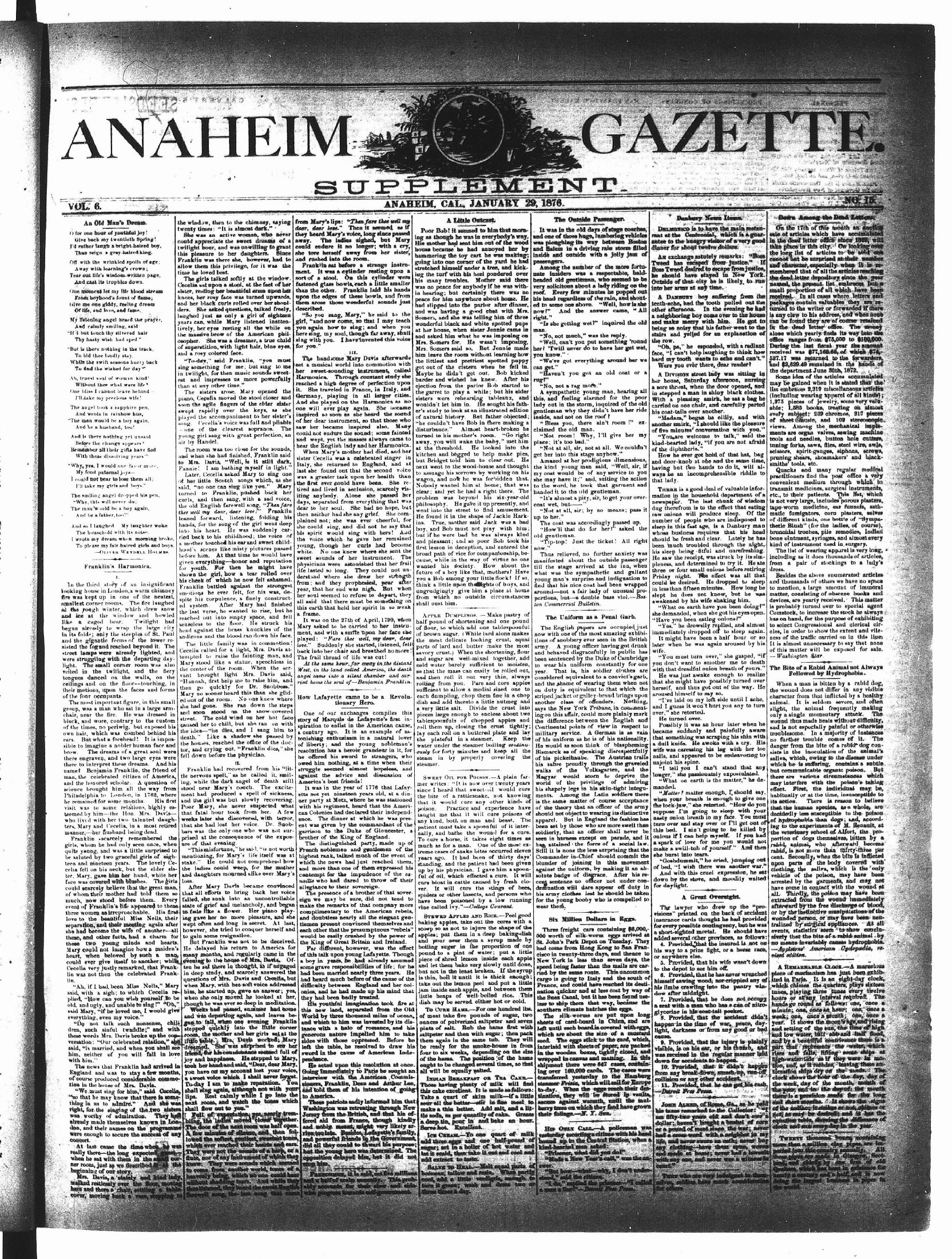
Searchable text
An Old Man's Dream
O for one hour of youthful joy!
Give back my twentleth Spring!
I'd rather laugh a bright-haired boy,
Than reign a gray-haired king.
Off with the wrinkled apoils of age;
Away with learning's crown;
Tear out life's wisdom-written page,
And cast its trophics down.
One moment let my life blood stream
From boyhood's fount of flame;
Give me one giddy, reeling dream
Of life, and love, and fame.
My listening angel heard the prayer,
And calmly smiling, said:
"If I but touch thy silvered hair
Thy hasty wish had sped"
"But is there nothing in the track,
To bid these fondly stay.
While the swift seasons hurry back
To find the wished for day"
Ah, truest soul of woman kind!
Without these what were life?
One bliss I cannot leave behind
I'll take my precious wife!
The angel took a sapphire pen,
And wrote in rainbow hue,
"The man would be a boy again,
And he a husband, too"
And is there nothing yet unsaid
Before the change appears?
Remember all their gifts have fled
With these dissolving years"
"Why, yes, I would one favor more,
the window, then to the chimney, saying twenty times: "It is almost dark."
She was an active woman, who never could appreciate the sweet dreams of a twilight hour, and was unwilling to grant this pleasure to her daughters. Since Franklin was there she, however, had to allow them this privilege, for it was the time he loved best.
The girls talked softly at the window.
Cecelia sat upon a stool, at the feet of her sister, resting her beautiful arms upon her knees, her rosy face was turned upwards, and her black curls rolled over her shoulders. She asked questions, talked freely, laughed just as only a girl of eighteen years can, while Mary listened in attentively, her eyes resting all the while on the massive brow of the American philosopher. She was a dreamer, a true child of superstition, with light hair, blue eyes, and a rosy colored face.
"To-day," said Franklin, "you must sing something for me; but sing to me in twilight, for then music sounds sweetest and impresses us more powerfully than at any other time."
The sisters arose. Mary opened the piano, Cecelia moved the stool closer and soon the agile fingers of the elder sister swept rapidly over the keys, as she played the accompaniment to her sister's song. Cecelia's voice was full and pliable—one of the clearest sopranos. The young girl sang with great perfection, an air by Handel.
The room was too close for the sounds, and when she had finished, Franklin said to Mrs. Davia, "Well, is it still dark, Fannie! I am bathing myself in light."
from Mary's lips: "The dear, dear lost." They heard Mary's voice away. The ladies could endure it no longer; she tore herself awake and rushed into the room.
Franklin sat before it. It was a cynic sort of a stool. On fastened glass bowls, than the other. Frank upon the edges of them arose those words described.
"So you sang, Mary girl," and now come, you again how to sit here sing, my soul, that sing with you. I have for you."
The handsome Mae set a musical world in her sweet-sounding Harmonica. Through reached a high degree it. She traveled in Germany, playing it. And she played on the one will ever play as inspired so soon as of her dear instrument saw her became insane could not endure the sigh and wept, yet the mae hear the English lady.
When Mary's mother sister Cecelia was a cottage Italy, she returned to
Franklin's Harmonica.
In the third story of an insignificant looking house in London, a warm chimney fire was kept up in one of the neatest, smallest corner rooms. The fire laughed at the rough winter, which drew snow and ice at the window and howled like a caged bear. Twilight had begun already to wrap the large city in its folds; only the steeples of St. Paul and the gigantic forms of the tower resisted the fog and reached beyond it. The street lamps were already lighted, and were struggling with the departing daylight. The small corner room was also velled in the twilight, and the fiery tongues danced on the walls, on the ceilings and on the floor—touching, in their motions, upon the faces and forms of the four occupants.
The most important figure, in this small group, was a man who sat in a large armchair, near the fire. He was dressed in black, and wore, contrary to the custom of the times, no periwig, but exposed his own hair, which was combed behind his ears. But what a forehead! It is impossible to imagine a nobler human face and brow. The dreams of a great soul were there engraven, and two large eyes were there to interpret these dreams. And his name! Benjamin Franklin, the friend of man, the celebrated citizen of America, and the honored scholar. A question of science brought him all the way from Philadelphia to London, in 1762, where he remained for some months. His first visit was to some relations, highly esteemed by him—the Hon. Mrs. Davis—who lived with her two talented daughters, Mary and Cecelia, in a most retired manner—her husband being dead.
Franklin scarcely remembered the girls, whom he had only seen once, when quite young, and was a little surprised to be saluted by two graceful girls of eighteen and nineteen years. The lovely Cecelia fell on his neck, but the elder sister, Mary, gave him her hand, while her face was covered with blushes. The girls could scarcely believe that the great man,
in twilight, for then music sounds sweetest and impresses us more powerfully than at any other time."
The sisters arose. Mary opened the piano, Cecelia moved the stool closer and soon the agile fingers of the elder sister swept rapidly over the keys, as she played the accompaniment to her sister's song. Cecelia's voice was full and pliable — one of the clearest sopranos. The young girl sang with great perfection, an air by Handel.
The room was too close for the sounds, and when she had finished, Franklin said to Mrs. Davia, "Well, is it still dark, Fannie! I am bathing myself in light."
Later, Cecelia asked Mary to sing one of her little Scottish songs which, as she said, "no one can sing like you." Mary turned to Franklin, pushed back her curls, and then sang with a sad voice, the old English farewell song, "Than fare thee well my dear, dear love!" Franklin leaned forward, listening, folding his hands, for the song of the girl went deep into his heart. He was suddenly carried back to his childhood; the voice of a mother touched his ear and sweet childhood's scenes like misty pictures passed before him. At that time he would have given everything—honor and reputation for youth. For then he might have shown the girl, how a tear rolled over his cheek of which he now felt ashamed. Franklin battled against the strongest emotions he ever felt, for his was, despite his corpulence, a finely constructed system. After Mary had finished the last verse, he wanted to rise, but he reached out into empty space, and fell senseless to the floor. He struck his head against the brass knuckles of the androns and the blood ran down his face.
The little family was in commotion! Cecelia called for a light, Mrs. Davis attempted to raise the fainting man, and Mary stood like a statue, speechless in the center of the room. When the servant brought light Mrs. Davis said, "Hannah, first help me to raise him, and then go quickly for Dr. Snobben." Mary no sooner heard this than she glided out of the room. No one knew where she had gone. She ran down the steps and soon stood on the snow-covered street. The cold wind on her hot face caused her to chill, but she ran on with the idea—"he dies," and I sang him to death." Like a shadow she passed by the houses, reached the office of the doctor, and crying out, "Franklin dies," she fell down before the physician.
Franklin had recovered from his "little nervous spell," as he called it, smiling while the dark angel of death still stood near Mary's couch. The excitement had produced a spell of sickness, and the girl was but slowly recovering. Poor Mary, she never suspected what that fatal hour took from her. A few weeks later she discovered, with terror, that she had lost her voice. Dr. Snobben was the only one who was not surprised at the consequence of the exposure of that evening.
“This misfortune,” he said,“is not worth mentioning; for Mary's life itself was at stake.” He could not comprehend how the ladies could weep, for the mother and daughters mourned alike over Mary's loss.
After Mary Davis became convinced in twilight, for then music sounds sweetest and impresses us more powerfully than at any other time."
The sisters arose. Mary opened the piano, Cecelia moved the stool closer and soon the agile fingers of the elder sister swept rapidly over the keys, as she played the accompaniment to her sister's song. Cecelia's voice was full and pliable — one of the clearest sopranos. The young girl sang with great perfection, an air by Handel.
The room was too close for the sounds, and when she had finished, Franklin said to Mrs. Davia, "Well, is it still dark, Fannie! I am bathing myself in light."
Later, Cecelia asked Mary to sing one of her little Scotch songs which, as she said, "no one can sing like you." Mary turned to Franklin, pushed back her curls, and then sang with a sad voice, the old English farewell song,"Than fare thee well my dear, dear love!" Franklin leaned forward, listening, folding his hands, for the song of the girl went deep into his heart. He was suddenly carried back to his childhood; the voice of a mother touched his ear and sweet childhood's scenes like misty pictures passed before him. At that time he would have given everything—honor and reputation for youth. For then he might have shown the girl, how a tear rolled over his cheek of which he now felt ashamed. Franklin battled against the strongest emotions he ever felt, for his was, despite his corpulence, a finely constructed system. After Mary had finished the last verse, he wanted to rise, but he reached out into empty space, and fell senseless to the floor. He struck his head against the brass knuckles of the androns and the blood ran down his face.
The little family was in commotion! Cecelia called for a light, Mrs. Davia attempted to raise the fainting man, and Mary stood like a statue, speechless in the center of the room. When the servant brought light Mrs. Davia said,"Hannah, first help me to raise him, and then go quickly for Dr. Snobben." Mary no sooner heard this than she glided out of the room. No one knew where she had gone. She ran down the steps and soon stood on the snow-covered street. The cold wind on her hot face caused her to chill, but she ran on with the idea—"he dies," and I sang him to death." Like a shadow she passed by the houses,reached the office of the doctor,and crying out,"Franklin dies,"she fell down beforethe physician.
Franklin had recovered from his "little nervous spell,"as he called it,smiling while the dark angel of death still stood near Mary's couch.The excitement had produced a spell of sickness,andthe girlwasbutslowlyrecovering.PoorMary,sheneversuspectedwhatthatfatalhourtookfromher.A fewweekslatershediscoveredwithterror,theatsshadlosthervoice.Dr.Snobbenwasontheonlyonewhowasnotsurprisedattheconsequenceoftheexposureofthatevening.
“Thismisfortune,”hesaid,"isnotworthmentioning,fors玛丽'slifeitselfwasatstake.”Hecouldnotcomprehendhowtheladiescouldweep,forgethemotheranddaughtersmournedalikeoverMary'sloss.
After Mary Davis became convinced in twilight,forsthenusicsoundsweetestandimpressesusmorepowerfullythanatanyothertime."
The sisters arose.Mary openedthe piano,Cecelia movedthestoolcloserandsoontheagilefingersoftheeldirstevercouldbethiredandlivedinsecitinganybody.Alldays,s separatedfromdeartohersoul.Shethenneardhadsheplainednot;shewasshecouldsing,andhisspiritwouldsimilicethevoicewhichheyoung,toughherwhite.Nooneknewsweet soundsofherphysicianswereastionifelastedsolong.“derastandwhereshefrom;andtheyprovinceyear,theherendwhetherthisearntaidallsaidthattheremainthisearththatheldhersaframe.
Itwasonthe27thdayMaryaskedtobecarment,andwithasmithplayed:"Faretheeslove."SuddenlyshebackintoherchairandThefrailthreadoflife.
Atthesamaheur,forsWest,在thelandcalleangelcameintoasilriedhomethesoulof—
HowLafayettecanctionary
Oneof ourexchange storyofMarqulsdepirationtoenlistinaccenturyago.Iitistonishingenthusiasmofliberty;andtheresolutionhasaheroofferedhiswordowedhimnothing,astruggleseemedsalongagaintheadviceAmerica'sbestfriend.
ItwasintheyearettenotyetnineteenthnerpartatMetzwithhisregiment,becauseColonieshaddecision.ThedinnerattentwentgivenbythegarrisontotheDukebrotheroftheKing.
ThedistinguishedFrenchnoblemenandhighestrank,talkedwhichthenewshadandmorethanonecontemptfortheinnaillewhohaddaredallegiancetotheirs
Philadelphia to London, in 1762, where he remained for some months. His first visit was to some relations, highly esteemed by him—the Hon Mrs. Davis—who lived with her two talented daughters, Mary and Cecelia, in a most retired manner,—her husband being dead.
Franklin scarcely remembered the girls whom he had only seen once, when quite young, and was a little surprised to be saluted by two graceful girls of eighteen and nineteen years. The lovely Cecelia fell on his neck, but the elder sister, Mary, gave him her hand, while her face was covered with blushes. The girls could scarcely believe that the great man, of whom their mother had told them so much, now stood before them. Every event of Franklin's life appeared to these three women as irreproachable. His first love to the beautiful Miss Nells, their separation, and their meeting again after she had become the wife of another—all those, and other facts, had a charm for these two young minds and hearts. Mary could not imagine how a maiden's heart, when beloved by such a man, could ever give itself to another; while Cecelia very justly remarked, that Franklin was not then the celebrated Franklin.
"Ah, if I had been Miss Nells," Mary said, with a sigh; to which Cecelia replied, "How can you wish yourself to be old, and ugly, and unable to sing?" "Oh," said Mary, "if he loved me, I would give everything, even my voice."
"Do not talk such nonsense, children, such sinful twaddle;" and with these words Mrs. Davis broke up the conversation: "Our celebrated relation," she said, "is married, and when you shall see him, neither of you will fall in love with him."
The news that Franklin had arrived in England and was to stay a few months, of course produced considerable commotion in the house of Mrs. Davia.
"We must sing for him," said Cecelia, "so that he may know that there is something in us to admire." And she was right, for the singing of the two sisters was worthy of admiration. They had already made themselves known in London, and their names on the programme were enough to secure the success of any concert.
At last came the time when he was really there—the long expected guest when he sat with them in the small corner room, just as we described it at the beginning of our story.
Mrs. Davis, a stately and kind lady, walked restlessly over the floor, moving hands and there a chair, sitting a table cover, moving back a vase, snapping toment had produced a spell of sickness, and the girl was but slowly recovering. Poor Mary, she never suspected what that fatal hour took from her. A few weeks later she discovered, with terror, that she had lost her voice. Dr. Snobers was the only one who was not surprised at the consequence of the exposure of that evening.
“This misfortune,” he said, “is not worth mentioning, for Mary’s life itself was at stake.” He could not comprehend how the ladies could weep, for the mother and daughters mourned alike over Mary’s loss.
After Mary Davis became convinced that all efforts to bring back her voice failed, she sunk into an uncontrollable state of grief and melancholy, and began to fade like a flower. Her piano playing gave her no more pleasure, and she wept often and long in secret. At last, however, she tried to conquer herself and to gain some resignation.
But Franklin was not to be deceived. He delayed his return to America for many months, and regularly came in the evening to the house of Mrs. Davis. Often he sailed there in thought, as if engaged in deep study, and scarcely answered the questions of Mrs. Davis and Cecelia, but when Mary, with her soft voice addressed him, he started up, gave an answer; yes, when she only moved he looked at her, though he was ever so deep in meditation.
Weeks had passed, summer had home and was departing again, and leaves began to fall when one evening Franklin stepped quickly into the little corner room, the mother and her girls sat at the little table. Mrs. Davis worked; Mary dreamed. She was surprised to see her friend for his consolation second full of joy and happiness. He stepped to Mary, took her hand and said, "Dear dear Mary, you have on my account lost your voice, a sweet voice which I shall never forget. To-day I am to make reparation. You shall sing again, although not with your lips. Rest calmly while I go into the next room, and watch the times which shall flow out to you."
Full of excitement, you nearly trembling the ladies moved closer together. The door of the next room was half open. A few minutes of silence, and then followed the softest gentle sounding tone which ever reached their hearts and ears. They were not the sounds of a flute or a flute nor of any instrument of which they knew. They were sounds which seemed to come from another world; towns of a heavenly being which no one could hear without shudding tears. And while they thus listened, they heard the sweet English firework song; the last song that cameette not yet nineteenthner party at Metz, with his regiment; he can Colonies had decence. The dinner atent was given by the garrison to the Duke brother of the King.
The distinguished French noblemen and highest rank talked which the news had and more than one o'cantempt for the innaille who had dared allegiance to their se
The presence of a sign we may be sure make the remarks of complimentary to them and doubtless nearly them present present each other that the peace would be easily crushed the King of Great Britain.
Far different, how of this talk upon you—a boy in years; he some grave responsibility had been married new had heard much before difficulty between onions; and he had met they had been badly.
His youthful ima this new land; apart World by three thousand and which to him wance with a halo generous nature in sides with those on left the table; he sword in the cause pendence.
He acted upon the Going Immediately interview with the sisters, Franklin; D and told them of his to America.
These patriots and Washington was revered Jersey from the Bride aid from Prince edward two late. Bound and powerful friends did all they could but the young harper opposition delayed stop him.
Francois; it is a half-walks narrower for who progresses
IM GA
SUPPLEMENT.
ANAHEIM, CAL., JANUARY 29, 1876.
from Mary's lips: "Then fare these well my dear, dear love." Then it seemed as if they heard Mary's voice, long since passed away. The ladies sighed, but Mary could endure it no longer; with a cry, she tore herself away from her sister, and rushed into the room.
Franklin sat before a strange instrument. It was a cylinder resting upon a sort of a stool. On this cylinder were fastened glass bowls, each a little smaller than the other. Franklin laid his hands upon the edges of these bowls, and from them arose those wonderful sounds just described.
"So you sang, Mary," he said to the girl, "and now come, so that I may teach you again how to sing; and when you here sing, my soul, though far away, shall sing with you. I have invented this voice for you."
The handsome Mary Davis afterwards set a musical world into commotion with her sweet-sounding instrument, called Harmonica. Through constant study she reached a high degree of perfection upon it. She traveled in France, in Italy, and Germany, playing in all larger cities. And she played on the Harmonica as no one will ever play again. She became inspired so soon as she heard the sound of her dear instrument, so that those who saw her became inspired also. Many could not endure the sound; many fainted and wept, yet the masses always came to hear the English lady and her Harmonica.
When Mary's mother had died, and her sister Cecelia was a celebrated singer in Italy, she returned to England, and at the found out that the wood-house and thought
A Little Outcast.
Poor Bob! it seemed to him that morning as though he was in everybody's way. His mother had sent him out of the wood house because he had annoyed her by hammering the toy cart he was making; going into one corner of the yard he had stretched himself under a tree, and kicking the turf with his heel pondered over his many troubles. Mother said there was no peace for anybody if he was within hearing; but certainly there was no peace for him anywhere about home. He had slipped into the parlor after dinner, and was having a good chat with Mrs. Somers, and she was telling him of three wonderful black and white spotted pups at her house, when sister Jennie came in and asked him what he was imposing on Mrs. Somers for. He wasn't imposing, Mrs. Somers said so. But Jennie made him leave the room without learning how the littlest and prettiest spotted puppy got out of the clistern when he fell in. Maybe he didn't get out. Bob kicked harder and wished he knew. After his ejection from the parlor Bob started to the garret to play a while; but his elder sisters were rehearsing tableaux, and wouldn't let him in. He sought his father's study to look at an illustrated edition of natural history. But father objected; "he couldn't have Bob in there making a disturbance." Almost heart-broken he turned to his mother's room. "Go right away, you will wake the baby," met him at the threshold. He looked into the kitchen and begged to help make pies, but Bridget told him to clear out. He next went to the wood-house and thought
The Outside Passenger.
It was in the old days of stage coaches, and one of those huge, lumbering vehicles was ploughing its way between Boston and Salem in a driving rain storm filled inside and outside with a jolly jam of passengers.
Among the number of the more fortunate insiders was a respectable, bald-headed old gentleman, who seemed to be very solicitous about a lady riding on the roof. Every few minutes he popped out his head regardless of the rain, and shouted to some one above. "Well, how is she now?" And the answer came, "All right."
"Is she getting wet?" inquired the old man.
"No, not much," was the reply.
"Well, can't you put something round her? Twill never do to have her get wet, you know."
"We've got everything around her we can get."
"Haven't you got an old coat or a rug!"
"No, not a rag more."
A sympathetic young man, hearing all this, and feeling alarmed for the poor lady out in the storm, inquired of the old gentleman why they didn't have her ride inside, and not on the roof!
"Bless you, there ain't room!" exclaimed the old man.
"Not room! Why, I'll give her my place; it's too bad."
"Not at all, sir, not at all. We couldn't get her into this stage anyhow."
Amazed at her prodigious dimensions, the kind young man said, "Well, sir, if
her sweet-sounding instrument, called Harmonica. Through constant study she reached a high degree of perfection upon it. She traveled in France, in Italy, and Germany, playing in all larger cities. And she played on the Harmonica as no one will ever play again. She became inspired so soon as she heard the sound of her dear instrument, so that those who saw her became inspired also. Many could not endure the sound; some fainted and wept, yet the masses always came to hear the English lady and her Harmonica.
When Mary's mother had died, and her sister Cecelia was a celebrated singer in Italy, she returned to England, and at last she found out that the second voice was a greater task upon her health than the first ever could have been. She retired and lived in seclusion, scarcely visiting anybody. Alone she passed her days, separated from everything that was dear to her soul. She had no hope, but then neither had she any grief. She complained not; she was ever cheerful, for she could sing, and did not he say that his spirit would sing with hers! And the voice which he gave her remained young, though her curis had become white. No one knew where she sent the sweet sounds of her instrument. The physicians were astonished that her frail life lasted so long. They could not understand where she drew her strength from; and they prophesied, year after year, that her end was nigh. But when her soul seemed to refuse to depart, they all said that there must be something on this earth that held her spirit in so weak a frame.
It was on the 27th of April, 1790, when Mary asked to be carried to her instrument, and with a smile upon her face she played: "Fare thee well, my dear, dear love." Suddenly she started, listened, fell back into her chair and breathed no more! The frail thread of life was cut!
At the same hour, far away in the distant West, in the land called America, the death angel came into a silent chamber and carried home the soul of—Benjamin Franklin.
How Lafayette came to be a Revolutionary Hero.
One of our exchanges compiles this story of Marquis de Lafayette's first inspiration to enlist in the American cause, a century ago. It is an example of astonishing enthusiasm in a natural lover of liberty; and the young nobleman's resolution has a heroic grandeur in it, for he offered his sword to strangers, who owed him nothing, at a time when their struggle seemed almost hopeless, and against the advice and discussion of America's best friends!
It was in the year of 1776 that Lafayette not yet nineteen years old, at a dinner party at Metz, where he was stationed with his regiment, heard that the American Colonies had declared their independence. The dinner at which he was present was given by the commandant of the garrison to the Duke of Gloucester, a brother of the King of England.
The distinguished party, made up of French noblemen and gentlemen of the highest rank, talked much of the event of which the news had just reached them, and more than one of them expressed his contempt for the impudence of the cannile who had dared to throw off their allegiance to their sovereign.
Maybe he didn't get out. Bob kicked harder and wished he knew. After his ejection from the parlor Bob started to the garret to play a while; but his elder sisters were rehearsing tableaux, and wouldn't let him in. He sought his father's study to look at an illustrated edition of natural history. But father objected; "he couldn't have Bob in there making a disturbance."
Almost heart-broken he turned to his mother's room. "Go right away, you will wake the baby," met him at the threshold. He looked into the kitchen and begged to help make pies, but Bridget told him to clear out. Next went to the wood-house and thought to assuage his sorrows by working on his wagon, and now he was forbidden that Nobody wanted him at home; that was clear; and yet he had a right there. The problem was beyond his six-year-old philosophy. He gave it up presently, and went into the street to find amusement. He found it in the shape of Jackie Harkins. True, mother said Jack was a bad boy, and Bob must not play with him; but if he were bad he was always kind and pleasant; and so poor Bob took his first lesson in deception, and entered the broad path of vice for companionship, because, while in the way of virtue no one wanted his society. How about the future of a boy like that, mothers? Have you a Bob among your little flock? If so, think a little upon the lights of boys, and ungrudgingly give him a place at home from which no outside circumstances shall oust him.
Apple Dumplings. — Make pastry of half pound of shortening and one pound of flour, to which add one tablespoonful of brown sugar. (While hard alone makes the most delicate looking crust, equal parts of lard and butter make the most savory crust.) When the shortening, flour and sugar are well-mixed together, add cold water barely sufficient to moisten so that the mass can easily be rolled out, and then roll it out very thin, always rolling from you. Pare and core apples sufficient to allow a medial sized one to each dumpling, chop them fine in a chop dish and add thereto a little nutmeg and a very little salt. Divide the crust into pieces large enough to enclose about two tablespoonsfuls of chopped apples and roll them up, closing the crust tightly; lay each roll on a buttered plate and lay the plateful in a steamer. Keep the water under the steamer boiling continuously for forty minutes and keep all the steam in by properly covering the steamer.
Sweet Oil for Poison. — A plain farmer writes: "It is now over twenty years since I heard that sweet-oil would cure the bite of a rattlesnake, not knowing that it would cure any other kinds of poison. Practice and experience have taught me that it will cure poisons of any kind, both on man and beast. The patient must take a spoonful of it internally, and bathe the wound for a cure. To cure a horse, it takes eight times as much as for a man. One of the most extreme cases of snake bites occurred eleven years ago. It had been of thirty days' standing, and the patient had been given up by his physician. I gave him a spoonful of oil, which effected a cure. It will cure bloat in cattle caused by fresh clover. It will cure the stings of bees."
"Haven't you got an old coat or rugt!"
"No not a rag more."
A sympathetic young man, hearing all this, and feeling alarmed for the poor lady out in the storm, inquired of the old gentleman why they didn't have her ride inside, and not on the roof!
"Bleas you, there ain't room!" exclaimed the old man.
"Not room! Why, I'll give her my place; it's too bad."
"Not at all, sir, not at all. We couldn't get her into this stage anyhow."
Amazed at her prodigious dimensions, the kind young man said, "Well, sir, if my coat would be of any service to you she may have it;" and, suiting the action to the word, he took that garment and handed it to the old gentleman.
"It's almost a pity, sir, to get your overcoat wet, but——"
"Not at all, sir; by no means; pass it up to her."
The coat was accordingly passed up.
"How'll that do for her?" asked the old gentleman.
"Tip-top! Just the ticket! All right now."
Thus relieved, no further anxiety was manifested about the outside passenger till the stage arrived at the inn, when what was the sympathetic and gallant young man's surprise and indignation to find that his nice coat had been wrapped around—not a fair lady of unusual proportions, but—a double bass viol.
Boston Commercial Bulletin.
The Uniform as a Penal Garb.
The English papers are occupied just now with one of the most amazing exhibitions of snobbery ever seen in the British army. A young officer having got drunk and behaved disgracefully in public has been sentenced by the Duke of Cambridge to wear his uniform constantly for one year. That is, his soldier clothes are considered equivalent to a convict's garb, and the shame of wearing them when not on duty is equivalent to that which the striped jacket or galley-brand brings upon another class of offenders. Nothing says the New York Tribune, in commenting on this affair, could more plainly mark the difference between the English and Continental points of view in respect to military service. A German is as vain of his uniform as he is of his nationality. He would as soon think of blaspheming Bismarck as of speaking disrespectfully of his pickelhaube. The Austrian trails his sabre proudly through the gravelled walks of the Volkskarten, and the Magyar would scorn to deprive the world of the privilege of admiring his shapely legs in his skin-tight integraments. Among the Latin soldiers there is the same matter of course acceptance of the theory that an officer of the army should not object to wearing its distinctive apparel. But in England the fashion has been set by those who are more swell than soldierly; that an officer shall never be seen in harness except on parade, and it has attained the force of a social law. Still it is none the less surprising that the Commander in-Chief should commit the blunder of joining in this movement against the uniform, by making it an absolute badge of disgrace. After his recent sentence no officer not under condemnation will dare appear off duty in
The distinguished party, made up of French noblemen and gentlemen of the highest rank, talked much of the event of which the news had just reached them, and more than one of them expressed his contempt for the impudence of the cannail who had dared to throw off their allegiance to their sovereign.
The presence of a brother of that sovereign we may be sure, did not tend to make the remarks of that company more complimentary to the American rebels, and doubtless nearly all the elegant gentlemen present convinced themselves and each other that the presumptuous "rebels" would be easily crushed by the power of the King of Great Britain and Ireland.
Far different, however, was the effect of this talk upon young Lafayette. Though a boy in years, he had already assumed some grave responsibilities of life; for he had been married nearly three years. He had heard much before of the cause of the difficulty between England and her colonies, and he had made up his mind that they had been badly treated.
His youthful imagination took fire at this new land, separated from the Old World by three thousand miles of ocean, and which to him was invested by its distance with a halo of romance, and his generous nature impelled him to take sides with those oppressed. Before he left the table, he resolved to draw his sword in the cause of American Independence.
He acted upon this resolution at once. Going Immediately to Paris he sought an interview with the American Commissioner, Franklin, Dean and Arthur Lee, and told them of his intention of going to America.
These patriots endly informed him that Washington was retreating through New Jersey from the British, and that his offered aid from France, though kindly and nobly meant, might very likely arrive too late. Besides Lafayette's family, and powerful friends in the Government, did all they could to thwart his purpose; but the young hero was determined. The opposition delayed him, but it did not stop him.
Francisman, it is said, cut five millions and a half of ruins annually. This probably accounts for their close and intimate progress towards self-government.
Since I heard that sweet-oil would cure the bite of a rattlesnake, not knowing that it would cure any other kinds of poison. Practice and experience have taught me that it will cure poisons of any kind, both on man and beast. The patient must take a spoonful of it internally, and bathe the wound for a cure. To cure a horse, it takes eight times as much as for a man. One of the most extreme cases of snake bites occurred eleven years ago. It had been of thirty days' standing, and the patient had been given up by his physician. I gave him a spoonful of oil, which effected a cure. It will cure bloat in cattle caused by fresh clover. It will cure the stings of bees, spiders or other insects, and persons who have been poisoned by a low running vine called ivy."—College Courant.
STREWED APPLES AND RICE—Peel good baking apples, take out the cores with a scoop so as not to injure the shape of the apples; put them in a deep baking-dish and pour over them a syrup made by boiling sugar in the proportion of one pound to a pint of water; put a little piece of shred lemon inside each apple and let them bake very slowly until done, but not in the least broken. If the syrup is thin, boil it until it is thick enough; take out the lemon peel and put a little jam inside each apple, and between them little heaps of well-boiled rice. This dish may be served either hot or cold.
TO CURE HAMS—For one hundred lbs. of meat take five pounds of sugar, two ounces of pulverized saltpeter and seven pints of salt. Rub the hams first with saltpeter and then with sugar; then pack them again in the same tab. They will be ready for the smoke-house in from four to six weeks, depending on the size of the hams. The position of the hams ought to be changed several times, so that all will be equally salted.
INDIAN BREAKPART OR TEA CAKE—Those having plenty of milk will find this cake excellent. It is made as follows: Take a quart of skim milk—if a little sour all the better—salt in fine meal to make a thin batter. Add malt, and a little soda, as per quantity of cake. Grasse a deep tin, pour in and shake an hour. Serve hot. Excellent.
ICE CREAM—To one quart of milk add three eggs and one half-pound of sugar; set in a boiler of hot water and let it soak; then take it out and cool and add extract to taste.
SALVE TO KNEA—Melt equal parts of honey, tallow and corn. When partly cool add a little verdigris, enough to turn it green; wash and then two or three times a day.
Among the Latin soldiers there is the same matter of course acceptance of the theory that an officer of the army should not object to wearing its distinctive apparel. But in England the fashion has been set by those who are more swell than soldierly, that an officer shall never be seen in harness except on parade, and it has attained the force of a social law. Still it is none the less surprising that the Commander in-Chief should commit the blunder in joining in this movement against the uniform, by making it an absolute badge of disgrace. After his recent sentence no officer not under condemnation will dare appear off duty in his army clothes last he should be taken for the young booby who is compelled to wear them.
Six Million Dollars in Eggs.
Three freight cars containing $6,000,-000 worth of silk-worm eggs arrived at St. John's Park Depot on Tuesday. They had come from Hong Kong to San Francisco in twenty-three days, and thence to New York in less than seven days, the speed being faster than the mails are carried by the same route. This uncommon cargo is going to Italy and the south of France, and could have reached its destination quicker and at less cost by way of the Suez Canal, but it has been found useless to ship them that way, because the southern climate hatches the eggs.
The silk-worms are put upon long sheets of card-board in China, and are left until each board is covered with eggs, which are about the size of a mustard seed. The eggs stick to the card, which interlaced with sheets of paper; are packed in the wooden boxes, tightly closed, and wrapped in canvas and matting. In this shipment there were 647 cases, containing over 160,000 cards. The cases were transferred yesterday to the Hamburg steamer Prinzia, which will sail for Europe today. When the eggs reach their destination, they will be diarrhea, seizure against warmth, until the mulberry trees on which they feed have grown their foliage.
N.Y. Sun.
His Only Call—a policeman was yesterday according a citizen with his hand bound up to the Central Station when a kind-hearted man asked:
"Primeman, what did you call?"
"Made a New Year's call," was the answer.
But how—what? I don't understand; said the citizen.
"I do," replied the prince—"I called a man a lie."
"The vision insurance for even a short added day."
"P. his way or any way."
"P. himself his limb downgown."
"P. a seat glycerin."
"P. happen light caffeine."
"P. visible was rained down."
"P. from another colliery."
"Dust."
Jones his tax man fifty dollars.
"Matter insurance for even a short added day."
"P. his way or any way."
"P. himself his limb downgown."
"P. a seat glycerin."
"P. happen light caffeine."
"P. visible was rained down."
"P. from another colliery."
GAZETTE.
NO. 15
Passenger.
of stage coaches,
numbering vehicles
between Boston
rain storm filled
with a jolly jam of
the more forturespectable, baldwho seemed to be
lady riding on the
states he popped out
the rain, and shout-
"Well, how is she
answer came," "All
inquired the old
reply.
something 'round
have her got wet,
ang around her we
an old coat or a
g man, hearing all
named for the poor
inquired of the old
didn't have her ride
cain't room!" exI'll give her my
at all. We couldn't
anyhow."
figures dimensions,
said, "Well, sir, if
Danbury News Items.
DELMONICO is to have the main restaurant at the Centennial, which is a guarantor to the hungry visitor of a very good dinner for about twelve dollars.
An exchange satutely remarks: "Boss Tweed has escaped from justice." If Boss Tweed desired to escape from justice, he should have stayed in New York. Outside of that city he is likely to run into her arms at any time.
A DANBURY boy suffering from the teeth-ache, had the tooth pulled out the other afternoon. In the evening he had a neighboring boy come over to the house and make merry with him. He got to being so noisy that his father went to the stairs and yelled for an explanation of the row.
"Oh, pa," he esponded, with a radiant face, "I can't help laughing to think how hard my tooth wants to ache and can't."
Were you ever there, dear reader?
A Division street lady was sitting in her house, Saturday afternoon, nursing a sore throat, when the door opened, and in stepped a man in shiny black clothes. With a pleasing smirk, he sat a bag he carried on one chair, and carefully parted his coat-tails over another.
"Madam," began he oolily, and with another smirk, "I should like the pleasure of five minutes' conversation with you."
"You are welcome to talk," said the kind-hearted lady, "if you are not afraid of the diphtheria."
How he ever got hold of that hat, bag and door-knob at one and the same time, having but two hands to do it, will al-
Down Among the Dead Letters.
On the 17th of this month an auction sale of articles which have accumulated in the dead letter office since 1800, will take place in this city. On looking over the long list of articles to be sold one cannot but be surprised at their number and character, especially when it is remembered that of all the articles reaching the dead letter depositary since the year named, the present list embraces but a small proportion of all which have been received. In all cases where letters and packages contain valuables they are returned to the writer or forwarded if there is any clew to his address, and when none can be found they are of course retained in the dead letter office. The money alone which yearly finds its way into the office ranges from $75,000 to $100,000. During the last fiscal year the amount received was $77,169.64, of which $74,527.17 was returned to the forwarders, and $2,629.49 remained in the hands of the department June 30th, 1872.
Some idea of the articles accumulated may be gained when it is stated that the list embraces 2,219 miscellaneous articles (including wearing apparel of all kinds); 1,875 pieces of jewelry; some very valuable; 1,585 books; treating on almost every subject; 239 chromoses; 217 places of sheet music; and 109 stereoscopic views. Among the mechanical implements are organ valves, sewing machine tools and needles, button hole cutters, tuning forks, saws, files, steel wire, awls, scissors, spirit-gauges, alphons, screws, pruning shears, shoemakers' and blacksmith's tools, etc.
A Division street lady was sitting in her house Saturday afternoon, nursing a sore throat, when the door opened, and in stepped a man in shiny black clothes. With a pleasing smirk, he sat a bag he carried on one chair, and carefully parted his coat-tails over another.
"Madam," began he ollily, and with another smirk, "I should like the pleasure of five minutes' conversation with you."
"You are welcome to talk," said the kind-hearted lady, "if you are not afraid of the diphtheria."
How he ever got hold of that hat, bag and door-knob at she and the same time, having but two hands to do it, will always be an incomprehensible riddle to that lady.
There is a good deal of valuable information in the household department of a newspaper. The last chunk of wisdom dug therefrom is to the effect that eating raw onions will produce sleep. Of the number of people who are indisposed to sleep in this fast age, is a Danbury man whose business requires that his head should be fresh and clear. Lately he has been much troubled through the night, his sleep being fitful and unrefreshing. He saw the receipt, was struck by its simplicity, and determined to try it. He ate three or four small onions before retiring Friday night. The effect was all that could be desired. He dropped to sleep in less than fifteen minutes. How long he slept he does not know, but he was awakened by his wife shaking him.
"What on earth have you been doing?" she demanded, when she got his eyes open. "Have you been eating onions?"
"Yes," she drowsily replied, and almost immediately dropped off to sleep again. It might have been a half hour or so later when he was again aroused by his wife.
"You must turn over," she gasped, "if you don't want to another me to death with that dreadful onion breath of yours." He was just awake enough to realize that she might have possibly turned over herself, and thus got out of the way. He aroused himself to say so.
"I've laid on my left side until I ache, and I guess it won't hurt you any to turn over," she retorted.
He turned over.
Possibly it was an hour later when he became suddenly and painfully aware that something was scraping his shin with a dull knife. He awoke with a cry. His wife was caressing his leg with her toe nails, and appeared to be endeavoring to unjoint his spine.
"I tell you I can't stand that any longer," she passionately expostulated.
"What on earth is the matter," he demanded.
"Matter? matter enough," I should say, when your breath is enough to give one lock-jaw," she retorted. "How do you suppose I'm going to sleep with your nasty onion breath in my face. You must turn over and stay over or I'll get out of this bed. I ain't going to be killed by onions if I can help myself. If you had a spark of love for me you would not make a swill-tub of yourself." And then she burst into tears.
"Gosdhummit," he cried, jumping out of bed, "I wish there was another war."
And with this cruel expression, he sat down by the stove, and moodily waited for daylight.
Some idea of the articles accumulated may be gained when it is stated that the list embraces 2,319 miscellaneous articles (including wearing apparel of all kinds); 1,875 pieces of jewelry; some very valuable; 1,585 books; treating on almost every subject; 239 chromoses; 217 pieces of sheet music; and 109 stereoscopic views. Among the mechanical implements are organ valves, sewing machine tools and needles, button hole cutters, tuning forks, saws, files, steel wire, awls, scissors, spirit-gauges, siphons, scrows, pruning shears, shoemakers' and blacksmith's tools, etc.
Quacks and many regular medical practitioners find the post office a very convenient medium through which to transmit medicines, surgical instruments, etc., to their patients. This list, which is not very large, includes porous plasters, tape-worm medicine, ear funnels, asthmatic fumigators, corn plasters, salves of different kinds, one bottle of "Bympathetic Blush" (for the ladies, of course), bronchial troheses, pile remedies, Indian bone ointment, syringes, and almost every kind of instrument used in surgery.
The list of wearing apparel is very long, including as it does thousands of articles from a pair of stockings to a lady's dress.
Besides the above enumerated articles and thousands of others we have no spice to mention, a large amount of immoral matter, consisting of obscene books and devices, are yearly received. This matter is probably turned over to special agent Cosstock, to increase the stock he always has on hand, for the purpose of exhibiting to select Congressional and clerical circles, in order to show the extent and vileness of the traffic carried on in this line. It is almost unnecessary to say that none of this matter will be exposed for sale.
— Washington Star.
The Bite of a Rabid Animal not Always Followed by Hydrophobia.
When a man is bitten by a rabid dog, the wound does not differ in any visible character from that inflicted by a healthy animal. It is seldom severe, and often slight, the animal frequently making only a single momentary attack. The wound thus made heals without difficulty, and is not especially painful or otherwise troublesome. In a majority of instances no further trouble comes of it. The danger from the bite of a rabid dog consists in the inoculation of the animal's saliva, which, owing to the disease under which he is suffering, contains a subtle but communicable organic poison. But there are various circumstances which may interfere with the poison's taking effect. First, the individual may be habitually or at the time, insusceptible to its action. There is reason to believe that the human species, as a whole, are decidedly less susceptible to the poison of hydrophobia than dogs; and according to the experiments of M. Renault, at the veterinary school of Alfort, the proportion of dogs themselves, bitten by a rabid animal, who afterward become rabid, is not more than thirty-three per cent. Secondly, when the bite is inflicted upon parts of the body covered with clothing, the saliva which is the only vehicle of the poison may have been arrested by the garments; and may not have come in contact with the wound at
"Matter? matter enough, I should say, when your breath is enough to give one the lock-jaw," she retorted. "How do you suppose I'm going to sleep with your naasty onion breath in my face. You must turn over and stay over or I'll get out of this bed. I ain't going to be killed by onions if I can help myself. If you had a spark of love for me you would not make a swill-tub of yourself." And then she burst into tears.
"Goshdummit," he cried, jumping out of bed, "I wish there was another war."
And with this cruel expression, he sat down by the stove, and moodily waited for daylight.
A Great Overnight.
The lawyer who drew up the provisions printed on the back of accident insurance cards thought he had provided for every possible contingency, but he was a short-sighted mortal. He should have added several other provisions, as follows:
4. Provided that the insured is not on his way to a prize fight, or a horse race, or anywhere else.
5. Provided that his wife wasn't down to the depot to see him off.
6. Provided that he has never wrenched himself sawing wood; nor crippled any of his limbs crawling into the pantry window after midnight.
7. Provided that he does not occupy a seat with a man who has a can of nitroglycerine in his coat-tail pocket.
8. Provided that the accident didn't happen in the time of war, peace, daylight, darkness or from any good or bad cannue.
9. Provided that the injury is plainly visible, is on his ear, or his thalmab, and was received in the regular manner laid down for accidents to happen.
10. Provided that it didn't happen from any break-down, smash-up, run-off collision or any other accident.
11. Provided that he can get his cash—Detroit Prison Press.
John Alman, of Rome, Ga., as he paid his taxes remarked to the Collector: "I am fifty-two years old and don't owe a dollar; haven't bought a bushel of corn or a pound of meat since the war; never had a name word with a neighbor in my life, and never swam an oath; never buy any clothing—have them spain, woven and made at home; never had a lawsuit with any one, and never was a witness in court."
Those who are very indignant to themselves, colonies have much consideration for others.
There is reason to believe that the human species, as a whole, are decidedly less susceptible to the poison of hydrophobia than dogs; and, according to the experiments of M. Renault, at the veterinary school of Allfort, the proportion of dogs themselves, bitten by a rabid animal, who afterward become rabid, is not more than thirty-three per cent. Secondly, when the bite is inflicted upon parts of the body covered with clothing, the saliva, which is the only vehicle of the poison, may have been arrested by the garments, and may not have come in contact with the wound at all. Thirdly, the poison may have been extracted from the wound immediately afterward by the free discharge of blood, or by the instinctive manipulations of the wounded person, or may have been neutralized by surgical appliances. At all events, statistics seem to show conclusively that the bite of a rabid animal by no means invariably causes hydrophobia—Appletana American Oculopodia, revised edition.
A Remarkable Clock.—A marvelous piece of mechanism has just been exhibited in Paris. It is an eight-day clock, which chimes the quarters, plays sixteen tunes, playing three tunes every twelve hours or afar interval required. The hands go round as follows: one, once a minute; one, once an hour; one, once a week; one, once a month; one, once a year. It shows the moon's age and rising and setting of the sun, the time of high and low water, half elb and half flood, and by a beautiful contrivance there is a part that represents the water; which rises and falls. Hitting some ships at high-water titles as if they were in motion, and as it recedes, having these automation ships dry off the sands. The clock shows the hour of the day, day of the week, day of the month, month of the year, and in the day of the month there is a pendulum made for the long and short months. It shows the signs of the solder; its solder are not chimes or tick; as may be dullest; and it has the equation table, showing the difference of clock and main-mary day in the year.
Twenty thousand bones containing more than a million clay pipes are imported into this country annually. All these pipes are made in Glasgow, Scotland; and chiefly by one firm of old Quakers, which has been in existence for nearly a century and a half, and in most during the largest business in Europe in the world.