anaheim-gazette 1876-01-22
Scanned page
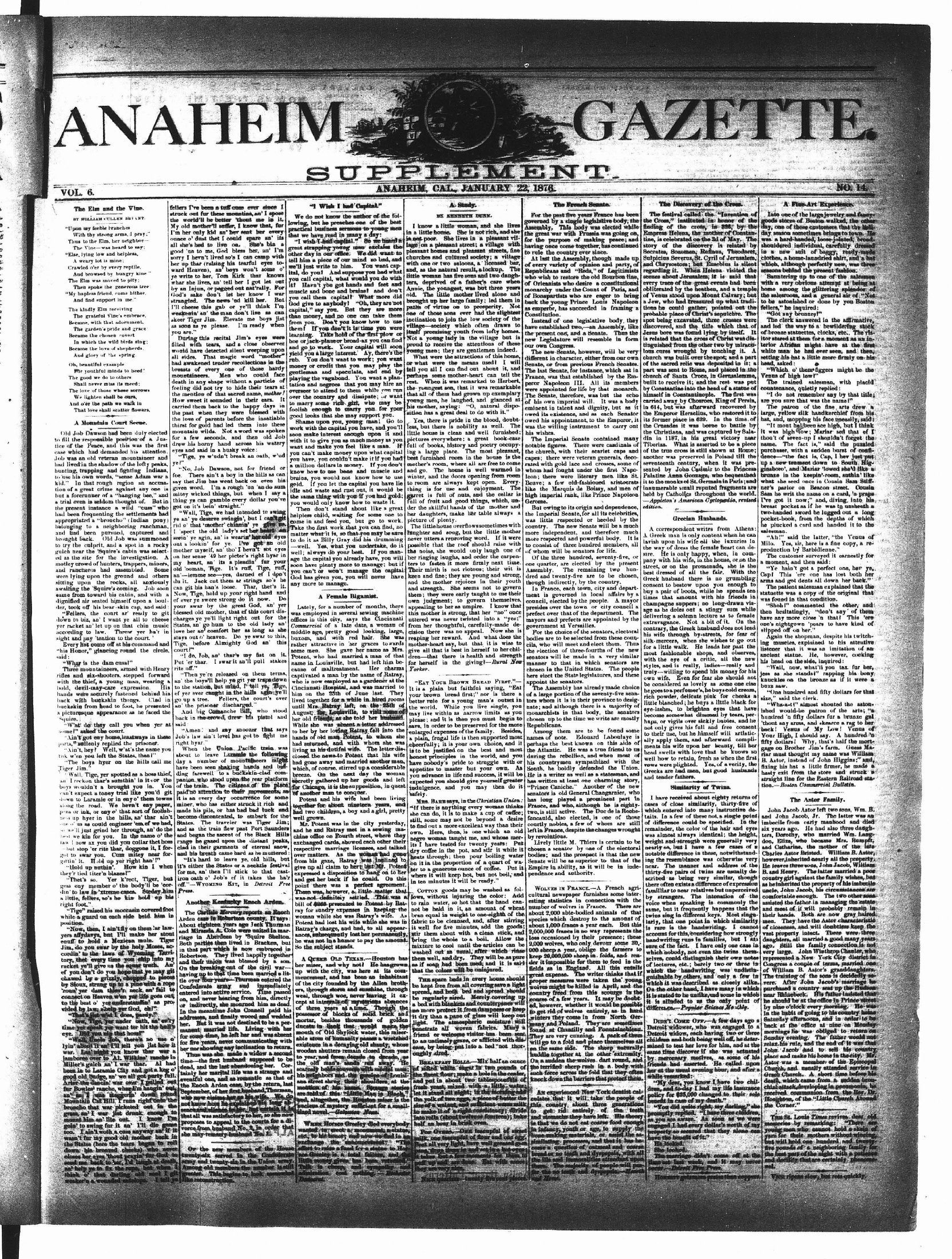
Searchable text
ANAHEIM
VOL. 6.
The Elm and the Vine.
BY WILLIAM CULLEN BRYANT.
"Upon my feeble branches
With thy strong arms, I pray;
Thus to the Elm, her neighbor—
The Vine—was heard to say:
"Else, lying low and helpless,
A weary lot is mine;
Crawled o'er by every reptile,
And browsed by hungry kine."
The Elm was moved to pity;
Then spoke the generous tree:
"My hapless friend, come hither,
And find support in me."
The kindly Elm receiving
The grateful Vine's embrace,
Became with that adornment,
The garden's pride and grace:
Became the chosen covert
In which the wild birds sing;
Became the love of shepherds,
And glory of the spring.
Oh, beautiful example
For youthful minds to beef!
The good we do to others
Shall never miss its meed;
The love of those whose sorrows
We lighten shall be ours,
And o'er the path we walk in
That love shall scatter flowers.
A Mountain Court Scene.
Old Job Dawson had been duly elected to fill the responsible position of a Justice of the Peace, and this was the first case which had demanded his attention. Job was an old veteran mountaineer and had lived in the shadow of the lofty peaks,
fellers I've been a tuff one ever since I struck out fur these mountains, an' I spose the world'll be better 'thou me in it.
My old mother'll suffer, I know that, fur I'm her only kid an' her sent her every ounce o' dust that I could spare an' its all she's had to live on. She's bin a good 'un to me, God bless her, an' I'm sorry I haven't lived so's I can camp with her up thar (raising his tearful eyes toward Heaven), an' boys won't some o' ye write to her, Tom Kirk thar knows what she lives, an' tell her I got let out by an Injun, or pegged out natrally. For God's sake don't let her know I war strangled. The news 'od kill her. But I'll cheese this gab or ye'll think I'm weakenin' an' the man don't live as can skerer Tiger Jim. Elevate me boys jist as soon as ye please. I'm ready when you are."
During this recital Jim's eyes were filled with tears, and a close observer would have detected silent weeping upon all sides. That magic word "mother" had awakened tender recollections in the breasts of every one of those hardy mountaineraers. Men who could face death in any shape without a particle of feeling did not try to hide their tears at the mention of that sacred name, mother! How sweet it sounded in their ears. It carried them back to the happy days in the past when they were blessed with the love of parents before the insatiable thirst for gold had led them into these mountain wilds. Not a word was spoken for a few seconds, and then old Job drew his horny hand across his watery eyes and said in a husky voice:
"Tige, ye w'indn't break an oath, w'ind ye!"
No Job Dawson, not for friend or
"I Wish I had"
We do not know the slowing, but he preaches practical business service that we have read in man.
"I wish I had capital." great strapping young man other day in our office; tell him a piece of our m we'll just write to him; ital, do you? And supplie you call capital, what w it! Havn't you got ham muscle and bone and br you call them capital! God give to anybody! capital," say you. But than money, and no one from you. Don't you kn them! If you don't it learning. Take hold of hoe or jack-plains or broa and go to work. Your yield you a large interest rub. You don't want to money or credit that you gentleman and specula playing the vagabond. tation and negroes that overeret to attend to the over the country and d to marry some rich girl foolish enough to mar good looks that she may Shame upon you, you work with the capital you soon make interest eno with it to give you as m want and make you feel you can't make money w you have, you couldn't r a million dollars in mo
Old Job Dawson had been duly elected to fill the responsible position of a Justice of the Peace, and this was the first case which had demanded his attention. Job was an old veteran mountaineer and had lived in the shadow of the lofty peaks, hunting, trapping and fighting Indians, to use his own words, "sense Adam war a kid." In that rough region an accusation of a great crime against any one is but a forerunner of a "hanging bee," and a trial even is seldom thought of. But in the present instance a wild "cuss" who had been frequenting the settlements had appropriated a "broncho" (Indian pony) belonging to a neighboring ranchman, and had been pursued, captured and brought back. Old Job was summoned to try the culprit, and a spot in a rocky gulch near the Squire's cabin was selected as the site for the investigation. A motley crowd of hunters, trappers, miners, and rancheros had assembled. Some were lying upon the ground and others sitting upon the rocks, all anxiously awaiting the Squire's coming. Job soon came from toward his cabin, and with a dignified air seated himself upon a boulder, took off his bear-skin cap, and said:
"Fellers, the court ar' ready to git down to biz, an' I want ye all to cheese yer racket an' let up on that chin music according to law. Throw yer hair in sight and pay 'tention to the court."
Every hat come off at his command and "his Honor," glancing round the circle, said:
"What is the dam cuss?"
Three mountaineers, armed with Henry rifles and six-shooters, stepped forward with the thief, a young man, wearing a hold, devil-may-care expression. His hands were securely fastened behind his back with buckskin thongs. Clad in buckskin from head to foot, he presented a picturesque appearance as he faced the Squire.
"We at do they call you when yer at home!" asked the court.
"Ain't got eny home leastways in these parts," sailed replied the prisoner.
"Ain't hey! Well, wat's the name you tak wen you left the States, then!"
"The boys hyer on the hills call me Tiger Jim."
"Wall, Tige, yer spotted as a hoss thief, an' I reckon that's sumthin' in it or the boys wouldn't a brought you in. You can't expect a toney trial like you'd git down to Laramie or in enyo' them towns along the road. We haven't eny paper, pens or ink, or eny o' that sort of foolishness up hyer in the hills, an' thar ain't one of us as could engineer'em of we had, we'll just grind her through, an' do the best we kin for you. In the name of the law now ax you did collar that hoes but stop 'er rite thar, doggone it, I forgot to swear you. Cum miteye near forgittin' it. Hold up yer right han'l!"
"Hold up nuthin'. How kin I when they're tied titer'n blazal!"
"Thet's so. Yer k'rect, Tiger, but gesy eny member o' the body'll be 'cor-
Men who could face death in any shape without a particle of feeling did not try to hide their tears at the mention of that sacred name, mother! How sweet it sounded in their ears. It carried them back to the happy days in the past when they were blessed with the love of parents before the insatiable thirst for gold had led them into these mountain wilds. Not a word was spoken for a few seconds, and then old Job drew his horny hand across his watery eyes and said in a husky voice:
"Tige, ye wndn't break an oath, wud ye!"
No, Job Dawson, not for friend or foe. There ain't a boy in the hills as can say that Jim has went back on even his given word. I'm a rough 'n'an do sum mitey wicked things, but when I say a thing ye can gamble every dollar you've got on it's bein' straight."
"Wall, Tige, we had intended to swing ye an' ye deserve swingin', but I can't get rid o' that 'mother' chinnin' ye give me. I spect the old lady's set her heart and seein' ye again, an' is wearin' her old eyes out a lookin'in' for ye. I've got an old mother myself, an' tho' he haven't not eyes on her sense '49 her picter's right hyar in my heart, an' its a pleadin' fur your old 'ooman, Tige. It's ruff, Tige, ruff an—lemme see—yes, darned ef I don't du it. Jack cut them ar strings so's he can git his han's loose. Thar, that's it. Now, Tige, hold up your right hand and of ever ye swore strong do it now. Do your swar by the great God, an' yer blessed old mother, that if this court discharges ye you'll light right out for the States, an go hum to the old lady an' love her an' comfort her as long as she stays out o' heaven. Do ye swar to this, Tige, before Almighty God an' this court!"
"I do, Job, an' thar's my fist on it. Put 'er thar. I swar it an'll pull stakes rite off."
Then ye're released on them terms, an' the boys'll help ye git yer traps down to the station, but mind, I tell ye, Tige, if yer ever caught in the hills again ye'll go up a tree. Fellers, the court's over an' the prisoner discharged."
And big Comanche Bill, who stood back in the crowd, drew his pistol and said:
"Amen: and any snoozer that says Job's law ain't level has got to fight me right hyar."
When the Union Pacific train was about to leave Laramie the following day a number of mountaineers might have been seen shaking hands and budding farewell to a buckskin-clad companion who stood upon the rear platform of the train. The citizens of the place paid no attention to their movements; as it is an every day occurrence for some miner, who has either struck it rich and made his pile, or has had bad luck and become discontented, to embark for the States. The traveler was Tiger Jim; and as the train flew past Port Saunders and began the ascent of the Black Hills range he grazed upon the distant peaks, clad in their garments of eternal snow, and his breath came hard as he muttered:
"It's hard to leave ye, old hills, but it's either the States or a neckle festival for me, an' then I'll stick to that castiron oath o' Job's ef it takes the ha'ar off." —WYOMING KIT, in Detroit Free
Lately, for a number was employed in several offices in this city, says Commercial of a late middle age, pretty good buxom, and with recorder attractive in 'aes some men. She gave Potent, who had marrié name in Louisville, but cause of maltreatment captivated a man by that who is now employed at Cincinnati Hospital; an him on the 25th of June lived together for a while until Mrs. Ratray left; August; for Louisville her old friend; as she fled While she was absent to her by her loving R hands of old man Potent had returned; and living as his dutiful wife closed the news-to Potent had gone away and ma-which of course, stirred breeze. On the next secretly gathered up her for Chicago; it is the up of another man to con-Potens and his wife together for about half had two children; a boy well grown.
Mr. Potent was in tha and he and Ratray met chine office on Fourth respective marriage life over matters. As tha from his gaze, Ratray give up all claim to be expressed a disposition and get her back if he point there was a
can't expect a toney trial like you'd git down to Laramie or in enyo' them towns along the road. We haven't eny paper, pens or ink, or enyo' that sort of foolishness up hyer in the hills, an' thar ain't one us as could engineer 'em if we had, we'll just grind her through, an' do the best we kin for you. In the name o' the law I now ax you did you collar the hoose but stop 'er rite thar, doggone it, I forgot to swar you. Cum mitsey for forgittin' it. Hold up yer right han!"
"Hold up nuthin'. How kin I when they' tied titer'n blazes!"
"The's so. Yer k'rect, Tiger, but gess eny member o' the body'll be cordin' to law in 'xtreme cases. Stoddy him a little, fellers, so's he kin hold up his right foot."
"Tige' raised his moccasin covered foot while a guard on each side held him in position.
"Now, then, I ain't fly on them'ar lawyers alfydavya, but I'll make her stout enuff to hold a Mexican mute. Tiger Jim, do you swar by the holy Moses, accordin' to the laws of Wyoming Territory, that every time you ship into my racket ye'll give us the squar truth. An' ef you don't do you hope that ye may gilt chained by a grizzly, chopped to pancs by Sioux, strung up to a pine with a rope 'ron' yer dam threen'n neck, an' fail to connect on Heaven when yur life goes out to the best o' yer understandin' as provided by law, ahalp yur God, eh!"
"The's hot what I done, parry."
"Now, Tige, yet under oath, an' every time yur speak yur want ter hit the bull's eye. Did you pin that host!"
"Will Knoke John, there's no use o' lyin' about it am'I'll jist you jiat how it war. Lens night you know that war a jambore over to Al. Wilkina' manche in Miller's gulch an'I war thar. Al had been in to Laramie Clay and got a key o' good old budge, an' we all got party full. After the dancin' war over I pulled out far Bowles' ranche, when I'm hangin' out, an' I was 'dagger'in' down round Mountain Cal Hill. I runs right onto the bruncho that war picketed out in the green, an'I war just drunk enough to mount him an'l lite out. I knew I'm gone' to swing fur it an'I I'll die game too. I ain't woth a cus anyway an'I it wasn't for my good old mother back in the States (here the tears began to roll down his bronze clams) who never close her eyes 'hout prayin' for God to send me tack to her. I'd laugh at death, an' help yo to fix the rope, but when I think o' that darling old soul I git worker's a wounded salsopea. I till ye paid no attention to their movements; an it is an everyday occurrence for some miner, who has either struck it rich and made his pile, or has had bad luck and become discontented, to embark for the States. The traveler was Tiger Jim; and as the train flew past Port Saunders and began the ascent of the Black Hills range he gazed upon the distant peaks, clad in their garments of eternal snow, and his breath came hard as he muttered:
"It's hard to leave ye, old hills, but it's either the States or a necktie festival for me, an' then I'll stick to that castiron otho' Job's ef it takes the hair off." — Wyoming Kit, in Detroit Free Press.
Another Kenimpy Enoch Arden.
The Carlile Mercury reports an Enoch Arden case in Holbertown county. It says: About eighteen years ago Jack Thurman and Miranda A. Cole were united in marriage in Aberdeen by Squire Shalton. Both parties then lived in Bracken, but in that part which is now embraced in Robertson. They lived happily together and their union was blessed by a son. On the breaking out of the civil war—having up to that time been married a little over four years—Thurman entered the Confederate army and immediately entered into active service. Time passed on, and never hearing from him, directly or indirectly, she mourned him as dead. In the meantime John Connell paid his address, and finally wooed and wedded her. But it was not destined to be a permanent married life. Living with her for some time, he left her and was absent for five years, never communicating with her nor showing any inclination to return.
Thus was she made a widow a second time—the first husband supposed to be dead, and the last shandoning her. Certainly her marital life was a strange and eventful one, and as romantic as that of the Enoch Arden case, by the return, last September, of her first husband Thurman, who now shannon his wife. We do not know him his imprisoned long absence and alliance before he met this all was satisfactory to her, so she now proposes to appeal to the courts for a divorce from husband No. 2, in order that she may remarry husband No. 1.
Or the new members of the House twentyself served in the Confederate army and twenty-six in the Union army. Among old members the number is still greater. This begins to look somewhat like reconstruction.
"I Wish I had Capital."
We do not know the author of the following, but he preaches one of the best practical business sermons to young men that we have read in many a day:
"I wish I had capital." So we heard a great strapping young man explain the other day in our office. We did want to tell him a piece of our mind so loud, and we'll just write to him. You want capital, do you! And suppose you had what you call capital, what would you do with it? Haven't you got hands and feet and muscle and bone and brains? and don't you call them capital? What more did God give to anybody? "Oh, they are not capital," say you. But they are more than money, and no one can take them from you. Don't you know how to use them! If you don't it is time you were learning. Take hold of the first plow or hoe or jack-plane or broad-ax you can find and go to work. Your capital will soon yield you a large interest. Ay, there's the rub. You don't want to work; you want money or credit that you may play the gentleman and speculate, and end by playing the vagabond. You want a plantation and negroes that you may hire an overseer to attend to them while you run over the country and dissipate; or want to marry some rich girl, who may be foolish enough to marry you for your good looks that she may support you.
Shame upon you, young man! Go to work with the capital you have, and you'll soon make interest enough upon it and with it to give you as much money as you want and make you feel like a man. If you can't make money upon what capital you have, you couldn't make it if you had a million dollars in money. If you don't
A Study.
BY KENNETH DURK.
I know a little woman, and she lives in a little house. She is not rich, and she is not poor. She lives in a pleasant village on a pleasant street; a village with pleasant homes and pleasant streets, fine churches and cultured society; a village with one or two saloons, a licensed bar, and, as the natural result, a lockup. The little woman has five sons and two daughters, deprived of a father's care when Annie, the youngest, was but three years old. The little mother lived alone and brought up her large family; led them in paths of virtue on to prosperity. Not one of those sons ever had the slightest inclination to join the low society of the village—society which often draws to itself promising youth from lofty homes. Not a young lady in the village but is proud to receive the attentions of these young men; they are gentlemen indeed.
What were the attractions of this home, or what were the means used? I will tell you all I can find out about it, and perhaps some mother-heart can tell the rest. When it was remarked to Herbert, the youngest son, that it was remarkable that all of them had grown up exemplary young men, he laughed, and glanced at his mother, saying: "O, natural disposition has a great deal to do with it."
Yes, there is pride in the blood, doubtless, but there is nobility as well. The little house is clean and well furnished; pictures everywhere; a great book-case full of books, history and poetry occupying a large place. The most pleasant, best furnished room in the house is the mother's room, where all are free to come and go.
The French Senate.
For the past five years France has been governed by a single legislative body, the Assembly. This body was elected while the great war with Prussia was going on, for the purpose of making peace; and having once come together, has continued to rule the country ever since.
At last the Assembly, though made up of every variety of opinion and party, of Republicans and "Reds," of Legitimists who wish to restore the old Bourbon line, of Orleanists who desire a constitutional monarchy under the Count of Paris, and of Bonapartists who are eager to bring back the young Prince Louis Napoleon as emperor, has succeeded in framing a Constitution.
Instead of one legislative body, they have established two—an Assembly, like the present one, and a Senate. Thus the new Legislature will resemble in form our own Congress.
The new Senate, however, will be very different in character, either from our own Senate, or from previous French Senates. The last Senate, for instance, which sat in France, was that established by the Emperor Napoleon III. All its members were appointed for life by that monarch. The Senate, therefore, was but the echo of his own imperial will. It was a body eminent in talent and dignity, but as it owed its existence, and as each Senator owed his appointment, to the Emperor, it was the willing instrument to carry out his wishes.
The Imperial Senate contained many notable figures. There were cardinals of the church, with their scarlet caps and capes; there were veteran generals, decorated with gold lace and crosses; some of whom had fought under the first Napa.
The feast of Cronus,
finding of Empress Bertine,
story of Socrates,
Sulpicina Sulpicina,
and Chrysophae regarding scenes about every trace obliterated of Venus among a Jew, whose tions he probable put spot being discovered.
Jesus bore is related to tinguished lous cures of church wagon of the sacred part was seized by Constantine himself in 614, but the Emperor owed his appointment to the Emperor, it was the willing instrument to carry out his wishes.
The Imperial Senate contained many notable figures. There were cardinals of the church, with their scarlet caps and capes; there were veteran generals, decorated with gold lace and crosses; some of whom had fought under the first Napa.
The feast of Cronus,
finding of Empress Bertine,
story of Socrates,
Sulpicina Sulpicina,
and Chrysophae regarding scenes about every trace obliterated of Venus among a Jew, whose tions he probable put spot being discovered.
Jesus bore is related to tinguished lous cures of church wagon of the sacred part was seized by Constantine himself in 614, but the Emperor owed his appointment to the Emperor, it was the willing instrument to carry out his wishes.
The Imperial Senate contained many notable figures. There were cardinals of the church, with their scarlet caps and capes; there were veteran generals, decorated with gold lace and crosses; some of whom had fought under the first Napa.
The feast of Cronus,
finding of Empress Bertine,
story of Socrates,
Sulpicina Sulpicina,
and Chrysophae regarding scenes about every trace obliterated of Venus among a Jew, whose tions he probable put spot being discovered.
Jesus bore is related to tinguished lous cures of church wagon of the sacred part was seized by Constantine himself in 614, but the Emperor owed his appointment to the Emperor, it was the willing instrument to carry out his wishes.
The Imperial Senate contained many notable figures. There were cardinals of the church, with their scarlet caps and capes; there were veteran generals, decorated with gold lace and crosses; some of whom had fought under the first Napa.
The feast of Cronus,
finding of Empress Bertine,
story of Socrates,
Sulpicina Sulpicina,
and Chrysophae regarding scenes about every trace obliterated of Venus among a Jew, whose tions he probable put spot being discovered.
Jesus bore is related to tinguished lous cures of church wagon of the sacred part was seized by Constantine himself in 614, but the Emperor owed his appointment to the Emperor, it was the willing instrument to carry out his wishes.
The Imperial Senate contained many notable figures. There were cardinals of the church, with their scarlet caps and capes; there were veteran generals, decorated with gold lace and crosses; some of whom had fought under the first Napa.
The feast of Cronus,
finding of Empress Bertine,
story of Socrates,
Sulpicina Sulpicina,
and Chrysophae regarding scenes about every trace obliterated of Venus among a Jew, whose tions he probable put spot being discovered.
Jesus bore is related to tinguished lous cures of church wagon of the sacred part was seized by Constantine himself in 614, but the Emperor owed his appointment to the Emperor, it was the willing instrument to carry out his wishes.
The Imperial Senate contained many notable figures. There were cardinals of the church, with their scarlet caps and capes; there were veteran generals, decorated with gold lace and crosses; some of whom had fought under the first Napa.
The feast of Cronus,
finding of Empress Bertine,
story of Socrates,
Sulpicina Sulpicina,
and Chrysophae regarding scenes about every trace obliterated of Venus among a Jew, whose tions he probable put spot being discovered.
Jesus bore is related to tinguished lous cures of church wagon of the sacred part was seized by Constantine himself in 614, but the Emperor owed his appointment to the Emperor, it was the willing instrument to carry out his wishes.
The Imperial Senate contained many notable figures. There were cardinals of the church, with their scarlet caps and capes; there were veteran generals, decorated with gold lace and crosses; some of whom had fought under the first Napa.
The feast of Cronus,
finding of Empress Bertine,
story of Socrates,
Sulpicina Sulpicina,
and Chrysophae regarding scenes about every trace obliterated of Venus among a Jew, whose tions he probable put spot being discovered.
Jesus bore is related to tinguished lous cures of church wagon of the sacred part was seized by Constantine himself in 614, but the Emperor owed his appointment to the Emperor, it was the willing instrument to carry out his wishes.
The Imperial Senate contained many notable figures. There were cardinals of the church, with their scarlet caps and capes; there were veteran generals, decorated with gold lace and crosses; some of whom had fought under the first Napa.
The feast of Cronus,
finding of Empress Bertine,
story of Socrates,
Sulpicina Sulpicina,
and Chrysophae regarding scenes about every trace obliterated of Venus among a Jew, whose tions he probable put spot being discovered.
Jesus bore is related to tinguished lous cures of church wagon of the sacred part was seized by Constantine himself in 614, but the Emperor owed his appointment to the Emperor, it was the willing instrument to carry out his wishes.
The Imperial Senate contained many notable figures. There were cardinals of the church, with their scarlet caps and capes; there were veteran generals, decorated with gold lace and crosses; some of whom had fought under the first Napa.
The feast of Cronus,
finding of Empress Bertine,
story of Socrates,
Sulpicina Sulpicina,
and Chrysophae regarding scenes about every trace obliterated of Venus among a Jew, whose tions he probable put spot being discovered.
Jesus bore is related to tinguished lous cures of church wagon of the sacred part was seized by Constantine himself in 614, but the Emperor owed his appointment to the Emperor, it was the willing instrument to carry out his wishes.
The Imperial Senate contained many notable figures. There were cardinals of the church, with their scarlet caps and capes; there were veteran generals, decorated with gold lace and crosses; some of whom had fought under the first Napa.
The feast of Cronus,
finding of Empress Bertine,
story of Socrates,
Sulpicina Sulpicina,
and Chrysophae regarding scenes about every trace obliterated of Venus among a Jew, whose tions he probable put spot being discovered.
Jesus bore is related to tinguished lous cures of church wagon of the sacred part was seized by Constantine himself in 614, but the Emperor owed his appointment to the Emperor, it was the willing instrument to carry out his wishes.
The Imperial Senate contained many notable figures. There were cardinals of the church, with their scarlet caps and capes; there were veteran generals, decorated with gold lace and crosses; some of whom had fought under the first Napa.
The feast of Cronus,
finding of Empress Bertine,
story of Socrates,
Sulpicina Sulpicina,
and Chrysophae regarding scenes about every trace obliterated of Venus among a Jew, whose tions he probable put spot being discovered.
Jesus bore is related to tinguished lous cures of church wagon of the sacred part was seized by Constantine himself in 614, but the Emperor owed his appointment to the Emperor, it was the willing instrument to carry out his wishes.
The Imperial Senate contained many notable figures. There were cardinals of the church, with their scarlet caps and capes; there were veteran generals,decorated with gold lace and crosses;someof whom had fought underthefirstNapola.
The feast of Cronus,
findingofEmpressBertine,
storyofSocrates,
SulpicinaSulpicina,
andChrysophae regardingscenesabouteverytraceobliteratedofVenusamongaJewwhosetionsheprobableputspotbeingdiscovered.JesusboreisrelatedtotinguishedlouscuresoftheCronusbandtheChristi din118Tiberias.foundofEmpressBertine,takingoffofEmpressBertine,basedonwhetherwereseventeenattendedbytheEmperorsitsformeroftheCrusi din118Tiberias.foundofEmpressBertine,basedonwhetherwereseventeenattendedbytheEmperorsits formeroftheCrusi din118Tiberias.foundofEmpressBertine,basedonwhetherwereseventeenattendedbytheEmperorsits formeroftheCrusi din118Tiberias.foundofEmpressBertine,basedonwhetherwereseventeenattendedbytheEmperorsits formeroftheCrusi din118Tiberias.foundofEmpressBertine,basedonwhetherwereseventeenattendedbytheEmperorsits formeroftheCrusi din118Tiberias.foundofEmpressBertine,basedonwhetherwereseventeenattendedbytheEmperorsits formeroftheCrusi din118Tiberias.foundofEmpressBertine,basedonwhetherwereseventeenattendedbytheEmperorsits formeroftheCrusi din118Tiberias.foundofEmpressBertine,basedonwhetherwereseventeenattendedbytheEmperorsits formeroftheCrusi din118Tiberias.foundofEmpressBertine,basedonwhetherwereseventeenattendedbytheEmperorsits formeroftheCrusi din118Tiberias.foundofEmpressBertine,basedonwhetherwereseventeenattendedbytheEmperorsits formeroftheCrusi din118Tiberias.foundofEmpressBertine,basedonwhetherwereseventeenattendedbytheEmperorsits formeroftheCrusi din118Tiberias.foundofEmpressBertine,basedonwhetherwereseventeenattendedbytheEmperorsits formeroftheCrusi din118Tiberias.foundofEmpressBertine,basedonwhetherwereseventeenattendedbytheEmperorsits formeroftheCrusi din118Tiberias.foundofEmpressBertine,basedonwhetherwereseventeenattendedbytheEmperorsits formeroftheCrusi din118Tiberias.foundofEmpressBertine,basedonwhetherwereseventeenattendedbytheEmperorsits formeroftheCrusi din118Tiberias.foundofEmpressBertine,basedonwhetherwereseventeenattendedbytheEmperorsits formeroftheCrusi din118Tiberias.foundofEmpressBertine,basedonwhetherwereseventeenattendedbytheEmperorsits formeroftheCrusi din118Tiberias.foundofEmpressBertine,basedonwhetherwereseventeenattendedbytheEmperorsits formeroftheCrusi din118Tiberias.foundofEmpressBertine,basedonwhetherwereseventeenattendedbytheEmperorsits formeroftheCrusi din118Tiberias.foundofEmpressBertine,basedonwhetherwereseventeenattendedbytheEmperorsits formeroftheCrusi din118Tiberias.foundofEmpressBertine,basedonwhetherwereseventeenattendedbytheEmperorsits formeroftheCrusi din118Tiberias.foundofEmpressBERTINE,BASEDONWHEREWERESEVENTEENATTENDEDBYTHEEMPEROR,SURESTATEOFEMEROR,SURESTATEOFEMEROR,SURESTATEOFEMEROR,SURESTATEOFEMEROR,SURESTATEOFEMEROR,SURESTATEOFEMEROR,SURESTATEOFEMEROR,SURESTATEOFEMEROR,SURESTATEOFEMEROR,SURESTATEOFEMEROR,SURESTATEOFEMEROR,SURESTATEOFEMEROR,SURESTATEOFEMEROR,SURESTATEOFEMEROR,SURESTATEOFEMEROR,SURESTATEOFEMEROR,SURESTATEOFEMEROR,SURESTATEOFEMEROR,SURESTATEOFEMEROR,SURESTATEOFEMEROR,SURESTATEOFEMEROR,SURESTATEOFEMEROR,SURESTATEOFEMEROR,SURESTATEOFEMEROR,SURESTATEOFEMEROR,SURESTATEOFEMEROR,SURESTATEOFEMEROR,SURESTATEOFEMEROR,SURESTATEOFEMEROR,SURESTATEOFEMEROR,SURESTATEOFEMEROR,SURESTATEOFEMEROR,SURESTATEOFEMEROR,SURESTATEOFEMEROR,SURESTATEOFEMEROR,SURESTATEOFEMEROR,SURESTATEOFEMEROR,SURESTATE OF EMEROR,SURESTATE OF EMEROR,SURESTATE OF EMEROR,SURESTATE OF EMEROR,SURESTATE OF EMEROR,SURESTATE OF EMEROR,SURESTATE OF EMEROR,SURESTATE OF EMEROR,SURESTATE OF EMEROR,SURESTATE OF EMEROR,SURESTATE OF EMEROR,SURESTATE OF EMEROR,SURESTATE OF EMEROR,SURESTATE OF EMEROR,SURESTATE OF EMEROR,SURESTATE OF EMEROR,SURESTATE OF EMEROR,SURESTATE OF EMEROR,SURESTATE OF EMEROR,SURE STATES OF EMEROR,SURE STATES OF EMEROR,SURE STATES OF EMEROR,SURE STATES OF EMEROR,SURE STATES OF EMEROR,SURE STATES OF EMEROR,SURE STATES OF EMEROR,SURE STATES OF EMEROR,SURE STATES OF EMEROR,SURE STATES OF EMEROR,SURE STATES OF EMEROR,SURE STATES OF EMEROR,SURE STATES OF EMEROR,SURE STATES OF EMEROR,SURE STATES OF EMEROR.SUPREME STATES OF EMEROR.SUPREME STATES OF EMEROR.SUPREME STATES OF EMEROR.SUPREME STATES OF EMEROR.SUPREME STATES OF EMEROR.SUPREME STATES OF EMEROR.SUPREME STATES OF EMEROR.SUPREME STATES OF EMEROR.SUPREME STATES OF EMEROR.SUPREME STATES OF EMERORSUPREME STATES OF EMERORSUPREME STATES OF EMERSUPREME STATES OF EMERSUPREME STATES OF EMERSUPREME STATES OF EMERSUPREME STATES OF EMERSUPREME STATES OF EMERSUPREME STATES OF EMERSUPREME STATES Of EMERSUPREME STATES Of EMERSUPREME STATES Of EMERSUPREME StatEsOfEMERSUpreMeStatEsOfEMERSUpreMeStatEsOfEMERSUpreMeStatEsOfEMERSUpreMeStatEsOfEMERSUpreMeStatEsOfEMERSUpreMeStatEsOfEMERSUpreMeStatEsOfEMERSUpreMeStatEsOfEMERSUpreMeStatEsOfEMERSUpreMeStatEsOfEMERSUpreMeStatEsOfEMERSUpreMeStatEsOfEMERSUpreMeStatEsOfEMERSUpreMeStatEsOfEMERSUpreMeStatEsOfEMERSUpreMeStatEsOfEMERSUpreMeStatEsOfEMERSUpreMeStatEsOfEMERSUpreMeStatEsOfEMERSUpreMeStatEsOfEMERSUpreMeStatEsOfEMERSUpreMeStatEsOfEMERSUpreMeStatEsOfEMERSUpreMeStatEsOfMEMERSUpreMeStatEsOfMEMERSUpreMeStatEsOfMEMERSUpreMeStatEsOfMEMERSUpreMeStatEsOfMEMERSUpreMeStatEsOfMEMERSUpreMeStatEsOfMEMERSUpreMeStatEsOfMEMERSUpreMeStatEsOfMEMERSUpreMeStatEsOfMEMERSUpreMeStatEsOfMEMERSUpreMeStatEsOfMEMERSUpreMeStatEsOfMEMERSUpreMeStatEsOfMEMERSUpreMeStatEsOfMEMERSUpreMeStatEsOfMEMERSUpreMeStatEsOfMEMERSUpreMeStatEsOfMEMERSUpreMeStatEsOfMEMERSUpreMeStatEsOfMEMHERSUpreMEStatEsOfMEMHERSUpreMEStatEsOfMEMHERSUpreMEStatEsOfMEMHERSUpreMEStatEsOfMEMHERSUpreMEStatEsOfMEMHERSUpreMEStatEsOfMEMHERSUpreMEStatEsOfMEMHERSUpreMEStatEsOfMEMHERSUpreMEStatEsOfMEMHERSUpreMEStatEsOfMEMHERSUpreMEStatEsOfMEMHERSUpreMEStatEsOfMEMHERSUpreMEStatEsOfMEMHERS UpreME StatEs OfMEMHERS UpreME StатЕс OfMEMHERS Upреме StатЕс OfMEMHERS Upреме StатЕс OfMEMHERS Upреме StатЕс OfMEMHERS Upреме StатЕс OfMEMHERS Upреме StатЕс OfMEMHERS Upреме StатЕс OfMEMHERS Upреме StатЕс OfMEMHERS Upреме StатЕс OfMEMHERS Upреме StатЕс OfМЕНЕРС Upреме StатЕс OfМЕНЕРС Upреме StатЕс OfМЕНЕРС Upреме StатЕс OfМЕНЕРС Upреме StатЕс OfМЕНЕРС Upреме StатЕс OfМЕНЕРС Upреме StатЕс OfМЕНЕРС Upреме StатЕс OfМЕНЕРС Upресме StатЕс OfМЕНЕРС Upресме StатЕс OfМЕНЕРС Upресме StатЕс OfМЕНЕРС Upресме StатЕс OfМЕНЕРС Upресме StатЕс OfМЕНЕРС Upресме StатЕс OfМЕНЕРС Upресме СтатЕс OfМЕНЕРС Upресме СтатЕс OfМЕНЕРС Upресме СтатЕс OfМЕНЕРС Upресме СтатЕс OfМЕНЕРС Upресме СтатЕс OfМЕНЕРС Upресме СтатЕс OfМЕНЕРС Upресме СтатЕс OfМЕНЕРС Upресме СтатЕс ОПРЕМЯТЬ ВОЛЮЧИТЕЛЬНОЙ СУРКА И МОЩИТЕЛЬНОЙ СУРКА И МОЩИТЕЛЬНОЙ СУРКА И МОЩИТЕЛЬНОЙ СУРКА И МОЩИТЕЛЬНОЙ СУРКА И МОЩИТЕЛЬНОЙ СУРКА И МОЩИТЕЛЬНОЙ СУРКА И МОЩИТЕЛЬНОЙ СУРКА И МОЩИТЕЛЬНОЙ СУРКА И МОЩИТЕЛЬНОЙ СУРКА И МОЩИТЕЛЬНОЙ СУРКА И МОЩИТЕЛЬНОЙ СУРКА И МОЩИТЕЛЬНОЙ СУРКА И МОШИТЕЛЬНОЙ СУРКА И МОШИТЕЛЬНОЙ СУРКА И МОШИТЕЛЬНОЙ СУРКА И МОШИТЕЛЬНОЙ СУРКА И МОШИТЕЛЬНОЙ СУРКА И МОШИТЕЛЬНОЙ СУРКА И МОШИТЕЛЬНОЙ СУРКА И МОШИТЕЛЬНОЙ СУРКА И МОШИТЕЛЬНОЙ СУРКА И МОШИТЕЛЬНОЙ СУРКА И МОШИТЕЛЬНОЙ СУРКА И МОШИТЕЛЬНОЙ СУРКА И МОШИТЕЛЬНОЙ СУРКА И МОШИТЕЛЬНОЙ СУРКА И МОШИТЕЛЬНОЙ СУРКА И МОШИТЕЛЬНОЙ СУРКА І МОШИ
gentleman and speculate, and end by playing the vagabond. You want a plantation and negroes that you may hire an overseer to attend to them while you run over the country and dissipate; or want to marry some rich girl, who may be foolish enough to marry you for your good looks that she may support you.
Shame upon you, young man! Go to work with the capital you have, and you'll soon make interest enough upon it and with it to give you as much money as you want and make you feel like a man. If you can't make money upon what capital you have, you couldn't make it if you had a million dollars in money. If you don't know how to use bene and muscle and brains, you would not know how to use gold. If you let the capital you have lie idle and waste and rust out, it would be the same thing with you if you had gold; you would only know how to waste it.
Then don't stand about like a great halpless child, waiting for some one to come in and feed you, but go to work. Take the first work that you can find, no matter what it is, so that you may be sure to do it as Billy Gray did his drumming—well. Yes, what you undertake, do it well; always do your best. If you manage the capital you already have, you will soon have plenty more to manage; but if you can't or won't manage the capital God has given you, you will never have any more to manage.
A Female Bigamist.
Lately, for a number of months, there was employed in several sewing machine offices in this city, says the Cincinnati Commercial of a late date, a woman of middle age, pretty good looking, large, buxom, and with red hair. She was rather attractive in her graces to wards some men. She gave her name as Mrs. Potent, who had married a man of that name in Louisville, but had left him because of maltreatment. Her charms captivated a man by the name of Ratray, who is now employed as a gardener at the Cincinnati Hospital, and was married to him on the 25th of June last. They lived together for a while in hired rooms until Mr. Ratray left, on the 25th of August, for Louisville, to visit some of her old friends, as she told her husband. While she was absent a letter addressed to her by her loving Ratray fell into the hands of old man Potent, to whom she had returned, and with whom she was living as his dutiful wife. The letter disclosed the news to Potent that his wife had gone away and married another man, which, of course, stirred up a considerable breeze. On the next day the woman secretly gathered up her goods and left for Chicago, it is the supposition, in quest of another man to conquer.
Potent and his wife had been living together for almost nineteen years, and had two children, a boy and a girl, pretty well grown.
Mr. Potent was in the city yesterday, and he and Ratray met in a sewing machine office on Fourth street, where they exchanged cards, showed each other their respective marriage licenses, and talked over matters. As the woman had gone from his gaze, Ratray was impatient to give up all claim to hers but Mr. Potent expressed a disposition to hang on to her and get her back if he could. On this point there was a perfect agreement.
Yes, there is pride in the blood, doubtless, but there is nobility as well. The little house is clean and well furnished; pictures everywhere; a great book-case full of books, history and poetry occupying a large place. The most pleasant, best furnished room in the house is the mother's room, where all are free to come and go. The house is well warmed in winter, and the doors opening from room to room are always kept open. Everything is for use and enjoyment. The garret is full of nuts, and the callar is full of fruit and good things, which, under the skillful hands of the mother and her daughters, make her table always a picture of plenty.
The littlehouse overflows sometimes with laughter and song, but the littlemother never utters a reproving word. If it were possible that the roof should raise with the noise, she would only laugh one of her ringing laughs, and order the carpenters to fasten it more firmly next time. Their mirth is not riotous; their wit is keen and fine; they are young and strong, and the mother rejoices in their youth and strength. She seems not to govern them; they were early taught to use their own judgment; to govern themselves, appealing to her as umpire. I know that this mother is strong, that her "no" once uttered was never twisted into a "yes"; from her thoughtful, carefully-made decision there was no appeal. Now she is reaping her reward. And what does the mother-heart say, but that it is wise to give all that is best in herself to her children—that there is health and strength for herself in the giving?—Rural New Yorker.
"EAT YOUR BROWN BREAD FIRST." — It is a plain but faithful saying, "Eat your brown bread first;" nor is there a better rule for a young man's outset in the world. While you live single, you may live within as narrow limits as you please; and it is then you must begin to save, in order to be preserved for the more enlarged expenses of the family. Besides, a plain frugal life is then supported most cheerfully; it is your own choice, and it is justified on the best and most honest principles in the world, and you have nobody's pride to struggle with or appetites to master but your own. As you advance in life and success, it will be expected you should give yourself greater indulgence, and you may then do it safely.
Mrs. Barre says in the Christian Union: "If there is anything every woman thinks she can do, it is to make a cup of coffee; still, some may not be beyond a desire to find out a more excellent way than their own. Here, then, is one which an old negro woman taught me, and whose merits I have tested for twenty years: Put dry coffee in the pot, and stir it while it heats through; then pour boiling water on it in the proportion of a quart of water to a generous ounce of coffee. Put it where it will keep hot, but not boil; and in ten minutes it will be ready."
The Imperial Senate contained many notable figures. There were cardinals of the church, with their scarlet caps and capes; there were veteran generals, decorated with gold lace and crosses, some of whom had fought under the first Napoleon; there were literary men like St. Beave; a few old-fashioned aristocrats like the Marquis de Bolssy, and men of high imperial rank, like Prince Napoleon Gerome.
But owing to its origin and dependence, the Imperial Senate, for all its celebrities, was little respected or heeded by the country. The new Senate will be a much more independent, and therefore much more respected and powerful body. It is to consist of three hundred members, all of whom will be senators for life.
Of the three hundred, seventy-five, or one quarter, are elected by the present Assembly. The remaining two hundred and twenty-five are to be chosen, though indirectly, by the country.
In France, each town, city and department is governed in local affairs by a council, elected by the people. A mayor presides over the town or city council a prefect over that of the department. The mayors and prefects are appointed by the government at Versailles.
For the choice of the senators, electoral bodies are to be selected from these councils, who will meet and elect them. Thus the election of three-fourths of the new senators will be made in a very similar manner to that in which senators are chosen in the United States. The people here elect the State legislatures,and these appoint the senators.
The Assembly has already made choice of a large portion of the seventy-five senators whom it is in their province to designate; and although there is a majority of monarchists in that body,the senators chosen up to the time we write are mostly Republicans.
Among them are to be found some names of note. Edouard Labonlaye perhaps the best known on this side of the Atlantic. He was a true friend to us during the rebellion,and when most of his countrymen sympathized with the South,here boldly defended the Union. He is a writer as well as a statesman,and has written at least one charming story,"Prince Caniche." Another of the new senators is old General Changarnierwho has long played a prominent part in France,and who although he is eight-twois still active.The Duc de la Rochefoucaultalso elected,是one of those courtly noble,a few of whom are still left in France,d despitethe changeswroughtby revolutions.
Lively little M. Thiers is certain to be chosen a senator by one of the electoral bodies;and the prospect is that the new Senate will be as superior to that of the Empire in ability.as it will be in independence and authority.
WOLVER IN FRANCE—A French agrig
Potent and his wife had been living together for about nineteen years, and had two children, a boy and a girl, pretty well grown.
Mr. Potent was in the city yesterday, and he and Ratray met in a sewing machine office on Fourth street, where they exchanged cards, showed each other their respective marriage licenses, and talked over matters. As the woman had gone from his gaze, Ratray was indulged to give up all claim to her but Mr. Potent expressed a disposition to hang on to her and get her back if he could. On this point there was a perfect agreement. There was, however, a little matter that was not definitely settled. This was a bill of 4205 presented to Potent by Ratray for sundry expenses in keeping the woman while she was Ratray's wife. As Potent had lost his wife while she was in Ratray's charge, and had, to all appearances, subsequently lost her permanently, he was not in a humor to pay the amount. So the subject stands.
A QUEEN OLD TEXAN—Houston has her miser, and why not? He has grown up with the city, was here at its commencement, and has been an inhabitant of the city founded by the Allen brothers, through storm and sunshine, through weal, through woe, never leaving it except at intervals of mysterious absences of three years at a time. Though the possessor of blocks of solid brick and mortar, besides thousands of golden decata in shell that would make the mouth of Old Shylock water, this miserable atom of humanity passes a twisted existence in a decaying old shanty, whose wooden shutters remain closed from year to year, and from decade to decade, as the old man's hands run away. He scarcely holds anew with mindless man; his neighbors and the guards of Louisiana street shrug their shoulders at the mention of his name. Strange stories are told of this "Little Man in Black," and altogether, the Houston miner is the nucleus of mystery sufficient for a small-lined novel—Galentine News.
When Horne Grosley died everybody wanted to erect a monument, statuary, to his honour; and now we find in an exchange the subimanche:
"The affair to which a final for a statue to Horne Grosley is a total failure, and the little money given him cannot sustain." This is cheap, and sympathetic and admirable and nothing—Bishop Dempsey.
MRS. BARN says, in the Christian Union: "If there is anything every woman thinks she can do, it is to make a cup of coffee; still, some may not be beyond a desire to find out a more excellent way than their own. Here, then, is one which an old negro woman taught me, and whose merits I have tested for twenty years: Put dry coffee in the pot, and stir it while it heats through; then pour boiling water on it in the proportion of a quart of water to a generous ounce of coffee. Put it where it will keep hot, but not boil; and in ten minutes it will be ready."
Cotton goods may be washed as follows without injuring the color: Add to rain water, so hot that the hand cannot be held in it, an amount of wheat bran equal in weight to one-eighth of the fabric to be cleansed, and after stirring it well for five minutes, add the goods; stir them about with a clean stick, and bring the whole to a boil. Allow the mixture to cool until the articles can be washed out as usual, after which rinse them well, and dry. They will be as pure as if soap had been used; and it is said that the colson will be uninjured.
The spare beds in every house should be kept free from all covering save a light spread, and both bed and spread should be regularly airied. Merely covering up a bed with blankets and counterpanes will no more protect it from dampness or keep it dry than a pane of glass will keep out light. The atmospheric moisture will penetrate all woven fabrics. Many a friend or welcome visitor has been sent to an untimely grate, or afflicted with disease, by being put into a bed "not thoroughly airied."
BREAKFAST ROLLS—Mix half an ounce of sifted white sugar in two pounds of the finest flour; make a hole in the center, and put in about two tablespoons of fresh yeast; mixed with a little water; let it stand all night; in the morning add the yolk of two eggs, a piece of butter the size of a walnut, and suffused warm milk to make it of a might consistency; divide into rolls (about two or fourteen); shake half an hour in brink oven.
Pine Ornaments—One leasurable of sweet milk, one leasurable of floral and egg-shaped all very light; have well ground pine nuts; drop them in mud and set fire but never take them a few moments. But with muse they are very nice.
Nice question—twenty-five new places.
WOLVERIN FRANCE—A French agricultural newspaper furnishes some interesting statistics in connection with the number of wolves in France. There are about 2,000 able-bodied animals of that species which destroy to the amount of about 1,000 francs a year each. But this 2,000,000 francs in no way represents the less occasioned by their presence; these 2,000 wolves, who only devour some 80,000 sheep a year, oblige the farmers to keep 20,000,000 sheep in folds, and render it impossible for them to feed in the fields as in England. All this entails great expense. The writer thinks that if proper measures were taken the young wolves might be killed in April, and the country freed from this scourge in the course of a few years. It may be doubted, however, whether it would be possible to get rid of wolves entirely, as in hard winters they come in from North Germany and Poland. They are sometimes found at Chantilly and Fountainebleau. They are very cunning. A pack of them will go to a fold and place themselves all on the same side. The sheep naturally huddles together at the other extremity. On a sudden the wolves dart round, and the terrified sheep rush in a body with such force across the fold that they often knock down the barriers that protect them.
An experienced New York dentist calculates that it will take the people of this country about three generations to get rid entirely of the teeth and stomachs they have left. His theory is that we do not eat coarse food enough in infancy, youth or age, to supply the bone-making materials, or sand the spilling processes, and that it has become a question of oatmeal and corn bread or no tooth and dyspeptic, with all the illies and humoral illnesses attendant upon them. The majority of people will prefer the sooth and dysppeptic—Hallam and Horns.
GAZETTE.
NO. 14.
The Discovery of the Cross.
The festival called the "Invention of the Cross," instituted in honor of the finding of the cross, in 528, by the Empress Helena, the mother of Constantine, is celebrated on the 31st of May. The story of the discovery is related by Socrates, Sozomen, Rufinus, Theodoret, Sulpicius Severus, St. Cyril of Jerusalem, and Chrysostom; but Enacblius is silent regarding it. When Helena visited the scenes about Jerusalem, it is said that every trace of the great events had been obliterated by the heathen, and a temple of Venus stood upon Mount Calvary; but a Jew, who had treasured up what traditions he could gather, pointed out the probable place of Christ's sepulchre. The spot being excavated, three crosses were discovered, and the title which that of Jesus bore was found lying by itself. It is related that the cross of Christ was distinguished from the other two by miraculous cures wrought by touching it. A church was built over the spot, and a part of the sacred reliot was deposited in it; a part was sent to Rome, and placed in the church of Santa Croce, in Gerusalemme, built to receive it; and the rest was put by Constantine into the head of a statue of himself in Constantinople. The first was carried away by Choerosa, King of Persia, in 614, but was afterward recovered by the Emperor Heraclius, who restored it to its former place in 629. In the time of the Crusades it was borne to battle by the Christians, and was captured by Saladin in 1187, in his great victory near Tiberias. What is asserted to be a piece of the true cross is still shown at Rome; another was preserved in Poland till the seventeenth century, when it was presented by John Casimir to the Princess.
A Fine-Art Experience.
Into one of the large jewelry and fancy goods stores of Boston walked, the other day, one of those customers that the holiday season sometimes brings to town. He was a hard-handed, loose-jointed, broad-shouldered individual, carefully dressed in a new suit of baggy, ready-made clothes, a home-laundried shirt, and a hat which, although perfectly new, was three seasons behind the present fashion.
Santering up to one of the salesmen with a very obvious attempt at being at home among the glittering splendor of the salesroom, and a general air of "Not to be astonished or done by you Boston fellers," he inquired:
"Got any brunzes!"
The clerk answered in the affirmative, and led the way to a bewildering stock of bronze statuettes, clocks, etc.. The visitor stared at them for a moment as an interior African might have at the first white man he had ever seen, and then, setting his hat a little more firmly on his head, asked:
"Which o' theme figures might be the Venus of high low?"
The trained salesman, with placid countenance, quietly replied:
"I do not remember any by that title; are you sure that was the name!"
The patron of the fine arts drew a large, yellow silk handkerchief from his hat, and mopping his face uneasily, said:
"It mont has been ace high, but I think it was high low; Mariar said that if I thou't of seven-up I shouldn't forget the name. The fact is," said the puzzled purchaser, with a sudden burst of confidence—"the fact is, Cap, I hav just put up a new tenement down to South Higginboro; Mariar 'towed shall like a..."
contained many here cardinals of marital caps and generals, deco-crosse, some of the first Napomen like St. and aristocrats may, and men of Prince Napoleon and dependence, all its celebrities, heeded by the will be a much therefore much ful body. It is bad members, all for life.
Seventy-five, or by the present being two huntled to be chosen, country.
City and departmental affairs by a people. A mayor of city council a department. The appointed by the senators, electoral from these countect them. Thus truths of the new a very similar with senators are lies. The people pictures, and these body made choice twenty-five senprovince to design is a majority of by, the senators write are mostly be found some Laboulaye on this side of our friend to us when most of with the United Union. a statesman, and charming story, other of the new shangarnier, who imminent part in which he is eighty-Duc de la Boche one of those whom are still changes wrought is certain to be of the electoral is that the new war to that of the will be in inde-
Grecian Hushands.
A correspondent writes from Athens: A Greek man is only content when he can lavish upon his wife all the luxuries in the way of dress the female heart can desire. He is only happy, when, in company with his wife, in the house, or on the street, or on the promenade, she is the best dressed of all the fair. With the Greek husband there is no grumbling consent to bestow upon you enough to buy a pair of boots, while he spends ten times that amount with his friends in champagne suppers; no long-drawn visage as he does out a stingy sum while delivering a solemn lecture as to female extravagance. Not a bit of it. On the contrary, the Greek husband does not lead his wife through by-streets, for fear of silk-mercers, when she wishes to go out for a little walk. He leads her past the most fashionable shops, and observes, with the eye of a critic, all the new styles, and is really, ladies—really and truly—willing to spend his money for his own wife. Even for fear she should not be considered as lovely as some one else he goes to a perfumer's, he buys cold cream, rich powder, delicate pink for cheeks a little blanched; he buys a little black for eye-lashes, to brighten eyes that have become somewhat dimmed by tears, perhaps, or vigils over sickly babies, and he not only gives his full and free consent to their use, but he himself will artificially apply them, and afterward compliments his wife upon her beauty, till her head swells with love that he knows so well how to retain, fresh as when the first wows were plighted. Yes, of a verity, the Greeks are bad men, but good husbands and tender fathers.
Similarity of Twins.
I have received about eighty returns of cases of close similarity, thirty-five of which entered into many instructive details. In a few of these not a single point of difference could be specified. In the remainder, the color of the hair and eyes was almost always identical; the height, weight and strength were generally very nearly so, but I have a few cases of a notable difference in these, notwithstanding the resemblance was otherwise very near. The manner and address of the thirty-five pairs of twins are usually described as being very similar, though there often exists a difference of expression which of themUGHTS might be the Venus of high low!
The trained salesman, with placid countenance, quietly replied:
"I do not remember any by that title; are you sure that was the name!"
The patron of the fine arts drew a large, yellow silk handkerchief from his hat, and, mopping his face uneasily, said:
"It mont has been ace high, but I think it was high Low; Mariar sed that if I thou't of seven-up I shouldn't forget the name. The fact is," said the puzzled purchaser, with a sudden burst of confidence—"the fact is, Cap, I her just put up a new tenment down to South Higginaboro', and Mariar 'lowed she'll like a brunze in the keepin'-room, authin' like what she seed once in Cousin Sam Stiffner's parlor on Beacon street. Cousin Sam he writ the name on a card,'n praps I've got it now;" and, diving into his breast pocket as if he was to unsheath a two-handed sword he lagged out a long pocket-book, from the depths of which he plucked a card and handed it to the salesman.
"Ah!" said the latter, "the Venus of Milo. Yes, sir, here is a fine copy, a reproduction by Barbdienne."
The customer surveyed it earnestly for a moment, and then said:
"Ye hain't got a perfect one, hav ye Cap! This ere one has lost both her arms and got dents all down her back."
The patient salesman explained that the statuette was a copy of the original that was found in that condition.
"Shohl!" commented the other, and then hesitatingly, "don't any' of them have any more close'n that! This 'ere one's nightgown 'pears to have kind of slipped off on her."
Again the shopman, despite his twitching muscles, explained to his attentive listener that it was an imitation of an ancient statue. He, however, cocking his head on the side, inquired:
"Wall, now, what'll you tax fur her, jeas as she stands!" rapping his bony knuckles on the bronze as if it were a buzz saw.
"One hundred and fifty dollars for that size," said the clerk.
"Wha-a-t!" almost shouted the astonished would-be patron of the arts; "a hundred 'n fifty dollars fur a brunze gal 'thou any arms, and akeara a rag to her neck! Venus of My Low! Venus of Your High, I should say. A hundred 'n fifty dollars! Why, that's half the mortgage on Brother Jim's farm. Guess Mariar must thought my name was William B. Astor; instead of John Higgins:" and fixing his hat a little firmer, he made a hasty exit from the store and struck a straight line for the Eastern Railroad station." Boston Commercial Bulletin.
The Astor Family.
John Jacob Astor left two sons, Wm. B. and John Jacob Jr. The latter was an imbecile from early manhood and died six years ago. He had also three daughters, Dorothy, who married Wm. Langdon, Eliza, who became Mrs. Rumpfif, and Catharine, the mother of the late Charles Astor Bristol. William B. Astor; however inherited nearly all the property. He leaves three sons, John Jacob, William B. and Henry. The latter married a poor country girl against the family wishes, but as he inherited the property of his imbeciles John Jacob his circumstances are
I have received about eighty returns of cases of close similarity, thirty-five of which entered into many instructive details. In a few of these not a single point of difference could be specified. In the remalder, the color of the hair and eyes was almost always identical; the height, weight and strength were generally very nearly so, but I have a few cases of notable difference in these, notwithstanding the resemblance was otherwise very near. The manner and address of the thirty-five pairs of twins are usually described as being very similar, though there often exists a difference of expression familiar to near relatives but unperceived by strangers. The intonation of the voice when speaking is commonly the same, but it frequently happens that the twins sing in different keys. Most singularly, that one point in which similarity is rare is the handwriting. I cannot account for this, considering how strongly handwriting runs in families, but I am sure of the fact. I have only one case in which nobody, not even the twins themselves, could distinguish their own notes of lectures, etc.; barely two or three in which the handwriting was undistinguishable by others, and only a few in which it was described as closely alike. On the other hand, I have many in which it is stated to be unlike, and some in which it is alluded to as the only point of difference—Popular Science Monthly.
DIDN'T COME ONY—A few days ago a Detroit widower, who was engaged to a Detroit widow, each having two or three children and both being well off, determined to test her love for him, and at the same time discover if she was actuated by mercenary motives, as some of his friends had asserted. He called upon her at the usual evening hour, and after a while remarked:
"My dear, you know I have two children, and to-day I had my life insurance policy for $25,000 changed to their sole benefit in case of my death."
"You did quite right; my darling," she promptly replied. "I have three children, as you are aware. As soon as we were engaged I had every dollar's worth of my property so secured that they alone can have the benefit of it."
He looked.
She looked.
The marriage didn't come off at the time not last week, and it may never come—Indent Two Press.
Honest gentleman praises them稍稍。
The Astor Family.
John Jacob Astor left two sons, Wm. B. and John Jacob Jr. The latter was an imbecile from early manhood and died six years ago. He had also three daughters, Dorothy, who married Wm. Langdon, Eliza, who became Mrs. Humpff, and Catharine, the mother of the late Charles Astor Bristed. William B. Astor, however inherited nearly all the property. He leaves three sons, John Jacob, William B. and Henry. The latter married a poor country girl against the family wishes, but as he inherited the property of his imbecile uncle, John Jacob, his circumstances are comfortable enough. The two other sons assisted the father in managing the estate and most of it will probably remain in their hands. Both are now gray haired men. They have the Astor characteristic of closeness, and will doubtless keep the vast property intact. There were three daughters, all married a good many years ago. Still the family connection is not very large. John Winthrop Chanler, who represented a New York City district in Congress a couple of terms, married one of William B. Astor's granddaughters. The training of the sons is decidedly severe. After John Jacob's marriage he purchased a country seat up the Hudson near Rhinebeck. His father insisted that he should be at the office in Prince street by nine o'clock every morning. He was in the habit of going to his country home Saturday afternoons, and in order to be back at the office at nine on Monday mornings he was obliged to return on Sunday evening. The father would not relax his rule, and the end of it was that John Jacob had to sell his country place and make his home in the city. Mr. Astor was a member of the Episcopal Church, and naturally attended service in Gran Church. A short time before his death, which came from a sudden bronchial attack developing in pneumonia, he received communion from the Bar. Dr. Houghton, of the "Little Church At around the Corner."
The St. Louis Times revives dear old memories by remarking: "There are young men who cannot hold a skim of yarn for their mothers without winding; but will hold one hundred and twenty-five pounds of a neighboring family for the best part of the night with a pleasure and decency that are certainly phenomenal."