anaheim-gazette 1876-01-08
Scanned page
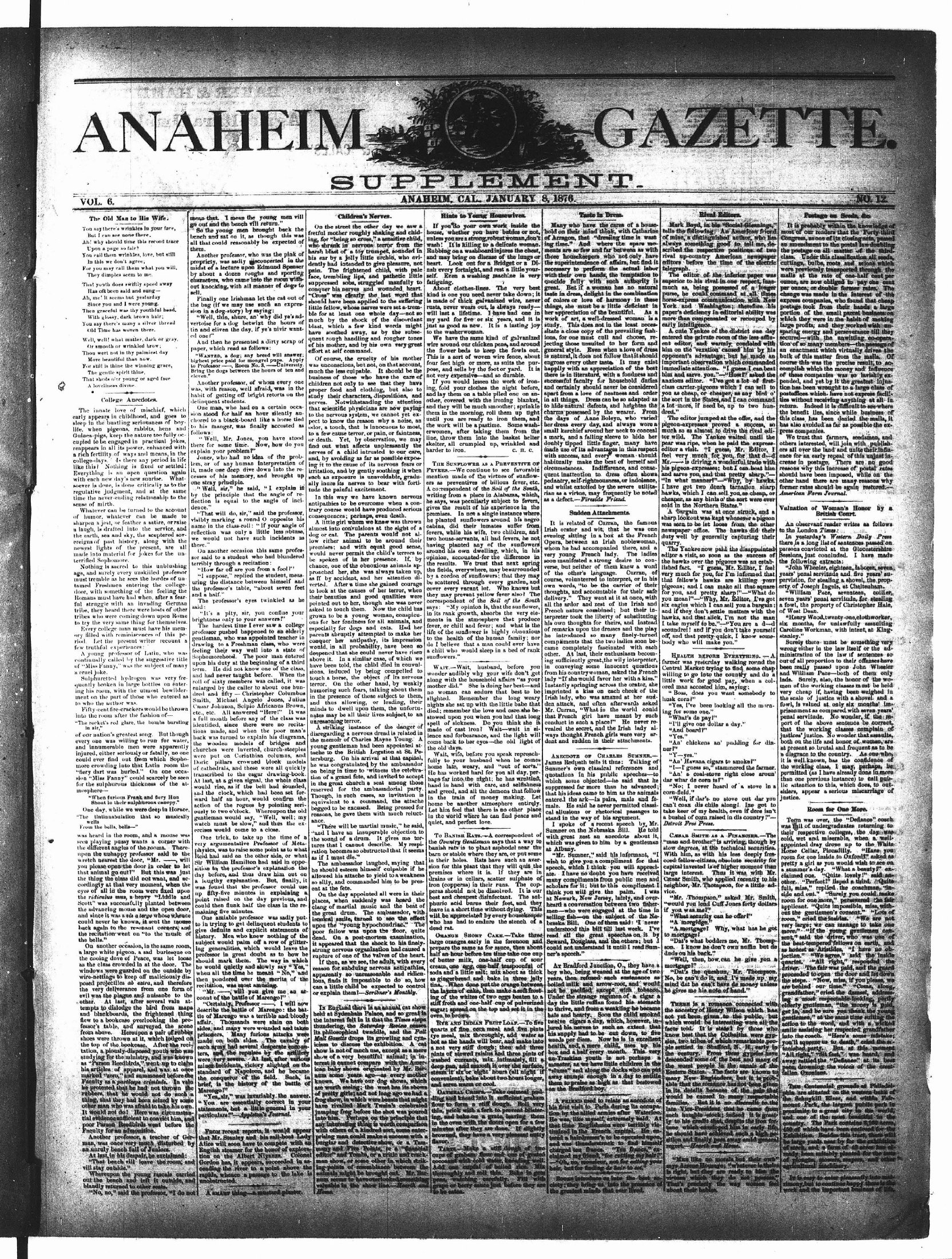
Searchable text
ANAHEIM
VOL. 6.
The Old Man to His Wife.
You say there's wrinkles in your face,
But I can see none there.
Ah! why should time this record trace
Upon a page so fair?
You call them wrinkles, love, but still
In this we don't agree;
For you may call them what you will,
They dimples seem to me.
That youth does swiftly speed away
Has oft been said and sung—
Ah, me! it seems but yesterday
Since you and I were young.
Then graceful was thy youthful head,
With glossy, dark brown hair;
You say there many a silver thread
Old Time has woven there.
Well, well! what matter, dark or gray,
Or smooth or wrinkled brow;
Thou wert not in thy palmest day
More beautiful than now.
For still is thine the winning grace,
The gentle spirit thine,
That sheds o'er young or aged face
A loveliness divine.
College Anecdotes.
The innate love of mischief, which
early appears in childhood, and goes to
sleep in the bustling seriousness of boylife, when pigeons, rabbits, hens and
Guinea-pigs, keep the nature too fully occupied to be engaged in practical jokes,
reappears in all its power, enhanced with
a rich fertility of ways and means, in the
college-days. Is there any period in life
like this? Nothing is fixed or settled!
mean that. I mean the young men will
go out and the bench vill return."
So the young men brought back the
bench and sat on it, as though this was
all that could reasonably be expected of them.
Another professor, who was the pink of
propriety, was sadly disconcerted in the
midst of a lecture upon Edmund Spenser
by about a dozen roughs and sporting
characters, who came into the room without knocking, with all manner of dogs to sell.
Finally one Irishman let the cat out of
the bag (if we may use such an expression in a dog-story) by saying:
"Well, thin, shure, an' why did ye's advertise for a dog betwixt the hours of
tin and eliven the day, if ye's nivir wanted one!"
And then he presented a dirty scrap of
paper, which read as follows:
"WANTED, a dog; any breed will answer:
highest price paid for mongrel pups. Apply
to Professor — Room No. 2. University.
Bring the dogs between the hours of ten and eleven."
Another professor, of whom every one
was, with reason, well afraid, was in the
habit of getting off bright retorts on the
delinquent students.
One man, who had on a certain occasion stood for half an hour silently anchored to a black-board like a horse tied
to his manger, was finally accosted as follows:
"Well, Mr. Jones, you have stood
there for some time. Now, how do you
explain your problem?"
Jones, who had no idea of the problem, or of any human interpretation of it,
made one deaf dive down into the re-
Children
On the street theretiful mother rooing, for "being so who shrank in naharsh blast of a his ear by a jolldently had intense pain. The frightface, trembling lily suppressed sobs,
conquer his nerves.
"Cross" was clear should have been little fellow, whose blee for at least much by the slab blast, which a fihave soothed avowent rough hand of his mother, and effort at self comOf course, the was unconscious,
much the less culpable business of those children not only proper food and study their charm nerves. Notwithin that scientific phito the nervous syspect to know tha odor, a touch, tha to a few cause ter or death. Yet, find out what a nerves of a child and, by avoiding ing it to the caus
The innate love of mischief, which early appears in childhood, and goes to sleep in the bustling seriousness of boy life, when pigeons, rabbits, hens and Guinea-pigs, keep the nature too fully occupied to be engaged in practical jokes, reappears in all its power, enhanced with a rich fertility of ways and means, in the college-days. Is there any period in life like this? Nothing is fixed or settled! Everything is an open question again with each new day's new sunrise. Whatsoever is done, is done critically as to the regulative judgment, and at the same time the never-ending relationship to the sense of mirth.
Whatever can be turned to the account of humor, whatever can be made to sharpen a jest, or feather a satire, or raise a laugh, is drafted into the service, and the earth, sea and sky, the scaptered sorcerions of past history, along with the newest lights of the present, are all made into material for jokes for the unterrified Sophomore.
Nothing is sacred to this unblushing age, and surely every unskilled professor must tremble as he sees the hordes of untamed Freshmen entering the college-door, with something of the feeling the Romans must have had when, after a fearful struggle with an invading German tribe, they heard there were hosts of other tribes who were coming down upon Rome to try the very same thing for themselves.
Every college-man must have his memory filled with reminiscences of this period. Let the present writer recount a few truthful experiences:
A young professor of Latin, who was continually called by the suggestive title of "Miss Fanny," was the subject of many a cruel joke.
Sulphuretted hydrogen was very frequently broken in large bottles on entering his room, with the utmost bewilderment on the part of those who entered as to who the author was.
Fifty-cent fire-crackers would be thrown into the room after the fashion of—"The rocket's red glare, the bombs bursting in air," of our nation's greatest song. But though every one was willing to run for water, and innumerable men were apparently injured, either seriously or fatally, no one could ever find out from which Sophomore crowding into that Latin room the "fiery dart was hurled." On one occasion "Miss Fanny" could scarcely be seen for the sulphurous thickness of the atmosphere—
"When furious Frank and Serry Hun Shout in their sulphurous canopy."
One day, while we were deep in Horace, "The tintinnabulation that so musically wells From the bells, bells—"
was heard in the room, and a mouse was seen playing pussy wants a corner with the different angles of the rooms. Thereupon the unhappy professor said to the wretch nearest the door, "Mr. — will you please open the door in order to let that animal go out?" But this was just the thing the class did not want, and accordingly at that very moment, when the
Another professor, of whom every one was, with reason, well afraid, was in the habit of getting off bright retorts on the delinquent students.
One man, who had on a certain occasion stood for half an hour silently anchored to a black-board like a horse tied to his manger, was finally accosted as follows:
"Well, Mr. Jones, you have stood there for some time. Now, how do you explain your problem?"
Jones, who had no idea of the problem, or of any human interpretation of it, made one deep dive down into the recesses of his memory, and brought up one stray principle.
"Well, sir," he said, "I explain it by the principle that the angle of reflection is equal to the angle of incidence."
"That will do, sir," said the professor, visibly marking a round O opposite his name in the class-roll: "If your angle of reflection was only a little less obtuse, we would not have such incidents as these."
On another occasion this same professor said to a student who had blundered terribly through a recitation:
"How far off are you from a fool?"
"I suppose," replied the student, measuring the distance between himself and the professor's table, "about seven feet and a half."
The professor's eyes twinkled as he said:
"It's a pity, sir, you confine your brightness only to your answers!"
The hardest time I ever saw a college professor pushed happened to an elderly gentleman, who was appointed teacher in drawing to a Freshman class, who were feeling their way well into a state of Sophomorehood. The poor man entered upon his duty at the beginning of a third term. He did not know one of the class, and had never taught before. When the roll of sixty members was called, it was enlarged by the caller to about one hundred and fifty — Christopher Columbus Smith, Michael Angelo Jones, Julius Caesar Johnson, Scipio Africanus Brown, etc., etc. All answered "Here!" It was a full month before any of the class was identified, since there were no recitations made, and when the poor man's back was turned to explain his diagrams, the wooden models of bridges and churches were inverted, church-steeples were put on Corinthian columns, and Doric pillars crowned block models of cathedrals, and those were all quickly transcribed to the cagar drawing-book. At last, at a given signal, the whole class would rise, as if the bell had sounded, and the clock, which had been set forward half an hour, would confirm the action of the rogues by pointing seriously to two o'clock. Whereupon the old gentleman would say, "Well; well; my watch must be slow," and thus the exercises would come to a close.
One trick, to take up the time of a very argumentative Professor of Metaphysics, was to raise some point as to what Reid had said on the other side, or what Sir William Hamilton had said in opposition to the professor's explanation the day before, and thus draw him out on a leugthy explanation. But, finally, it was found that the professor could use much the less culinary business of those children not only proper food and study their charm nerves. Notwithstanding that scientific phantasy to the nervous system pectet know tha odor,a touch,the to a few cause terror or death. Yet,Because find out what a nerves of a child,and by avoiding ing it to the cause irritation,and by such an exposure ally inure its nerve tudethe painful
In this way we antipathies to be trary course would consequences;per A little girl who almost into convict dog or eat.The low either anim premises;and w would never persebe spoken of in chance,一of tha proached her,she as if by accident verted. After a look at at the caft their beauties are pointed out to ho asked to touch tha grown to be a yeous for her fond especially for dogs parents abruptly conquer her and would.in all prie deopened that sho above it.In a s have been told,thesions inducedB toucha horse,the terror.On tha humoring such fo inthe presence o and thus allow minds to dwelling nates may be all unreasoning terrors.
A striking insis disregarding a na memoir of C young gentleman tache to the Brt ersburg.On hi he was congratulations on being in time tion of a grand chu reserved for tha Though.in such equivalent to ad begged to be exe reasons,h he gave ance.
"There will be "and I have an ta sound of a catures that I can ration becomes as if I must die.
The ambassadee he should esteem allowed his atta so silly,and cont ant at the fete.
"When furious Frank and fiery Hun Shout in their sulphurous canopy."
One day, while we were deep in Horace,
"The tintinnabulation that so musically wells From the bells, bells—"
was heard in the room, and a mouse was seen playing pussy wants a corner with the different angles of the rooms. Thereupon the unhappy professor said to the wretch nearest the door, "Mr. —, will you please open the door in order to let that animal go out!" But this was just the thing the class did not want, and accordingly at that very moment, when the eyes of all in the room were fixed upon the ridiculus mus, a heavy "Liddle and Scott" was successfully planted between the advancing mouse and the open door, and since it was a side a cargo whose whence could never be known, it sent the mouse back again to the resonant corners, and the recitation went on "to the music of the bells."
On another occasion, in the same room, a large white pigeon, a sad burlesque on the cooling dove of Peace, was let loose as the class crowded in at the door. The windows were guarded on the outside by wire-nettings to keep off maliciously disposed projectiles ab extra, and therefore the very deliverance from one form of evil was the plague and nuisance to the other. At last, after several vain attempts to dislodge the bird from maps and blackboards, the frightened thing flew to a bookcase overlooking the professor's table, and surveyed the scene from above. Hereupon a pair of rubber shoes were thrown at it, which lodged on the top of the bookcase. After the recitation, a plously-disposed youth who was studying for the ministry, and was known as "Parson Reedbirds," went up to claim his articles of apparel, and was at once marked "zero," and summoned before the Faculty as a participa criminal. In valle he protested that he had not thrown the rubbers, that he would not do such a thing, that they had been seized by some other man who was afraid to take his own. It would not do! Here was circumstantial evidence sufficient to convict him, and poor Parson Reedbirds went before the Faculty for an admonition.
Another professor, a teacher of German, was once very much disturbed by an unruly bench full of Juniors.
At last, in his despair, he exclaimed:
"That bench will leave the room; and vill stay outside."
Whereupon the young rats carried out the bench and left it outside, and blandly returned to other seats.
"No, no," said the professor, "I do not and the clock, which had been set forward half an hour, would confirm the action of the rogues by pointing seriously to two o'clock. Whereupon the old gentleman would say, "Well, well; my watch must be slow," and thus the exercises would come to a close.
One trick, to take up the time of a very argumentative Professor of Metaphysics, was to raise some point as to what Reid had said on the other side, or what Sir William Hamilton had said in opposition to the professor's explanation the day before, and thus draw him out on a lengthy explanation. But, finally, it was found that the professor could use up fifty-five minutes in explaining a point raised on the day previous, and could then flunk half the class in the remaining five minutes.
One amiable professor was sadly put to in trying to get delinquent students to give definite and explicit statements of history. Men who knew nothing of the subject would palm off a row of glittering generalities, which would leave the professor in great doubt as to how he should mark them. The way in which he would quietly and slowly say "Yes," when all the time he meant "No," and then pondered over the merits of the recitation, was most amusing.
"Mr. — will you give me an account of the battle of Marengol?"
"Certainly, Professor — I will now describe the battle of Marengo: the battle of Marengo was a terrible and bloody affair. Thousands were slain on both sides, and many were wounded and taken prisoners. Many furies attacks were made on both sides. The cavalry of each army had several desperate encounters, and the repulses by the artillery were very severe. At last, after various miscellaneous victories alighted on the standard of Napoleon, and he became the conqueror of the field. Such, in brief, is the history of the battle of Marengo."
"Yes, sir," was invariably the answer. "You are essentially correct in your statements, but a little general in your particulars!"—Appleton's Journal.
From recent reports, it would appear that Mr. Stanley and his sail-boot Lady Alice will soon have to compete with an English streamer for the honor of exploration on the Albert Niyanza. Colonial Gordon has it appears succeeded in ascending the river to a point above the rapids, whence a passage to the lake is unobstructed.
A major thing—a mustard plaster.
EM GAS
SUPPLEMENT.
ANAHEIM, CAL. JANUARY 8, 1876.
Children's Nerves.
On the street the other day we saw a fretful mother roughly shaking and chiding, for "being so cross," a sensitive child, who shrank in nervous terror from the harsh blast of a toy trumpet, sounded in his ear by a jolly little urchin, who evidently had intended to give pleasure, not pain. The frightened child, with pale face, trembling lips, and pathetic little suppressed sobs, struggled manfully to conquer his nerves and wounded heart. "Cross" was clearly the last word that should have been applied to the suffering little fellow, whose nerves were set a-tremble for at least one whole day—not so much by the shock of the discordant blast, which a few kind words might have soothed away, as by the subsequent rough handling and rougher tones of his mother, and by his own very great effort at self command.
Of course, the cruelty of his mother was unconscious, but not, on that account, much the less culpable. It should be the business of those who have the care of children not only to see that they have proper food and clothing, but also to study their characters, dispositions, and nerves. Notwithstanding the attention that scientific physicians are now paying to the nervous system, we cannot yet expect to know the reason why a noise, an odor, a touch, that is innocuous to most, to a few cause terror, or pain, or faintness, or death. Yet, by observation, we may find out what affects unpleasantly the nerves of a child intrusted to our care, and, by avoiding as far as possible exposing it to the cause of its nervous fears or hints to Young Housewives.
If you do your own work inside the house, whether you have babies or not, unless you are a strong, robust woman, don't wash! It's killing to a delicate woman. Rubbing on a washboard injures the chest, and may bring on disease of the lungs or heart. Look out for a Bridget or a Dinah every fortnight, and rest a little yourself. Even a washing machine is very fatiguing.
About clothes-lines. The very best kind is one you need never take down; it is made of thick galvanized wire, never rusts, never wears out, is always ready—will last a lifetime. I have had one in my yard for five or six years, and it is just as good as new. It is a lasting joy to the washerwoman.
We have the same kind of galvanized wire around our chicken penis, and around the flower beds to keep the fowls out. This is a sort of woven wire fence, about four feet high or more, as suits the purpose, and sells by the foot or yard. It is not very expensive—and so durable.
If you would lessen the work of ironing, fold your clothes the night before, and lay them on a table piled one on another, covered with the ironing blanket, and they will be much smoother; sprinkle them in the morning, roll them up tight until you are ready to iron them, and the work will be a pastime. Some washersomen, after taking them from the line, throw them into the basket helter skelter, all crumpled up, wrinkled and harder to iron.
The Sunflower as a Preventive Of Exposure.
We continue to see favorable indications and conscientious efforts make the best of herself and circumstances. Indifference and conscientious efforts make the best of herself and circumstances. Indifference and conscientious efforts make the best of herself and circumstances. Indifference and conscientious efforts make the best of herself and circumstances. Indifference and conscientious efforts make the best of herself and circumstances. Indifference and conscientious efforts make the best of herself and circumstances. Indifference and conscientious efforts make the best of herself and circumstances. Indifference and conscientious efforts make the best of herself and circumstances. Indifference and conscientious efforts make the best of herself and circumstances. Indifference and conscientious efforts make the best of herself and circumstances. Indifference and conscientious efforts make the best of herself and circumstances. Indifference and conscientious efforts make the best of herself and circumstances. Indifference and conscientious efforts make the best of herself and circumstances. Indifference and conscientious efforts make the best of herself and circumstances. Indifference and conscientious efforts make the best of herself and circumstances. Indifference and conscientious efforts make the best of herself and circumstances. Indifference and conscientious efforts make the best of herself and circumstances. Indifference and conscientious efforts make the best of herself and circumstances. Indifference and conscientious efforts make the best of herself and circumstances. Indifference and conscientious efforts make the best of herself and circumstances. Indifference and conscientious efforts make the best of herself and circumstances. Indifference and conscientious efforts make the best of herself and circumstances. Indifference and conscientious efforts make the best of herself and circumstances. Indifference and conscientious efforts make the best of herself and circumstances. Indifference and conscientious efforts make the best of herself and circumstances. Indifference and conscientious efforts make the best of herself and circumstances. Indifference and conscientious efforts make the best of herself and circumstances. Indifference and conscientious efforts make the best of herself and circumstances. Indifference and conscientious efforts make the best of herself and circumstances. Indifference and conscientious efforts make the best of herself and circumstances. Indifference and conscientious efforts make the best of herself and circumstances. Indifference and conscientious efforts make the best of herself and circumstances. Indifference和conscientious efforts make the best of herself和concerns
Many who have the care of a household on their mind think, with Catharine of Arragon, that "dressing time is wasting time." And where the spare moments are so few and far between as with those housekeepers who not only have the superintendence of affairs but find it necessary to perform the actual labor with their own hands, the temptation to coincide fully with such authority is great. But if a woman has no natural taste in dress, delight in the combination of colors or love of harmony in these things she must be a little deficient in her appreciation of the beautiful. As a work of art, a well-dressed woman is a study. This does not in the least necessitate a close copy of the prevailing fashion for one must cull and choose rejecting those unsuited to her form and general style. Even when a love of dress is natural, it does not follow that it should engross every other taste. It may exist happily with an appreciation of the best there is in literature, with a fondness and successful faculty for household duties certainly should never be considered apart from a love of neatness and order in all things. Dress can be so adapted as to hide natural defects, and heighten the charms possessed by the wearer.From the days of Anne Boleyn, who varied her dress every day,and always wore a small kerchief around her neck to conceal a mark,and a falling sleeve to hide her doubly tipped little finger,many have made use of its advantages in this respect with success,and every woman should habitually make the best of herselfandcircumstances.
Indifferentia,andconsent
It should be the business of those who have the care of children not only to see that they have proper food and clothing, but also to study their characters, dispositions, and nerves. Notwithstanding the attention that scientific physicians are now paying to the nervous system, we cannot yet expect to know the reason why a noise, an odor, a touch, that is innocuous to most, to a few cause terror, or pain, or faintness, or death. Yet, by observation, we may find out what affects unpleasantly the nerves of a child intrusted to our care, and by avoiding as far as possible exposing it to the cause of its nervous fears or irritation, and by gently soothing it when such an exposure is unavoidable, gradually inure its nerves to bear with fortitude the painful excitement.
In this way we have known nervous antipathies to be overcome when a contrary course would have produced serious consequences; perhaps, even death.
A little girl whom we knew was thrown almost into convulsions at the sight of a dog or cat. The parents would not allow either animal to be around their premises; and with equal good sense, would never permit the child’s terrors to be spoken of in her presence. If, by chance, one of the obnoxious animals approached her, she was always taken up, as if by accident, and her attention diverted. After a time she gained courage to look at the causes of her terror, when their beauties and good qualities were pointed out to her, though she was never asked to touch them. Now the child has grown to be a young woman, conspicuous for her fondness for all animals, and especially for dogs and cats. Had her parents abruptly attempted to make her conquer her antipathy, its impression would, in all probability, have been so deepened that she could never have risen above it. In a similar case, of which we have been told, the child died in convulsions, induced by being compelled to touch a horse, the object of its nervous terror. On the other hand, by weakly humoring such fears, talking about them in the presence of those subject to them, and thus allowing, or leading, their minds to dwell upon them, the unfortunate may be all their lives subject to an unreasoning terror.
A striking instance of the danger of disregarding a nervous dread is related in the memoir of Charles Mayne Young. A young gentleman had been appointed attache to the British Legation at St. Petersburg. On his arrival at that capital, he was congratulated by the ambassador on being in time to witness the celebration of a grand fete, and invited to accept in the great church a seat among those reserved for the ambassadorial party. Though, in such cases, an invitation is equivalent to a command, the attache begged to be excused. Being pressed for reasons, he gave them with much reluctance.
“There will be martial music,” he said, “and I have an insuperable objection to the sound of a drum. It gives me tortures that I cannot describe. My respiration becomes so obstructed that it seems as if I must die.”
The ambassador laughed, saying that he should esteem himself culpable if he allowed his attache to yield to a weakness so silly, and commanded him to be present at the fete.
If you would lessen the work of ironing, fold your clothes the night before, and lay them on a table piled one on another, covered with the ironing blanket, and they will be much smoother; sprinkle them in the morning, roll them up tight until you are ready to iron them, and the work will be a pastime. Some washervenomen, after taking them from the line, throw them into the basket helter skelter, all crumpled up, wrinkled and harder to iron.
THE SUNFLOWER AS A PREVENTIVE OF FEVERs.—We continue to see favorable mention made of the virtues of sunflowers as preventives of bilious fever, etc. A correspondent of the Soil of the South, writing from a place in Alabama, which he says, was peculiarly subject to fevers, gives the result of his experience in the premises. In not a single instance where he planted sunflowers around his negro cabins, did their inmates suffer from fevers, while his wife, two children, and two house-servants, all had fevers, he not having planted any of the sunflowers around his own dwelling, which, in his opinion, accounted-for the difference in the results. We trust that next spring the fields everywhere may be surrounded by a cordon of sunflowers; that they may be scattered through every garden, and cover every vacant lot. Who knows but they may prevent yellow fever also? The correspondent of the Soil of the South says: "My opinion is, that the sunflower, in its rank growth, absorbs the very elements in the atmosphere that produce fever, or chill and fever; and what is the life of the sunflower is highly obnoxious to the health of the human family; nor do I believe that a man could ever have a chill who would sleep in a bed of rank sunflowers."
WAIT.—Wait, husband, before you wonder audibly why your wife don’t get along with the household affairs“as your mother did.” She is doing her best—and no woman can endure that best to be slighted. Remember the long weary nights she sat up with the little babe that died; remember the love and care she bestowed upon you when you had that long spell of sickness. Do you think she is made of cast iron? Wait—wait in silence and forbearance, and the light will come back to her eyes—the old light of the old days.
Wait, wife, before you speak reproachfully to your husband when he comes home late, weary, and “out of sorts.” He has worked hard for you all day, perhaps far into the night; he has wrestled hand in hand with care, and selfishness and greed, and all the demons that follow in the train of money making. Let home be another atmosphere entirely. Let him feel that there is no other place in the world where he can find peace and quiet, and perfect love.
TO BANISH RATS.—A correspondent of the Country Gentleman says that a way to banish rats is to plant asphodel near the barn or stable where they are, or put some in their holes. Rats have such an aversion for this plant that they will quit—the premises where it is. If they are in drains or in callars, scatter sulphate of iron (copperas) in their runs. The cop-
SUDden Attachments.
It is related of Curran, the famous Irish orator and wit; that he was one evening sitting in a box at the French Opera, between an Irish noblewoman, whom he had accompanied there, and a very young French lady. The ladies soon manifested a strong desire to converse, but neither of them knew a word of the other’s language. Curran, of course volunteered to interpret, or in his own words,“to be the carrier of their thoughts,and accountable for their safe delivery.” They went at it at once with all the ardor and zest of the Irish and French nature combined; but their interpreter took the liberty of substituting his own thoughts for theirs,and instead of remarks upon the dresses and the play he introduced so many finely-turned compliments that the two ladies soon became completely fascinated with each other. At last their enthusiasm becoming sufficiently great,the wily interpreter,在 conveying some innocent questions from his countrywoman,s asked the French lady“If she would favor her with a kiss.” Instantly springing across the orator,s she imprinted a kiss on each cheek of the Irish lady,hwas amazed at her sudden attack,and often afterwards asked Mr.Curran.“What in the world could that French girl have meant by such conduct in such a place?” He never revealed the secret,and the Irish lady always thought French girls were very ardent and sudden in their attachments.
ANECDOTE OF CHARLES SUMNER.—James Redpath tells it thus: Talking of Sumner’s own classical references and quotations in his public speeches—to which some objected—he said that he suppressed far more than he advanced; that his ideas came to him as the animals entered the ark—is pairs,male and female. He said he never permitted classical allusions or rhetorical passages to stand in the way of his argument.
I spoke of a recent speech by Mr. Sumner on the Nebraska Bill. He told with great zeast an anecdote about it which was given to him by a gentleman at Albany.
“Mr. Sumner,”his informant,“I wish to give you a compliment for that speechwhich I thinkyou will appreciate.I have no doubt you have received many compliments from public men and scholars for it;but to this compliment.I
I will now show the content of the newspaper page.
In England there is an annual cat show held at Sydenham Palace, and so great is the interest felt in it that the Times stops thundering, the Saturday Review ceases its philosophical twaddle, and the Pall Mall Gazette drops its growing and cynicism to discuss the exhibition. A cat show is not of much use, except as a mere show of a very beautiful animal; in interest it cannot compare with the American baby shows originated by Mr. Barnum some years ago—as every mother knows. We have our dog shows, which are worth seeing; the west has its shows of pretty girls; and not long ago we had a frog show, in which were beasts that might have rivalled Mark Twain's celebrated jumping frog before the shot was poured into him. Perhaps on the principle that any interesting thing is worth comparison with others of a kindred sat, some enterprising man could make a success with a burglar and detective show, or a Tammy and Five Points, or a financial editor" and Tomba, or a critic and trackman show, or some other in which striking points of resemblance between the animals might be brought out. Mr. Barnum seems to have overtended something valuable in the show line—Hearth and Home.
To Banish Rats.—A correspondent of the Country Gentleman says that a way to banish rats is to plant asphodel near the barn or stable where they are, or put some in their holes. Rats have such an aversion for this plant that they will quit the premises where it is. If they are in drains or in cellars, scatter sulphate of iron (copperas) in their runs. The copper should not be dissolved. It is our best and cheapest disinfectant. The sulphuric acid burns their feet, and they leave in a short time without dying. This will be appreciated by every housekeeper who has had to endure the stench of a dead rat.
Orange Short Cake.—Take three large orange early in the forenoon and prepare the same as for sauce, then about half an hour before tea time take one cup of butter milk, one-half cup of sour cream, one egg, one-half teaspoonful of soda and a little salt; mix about as thick as gingerbread and bake in three jelly tins. When done put the orange between the layers of cake, then make a soft frosting of the whites of two eggs heated to a stiff froth and one-half cup of pulverized sugar; spread on the top and set it in the oven to brown.
Rye and Indian Fruit Loaf.—To five quarts of fine corn meal and five pints rye meal, mix thoroughly, add water as hot as the hands will bear, and make into a not very stiff dough; then add three plates of stewed raisins and three pints of washed currants, mix intimately, fill a deep pan, and smooth it over the surface, steam it six or eight hours (all night if convenient), bake about two hours longer, and serve warm or cool.
Oatmeal Cream.—Take oatmeal pudding and knead into it sufficient graham flour to form a still dough. Roll very thin, prick with a fork to prevent blistering, and bake on a grate, leaving them in the oven with the doors open for a few minutes after they are done. If slightly browned, they have a very pleasant entry flavor.
Tartar.—Make a stiff dough of two cups of graham flour and one of ground coconut with cold water, handling well. Add one capful of boiled rice. Mix thoroughly and roll this. Bake in granite, watching carefully. Fill with grate or barry sauce just before they are to be eaten.
I spoke of a recent speech by Mr. Sumner on the Nebraska Bill. He told with great zest anecdote about it, which was given to him by a gentleman at Albany.
“Mr. Sumner,” said his informant, “I wish to give you a compliment for that speech, which I think you will appreciate. I have no doubt you have received many compliments from public men and scholars for it; but to this compliment I think you will give the palm. I was at Newark, New Jersey, lately, and heard a conversation between two fishermen—who were engaged at the time in selling fish—on the subject of the Nebraska Bill. One of them said: ‘I never understood this bill till last week. I've read all the great speeches on it by Seward, Douglas, and the others; but I could not understand it until I read Sumner's speech.”
At Bradford Junction, O., they have a boy who, being weaned at the age of two years, then refused such sustenance as boiled milk and arrow-root, and would not be pacified except with tobacco. Under the strange regimen of a cigar a day the little ruffian found his stomach to thrive, and from a weakling he became hale and hearty. Soon the child smoked twelve cigars a day, which, however, injured his nerves to such an extent that his supply had to be cut down, to five wheels per diem. Now he is in excellent health, and, a mere child, nausea up his box and a half every month. This very on-Trankian youth is not perhaps a monster; as we have little children in the "alums" and along the docks who can put away stumps enough in a day to entitle them to praise as high as that bestowed on the Bradford boy.
A woman used to relate an anecdote of his first visit to Paris during his occupation by the allied armies after Waterloo; He was like myself extremely bald. At that time Englishmen were terribly victimized in the French capital. He entered a hairdresser's to be operated upon, and was thunderstruck to find himself charged ten francs. “Ten francs,” exclaimed my friend, “for cutting my hair!” —Oh, no, mountain; not for cutting your hair; but for finding de hair to sell.”
Rooms introduce us into the best society; they bring us into the presence of the greatest minds that ever lived.
GAZETTE.
NO. 12
In Dress.
the cares of a housethink, with Catharine
addressing time is wast
where the spare mond far between as with
who not only have
of affairs, but find it
form the actual labor
ands, the temptation to
with such authority is
woman has no natural
right in the combination
of harmony in these
a little deficient in
the beautiful. As a
dressed woman is a
not in the least necesof the prevailing fashcull and choose, reted to her form and
when a love of dress
not follow that it should
taste. It may exist
preparation of the best
and with a fondness
for household duties
never be considered
of neatness and order
can be so adapted as
ects, and heighten the
by the wearer. From
the Boleyn, who varied
years, and always wore a
and her neck to conceal
sleeve to hide her
finger, many have
antages in this respect
every woman should
the best of herself and
difference, and conse-
Rival Editors.
Mark Boyd, in his "Social Gleanings," tells the following: An American friend of mine, a distinguished author, who has always something good to tell me, described the respective positions of two rival up-country American newspaper editors before the time of the electric telegraph.
The editor of the inferior paper was superior to his rival in one respect, in much as being possessed of a longer purse, he could command at all times horse-express communication with New York and Washington; therefore his paper's deficiency in editorial ability was more than compensated or recouped by early intelligence.
A cute Yankee of the district one day entered the private room of the less affluent editor, and warmly condoled with him on the vacation caused him by his opponent's advantage; but he made an important observation which commanded immediate attention. "I guess I can beat him and serve you."—"How?" asked the anxious editor. "I've got a lot of first-class carrier-pigeons which I can sell to you as cheap, or cheaper, as any bird o' the sort in the States, and I can command a lot more, if need be, up to two hundred."
The editor jumped at the offer, and the pigeon-expresses proved a success, so much so as almost to drive the rival editor wild. The Yankee waited until the pear was ripe, when he paid the expresseditor a visit. "I guess, Mr. Editor, I feel very much for you, for that d--Mr.——is driving a wonderful trade with his pigeon-expresses; but I can heat him
Postage on Seeds, on
It is probably within the knowledge of most of our readers that the Forty-third Congress, as one of its closing notes, passed an amendment to the postal law doubling the postage on all matter of the third-class. Under this classification all seeds, cuttings, bulbs, roots and sions which were previously transported through the malls at the rate of one-half cent per ounce, are now obliged to pay one cent per ounce; or double farmer rates. The change was made in this interest of the express companies, who found that cheap postage took from their hands a large portion of the small parcel business on which they were in the habit of making large profits; and they worked with unsparing energy and perseverance till they secured—with the unwitting co-operation of so many members—the passage of an enactment which virtually drives the bulk of this matter from the mails. Of course this was the precise result; to accomplish which the money and influence of these companies was so lavishly expended, and yet by it the greatest injustice has been wrought to a large class of postoffices which have not express facilities without receiving anything at all in return. Indeed it is difficult to see where the benefit lies, since while business of this class has been denied the mails, it has also avoided as far as possible the express companies.
We trust that farmers, seedman, and others interested will join with publishers all over the land and unite their influence for an early repeal of this unjust increase in postage. There are no good reasons why this increase of postal rates
Curran, the famous vit, that he was one in a box at the French Irish noblewoman, companied there, and a rich lady. The ladies strong desire to conceive them knew a word language. Curran, of to interpret, or in the carrier of their untable for their safe event at it at once, with rest of the Irish and dubined; but their liberty of substituting for theirs, and instead dresses and the play many finely-turned the two ladies soon be fascinated with each ear enthusiasm become at the wily interpreter, the innocent questions man, asked the French favor her with a kiss." Across the orator, she on each cheek of the amazed at her sudden afterwards asked in the world could have meant by such place?" He never re-read the Irish lady although girls were very aware of their attachments.
Charles Sumner—is it thus? Talking of classical references and public speeches—to ted—he said that he more than he advanced; to him as the animals pairs, male and female permitted classi- rhetorical passages to his argument. Recent speech by Mr. Nebraska Bill. He told an anecdote about it, him by a gentleman said his informant, "I am compliment for that think you will appreciate you have received from public men and to this compliment I
Attachments.
Curran, the famous vit, that he was one in a box at the French Irish noblewoman, companied there, and a rich lady. The ladies strong desire to conceive them knew a word language. Curran, of to interpret, or in the carrier of their untable for their safe event at it at once, with rest of the Irish and dubined; but their liberty of substituting for theirs, and instead dresses and the play many finely-turned the two ladies soon be fascinated with each ear enthusiasm become at the wily interpreter, the innocent questions man, asked the French favor her with a kiss." Across the orator, she on each cheek of the amazed at her sudden afterwards asked in the world could have meant by such place?" He never re-read the Irish lady although girls were very aware of their attachments.
Charles Sumner—is it thus? Talking of classical references and public speeches—to ted—he said that he more than he advanced; to him as the animals pairs, male and female permitted classi- rhetorical passages to his argument. Recent speech by Mr. Nebraska Bill. He told an anecdote about it, him by a gentleman said his informant, "I am compliment for that think you will appreciate you have received from public men and to this compliment I
Valuation of Woman's Honor by a British Court.
An observant reader writes as follows to the London Times:
In yesterday's Western Daily Press there is a long list of sentences passed on persons convicted at the Glocostarshire Sessions, just concluded. I have made the following extracts:
"John Wheeler, eighteen laborer, seven years' penal servitude and five years' supervision, for stealing a shovel, the property of Joseph Ingels, at Chaltenham.
William Pace, seventeen collier, seven years' penal servitude, for stealing a fowl, the property of Christopher Hale, of West Dean.
Henry Wood, twenty-one clothworker, six months, for unlawfully assaulting Caroline Workman, with intent, at Kingstanley."
Surely there must be something very wrong either in the law itself or the administration of the law if sentences so out of all proportion to their offences have been really passed upon John Wheeler and William Pace—both of them only lads. Surely also, the honor of the women of the working classes must be held very cheap if having been weighed in the scale of justice with a shovel and a fowl, is valued at only six months' imprisonment as compared with seven years' penal servitude. No wonder, if the report of the above sentence be correct, that the working classes complain of justices' justice. No wonder that assaults both on the life and honor of women, are at present so brutal and frequent as to be a disgrace to the country. As one who, it is well known, has the condemnance of the working class, I may, perhaps, be permitted (as I have already done in more than one previous instance) to call public attention to this, which does, to outsiders, appear a serious miscarriage of justice.
Room for One More.
Term was over, the "Defiance" coach was full of undergraduates returning to their respective colleges, the day was cold, wet and miserable, when a well-appointed dray drove up to the White Horse Collar, Piccadilly. "Have you room for one inside to Oxford!" asked as pretty a girl as you would wish to see on a summer's day. "What a beauty!" exclaimed one. "Quite lovely!" said another. "Perfect!" lapsed a third. "Quite full miss," replied the coachman,"in
Well, if dar's no stove out dar you can't coax chile along! Iz got to take keer of my health, even if dere isn't a bushel of corn raised in dis country!" —Detroit Free Press.
Cesar Smith as a financier. The "man and brother" is arriving, though by slow degrees, at the technical securities. With him, with his less deeply fenced fellow-citizen, obsolete security for capital invested is of higher moment than large interest. Thus it was with Mr. Caesar Smith, who applied recently to his neighbor, Mr. Thompson, for a little advice.
Mr. Thompson," asked Mr. Smith, "would you lend Cuff Jones forty dollars if you was me?"
What security can he offer?
A morgidge.
A mortgage? Why, what has he got to mortgage?
Dat's what bodders me, Mr. Thompson. I know he don't own nuffin but de duds on his back."
Well, then, how can he give you a mortgage?
Dat's the quebun, Mr. Thompson. No, he can't do it, and I'm made up my mind dat he can't have do money unless he gives me his note of hand."
There is a romance connected with the ancestry of Henry Wilson which has not yet been given to the public, but which would be interesting were all the facts told. It is stated by those who know best that the Collaitha were gynies, two tribes of which remarkable people settled in Shafford, N. H., early in the century. From these gynies have descended some of the best and many of the worst people in the annals of the Eastern States. The facts are known to many New Englanders, but it is probable that the romance has not been given in its details because of the pain that would be caused to many reasonable families. But it is no dismissal to the late Vice-President that he came from such humble stock; indeed it is greatly to his credit that, despite the iron fortune which enveloped him in early life, he should have achieved such a high position and finally pass away general regret—Henrich and Home.
Mans like no morals but their own ways Arnae Hornege; "whatever is there is right, but they are ready to him, the written which they do not present." That's precisely the way women feel about their babies.
Room for One More.
Term was over, the "Defiance" coach was full of undergraduates returning to their respective colleges, the day was cold, wet and miserable, when a well-appointed dray drove up to the White Horse Cellar, Pleadilly. "Have you room for one inside to Oxford?" asked as pretty a girl as you would wish to see on a summer's day. "What a beauty!" exclaimed one. "Quite lovely!" said another. "Perfect!" lisped a third. "Quite full, miss," replied the coachman, "inside and out." "Surely you could make room for one more," parametered the fair applicant. "Quite impossible, miss, without the gentlemen's consent." "Lots of room," cried the insider. "We are not very large; we can manage to take one more." "If the young gentlemen consent," said the driver, who was one of the best-tempered fellows on earth, and as honest as Aristides. "I have no objection." "We agree," said the inside quartet. "All right," responded the driver. The fair was paid, and the guard proceeded to open the door and let down the steps. "Now, miss, if you please, we are behind our time." "Come, along, grandfather," cried the damsel, addressing a most respectable-looking elderly gentleman: "the money is paid, get in; and he sure you thank the young gentleman," at the same time suiting the action to the word, and with a witful smile saluting her respected grandfather into the coach. "Here's some mistake; you'll squeeze us to death," cried the astonished party. But at this moment "All right," "Blt feet," was heard, and away rattled the "Defiance" at its best pace, drowning the volce of the crossfallen Oxonians.
Two Centennial grounds at Philadelphia are situated on the western bank of the Delphykill Houses, and within Palmont Park, the largest public park in proximity to a great city in the world; and one of the most beautiful in the country. The Park contains 8,160 acres, 450 of which have been enclosed for the Exhibition. Besides this tract, there will be large yards near by for the exhibition of stock, and a farm of 41 acres already been suitably planted for the town of ploughs, women wagons, and other agricultural machinery.
It is easy to enter plentifully into matrimony, but to continue happy there is the work and the important business of life.