anaheim-gazette 1875-12-25
Scanned page
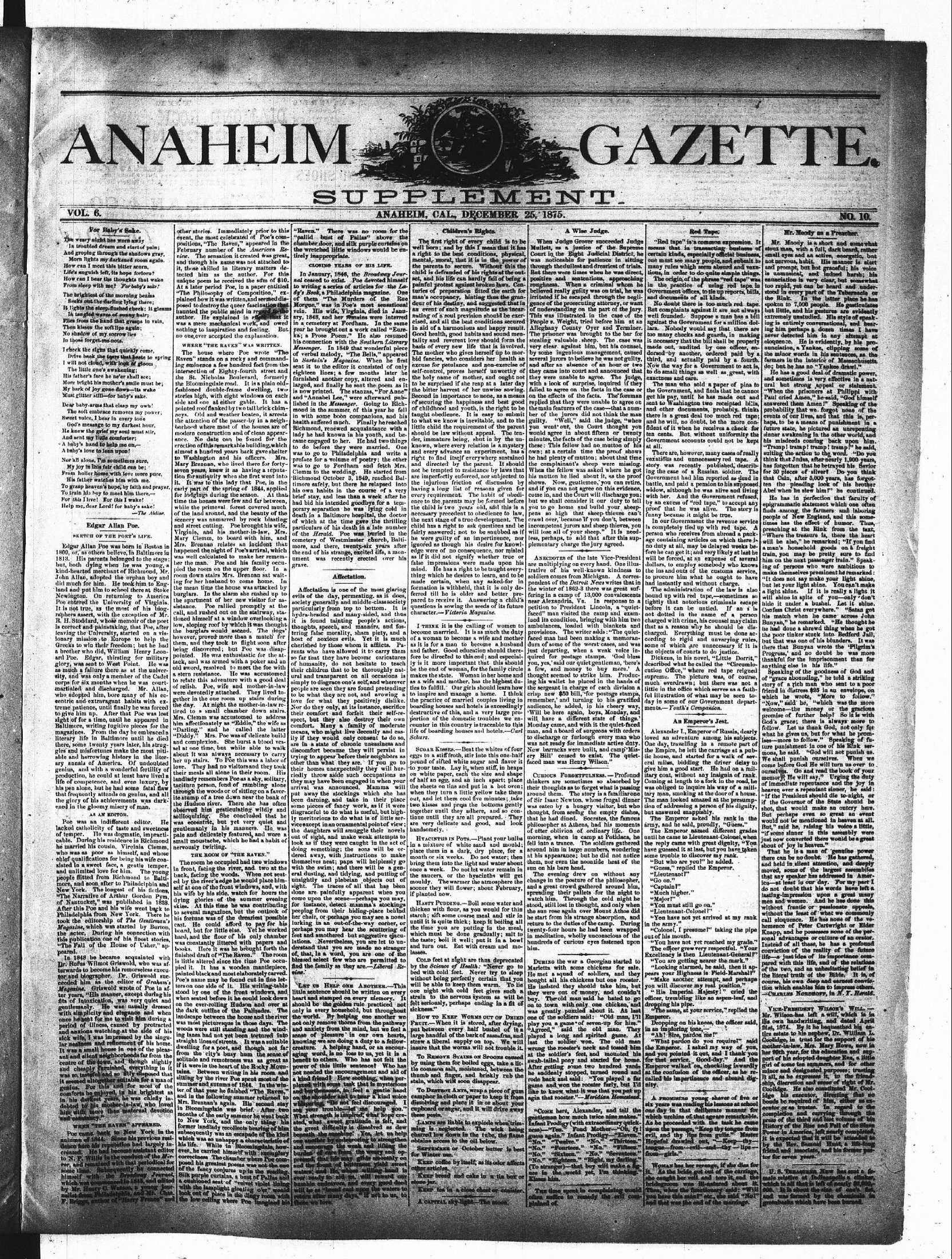
Searchable text
ANAHEIM
VOL. 6.
For Baby's sake.
The weary night has worn away
In troubled dream and start of pain;
And groping through the shadows gray,
Morn lights my darkened room again.
How can I meet this bitter scorn,
Life's anguish left, its hope forlorn?
How can I bear the thoughts that wake
From sleep with me? For baby's sake!
The brightest of the morning beams
Seeks out the darling lying there;
It lights the sleep-flipped cheek; it gleams
In tangled waves of sunny hair;
Files from the hand that grasps in vain,
Then kisses the soft lips again;
No shadow of my sorrow lies
In those forget-me-nots.
I check the signs that quickly come,
Drive back the tears that haste to spring
I will not cloud, with look of gloom
The little one's awakening;
His father's face he never shall see;
More bright his mother's smile must be;
My bark of joy gone down—its wake
Must glitter still—for baby's sake.
Dear baby-arms that clasp my owh!
The soft embrace removes my power;
Sweet voice, I hear in every tone
God's message to my darkest hour,
He knew the grief my soul must stir,
And sent my little comforter;
A baby's hand to help me on,
A baby's love to lean upon!
Nor all alone, I'm sometimes sure,
My joy in this fair child can be;
other stories. Immediately prior to this event, the most celebrated of Poe's compositions, "The Raven," appeared in the February number of the American Review. The sensation it created was great, and though his name was not attached to it, those skilled in literary matters detected him as the author. For this unique poem he received the sum of $10. At a later period Poe, in a paper entitled "The Philosophy of Composition," explained how it was written, and seemed disposed to destroy the queer fascination that haunted the public mind in regard to the author. He explained in effect that it was a mere mechanical work, and owed nothing to inspiration and feeling. But no one, ever accepted the explanation.
WHERE "THE RAVEN" WAS WRITTEN.
The house where Poe wrote "The Raven" stands on a rocky and commanding eminence a few hundred feet from the intersection of Eighty-fourth street and the St. Nicholas Boulevard, formerly the Bloomingdale road. It is a plain old-fashioned double-frame dwelling, two stories high, with eight windows on each side and one at either gable. It has a pointed roof flanked by two tall brick chimneys. Old and weather beaten, it arrests the attention of the passer-by in a neighborhood where most of the houses are of modern construction and of clean appearance. No date can be found for the erection of this remarkable building, which almost a hundred years back gave shelter to Washington and his officers. Mrs. Mary Brennan, who lived there for forty-years, knew it as having a reputation.
"Raven." There was no pallid bust of Poe chamber door, and silky the wretched little wrist tirely inappropriate.
CLOSING YEARS
In January, 1846, the nat ceased to exist. Poe to writing a series of a day's Book, a Philadelphia of them "The Murder Morgue," was in Poe's vein. His wife, Virgina, 1848, and her remnants in a cemetery at Fordham year he brought out a waist; a Prose Poem," his connection with the Messenger. In 1849 the of verbal melody, "The Sartain's Magazine" sent it to the editor it eighteen lines; a few furnished another copy larged, and finally he is now printed. The stair and "Annabel Lee," were lished in the Messenger monad in the summer, or in with some boon co-health suffered much. Richmond, renewed acid lady he had known in came engaged to her. To do before they went was to go to Philadelphia preface for a volume of was to go to Fordham.
Edgar Allan Poe.
SKETCH OF THE POET'S LIFE.
Edgar Allan Poe was born in Boston in 1809, or, as others believe, in Baltimore in 1813. His parents belonged to the stage; but, both dying when he was young, a kind-hearted merchant of Richmond, Mr. John Allan, adopted the orphan boy and did much for him. He took him to England and put him to school there at Stoke Newington. On returning to America Poe entered the University of Virginia. It is not true, as the most of his biographers assert, with the exception of Mr. R. H. Stoddard, whose memoir of the poet is correct and palindrical, that Poe, after leaving the University, started on a visionary mission to Europe to help the Greeks to win their freedom; but he had a brother who did, William Henry Leonard Poe. Edgar, thirsting for military glory, was sent to West Point. He was as much a failure there as at the university, and was only a member of the Cadet corps for six months when he was court-martialled and discharged. Mr. Allan, who adopted him, bore many of his eccentric and extravagant habits with extreme patience, until finally he was forced to give him up. After that Poe was lost sight of for a time, until he appeared in Baltimore, writing fugitive pieces for the magazines. From the day he embraced a literary life in Baltimore until he died there, some twenty years later, his struggles and misfortunes make the most pitilable and harrowing history in the literary annals of America. Of undoubted genius, and with a wonderful fertility of production, he could at least have lived a life of competence, and even luxury, by his pen alone, but he had some fatal flaw that frequently attends on genius, and all the glory of his achievements was darkened in the gloomy misery of man.
AS AN EDITOR.
Poe was an indifferent editor. He lacked catholicity of taste and sweetness of temper. He was dogmatic, impracticable. During his residence in Richmond he married his cousin, Virginia Clemm, who was as poor as himself, and whose chief qualifications for being his wife consisted in a sweet face, a gentle temper, and unlimited love for him. The young people flitted from Richmond to Baltimore, and soon after to Philadelphia and New York. The longest of his flattened intersection of Eighty-fourth street and the St. Nicholas Boulevard, formerly the Bloomingdale road. It is a plain old-fashioned double-frame dwelling, two stories high with eight windows on each side and one at either gable. It has a pointed roof flanked by two tall brick chimneys. Old and weather beaten, it arrests the attention of the passer-by in a neighborhood where most of the houses are of modern construction and of clean appearance. No date can be found for the erection of this remarkable building, which almost a hundred years back gave shelter to Washington and his officers. Mrs. Mary Brennan, who lived there for forty-seven years, knew it as having a reputation for antiquity when she first went into it. It was to this lady that Poe, in the early part of the spring of 1844, applied for lodgings during the season. At that time the houses were few and far between, while the primeval forest covered much of the land around, and the beauty of the scenery was unmarred by rock blasting and street cutting. Poe brought his wife, Virginia, and his mother-in-law, Mrs. Mary Clemm, to board with him, and Mrs. Brennan relates an incident that happened the night of Poe's arrival, which was well calculated to make her remember the man. Poe and his family occupied the room on the upper floor. In a room down stairs Mrs. Brennan sat waiting for her husband to come home. In the mean time the house was attacked by burglars. In the alarm she rushed up to the apartment of her new visitor for assistance. Poe rallied promptly at the call, and rushed out on the stairway, stationed himself at a window overlooking a low, sloping roof by which it was thought the burglar would ascend. The dogs' however, proved more than a match for them, and they took to flight soon after being discovered; but Poe was disappointed. He was enthusiastic for the attack, and was armed with a poker and an old sword, resolved to meet the foe with a stern resistance. He was accustomed to relate this adventure with a good deal of relish. Poe, wife and mother-in-law were devotedly attached. They lived together in the one room up stairs during the day. At night the mother-in-law retired to a small chamber down stairs. Mrs. Clemm was accustomed to address him affectionately as "Eddie," the wife as "Darling," and he called the latter "Diddy." Mrs. Poe was of delicate build and complexion. She burst a blood vessel at one time, but while able to walk about it was always necessary to carry her up stairs. To Poe this was a labor of love. They had no visitors and they took their meals all alone in their room. His landlady remembers Poe as a shy, solitary, taciturn person, fond of rambling alone through the woods or sitting on a favorite stump of a tree down near the bank of the Hudson river. There she has often observed him gesticulating wildly and soliloquizing. She concluded that he was eccentric, but yet very quiet and gentlemanly in his manners. He was pale and delicately featured, and wore a small moustache, which he had a habit of nervously twirling.
THE ROOM OF "THE RAVEN."
The room he occupied had two windows in front, facing the river, and two at the back, facing the woods. When not seated by the river's edge he would place himself at one of the front windows, and, with eighteen lines; a few furnished another copy larger, and finally he is now printed. The size and "Annabel Lee," we listed in the Messenger monad in the summer; in with some boon coats health suffered much. Richmond, renewed access lady he had known in came engaged to her; to do before they were was to go to Philadelphia; preface for a volume of was to go to Fordham Clemm to the wedding Richmond October 31st; timore safely, but there his own habits in their brief stay, and less than had bid his intended goratory separation he will death in a Baltimore hive of which at the time particulars of his death of the Herald. Poe was cemetery of Westminster more, and there, twenty the end of his strange; anument was recently grave.
Affectation is one of evils of the day, permitting society generally and particularly from top hydra-headed and mankind it is found tainting thoughts; speech, and tering false morality; host of noxious evils; cherished by those who rentes who have allowed so far that they have been of humanity; do not their children that to be what they are not love for what they perish Nor do they only; at its their comfort and for spect, but they also comfort. Many a fan means, who might live if they would only are in a state of chronic discomfort because they trying to appear before other than what they are their homes unexpectedly throw aside such they may have been engrossed arrival was announced put away the stocking been darning, and take some pieces of fancy we disgraceful to do what is likely meritorious to do which vice except in an ornamental daughters will smudge out of sight, and make look as if they were cared doing something; they derered away, with instill themselves neat; paps with the swim; and their eral dusting, and tidying unsightly and plebeian sight. The traces of
Poe was an indifferent editor. He lacked catholicity of taste and sweetness of temper. He was dogmatic, impracticable. During his residence in Richmond he married his cousin, Virginia Clemm, who was as poor as himself, and whose chief qualifications for being his wife consisted in a sweet face, a gentle temper, and unlimited love for him. The young people flitted from Richmond to Baltimore, and soon after to Philadelphia and New York. The longest of his fictions, "The Narrative of Arthur Gordon Pym, of Nantucket," was published in 1838. After this Poe and his wife went back to Philadelphia from New York. There he took the editorship of *The Gentleman's Magazine*, which was started by Burton, the actor. During his connection with this publication one of his finest stories, "The Fall of the House of Usher," appeared.
In 1843 he became acquainted with Dr. Rufus Wilmot Griswold, who was afterwards to become his remorseless executor and biographer. Dr. Griswold succeeded him as the editor of *Graham's Magazine*. Griswold wrote of Poe in after years, "His manner, except during his fits of intoxication, was very quiet and gentlemanly. He was usually dressed with simplicity and elegance and when once he sent for me to visit him during a period of illness, caused by protracted and anxious watching at the side of his sick wife, I was impressed by the singular naïness and refinement of his home. It was a small house in one of the pleasant and silent neighborhoods far from the centre of the town, and though slightly cheaply furnished, everything in it was so tasteful and so silly disposed that it seemed altogether suitable for a man of genius. For this and for most of the comforts he enjoyed, in his brightest as in his darkest years, he was chiefly indebted to his mother-in-law, who loved him with more than maternal devotion and sympathy."
WHEN "THE RAVEN" APPEARED.
Poe came back to New York in the autumn of 1844. Since his previous realization has his reputation had largely increased. He had become assistant editor to N. F. Willis in the conduct of the Mirror, and remained with that periodical for some time. Subsequently he connected himself with the Brendon Journal, which was commenced in 1845, and edited by Mr. Henry G. Watson, a young journalist from Philadelphia, and Ms. Chas. F. Briggs, author of "Harry Prentice" and through the woods or sitting on a favorite stump of a tree down near the bank of the Hudson river. There she has often observed him gesticulating wildly and soliloquizing. She concluded that he was eccentric, but yet very quiet and gentlemanly in his manners. He was pale and delicately featured, and wore a small moustache, which he had a habit of nervously twirling.
THE ROOM OF "THE RAVEN."
The room he occupied had two windows in front, facing the river, and two at the back, facing the woods. When not seated by the river's edge he would place himself at one of the front windows, and, with his wife by his side, watch for hours the dying glories of the summer evening skies. At this time he was contributing to several magazines, but the outlook of his fortune was of the dreariest possible cast. He could afford to pay for his board, but for little else. Yet he worked hard, and the floor of his only chamber was constantly littered with papers and books. Here it was he brought forth the finished draft of "The Raven." The room is little altered since the time Poe occupied it. It has a wooden mantlepiece, painted black and most elaborately carved. Poe's name may be found cut in fine letters on one side of it. His writing-table stood by one of the front windows, and when seated before it he could look down on the ever-rolling Hudson and over at the dark outline of the Palisades. The landscape between the house and the river was most picturesque in those days. The woods were still standing and the winding lanes had not yet been tortured into straight lines of streets. It was a suitable dwelling for a poet, and though not far from the city's buoy hum the sense of solitude and remoteness was as great as if it were in the heart of the Rocky Mountains. Between writing in his room and sitting by the river Poe spent most of the summer and autumn of 1844. In the winter of that year he finished "The Raven," and in the following summer returned to Mrs. Brunnan's again. His second stay in Bloomingdale was brief. After two months of the early summer he went back to New York, and the only thing his former landlady recollects hearing of him subsequently was an escapade of the kind which was so unhappy a characteristic of his life. While in Bloomingdale, however, he carried himself with exemplary correctness. The chamber where Poe composed his greatest poems was not the one of the fancy conjures up in the reading: Silk purple curtains, a bust of Palissadia a cushioned seat of "velvet violet lining with the lamplight gloating out" would look out of place in the dingy room with the low ceiling where Poe imagined his put away the stockings been darning, and take some pieces of fancy wilt disgraceful to do what is likely meritorious to do while vice except in an ornamental daughter will smug out of sight, and make look as if they were care doing something; the derered away, with instill themselves neat; paps with the swim; and the eral dusting, and tidying unsightly and plebeian sight. The traces of it done are painfully appear come upon the scene—for instance, detect my peeping from their hide her chair, or perhaps you lurking in an out-of-the-perhaps you may hear feet and amothered but lations. Nevertheless, derstand that you are not of that. In a word, you blessed select few who find the family as they desire.”
LET US HELP ONE LITTLE sentence should be heart and stamped on each should be the golden rule only in every household the world. By helping not only remove thorns and anxiety from the mind sense of pleasure in knowing we are doing creature. A helping aging word is no loss benefit to others. When power of this little set not needed encourage a kind friend! How aplexed with some task and barthematic, in fear on the shoulder and tail whispering "Do not fear see your trouble—let What strength is insisted what sweet graft the great difficulty is beneath the sunshine! One another by endeavor and encourage the way burdened care from present that life may and the foetus endure easy water; and His white over ready to aid man humble endeavors; will be as "broad cast return after many days these we love."
IM GAIT
SUPPLEMENT.
ANAHEIM, CAL., DECEMBER 25, 1875.
"Raven." There was no room for the "pallid bust of Pallas" above the chamber door, and silk purple curtains on the wretched little windows would be entirely inappropriate.
CLOSING YEARS OF HIS LIFE.
In January, 1846, the Broadway Journal ceased to exist. Poe devoted himself to writing a series of articles for the Lady's Book, a Philadelphia magazine. One of them "The Murders of the Rue Morgue," was in Poe's most sensational vein. His wife, Virginia, died in January, 1848, and her remains were interred in a cemetery at Fordham. In the same year he brought out a work called "Enreka; a Prose Poem." He also resumed his connection with the Southern Literary Messenger. In 1849 that wonderful piece of verbal melody, "The Bells," appeared in Sartain's Magazine. When he first sent it to the editor it consisted of only eighteen lines; a few months later he furnished another copy, altered and enlarged, and finally he sent the poem as it is now printed. The stanzas, "For Anne" and "Annabel Lee," were afterward published in the Messenger. Going to Richmond in the summer of this year he fell in with some boon companions, and his health suffered much. Finally he reached Richmond, renewed acquaintance with a lady he had known in his youth, and became engaged to her. He had two things to do before they were married. One was to go to Philadelphia and write a preface for a volume of poetry; the other was to go to Fordham and fetch Mrs.
Children's Rights.
The first right of every child is to be well born; and by this I mean that it has a right to the best conditions, physical, mental, moral, that it is in the power of the parents to secure. Without this the child is defrauded of his rights at the outset, and his life can hardly fall of being a painful protest against broken laws. Centuries of preparation fitted the earth for man's occupancy, hinting thus the grandeur of his destiny, and suggested that in an event of such magnitude as the incarnation of a soul precision should be exercised, and all the best conditions secured in aid of a harmonious and happy result. Good health, good habits and sound mentality and reverent love should form the basis of every new life that is involved. The mother who gives herself up to morbid fancies, who considers her health an excuse for petulance and non-exercise of self-control, proves herself unworthy of the holy name of mother, and ought not to be surprised if she reap at a later day the bitter harvest of her unwise sowing. Second in importance to none, as a means of securing the happiness and best good of childhood and youth, is the right to be taught obedience. It is easy to submit to what we know is inevitable, and to the little child the requirement of the parent should be law without appeal. The tender, immature being, shut in by the unknown, where every relation is a mystery and every advance an experiment, has a right to find itself everywhere sustained and directed by the parent. It should not be tempted to resistance its laws that
A Wise Judge.
When Judge Grover succeeded Judge Mullett, as a justice of the Supreme Court in the Eight Judicial District, he was noticeable for patience in sitting through the dullest and drearest of trials. But there were times when he was direct, positive and sententious, approaching roughness. When a criminal whom he believed really guilty was on trial, he was irritated if he escaped through the negligence of the prosecuting attorney, or want of understanding on the part of the jury. This was illustrated in the case of the People v. Weight, tried before him at an Alleghany County Oyer and Terminer. The prisoner was brought to the bar for stealing valuable sheep. The case was very clear against him, but his counsel, by some ingenious management, caused several jurors to believe he was not guilty, and after an absence of an hour or two they came into court and announced that they were unable to agree. The judge, with a look of surprise, inquired if they failed to agree on the facts in the case or on the effects of the facts. The foreman replied that they were unable to agree on the main features of the case—that a number of the jurors did not think the man guilty. "Well," said the judge, "when you went out, the Court thought you would agree in about fifteen or twenty minutes, the facts of the case being simply these: This fellow had no mutton of his own; at a certain time the proof shows he had plenty of mutton; about that time the complainant's sheep were missing. When the fellow was asked where he got."
"Red," means that certain knights many rulings. The order in the policeGovernmentanddocument.
No down But compass well found against lars. No too many it necessitated made out dorsed by third,and Nowtheto do small exactness.The manthe Governorget his passent toWandotherthereisaandhewifidentoftencent.Governmentatall.
There are vexatious storywas
Affectation.
Affectation is one of the most glaring evils of the day, permeating, as it does, society generally and middle-class society particularly from top to bottom. It is hydra-headed and many-sided, and thus it is found tainting people's actions, thoughts, speech, and manners, and fostering false morality, sham piety, and a host of noxious evils. Yet it is much cherished by those whom it afflicts. Parents who have allowed it to carry them so far that they have become caricatures of humanity, do not hesitate to teach their children that to be thoroughly natural and transparent on all occasions is simply to disgrace one's self, and wherever people are seen they are found pretending to be what they are not, and avowing a love for what they positively dislike. Nor do they only, at its instance, sacrifice their comfort and forfeit their self-respect, but they also destroy their own comfort. Many a family of moderate means, who might live decently and easily if they would only consent to do so, are in a state of chronic uneasiness and discomfort because they will persist in trying to appear before their neighbors as other than what they are. If you go to their homes unexpectedly they will hurriedly throw aside such occupations as they may have engaged in when your arrival was announced. Mamma will put away the stockings which she has been darning, and take in their place some pieces of fancy work, as if it were disgraceful to do what is useful, but highly meritorious to do what is of little service except in an ornamental point of view; the daughters will smuggle their novels out of sight, and make weak attempts to look as if they were caught in the act of doing something; the sons will be ordered away, with instructions to make themselves neat; papa will helplessly go with the swim; and there will be a general dusting, and tidying, and putting of unsightly and plebeian objects out of sight. The traces of all that has been eighteen lines; a few months later he furnished another copy, altered and enlarged, and finally he sent the poem as it is now printed. The stanzas, "For Anne" and "Annabel Lee," were afterward published in the Messenger. Going to Richmond in the summer, of this year he fell in with some boon companions, and his health suffered much. Finally he reached Richmond, renewed acquaintance with a lady he had known in his youth, and became engaged to her. He had two things to do before they were married. One was to go to Philadelphia and write a preface for a volume of poetry; the other was to go to Fordham and fetch Mrs. Clemm to the wedding. He started from Richmond October 3, 1849, reached Baltimore safely, but there he relapsed into his own habits in the course of a very brief stay, and less than a week after he had bid his intended goodbye for a temporary separation he was lying cold in death in a Baltimore hospital, the doctor of which at the time gave the thrilling particulars of his death in a late number of the Herald. Poe was buried in the cemetery of Westminster church, Baltimore, and there, twenty-six years after the end of his strange, excited life, a monument was recently erected over his grave.
Affectation.
Affectation is one of the most glaring evils of the day, permeating, as it does, society generally and middle-class society particularly from top to bottom. It is hydra-headed and many-sided, and thus it is found tainting people's actions, thoughts, speech, and manners, and fostering false morality, sham piety, and a host of noxious evils. Yet it is much cherished by those whom it afflicts. Parents who have allowed it to carry them so far that they have become caricatures of humanity, do not hesitate to teach their children that to be thoroughly natural and transparent on all occasions is simply to disgrace one's self, and wherever people are seen they are found pretending to be what they are not, and avowing a love for what they positively dislike. Nor do they only, at its instance, sacrifice their comfort and forfeit their self-respect, but they also destroy their own comfort. Many a family of moderate means, who might live decently and easily if they would only consent to do so, are in a state of chronic uneasiness and discomfort because they will persist in trying to appear before their neighbors as other than what they are. If you go to their homes unexpectedly they will hurriedly throw aside such occupations as they may have engaged in when your arrival was announced. Mamma will put away the stockings which she has been darning, and take in their place some pieces of fancy work, as if it were disgraceful to do what is useful, but highly meritorious to do what is of little service except in an ornamental point of view; the daughters will smuggle their novels out of sight, and make weak attempts to look as if they were caught in the act of doing something; the sons will be ordered away, with instructions to make themselves neat; papa will helplessly go with the swim; and there will be a general dusting, and tidying, and putting of unsightly and plebeian objects out of sight. The traces of all that has been eighteen lines; a few months later he furnished another copy, altered and enlarged, and finally he sent the poem as it is now printed. The stanzas, "For Anne" and "Annabel Lee," were afterward published in the Messenger. Going to Richmond in the summer, of this year he fell in with some boon companions, and his health suffered much. Finally he reached Richmond, renewed acquaintance with a lady he had known in his youth, and became engaged to her. He had two things to do before they were married. One was to go to Philadelphia and write a preface for a volume of poetry; the other was to go to Fordham and fetch Mrs. Clemm to the wedding. He started from Richmond October 3, 1849, reached Baltimore safely, but there he relapsed into his own habits in the course of a very brief stay, and less than a week after he had bid his intended goodbye for a temporary separation he was lying cold in death in a Baltimore hospital, the doctor of which at the time gave the thrilling particulars of his death in a late number of the Herald. Poe was buried in the cemetery of Westminster church, Baltimore, and there, twenty-six years after the end of his strange, excited life, a monument was recently erected over his grave.
Affectation.
Affectation is one of the most glaring evils of the day, permeating, as it does, society generally and middle-class society particularly from top to bottom. It is hydra-headed and many-sided, and thus it is found tainting people's actions, thoughts, speech, and manners, and fostering false morality, sham piety, and a host of noxious evils. Yet it is much cherished by those whom it afflicts. Parents who have allowed it to carry them so far that they have become caricatures of humanity, do not hesitate to teach their children that to be thoroughly natural and transparent on all occasions is simply to disgrace one's self, and wherever people are seen they are found pretending to be what they are not, and avowing a love for what they positively dislike. Nor do they only, at its instance, sacrifice their comfort and forfeit their self-respect, but they also destroy their own comfort. Many a family of moderate means, who might live decently and easily if they would only consent to do so, are in a state of chronic uneasiness and discomfort because they will persist in trying to appear before their neighbors as other than what they are. If you go to their homes unexpectedly they will hurriedly throw aside such occupations as they may have engaged in when your arrival was announced. Mamma will put away the stockings which she has been darning, and take in their place some pieces of fancy work, as if it were disgraceful to do what is useful, but highly meritorious to do what is of little service except in an ornamental point of view; the daughters will smuggle their novels out of sight, and make weak attempts to look as if they were caught in the act of doing something; the sons will be ordered away, with instructions to make themselves neat; papa will helplessly go with the swim; and there will be a general dusting, and tidying, and putting of unsightly and plebeian objects out of sight. The traces of all that has been eighteen lines; a few months later he furnished another copy, altered and enlarged, and finally he sent the poem as it is now printed. The stanzas, "For Anne" and "Annabel Lee," were afterward published in the Messenger. Going to Richmond in the summer, of this year he fell in with some boon companions,and his health suffered much. Finally he reached Richmond,renewed acquaintance with a lady he had known in his youth,and became engaged to her. He had two things to do before they were married. One was to go to Philadelphia和write a preface for a volume of poetry;the other was去to Fordham和fetch Mrs.Clemm到wedding。He started fromRichmondOctober3,1849,reachedBaltimore safely,但therehe relapsedintohisownhabitsinthecourseofaverybriefstay,andlessthanawaskethebidhistintotheparentsmaybeformedbeforethechildistwoyearsold,andthisisa necessaryprecedentobediencetolaw,thenextstageofatruedevelopment.Thechildhasahightthataskquestionsandbe fairlyanswered;nottobesnubbedasifhewereguiltyofanimertinence,norignoredasthoughhisdesireforknowseventhermisdiseasenorignoredasthoughhisdesireforknowseventhermisdiseasenorignoredasthoughhisdesireforknowseventhermisdiseasenorignoredasthoughhisdesireforknowseventhermisdiseasenorignoredasthoughhisdesireforknowseventhermisdiseasenorignoredasthoughhisdesireforknowseventhermisdiseasenorignoredasthoughhisdesireforknowseventhermisdiseasenorignoredasthoughhisdesireforknowseventhermisdiseasenorignoredasthoughhisdesireforknowseventhermisdisease norignoredasthoughhisdesireforknowseventhermisdiseasenorignoredasthoughhisdesireforknowseventhermisdiseasenorignoredasthoughhisdesireforknowseventhermisdiseasenorignoredasthoughhisdesireforknowseventhermisdiseasenorignoredasthoughhisdesireforknowseventhermisdiseasenorignoredasthoughhisdesireforknowseventhermisdiseasenorignoredasthoughhisdesireforknowseventhermisdisease norignoredas thoughhisdesireforknowseventhermisdisease norignoredas thoughhisdesireforknowseventhermisdisease norignoredas thoughhisdesireforknowseventhermisdisease norignoredas thoughhisdesireforknowseventhermisdisease norignoredas thoughhisdesireforknowseventhermisdisease norignoredas thoughhisdesireforknowseventhermisdisease norignoredas thoughhisdesireforknowseventhermisdisease norignoredas thoughhisdesireforknowseventhermisdisease norignoredas thoughhisdesireforknowseventhermisdisease norignoredas thoughhisdesireforknowseventhermisdisease norignoredas thoughhisdesireforknowseventhermisdisease norignoredas thoughhisdesireforknowseventhermisdisease norignoredas thoughhisdesireforknowseventhermisdisease norignoredas thoughhisdesireforknowseventhermisdisease norignoredas thoughhisdesireforknowseventhermisdisease norignoredas thoughhisdesireforknowseventhermisdisease norignoredas thoughhisdesireforknowseventhermisdiseage norignoredas thoughhisdesireforknowseventhermisdiseage norignoredas thoughhisdesireforknowseventhermisdiseage norignoredas thoughhisdesireforknowseventhermisdiseage norignoredas thoughhisdesireforknowseventhermisdiseage norignoredas thoughhis desiureforknowseventhermisdiseage norignoredas thoughhis desiureforknowseventhermisdiseage norignoredas thoughhis desiureforknowseventhermisdiseage norignoredas thoughhis desiureforknowseventhermisdiseage norignoredas thoughhis desiureforknowseventhermisdiseage norignoredas thoughhis desiureforknowseventhermisdiseage norignoredas thoughhis desiureforknowseventhermisdiseage norignoredas thoughhis desiureforknowseventhermisdiseage norignoredas thoughhis desiureforknowseventhermisdiseage norignoredas thoughhis desiureforknowseventhermisdiseage norignoredas thoughhis desiureforknowseventhermisdiseage norignoredas thoughhis desiureforknowseventhermisdiseage norignoredas thoughhis desiureforknowseventhermisdiseage norignoredas thoughhis desiureforknowseventhermisdiseage norIGNOREDAS THROUGH THE CITY OF NEW YORK.
Curious Forgetfulness — Profound thinkers are sometimes so absorbed by their thoughts as to forget what is passing around them. The story is a familiar one of Sir Isaac Newton,whose frugal dinner was eaten by a hungry visitor,but who thought,from seeing the empty dishes,that he had dined.Socrates,the famous philosopher at Athens,had his moments of utter oblivion of ordinary life.One morning,when in camp at Potidaca,he fell into a trance.The soldiers gathered around him in large numbers,wondering at his appearance;but he did not notice them,nor even the noontide heat of the sun on his bare head.
The evening drew on without any change in the posture of the philosopher,and a great crowd gathered around him,to do anything exactly like them.
The man the Governor gets his passport from Washington,and other there is an order for him by an exact proof that funny because there is an order for him by an exact proof that funny because there is an order for him by an exact proof that funny because there is an order for him by an exact proof that funny because there is an order for him by an exact proof that funny because there is an order for him by an exact proof that funny because there is an order for him by an exact proof that funny because there is an order for him by an exact proof that funny because there is an order for him by an exact proof that funny because there is an order for him by an exact proof that funny because there is an order for him by an exact proof that funny because there is an order for him by an exact proof that funny because there is an order for him by an exact proof that funny because there is an order for him by an exact proof that funny because there is an order for him by an exact proof that funny because there is an order for him by an exact proof that funny because there is an order for him by an exact proof that funny because there is an order for him by an exact proof that funny because there is an order for him by an exact proof that funny because there is an order for him by an exact proof that funny because there is an order for him by an exact proof that funny because there is an order for him by an exact proof that funny because there is an order for him by an exact proof that funny because there is an order for him by an exact proof that funny because there is an order for him by an exact proof that funny because there is an order for him by an exact proof that funny because there is an order for him by an exact proof that funny because there is an order for him by an exact proof that funny because there is an order for him by an exact proof that funny because there is an order for him by an exact proof that funny because there is an order for him by an exact proof that funny because there is an order for him by an exact proof that funny because there is an order for him by an exact proof that funny because there is an order for him by an exact proof that funny because there is an order for him by an exact proof that funny because there is an order for him by an exact proof that funny because there is an order for him by an exact proof that funny because there is an order for him by an exact proof that funny because there is an order for him by an exact proof that funny because there is an order for him by an exact proof that funny because there is an order for him by an exact proof that funny because there is an order for him by an exact proof that funny because there is an order for him by an exact proof that funny because there is an order for him by an exact proof that funny because there is An Order Of New York
Alexandria loved aman One day,the Empirie house,er al milieu,give him a titary coat,Coming at attention,coming at attention,coming at attention,coming at attention,coming at attention,coming at attention,coming at attention,coming at attention,coming at attention,coming at attention,coming at attention,coming at attention,coming at attention,coming at attention,coming at attention,coming at attention,coming at attention,coming at attention,coming at attention,coming at attention,coming at attention,coming at attention,coming at attention,coming at attention,coming at attention,coming at attention,coming at attention,coming at attention,coming at attention,coming at attention,coming at attention,coming at attention,coming at attention,coming at attention,coming at attention,coming at attention,coming at attention,coming at attention,coming at attention,coming at attention,coming at attention,coming at attention,coming at attention,coming at attention,coming at attention,coming at attention,coming at attention,coming at attention,coming at attention,coming at attention,coming at attention,coming at attention,coming at attention,coming at attention,coming at attention,coming at attention,coming at attention,coming at attention,coming at attention,coming at attention,comining at attention,
comining at attention,
comining at注意力,
comining at注意力,
comining at注意力,
comining at注意力,
comining at注意力,
comining at注意力,
comining at注意力,
comining at注意力,
comining at注意力,
comining at注意力,
comining at注意力,
comining at注意力,
comining at注意力,
comining at注意力,
comining at注意力,
comining at注意力,
comining at注意力,
comining at注意力,
comining at注意力,
comining at注意力,
comining ATTENTION OF NEW YORK
Hyacinthus In Pots — Plant your bulbs in a mixture of white sand and mould: place them on tin sands and put in a hot oven; when they turn a little yellow take them out; and let them cool five minutes; take two kisses and press the bottom gently together until they adhere; and so continue until they are all prepared. They are very delicate and good; look handsomely.
Hyacinthus In Pots — Plant your bulbs in a mixture of white sand and mould: place them on tin sands and put in a hot oven; when they turn a little yellow take them out; and let them cool five minutes; take two kisses and press the bottom gently together until they adhere; and so continue until they are all prepared. They are very delicate and good; look handsomely.
Hyacinthus In Pots — Plant your bulbs in a mixture of white sand和 mould: place them on tin sands和 put in a hot oven; when they turn a little yellow take them out; and let them cool five minutes; take two kisses和 press the bottom gently together until they adhere; and so continue until they are all prepared. They are very delicate和 good; look handsomely.
Hyacinthus In Pots — Plant your bulbs in a mixture of white sand和 mould: place them on tin sands和 put in a hot oven; when they turn a little yellow take them out; and let them cool five minutes; take two kisses和 press the bottom gently together until they adhere; and so continue until they are all prepared. They are very delicate和 good; look handsomely.
Hyacinthus In Pots — Plant your bulbs in a mixture of white sand和 mould: place them on tin sands和 put in a hot oven; when they turn a little yellow take them out; and let them cool five minutes; take two kisses和 press the bottom gently together until they adhere; and so continue until they are all prepared. They are very delicate和 good; look handsomely.
Hyacinthus In Pots — Plant your bulbs in a mixture of white sand和 mould: place them on tin sands和 put in a hot oven; when they turn a little yellow take them out; and let them cool five minutes; take two kisses和 press the bottom gently together until they adhere; and so continue until they are all prepared. They are very delicate和 good; look handsomely.
Hyacinthus In Pots — Plant your bulbs in a mixture of white sand和 mould: place them on tin sands和 put in a hot oven; when they turn a little yellow take them out; and let them cool five minutes; take two kisses和 press the bottom gently together until they adhere; and so continue until they are all prepared. They are very delicate和 good; look handsomely.
Hyacinthus In Pots — Plant your bulbs in a mixture of white sand和 mould: place them on tin sands和 put in a hot oven; when they turn a little yellow take them out; and let them cool five minutes; take two kisses和 press the bottom gently together until they adhere; and so continue until they are all prepared. They are very delicate和 good; look handsomely.
Hyacinthus In Pots — Plant your bulbs in a mixture of white sand和 mould: place them on tin sands和 put in a hot oven; when they turn a little yellow take them out; and let them cool five minutes; take two kisses和 press the bottom gently together until they adhere; and so continue until they are all prepared. They are very delicate和 good; look handsomely.
Hyacinthus In Pots — Plant your bulbs in a mixture of white sand和 mould: place them on tin sands和 put in a hot oven; when they turn a little yellow take them out; and let them cool five minutes; take two kisses和 press the bottom gently together until they adhere; and so continue until they are all prepared. They are very delicate和 good; look handsomely.
Hyacinthus In Pots — Plant your bulbs in a mixture of white sand和 mould: place them on tin sands和 put in a hot oven; when they turn a little yellow take them out; 和 let them cool five minutes;take two kisses和 press the bottom gently together until they adhere;and so continue until they are all prepared. They are very delicate和 good;look handsomely.
Hyacinthus In Pots — Plant your bulbs in a mixture of white sand和 mould: place them on tin sands和 put in a hot oven;when they turn a little yellow take them out;and let them cool five minutes;take two kisses和 press the bottom gently together until they adhere;and so continue until they are all prepared. They are very delicate和 good;look handsomely.
Hyacinthus In Pots — Plant your bulbs in a mixture of white sand和 mould: place them on tin sands和 put in a hot oven;when they turn a little yellow take them out;and let them cool five minutes;take two kisses和 press the bottom gently together until they adhere;and so continue until they are all prepared. They are very delicate和 good;look handsomely.
Hyacinthus In Pots — Plant your bulbs in A mixture of white sand和 mould: place them on tin sands和 put in a hot oven;when they turn a little yellow take them out;and let them cool five minutes;take two kisses和 press the bottom gently together until they adhere;and so continue until they are all prepared. They are very delicate和 good;look handsomely.
Hyacinthus In Pots — Plant your bulbs in A mixture of white sand和 mould: place them on tin sands和 put in a hot oven;when they turn a little yellow take them out;and let them cool five minutes;take two kisses和 press the bottom gently together untilthey adhere;and so continue until they are all prepared. They are very delicate和 good;look handsomely.
Hyacinthus In Pots — Plant your bulbs in A mixture of white sand和 mould: place them on tin sands和 put in a hot oven;when they turn a little yellow take them out;and let them cool five minutes;take two kisses和 press the bottom gently together untilthey adhere;and so continue until they are all prepared. They are very delicateand good;look handsomely.
Hyacinthus In Pots — Plant your bulbs in A mixture of white sand和 mould: place them on tin sands和 put in a hot oven;when they turn a little yellow take them out;and let them cool five minutes;take two kisses和 press the bottom gently together untilthey adhere;and so continue until他们areall prepared.Since every detail matters,they should be careful about these details,they should be careful about these details,they should be careful about these details,they should be careful about these details,they should be careful about these details,they should be careful about these details,they should be careful about these details,they should be careful about these details,they should be careful about these details,they should be careful about these details,they should be careful about these details,they should be careful about these details,they should be careful about these details,they should be careful about these details,they should be careful about these details,they should be careful about these details,they should be careful about these details,they should be careful about these details,they should be careful about these details,they should be careful about these details,they should be careful about these details,they should be careful about these details,they should be careful about these details,they should be careful about these details,they should be careful about these details,they should be careful about these details,they should be careful about these details,they should be careful about these details,they should be careful about these details,they should be careful about these details,they should be careful about these details,they should be careful about these details,they should be careful about these details,they should be careful about these details,they should be careful about these details,they should be careful about these details,they should be careful about these details,they should be careful about these details,they should be careful about these details,they should be careful about these details,they should be careful about these details,they should be careful about these details,they should be careful about these details,they should be
LET US HELP ONE ANOTHER.—This little sentence should be written on every heart and stamped on every memory. It should be the golden rule practiced not only in every household; but throughout the world. By helping one another we not only remove thorns from the pathway and anxiety from the mind, but we feel a sense of pleasure in our own hearts, knowing we are doing a duty to a fellow creature. A helping hand, or an encouraging word, is no loss to us, yet it is a benefit to others. Who has not felt the power of this little sentence? Who has not needed the encouragement and aid of a kind friend? How soothing, when perplexed with some task that is mysterious and burrtamme, to feel a gentle hand on the shoulder and to hear a kind voice whispering, "Do not feel discouraged. I see your trouble—let me help you." What strength is inspired, what hope created, what sweet gratitude is felt, and the great difficulty is dissolved as dew beneath the machine. Yes, let us help one another by encouraging to strengthen and encourage the weak and lifting the burden of care from the worry and oppressed that life may gilden smoothly on and the front of bitterness yield sweet waters; and the whines willing hand is ever ready to aid us, will reward our humble endeavors, and every good deed will be as "hand cast upon the waters to return after many days," if not to us, to these we love.
HYACINTHS IN POTS.—Plant your bulbs in a mixture of white sand and mould; place them in a dark, dry place, for a month or six weeks. Do not water; then bring them into the light and water about once a week. Do not let water remain in the saucers, or the hyacinths will get mouldy. The warmer the atmosphere the sooner they will flower; about February, if planted now.
HASTY PUDDING.—Boil some water and thicken with flour, as you would for thin starch; sift some coarse meal and stir in until it is quite thick; keep it boiling all the time you are putting in the meal, which must be done gradually; salt to the taste; boil it well; put it in a bowl and turn out. Eat with cream and mo-lasses.
COLD feet at night are thus deprecated by the Science of Health: "Never go to bed with cold feet. Never try to sleep without being perfectly certain that you will be able to keep them warm. To lie one night with cold feet gives such a strain to the nervous system as will be felt seriously, perhaps ending in a fit of sickness."
HOW TO KEEP WORMS OUT OF DRIED Fruit.—When it is stored, after drying, put between every half bushel of it a large handful of the bark of sassafras, and strew a liberal supply on top. We will insure that the worms will not trouble it.
TO REMOVE STAINS ON SPOONS caused by using them for boiled eggs, take a little common salt, moistened between the thumb and finger, and briskly rub the stain, which will soon disappear.
TO DESTRUCT ANYS, wrap a piece of gum camphor in cloth or paper to keep it from dissolving and place it in or about your cupboard or sugar, and it will drive away these pests.
LAMPS are liable to explode when trimming is neglected. The wick being charred low down in the tube, the flame obtains access to the oil below.
SEPTIMES or October butter is best for Winter use.
KEEP coffee by itself, as its odor affects other articles.
KEEP bread and cake in a tin box or stone jar.
KEEP ice in a close chest or canister.
A CAPITAL SKY-LIGHT—The moon.
THE evening drew on without any change in the posture of the philosopher, and a great crowd gathered around him, spreading their pallets for the night to watch him. Through the cold night he stood, still lost in thought, and only when the sun rose again over Mount Athos did he start from his strange absorption, and return to the duties of the camp. During twenty-four hours he had been wrapped in meditation, wholly unconscious of the hundreds of curious eyes fastened upon him.
DURING THE war a Georgian started to Marietta with some chickens for sale. He met a squad of soldiers, and they bought all his chickens but one rooster. He insisted they should take him, but they were out of money, and couldn't buy. The old man said he hated to go on to town with only one chicken, and was greatly puzzled about it. At last one of the soldiers said: "Old man, I'll play you a game of seven-up for him." "Agreed," said the old man. They played a long and spirited game. At last the soldier won. The old man wrung the rooster's neck and tamed him at the soldier's feet, and monitored his swab-tailed pony and started for home. After getting some two hundred yards he suddenly stopped, turned round and rode back and said: "You played a far game and won the rooster fairly, but I'd like to know what it was that you put up again that rooster."—Meridian Homeland.
"Come here, Alexander, and tell the gentleman how much twice nine makes." Infant Prodigy (with extraordinary quickness)—"Ten." Fond Mother—"Oh, fyl guess again." Infant Prodigy—"Eleven." No." Twelve." No." Thirteen." No." Fourteen." No." Fifteen." No." Sixteen." No." Seventeen." No." Eighteen." "Right my darling." (To stranger)—that boy will make a figure in the world yet, I'm thinking." Kisses him.
The time spent in complaining would often suffice to remedy the evil complained of.
GAZETTE.
NO. 10.
Judge.
Succeded Judge of the Supreme Judicial District, he evidence in sitting the earliest of trials. When he was direct, approaching criminal whom he was on trial, he was through the neglig- attorney, or want part of the jury. In the case of the before him at an ear and Terminer. It to the bar for. The case was but his counsel, engagement, caused he was not guilty, an hour or two announced that free. The judge, inquired if they acts in the case or is. The foreman unable to agree on case—that a num- not think the man the judge, "when hurt thought you fifteen or twenty case being simply no mutton of his the proof shows about that time we were missing.
Red Tape:
"Red tape" is a common expression. It means that in transacting business of certain kinds, especially official business, one must see many people, and submit to many rules which seem absurd and vacations, in order to do quite simple things. The origin of the phrase "red tape" was in the practice of using red tape in Government offices, to tie up reports, bills, and documents of all kinds.
No doubt there is too much red tape. But complaints against it are not always well founded. Suppose a man has a bill against the Government for a million dollars. Nobody would say that there are too many checks and guards, in making it necessary that the bill shall be properly made out, audited by one officer, endorsed by another, ordered paid by a third, and actually paid by a fourth. Now the way for a Government to act is, to do small things as well as great, with exactness and care.
The man who sold a paper of pins to the Government, and finds that he cannot get his pay, until he has made out and sent to Washington two receipted bills, and other documents, probably thinks there is a great deal too much red tape; and he will, no doubt, be the more confident of it when he receives a check for ten cents. But without uniformity the Government accounts could not be kept at all.
There are, however, many cases of really vexatious and unnecessary red tape. A story was recently published; describ-
Mr. Moody as a Preacher.
Mr. Moody is a short and somewhat stout man, with a full, dark beard, rather small eyes and an active, energetic, but not nervous, habit. His manner is alert and prompt, but hot graceful; his voice is uamusical, and indeed harsh; his enunciation is very clear, but somewhat too rapid, yet can be heard and understood in every part of the Tabernacle or the Rink. In the latter place he has spoken to 7,000 people. He gesticulates but little, and his gestures are evidently extremely unstudied. His style of speaking is entirely conversational, and hearing him perhaps a dozen times I have never detected him in any attempt at eloquence. He is evidently, by his pronunciation, a Yankee, clipping some of the minor words in his sentences, as the farmers in the interior of Massachusetts do; but he has no "Yankee drawl."
He has a good deal of dramatic power, and sometimes is very effective in a natural but strong appeal or statement. "When the prisoners at Phillipi with Paul cried Amen," he said, "God himself answered them Amen!" Speaking of the probability that we forgot none of the events of our lives, and that this is perhaps to be a means of punishment in a future state, he pictured an unrepenting sinner awakening in the other world, and his misdeeds coming back upon him. "Tramp! tramp! tramp!" he said, suiting the action to the word. "Do you think that Judas, after nearly 1,000 years, has forgotten that he betrayed his Savior."
The Vice-President hand. One illusuwn kindness to Michigan. A corressus writes that in the was great sufficiency response to a Lincoln, a "quiet stamp and examing with him two blankets and holds." The quieting a memorandum cases, and was weak voice inumps. 'God bless gentleman, here's buy more.' A him. Produced in the hands of each division a postage stamps, to his gratified this cheery way, days, Monday, and date of things' in the quiet-faced relations with orders every man whoitate active duty, and camp'Mississippi. The quiet-lson."
Press. — Profound so absorbed by what is passing is a familiar one the frugal dinner visitor, but who empty dishes, states, the famous and his moments binary life. One at Potidaca, he soldiers gathered others, wondering did not notice shade heat of the without any the philosopher, red around him,
The man who sold a paper of pins to the Government, and finds that he cannot get his pay, until he has made out and sent to Washington two receipted bills, and other documents, probably thinks there is a great deal too much red tape; and he will, no doubt, be the more confident of it when he receives a check for ten cents. But without uniformity the Government accounts could not be kept at all.
There are, however, many cases of really vexatious and unnecessary red tape. A story was recently published, describing the case of a Russian soldier. The Government had him reported as dead in battle, and paid a pension to his supposed widow, although he was alive and living with her. And the Government refused, by an excess of "red tape," to accept any proof that he was alive. The story is funny because it might be true.
In our Government the revenue service is completely tied up with red tape. A person who receives from abroad a package containing articles on which there is no duty at all, may be delayed weeks before he can get it; and very likely at last he will be forced, at an expense of several dollars, to employ somebody who knows the ins and outs of the customs service, to procure him what he ought to have instantly and without charge.
The administration of the law is also bound up with red tape—sometimes so tightly that notorious criminals escape before it can be untied. If an it is not dotted in the name of a person charged with crime, his counsel may claim that as a reason why he should be discharged. Everything must be done according to rigid and unvarying rules, some of which are unnecessary if it is the objects of courts to do justice.
Dickens, in his novel, "Little Dorrit," described what he called the "Circumlocation Office," where red tape reigned supreme. The picture was, of course, much everdrawn; but there was not a little in the office which serves as a faithful illustration of what may be seen today in some of our Government departments.—Youth's Companion.
An Emperor's Jest.
Alexander I., Emperor of Russia, deeply loved an adventure among his subjects. One day, travelling in a remote part of the Empire, he left the carriage at a public house, and started for a walk of several miles, bidding the driver delay to give him a good start. He had on a military coat, without any insignia of rank. Coming at length to a fork in the road, he was obliged to inquire his way of a military man, smoking at the door of a house. The man looked amazed at the presumption of addressing a person of his dignity, but answered snappishly.
The Emperor asked his rank in the army, and he said, proudly, "Guess."
The Emperor named different grades until he came to Lieutenant-Colonel, when the reply came with great dignity, "You have guessed it at last, but you have taken some trouble to discover my rank.
"But who are you?" he added.
"Guess," replied the Emperor.
"Lieutenant?"
"Go on."
"Captain!"
He has a good deal of dramatic power, and sometimes is very effective in a natural but strong appeal or statement.
"When the prisoners at Philippi with Paul cried Amen," he said, "God himself answered them Amen!" Speaking of the probability that we forgot none of the events of our lives, and that this is perhaps, to be a means of punishment in a future state, he pictured an unrepenting sinner awakening in the other world, and his misdeeds coming back upon him.
"Tramp! tramp! tramp! tramp!" he said, suiting the action to the word. "Do you think that Judas, after nearly 1,000 years, has forgotten that he betrayed his Savior for 30 pieces of silver? Do you think that Cain, after 5,000 years, has forgotten the pleading look of his brother Abel when he slew him!" he continued.
He has in perfection that faculty of epigrammatic statement which one often fluds among the farmers and laboring people of New England, and this sometimes has the effect of humor. Thus, preaching at the Rink from the text:
"Where the treasure is, there the heart will be also," he remarked; "If you find a man's household goods on a freight train, you may be pretty sure to find him on the next passenger train." Speaking of persons who were ambitious to make themselves prominent he remarked: "It does not say make your light shine, but let your light shine. You can't make a light shine. If it is really a light it will shine in spite of you—only don't hide it under a bushel. Let it shine. Confess Christ everywhere." "Satan got his match when he came across John Bunyan," he remarked. "He thought he had done a shrewd thing when he got the poor tinker stuck into Bedford Jail, but that was one of his blunders. It was there that Bunyan wrote the 'Pilgrim's Progress,' and no doubt he was more thankful for the imprisonment than for anything else in his life."
Speaking of the goodness of God and of "grace abounding," he told a striking story of a rich man who sent to a poor friend in distress $25 in an envelope, on which he wrote, "More to follow." "Now," said he, "which was the more welcome—the money or the gracious promise of further help? So it is with God's grace; there is always more to follow. Let us thank God, not only for what he gives us, but for what he promises—more to follow." Speaking of future punishment in one of his Rink sermons, he said: "God will not punish us. We shall punish ourselves. When we come before God He will turn us over to ourselves. Go and read the book of your memory. He will say," Urging the duty of immediate repentance and the joy in heaven ever a repentant sinner, he said: "If the President should die to night, or if the Governor of the State should be shot, that would make an outcry here. But perhaps even so great an event would not be mentioned in heaven at all. But," said he, raising his voice a little, "if some sinner in this assembly were just now converted there would be a great shout of joy in heaven."
That is a man of gemnine power there can be no doubt. He has gathered, and held in silent attention, and deeply moved, some of the largest assemblies that any speaker has addressed in America—at least in our day. For my part I do not doubt that his words have left
without any philosopher, around him, for the night to cold night he and only when Mount Athos did absorption, and camp. During been wrapped conscious of the fastened upon tary man, smoking at the door of a house. The man looked amazed at the presumption of addressing a person of his dignity, but answered snappily.
The Emperor asked his rank in the army, and he said, proudly, "Guess."
The Emperor named different grades until he came to Lieutenant-Colonel, when the reply came with great dignity, "You have guessed it at last, but you have taken some trouble to discover my rank.
"But who are you?" he added.
"Guess," replied the Emperor.
"Lieutenant?"
"Go on."
"Captain?"
"Much higher."
"Major?"
"You must still go on."
"Lieutenant-Colonel?"
"You have not yet arrived at my rank in the army."
"Colonel, I presume!" taking the pipe out of his mouth.
"You have not yet reached my grade."
The officer grew very respectful. "Your Excellency is then Lieutenant-General?"
"You are getting nearer the mark."
Looking alarmed, he said, then it appears your Highness is Field-Marshal?
Make another attempt, and perhaps you will discover my real position.
His Imperial Majesty! cried the officer, trembling like an aspen-leaf, and dropping his pipe.
"The same, at your service," replied the Emperor.
Dropping on his knees, the officer said, in an imploring tone,
"Ah! Sire, pardon me!
What pardon do you require?" said the Emperor. I asked my way of you, and you pointed it out, and I thank you for that service. Good-day." And the Emperor walked on, chuckling inwardly at the confusion of the officer, as he recalled his impertinence and absurd dignity.
A promising young shaver of five or six years was reading his lessons at school one day in that deliberate manner for which urethane of that age are remarkable. As he proceeded with the task he came upon the passage, "Keep thy tongue from evil, and thy lips from guille." Master Hopeful drawn out, "Keep thy tongue from evil—and thy lips from girls."
Woman has her revenge, if she dies for it. As the bride got out of the carriage, she caught her veil and tilt it, and the bridegroom was ill-natured about it. Then, when the functionary said: "Will you have this man?" etc., she said "No!" and that was the end of the marriage.
If the President should die to night, or if the Governor of the State should be shot, that would make an outcry here. But perhaps even so great an event would not be mentioned in heaven at all. But," said he, raising his voice a little, "if some sinner in this assembly were just now converted there would be a great shout of joy in heaven."
That he is a man of genuine power there can be no doubt. He has gathered, and held in silent attention, and deeply moved, some of the largest assemblies that any speaker has addressed in America—at least in our day. For my part I do not doubt that his words have left a lasting impression upon a great many men and women. And he has done this without frantic or passionate appeals, without the least of what we commonly call eloquence. He has none of the vehemence of Peter Cartwright or Elder Knapp, and he possesses none of the personal advantages or culture of an orator. Instead of all these, he has a profound conviction of the reality of the future life—a just idea of its importance compared with this life, and of the relations of the two, and an unhesitating belief in the literal truth of the Bible. It is, of course, his own deep and earnest conviction which enables him to impress others.
CHARLES NORDMONT, in M. Y. Harold.
VICE-PRESIDENT WILSON'S WILL. Mr. Wilson has left a will, which is in his own handwriting, and dated April 21st, 1874. By it he bequeathed his entire estate to his nephew Dr. William L. Coolidge, in trust for the support of his mother-in-law Mrs. Mary Howe, now in her 90th year, for the education and support of his adopted daughter Erica, a little girl of some ten summers, and for other minor and designated purposes; trusting it all, as he expresses it, to the friendship, discretion and sense of right of Mr. Coolidge. He also constituted Mr. Coolidge his executor, directing that no bonds be required of him, either as executor or as trustee. In regard to the completion and carrying through the press of the third and last volume of his History of the Rise and Fall of the Slave Tower in America, left nearly completed, it is expected that it will be attended to by the Rev. Samuel Hunt, a life-long friend and associate, and his former pastor for seven years.
U.S. Treasurer New has sent a female relative at Indianapolis a clinker, which is all that is left or nearly $0,000-$000. It is about the size of one's fat, and was formed by the chemists in greenbanks which have been burned.