anaheim-gazette 1875-12-11
Scanned page
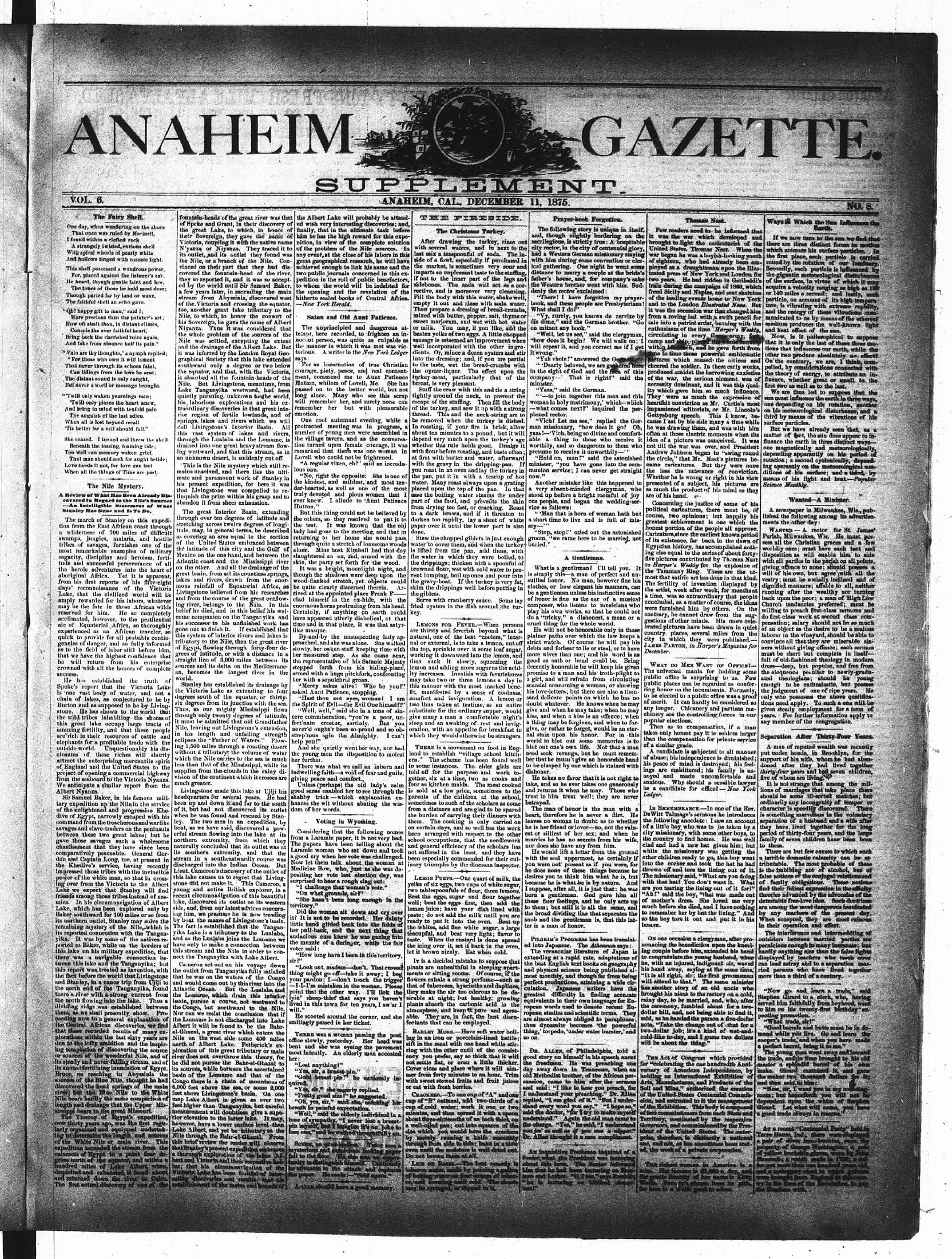
Searchable text
ANAHEIM
VOL. 6.
The Fairy Shell.
One day, when wandering on the shore
That once was ruled by Marinell,
I found within a cleft rock
A strangely twisted, curious shell
With spiral whorls of pearly white
And hollows tinged with roseate light.
This shell possessed a wondrous power,
For, placed against the listener's ear,
He heard, though gentle faint and low,
The tomes of those he held most dear;
Though parted far by land or wave,
The faithful shell an echo gave.
"Oh! happy gift to man," said I;
More precious than the painter's art;
How oft shalt thou, in distant climes,
Console the ever faithful heart;
Bring back the cherished voice again,
And take from absence half its pain."
"Vain are thy thoughts," a nymph replied;
"For those who own it will lament
That never through its echoes faint,
Can tidings from the love be sent;
The distant sound is only caught,
But never a word or message brought.
"Twill only waken yearnings vain;
Twill only pierce the heart anew,
And bring to mind with tenfold pain
The anguish of the last adieu.
When all is lost beyond recall
Tis better far a vell should fall."
She ceased. I turned and threw the shell
Beneath the tossing, foaming tide;
Too well can memory waken grief,
That man should seek for aught betide;
Love needs it not, for love can last
fountain-heads of the great river was that of Speke and Grant, in their discovery of the great Lake, to which, in honor of their Sovereign, they gave the name of Victoria, coupling it with the native name N'yanza or Niyanza. They traced it to its outlet, and its outlet they found was the Nile, or a branch of the Nile. Convinced on their part that they had discovered the fountain-head of the river, they so reported it, and it was so accepted by the world until Sir Samuel Baker, a few years later, in ascending the main stream from Abyssinia, discovered west of the Victoria and crossing the equator, too, another great lake tributary to the Nile, to which, to honor the consort of his Sovereign, he gave the name of Albert Niyanza. Thus it was considered that the whole problem of the sources of the Nile was settled, excepting the extent and the drainage of the Albert Lake. But it was inferred by the London Royal Geographical Society that this lake extended southward only a degree or two below the equator, and that, with the Victoria, it absorbed all the fountain-heads of the Nile. But Livingstone, meantime, from Lake Tanganyika westward, had been quietly pursuing, unknown to the world, his laborious explorations and his extraordinary discoveries in that great interior region of fertile lowlands, and of springs, lakes and rivers which we will call Livingstone's Interior Basin. All this vast system of lakes and rivers, through the Lualaba and the Lomame, is drained into one great heavy stream flowing westward, and that this stream, as in an unknown desert, is suddenly cut off.
This is the Nile mystery which still re-
the Albert Lake will ed with very interest finally, that in the u him he has the high r nation, in view of the of the problem of th any event, at the close great geographical re achieved enough to li two public journals c pedition in the roll o to whom the world w hitherto sealed books — New York Herald.
Satan and Old A
The unprincipled tempt here recorded,
nocent person, was qu
manner in which i torious. A writer in th says:
For an incarnation courage, piety, peace,
ment, commend me Hutton, whilom of Lo passed on to the be long since. Many w will remember her but emotion.
One cool autumnal protracted meeting w number of young men the village tavern, and tion turned upon fem remarked that there w Lovell who could not not "A regular vixen, eh
Can tidings from the love be sent;
The distant sound is only caught,
But never a word or message brought.
"Twil only waken yearnings vain;
Twil only pierce the heart anew,
And bring to mind with tenfold pain
The anguish of the last adieu.
When all is lost beyond recall
Tis better far a vell should fall."
She ceased. I turned and threw the shell.
Beneath the tossing, foaming tide;
Too well can memory waken grief.
That man should seek for aught betide;
Love needs it not, for love can last
When all the things of Time are past.
The Nile Mystery.
A Review of What Has Been Already Discovered in Regard to the Nile's Sources
An Intelligible Statement of What Stanley Has Done and Is To Do.
The march of Stanley on this expedition from the East African coast through a wilderness of 700 miles of difficult swamps, jungles, malaria, and hostile tribes of savages, furnishes one of the most remarkable examples of military sagacity, discipline and heroism, fortitude and successful perseverance of all heroe adventures into the heart of aboriginal Africa. Yet it is apparent, from his first reports of his fifty-eight days' reconnoissance of the Victoria Lake, that the civilized world will be amply rewarded for his labors, whatever may be the fate in those African wilds reserved for him. He so completely acclimated, however, to the pestilential air of Equatorial Africa, so thoroughly experienced as an African traveler, so quick to provide for all probable contingencies of danger, and so fully informed as to the field of labor still before him, that we have the highest confidence that he will return from his enterprise crowned with all the honors of complete success.
He has established the truth of Speke's report that the Victoria Lake is one vast body of water, and not a chain of lakes, as conjectured to be by Burton and as supposed to be Livingstone. He has shown to the world that the wild tribes inhabiting the shores of this great lake occupy large tracts of amazing fertility, and that these people are rich in their resources of cattle and elephants for a profitable trade with the outside world. Unquestionably his disclosures of these riches will shortly attract the enterprising mercantile spirit of England and the United States to the project of opening a commercial highway from the seaboard to the Victoria Nyanza. We anticipate a similar report from the Albert Nyanza.
Sir Samuel Baker, in his famous military expedition up the Nile in the service of the enlightened and progressive Khedive of Egypt, narrowly escaped with his command from the treacherous and warlike savages and slave-traders on the peninsula between these two great lakes; but he gave those savages such a wholesome chastisement that they have since been comparatively peaceable: General Gordon and Captain Long, too, at present in the Khedive's service, having recently impressed those tribes with the invincible power of the white man, so that in crossing over from the Victoria to the Albert Lake we expect that Stanley will find the equator, and that, with the Victoria, it absorbed all the fountain-heads of the Nile. But Livingstone, meantime, from Lake Tanganyika westward, had been quietly pursuing, unknown to the world, his laborious explorations and his extraordinary discoveries in that great interior region of fertile lowlands, and of springs, lakes and rivers which we will call Livingstone's Interior Basin. All this vast system of lakes and rivers, through the Lualaba and the Lomame, is drained into one great heavy stream flowing westward, and that this stream, as in an unknown desert, is suddenly cut off.
This is the Nile mystery which still remains unsolved, and there lies the ultimate and paramount work of Stanley in his present expedition, for here it was that Livingstone was compelled to relinquish the prize within his grasp and to abandon it from sheer exhaustion.
The great Interior Basin, extending through over ten degrees of latitude and stretching across twelve degrees of longitude, may, in general terms, be described as covering an area equal to the section of the United States embraced between the latitude of this city and the Gulf of Mexico on the one hand, and between the Atlantic coast and the Mississippi river on the other. And all the drainage of the great basin, from all its countless springs, lakes and rivers, drawn from the enormous rainfall of Equatorial Africa, as Livingstone believed from his researches and from the course of the great outflowing river, belongs to the Nile. In this belief he died, and in this belief his welcome companion on the Tangaryika and his successor to his unfinished work has gone out to finish it. If established that this system of Interior rivers and lakes is tributary to the Nile, then the great river of Egypt, flowing through forty-four degrees of latitude, or with a distance in a straight line of 3,000 miles between its sources and its delta on the Mediterranean, becomes the longest river in the world.
Stanley has established its drainage by the Victoria Lake as extending to four degrees south of the equator, or thirty-six degrees from its junction with the sea. Thus, as our mighty Mississippi flows through only twenty degrees of latitude, it must be admitted that old Grandfather Nile, leaving out Livingstone's extension, in his length and unfailing strength eclipses the "Father of Waters." Flowing 1,500 miles through a roasting desert without a tributary; the volume of water which the Nile carries to the sea is much less than that of the Mississippi, while its supplies from the clouds in the rainy division of the continent which it crosses are much greater.
Livingstone made this lake at Ujiji his headquarters for several years. He had been up and down it and far to the south of it, but had not discovered its outlet when he was found and rescued by Stanley. The two men in an expedition, by boat, as we have said, discovered a powerful stream flowing into the lake at its northern extremity, from which they naturally concluded that its outlet was at its southern extremity, and that the stream in a southeastwardly course was discharged into the Indian Ocean. But Lieut. Cameron's discovery of the outlet of this lake causes us to regret that Livingstone did not make it. This Cameron, a young and active British explorer in a courageful piety peacefully resided on Hutton, whilom of Lovell passed on to be long since. Many who will remember her but remember her but emotion.
One cool autumnal protracted meeting with number of young men;the village tavern,and tion turned upon female remarked that there were Lovell who could not not "A regular vixen,ehlous one.
"No, right the oppose,the kindest,and mildder-hearted.as well as truly devoted and pious ever knew.I allude Hutton."
But this thing could not die,the others,so they read the test. It was knot lady had gone to to me returning to her home through quite a stretch alone. Mine host King slaughtered an ox,and skin,the party set forth.
It was a bright moon though the shadows were wood-flanked stretch,and be quite clearly discerned at the appointed place himself in the obernormous horns protrud Certainly,if anything have appeared utterly time and in that place like masque.
By-and-by the unsurproached,and she was slowly,here oaken staff her measured step.Athe representative of her stepped forth from armed with a huge pitcher her with a sepulchral gren
"Mercy sakes alive asked Aunt Patience,she "Hast thou not eye the Spirit of Evil—the "Well ,well," said she cere commiseration,"yo fort'nate creetur,sart never'd ought'r been so strep'rous agin the Athe help you!"
And she quietly went,the young men diehher further.
There was what we can indwelling faith—a void giving peace and comfort Unless (perhaps)the good sense enabled her shabily trick—which hances the wit without dom of her words.
Voting in Wyoming
Considering that she from a Laramie paper,she "The papers have been Laramie woman who sailed a good cry when her vote Now let let them talk about Medicine Bow,bow positing her vote last surprised to hear a rough "I challenge that work
Sir Samuel Baker, in his famous military expedition up the Nile in the service of the enlightened and progressive Khodive of Egypt, narrowly escaped with his command from the treacherous and warlike savages and slave-traders on the peninsula between these two great lakes; but he gave those savages such a wholesome chastisement that they have since been comparatively peaceable. General Gordon and Captain Long, too, at present in the Khedive's service, having recently impressed those tribes with the invincible power of the white man, so that in crossing over from the Victoria to the Albert Lake we expect that Staplier will find friends among those tribes instead of enemies. In his circumnavigation of Albert Lake, which has been explored only by Baker southward for 100 miles or so from its northern outlet, Stanley may solve the remaining mystery of the Nile—which is its reported connection with the Tanganyika. It was by some of the natives reported to Baker, while on the borders of this lake on his military expedition, that there was a navigable connection between this lake and the Tanganyika; but this report was treated as invention, with the fact before the world that Livingstone and Stanley, in a canoe trip from Ujiji to the north end of the Tanganyika, found there a river with a strong current from the north flowing into the lake. Thus a dividing ridge was established between them, as we shall presently show. Proceeding now to a general explanation of the Central African discoveries, we find that these recorded results of many explorations within the last sixty years are due to the lofty ambition and the inspiring temptation of discovering the source or sources of the wonderful Nile, and of its steady and never-failing stream, and of its annual fertilizing inundation of Egypt. Bruce, on reaching in Abyssinia the sources of the Blue Nile, thought he had discovered the head springs of the main river; but the Blue Nile to the White Nile bears hardly the same comparison of length and drainage that the Upper Mississippi bears to the great Missouri.
The Viceroy of Egypt's expedition, over thirty years ago, was the first regularly organized and equipped undertaking to determine the length and sources of the White Nile or main river. This expedition ascended the stream from the cataracts of Egypt to a point four degrees north of the equator, and within a hundred miles of Lake Albert, when, displaced and exhausted, it faced about and returned down the river to Cairo. The first actual discovery of one of the Livingstone made this lake at Ujiji his headquarters for several years. He had been up and down it far and far to the south of it, but had not discovered its outlet when he was found and rescued by Stanley. The two men in an expedition, by boat, as we have said, discovered a powerful stream flowing into the lake at its northern extremity, from which they naturally concluded that its outlet was at its southern extremity, and that the stream in a southeastwardly course was discharged into the Indian Ocean. But Lieut. Cameron's discovery of the outlet of this lake causes us to regret that Livingstone did not make it. This Cameron, a young and active British explorer, in a recent circumnavigation of this beautiful lake, discovered its outlet on its western side, and, from our latest advices concerning him, we presume he is now treading by boat the mazes of Livingstone's basin. The fact is established that the Tanganyika Lake is a tributary to the Lualaba, and as the Lualaba joins the Lomame we have only to make a connection between this stream and the Nile in order to connect the Tanganyika with Lake Albert.
Cameron set out on his voyage down the outlet from Tanganyika fully satisfied that he was on the waters of the Congo and would come out by this river into the Atlantic Ocean. But the Lualaba and the Lomame, which drains this interior basin, pursue a course, not westward to the Congo, but northward to the Nile. Nor can we resist the conclusion that if the Lomame is not discharged into Lake Albert it will be found to be the Bahre-al-Ghazal, a great river which enters the Nile on the west side some 400 miles north of Albert Lake. Petherick's exploration of this great tributary or main river does not overthrow this theory, for he did not pursue the Bahr-el-Ghazal to its sources, while between the ascertained basin of the Lomame and that of the Congo there is a chain of mountains of 5,000 feet above the sea, or some 2,000 feet above Livingstone's basin. On one map Lake Albert is given as over two feet higher than Tanganyika, but careful measurement will doubtless give a superior elevation to the latter lake. It may, however, have a lower surface level than Lake Albert, and yet be tributary to the Nile through the Bahr-el-Ghazal. From this brief review the reader will observe that Staplier's present expedition embarks a thorough exploration of the lakes Albert and Victoria and their respective basins; that his circumnavigation of the Victoria Lake has been fruitful of interesting discoveries and results; that his establishment of the maps and bounds of good sense enabled her shabby trick—which hances the wit without dom of her words.
Voting in Wy
Considering that she from a Laramie paper,
The papers have been Laramie woman who sailed a good cry when her vote Now let them talk about Medicine Bow, who just positing her vote last surprised to hear a rough "I challenge that won" "On what grounds," "She hasn't been long territory."
Did the woman sit down it? It is not to be recount little hand glided back her pull-back, and she audacious cuss knew how she muzzle of a deringer voter said:
"How long have I been sir?"
"Look out, madam—thing might go off—take your pardon; I—don't try—I-I I'm mistaken in this point that other water lily' sheep-thief that lived in this town for ten will."
He scooted around them smilingly passed in her t
Thakrk was a woman office slowly, yesterday. bent and she was eyeing most intently. An elder her:
"Lost anything!"
"Yes, sir, a breast-pin"
"Gold breast-pin!"
quired.
"Yes, sir," she sugarly "Pretty good size!" he "Oh, yes, sir," said al breath in painful expectation well to distinguish film his advances to the altitude
the paper. He reads:—
A LIAR should have a
ALM GAS
SUPPLEMENT.
ANAHEIM, CAL., DECEMBER 11, 1875.
the Albert Lake will probably be attended with very interesting discoveries; and, finally, that in the ultimate task before him he has the high reward for this expedition, in view of the complete solution of the problem of the Nile sources. In any event, at the close of his labors in this great geographical research, he will have achieved enough to link his name and the two public journals concerned in this expedition in the roll of public benefactors, to whom the world will be indebted for the opening and the revelation of the hitherto sealed books of Central Africa. —New York Herald.
Satan and Old Aunt Patience.
The unprincipled and dangerous attempt here recorded, to frighten an innocent person, was quite as culpable as the manner in which it was met was victorious. A writer in the New York Ledger says:
For an incarnation of true Christian courage, piety, peace, and real contentment, commend me to Aunt Patience Hutton, whilom of Lovell, Me. She has passed on to the better world, but not long since. Many who see this scrap will remember her, and surely none can remember her but with pleasurable emotion.
One cool autumn evening, while a protracted meeting was in progress, a number of young men were assembled in the village tavern, and as the conversation turned upon female courage, it was remarked that there was one woman in Lovell who could not be frightened.
"A regular vixen, eh?" said an incredulous one.
THE FIRESIDE.
The Christmas Turkey.
After drawing the turkey, rinse out with several waters, and in next to the last mix a teaspoonful of soda. The inside of a fowl, especially if purchased in the market, is sometimes very sour and imparts an unpleasant taste to the stuffing, if not to the inner part of the legs and sidebones. The soda will act as a corrective, and is moreover very cleansing. Fill the body with this water, shake well, empty it out and rinse with soda water. Then prepare a dressing of bread-crumbs, mixed with butter, pepper, salt, thyme or sweet marjoram, and wet with hot water or milk. You may, if you like, add the beaten yolks of two eggs. A little chopped sausage is esteemed an improvement when well incorporated with the other ingredients. Or, mince a dozen oysters and stir into the dressing; and, if you are partial to the taste, wet the bread-crumbs with the oyster-liquor. The effect upon the turkey-meat, particularly that of the breast, is very pleasant.
Stuff the craw with this and tie a string tightly around the neck, to prevent the escape of the stuffing. Then fill the body of the turkey, and sew it up with a strong thread. This and the neck-string are to be removed when the turkey is dishevelled. In roasting, if your fire is brisk, allow about ten minutes to a pound, but it will depend very much upon the turkey's age whether this rule holds good. Dredge it with flour before roasting, and baste often; at first with butter and water, afterward with the gravy in the dripping-pan. If roast in an oven and let it turn in.
Prayer-book Forgotten.
The following story is unique in itself, and though slightly bordering on the sacrilegious, is strictly true: A hospitable city rector, in the city of centennial glory, had a Western German missionary staying with him during some convention or clerical gathering. One night he went some distance to marry a couple at the bride's father's house, and, for company's sake the Western brother went with him. Suddenly the rector exclaimed:
"There! I have forgotten my prayer-book, and these people are Presbyterians! What shall I do?"
Vy, surely, you knows de zervize by dis dime," said the German brother. "Go on mitout any book."
Well, let us see," said the clergyman, "how does it begin? We will walk on; I will repeat it, and you correct me if I get it wrong."
"Yah whole!" answered the German.
"Dearly beloved, we are gathered here in the sight of God and the face of this company—" That is right!" said the minister.
"Yaa," said the German.
"—to join together this man and this woman in holy matrimony,' which—which—what comes next!" inquired the perplexed rector.
"Vich? Let me see," replied the German missionary, "how does it go? Oh, yaas!—Vich, being so divine and comfortable a thing to those who receive it worthily, and so dangerous to them who presume to receive it unworthily—"
"Hold on, man!" said the astonished minister, "you have gone into the communion." I am not sure how many times this phrase has been used in newspapers over time. It seems to be more frequently used in religious contexts than in secular ones.
courage, piety, peace, and real contentment, commend me to Aunt Patience Hutton, whilom of Lovell, Me. She has passed on to the better world, but not long since. Many who see this scrap will remember her, and surely none can remember her but with pleasurable emotion.
One cool autumnal evening, while a protracted meeting was in progress, a number of young men were assembled in the village tavern, and as the conversation turned upon female courage, it was remarked that there was one woman in Lovell who could not be frightened.
"A regular vixen, eh?" said an incredulous one.
No, right the opposite: She is one of the kindest, and mildest, and most tender-hearted, as well as one of the most truly devoted and pious women that I ever knew. I allude to "Aunt Patience Hutton."
But this thing could not be believed by the others, so they resolved to put it to the test. It was known that the old lady had gone to the meeting, and that in returning to her home she would pass through quite a stretch of lonesome woods alone. Mine host Kimball had that day slaughtered an ox, and, armed with the skin, the party set forth for the wood.
It was a bright moonlight night, and though the shadows were deep upon the wood-flanked stretch, yet objects could be quite clearly discerned therein. Arrived at the appointed place Frank F—clad himself in the ox-hide, with the enormous horns protruding from his head. Certainly, if anything on earth could have appeared utterly diabolical, at that time and in that place, it was that satyr-like masque.
By-and-by the unsuspecting lady approached, and she was alone. She walked slowly, her oaken staff keeping time with her measured step. As she came near, the representative of his Satanic Majesty stepped forth from his hiding-place, armed with a huge pitchfork, confronting her with a sepulchral groan.
"Mercy sakes alive! Who be you?" asked Aunt Patience, stopping.
"Hast thou not eyes, woman? I am the Spirit of Evil—the Evil One himself!" "Well, well," said she in a tone of sincere commiseration, "you're a poor, unfortunate creetur, sartingly. But you never'd ought's been so proud and so obstrep'rous agin the Almighty. I can't help you!" And she quietly went her way, nor had the young men the disposition to molest her further.
There was what we call an inborn and indwelling faith—a void of fear and guile, giving peace and comfort.
Unless (perhaps) the old lady's calm good sense enabled her to see through the shabby trick—which explanation enhances the wit without abating the wisdom of her words.
Voting in Wyoming.
Considering that the following comes from a Laramie paper, it is not very bad. The papers have been telling about the Laramie woman who sat down and took a good cry when her vote was challenged. Now let them talk about the woman at Medicine Bow, who just as she was depositing her vote last election day, was surprised to hear a rough sing out:
"I challenge that woman's vote."
LEMONS FOR FEVER. When persons are thirsty and feverish beyond what is natural, one of the best "coolers," internal or external, is to take a lemon, cut off the top, sprinkle over it some loaf sugar, working it downward into the lemon, and then suck it slowly, squeezing the lemon and adding more sugar as the acidity increases. Invalids with feverishness may take two or three lemons a day in this manner with the most marked benefit, manifested by a sense of coolness, comfort and invigoration. A lemon or two thus taken at teatime, as an entire substitute for the ordinary supper, would give many a man a comfortable night's sleep and an awakening of rest and invigoration, with an appetite for breakfast to which they would otherwise be strangers.
There is a movement on foot in England to establish "village school kitchens." The scheme has been found well in some instances. The elder girls are told off for the purpose and work together, six at a time, two as cooks and four as kitchen maids. The meat cooked is sold at a low price, sometimes to the parents of the children at the school, sometimes to such of the scholars as come from a distance and are glad to be spared the burden of carrying their dinners with them. The cooking is only carried on on certain days, and so well has the work been arranged with respect to the other school occupations, that the needlework and general efficiency of the scholars has not suffered in the least, and they have especially commended for their culinary triumphs by the dioecesan inspector.
LEMON PUPS. One quart of milk, the yelks of six eggs, two cups of white sugar, two tablespoons of milk powder is to be removed when the turkey is dished. In roasting, if your fire is brisk, allow about ten minutes to a pound, but it will depend very much upon the turkey's age whether this rule holds good. Dredge it with flour before roasting, and baste often; at first with butter and water, afterward with the gravy in the dripping-pan. If you roast in an oven and lay the turkey in the pan, put it in with a teacup of hot water. Many roast always upon a grating placed upon the top of the pan. In that ease the boiling water steams the under part of the fowl, and prevents the skin from drying too fast, or cracking. Roast to a dark brown, and if it threaten to darken too rapidly, lay a sheet of white paper over it until the lower part is also done.
Stew the chopped giblets in just enough water to cover them, and when the turkey is lifted from the pan, add these, with the water in which they were boiled, to the drippings; thicken with a spoonful of browned flour, wet with cold water to prevent lumping, boil up once and pour into the gravy-boat. If the turkey is very fat, skim the drippings well before putting in the giblets.
Serve with cranberry sauce. Some lay fried oysters in the dish around the turkey key.
LEMONS FOR FEVER. When persons are thirsty and feverish beyond what is natural, one of the best "coolers," internal or external, is to take a lemon, cut off the top, sprinkle over it some loaf sugar, working it downward into the lemon, and then suck it slowly, squeezing the lemon and adding more sugar as the acidity increases. Invalids with feverishness may take two or three lemons a day in this manner with the most marked benefit, manifested by a sense of coolness, comfort and invigoration. A lemon or two thus taken at teatime, as an entire substitute for the ordinary supper would give many a man a comfortable night's sleep and an awaking of rest and invigoration, with an appetite for breakfast to which they would otherwise be strangers.
There is a movement on foot in England to establish "village school kitchens." The scheme has been found well in some instances. The elder girls are told off for the purpose and work together, six at a time, two as cooks and four as kitchen maids. The meat cooked is sold at a low price, sometimes to the parents of the children at the school, sometimes to such of the scholars as come from a distance and are glad to be spared the burden of carrying their dinners with them. The cooking is only carried on on certain days, and so well has the work been arranged with respect to other school occupations, that the needlework and general efficiency of the scholars has not suffered in the least, and they have especially commended for their culinary triumphs by the dioecesan inspector.
LEMON PUPS. One quart of milk, the yelks of six eggs, two cups of white sugar, two tablespoons of milk powder is to be removed when the turkey is dished. In roasting, if your fire is brisk, allow about ten minutes to a pound, but it will depend very much upon the turkey's age whether this rule holds good. Dredge it with flour before roasting,and baste often; at first with butter and water, afterward with the gravy in the dripping-pan. If you roast in an oven and lay the turkey in the pan, put it in with a teacup of hot water. Many roast always upon a grating placed upon the top of the pan. In that ease the boiling water steams the under part of the fowl,and prevents the skin from drying too fast,或 cracking. Roast to a dark brown,and if it threaten to darken too rapidly,Lay a sheet of white paper over it until the lower part is also done.
Stew the chopped giblets in just enough water to cover them,and when the turkey is lifted from the pan,加这些with water in which they were boiled,到drippings; thicken with a spoonful of browned flour,twice cold,and then suck it slowly,squeezingthe lemon and adding more sugar asthe acidityincreases.Invalidswithfeverishnessmaytaketwoorthreelemonsadayinthismannerwiththemostmarkedbenefit manifestedbya senseofcoolnesscomfortandinvigoration.Alemonor twothustakenatteattime.asanent substitutefortheordinarysupper,givemanyamancomfortablenight'ssleepandanawakkingofrestandinvigoration.withanappetiteforebreakfasttowhichtheywouldotherwisebestrangers.
ThereisamovementonfootinEnglandtocastlishandfeverishbeyondwhatisnaturaloneofthebest"coolers"internalorexternalistotakealowprice,sometimestotheparentsofthechildrenattheschool,sometimestotuchofthescholarsascomefroma distanceandaregladtobsparedtheburdenofcarryingtheirdinnerswiththem.Thecookingisonlycarriedononcertaindays,andsowellhastheworkbeenarrangedwithrespecttotheotherschooloccupations,theneedleworkandgeneralefficiencyofthescholarshasnotsufferedintheleast,andtheyhaveespeciallycommendedfortheculinarytriumphsbylearnofmoneywhatisbutbecauseheisbyneitherbitethoughthimwhatheis,butbecauseheisbyneitherbitethoughthimwhatheis,butbecauseheisbyneitherbitethoughthimwhatheis,butbecauseheisbyneitherbitethought himwhatheis,butbecauseheisbyneitherbitethought himwhatheis,butbecauseheisbyneitherbitethought himwhatheis,butbecauseheisbyneitherbitethought himwhatheis,butbecauseheisbyneitherbitethought himwhatheis,butbecauseheisbyneitherbitethought himwhatheis,butbecauseheisbyneitherbitethought himwhatheis,butbecauseheisbyneitherbitethought himwhatheis,butbecauseheisbyneitherbitethought himwhatheis,butbecauseheisbyneitherbitethought himwhatheis,butbecauseheisbyneitherbitethought himwhatheis,butbecauseheisbyneitherbitethought himwhatheis,butbecauseheisbyneitherbitethought himwhatheis,butbecauseheisbyneitherbitethought himwhatheis,butbecauseheisbyneitherbitethought himwhatheis,butbecauseheisbyneitherbitethought himwhatheis,butbecauseheisbyneitherbitethought himwhatheis,butbecauseheisbyneitherbitethought himwhatheis,butbecauseheisbyneitherbitethought himwhatheis,butbecauseheisbynetherbitethought himwhatheis,butbecauseheisbynetherbitethought himwhatheis,butbecauseheisbynetherbitethought himwhatheis,butbecauseheisbynetherbitethought himwhatheis,butbecauseheisbynetherbitethought himwhatheis,butbecauseheisbynetherbitethought himwhatheis,butbecauseheisbynetherbitethought himwhat heis,butbecausehеe是勿死不死不死不死不死不死不死不死不死不死不死不死不死不死不死不死不死不死不死不死不死不死不死不死不死不死不死不死不死不死不死不死不死不死不死不死不死不死不死不死不死不死不死不死不死不死不死不死不死不死不死不死不死不死不死不死不死不死不死不死不死不死不死不死不死不死不死不死不死不死不死不死不死不死不死不死不死不死不死不死不死不死不死不死不死不死不死不死不死不死不死不死不死不死不死不死不死不死不死不死不死不死不死不死不死不死不死不死不死不死不死不死不死不死不死不死不死不死不死不死不死不死不死不死坏死坏死坏死坏死坏死坏死坏死坏死坏死坏死坏死坏死坏死坏死坏死坏死坏死坏死坏死坏死坏死坏死坏死坏死坏死坏死坏死坏死坏死坏死坏死坏死坏死坏死坏死坏死坏死坏死坏死坏死坏死坏死坏死坏死坏死坏死坏死坏死坏死坏死坏死坏死坏死坏死坏死坏死坏死坏死坏死坏死坏死坏死坏死坏死坏死坏死坏死坏死坏死坏死坏死坏死坏死坏死坏死梗死梗死梗死梗死梗死梗死梗死梗死梗死梗死梗死梗死梗死梗死梗死梗死梗死梗死梗死梗死梗死梗死梗死梗死梗死梗死梗死梗死梗死梗死梗死梗死梗死梗死梗死梗死梗死梗死梗死梗死梗死梗死梗死梗死梗死梗死梗死梗死梗死梗死梗死梗死梗死梗死梗死梗死寝寝寝寝寝寝寝寝寝寝寝寝寝寝寝寝寝寝寝寝寝寝寝寝寝寝寝寝寝寝寝寝寝寝寝寝寝寝寝寝寝寝寝寝寝寝寝寝寝寝寝寝寝寝寝寝寝寝寝寝寝寝寝寝寝寝寝寝寝寝寝寝寝寝寝寝寝寝寝寝寝寝寝寝寝寝寝寝寝寝寝寝寝寝寝寝寝寝寝寝寝寐寐寐寐寐寐寐寐寐寐寐寐寐寐寐寐寐寐寐寐寐寐寐寕寕寕寕寕寕寕寕寕寕寕寕寕寕寕寕寕寕寕寕寕寕寕寕寕寕寕寕寕寕寕寕寕寕寕寕寕寕寕寕寕寕寕寕寕寕寕寕寕寕寕寕寕寕寕宽宽宽宽宽宽宽宽宽宽宽宽宽宽宽宽宽宽宽宽宽宽宽宽宽宽宽宽宽宽宽宽宽宽宽宽宽宽宽宽宽宽宽宽宽宽宽宽宽宽宽宽宽宽宽宽宽宽宽宽宽宽宽宽度宽度宽度宽度宽度宽度宽度宽度宽度宽度宽度宽度宽度宽度宽度宽度宽度宽度宽度宽度宽度宽度宽度宽度宽度宽度宽度宽度宽度宽度宽度宽度宽度宽度宽度宽度宽度宽度宽度宽度宽度宽度宽度宽度宽度宽度宽度宽度宽度宽度宽度宽度宽度宽度宽度宽度宽度宽度维度维度维度维度维度维度维度维度维度维度维度维度维度维度维度维度维度维度维度维度维度维度维度维度维度维度维度维度维度维度维度维度维度维度维度维度维度维度维度维度维度维度维度维度维度维度维度维度维度维度维度维度维度维度维度维度维度维度维度维度维度维度维度维度维度维度维度维度维度维度维度维度维度维度DimensionDimensionDimensionDimensionDimensionDimensionDimensionDimensionDimensionDimensionDimensionDimensionDimensionDimensionDimensionDimensionDimensionDimensionDimensionDimensionDimensionDimensionDimensionDimensionDimensionDimensionDimensionDimensionDimensionDimensionDimensionDimensionDimensionDimensionDimensionDimensionDimensionDimensionDimensionDimensionDimensionDimensionDimensionDimensionDimensionDimensionDimensionDimensionDimensionDimensionDimensionDimensionDimensionDimensionDimensionDimensionDimensionDimensionDimensionDimensionDimensionDimensionDimensionDimensionDimensionDimensionDimensionDimensionDimensionDimensionDimensionDimension dimension Dimension Dimension Dimension Dimension Dimension Dimension Dimension Dimension Dimension Dimension Dimension Dimension Dimension Dimension Dimension Dimension Dimension Dimension Dimension Dimension Dimension Dimension Dimension Dimension Dimension Dimension Dimension Dimension Dimension Dimension Dimension Dimension Dimension Dimension Dimension Dimension Dimension Dimension Dimension Dimension Dimension Dimension Dimension Dimension Dimension Dimension Dimension Dimension Dimensions Dimensions Dimensions Dimensions Dimensions Dimensions Dimensions Dimensions Dimensions Dimensions Dimensions Dimensions Dimensions Dimensions Dimensions Dimensions Dimensions Dimensions Dimensions Dimensions Dimensions DimensionsDimensionsDimensionsDimensionsDimensionsDimensionsDimensionsDimensionsDimensionsDimensionsDimensionsDimensionsDimensionsDimensionsDimensionsDimensionsDimensionsDimensionsDimensionsDimensionsDimensionsDimensionsDimensionsDimensionsDimensionsDimensionsDimensionsDimensionsDimensionsDimensionsDimensionsDimensionsDimensionsDimensionsDimensionsDimensionsDimensionsDimensionsDimensionsDimensionsDimensionsDimensionsDimensionsDimENSIONDimENSIONDimENSIONDimENSIONDimENSIONDimENSIONDimENSIONDimENSIONDimENSIONDimENSIONDimENSIONDimENSIONDimENSIONDimENSIONDimENSIONDimENSIONDimENSIONDimENSIONDimENSIONDimENSIONDimENSIONDimENSIONDimENSIONDimENSIONDimENSIONDimENSIONDimENSIONDimENSIONDimENSIONDimENSIONDimENSIONDimENSIONDimENSIONDimENSIONDimENSIONdimENSIONdimENSIONdimENSIONdimENSIONdimENSIONdimENSIONdimENSIONdimENSIONdimENSIONdimENSIONdimENSIONdimENSIONdimENSIONdimENSIONdimENSIONdimENSIONdimENSIONdimENSIONdimENSIONdimENSIONdimENSIONdimENSIONdimENSIONdimENSIONdimENSIONdimENSIONdimENSIONdimENSIONdimENSIONdimENSIONdimENSIONdimENSIONdimENSIONdimENSIONdimENSIONdimENSIONdimENSIONdimENSIONdimENSIONdimENSIONdimENSIONdimENSIONdimENSIONdimENSIONdimENSIONdimENSIONdimENSIONdimENONDIMENONDIMENONDIMENONDIMENONDIMENONDIMENONDIMENONDIMENONDIMENONDIMENONDIMENONDIMENONDIMENONDIMENONDIMENONDIMENONDIMENONDIMENONDIMENONDIMENONDIMENONDIMENONDIMENONDIMENONDIMENONDIMENONDIMENONDIMENONDIMENONDIMENONDIMENONDIMENONDIMENONDIMENONDIMENONDIMENONDIMENONDIMENONDIMENONDIMENONDIMENONDIMENONDIMENONDIMENONDIMENONDIMENONDIMENONDIMENONDIMENONDIMENONDIMENONDIMENONDIMENONDIMENONDIMENONDIMENONDIMENONDIMENONDIMENONDIMENONDIMENONDIMENONDIMENONDIMENONDIMENONDIMENONDIMENONDimEnNODimEnNODimEnNODimEnNODimEnNODimEnNODimEnNODimEnNODimEnNODimEnNODimEnNODimEnNODimEnNODimEnNODimEnNODimEnNODimEnNODimEnNODimEnNODimEnNODimEnNODimEnNODimEnNODimEnNODimEnNODimEnNODimEnNODimEnNODimEnNODimEnNODimEnNODimEnNODimEnNODimEnNODimEnNODimEnNODimEnNODimEnNODimEnNODimEnNODimEnNODimEnNODimEnNODimEnNODimEnNODimEnNODimEnNODimEnNODimEnNodIm EnNodIm EnNodIm EnNodIm EnNodIm EnNodIm EnNodIm EnNodIm EnNodIm EnNodIm EnNodIm EnNodIm EnNodIm EnNodIm EnNodIm EnNodIm EnNodIm EnNodIm EnNodIm EnNodIm EnNodIm EnNodIm EnNodIm EnNodIm EnNodIm EnNodIm EnNodIm EnNodIm EnNodIm EnNodIm EnNodIm EnNodIm EnNodIm EnNodIm EnNodIm Enn Nod Im Enn Nod Im Enn Nod Im Enn Nod Im Enn Nod Im Enn Nod Im Enn Nod Im Enn Nod Im Enn Nod Im Enn Nod Im Enn Nod Im Enn Nod Im Enn Nod Im Enn Nod Im Enn Nod Im Enn Nod Im Enn Nod Im Enn Nod Im Enn Nod Im Enn Nod Im Enn Nod Im Enn Nod Im Enn Nod Im Enn Nod Im Enn Nod Im Enn Nod Im Enn Nod Im Enn Nod Im Enn Nod Im ennn nn nn nn nn nn nn nn nn nn nn nn nn nn nn nn nn nn nn nn nn nn nn nn nn nn nn nn nn nn nn nn nn nn nn nn nn nn nn nn nn nn nn nn nn nn nn nn nn nn nn nn nn nn nn nn nn nn nn nn nn nn nn nn nn nn nn nn nn nn nn nnNNNNNNNNNNNNNNNNNNNNNNNNNNNNNNNNNNNNNNNNNNNNNNNNNNNNNNNNNNNNNNNNNNNNNNNNNNNNNNNNNNNNNNNNNNNNNNNNNNNNNNNNNNNNNNNNNNNNNNNNNNNNNNNNNNNNNNNNNNNNNNNNNNNNNNNNNNNNNNNNNNNNNNNNNNNNNNNNNNANNANNANNANNANNANNANNANNANNANNANNANNANNANNANNANNANNANNANNANNANNANNANNANNANNANNANNANNANNANNANNANNANNANNANNANNANNANNANNANNANNANNANNANNANNANNANNANNANNANNANNANNANNANNANNANNANNANNANNANNANNANNANNANNANNANNANNANNANNANNANNANNANNANNANNANNANNANNANNANNANNANNANNANNANNANNannnnnnnnnnnnnnnnnnnnnnnnnnnnnnnnnnnnnnnnnnnnnnnnnnnnnnnnnnnnnnnnnnnnnnnnnnnnnnnnnnnnnnnnnnnnnnnnnnnnnnnnnnnnnnennennennennennennennennennennennennennennennennennennennennennennennennennennennennennennennennennennennennennennennennennennennennennennennennennennennennennennennennennennennennennennennennennennennenn Jenn Jenn Jenn Jenn Jenn Jenn Jenn Jenn Jenn Jenn Jenn Jenn Jenn Jenn Jenn Jenn Jenn Jenn Jenn Jenn Jenn Jenn Jenn Jenn Jenn Jenn Jenn Jenn Jenn Jenn Jenn Jenn Jenn Jenn Jenn Jenn Jenn Jenn Jenn Jenn Jenn Jenn Jenn Jenn Jenn Jenn Jenn Jenn Jenn Jenn Jenn Jenn Jenn Jenn Jenn Jenn Jenn Jenn Jenn Jenn Jenn Jenn Jennifer Jennifer Jennifer Jennifer Jennifer Jennifer Jennifer Jennifer Jennifer Jennifer Jennifer Jennifer Jennifer Jennifer Jennifer Jennifer Jennifer Jennifer Jennifer Jennifer Jennifer Jennifer Jennifer Jennifer Jennifer Jennifer Jennifer Jennifer Jennifer Jennifer Jennifer Jennifer Jennifer Jennifer Jennifer Jennifer Jennifer Jennifer Jennifer Jennifer Jennifer Jennifer Jennifer Jennifer Jennifer Jennifer Jennifer Jennifer Jennifer Jennifer Jennifer Jennifer Jennifer Jennifer Jennifer Jennifer Jennifer Jennifer Jennifer Jennifer Jennifer Jennifer Jennifer Jennifer Jennifer Jennifer Jennifer Jennifer Jennifer Jennifer Jennifer Jennifer Jennifer JEJJJJJJJJJJJJJJJJJJJJJJJJJJJJJJJJJJJJJJJJJJJJJJJJJJJJJJJJJJJJJJJJJJJJJJJJJJJJJJJJJJ J J J J J J J J J J J J J J J J J J J J J J J J J J J J J J J J J J J J J J J J J J J J J J J J J J J J J J J J J J J J J J J J J J J J J J J J J J J J J J J j j j j j j j j j j j j j j j j j j j j j j j j j j j j j j j j j j j j j j j j j j j j j j j j j j j j j j j j j j j j j j j j j j j j j j jjjjjjjjjjjjjjjjjjjjjjjjjjjjjjjjjjjjjjjjjjjjjjjjjjjjjjjjjjjjjjjjjjjjjjjjjjjjjjjjjjjjjjjjjjjudjudjudjudjudjudjudjudjudjudjudjudjudjudjudjudjudjudjudjudjudjudjudjudjudjudjudjudjudjudjudjudjudjudjudjudjudjudjudjudjudjudjudjudjudjudjud Jud Jud Jud Jud Jud Jud Jud Jud Jud Jud Jud Jud Jud Jud Jud Jud Jud Jud Jud Jud Jud Jud Jud Jud Jud Jud Jud Jud Jud Jud Jud Jud Jud Jud Jud Jud Jud Jud Jud Jud Jud Jud Jud Jud Jud Jud Jud Jud Jud Jud Jud Jud Jud Jud Jud Jud Jud Jud Judge Judge Judge Judge Judge Judge Judge Judge Judge Judge Judge Judge Judge Judge Judge Judge Judge Judge Judge Judge Judge Judge Judge Judge Judge Judge Judge Judge Judge Judge Judge Judge Judge Judge Judge Judge Judge Judge Judge Judge Judge Judge Judge Judge Judge Judge Judge Judge Judge Judge Judge Judge Judge Judge Judge Judge Judge Judge Judge Judge Judge Justice Justice Justice Justice Justice Justice Justice Justice Justice Justice Justice Justice Justice Justice Justice Justice Justice Justice Justice Justice Justice Justice Justice Justice Justice Justice Justice Justice Justice Justice Justice Justice Justice Justice Justice Justice Justice Justice Justice Justice Justice Justice Justice Justice Justice Justice Justice Justice Justice Justice Justice Justice Justice Justice Justice Justice Justice justice justice justice justice justice justice justice justice justice justice justice justice justice justice justice justice justice justice justice justice justice justice justice justice justice justice justice justice justice justice justice justice justice justice justice justice justice justice justice justice justice justice justice justice justice justice justice justice justice justice justice justice justice justice justice justice justice justice justice justice justice justice justice justice justice justice justice justice injustice injustice injustice injustice injustice injustice injustice injustice injustice injustice injustice injustice injustice injustice injustice injustice injustice injustice injustice injustice injustice injustice injustice injustice injustice injustice injustice injustice injustice injustice injustice injustice injustice injustice injustice injustice injustice injustice injustice injustice injustice injustice injustice injustice injustice injustice injustice injustice injusticejusticejusticejusticejusticejusticejusticejusticejusticejusticejusticejusticejusticejustICEjustICEjustICEjustICEjustICEjustICEjustICEjustICEjustICEjustICEjustICEjustICEjustICEjustICEjustICEjustICEjustICEjustICEjustICEjustICEjustICEjustICEjustICEjustICEjustICEjustICEjustICEjustICEjustICEjustICEjustICEjustICEjustICEjustICEjustICEjustICEjustICEjustICEjustICEjustICEjustICEjustICEjustICEjustICEjustICEjustICEjustICEjustICEjustICERustanceJustICErustanceJustICErustanceJustICErustanceJustICErustanceJustICErustanceJustICErustanceJustICErustanceJustICE
Voting in Wyoming.
Considering that the following comes from a Laramie paper, it is not very bad. The papers have been telling about the Laramie woman who sat down and took a good cry when her vote was challenged. Now let them talk about the woman at Medicine Bow, who just as she was depositing her vote last election day, was surprised to hear a rough sing out:
"I challenge that woman's vote."
"On what grounds, sir?"
"She hasn't been long enough in the territory."
Did the woman sit down and cry over it? It is not to be recorded. Her dalaty little hand glided back into the folds of her pull-back, and the next thing that audacious cus knew he was gazing into the muzzle of a deringer, while the fair voter said:
"How long have I been in this territory, sir?"
"Look out, madam—don't. That cursed thing might go off—take it away; I beg your pardon; I—don't touch the trigger —I-I'm mistaken in the woman. Please point that the other way. I'll lick the lynin' sheep-thief that says you haven't lived in this town for ten years, I sw'ar I will."
He scooted around the corner, and she smilingly passed in her ticket.
There was a woman passing the post office slowly, yesterday. Her head was bent and she was eyeing the pavement most intently. An elderly man accosted her:
"Lost anything!"
"Yes, air, a breast-pin."
"Gold breast-pin!" he anxiously inquired.
"Yes, air," she sugary replied.
"Pretty good size!" he suggested.
"Oh, yes, air," said she, catching her breath in painful expectation.
"Well," said the elderly individual in a tone of sympathy, "I never lost a breast-pin myself, but I imagine it's no joke to lose one," and he walked thoughtfully on.
Some, an unanimous opinion, Tutor uses a mysterious and impolite looking paper fall to the floor. He also sees an opportunity to distinguish himself. Cautiously he advances to the attack and captures the paper. He reads: "Sold again."
A liean should have a good memory.
LEMON PUKES. One quart of milk, the yelks of six eggs, two cups of white sugar, two tablespoonfuls of flour, three lemons. Beat the eggs, sugar and flour together well; beat the eggs first, then add the lemon juice; have your dish lined with paste; do not add the milk until you are ready to put it into the oven. Beat up the whites, add fine white sugar, a large teacupful, and beat very light; flavor to taste. When the custard is done spread the icing over it, set it back in the oven, let it brown nicely. Eat when cold.
It is a decided mistake to suppose that plants are unhealthful in sleeping apartments or sitting rooms. Of course, if the flowers exhale a strong perfume—such as that of tuberoses, hyacinths and daplines—they make the air too odorous to be desirable at night; but healthy: growing plants absorb the carbonic acid in the atmosphere, and keep it pure and agreeable. They are, in fact, the best disinfectants that can be employed.
BARLEY MUSHI. Have soft water boiling in an iron or porcelain-lined kettle; sift in the meal with one hand while stirring with the other until of the consistency you prefer, say so thick that it will not settle flat, or even a little thicker. Cover close and place where it will simmer from forty minutes to an hour. Trim with sweet stewed fruits and fruit juices or eat with fresh berries.
Crackers. To one cup of "A" and one cup of "B" oatmeal, add two-thirds of a cup of cold water; work it one or two minutes, and then spread it with a spoon about three-sixteenths of an inch thick on a well-oiled pan; cut into squares of the size which you would have the crackers by merely running a knife smoothly through from side to side; bake in a slow oven until the moisture is well dried out. Do not brown them at all.
Lion on Roan. The best remedy is tobacco smoke, made by pouring a gallon of boiling water on four ounces of tobacco, and covering until cold. The shouts may be ringed, or dipped in it.
The man of honor is the man with a heart, therefore he is never a flirt. He leaves no woman in doubt as to whether he is her friend or lover—no, not the vainest or silliest of her sex; and when he marries he has no secrets from his wife, nor does she have any from him.
He would lift a letter from the ground with the seal uppermost, as certainly if you were not present as if you were, for he does none of these things because he desires you to think him what he is, but because he is what he is by nature. And I suppose, after all, it is just that: he was born a gentleman. God gave him all these fluer feelings, and he only acts up to them; but still it is all the same, and the broad dividing line that separates the snob and the gentleman is, that this latter is a man of honor.
PILGRIM'S PROGRESS has been translated into Japanese. The Athenaeum says:
The vernacular literature of Japan is extending at a rapid rate, adaptations of the best English text books on geography and physical science being published almost monthly, and though far from being perfect productions, attaining a wide circulation. Japanese writers have the greatest difficulty in finding accurate equivalents in their own language for European words used to denote recent European studies and scientific terms. They are almost always obliged to paraphrase; thus dynamite becomes 'the powerful thing,' torpedo, 'under water burster,' and so on.
Dr. Allen, of Philadelphia, told a good story on himself in his speech anent the freedmen. He was preaching one day away down in Tennessee, when an old Methodist brother, of the African persuasion, came to him after the sermon and said: "I like to hear you preach, for I understand your preaching." Dr. Allen replied, "I am glad of it." "But I understand every word you say." "I hope so," said the doctor; "for I try to make myself understood." Again the old man came to the charge. "Yes," he said; "I understand you jar as if you were a singer." Dr. Allen thought it a ransom compliment.
An ingenuity Freshman Inquired of a Senior what the President was listening about this term. The Senior informed him that he had been lecturing on Humans and Lethar. "O I see," says Fashil; "he is lecturing on biblical characters!"
In Remembrance DeWitt Tall
the followings of a little city mission
the country clad and h
while the other children
into the co
thrown off.
The mission
with that ha
are you tame
"Ah!" said
of mother's
much before
to remember
so the boy
bosom.
On one o
nouncing th
ing couple
he, with an
his hand av
"It is all righ
will attend
has another
rainy day,
the ceremon
dollar bill,
said, as he ha
note, "Take
two-dollar
cold-like to
will be abo
The Act for "celebrati
versary holding an
Arts, Mannu
Soll and Milk
of two comTerritory,
w Governors,
a ident of th
price,
prize,
one and nith
ed,
the work
GAZETTE.
NO. 8
Margaret.
is unique in itself,
ordering on the
true: A hospitable
of centennial glory,
missionary staying
convention or clerght he went some
people at the bride's
company's sake
with him. Sudused:
notten my prayer
are Presbyterians!
wa de zervize by
man brother. "Go
and the clergyman,
he will walk on; I
correct me if I get
and the German们 are gathered here
the face of this
right!" said the
man.
this man and this
y,' which—which
required the perreplied the Gerdoes it go? Oh,
vine and comfortwho receive it
ous to them who
worthily—"
and the astonished
one into the community.
Thomas Nest.
Few readers need to be informed that
it was the war which developed and brought to light the caricaturist of the United States, Thomas Nast. When the war began he was a boyish-looking youth of eighteen, who had already been employed as a draughtsman upon the illustrated press of New York and London for two years. He had ridden in Garlhaldi's train during the campaign of 1860, which freed Sicily and Naples, and sent sketches of the leading events home to New York and to the London Illustrated News. But it was the secession war that changed him from a roving lad with a swift pencil for sale into a patriot artist, burning with the enthusiasm of the time. Harper's Weekly, circulating in every three army, four camp and ship, placed the whole country within his reach, and he gave forth from time to time those powerful emblematic pictures which roused the citizen and cheered the soldier. In these early works, produced amidst the harrowing anxieties of the war, the serious element was of necessity dominant, and it was this quality which gave him so much influence. They were as much the expression of heartfelt conviction as Mr. Curtis's most impassioned editorials, or Mr. Lincoln's Gettyburg speech. This I know, because I sat by his side many a time while he was drawing them, and was with him often at those electric moments when the idea of a picture was conceived. It was not till the war was over, and President Andrew Johnson began to "swing round the circle," that Mr. Nast's pictures became caricatures. But they were none
Ways in Which the Sun Influences the Earth.
If we now turn to the sun we find that there are three distinct forms in motion which animate his surface particles. In the first place, each particle is carried round by the rotation of our luminary. Secondly, each particle is influenced by the gigantic meteorological disturbances of the surface, in virtue of which it may acquire a velocity ranging as high as 130 or 140 miles a second; and lastly, each particle, on account of its high temperature, is vibrating with extreme rapidity, and the energy of these vibrations communicated to us by means of the ethereal medium produces the well-known light and heat effect of the sun.
Now, is it philosophical to suppose that it is only the last of these three motions that influences our earth, while the other two produce absolutely no effect? On the contrary, we are, I think compelled, by considerations connected with the theory of energy, to attribute an influence, whether great or small, to the first two as well as to the last.
We are thus led to suppose that the sun must influence the earth in three ways, one depending on his rotation, another on his meteorological disturbance, and a third by means of the vibrations of his surface particles.
But we have already seen that, as a matter of fact, the sun does appear to influence the earth in three distinct ways—one magnetically and meteorologically, depending apparently on his period of rotation; a second cyclotonically, depending apartantly on the meteorological com-
this happened to clergyman, who roomful of joy the wedding-serwoman hath but is full of misthe astonished be married, not
I'll tell you. It perfect and unhowever fine his manners, can instinctive sense of a musical musicians who that he could not jest, a mean or a world.
only in those the law keeps a will pay his steal, or to have his word is as should be. Being I keep his given troth-plight to from circulating man, or showing are also a thou-which he has no when he may see; when he may offence; when and when to forould be an eter.
For in this memories is to Not that a man must remem-b honorable hand is stained with it is not right to one generously say. Those who they are never
man with a flirt. He at as to whether not the vain and when he from his wife, on him.
from the ground as certainly if you were, for which because he what he is, but my nature. And that; that he was full of misproduced amidst the harrowing anxieties of the war, the serious element was of necessity dominant, and it was this quality which gave him so much influence. They were as much the expression of heartfelt conviction as Mr. Curtis's most impassioned editorials, or Mr. Lincoln's Gettysburg speech. This I know, because I sat by his side many a time while he was drawing them, and was with him often at those electric moments when the idea of a picture was conceived. It was not till the war was over, and President Andrew Johnson began to "swing round the circle," that Mr. Nast's pictures became caricatures. But they were none the less utterance of conviction. Whether he is wrong or right in his view presented of a subject, his pictures are as much the product of his mind as they are of his hand.
Concerning the justice of some of his political caricatures, there must be, of course, two opinions; but happily his greatest achievement is one which the honest portion of the people all approve. Caricature, since the earliest known period of its existence, far back in the dawn of Egyptian history, has accomplished nothing else equal to the series of about forty-five pictures contributed by Thomas Nast to Harper's Weekly for the explosion of the Tammany Ring. These are the utmost satiric art has done in that kind. The fertility of invention displayed by the artist, week after week, for months at a time, was so extraordinary that people concluded, as a matter of course, the ideas were furnished him by others. On the contrary, he cannot draw from the suggestions of other minds. His more celebrated pictures have been drawn in quiet country places, several miles from the city in which they were published.—JAMES PARTON, in Harper's Magazine for December.
WHAT DO MEN WANT OF OFFICE?—The universal mania for holding some public office is surprising to us. Few public places can be regarded as conferring honor on the incumbents. Formerly, to be elected to a public office was a proof of merit. It can hardly be considered so any longer. Chicanery and partisan machinery are the controlling forces in our popular elections.
Then as to compensation, if a man takes only honest pay it is seldom larger than the compensation for private service of a similar grade.
A candidate is subjected to all manner of abuse; his independence is diminished; his peace of mind is destroyed; his feelings are embittered; his family is annoyed and made uncomfortable and anxious. Why should a sensible lawyer be a candidate for office?—New York Ledger.
IN REMEMBRANCE.—In one of the Rev. DeWitt Talmage's sermons he introduces the following anecdote: I saw an account of a little boy who was to be taken by a city missionary, with some other boys, to the country to find homes. He was well clad and had a new hat given him; but while the missionary was getting the other children ready to go, this boy went into the corner and took the hat he had thrown off and tore the lining out of it. The missionary said, "What are you doing with that hat! You don't want it. What are you tearing the lining out of it for?"
the theory of energy, to attribute an influence, whether great or small, to the first two as well as to the last.
We are thus led to suppose that the sun must influence the earth in three ways, one depending on his rotation, another on his meteorological disturbance; and a third by means of the vibrations of his surface particles.
But we have already seen that, as a matter of fact, the sun does appear to influence the earth in three distinct ways—one magnetically and meteorologically, depending apparently on his period of rotation; a second cyclonically, depending apparently on the meteorological conditions of his surface; and a third, by means of his light and heat—Popular Science Monthly.
Wanted—a Minister.
A newspaper in Milwaukee, Wis., published the following among its advertisements the other day:
WANTED — A rector for St. James' Parish, Milwaukee, Wis. He must possess all the Christian graces and a few worldly ones; must have such tact and disposition as will enable him to side with all parties in the parish on all points, giving possession to none; should possess a will of his own, but agree with all the vestry; must be socially inclined and of dignified manners; affable to all, neither running after the wealthy nor turning back upon the poor; a man of High Low Church tendencies preferred; must be willing to preach first-class sermons and do first-class work at second class compensation; salary should not be so much of an object as the desire to be a zealous laborer in the vineyard, should be able to convince all that they are miserable sinners without giving offence; each sermon must be short but complete in itself—full of old-fashioned theology in modern dress—deep, but popular, and free from the eloquence peculiar to newly-graduated theologians; should be young enough to be enthusiastic, but possess the judgment of one ripe years. He only who possesses the above qualifications need apply. To such a one will be given stealthy employment for a term of years. For further information apply to any member of the congregation.
Separation After Thirty-Four Years.
A man of reputed wealth was recently put under honda, in Brooklyn, for the support of his wife, whom he had abandoned after they had lived together thirty-four years and had seven children, five of whom are living.
It is not strange that among the millions of marriages that take place there should be some ill-sorted matches; but ordinarily any incongruity of temper or character is speedily discovered. There is something marvellous in the voluntary separation of a husband and a wife after they have lived together for the long period of thirty-four years, and the large family of seven children have been born to them.
There are but few causes to which such a terrible domestic calamity can be attributable. The most probable of these is the imbibing not of alcohol, but of false notions of the conjugal relations and of family obligations. These notions find their fullest expression in the affinity
IN REMEMBRANCE.—In one of the Rev. DeWitt Talmage's sermons he introduces the following anecdote: I saw an account of a little boy who was to be taken by a city missionary, with some other boys, to the country to find homes. He was well clad and had a new hat given him; but while the missionary was getting the other children ready to go, this boy went into the corner and took the hat he had thrown off and tore the lining out of it. The missionary said, "What are you doing with that hat? You don't want it. What are you tearing the lining out of it for?" "Ah!" said the boy, "that was made out of mother's dress. She loved me very much before she died, and I have nothing to remember her by but the lining." And so the boy tore it out and put it in his bosom.
On one occasion a clergyman, after pronouncing the benediction upon the kneeling couple before him, extended his hand to congratulate the young husband, when he, with an injured, indignant air, waved his hand away, saying at the same time, "It is all right, sir; the first groomman will attend to that." The same minister has another story of an old uncle who brought his niece to the rectory on a cold, rainy day, to be married, and, who, after the ceremony, fumbled about for a two-dollar bill, and not being able to find it, said, as he handed the person a five-dollar note, "Take the change out of that for a two-dollar job; it's a kind of wet-and-cold-like to-day, and I guess two dollars will be about the thing."
The Act of Congress which provided for "celebrating the one hundredth Anniversary of American Independence, by holding an International Exhibition of Arts, Manufactures, and Products of the Soil and Mine," authorized the creation of the United States Centennial Commission, and entrusted to it the management of the Exhibition. This body is composed of two commissioners from each State and Territory, nominated by the respective Governors, and commissioned by the President of the United States. The enterprise, therefore, is distinctly a national one, and not as has sometimes been stated, the work of a private corporation.
Two rich women in America in a mine. Her income is $1,000 a day, and the gentle fondness of her name in Kitty Wolfe. Poverty's phone learns its pills, for here is a Wolf good to adore.
There is something marvous in the voluntary separation of a husband and a wife after they have lived together for the long period of thirty-four years, and the large family of seven children have been born to them.
There are but few causes to which such a terrible domestic calamity can be attributable. The most probable of these is the imbibing not of alcohol, but of false notions of the conjugal relations and of family obligations. These nations find their fullest expression in the affinity theories advanced by the advocates of the detestable free-love idea. Such doctrines are among the most dangerous insultated by any teachers of the present day. When accepted, they are most ruinous in their operation and effect.
The interference and intermedding of outsiders between married parties are pernicious enough in many instances; but hardly anything else than the false lights displayed by teachers who teach error can lead astray and to a separation married persons who have lived together more than a third of a century.
"Now go and learn a trade," said Stephen Girard to a clerk, who, having served him faithfully from boyhood, went to him on his twenty-first birthday expecting promotion.
"What trade, sir!"
"Good barrole and butts must be in demand while you live. Go and learn the cooper's trade, and when you have made a perfect barrel, bring it to me."
The young man went away and learned the trade, and in time brought to his old master a splendid barrel of his own make. Girard examined it, and gave the maker two thousand dollars for it; and then said to him:
"Now, sir, I want you in my counting-room; but henceforth you will not be dependent upon the whim of Stephen Girard. Let what will come, you have a good trade always in marmor."
At a recent "Centennial Party" held in Tette Hante, Ind., there were displayed a pair of silver horse-buckles; once the prosperity of George Washington: a pair of yellow harness gloves worn by John Hancock; a watch made in 1780; a dart-gun more than one hundred years old, and a maligny chest in which glories were brought from England to thenceby in the time of the Revolution, to pay the Hancocks with.