anaheim-gazette 1875-12-04
Scanned page
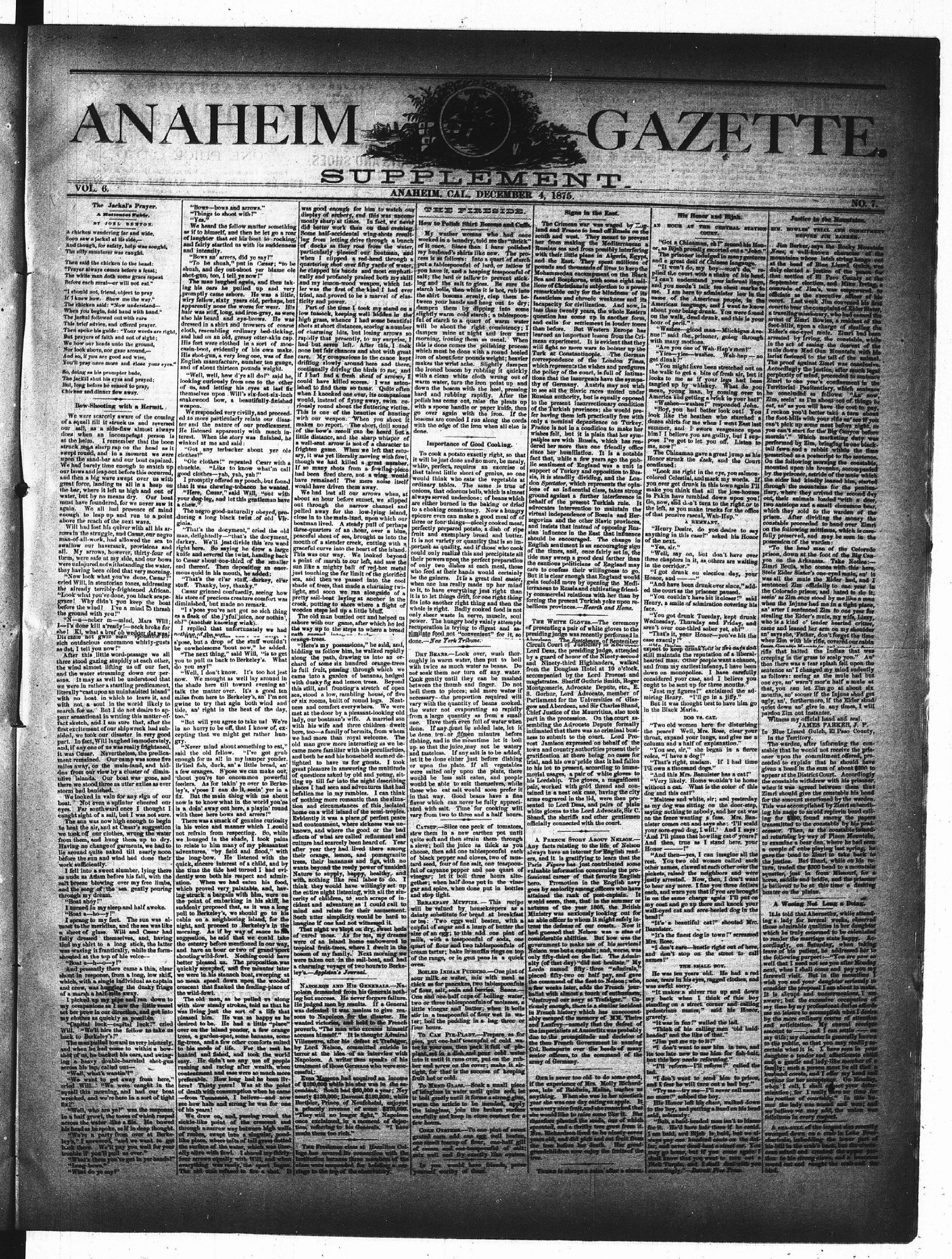
Searchable text
The Jackal's Prayer.
A Mottenton Table.
BY JOEL BENTON.
A chicken wandering far and wide,
Boon saw a jackal at his side,
And though, for safety, help was sought,
The silly saunterer was caught.
Then said the chicken to the beast:
"Prayer always comes before a feast;
The white man doth some grace repeat
Before each meal—or will not eat."
"I should not, friend, object to pray
If I knew how. Show me the way."
The chicken said: "Now understand—
When you begin, fold hand with hand."
The jackal followed out with ears
This brief advice, and offered prayer.
Then spoke his guide: "Your words are right,
But prayers of faith and not of sight;
We bow our heads unto the ground,
Nor look above, nor gaze around,
And so, if you are good and wise,
You'll pray once more and close your eyes."
So, doing as his prompter bade,
The jackal shut his eyes and prayed;
But, long before he ceased to pray,
Chicken and dinner flew away.
Dow-Shooting with a Hermit.
We were scarcely aware of the coming of a squall till it struck us and reversed our sail, as a side-flaw almost always does when an incompetent person is at the helm. I remember that the boon struck me sharp rap on the head as it swept round, and in a moment we were upon the sand-bar and our boat capized. We had barely time enough to snatch up
"Bows—bows and arrows."
"Things to shoot with?"
"Yes."
We heard the fellow mutter something as if to himself, and then he let go a roar of laughter that set his boot to rocking, and fairly startled us with its suddenness and intensity.
"Bows an' arrers, did ye say?"
To be shuah," put in Caesar; "to be shuah, and dey out-shoot yer blame ole shot-gun, too, I tell ye now!"
The man laughed again, and then taking his oars he pulled up and very promptly came ashore. He was a little, wiry fellow, sixty years old, perhaps, but apparently none the worse for wear. His hair was stiff, long, and iron-gray, as were also his beard and eye-brows. He was dressed in a shirt and trowers of coarse cloth, resembling ordinary bed-tickling, and had on an old, greasy otter-skin cap. His feet were clothed in a sort of moe-casin-boot, evidently of his own make. His shot-gun, a very long one, was of fine English manufacture, number ten gauge, and of about thirteen pounds weight.
"Well, well, how d'ye all do?" said he, looking curiously from one to the other of us, and letting his eyes at last fix themselves upon Will's six-foot-six-inch snakewood bow, a beautifully-finished weapon.
We responded very civilly, and proceeded to more particularly relate our disaster and the nature of our predicament. He listened apparently with much interest. When the story was finished, he winked at me and said:
"Got any terbacker about yer ole clothes?"
"Ole clothes!" repeated Caarr with a chuckle.
Like to know what I'm call was good enough for display of archery, monly sharp at time did better work than Some half-accidentally from letting dr of ducks as they r particularly pleased when I clipped a quartering shot over he clapped his hands cally and profanely w and my lemon-wood ler was the first of tried, and proved to ticity and power.
Part of the time I low tussock, keeping high grass, whence shots at short distance of charming hits, but rapidly that present had but seven left. none but fair chance care. My companion drifted slowly around continually driving th if I had had a fresh could have killed se ished to find them so when I knocked one would instead of flyriously round about th This is one of the b with our weapon. W makes no report. The of the bow's recoil o little distance, and th a well-sent arrow is m frighten game. Wh arry, it was yet literally though we had killed If so many shots fro
Doing as his prompt bade,
The jackal shut his eyes and prayed;
But, long before he ceased to pray,
Chicken and dinner flew away.
Bow-Shooting with a Hermit
We were scarcely aware of the coming of a squall till it struck us and reversed our self, as a side-flaw almost always does when an incompetent person is at the helm. I remember that the boon struck me sharp rap on the head as it swept round, and in a moment we were upon the sand-bar and our boat capsized. We had barely time enough to snatch up our bows and leap out before this occurred, and then a big wave swept over us with great force, landing us all in a heap on the bar, where it left us high and out of water, but by no means dry. Our boat must have foundered, for we never saw it again. We all had presence of mind enough to leap up and run to a point above the reach of the next wave.
Will had lost his quiver with all his arrows in the struggle, and Caesar, our negro man-of-all-work, had allowed the sea to swallow our haversack, provisions and all. My arrows, however, thirty-four of them, were safe at my side, and our bows were uninjured notwithstanding the water, they having been oiled that very morning.
"Now look what you've done, Caesar!" cried Will, in stentorian tones, addressing the already terribly-frightened African. "Look what you've done, you black scape-grace! Why didn't you keep the boat before the wind? I've a mind to thrash the ground with you."
"N—n—neber m—mind, Mars Will; I—I's done kill a'ready!—neck broke for she! KI, what a brief ob wedge dat wal Discine not gwin sean aphrase for sich outdacious oncommon whirly-gusts as dat, I tell you now!"
After this little word-passage we all three stood gazing stupidly at each other, the wind almost lifting us off our feet, and the water streaming down our persons. It may as well be understood that we were in rather a startling predicament, literally "cast upon an uninhabited island" with no boat, in which to leave it, and with not a soul in the world likely to search for us. But I do not desire to appear sensational in writing this matter-of-fact sketch, and I am sure that, after the first excitement of our shipwreck had subsided, we took our disaster in very good part. In fact, Will laughed immoderately, and, if any one of us was really frightened, it was Caesar. Nevertheless, the predicament remained. Our camp was some five miles away, on the main-land, and hidden from our view by a cluster of diminutive islands. Our boat was gone, and there we stood three as utter exiles as ever storm had banished.
We looked in vain for any sign of our boat. Not even a splinter cheered our eyes. Far southward once I thought I caught sight of a sail, but I was not sure.
The sun was now high enough to begin to heat the air, and at Caesar's suggestion we took off our clothes, wrung the water from them, and hung them up to dry. Having no change of garments, we had to lie around quite naked till nearly noon before the sun and wind had done their work sufficiently.
I fell into a sweet slumber, lying there as nude as Adam before his fall, with the salt breeze blowing over my free limbs, and the song of the sea gently pouring.
"Well, well, how d'ye all do?" said he, looking curiously from one to the other of us, and letting his eyes at last fix themselves upon Will's six-foot-six-inch snakewood bow, a beautifully-finished weapon.
We responded very civilly, and proceeded to more particularly relate our disaster and the nature of our predicament. He listened apparently with much interest. When the story was finished, he winked at me and said:
"Got any terbacker about yer ole clothes?"
"Ole clothes!" repeated Caarr with a chuckle. "Like to know what I'm call good clothes—yah, yah, yah!"
I promptly offered my pouch, but found that it was chewing-tobacco he wanted.
"Here, Caesar," said Will, "out with your dog-leg, and let this gentleman have a chew."
The negro good-naturedly obeyed, producing a long black twist of old Virginia.
"That's the docyment," cried the old man, delightedly—that's the docyment, darken. We'll just divide this ere weed right here. So saying he drew a large knife and severed the twist, handing back to Caar about one-third of the smaller end thereof. Then depositing an enormous quid in his mouth, he added:
"That’s the el'ar stuff, darkey, el'ar stuff. Thanky boy, thanky."
Caar grinned confusedly, seeing how his store of precious creature comfort was diminished, but made no remark.
"I s'pose you've not got no sich thing as a flask of the j'yful juice, nor nothin', ehf (another knowing wink).
I replied that unfortunately we had nothing of the sort.
I s'pose, but a drop of the stuff wouldn't be onwholesome 'bout now," he added.
"The next thing," said Will, "is to get you to pull us back to Berkeley's. What do you say?"
"Well, I don't know. It's too hot jest now. We mought as well lay around in the shade here till toward evening an' talk the matter over. It's a good ten miles from here to Berkeley's,' an I'm not gwine to try that agin both wind and tide, an' right in the heat of the day, too."
"But will you agree to take us? We're in no hurry to be off, that I know of, excepting that we might get rather hungry."
"Never mind about something to eat," said the old fellow. "I've got grub enough for us all in my hamper yonder. Brilled fish, duck, an' a little bread, an' a few oranges. S'pose we can make out,' thou're too oncommon powerful feeders. As for takin' ye over to Berkeley's,' s'pose I can do it, seein' yer in a fix. But the main thing with me about now is to know what in the world you'n is a doin' away out here, a playin' round with these here bows and arraera!"
There was a smack of genine curiosity in his voice and manner which I would not refrain from respecting. So, while we lounged in the shade, I took pains to relate to him many of my pleasantest adventures," by field and flood," with the long-bow. He listened with the quick,sincere interest of a child,and by the time the tide had turned I had evidently won both his respect and admiration. When we had eaten his food,the proved very palatable,and harifently driving for them if I had had a fresh could have killed soiled them so when I knocked one would instead of flying riously round about them.
This is one of the boys with our weapon.Makes no report.The of the bow's recoil little distance,and that a well-sent arrow is not frighten game.Wheray it was yet literally though we had killed If so many shots froh had been fired there,have remained! The would have driven them.
We had lost all our about an hour before we pulled away for the close in to the main-lair boatman lived.A steel three-quarters of an inch peaceful sheet of sea,b mouth of a slender creep graceful curve into the This was our way.Wa point of marsh to our sun like a mighty ball just touching the far life sea,and then we pass shade of trees,mach light,and soon we ran pretty sail-boat laying creek,puttting to shore wooden steps led up al
The old man bustled ashore with our game,the way up to the steps orange-trees.
"Here's my possession bidding us follow him along the path,drawing chard of some six hunts in full fruit,passing tha came into a garden of with dusky fig and lemma still,and fronting sea,cstood a low,rambler of six rooms,built of rains and comfort every met at the door by a pl lady,your boatman's wife with his wife and ther here,too—a family of ho we had more than rody old man grew more intimately came more familiar wit and both he and his house lighted to have us fo great pleasure in answerof questions asked by o ging up till far into thie places I had seen and be befallen me in my ramsof nothing more romantion and circumstance home on a wild island o Evidently it was a place and contentment WHERE known,and where ther effects of what are called culture had scarcely been after year they had lied their orange lemon,trees,their hanannas wants beyond the ready Nature to supply,hay with nothing like real think they would have
We looked in vain for any sign of our boat. Not even a splinter cheered our eyes. Far southward once I thought I caught sight of a sail, but I was not sure.
The sun was now high enough to begin to heat the air, and at Cesar's suggestion we took off our clothes, wring the water from them, and hung them up to dry. Having no change of garments, we had to lie around quite naked till nearly noon before the sun and wind had done their work sufficiently.
I fell into a sweet slumber, lying there as nude as Adam before his fall, with the salt breeze blowing over my free limbs, and the song of the sea gently pouring through my dream.
"Boat ahoy!"
I turned in my sleep and half awoke.
"Boat a—ho—y!"
I sprang to my feet. The sun was almost to the meridian, and the sea was like a sheet of glass. Will and Cesar had fully dressed themselves, and having tied my shirt to a long stick, the latter was waving it frantically, while the form-shouted at the top of his voice—
"Boat a—h—o—y!"
And presently there came a thin, clear shout in response from a long, low skiff, which, with a single individual as captain and crew, was hugging the dusky fringe of a marsh a half-mile away.
I picked up my pipe and ran down to my companions as I saw the little vessel set her prow in our direction, and got into my clothes as quickly as possible.
"Capital luck—capital luck!" cried Will. "We'll hire the fellow to take us back to Berkeley's!"
The man pulled toward us very leisurely, and when he had come to within a how-shot of us, he backed his oars, and swinging a heavy double-barreled shot-gun across his hip, called out—
"Well, what's wantin'!"
"We want to get away from here," cried Will. "We were caught in the squall this morning, and had our boat wrecked, and we're here in a sort of tight fix!"
"Well, who are you?" was the response, in a half growl, the tone of which rasped across the water like a file. He bowed his head as he spoke, as if in deep thought.
"We're a party from over at Berkeley's." I answered, "and we want to get back there. We'll pay you well for your trouble if you'll pull us over."
"What's them you've got in yer hands?"
"Long-bows."
"What do ye say!"
There was a smack of genuine curiosity in his voice and manner which I could not refrain from respecting. So, while we lounged in the shade, I took pains to relate to him many of my pleasantest adventures, "by field and flood," with the long-bow. He listened with the quick, sincere interest of a child, and by the time the tide had turned I had evidently won both his respect and admiration. When we had eaten his food, which proved very palatable, and having struck a bargain with him, were on the point of embarking in his skiff, he suddenly proposed that, as it was a long pull to Berkeley's, we should go to his cabin on a neighboring island, for the night, and proceed to Berkeley's in the morning. As if by way of sance to this suggestion, he said that we could take the estuary before mentioned in our way, and have an hour or two of grand sport shooting wild-fowl. Nothing could have better pleased us. The proposition was quickly accepted, and five minutes later we were in his stannish boat, sweeping at no mean speed down upon the wooded creasent that flanked the feeding-place of the wild-fowl.
The old man, as he pulled us along with slow steady strokes, told us that he was living just the sort of a life that pleased him. He was as happy as he desired to be. He had a little "place" over on the island yonder, a few orange trees, a garden-spot, some bananas, some fig-trees, and a few other comforts suited to his mode of life. For the rest he hunted and fished, and took the world easy. He didn't see any use of people rushing and racing after wealth, when contentment and ease were so much more preferable. How long had he been livelier? Thirty years! Was at the point of death with consumption when he came from Tennessee; I believe—and now see how half and strong he was for one of his years!
We drew on, and passing round the sickle-like point of the crècent and through a narrow way between high walls of rushes, swept into a singular pond-like place, where talts of tall grass dotted the surface of the water, which was literally alive with fowl. I shoved my thirty-four arrows equally with Will, and what everything war really, the sport began. The old man refused to fire a shot.
But the main thing with me about now is to know what in the world you'n is a doln' away out here, a playin' round with these here bows and arrers!"
There was a smack of genuine curiosity in his voice and manner which I could not refrain from respecting. So, while we lounged in the shade, I took pains to relate to him many of my pleasantest adventures, "by field and flood," with the long-bow. He listened with the quick, sincere interest of a child, and by the time the tide had turned I had evidently won both his respect and admiration. When we had eaten his food, which proved very palatable, and having struck a bargain with him, were on the point of embarking in his skiff, he suddenly proposed that, as it was a long pull to Berkeley's, we should go to his cabin on a neighboring island, for the night, and proceed to Berkeley's in the morning. As if by way of sance to this suggestion, he said that we could take the estuary before mentioned in our way, and have an hour or two of grand sport shooting wild-fowl. Nothing could have better pleased us. The proposition was quickly accepted, and five minutes later we were in his stannish boat, sweeping at no mean speed down upon the wooded creasent that flanked the feeding-place of the wild-fowl.
The old man, as he pulled us along with slow steady strokes, told us that he was living just the sort of a life that pleased him. He was as happy as he desired to be. He had a little "place" over on the island yonder, a few orange trees, a garden-spot, some bananas, some fig-trees, and a few other comforts suited to his mode of life. For the rest he hunted and fished, and took the world easy. He didn’t see any use of people rushing and racing after wealth, when contentment and ease were so much more preferable. How long had he been livelier? Thirty years! Was at the point of death with consumption when he came from Tennessee; I believe—and now see how half and strong he was for one of his years!
We drew on, and passing round the sickle-like point of the crècent and through a narrow way between high walls of rushes, swept into a singular pond-like place, where talts of tall grass dotted the surface of the water, which was literally alive with fowl. I shoved my thirty-four arrows equally with Will, and what everything war really, the sport began. The old man refused to fire a shot.
That night we slept of cured moss. As far we were of an island hoo tropical fruit-trees, whoso bosom of my family.' were taken out in the charming voyage of Berkeley's.
Napoleon AND His polemical demand from success. He nee He judged men by reason was defeated it was no sons to Napoleon for wanted victories,and proverb.“The man who accuses himself.” It is Villeneuve; after his own by Lord Nelson; com terror at the idea-of Napoleon. A writer t treatment of those Gernessful:
Evan Magennis had ad of $100,000 while his condemn. Soult had $nearly $150,000; Daven Berthier; Prinsof N; a palmately revenue “They will no longer once exclaimed; in time referring to his made them too rich.”
Tomas Frischman clam lion has averred its co installation because this class were suspended ring to the top of th
CIM GA
SUPPLEMENT.
ANAHEIM, CAL. DECEMBER 4, 1875.
was good enough for him to watch our display of archery, and this was uncommonly sharp at times. In fact, we never did better work than on that evening. Some half-accidental wing-shots resulting from letting drive through a bunch of ducks as they rose from the water, particularly pleased our boatman, and when I clipped a red-head through a quartering shot over fifty yards of water, he clapped his hands and most emphatically and profanely praised both my skill and my lemon-wood weapon, which latter was the first of the kind I had ever tried, and proved to be a marvel of elasticity and power.
Part of the time I took my stand on a low fusock, keeping well hidden in the high grass, whence I had some beautiful shots at short distances, scoring a number of charming hits, but losing arrows so rapidly that presently, to my surprise, I had but seven left. After this, I took none but fair chances and shot with great care. My companions in the canoe kept drifting slowly around here and there, continually driving the birds to me, and if I had had a fresh sheaf of arrows, I could have killed scores. I was astonished to find them so tame. Quite often when I knocked one over, its companions would, instead of flying away, swim curiously round about the fluttering victim. This is one of the beauties of hunting with our weapon. When you shoot it makes no report. The short, dull sound of the bow's recoil can be heard but a little distance, and the sharp whisper of a well-sent arrow is not of a character to frighten game. When we left that estuary, it was yet literally moving with fowl, though we had killed a great number. If so many shots from a fewling piece
THE FIRESIDE.
How to Polish Shirt Roses and Cuffs.
My washer woman who had once worked in a laundry, told me the "thick" of it once. Since then I have polished my husband's shirts like new. The process is as follows: Into a quart of starch put a tablespoonful of lard, or tallow if you have it, and a heaping teaspoonful of salt; the lard or tallow to prevent sticking and the salt to gloss. Be sure the starch boils, then while it is hot, rub into the shirt bosoms evenly, clap them between your hands and hang out to dry; dampen them by dipping into some slightly warm cold starch; a tablespoonful of starch to a quart of warm water will be about the right consistency; I dampen mine at night and iron next morning, ironing them as usual. When this is done comes the polishing process which must be done with a round holed iron of about four pounds weight; heavier makes the wrist ache. Slightly dampen the ironed bosom by rubbing it quickly with a clean white cloth wrung out of warm water, turn the iron point up and down the bosom with the heel, pressing hard and rubbing rapidly. After the polish has come out, raise the pleats up with a spoon handle or paper knife, then go over again with the iron. If the bosoms are corded I run along the cords with the edge of the iron when all else is done.
Importance of Good Cooking.
To cook a potato exactly right, so that it will be just done and no more, be mealy, white, perfect, requires an exercise of
Importance of Good Cooking.
To cook a potato exactly right, so that it will be just done and no more, be mealy, white, perfect, requires an exercise of that talent little short of genius, so one would think who eats the vegetable at ordinary tables. The same is true of onions, that odorous bulb, which is almost always served underdone; of beans which are either burned in the baking or dried to a choking consistency. Now a hungry epicurean even can make a good meal off of three or four things—picely cooked meat, perfectly prepared potato, a dish of ripe fruit and exemplary bread and butter. It is not variety or quantity that is so important as quality, and if those who cook could only realize this and precipitate all their powers upon the perfect preparation of only two dishes at each meal, those who feed at their hands would certainly be the gainers. It is a great deal easier when one has really made up her mind to it, to have everything just right than it is to let things drift, for one right thing fits into another right thing and then the whole is right. Badly cooked food is not only sheer waste in nerve, muscle, soul power. The hungry body vainly attempts recuperation in trying to digest and assimilate food not "convenient" for it, so done.
New York Tribune
Dry Beans. Look over, wash thoroughly in warm water, then put to boil with twice as much water as beans. Do not soak them nor turn any water. Cook gently until they can be mashed between the thumb and finger. Do not boil them to pieces; add more water if necessary—the proportion required will vary with the quantity of beans cooked. The water not evaporating so rapidly from a large quantity as from a small one. Have them even full of water when done. If any must be added late, let it be done ten-or fifteen minutes before dishing, and in the meantime let it boil up so that the juice may not be watery and tasteless. If any salt is to be added, let it be done either just before dishing or upon the plate. If all vegetables were salted only upon the plate, there would be less salt eaten, and people would be able to suit themselves, while those who eat salt would soon prefer it in that way. Good beans have a fine flavor which can never be fully appreciated with salt. Time for cooking will vary from two to three and a half hours.
Catsup. Slice one peek of tomatoes, stew them in a new earthen pot until quite soft and then strain them through a sieve; boil the juice as thick as you choose, then add one tablespoonful each of black pepper and cloves, two of mustard seed, four of fine salt, one teaspoonful of cayenne pepper and one quart of vinegar; let it boil three hours altogether; when half done put in the vinegar and spice, when done nut in bottles.
A French Story About Nelson. Any facts relating to the life of Nelson always have an interest for English readers, and it is gratifying to learn that the Paris Figure has just contributed some valuable information concerning the professional career of that favorite English hero. Promotion in the English navy goes by seniority among officers who have
---
The walk looks to tangle me mean, yet America's look colored Crayon you ever get make you in Pekin lily Go now, at the left, of that perch.
Henry anything kind of Yes, silly Well, three clasp in the corner I got at Honor, and had ed the court You co Henry, a face.
You go Wednesday aren't over That's its case exactly Yes, silly Well, three clasp in the corner I got at Honor, and had ed the court You co Henry, a face.
Two old the peace throat exp columna and You see voce. IThat's its case exactly Yes, silly Well, three clasp in the corner I got at Honor, and had ed the court You co Henry, a face.
Two old the peace throat exp columna and You see voce. IThat's its case exactly Yes, silly Well, three clasp in the corner I got at Honor, and had ed the court You co Henry, a face.
And I'll own a pair worked with gold thread and contained in a neat oak case having the city arms engraved in the lid, were then presented to Lord Deas, and pairs of plain white gloves to the Lord Advocate, Sir C. Shand, the sheriffs and other gentlemen officially connected with the court.
A French Story About Nelson. Any facts relating to the life of Nelson always have an interest for English readers, and it is gratifying to learn that the Paris Figure has just contributed some valuable information concerning the professional career of that favorite English hero. Promotion in the English navy goes by seniority among officers who have
befallen me in my rambles. I can think of nothing more romantic than the situation and circumstances of this isolated home on a wild island of the semi-tropics. Evidently it was a place of perfect peace and contentment, where sickness was unknown, and where the good or the bad effects of what are called refinement and culture had scarcely been heard of. Year after year they had lived there among their orange, lemon, and pomegranate trees, their hannanas and figs, with no wants beyond the ready power of unaided Nature to supply, happy, healthy, and with nothing like real labor to do. I think they would have willingly set up the entire night listening, with all the sincerity of children, to such scraps of incident and adventure as I could call to mind and relate for their amusement. Such utter simplicity would be hard to imagine if one had not witnessed it.
That night we slept on dry, sweet beds of cured moss. As for me, my dreams were of an island home embowered in tropical fruit-trees, where I dwelt in the bosom of my family. Next morning we were taken out in the sail-boat, and had a charming voyage of two hours to Berkeley's.—Appleton's Journal.
NAPOLÉON AND HIS GENERALS.—Napoleon demanded from his Generals nothing but success. He never forgave failure. He judged man by results. If a General was defeated it was malleable to give reasons to Napoleon for the disaster. He wanted victories, and held to the French proverb, "The man who excuses himself accuses himself." It is thought Admiral Villeneuve, after his defeat at Trafalgar, by Lord Nelson, committed suicide in terror at the idea of an interview with Napoleon. A writer thus speaks of his treatment of those Germans who were successful:
Evan Magena had acquired an income of $100,000 while his star was in the ascendant. Soult had $80,000 a year; Ney nearly $150,000; Davenot $180,000; while Berthier, Prince of Neufchâtel, enjoyed a princely revenue of some $270,000. "They will no longer fight," Napoleon once exclaimed, in a moment of defiance, referring to his Generals. "I have made them too rich."
The Freeman class at Hamilton College has served its connection with the institution because three members of the class were suspended for holding a carriage to the top of the observatory.
CATSUIP:—Slice one peck of tomatoes, stew them in a new earthen pot until quite soft and then strain them through a sieve; boil the juice as thick as you choose, then add one tablespoonful each of black pepper and cloves, two of mustard seed, four of fine salt, one teaspoonful of cayenne pepper and one quart of vinegar; let it boil three hours altogether; when half done put in the vinegar and spice, when done put in bottles and stop tight.
BREAKFAST MUFFINS.—This recipe will be valued by housekeepers as a dainty substitute for bread at breakfast or tea: Two eggs well beaten, with a cupful of sugar and a lump of butter the size of an egg; to this add one plait of milk, with a teaspoonful of soda, one quart of flour and two tablespoonfuls of cream tartar; bake in muffin rings on top of the range, or in gem pans in a quick oven.
BOILED INDIAN PUDDING.—One pint of sour milk or water, mix with meal as thick as for pancakes, two tablespoonfuls of flour, salt, soda and berries. Sauce.—One and one-half cups of boiling water, two or three tablespoonfuls of molasses, a little vinegar and butter; when it boils stir in a teaspoonful of flour wet in water; boil the pudding in a bag three or four hours.
TO CAN PIE-PLANT.—Prepare as for pies, put one-half teaupiful of cold water in your can, then pack it full of pike-plant set in a dish and pour cold water into it until it runs over; put on the rubber and screw on the cover; make it airtight; for that is the success of keeping fruit hot or cold.
TO MEND GLASS.—Soak a small piece of silk glass in water until quits soft, let it boil gently until it forms a strong glue; warm the article to be mended, apply the silk glass, join the broken surface carefully and keep in close contact for a few hours.
COOK OVERKANS.—To one pint of sweet grated corn add one egg wall beaten, one small trumpet of flour, one-half gill of cream and one-teaupiful of salt; mix well and try easily like system.
In you would have friends, prefer yourself worthy of them.
A FRENCH STORY ABOUT NELSON.—Any facts relating to the life of Nelson always have an interest for English readers, and it is gratifying to learn that the Paris Figure has just contributed some valuable information concerning the professional career of that favorite English hero.
Promotion in the English navy goes by seniority among officers who have attained the rank of post-captain. It would seem, then, that in summer or autumn of the year 1805, the British Ministry was anxiously looking out for an able officer to whom it might safely intrust the defense of our coasts. Now it had guessed that Nelson was a man of considerable abilities. But how was the government to make use of his services? Nelson was but a captain; and worse, was only fifty-third on the list. The Admiralty (of that day) "did not hesitate." My Lords named fifty-three "admirals," placed fifty-two on half pay, and gave the command of the fleet to Nelson; who, a few weeks later, adds the French journalist with almost a touch of enthusiasm "destroyed our navy at Trafalgar." Curiously enough, there is a similar incident in French history which has unaccountably escaped the memory of MM. Theirs and Lanfrey—namely that the defeat of the imperialists at Ansterlitz was probably due to the promptitude and decision of the then French Government in naming Col. Banaparts over the heads of many senior officers, to the command of the army of Germany.
ONE is never too old to do some good, if the experience of Mrs. Molly Richardson late of Baldwin, Maine, teaches us anything. When she was in her nineteenth year she was one day eating an apple. It was a very nice fruit, and she remarked that she would like to raise some like it. She therefore planted the seeds, one of which sprouted, and a thrifty tree grew from it. Mrs. Richardson lived to be ninety-seven years old, and did pick and eat fruit from the tree before her death. Her great-grandchildren now enjoy the fruits of the tree.
Thomas is always a smile after a storm.
GAZETTE.
NO. 7.
His Honor and Bijah.
AN HOUR AT THE CENTRAL STATION COURY.
"Got a Chinaman, oh!" mused his Honor, as Bijah proudly escorted out a "John."
The prisoner indulged in many gestures and a great deal of Chinese language.
"It won't do, my boy—won't do," replied the court with a shake of his head.
"I can't understand your informal linge, and you needn't talk to tea chest marks to me. I am here to administer law in the name of the American people, in the American language, and I want to know about your being drunk. You were found on the walk, dead drank, and this is your hour of peril."
"Washee—glood man—Michigan Avenue!" said the prisoner, going through with many motions.
"Are you one of Wah-Hap's men?"
"Yles—yles—washee." Wah-hap—no get dunk!
"You might have been stretched out on the walk to get a bite of fresh air, but it looks to me as if your legs had been tangled up by whiskey. What do you mean, young man, by coming over to America and getting a brick in your hat!"
"Washee—washee!" responded John.
"Boy, you had better look out! You look like the heathen who starched a dozen shirts for me when I went East last summer, and I swore vengeance upon him! I believe you are guilty, but I suppose I've got to let you off. Listen to me, now!"
The Chinaman gave a great jump as his Honor struck the desk, and the Court continued:
Justice in the Mountain.
HIM. BOWLER'S TRIAL AND CONSTITUTION BEFORE JIM BARKER.
Jim Barker says the Rocky Mountains, a well-known character of the mountains whose late string hangs out at the head of Blue Lissirl Gulch, was duly elected a justice of the peace for that section of El Paso County at the September election, and Mike Irving, a comrade of Jim's, was empowered to officialize as the executive officer of his court. Last week Jim convened his first court to hear the complaints of Elder States, a travelling missionary, who had caused the arrest of Zimri Bowler, a resident of the foot-hills, upon a charge of stealing the Elder's one-eyed minie. Zimri had been arrested by Irving, the constable, while in the act of easing the descent of the mule down Mad Gun Mountain with his larist fastened to the tail of the animal. The proof against Zimri was conclusive. Accordingly the justice, after much legal perplexity of mind, proceeded to sentence Zimri to one year's confinement in the Territorial Penitentiary, which sentence he concluded as follows: "An' now, Zim, seein' as I'm about out of things be eat, an' as you will have the cost to pay. I reckon you'd better take a turn about the foot-hills with your rifle an' see If you can't pick up some meat before night, so you can't start for the Big Canyon before mornin'." Which marketing duty was performed by Zim, bringing in one black-tail fawn and a rabbit within the time prescribed as a postscript to the sentence. On the following morning the constable, mounted upon his broncho, accompanied
the walk to get a bite of fresh air, but it looks to me as if your legs had been tangled up by whiskey. What do you mean, young man, by coming over to America and getting a brick in your hat?
"Washee—washee!" responded John.
"Roy, you had better look out! You look like the heathen who starched a dozen shirts for me when I went East last summer, and I swore vengeance upon him! I believe you are guilty, but I suppose I've got to let you off. Listen to me, now!"
The Chinaman gave a great jump as his Honor struck the Leak, and the Court continued:
"Look me right in the eye, you salmon-colored Celestial, and mark my words. If you ever get drunk in this town again I'll make you think that all the joes-houses in Pakin have tumbled down upon you! Go, now, and don't turn to the right or to the left, as you make tracks for the office of that pensive rascal, Wah-Hap."
A REMNANT.
"Henry Desire, do you desire to any anything in this case?" asked his Honor of the next.
"Yes, sir."
"Well, say on, but don't have over three chapters in it, as others are waiting in the corridor."
"I got drunk on election day, your Honor, and——"
"And have been drunk ever since," added the court as the prisoner paused.
"You couldn't have hit it closer!" said Henry, a smile of admiration covering his face.
"You got drunk Tuesday, kept drunk Wednesday, Thursday and Friday, and aren't over one-third sober yet, oh!"
"That's it, your Honor—you've hit the case exactly!"
"Mr. Driens expect to keep drunk four or five days and still maintain the reputation of a liberal-hearted man. Other people want a chance, and from my earliest infancy, I have been down on monopolies. I have carefully considered your case, and I believe you ought to be sent up for three months."
"Just my figures!" exclaimed the admiring Henry. "I'll go in a jiffy."
But it was thought best to have him go in the Black Maria.
DOG VS. CAT.
"Two old women here for disturbing the peace? Well, Mrs. Rose, clear your throat, expand your lungs, and give me a column and a half of explanation."
"You see, sir," she began in a fierce voice, "I have a dog!"
"That's right, madam. If I had time I'd own a thousand dogs."
"And this Mrs. Bannister has a cat!"
"Very likely. Home wouldn't be home without a cat. What is the color of this dog and this cat?"
"Maltese and white, sir; and yesterday as my dog was sitting on the door-step, saying nothing to nobody, and her cat was on the fence wanting a fuse. Mrs. Bannister comes out and says she: 'I'll scald your sore-eyed dog, I will.' And I says: 'And I'll pizen that howling cat' yours! And then, true as I stand here, your Honor——!'
"And then—yes, I can imagine all the rest. You two old women called each other names, clawed at each other over the pickets, raised the neighbors and were justly arrested. Now, then, I don't want to hear any more. I fine you three dollars perplexity of mind, proceeded to sentence Zimri to one year's confinement in the Territorial Penitentiary, which sentence he concluded as follows: 'An' now, Zimri, seein' as I'm about out of things to eat, an' as you will have the coat to pay. I reckon you'd better take a turn about the foot-hills with your rifle an' see if you can't pick up some meat before night, as you can't start for the Big Canyon before mornin'."
Which marketing duty was performed by Zimri, bringing in one black-tail fawn and a rabbit within the time prescribed as a postscript to the sentence. On the following morning the constable mounted upon his broncho, accompanied by the prisoner, astride of the mule which the elder had kindly loaned him, started through the mountains for the penitentiary, where they arrived the second day out their animals loaded with a deer, two antelope and a small clanmon bear, which they sold to the warden of the prison. After dividing the money the constable proceeded to hand over Zimri on the followingmittime, which is carefully preserved, and may be seen in the possession of the warden:
"To the head man of the Colorado prison, down at the foot of the Big Canyon on the Arkansas. Take Notice: — Zimri Bouls, who comes with this here, Stole Elder Slater's one-eyed mule, an' it was all the mule the Elder had, and I sentenced Zim officially to one year in the Colorado prison, and hated to do it; seein' as Zim once stood by me like a man when the Injuns had me in a tight place, an' arter I sentenced Zim to one year for stealing the Elder's mule, my wife, Lizzy, who is a kind o' tender hearted criter, came and leaned her arm on my shoulder an' says she,' Father, don't forget the time Zim with his rifle, covered our cabin from Granite Mountain."rifle that halted the Indian that was creeping in the grass to scalp you." An' then there was a tear splash fall upon the sentence an' I changed my mind suddenly as follows: seeing as the mule had but one eye, an' warn't mor'n half a mule at that, you can let Zim go at about six months, an' sooner if the Injuns shud get ugly, an', furthermore, if the Elder shud quiet down an' give in any times, I will pardon Zim out instanter.
Witness my official hand and seal.
JAMES PARKER, J. P.
In Blue Lizard Gulch, El Paso County,
in the Territory.
The warden, after informing the constable that he would not receive the prisoner upon the commitment offered, proceeded to explain that he should have given a bond in the sum of about $200 to appear at the District Court. Accordingly the constable withdrew with his prisoner when it was agreed between them that Zimri should give the constable his bond for the amount mentioned by the warden. This was accomplished by Zimri subcribing his name to an old replvin bond calling for $200 found among the papers transmitted to the constable by his predecessor. Then, as the constable intended returning by way of Pinon Mountains,
to examine a bear den, where he had seen a couple of cubes playing last spring,
he gave the bond to Zimri to take back in the juxtice. But Zimri, while on his return, traded the $200 bend to a mountain squatter, just in from Missouri for a horse, saddle and bridle, and the prisoner is believed to be at this time a dashing
"Maltese and white; sir; and yesterday as my dog was sitting on the door-step, saying nothing to nobody, and her cat was on the fence wanting a fuse. Mrs. Bannister comes out and says she: 'I'll scald your sore-eyed dog, I will.' And I says: 'And I'll pizen that howling cat of yours!' And then, true as I stand here, your Honor —!"
"And then—yes, I can imagine all the rest. You two old women called each other names, clawed at each other over the pickets, raised the neighbors and were justly arrested. Now, then, I don't want to hear any more. I fine you three dollars each, and warn you that if you are brought in on the same charge again I'll put on my coat and go up there and knock your wall-eyed cat and sore-heeled dog in the head!"
"It's a beautiful cat!" shouted Mr. Bannister.
"It's the finest dog in town!" screamed Mrs. Rose.
"I don't care—hustle right out of here, and don't stop on the street to call names!"
THE SMALL BOY.
He was ten years old. He had a red nose, tears in his eyes, ragged clothes, and was awful sorry.
"It makes a shiver run up and down my back when I think of this boy standing on a street corner and calling pedestrians names," said his Honor, gravely.
"It was in fun!" wailed the lad.
"Think of his calling men 'old bald-headed' and the like of that."
"Jim put me up to it!"
"I don't want to saw him in two, and its ton late now to use him for fish-bait, but this boy needs reforming."
"I'll reform—I'll reform!" called the lad.
"I don't want to send him to prison, and I fear he will turn out a bad boy."
"Try me—try me—I'll never call names no more!" sobbed the boy.
His Honor left his chair, walked down to the boy, and putting a hand on his head said, selomantly:
"Buh, a bald-headed man isn't to blame for it. He'd have hair there if he could. I am bald, and Bijah is bald, but we always pay one hundred cents on the dollar, and never dead-heat a street car. You may go home, but if you come again I shall know that you want to turn out a Dich Tarpin, and I shall deal with you accordingly."—Detroit Free Press.
Zlmrl should give the constable his bond for the amount mentioned by the warden. This was accomplished by Zlmrl subscribing his name to an old replievin bond calling for $100, found among the papers transmitted to the constable by his predecessor. Then, as the constable intended returning by way of Pinon Mountain, to examine a bear den, where he had seen a couple of cubes playing last spring, he gave the bead to Zlmrl to take back to the justice. But Zlmrl while on his return, traded the $800 bond to a mountain squatter, just in from Missouri, for a horse, saddle and bridle, and the prisoner is believed to be at this time a dashing hunter on the plains.
A Woning Not Long A Doing.
It is told that Abernethy, while attending a lady for several weeks, observed those admirable qualities in her daughter which he truly esteemed to be calculated to render the marriage state happy. Accordingly, on Saturday, when taking leave of his patient, he addressed her to the following purport: "You are now so well that I need not see you after Monday next, when I shall come and pay you my farewell visit. But in the meantime I wish you and your daughter seriously to consider the proposal I am about to make. It is abrupt and unceremonious, I am aware; but the excessive occupation of my time by my professional duties affords me no leisure to accomplish what I desire by the more ordinary course of attention and solicitation. My annual receipt amount to —," and I can settle — on my wife; my character is generally known to the public, so that you may readily certain what it is. I have seen in your daughter a tender and affectionate child and a gentle and lady-like member of a family; such a person must be all that a husband covets, and I offer my hand and fortune for her acceptance. On Monday, when I call, I shall collect your determination; for I really have no time for the routine of courtship." In this hour the lady was woken and won; and we believe we may add, the union was felicitous in every respect.
A small quirk of the largest size recently swaged down on a crush in Lake Pond-shantale, imbodling the lower part of his bill in the crush's base; but the crustacean added and crushed the upper part in his strong claws; and a houndman round out and caught the crush and the hind.