anaheim-gazette 1875-11-13
Scanned page
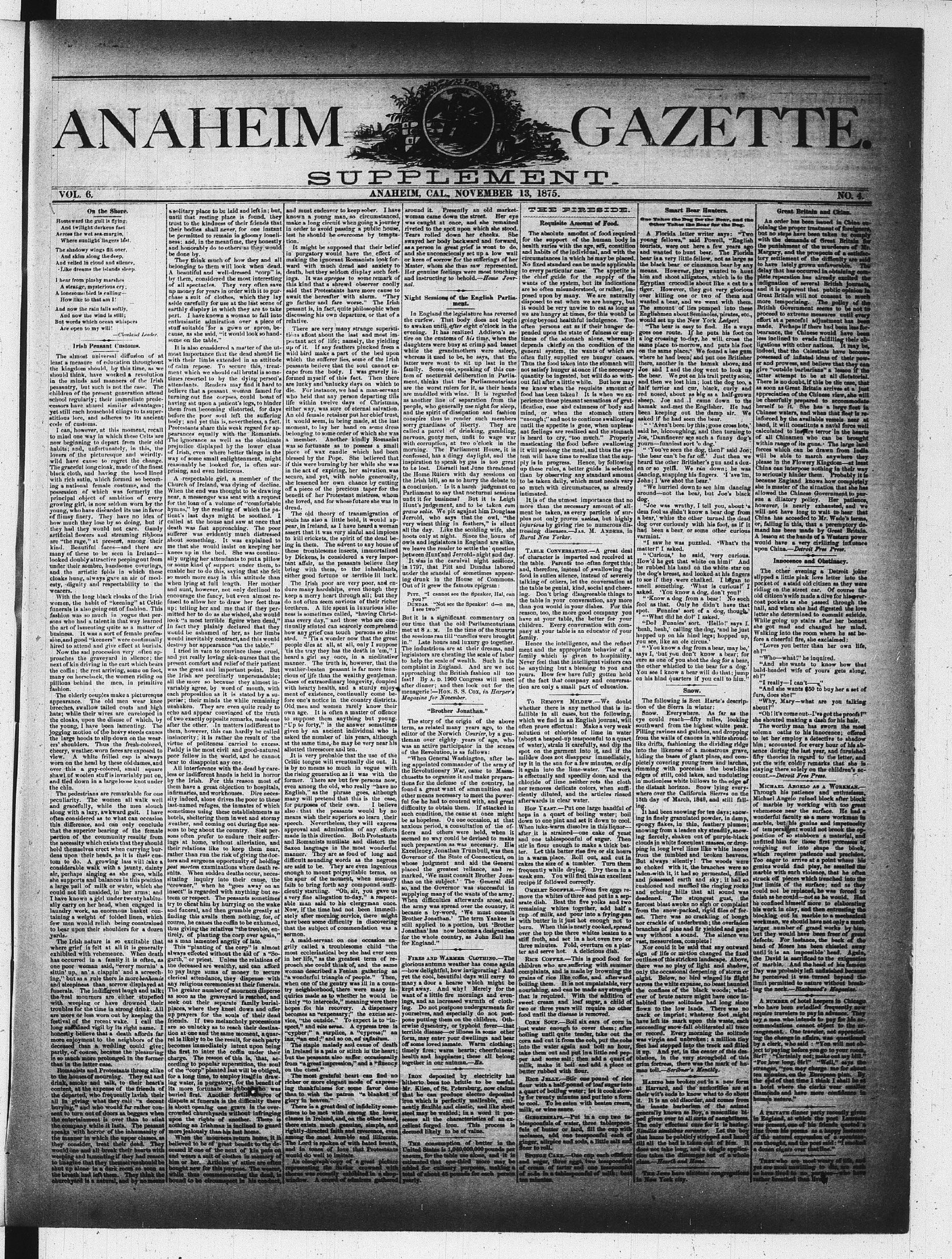
Searchable text
ANAHEIM
VOL. 6.
On the Shore.
Homeward the gull is flying;
And twilight darkens fast.
Across the wet sea-margin,
Where sunlight lingers last.
The shadowy wings flit over,
And skim along the deep,
And velled in cloud and silence.
Like dreams the islands sleep.
I hear from plashy marshes
A strange, mysterious cry;
A lonely bird is calling—
How like to that am I!
And now the rain falls softly,
And now the wind is still;
But words which ocean whispers
Are open to my will!
—Cherland Leader.
Irish Peasant Customs.
The almost universal diffusion of at least a measure of education throughout the kingdom should, by this time, as we should think, have worked a revolution in the minds and manners of the Irish peasantry, but such is not the case. The children of the present generation attend school regularly; their immediate predecessors have shared similar advantages; yet still each household clings to its superstitious lore, and adheres to its ancient code of customs.
I can, however, at this moment, recall to mind one way in which these Celts are now beginning to depart from their old habits; and, unfortunately, in this, the lovers of the picturesque and weirdly-wild have cause to regret the change. The graceful long cloak, made of the finest a solitary place to be laid and left in; but, until that resting place is found, they trust to the kindness of their friends that their bodies shall never, for one instant be permitted to remain in gloomy loneliness; and, in the meantime, they honestly and honorably do to others as they would be done by.
They think much of how they and all belonging to them will look when dead. A beautiful and well-dressed "corp" is, by them, considered the most interesting of all spectacles. They very often save up money for years in order with it to purchase a suit of clothes, which they lay aside carefully for use at the last scene of earthly display in which they are to take part. I have known a woman to fall into enthusiastic admiration over a piece of stuff suitable for a gown or apron, because, as she said, "it would look so handsome on the table."
It is also considered a matter of the utmost importance that the dead should lie with their limbs extended in an attitude of calm repose. To secure this, treatment which we should call brutal is sometimes resorted to by the dying person's attendants. Readers may find it hard to believe that a peasant woman famed for turning out fine corpses, could boast of having sat upon a patient's legs, to hinder them from becoming distorted, for days before the poor soul left the suffering body; and yet this is, nevertheless, a fact. Protestants share this weak regard for appearances equally with the Romanists. The ignorance as well as the obstinate prejudice displayed by the lower class of Irish, even where better things in the way of some small enlightenment, might reasonably be looked for, is often surmounted and must endeavor to keep known a young man, so make a long circuit when in order to avoid passing lest he should be overcome.
It might be supposed that in purgatory would have making the ignorant Romans ward with much dread death, but they seldom dings. It was apropos to this kind that a shrewd said that Protestants have awaited hereafter with go farther and fare worse peasant is, in fact, quite pacing his own departure relative.
There are very many situations afloat about the last important act of life; named up of it. If any feathers wild bird make a part of which the sufferer lies, so peasants believe that the cape from the body. I formed myself of this faction are lucky and unlucky day die. For instance, we have who held that any person life within twelve days either way, was sure of e. An old female retainer put it would seem, in being n moment, to lay her hand belonging to some order of a member. Another k was so fortunate as to put piece of wax candle w blessed by the Pope. Sh if this were burning by he
I can, however, at this moment, recall to mind one way in which these Celts are now beginning to depart from their old habits; and, unfortunately, in this, the lovers of the picturesque and weirdly-wild have cause to regret the change. The graceful long cloak, made of the finest black cloth, and having the hood lined with rich satin, which formed so becoming a national female costume, and the possession of which was formerly the principal object of ambition of every growing girl, is now seldom worn by the young, who have discarded its use in favor of flimsy finery. They have no idea of how much they lose by so doing, but if they had they would not care. Gaudy artificial flowers and streaming ribbons are "the rage," at present, among their kind. Beautiful faces—and there are many of these to be seen in Ireland—looked doubly attractive peeping out from under their sombre, handsome coverings, and the artistic folds in which these cloaks hung, always gave an air of modesty, dignity and respectability to the wearers.
With the long black cloaks of the Irish women, the habit of "keening" at Celtic funerals is also going out of fashion. This fashion was so much in vogue that persons who had a talent in that way learned the art of lamenting quite as a matter of business. It was a sort of female profession, and good "keeners" were continually hired to attend and give effect at burials.
Now the sad procession very often approaches the graveyard in silence; the next of kin driving in the cart which bears the coffin; the rest arriving, some on foot, many on horseback, the women riding on pillions behind the men, in primitive fashion.
The elderly couples make a picturesque appearance. The old men wear knee breeches, swallow tailed coats and high hats; while their wives are enveloped in the cloaks, upon the disuse of which, by the young, I have been lamenting. The jogging motion of the heavy steeds causes the large hoods to slip down on the wearers' shoulders. Thus the fresh-colored, cheery, weather-worn faces are exposed to view. A white frilled cap is always worn on the head by these old dames, and over this a gay-colored, small square shawl of woolen stuff is invariably put on, and tied down in a large loose knot under the chin.
The pedestrians are remarkable for one peculiarity. The women all walk well and gracefully, while the men slouch along with a lazy, awkward gait. I have often considered as to what can occasion this difference, and can only conclude that the superior bearing of the female portion of the community results from the necessity which exists that they should hold themselves erect when carrying burdens upon their heads, as it is their custom to do. A growing lass will take a considerable walk with a jaunty, dainty air, perhaps singing as she goes, while she supports and balances in this position a large pail of milk or water, which she mentions which we should call brutal is sometimes resorted to by the dying person's attendants. Readers may find it hard to believe that a peasant woman famed for turning out fine corpses, could boast of having sat upon a patient's legs, to hinder them from becoming distorted, for days before the poor soul left the suffering body; and yet this is, nevertheless, a fact. Protestants share this weak regard for appearances equally with the Romanists.
The ignorance as well as the obstinate prejudice displayed by the lower class of Irish, even where better things in the way of some small enlightenment, might reasonably be looked for, is often surprising, and even ludicrous.
A respectable girl, a member of the Church of Ireland, was dying of decline. When the end was thought to be drawing near, a messenger was sent with a request for the loan of a volume of "comfortable hymns," by the reading of which the patient's last days might be soothed. I called at the house and saw at once that death was fast approaching. The poor sufferer was evidently much distressed about something. It was explained to me that she would insist on keeping her knees up in the bed. She was continually urging her attendants to put a pillow or some kind of support under them, to enable her to do this, saying that she felt so much more easy in this attitude than when lying at full length. Her mother and aunt, however, not only declined to encourage the fancy, but even almost refused to allow her to draw her feet thus up; telling her and me that if they permitted her to do as she wished, she would look "a most terrible figure when dead." In fact they plainly declared that they would be ashamed of her, as her limbs would inevitably contract, and this would destroy her appearance "on the table."
I tried in vain to convince these cruel, and yet really loving sick-nurses that the present comfort and relief of their patient was the great and important point. But the Irish are peculiarly unpersuadable; all the more so because they almost invariably agree, by word of mouth, with each proposition as it is stated by a superior; their minds while remaining unshaken. They are even quite ready to echo and appear convinced of the truth of two exactly opposite remarks, made one after the other. In matters indifferent to them, however, this can hardly be called insincerity; it is rather the result of the virtue of politeness carried to excess. Paddy is the most civil and good-natured poor fellow in the world, and he cannot bear to disappoint any one.
All interference with the dead by careless or indifferent hands is held in horror by the Irish. For this reason most of them have a great objection to hospitals, infirmaries, and workhouses. Dire necessity indeed, alone drives the poor to these last-named refugees, the inmates of which sometimes using these establishments as hotels, sheltering them in wet and stormy weather, and coming out during fine seasons to beg about the country. Sick persons often prefer to endure their sufferings at home, without alleviation, and their relations like to keep them near, rather than run the risk of giving the doctors and surgeons opportunity of holding post mortem examinations where death results. When sudden deaths occur, necessitating inquiry into their cause, the "crowner," when he "goes away on an escape from the body." I formed myself of this faith are lucky and unlucky daily die. For instance, we have held that any person life within twelve days either way, was sure of eve. An old female retainer puts it would seem, in being nondement to lay her hand belonging to some order or a member. Another kis was so fortunate as to put piece of wax candle woven by the Pope. She if this were burning by her in the act of expiring, her secure, and yet, with no she lessened her own choice off a piece of the precious benefit of her Protestant faith she loved, and for whose fread.
The old theory of traps souls has also a little hollow pear, in Ireland, as I have asserted that it was very sinful to kill crickets, the spirit ing in them. The advent these troublesome insects by Dickens is considered tant affair, as the peasants bring with them, to the either good fortune or treason.
The Irish poor are very durable many hardships, ever keep a merry heart through do not often seem envious brethren. A life spent in nature is sometimes called in mas every day," and those tinually stinted can scarce how any grief can touch it.
"Tis a wonder now people dies at all, at all," 'tis the way they has his dearest girl say once in manner. The truth is, how weather-beaten peasant is cious of life than the weaker Cases of extraordinary longevity with hearty health,and amount of existence; continue fore one's notice in the colony Old men and women rare own age. It is often a man to suppose them anything "Up to forty," is the answer given by an ancient indictor asked the number of his at the same time; he may allotted threechess and ten.
It is very probable that Celtic tongue will eventually be by no means so much as rising generation as it former. There are but few even among the old, who are English," as the phrase is many will pretend that they for purposes of their own also that the peasants mean wish their superiors speech. Nevertheless,the approval and admiration made in this direction. Behind Romanists mutilate a Saxon language in the manner. They are as fond difficult sounding words as are said to be. They are enough to mount polysyllabic spur of the moment,fails to bring forth any causes which we should call brutal is sometimes resorted to by the dying person's attendants. Readers may find it hard to believe that a peasant woman famed for turning out fine corpses could boast of having sat upon a patient's legs, to hinder them from becoming distorted, for days before the poor soul left the suffering body; and yet this is,nevertheless,a fact. Protestants share this weak regard for appearance equally with the Romanists.
A respectable girl,a member of the Church of Ireland ,was dying of decline. When the end was thought to be drawing near,a messenger was sent with a request for the loan of a volume of "comfortable hymns,"by the reading of which the patient's last days might be soothed.I called at the house and saw at once that death was fast approaching.The poor sufferer was evidently much distressed about something. It was explained to me that she would insist on keeping her knees up in the bed.She was continually urging her attendants to put a pillow or some kind of support under them,tenable her to do this,saying that she felt so much more easy in this attitude than when lying at full length.Her mother and aunt,hhowever,not only declined to encourage the fancy,但even almost refused to allow her to draw her feet thus up;telling her and me that if they permitted her to do as she wished,she would look "a most terrible figure when dead,"In fact they plainly declared that they would be ashamed of her,as her limbs would inevitably contract,and this would destroy her appearance "on the table."
I tried in vain to convince these cruel, and yet really loving sick-nurses that the present comfort and relief of their patient was the great and important point.But the Irish are peculiarly unpersuadable; all the more so because they almost invariably agree,buy word of mouth,mwith each proposition as it is stated by a superior; their minds while remaining unshaken.Their eyes even quite ready to echo and appear convinced of the truthof two exactly opposite remarks,made one after the other.In matters indifferent to them,hhowever,thei can hardly be called insincerity;it is ratherthe resultofthe virtueof politeness carriedto excess.Paddy isthe most civilandgood-naturedpoor fellowintheworld,andhecannotbeartodisappointanyone.
All interference withthedeadbycarelessorindifferenthandsisheldinhorrorbytheIrishForthisreasonmostofthemhaveagreatobjectiontohospitalsinfirmaries,andworkhouses.Direnecessityindeedalonedrivesthepoortotheselast-namedrefuges,theimmatesofwhichsimestusingtheestablishmentsashotels,sheltertingtheinwetandstormyweather,andcomingoutduringfineseasonstoc begaboutthecountry.Siekpersonsoftenertheirsufferingsathomewithoutalleviation,andtherelationsliketokehmear,ratherthanruntheriskofgivingthedoctorsandsurgeonsopportunityholdingpostmortemexaminestwhere deathresultsWhen sudden deathsoccur,Necessitatinginquiryinto theircausethecrowner,"whenhe“goesawayonancapeformwhichweshouldcallbraltisisnecessaryreservedtobythedyingpersonsfammedforturningoutfinecorpsescouldboastofhavingsatuponapatient'slegs,towherfrombecomingdistressedfordaysbeforethepoorsoulfthesoulleftthesufferingbody;andyetthisisnenevertheless,afact.TheprotestantssharethisweakregardforappearanceequalwiththeRomanists.Arespectablegirl,amemberoftheChurchofIreland,thewyndyingofdeclineWhentheendwasthoughttobedrawingoutfinecorpsescouldboastofhavingsatuponapatient'slegs,towherfrombecomingdistressedfordaysbeforethepoorsoulfthesoulleftthesufferingbody;andyetthisisn whenevertheless,afact.TheprotestantssharethisweakregardforappearanceequalwiththeRomanists.Arespectablegirl,amemberoftheChurchofIreland,thewyndyingofdeclineWhentheendwasthoughttobedrawingoutfinecorpsescouldboastofhavingsatuponapatient'slegs,towherfrombecomingdistressedfordaysbeforethepoorsoulfthesoulleftthesufferingbody;andyetthisisn whenevertheless,afact.TheprotestantssharethisweakregardforappearanceequalwiththeRomanists.Arespectablegirl,amemberoftheChurchofIreland,thewyndyingofdeclineWhentheendwasthoughttobedrawingoutfinecorpsescouldboastofhavingsatuponapatient'slegs,towherfrombecomingdistressedfordaysbeforethepoorsoulfthesoulleftthesufferingbody;andyetthisisn whenevertheless,afact.TheprotestantssharethisweakregardforappearanceequalwiththeRomanists.Arespectablegirl,amemberoftheChurchofIreland,thewyndyingofdeclineWhentheendwasthoughttobedrawingoutfinecorpsesouldboastofhavingsatuponapatient'slegs,towherfrombecomingdistressedfordaysbeforethepoorsoulfthesoulleftthesufferingbody;andyetthisisn whenevertheless,afact.TheprotestantssharethisweakregardforappearanceequalwiththeRomanists.Arespectablegirl,amemberoftheChurchofIreland,thewyndyingofdeclineWhentheendwasthoughttobedrawingoutfinecorpsesouldboastofhavingsatuponapatient'slegs,towherfrombecomingdistressedfordaysbeforethepoorsoulfthesoulleftthesufferingbody;andyetthisisn whenevertheless,afact.TheprotestantssharethisweakregardforappearanceequalwiththeRomanists.Arespectablegirl,amemberoftheChurchofIreland,thewyndyingofdeclineWhentheendwasthoughttobedrawingoutfinecorpsesouldboastofhavingsatuponapatient'slegs,towherfrombecomingdistressedfordaysbeforethepoorsoulfthesoulleftthesufferingbody;andyetthisisn whenevertheless,afact.TheprotestantssharethisweakregardforappearanceequalwiththeRomanists.Arespectablegirl,amemberoftheChurchofIreland,thewyndyingofdeclineWhentheendwasthoughttobedrawingoutfinecorpsesouldboastofhavingsatuponapatient'slegs,towherfrombecomingdistressedfordaysbeforethepoorsoulfthesoulleftthesufferingbody;andyetthisisn whenevertheless,afact.TheprotestantssharethisweakregardforappearanceequalwiththeRomanists.Arespectablegirl,amemberoftheChurchofIreland,thewyndyingofdeclineWhentheendwasthoughttobedrawingoutfinecorpsesouldboastofhavingsatuponapatient'slegs,towherfrombecomingdistressedfordaysbeforethepoorsoulfthesoulleftthesufferingbody;andyetthisisn whenevertheless,afact.TheprotestantssharethisweakregardforappearanceequalwiththeRomanists.Arespectablegirl,amemberoftheChurchofIreland,thewyndyingofdeclineWhentheendwasthoughttobedrawingoutfinecorpsesouldboastofhavingsatuponapatient'slegs,towherfrombecomingdistressedfordaysbeforethepoorsoulfthesoulleftthesufferingbody;andyetthisisn whenevertheless,afact.TheprotestantssharethisweakregardforappearanceequalwiththeRomanists.Arespectablegirl,amemberoftheChurchofIreland,thewyndyingofdeclineWhentheendwasthoughttobedrawingoutfinecorpsesouldboastofhavingsatuponapatient'slegs,towherfrombecomingdistressedfordaysbeforethepoorsoulfthesoulleftthesufferingbody;andyetthisisn whenevertheless,afact.TheprotestantssharethisweakregardforappearanceequalwiththeRomanists.Arespectablegirl,amemberoftheChurchofIreland,thewyndyingofdeclineWhentheendwasthoughttobedrawingoutfinecorpsesouldboastofhavingsatuponapatient'slegs,towherfrombecomingdistressedfordaysbeforethepoorsoulfthesoulleftthesufferingbody;andyetthisisn whenevertheless,afact.TheprotestantssharethisweakregardforappearanceequalwiththeRomanists.Arespectablegirl,amemberoftheChurchofIreland,thewyndyingofdeclineWhentheendwasthoughttobedrawingoutfinecorpsesouldboastofhavingsatuponapatient'slegs,towherfrombecomingdistressedfordaysbeforethepoorsoulfthesoulleftthesufferingbody;andyetthisisn whenevertheless,afact.TheprotestantssharethisweakregardforappearanceequalwiththeRomanists.Arespectablegirl,amemberoftheChurchofIreland,thewyndyingofdeclineWhentheendwasthoughttobedrawingoutfinecorpsesouldboastofhavingsatuponapatient'slegs,towherfrombecomingdistressedfordaysbeforethepoorsoulfthesoulleftthesufferingbody;andyetthisisn whenevertheless,afact.TheprotestantssharethisweakregardforappearanceequalwiththeRomanists.Arespectablegirl,amemberoftheChurchofIreland,thewyndyingOfdeclineWhentheendwasthoughttobedrawingoutfinecorpsesouldboastofhavingsatuponapatient'slegs,towherfrombecomingdistressedfordaysbeforethepoorsoulfthesoulleftthesufferingbody;andyetthisisn whenevertheless,afact.TheprotestantssharethisweakregardforappearanceequalwiththeRomanists.Arespectablegirl,amemberoftheChurchofIreland,thewyndyingOfdeclineWhentheendwasthoughttobedrawingoutfinecorpsesouldboast Ofhavingsatuponapatient'slegs,towherfrombecomingdistressedfordaysbeforethepoorsoulfthesoulleftthesufferingbody;andyetthisisn whenevertheless,afact.TheprotestantssharethisweakregardforappearanceequalwiththeRomanists.Arespectablegirl,amemberoftheChurchofIreland,thewyndyingOfdeclineWhentheendwasthoughttobedrawingoutfinecorpsesouldboast Ofhavingsatuponapatient'slegs,towherfrombecomingdistressedfordaysbeforethepoorsoulfthesoulleftthesufferingbody;andyetthisisn whenevertheless,afact.TheprotestantssharethisweakregardforappearanceequalwiththeRomanists.Arespectablegirl,amemberoftheChurchofIreland,thewyndyingOfdeclineWhen.theendwasthoughttobedrawingoutfinecorpsesouldboast Ofhavingsatuponapatient'slegs,towherfrombecomingdistressedfordaysbefore-thepoorsoulfthesoulleft_the_suffering_body;andyetthisisn whenevertheless,afact.Theprotestants share this weak regard for appearance e equal with people dies at all ,at all ,tis tia yray hay has died at all ,at all ,tis tia yray hay has died at all ,at all ,tis tia yray hay has died at all ,at all ,tis tia yray hay has died at all ,at all ,tis tia yray hay has died at all ,at all ,tis tia yray hay has died at all ,at all ,tis tia yray hay has died at all ,at all ,tis tia yray hay has died at all ,at all ,tis tia yray hay has died at all ,at all ,tis tia yray hay has died at all ,at all ,tis tia yray hay has died at all ,at all ,tis tia yray hay has died at all ,at all ,tis tia yray hay has died at all ,at all ,tis tia yray hay has died at all ,at all ,tis tia yray hay has died at all ,at all ,tis tia yray hay has died at all ,at all ,tis tia yray hay has died at all ,at all ,tis tia yray hay has died at all ,at all ,tis tia yray hay has died at all ,at all ,tis tia yray hay has died at all ,at all ,tis tia yray hay has died at all ,at all ,tis tia yray hay has died at all ,at all ,tis tia yray hay has died at all ,at all ,tis tia yray hay has died at all ,at all ,tis tia yray hay has died at all ,at all ,tis tia yray hay has died at all ,at all ,tis tia yray hay has died at all ,at all ,tis tia yray hay has died at all ,at all ,tis tia yray hay has died at all ,at all ,tis tia yray hay has died at all ,at all ,tis tia yray hay has died at all ,at all ,tis tia yray hay has died at all ,atall ,tis tia yray hay has died at all ,atall ,tis tia yray hay has died at all ,atall ,tis tia yray hay has死了死亡的命运的命运的命运的命运的命运的命运的命运的命运的命运的命运的命运的命运的命运的命运的命运的命运的命运的命运的命运的命运的命运的命运的命运的命运的命运的命运的命运的命运的命运的命运的命运的命运的命运的命运的命运的命运的命运的命运的命运的命运的命运的命运的命运的命运的命运的命运的命运的命运的命运的命运的运
The pedestrians are remarkable for one peculiarity. The women all walk well and gracefully, while the men slouch along with a lazy, awkward gait. I have often considered as to what can occasion this difference, and can only conclude that the superior bearing of the female portion of the community results from the necessity which exists that they should hold themselves erect when carrying burdens upon their heads, as it is their custom to do. A growing lass will take a considerable walk with a jaunty, dainty air, perhaps singing as she goes, while she supports and balances in this position a large pail of milk or water, which she could not lift unaided, in her arms; and I have known a girl under twenty habitually carry on her head, when engaged in laundry work, an enormous basket containing a weight of folded linen, which few men would relish being constrained to bear upon their shoulders for a dozen yards.
The Irish nature is so excitable that where grief is felt at all it is generally exhibited with vehemence. When death has occurred in a family it is often, as one poor woman said, "every mornin' a sittin' up, an' a clappin' and a screeching," but as a rule there is more bonhomie and sleepiness than sorrow displayed at funerals. The indifferent laugh and talk; the real mourners are either stupefied with weeping or have drowned their troubles for the time in strong drink. All are more or less worn out by keeping the festival of the recent wake. I call the long sustained vigil by its right name. I honestly believe that a death affords far more enjoyment to the neighbors of the deceased than a wedding could give; partly, of course, because the pleasuring is so much more prolonged in the former than in the latter case.
Romanists and Protestants throng alike to the houses of mourning. They eat and drink, smoke and talk, to their heart's content, at the expense of the friends of the departed, who frequently lavish their all in giving what they call "a decent burying," and who would far rather consent to turn out of doors as beggars when the entertainment is over than to stint the company while it lasts. The peasant speaks with horror of the inhumanity of the manner in which the upper classes, as they consider, treat their dead. They would one and all break their hearts with weeping and lamenting if they had reason to imagine that they themselves should be shut up alone in a dark room so soon as the breath had left them. They think the churchyard is a natural, and by no means infirmaries, and workhouses. Dire necessity indeed, alone drives the poor to these last-named refugees, the inmates of which sometimes using these establishments as hotels, sheltering them in wet and stormy weather, and coming out during fine seasons to beg about the country. Siek persons often prefer to endure their sufferings at home, without alleviation, and their relations like to keep them near, rather than run the risk of giving the doctors and surgeons opportunity of holding post mortem examinations where death results. When sudden deaths occur, necessitating inquiry into their cause, the "crowner," when he "goes away on an insect" is regarded with anything but esteem or respect. The peasants sometimes try to cheat him by hurrying on the wake and fuceral, and then grumble greatly at finding this avails them nothing, for, of course, he causes the coffin to be exhumed, thus giving the relatives "the trouble, entirely, of planting the corp over again," as a man lamented angrily of late.
This "planting of the corp" is almost always effected without the aid of a "Sogarth," or priest. Unless the relations of the deceased are wealthy, and can afford to pay large sums of money to secure clerical attendance, they dispense with any religious ceremonies at their funerals. The greater number of mourners disperse as soon as the graveyard is reached, and seek out their separate family burialplaces, where they kneel down and offer up prayers for the souls of their dead friends. If two melancholy processions are so unlucky as to reach their destination at one and the same moment, a quarrel is likely to be the result, for each party becomes immediately intent upon being the first to inter the coffin under their charge. The reason of this is, that, according to popular superstition, the soul of the "corp" planted last will be obliged, for a long time, to employ itself in drawing water, in purgatory, for the benefit of its more fortunate neighbor who was buried first. Another fertile source of dispute at funerals is the difficulty there is about opening one grave in the overcrowded churchyards without infringing upon the rights of another. There is nothing an Irishman is inclined to guard more jealously than his last home.
When the mourners return home, it is believed to be of great benefit to the deceased if one of the next of kin puts on and wears a suit of clothes in memory of him or her. Articles of attire are often bought new for this purpose. The wearer, while thus commemorating the dead, is bound to be circumspect in his conduct.
English," as the phrase many will pretend that they also that the peasants mean wish their superior speech. Nevertheless,the approval and admiration made in this direction. Bexand Romanists mutilate a Saxon language in the manner. They are as found difficult sounding words are said to be. They are enough to mount polysyllabic the spur of the moment; fails to bring forth any clearly startling. "Oh, since a very allegation to-doable man said to his client Now, if the time had not atately after morning service have been some difficulty that the subject of common sermon.
A maid-servant on one grily called a troublesome most ecclesiastical boy shine in her life," as the greatest proach she could think of. A woman described a Fenian "a wonderful triangle of pain when one of the gentry wished neighborhood, there were quiries made as to whether likely "to intercede," meant hopes for his recovery. Becomes an "expensary;" vice,"the outside." To eject spect," and vice versa. A cypher;" a surplice, an inn," an end;" and so on.
The staple malady and in Ireland is a pain or stiff but the peasants also suffice from "a great impresslon," on the chest."
The most grateful hearer richer or more elegant moaning thankfulness for soon than to wish the patron glory in heaven."
There is a great deal of time to be met with same classes in Ireland,and on there exists much genuine rightly-directed faith and among the most humble The Lord is spoken of wit and in towns of love they would do well to initiate.
An obgraph copy of representing the Savior theres was recently exhibited window. A crowd of ad
and must endeavor to keep sober. I have known a young man, so circumstanced, make a long circuit when going a journey in order to avoid passing a public house, lest he should be overcome by temptation.
It might be supposed that their belief in purgatory would have the effect of making the ignorant Romanists look forward with much dread and anxiety to death, but they seldom display such feelings. It was apropos to some remark of this kind that a shrewd observer coolly said that Protestants have more cause to await the hereafter with alarm. "They go farther and fare worse." The Irish peasant is, in fact, quite philosophic when discussing his own departure, or that of a relative.
There are very many strange superstitions afloat about the last and most important act of life; namely, the yielding up of it. If any feathers plucked from a wild bird make a part of the bed upon which the sufferer lies, some of the Irish peasants believe that the soul cannot escape from the body. I was gravely informed myself of this fact. Then there are lucky and unlucky days on which to die. For instance, we had a man-servant who held that any person departing this life within twelve days of Christmas, either way, was sure of eternal salvation. An old female retainer put her chief trust, it would seem, in being made, at the last moment, to lay her hand on some dress belonging to some order of which she was a member. Another kindly Romanist was so fortunate as to possess a small piece of wax candle which had been blessed by the Pope. She believed that if this were burning by her while she was in the set of enamoring saliva around it. Presently an old market-woman came down the street. Her eye was caught at once, and she remained riveted to the spot upon which she stood. Tears rolled down her cheeks. She swayed her body backward and forward, as a person in great grief is wont to do, and she unconsciously set up a low wall or keen of sorrow for the sufferings of her Master, whom she thus saw represented. Her genuine feelings were most touching and instructing to behold.—Home Journal.
Night Sessions of the English Parliament.
In England the legislature has reversed the curfew. That body does not begin to awaken until after eight o'clock in the evening. It has realized Addison's satire on the customs of his time, when the daughters were busy at crimp and basset while the grandmothers were asleep, whereas it used to be, he says, that the latter were wont to sit up last in the family. Some one, speaking of this custom of nocturnal deliberation in Parliament, thinks that the Parliamentarians are the worst rulers for it, as their heads are muddled with wine. It is regarded as another line of separation from the people, who generally use night for sleep, and the spirit of dissipation and fashion conspire thus to render such members sorry guardians of liberty. They are called a parcel of drinking, gambling, nervous, gouty men, unfit to wage war with corruption, at two o'clock in the morning. The Parliament House, it is confessed, has a dingy daylight, and the inspiration to speak by gas is too great to be lost. Disraeli last June threatened
THE PIRESIDE.
Requisite Amount of Food.
The absolute amount of food required for the support of the human body in health varies with the age, sex, constitution and habits of the individual, and with the circumstances in which he may be placed. No fixed standard can be made applicable to every particular case. The appetite is the chief guide for the supply of the wants of the system, but its indications are so often misunderstood, or rather, imposed upon by many. We are naturally disposed to eat when we are hungry, but it would be very unwise to eat as long as we are hungry at times, for this would be going beyond healthful indulgence. Too often persons eat as if their hunger depended upon the state of fulness or emptiness of the stomach alone, whereas it depends chiefly on the condition of the general system, the wants of which are often fully supplied ere hunger ceases. Thus the food taken into the stomach will not satisfy hunger at once if the necessary quantity be ingested, but will do so without fall after a little while. But how may we know when the requisite amount of food has been taken? It is when we experience those pleasant sensations of gratification, ease and calmness of body and mind, or when the stomach utters "enough;" and not to continue swallowing until the appetite is gone, when unpleasant feelings are realized and the stomach is heard to cry, "too much." Properly masticating the food before swallowing it will prolong the meal, and thus the system will have time to realize that the supply is in progress. Hence, by following up these rules, a better guide is selected
A Florida young fellow tourists, we and wanted bear is a very black beanie. How him and show Egyptian tiger. How over killing wanted a beetle. The amount Englishmen would set up.
"The bear goes one row log crossing same place on the same where he had there another Joe and I bear. We and then we half terrier red nosed, sheep. Joe hamak and been keeping asked if he be "Aven't said he, hiccoc Joe, Damfin' youn—funny "You've seen 'the bear can heard the other on or so yell
The old theory of transmigration of souls has also a little hold, it would appear, in Ireland, as I have heard a woman assert that it was very sinful and impious to kill crickets, the spirit of the dead being in them. The advent to any house of these troublesome insects, immortalized by Dickens, is considered a very important affair, as the peasants believe they bring with them, to the inhabitants, either good fortune or terrible ill luck.
The Irish poor are very poor, and endure many hardships, even though they keep a merry heart through all; but they do not often seem envious of their richer brethren. A life spent in luxurious idleness is sometimes called, "having Christmas every day," and those who are continually stinted can scarcely comprehend how any grief can touch persons so situated.
"Tis a wonder now that the great people dies at all, at all, only I suppose 'tis the way they has the death in 'em,' I heard a girl say once, in a meditative manner. The truth is, however, that the weather-beaten peasant is far more tenacious of life than the wealthy gentleman. Cases of extraordinary longevity, coupled with hearty health, and a sturdy enjoyment of existence, continually come before one's notice in the country districts. Old men and women rarely know their own age. It is often a matter of offence to suppose them anything but young. "Up to forty," is the answer sometimes given by an ancient individual who is asked the number of his years, although at the same time, he may be very near his allotted threescore and ten.
It is very probable that the use of the Celtic tongue will eventually die out. It is by no means so much in vogue with the rising generation as it was with the former. There are but few persons now, even among the old, who really "have no English," as the phrase goes, although many will pretend that this is the case, for purposes of their own.
I believe also that the peasants would by no means wish their superiors so learn their speech. Nevertheless, they will express approval and admiration of any efforts made in this direction. Both Protestants and Romanists mutilate and distort the Saxon language in the most wonderful manner. They are as fond of long and difficult sounding words as the negroes are said to be. They are even ingenious enough to mount polysyllabic terms, on the spur of the moment, when memory fails to bring forth any compound suffice from the body. I was gravely informed myself of this fact. Then there are lucky and unlucky days on which to die. For instance, we had a man-servant who held that any person departing this life within twelve days of Christmas, either way, was sure of eternal salvation. An old female retainer put her chief trust, it would seem, in being made, at the last moment, to lay her hand on some dress belonging to some order of which she was a member. Another kindly Romanist was so fortunate as to possess a small piece of wax candle which had been blessed by the Pope. She believed that if this were burning by her while she was in the act of expiring, her salvation was secure, and yet, with noble generosity, she lessened her own chance by cutting off a piece of the precious taper for the benefit of her Protestant mistress, whom she loved, and for whose future she was in dread.
The old theory of transmigration of souls has also a little hold, it would appear, in Ireland, as I have heard a woman assert that it was very sinful and impious to kill crickets, the spirit of the dead being in them. The advent to any house of these troublesome insects, immortalized by Dickens, is considered a very important affair, as the peasants believe they bring with them, to the inhabitants, either good fortune or terrible ill luck.
The Irish poor are very poor, and endure many hardships, even though they keep a merry heart through all; but they do not often seem envious of their richer brethren. A life spent in luxurious idleness is sometimes called, "having Christmas every day," and those who are continually stinted can scarcely comprehend how any grief can touch persons so situated.
"Tis a wonder now that the great people dies at all, at all, only I suppose 'tis the way they has the death in 'em,' I heard a girl say once, in a meditative manner. The truth is, however, that the weather-beaten peasant is far more tenacious of life than the wealthy gentleman. Cases of extraordinary longevity, coupled with hearty health, and a sturdy enjoyment of existence, continually come before one's notice in the country districts. Old men and women rarely know their own age. It is often a matter of offence to suppose them anything but young. "Up to forty," is the answer sometimes given by an ancient individual who is asked the number of his years, although at the same time, he may be very near his allotted threescore and ten.
It is very probable that the use of the Celtic tongue will eventually die out. It is by no means so much in vogue with the rising generation as it was with the former. There are but few persons now, even among the old, who really "have no English," as the phrase goes, although many will pretend that this is the case, for purposes of their own.
I believe also that the peasants would by no means wish their superiors so learn their speech. Nevertheless, they will express approval and admiration of any efforts made in this direction. Both Protestants and Romanists mutilate and distort the Saxon language in the most wonderful manner. They are as fond of long and difficult sounding words as the negroes are said to be. They are even ingenious enough to mount polysyllabic terms, on the spur of the moment, when memory fails to bring forth any compound suffice from the body. I was gravely informed myself of this fact. Then there are lucky and unlucky days on which to die. For instance, we had a man-servant who held that any person departing this life within twelve days of Christmas, either way, was sure of eternal salvation. An old female retainer put her chief trust, it would seem, in being made, at the last moment, to lay her hand on some dress belonging to some order of which she was a member. Another kindly Romanist was so fortunate as to possess a small piece of wax candle which had been blessed by the Pope. She believed that if this were burning by her while she was in the act of expiring, her salvation was secure, and yet, with noble generosity, she lessened her own chance by cutting off a piece of the precious taper for the benefit of her Protestant mistress, whom she loved, and for whose future she was in dread.
The old theory of transmigration of souls has also a little hold, it would appear, in Ireland, as I have heard a woman assert that it was very sinful and impious to kill crickets, the spirit of the dead being in them. The advent to any house of these troublesome insects, immortalized by Dickens, is considered a very important affair, as the peasants believe they bring with them, to the inhabitants, either good fortune or terrible ill luck.
The Irish poor are very poor, and endure many hardships, even though they keep a merry heart through all; but they do not often seem envious of their richer brethren. A life spent in luxurious idleness is sometimes called, "having Christmas every day," and those who are continually stinted can scarcely comprehend how any grief can touch persons so situated.
"Tis a wonder now that the great people dies at all, at all, only I suppose 'tis the way they has the death in 'em,' I heard a girl say once, in a meditative manner. The truth is, however, that the weather-beaten peasant is far more tenacious of life than the wealthy gentleman. Cases of extraordinary longevity, coupled with hearty health, and a sturdy enjoyment of existence, continually come before one's notice in the country districts. Old men and women rarely know their own age. It is often a matter of offence to suppose them anything but young. "Up to forty," is the answer sometimes given by an ancient individual who is asked the number of his years, although at the same time, he may be very near his allotted threescore and ten.
It is very probable that the use of the Celtic tongue will eventually die out. It is by no means so much in vogue with the rising generation as it was with the former. There are but few persons now, even among the old, who really "have no English," as the phrase goes, although many will pretend that this is the case, for purposes of their own.
I believe also that the peasants would by no means wish their superiors so learn their speech. Nevertheless, they will express approval and admiration of any efforts made in this direction. Both Protestants and Romanists mutilate and distort the Saxon language in the most wonderful manner. They are as fond of long and difficult sounding words as the negroes are said to be. They are even ingenious enough to mount polysyllabic terms, on the spur of the moment, when memory fails to bring forth any compound suffice from the body. I was gravely informed myself of this fact. Then there are lucky and unlucky days on which to die. For instance, we had a man-servant who held that any person departing this life within twelve days of Christmas,either way,was sure of eternal salvation. An old female retainer put her chief trust,it would seem,in being made,at last moment,to lay her hand on some dress belonging to some order of which she was a member. Another kindly Romanist was so fortunate as to possess a small piece of wax candle which had been blessed by the Pope. She believed that if this were burning by her while she was in the act of expiring,her salvation was secure,and yet,with noble generosity,she lessened her own chance by cutting off a piece of the precious taper for the benefit of her Protestant mistress,whom she loved,and for whose future she was in dread.
The old theory of transmigration of souls has also a little hold,it would appear,in Ireland,as I have heard a woman assert that it was very sinful and impious to kill crickets,the spirit of the dead being in them. The advent to any house of these troublesome insects,immortalized by Dickens,is considered a very important affair,as the peasants believe they bring with them,to the inhabitants,either good fortune or terrible ill luck.
The Irish poor are very poor,and endure many hardships,even though they keep a merry heart through all;but they do not often seem envious of their richer brethren. A life spent in luxurious idleness is sometimes called,“having Christmas every day,”and those who are continually stinted can scarcely comprehend how any grief can touch persons so situated.
"Tis a wonder now that the great people dies at all,at all,only I suppose 'tis the way they has the death in 'em,”I heard a girl say once,in a meditative manner. The truth is,however,that the weather-beaten peasant is far more tenacious of life than the wealthy gentleman.Cases of extraordinary longevity,coupled with hearty health,and a sturdy enjoyment of existence,continually come before one's notice in the country districts.
Old men and women rarely know their own age. It is often a matter of offence to suppose them anything but young.“Up to forty,” is the answer sometimes given by an ancient individual who is asked the number of his years,although at the same time,he may be very near his allotted threescore and ten.
It is very probable that the use of the Celtic tongue will eventually die out. It is by no means so much in vogue with the rising generation as it was with the former. There are but few persons now,even among the old,who really “have no English,” as the phrase goes,although many will pretend that this is the case,for purposes of their own.
I believe also that the peasants would by no means wish their superiors so learn their speech. Nevertheless,they will express approval and admiration of any efforts made in this direction.Both Protestants and Romanists mutilate and distort the Saxon language in the most wonderful manner. They are as fond of long and difficult sounding words as the negroes are said to be. They are even ingenious enough to mount polysyllabic terms,on the spur of the moment,when memory fails to bring forth any compound suffice from the body.I was gravely informed myself of this fact. Then there are lucky and unlucky days on which to die. For instance,we had a man-servant who held that any person departing this life within twelve days of Christmas,either way,was sure of eternal salvation. An old female retainer put her chief trust,it would seem,in being made,at last moment,to lay her hand on some dress belonging to some order of which she was a member. Another kindly Romanist was so fortunate as to possess a small piece of wax candle which had been blessed by the Pope. She believed that if this were burning by her while she was in the act of expiring,她 salvation was secure,and yet,with calmness,she lessened her own chance by cutting off a piece of the precious taper for the benefit of her Protestant mistress,whom she loved,and for whose future she was in dread.
The old theory of transmigration of souls has also a little hold,it would appear,in Ireland,as I have heard a woman assert that it was very sinful and impious to kill crickets,the spirit of the dead being in them. The advent to any house of these troublesome insects,immortalized by Dickens,is considered a very important affair,as the peasants believe they bring with them,to the inhabitants,either good fortune or terrible ill luck.
The Irish poor are very poor,and endure many hardships,even though they keep a merry heart through all;但他们 do not often seem envious of their richer brethren.A life spent in luxurious idleness is sometimes called,“having Christmas every day,”and those who are continually stinted can scarcely comprehend how any grief can touch persons so situated.
"Tis a wonder now that the great people dies at all,at all,only I suppose 'tis the way they has the death in 'em,”I heard a girl say once,in a meditative manner. The truth is,however,that the weather-beaten peasant is far more tenacious of life than the wealthy gentleman.Cases of extraordinary longevity,coupled with hearty health,and a sturdy enjoyment of existence,continually come before one's notice in the country districts.
Old men and women rarely know their own age. It is often a matter of offence to suppose them anything but young.“Up to forty,” is the answer sometimes given by an ancient individual who is asked the number of his years,although at times,he may be fully grown hold up after dinner;and then he may see if they have seen if they have seen if they have seen if they have seen if they have seen if they have seen if they have seen if they have seen if they have seen if they have seen if they have seen if they have seen if they have seen if they have seen if they have seen if they have seen if they have seen if they have seen if they have seen if they have seen if they have seen if they have seen if they have seen if they have seen if they have seen if they have seen if they have seen if they have seen if they have seen if they have seen if they have seen if they have seen if they have seen if they have seen if they have seen if they have seen if they have seen if they have seen if they have seen if they have seen if they have seen if they have seen if they have seen if they have seen if they have seen if they have seen if they have seen if they have seen if they have seen if they have seen if they have seen if they have seen if they have seen if they have seen if they have seen if they have seen if they have seen if they have seen if they haveseeniftheyhaveseeniftheyhaveseeniftheyhaveseeniftheyhaveseeniftheyhaveseeniftheyhaveseeniftheyhaveseeniftheyhaveseeniftheyhaveseeniftheyhaveseeniftheyhaveseeniftheyhaveseeniftheyhaveseeniftheyhaveseeniftheyhaveseeniftheyhaveseeniftheyhaveseeniftheyhaveseeniftheyhaveseeniftheyhaveseeniftheyhaveseeniftheyhaveseeniftheyhaveseeniftheyhaveseeniftheyhaveseeniftheyhaveseeniftheyhaveseeniftheyhaveseeniftheyhaveseeniftheyhaveseeniftheyhaveseeniftheyhaveseeniftheyhaveseeniftheyhaveseeniftheyhaveseeniftheyhaveseeniftheyhaveseeniftheyhaveseeniftheyhaveseeniftheyhaveseeniftheyhaveseeniftheyhaveseeniftheyhaveseeniftheyhaveseenifthey HaveSeenIfTheyHaveSeenIfTheyHaveSeenIfTheyHaveSeenIfTheyHaveSeenIfTheyHaveSeenIfTheyHaveSeenIfTheyHaveSeenIfTheyHaveSeenIfTheyHaveSeenIfTheyHaveSeenIfTheyHaveSeenIfTheyHaveSeenIfTheyHaveSeenIfTheyHaveSeenIfTheyHaveSeenIfTheyHaveSeenIfTheyHaveSeenIfTheyHaveSeenIfTheyHaveSeenIfTheyHaveSeenIfTheyHaveSeenIfTheyHaveSeenIfTheyHaveSeenIfTheyHaveSeenIfTheyHaveSeenIfTheyHaveSeenIfTheyHaveSeenIfTheyHaveSeenIfTheyHaveSeenIfThey HaveSeenIfThey HaveSeenIfThey HaveSeenIfThey HaveSeenIfThey HaveSeenIfThey HaveSeenIfThey HaveSeenIfThey HaveSeenIfThey HaveSeenIfThey HaveSeenIF They Have Seen IF They Have Seen IF They Have Seen IF They Have Seen IF They Have Seen IF They Have Seen IF They Have Seen IF They Have Seen IF They Have Seen IF They Have Seen IF They Have Seen IF They Have Seen IF They Have Seen IF They Have Seen IF They Have Seen IF They Have Seen IF They Have Seen IF They Have Seen IF They Have Seen IF They Have Seen IF They Have Seen IF They Have Seen IF They Have Seen IF They Have Seen IF They Have Seen IF They Have Seen IF They Have Seen IF They Have Seen IF They Have Seen IF They Have SeENIF They Have SeENIF They Have SeENIF They Have SeENIF They Have SeENIF They Have SeENIF They Have SeENIF They Have SeENIF They Have SeENIF They Have SeENIF They Have SeENIF They Have SeENIF They Have SeENIF They Have SeENIF They Have SeENIF 他们有 seene seene seene seene seene seene seene seene seene seene seene seene seene seene seene seene seene seene seene seene seene seene seene seene seene seene seene seene seene seene seene seene seene seene seene seene seene seene seene seene seene senee senee senee senee senee senee senee senee senee senee senee senee senee senee senee senee senee senee senee senee senee senee senee senee senee senee senee senee senee senee senee senee senee senee senee senee senee senee senee senee senee senee senee seinee seseinee seseinee seseinee seseinee seseinee seseinee seseinee seseinee seseinee seseinee seseinee seseinee seseinee seseinee seseinee seseinee seseinee seseinee seseinee seseinee seseinee seseinee seseinee seseinee seseinee seseinee seseinee seseinee seseinee seseinee seseinee seseinee seseinee seseinee seseinee seseinee seseinee seseinee seseinee seseinee seseinee seseinee seseinee seseinee seseinee seseinee seseinee seseinee SSEEINEF SSEEINEF SSEEINEF SSEEINEF SSEEINEF SSEEINEF SSEEINEF SSEEINEF SSEEINEF SSEEINEF SSEEINEF SSEEINEF SSEEINEF SSEEINEF SSEEINEF SSEEINEF SSEEINEF SSEEINEF SSEEINEF SSEEINEF SSEEINEF SSEEINEF SSEEINEF SSEEINEF SSEEINEF SSEEINEF SSEEINEF SSEEINEF SSEEINEF SSEEINEF SSEEINEF SSEEINEF SSEEINEF SSEEINEF SSEEINEF SSEEINEF SSEEINEF SSEEINEF SSEEINEF SSEEEIN F SEEEIN F SEEEIN F SEEEIN F SEEEIN F SEEEIN F SEEEIN F SEEEIN F SEEEIN F SEEEIN F SEEEIN F SEEEIN F SEEEIN F SEEEIN F SEEEIN F SEEEIN F SEEEIN F SEEEIN F SEEEIN F SEEEIN F SEEEIN F SEEEIN F SEEEIN F SEEEIN F SEEEIN F SEEEIN F SEEEIN F SEEEIN F SEEEIN F SEEEIN F SEEEIN F SEEEIN F SEEEIN F SEEEIN F SEEEIN F SEEEIN F SEEEIN F SEEEIN F SEEEIN F SEEEIN F SEEEIN F SEEEIN F SEEEIN F SE EE IN F SE EE IN F SE EE IN F SE EE IN F SE EE IN F SE EE IN F SE EE IN F SE EE IN F SE EE IN F SE EE IN F SE EE IN F SE EE IN F SE EE IN F SE EE IN F SE EE IN F SE EE IN F SE EE IN F SE EE IN F SE EE IN F SE EE IN F SE EE IN F SE EE IN F SE EE IN F SE EE IN F SE EE IN F SE EE IN F SE EE IN F SE EE IN F SE EE IN F SE EE IN F SE EE IN F SE EE IN F SE EE IN F SE EE IN F SE EE IN F SE EE IN f SF E E E E E E E E E E E E E E E E E E E E E E E E E E E E E E E E E E E E E E E E E E E E E E E E E E E E E E E E E E E E E E E E E E E E E E E E E E E E E E E E E E E E E E E E E E E E E E E E E E
The story of the origin of the above term , as related many years ago , to the editor of Norwich Courier ,by a gentleman over eighty years ago ,age who was an active participator in scenes like this :
"When General Washington ,after being appointed commander of the army of Massachusetts ,arrived on his garment into it ,and if mildew does not disappear immediately ,lay it in sun for a few minutes ,or dip it again into the lime-water .The work is effectually and speedily done ;andthe chloride of lime neither rotsthe cloth nor removes delicate colors ,when sufficiently diluted ,andthe articles rinsed afterwards in clear water."
HOP YEAST.-Put one large handfulof hops in a quart boiling water ;boil down to one pint and set it down to cool.Make a very weak solutionof chlorideof limein water (abouta heaped-up teaspoonfultoa quartof water) ,strain it carefully,and dipthe spotincrease,dilute,and dipthe spotincrease,dilute,and dipthe spotincrease,dilute,and dipthe spotincrease,dilute,and dipthe spotincrease,dilute,and dipthe spotincrease,dilute,and dipthe spotincrease,dilute,and dipthe spotincrease,dilute,and dipthe spotincrease,dilute,and dipthe spotincrease,dilute,and dipthe spotincrease,dilute,and dipthe spotincrease,dilute,and dipthe spotincrease,dilute,and dipthe spotincrease,dilute,and dipthe spotincrease,dilute,and dipthe spotincrease,dilute,and dipthe spotincrease,dilute,and dipthe spotincrease,dilute,and dipthe spotincrease,dilute,and dipthe spotincrease,dilute,and dipthe spotincrease,dilute,and dipthe spotincrease,dilute,and dipthe spotincrease,dilute,and dipthe spotincrease,dilute,and dipthe spotincrease,dilute,and dipthe spotincrease,dilute,and dipthe spotincrease,dilute,and dipthe spotincrease,dilute,and dipthe spotincrease,dilute,and dipthe spotincrease,dilute,and dipthe spotincrease,dilute,and dipthe spotincrease,dilute,and dipthe spotincrease,dilute,and dipthe spotincrease,DILYEAST.-Put one large handfulof hops in a quart boiling water ;boil down to one pint and set it down to cool.Make a very weak solutionof chlorideof limein water (abouta heaped-up teaspoonfulltoa quartof water) ,strain it perfectlyand speedily done ;andthe chlorideof limeneverrips,the clothnorremoves delicatecolors ,when sufficiently diluted ,andthe particlesrinsed afterwardsin clear water."
HOP YEAST.-Put one large handfulof hops in a quart boiling water ;boil down to one pint and set it down to cool.Make a very weak solutionof chlorideof limein water (abouta heaped-up teaspoonfulltoa quartof water) ,strain it perfectlyand speedily done ;andthe chlorideof limeneverrips,the clothnorremoves delicatecolors ,when sufficiently diluted ,andthe particlesrinsed afterwardsin clear water."
HOP YEAST.-Put one large handfulof hops in a quart boiling water ;boil down to one pint和set it down to cool.Make a very weak solutionof chlorideof limein water (abouta heaped-up teaspoonfulltoa quartof water) ,strain it perfectlyand speedily done ;andthe chlorideof limeneverrips,the clothnorremoves delicatecolors ,when sufficiently diluted ,andthe particlesrinsed afterwardsin clear water."
HOP YEAST.-Put one large handfulof hops in a quart boiling water ;boil down to one pint和set it down to cool.Make a very weak solutionof chlorideof limein water (abouta heaped-up teaspoonfulltoa quartof water) ,strain it perfectlyand speedily done ;andthe chlorideof limeneverrips,the clothnorremoves delicatecolors ,when sufficiently diluted ,andthe particlesrinsed afterwardsin clear water."
H
English," as the phrase goes, although many will pretend that this is the case, for purposes of their own. I believe also that the peasants would by no means wish their superiors so learn their speech. Nevertheless, they will express approval and admiration of any efforts made in this direction. Both Protestants and Romanists mutilate and distort the Saxon language in the most wonderful manner. They are as fond of long and difficult sounding words as the negroes are said to be. They are even ingenious enough to mount polysyllabic terms, on the spur of the moment, when memory fails to bring forth any compound sufficiently startling. "Oh, sir, you gave us a very fine allegation to-day," a respectable man said to his clergyman once. Now, if the time had not been immediately after morning service, there might have been some difficulty in discovering that the subject of commendation was a sermon.
A maid-servant on one occasion angrily called a troublesome child "the most ecclesiastical boy she had ever seen in her life," as the greatest term of reproach she could think of, and the same woman described a Fenian gathering as "a wonderful triangle of people." Then, when one of the gentry was ill in a country neighborhood, there were many inquiries made as to whether he would be likely "to intercede," meaning were there hopes for his recovery. A dispensary becomes an "expensary;" the excise service, "the outside." To expect is to "inspect," and vice versa. A cypress tree is "cypher;" a surplice, a "cypress;" an inn, "an end;" and so on, ad infinitum.
The staple malady and cause of death in Ireland is a pain or stitch in the heart; but the peasants also suffer occasionally from "a great impression," and a "fluency on the chest."
The most grateful heart can find no richer or more elegant mode of expressing thankfulness for some favor done than to wish the patron "a blanket of glory in heaven."
There is a great deal of infidelity sometimes to be met with among the lower classes in Ireland, and, on the other hand, there exists much genuine, simple, and rightly-directed faith and reverence, even among the most humble and illiterate. The Lord is spoken of with hated breath, and in tones of love that Protestants would do well to initiate.
An oblong copy of a great picture representing the Savior crowded with thorns was recently exhibited in a shop window. A crowd of admirers gathered
FIRES AND WARMER CLOTHING.—The glorious autumn weather has come again—how delightful, how invigorating! And yet the cool, beautiful days will carry to many a door a hearse which might be kept away. And why? Merely for the want of a little fire mornings and evening, and an increased warmth of clothing. Do not postpone undergarments for yourselves, and especially do not postpone putting them on the children. Otherwise dysentery, or typhoid fever—that terrible disease—or illness in some other form, may enter your dwellings and bear off some loved inmate. Warm clothing; timely fires; warm hearts; cheerfulness; health and happiness; these all belong together in our autumn—Ez.
IRON deposited by electricity has hitherto been too brittle to be useful. Mr. Klien, of St. Petersburg, now claims that he can produce electro deposition iron which is perfectly malleable, eminently flexible and elastic, and like sheet steel may be welded; in a word it possesses all the characteristics of an excellent forged iron. This process is deemed likely to be of value.
The consumption of butter in the United States is 1,040,000,000 pounds per annum, for the table use alone, and it is estimated that one-third more may be added for culinary purposes, making a total of about 45 pounds for each person yearly.
HOP YEAST.—Put one large handful of hops in a quart of boiling water; boil down to one pint and set it down to cool. When luke-warm dissolve in this liquor—after it is strained—one cake of yeast and one tablespoonful of sugar. Then stir in flour enough to make a thick batter. Let this batter rise five or six hours in a warm place. Roll out, and cut in cakes the size of a tumbler. Turn them frequently while drying. Dry them in a weak sun. You will find this an excellent recipe if followed correctly.
OMELET SOUFFLE.—From five eggs remove the whites of three and put in a separate dish. Beat the five yolks and two remaining whites together, add half a cup of milk, and pour into a frying pan with butter in it just hot enough not to burn. When this is nearly cooked, spread over the top the three whites beaten to a stiff froth, and set in a hot oven two or three minutes. Fold, overturn on a platter and serve hot. A delicious dish.
RICE COFFEE.—This is good food for children who are suffering with summer complaints, and is made by browning the grains of rice like coffee, and afterward boiling them. It is not unpalatable, very nourishing, and can be made any strength that is required. With the addition of sweet cream and loaf sugar, a child of two or three years will require no other food until the disease is removed.
CORN SOUP.—Boil six ears of corn in just water enough to cover them; after boiling until quite tender, take out the corn and cut it from the cob, put the cobs into the water again and boil an hour, take them out and put in a little red pepper and some salt; then add a quart of milk, make it boil and add a piece or butter rubbed with flour.
RICE JELLY.—Stir one pound of rice flour with a half-pound of loaf sugar into a quart of boiling water; let it cook slowly for twenty minutes and put into a form to cool. To be eaten with beaten cream, milk, or wine sauce.
GINGERONAPA.—Put in a cup two tablespoonfuls of water, three tablespoonfuls of butter or lard, fill the cup with molasses, add one teaspoonful each of ginger, allspice and soda, a little salt and flour to roll.
SWOON CARE.—One cup each ounce and sugar, three eggs, two teaspoonfuls of cream of tartar and one teaspoonful of soda in a tablespoonful of milk: best ten minutes.
HAZING HAT at Harvard, their wit's end it. It is an old invention generally known given over. The only effect Simile similes that hazes be still all the lah does not take place takes the claim—Heart.
THE JOBS IN NEW YORK
GAZETTE.
NO. 4.
SIDE.
Of Food.
food required human body in exertion, constitution, and with the may be placed. made applicable the appetite is supply of the indications or rather, imitate naturally hungry, but eat as long as this would be negligence. Too their hunger demeaness or emptiness, whereas it condition of the of which are hunger ceases. stomach will the necessary will do so with. But how may the amount of when we excisions of gratification of body and mouth utters the swallowing when unpleasant the stomach is selected
Smart Bear Hunters.
One Takes the Dog for the Bear, and the Other Takes the Bear for the Dog.
A Florida letter writer says: "Two young fellows," said Powell, "English tourists, were out here a few years ago and wanted to hunt bear. The Florida bear is a very little fellow, not as large as the black bear or cinnamon bear by any means. However, they wanted to hunt him and shoot alligators, which is to the Egyptian crocodile about like a cat to a tiger. However, they got very glorious over killing one or two of them and wanted a bear, and we went with them. The amount of lies pumped into these Englishmen about Seminoles, pirates, etc., would set up the New York Ledger!
"The bear is easy to find. He a ways goes one route. If he puts his foot on a log crossing to-day, he will cross the same place to-morrow, and puts his foot on the same place." We found a bee gum where he had been, and put one Britisher there, another in the hamak above, and Joe and I and the dog went to look up the bear. We got on his trail pretty soon, and then we lost him; lost the dog too, a half terrier and cur, black, curly and red nosed, about as big as a half-grown sheep. Joe and I came down to the hamak and met the Englisher. He had been keeping out the damp air. We asked if he had seen the bear.
"'Aven't been by this; gone cross lots,' said he, hiccoughing, and then turning to Joe, 'Damfinever see such a funny dog's yourn—funniest sort 'o dog.'"
'You've seen the dog, then?' said Joe; 'the bear can't be far off.' Just then we heard the other Britisher's gun and a dozen or so vells. We ran down; he was
Great Britain and China.
An order has been issued in China enjoining the proper treatment of foreigners, but no steps have been taken to comply with the demands of Great Britain for the punishment of the murderers of Mr. Margary, and the prospects of a satisfactory settlement of the difficulty are said to have lately grown unfavorable. The delay that has occurred in obtaining complete reparation has already excited the indignation of several British journals, and it is apparent that public opinion in Great Britain will not consent to much more temporizing. The policy of the British Government seems to be not to proceed to extreme measures until every effort at a peaceful adjustment has been made. Perhaps if there had been less forebearance, the Chinese would have been less inclined to evade fulfilling their obligations with other nations. It may be, indeed, that the Celestials have become possessed of inflated ideas of their power and prowess, and believe that they can give "outside barbarians" a lesson if the latter attempt to be at all dictatorial. There is no doubt, if this be the case, that as soon as Great Britain arrives at a just appreciation of the Chinese view, she will be cheerfully prepared to accommodate herself to it. She has a large fleet in Chinese waters, and when that fleet is reinforced by the available vessels near at hand, it will constitute a naval force well calculated to inspire terror in the hearts of all Chinamen who can be brought within range of its guns.* The large land forces which can be drawn from India will be able to march anywhere they please in the Flowery Kingdom—at least China can internpose nothing in their way.
But how may the amount of when we ex- tensions of grat- of body and armachutters swallowing when unpleas- the stomach.” Properly the swallowing thus the sys- that the sup- by following the is selected standard amount just needs vary as already
We hurried down to see him dancing around—not the bear, but Joe's black dog.
Joe was wrathy, I tell you, about 'a dem fool as didn't know a bear dog from a bear,' while the other turned the dead dog over curiously with his foot, as if it had been a bear, or some other curious varmint.
"I saw he was puzzled. 'What's the matter?' I asked.
"Curious," he said, "very curious. How'd he get that white on him?" And he rubbed his hand on the white star on the dog's breast, and looked at his fingers to see if they were chalked. I began to smell something. 'What is curious?' I asked. 'You know a dog, don't you?'
"Know a dog from a bear! No such fool as that. Only he didn't have that spot. Funnies' sort of a dog, though."
"What did he do? I asked.
Do? Funnies' sort. 'Hello!' says I. 'heah, heah,' calling the dog, 'and he just hopped up on his hind legs; hopped up, you see, like an ole circus.'
"You know a dog from a bear, may be," says I, "but you don't know a bear; for sure as one of you shot the dog for a bear, the other whistled to the bear for a dog." You see I know a bear will do that; jump on his hind quarters if you call to him."
Snow.
The following is Bret Harte's description of the Sierra in winter:
Snow. Everywhere. As far as the eye could reach—fifty miles, looking southward from the highest white peak. Filling ravines and gulches, and dropping from the walls of canons in white shroud-like drifts, fashioning the dividing ridge into the likeness of a monstrous grave, hiding the bases of giant pines, and completely covering young trees and larches, rimming with porcelain the bowl-like edges of still, cold lakes, and undulating in motionless white billows to the edge of the distant horizon. Snow lying everywhere over the California Sierras on the 15th day of March, 1848, and still falling.
It had been snowing for ten days; snowing in finely granulated powder, in damp, spongy flakes, in thin, feathery plumes; snowing from a leaden sky steadily, snowing fiercely, shaken out of purple-black clouds in white flocculent masses, or dropping in long level lines like white lances from the tumbled and broken heavens. But always silently! The woods were so choked with it, the branches were so laden-with it, it had so permeated, filled and possessed earth and sky; it had so cushioned and muffled the ringing rocks give outcome barbarisms a lesson if the latter attempt to be at all dictatorial. There is no doubt, if this be the case, that as soon as Great Britain arrives at a just appreciation of the Chinese view, she will be cheerfully prepared to accommodate herself to it. She has a large fleet in Chinese waters, and when that fleet is reinforced by the available vessels near at hand, it will constitute a naval force well calculated to inspire terror in the hearts of all Chinamen who can be brought within range of its guns. The large land forces which can be drawn from India will be able to march anywhere they please in the Flowery Kingdom—at least China can interpose nothing in their way to seriously hinder them. Probably it is because England knows how completely she is master of the situation that she has allowed the Chinese Government to pursue a dilatory policy. Her patience, however, is nearly exhausted, and we will not have long to wait to hear that China has acceded to Mr. Wade's terms, or falling in this, that a peremptory demand has been made by Great Britain. A lesson at the hands of a Western power would have a very civilizing influence upon China.
Innocence and Obstinacy.
The other evening a Detroit joker slipped a little pink love letter into the pocket of a staid old citizen as they were riding on the street car. Of course the old citizen's wife made a dive for his overcoat pockets as she passed through the hall, and when she had digested the love letter she determined to commit suicide. While going up stairs after her bonnet she got mad and changed her mind. Walking into the room where he sat before a cheerful fire, she exclaimed:
"Loves you better than her own life, eh?"
"Who—what!" he inquired.
And she wants to know how that bald-headed wife of yours gets along, eh?
"I really—I can't——"
And she wants $50 to buy her a set of furs, does she?
"Why, Mary—what are you talking about?"
Oh! it's come out--I've got the proofs!" she shouted making a dash for his hair.
The worthy man has sworn the most solemn oaths to his innocence; offered to let her employ a detective to shadow him; accounted for every hour of his absence during the last year, and furnished fifty theories in regard to the letter, and yet the wife coldly remarks that she is staying there solely on the children's account.
MICHAEL ANGELO AS A WORKMAN—Through his patience and enthusiasm, Michael Angelo ruined block after block of marble by working with too great vehemence near the surface. He had a wonderful faculty as a mere workman in marble, but his genius and impetuosity of temperament would not brook the opposition of so stubborn a material, and unfitted him for those first processes of roughing out into shape the block, which requires patience and precision. Too eager to arrive at a point where his genius would find play, he assailed the marble with such violence, that he often struck off pieces which tranched into the just limits of the surface; and as they
where over the California Sierra on the 15th day of March, 1848, and still falling.
It had been snowing for ten days; snowing in finely granulated powder, in damp, spongy flakes, in thin, feathery plumes; snowing from a leaden sky steadily, snowing fiercely, shaken out of purple-black clouds in white flocculent masses, or dropping in long level lines like white lances from the tumbled and broken heavens. But always silently! The woods were so choked with it, the branches were so laden-with it, it had so permeated, filled and possessed earth and sky; it had so cushioned and muffled the ringing rocks and echoing hills that all sound was deadened. The strongest gust, the fiercest blast awoke no sigh or complaint from the snow-packed, rigid files of forest. There was no crackling of bough nor crackle of underbrush; the overladen branches of pine and fir yielded and gave way without a sound. The silence was vast, measureless, complete!
Nor could it be said that any outward sign of life or motion changed the fixed outlines of this stricken landscape. Above, there was no play of light and shadow, only the occasional deepening of storm or night. Below, no bird winged its flight across the white expanse, no beast haunted the confines of the black woods; whatever of brute nature might have once inhabited these solitudes had long since flown to the low lands. There was no track or imprint; whatever foot might have left its mark upon this waste, each succeeding snow-fall obliterated all trace or record. Every morning the solitude was virgin and unbroken; a million tiny feet had stepped into the track and filled it up. And yet, in the center of this desolation, in the very stronghold of this grim fortress, there was the mark of human toil—Scribner's Monthly.
Hazino has broken out in a new form at Harvard, and the authorities are at their wit's ends to know what to do about it. It is an old disorder, and comes from the innate barbarism of the animal generally known as Boy, a masculine bioped given over to all sorts of naughtiness. The only effectual cure for it is hazing: Slimile simulibus curatur. Let the boy that hares be publicly stripped and hosed till all the bad is taken out of him. It does not take long, and a single application takes the distemper out of a whole clam—Heath and Home.
The Jews have nineteen congregations in New York city.
Through his patience and enthusiasm, Michael Angelo ruined block after block of marble by working with too great vehemence near the surface. He had a wonderful faculty as a mere workman in marble, but his genius and impetuosity of temperament would not brook the opposition of so stubborn a material, and unfitted him for those first processes of roughing out into shape the block; which requires patience and precision. Too eager to arrive at a point where his genius would find play, he assailed the marble with such violence, that he often struck off pieces which tranched into the just limits of the surface; and as they could not be replaced, he was forced to finish as he could—not as he would. Had he confined himself more to elaborating his work in clay, and then entrusting the blocking out in marble to a mechanical workman, we should have not only a much larger number of grand works by him, but they would have been free of great defects. For instance, the back of the head of Moses has been chiselled away until it is an impossible head. Again, the David is sacrificed to the exigencies of marble. And the head of his famous Day was probably left unfinished because he perceived it was turned beyond the limit permitted to nature without breaking the neck—Blackwood's Magazine.
A number of hotel keepers in Chicago who have been swindled frequently now require travelers to pay in advance. They say a man who intends to pay for his accommodations cannot object to the arrangement. One traveler, not appreciating the change in affairs, was questioned by a clerk, who said: "You will not object to paying before you go to your room. Sir? "Certainly not; make out my bill." "For how long, Sir!" "Well," says the stranger, "you may charge me for about ten minutes, on the European plan. By the end of that time I think I shall be at a hotel where the clerks wear smaller diamonds and have more confidence in humans mature."
A private dinner party recently given in England, at which the poet Laurette was present, one of his friends quoted a line from his poems as a happy instance of the natural expression of a spontaneous thought, and the post said: "I smoked a dozen cigars over that line."
Thus who are most weary of life, and yet are most unwilling to die, are such as have lived to no purpose—who have rather breathed than living.