anaheim-gazette 1875-11-06
Scanned page
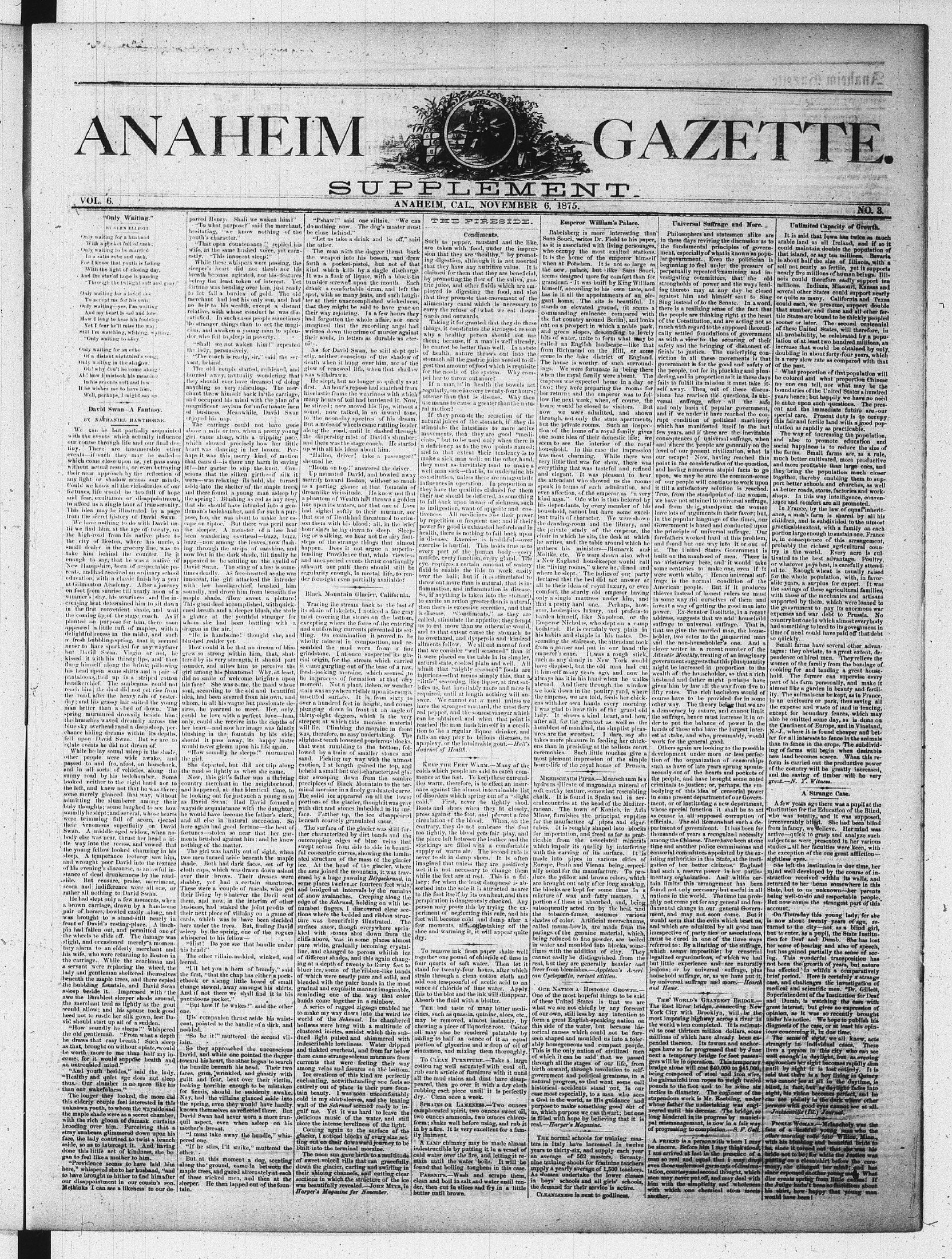
Searchable text
ANAHEIM
VOL. 6.
"Only Waiting."
BY GLEN ELLOFT
Only waiting for a husband
With a pocket full of cash;
Only waiting to be married
In a satin robe and sash.
For I know that youth is fading
With the light of closing day,
And the star of hope is passing
Through the twilight soft and gray.
Only waiting for a loved one
To accept me for his own;
Only waiting—yes, I'm waiting
And my heart is sad and lonely
How I long to hear his footstep—
Yet I fear he'll miss the way!
Still I'm watching, wishing, waiting.
"Only waiting to okey"
Only waiting for an echo
Of a distant nightbird's song;
Only waiting in the shadow.
Oh! why don't he come along?
Ah! how I mistook his meaning
In his accents soft and low—
If he wishes me to have him,
Well, perhaps, I might say no.
David Swan—A Fantasy.
BY NATHANIEL HAWTHORNE.
We can be but partially acquainted with the events which actually influence our course through life and our final destiny. There are innumerable other events—if such they may be called—which come close upon us, yet pass away without actual results, or even betraying parted Henry. Shall we waken him?
"To what purpose?" said the merchant, hesitating, "we know nothing of the youth's character."
"That open countenance?" replied his wife, in the same hushed voice, yet earnestly, "This innocent sleep."
While these whispers were passing, the sleeper's heart did not throb nor his breath become agitated, nor his features betray the least token of interest. Yet fortune was bending over him, just ready to let fall a burden of gold. The old merchant had lost his only son, and had no heir to his wealth, except a distant relative, with whose conduct he was dissatisfied. In such cases people sometimes do stranger things than to act the magician, and awaken a young man to splendor who fell to sleep in poverty.
"Shall we not waken him?" repeated the lady, persuasively.
"The coach is ready, sir," said the servant, behind.
The old couple started, reddened, and hurried away, mutually wondering that they should ever have dreamed of doing anything so very ridiculous. The merchant threw himself back in the carriage, and occupied his mind with the plan of a magnificent asylum for unfortunate men of business. Meanwhile, David Swan enjoyed his nap.
The carriage could not have gone above a mile or two, when a pretty young girl came along, with a tripping pace, which showed precisely how her little heart was dancing in her bosom. Perhaps it was this merry kind of motion that caused—is there any harm in saying it?—her garter to slip the knot.
"Pshaw!" said do nothing now. He close behind.
"Let us take a look at the other."
The man with the weapon into forth a pocket-pick which kills it was a flask of lt tumbler screwed to drank a comforta spot, with so many ter at their unaccustomed that they might be their way rejoicing had forgotten the imagined that they written down the their souls, in lettuity.
As for David Swift, neither conscience death when it hung glow of renewed life was withdrawn.
He slept, but no first. An hour's rest his elastic frame the many hours of toil he stirred; now more sound, now talked to the noon-day sun. But a noise of wheeled along the road, until the dispersing mischief and there was the stair up with all his ideas.
"Hallooo, driver!" shouted he.
"Room on top!"
David Swan—A Fantasy.
BY NATHANIEL HAWTHORNE.
We can be but partially acquainted with the events which actually influence our course through life and our final destiny. There are innumerable other events—if such they may be called—which come close upon us, yet pass away without actual results, or even betraying their near approach by the reflection of any light or shadow across our minds. Could we know all the vicissitudes of our fortunes, life would be too full of hope and fear, exultation or disappointment, to afford us a single hour of true serenity. This idea may be illustrated by a page from the secret history of David Swan.
We have nothing to do with David until we find him, at the age of twenty, on the high-road from his native place to the city of Boston, where his uncle, a small dealer in the grocery line, was to take him behind the counter. Be it enough to say, that he was a native of New Hampshire, born of respectable parents, and had received an ordinary school education, with a classic finish by a year at Gilmanton Academy. After a journey on foot from sunrise till nearly noon of a summer's day, his weariness and the increasing heat determined him to sit down in the first convenient shade, and wait the coming up of the stage coach. As if planted on purpose for him, there soon appeared a little tuft of maples, with a delightful recess in the midst, and such a fresh bubbling spring, that it seemed never to have sparkled for any wayfarer but David Swan. Virgin or not, he kissed it with his thirsty lips, and then flung himself along the brink, pillowing his head upon some shirts and a pair of pantalons, tied up in a striped cotton handkerchief. The sunbeams could not reach him; the dust did not yet rise from the road, after the heavy rain of yesterday; and his grassy hair suited the young man better than a bed of down. The spring murmured drowsily beside him; the branches waved dreamily across the blue sky overhead and a deep sleep, perchance hiding dreams within its depths, fell upon David Swan. But we are to relate events he did not dream of.
While he lay sound asleep in the shade, other people were wide awake, and passed to and fro, afoot, on horseback, and in all sorts of vehicles, along the sunny road by his bedchamber. Some looked neither to the right hand nor to the left, and knew not that he was there; some merely glanced that way, without admitting the slumberer among their busy thoughts; some laughed to see how soundly he slept; and several, whose hearts were brimming full of scorn, ejected their venomous superfluity on David Swan. A middle-aged widow, when nobody else was near, thrust her head a little way into the recess, and vowed that the young fellow looked charming in his sleep. A temperance lecturer saw him, and wrought poor David into the texture of his evening's discourse, as an awful instance of dead drunkenness by the roadside. But censure, praise, merriment, scorn and indifference were all one, or
The carriage could not have gone above a mile or two, when a pretty young girl came along, with a tripping pace, which showed precisely how her little heart was dancing in her bosom. Perhaps it was this merry kind of motion that caused—is there any harm in saying it?—her garter to slip the knot. Consections that the silken girth—if silk it were—was relaxing its hold, she turned aside into the shelter of the maple trees, and there found a young man asleep by the spring! Blushing as red as any rose, that she should have intruded into a gentleman's bedchamber, and for such a purpose, too, she was about to make her escape on tiptoe. But there was peril near the sleeper. A monster of a bee had been wandering overhead—buzz, buzz, buzz—now among the leaves, now flashing through the strips of sunshine, and now lost in the dark shade, till finally he appeared to be settling on the eyelid of David Swan. The sting of a bee is sometimes deadly. As free-hearted as she was innocent, the girl attacked the intruder with her handkerchief, brushed him soundly, and drove him from beneath the maple shade. How sweet a picture! This good deed accomplished, with quickened breath and a deeper blush, she stole a glance at the youthful stranger for whom she had been battling with a dragon in the air.
"He is handsome!" thought she, and blushed redder yet.
How could it be that no dream of bliss grew so strong within him that, shattered by its very strength, it should part asunder, and allow him to perceive the girl among his phantoms? Why, at least, did no smile of welcome brighten upon his face? She was come, the maid whose soul, according to the old and beautiful idea, had been severed from his own, and whom, in all his wague but passionate desires, he yearned to meet. Her, only could he love with a perfect love—him only, could she receive into the depths of her heart—and now her image was faintly blushing in the fountain by his side; should it pass away, its happy lustre would never glamour upon his life again.
"How soundly he sleeps!" murmured the girl.
She departed, but did not trip along the road so lightly as when she came.
Now, this girl's father was a thriving country merchant in the neighborhood, and happened, at that identical time, to be looking out for just such a young man as David Swan. Had David formed a wayside acquaintance with the daughter, he would become the father's clerk, and all else in natural succession. So here again had good fortune—the best of fortunes—stolen so near that her garments brushed against him; and he knew nothing of the matter.
The girl was hardly out of sight, when two men turned aside beneath the maple shade. Both had dark faces, set off by cloth caps, which was drawn down aslant over their brows. Their dresses were shabby, yet had a certain smartness. These were a couple of rascals who got hurried away, mutually wondering that they should ever have dreamed of doing anything so very ridiculous. The merchant threw himself back in the carriage, and occupied his mind with the plan of a magnificent asylum for unfortunate men of business. Meanwhile, David Swan enjoyed his nap.
The carriage could not have gone above a mile or two, when a pretty young girl came along with a tripping pace which showed precisely how her little heart was dancing in her bosom. Perhaps it was this merry kind of motion that caused—is there any harm in saying it?—her garter to slip the knot. Conscious that the silken girth—if silk it were—was relaxing its hold, she turned aside into the shelter of the maple trees and there found a young man asleep by the spring! Blushing as red as any rose that she should have intruded into a gentleman's bedchamber, and for such a purpose, too, she was about to make her escape on tiptoe. But there was peril near the sleeper. A monster of a bee had been wandering overhead—buzz, buzz—now among the leaves, now flashing through the strips of sunshine,and now lost in the dark shade,till finally he appeared to be settling on the eyelid of David Swan. The sting of a bee is sometimes deadly. As free-hearted as she was innocent,the girl attacked the intruder with her handkerchief,brushed him soundly,and drove him from beneath the maple shade. How sweet a picture! This good deed accomplished,以quickened breath and a deeper blush,she stole a glance at the youthful stranger for whom she had been battling with a dragon in the air.
"He is handsome!" thought she,and blushed redder yet.
How could it be that no dream of bliss grew so strong within him that,shattered by its very strength,它should part asunder,and allow him to perceive the girl among his phantoms? Why.at least,did no smile of welcome brighten upon his face? She was come,the maid whose soul,according to the old and beautiful idea,had been severed from his own,and whom,在all his wague but passionate desires,he yearned to meet.Her onlycould he love with a perfect love—him only,could she receive into the depths of her heart—and now her image was faintly blushing in the fountain by his side;should it pass away,its happy lustre would never glamour upon his life again.
"How soundly he sleeps!" murmured the girl.
She departed,但 did not trip along the road so lightly as when she came.
Now,这女孩的父亲 was a thriving country merchant in the neighborhood,and happened,at that identical time,to be looking out for just such a young man as David Swan。Had David formed a wayside acquaintance with the daughter,他 would become the father's clerk,和 all else in natural succession.So here again had good fortune—the best of fortunes—stolen so near that her garments brushed against him;and he knew nothing of the matter.
The girl was hardly out of sight,when two men turned aside beneath the maple shade.Both had dark faces,set off by cloth caps,which was drawn down aslant over their brows.Their dresses were shabby,yet had a certain smartness。这些 were a couple of rascals who got hurried away,mutually wondering that they should ever have dreamed of doing anything so very ridiculous.Merchant threw himself back in the carriage,and occupied his mind with the plan of a magnificent asylum for unfortunate men of business.Merchant threw himself back in the carriage,and occupied his mind with the plan of a magnificent asylum for unfortunate men of business.Merchant threw himself back in the carriage,and occupied his mind with the plan of a magnificent asylum for unfortunate men of business.Merchant threw himself back in the carriage,and occupied his mind with the plan of a magnificent asylum for unfortunate men of business.Merchant threw himself back in
some merely glanced that way, without admitting the slumberer among their busy thoughts; some laughed to see how soundly he slept; and several, whose hearts were brimming full of scorn, ejected their venomous superfluity on David Swan. A temperance lecturer saw him, and wrought poor David into the texture of his evening's discourse, as an awful instance of dead drunkenness by the roadside. But censure, praise, merriment, scorn and indifference were all one, or rather all nothing to David Swan.
He had slept only a few moments, when a brown carriage, drawn by a handsome pair of horses, bowled easily along, and was brought to a stand-still nearly in front of David's resting place. A linchpin had fallen out, and permitted one of the wheels to slide off. The damage was slight, and occasioned merely a momentary alarm to an elderly merchant and his wife, who were returning to Boston in the carriage. While the coachman and a servant were replacing the wheel, the lady and gentleman sheltered themselves beneath the maple trees, and there espied the bubbling fountain, and David Swan asleep beside it. Impressed with the awe the hamblest sleeper sheds around, the merchant trod as lightly as the gout would allow; and his spouse took good heed not to rustle her silk gown, lest David should start up all of a sudden.
"How soundly he sleeps!" whispered the old gentleman. "From what a depth he draws that easy breath! Such sleep as that, brought on without opiate, would be worth more to me than half my income; for it would suppose health and an untroubled mind."
"And youth besides," said the lady. "Healthy and quiet age does not sleep thus. Our slumber is no more like his than our wakefulness."
The longer they looked, the more did this elderly couple feel interested in this unknown youth, to whom the wayside and the maple shade were as a secret chamber, with the rich gloom of damask curtains brooding over him. Perceiving that a stray sunbeam glimmered down upon his face, the lady contrived to twist a branch aside, so as to intercept it. And having done this little act of kindness, she began to feel like a mother to him.
"Providence seems to have laid him here," whispered she to her husband, "and to have brought us hither to find him after our disappointment in our cousin's son. Methinks I can see a likeness to our de-
be looking out for just such a young man as David Swan. Had David formed a wayside acquaintance with the daughter, he would have become the father's clerk, and all else in natural succession. So here again had good fortune—the best of fortunes—stolen so near that her garments brushed against him; and he knew nothing of the matter.
The girl was hardly out of sight, when two men turned aside beneath the maple shade. Both had dark faces, set off by cloth caps, which was drawn down aslant over their brows. Their dresses were shabby, yet had a certain smartness. These were a couple of rascals, who got their living by whatever the Devil sent them, and now, in the interim of other business, had staked the joint profits of their next piece of villajny on a game of cards, which was to have been decided here under the trees. But, finding David asleep by the spring, one of the rogues whispered to his fellow—
"Hist? Do you see that bundle under his head?"
The other villain nodded, winked, and leered.
"I'll bet you a horn of brandy," said the first, "that the chap has either a pocketbook or a snug little hoard of small change stowed away amongst his shirts. And if not there we shall find it in his pantaloons pocket."
"But how if he wakes?" said the other one.
His companion thrust aside his waistcoat, pointed to the handle of a dirk, and nodded.
"So be it!" muttered the second villain.
So they approached the unconscious David, and while one pointed the dagger toward his heart, the other began to search the bundle beneath his head. Their two faces, grim, wrinkled, and ghastly with guilt and fear, bent over their victim, looking horrible enough to be mistaken for fiends, should he suddenly awake. Nay, had the villains glanced aside into the spring, even they would have hardly known themselves as reflected there. But David Swan had never worn a more tranquil aspect, even when asleep on his mother's breast.
"I must take away the bundle," whispered one.
"If he stirs, I'll strike," muttered the other.
But at this moment a dog, scenting along the ground, came in between the maple trees, and gazed alternately at each of these wicked men, and then at the sleeper. He then lapped out of the fountain.
The surface of the surface characterized by outerropping edges swept across from side to side concentric curves at structure of the ice. At the head of the neve joined the mersged by a huge yawn some places twelve o'clock and bridged at intervals of snow avalanches.
edge of the Schrund, numbed fingers, I detions where the beddure was beautifully surface snow, though skled with stones she cliffs above, was in pure white, gradually line, and changed to two bluer ice; some of the of which were nearly blended with the pale gradual and exquisite reminding one of the bands come together.
A series of rugged to make my way down world of the Schrund hollows were hung with clustered icicles, amid dled light pulsed an indescribable loveline and tinkled overhead; there came strange so currents that were among veins and fissures.
Ice creations of this enchanting, notwithstanding entirely out of place beauty. I was cold in my shirt-sleeve wall of the Schrund s gulf me. Yet it was delicious music of this more intense loveliness.
Coming again to glacier, I noticed blocking out on their down built into the terminal.
The moon sun gave of sweet-voiced rills down the glacier; curved their shining channels in which they was beautifully revealed Harper's Magazine for
EIM GA
SUPPLEMENT.
ANAHEIM, CAL., NOVEMBER 6, 1875.
"Pshaw!" said one villain. "We can do nothing now. The dog's master must be close behind."
"Let us take a drink and be off," said the other.
The man with the dagger thrust back the weapon into his bosom, and drew forth a pocket-pistol, but not of that kind which kills by a single discharge. It was a flask of liquor, with a block-tin tumbler screwed upon the mouth. Each drank a comfortable dram, and left the spot, with so many jests, and such laughter at their unaccomplished wickedness, that they might be said to have gone on their way rejoicing. In a few hours they had forgotten the whole affair, nor once imagined that the recording angel had written down the crime of murder against their souls, in letters as durable as eternity.
As for David Swan, he still slept quietly, neither conscious of the shadow of death when it hung over him, nor of the glow of renewed life, when that shadow was withdrawn.
He slept, but no longer so quietly as at first. An hour's repose had snatched from his elastic frame the weariness with which many hours of toil had burdened it. Now, he stirred; now moved his lips, without a sound, now talked, in an inward tone, to the noon-day spectres of his dream.
But a noise of wheels came rattling louder along the road, until it dashed through the dispersing mist of David's slumber; and there was the stage coach. He started up with all his ideas about him.
"Halloo, driver! take a passenger?" shouted he.
"Room on top!" answered the driver.
THE FIRESIDE.
Condiments,
Such as pepper, mustard and the like, are taken with food, under the impression that they are "healthy," by promoting digestion, although it is not asserted that they have any nutritive value. It is claimed for them that they are beneficial, by promoting the flow of the saliva, gastric juice, and other fluids which are employed in digesting the food, and also that they promote that movement of the alimentary canal which is necessary to carry the refuse of what we eat downwards and outwards.
Taking it for granted that they do these things, it constitutes the strongest reason why a healthy person should not use them; because, if a man is well already, he cannot be better than well. In a state of health, nature throws out into the stomach all the gastric juice needed to digest that amount of food which is requisite for the needs of the system. Why compel her to throw out more?
If a man is in health the bowels act regularly, once in every twenty-four hours; oftener than that is disease. Why then use means to cause a greater than the natural motion?
If they promote the secretion of the natural juices of the stomach, if they do stimulate the intestines to more active movements, then they are good "medicines," but to be used only when there is a deficiency as to the two points named; and to that extent their tendency is to make a sick man well; on the other hand, they must as inevitably tend to make a
Emperor William's Palace.
Babelsberg is more interesting than Sans Souci, writes Dr. Field to his paper, as it is associated with living personages who occupy the most exalted stations. It is the home of the emperor himself when at Potsdam. It is not so large as the new palace, but like Sans Souci, seems designed more for comfort than for grandeur. It was built by King William himself, according to his own taste, and has in it all the appointments of an elegant home. The site is beautiful. It stands on elevated ground, (it seems a commanding eminence compared with the flat country around Berlin), and looks out on a prospect in which a noble park, and green slopes, descending to lovely bits of water, unite to form what may be called an English landscape—like that from Richmond on the Hill, or some scene in the lake district of England. The house is worthy of such surroundings. We were fortunate in being there when the royal family were absent. The empress was expected home in a day or two; they were preparing the rooms for her return; and the emperor was to follow the next week, when, of course, the house would be closed to visitors. But now we were admitted, and shown through, not only the state apartments, but the private rooms. Such an inspection of the home of a royal family gives one some idea of their domestic life; we seem to see the interior of the royal household. In this case the impression was most charming. While there was very little that was for show, there was everything that was tasteful and refined.
He slept, but no longer so quietly as at first. An hour's repose has snatched from his elastic frame the weariness with which many hours of toil had burdened it. Now, he stirred; now moved his lips, without a sound, now talked, in an inward tone, to the noon-day spectres of his dream. But a noise of wheels came rattling louder along the road, until it dashed through the dispersing mist of David's slumber; and there was the stage coach. He started up with all his ideas about him.
"Halloo, driver!" take a passenger? shouted he.
"Room on top!" answered the driver. Up mounted David, and bowled away merrily toward Boston, without so much as a parting glance at that fountain of dreamlike vicissitude. He knew not that a phantom of Wealth had thrown a golden hue upon its waters, nor that one of Love had sighed softly to their murmur, nor that one of Death had threatenck to crimson them with his blood; all, in the brief hour since he lay down to sleep. Sleeping or walking, we hear not the airy footsteps of the strange things that almost happen. Does it not argue a superintending Providence that, while viewless and unexpected events thrust continually athwart our path? there should still be regularity enough, in mortal life, to render foresight even partially available?
Black Mountain Glacier, California.
Tracing the stream back to the last of its chain of lakesets, I noticed a fine gray mud covering the stones on the bottom, excepting where the force of the entering and outflowing currents prevented its settling. On examination it proved to be wholly mineral in composition, and resembled the mud worn from a fine grindstone. It at once suspected its glacial origin, for the stream which carried it came gurgling out of the base of a raw, fresh-looking moraine, which seemed to be in process of formation at that very moment. Not a plant, lichen, or weather stain was anywhere visible upon its rough, unsettled surface. It is from sixty to over a hundred feet in height, and comes plunging down in front at an angle of thirty-eight degrees, which is the very steepest at which this moraine material will lie. Climbing the moraine in front was therefore, no easy undertaking. The slightest touch loosened ponderous blocks, that went rumbling to the bottom, followed by a train of smaller stones and sand. Picking my way with the utmost caution, I at length gained the top, and beheld a small but well-characterized glacier swooping down from the sombre precipices of Black Mountain to the terminal moraine in a finely graduated curve. The solid ice appeared on all the lower portions of the glacier, though it was gray with dirt and stones imbedded in its surface. Farther up, the ice disappeared beneath coarsely granulated snow.
The surface of the glacier was still further characterized by dirt bands and the outropping edges of blue veins that swept across from side to side in beautiful concentric curves, showing the laminated structure of the mass of the glacier ice. At the head of the glacier, where the new joined the mountain, it was traversed by a huge yawning Bergsrund, in some places twelve or fourteen feet wide and bridged at intervals by a bridge.
If a man is in health the bowels act regularly, once in every twenty-four hours; oftener than that is disease. Why then uses means to cause a greater than natural motion?
If they promote the secretion of the natural juices of the stomach, if they do stimulate the intestines to more active movements, then they are good "medicines," but to be used only when there is a deficiency as to the two points named; and to that extent their tendency is to make a sick man well; on other hand, they must as inevitably tend to make a well man sick—that is, to undermine his constitution, unless there are antagonistic influences in operation. In proportion as they have the qualities claimed for them their use should be deferred, as something to fall back upon in case of sickness, such as indigestion, want-of appetite and cositeness. All medicines lose their power by repetition or frequent use; and if their power for good is exhausted beforehand in health, there is nothing to fall back upon in disease. Exercise is healthful—over exercise is hurtful. This holds true as to every part of the human body—every muscle, every function, every gland. The eye requires a certain amount of watery fluid to enable the lids to work easily over the ball; but if it is stimulated to throw out more than is natural, that is inflammation, and inflammation is disease. So, if anything is taken into the stomach to excite an action greater than is natural, then there is excessive secretion, and that is disease. "Conditions," as they are called, stimulate the appetite; they tempt us to eat more than we otherwise would, and to that extent cause the stomach to be overtaxed, and dyspepsia and kindred ailments follow. We all eat more of food that we consider "well seasoned" than if it were placed on the table in its simpler natural state, cooked plain and well. All admit that "nighly seasoned" foods are injurious—that means simply this, that a "ittle" seasoning, like liquor, at first satisfies us, but inevitably more and more is required; until at length nothing will answer. We cannot eat a meal unless we have the strongest mustard, the most fiery red pepper, and the sourest vinegar which can be obtained, and when that point is reached the man finds himself in a condition to be a regular liquor drinker, and falls an easy prey to bilious diseases, to apoplexy, or the intolerable gout. —Hail's Journal of Health.
KEEP THE FEET WARM. Many of the colds which people are said to catch commence at the feet. To keep these extremities warm, therefore, is to effect an insurance against the almost interminable list of disorders which spring out of a "slight cold." First, never be tightly shed. Boots and shoes when they fit closely, press against the foot, and prevent a free circulation of the blood. When on the contrary, they do not embrace the foot too tightly; the blood gets fair play, and the place left between the leather and the stockings are filled with a comfortable supply of warm air. The second rule is never to sit in damp shoes. It is often imagined that unless they are positively wet it is not necessary to change them while the feet are at rest. This is a falacy; for when the least dampness is absorbed into the sole it is attracted nearer
MERCERSAUM PIPES. — Meerschaum is a hydrous silicate of magnesia,a mineral of soft earthy texture,somewhat resembling chalk. It is found in Spain and in several countries at the head of the Mediterranean.The town of Konieh ,in Azia Minor,furnishesthe principal supplies forthe manufactureof pipesandcigarettes.Itis roughly shaped intoblocksforimportation,andfreedasaparticablefromtheassociated mineralswhich impairitsqualitybyinterferingwiththecarvingofitsurface.Itismadeinto pipesinvariouscitiesofEurope,PesthandViennabeingespeciallynotedforthemanufacture.Toproducetheyellowandbrowncolors,thebrountoutonlyafterlongsmoking,theblocksarekentforsometimeinotherdevelopmentofthehome-lifeoftheroyalhouseofPrussia.
MERCERSAUM PIPES. — Meerschaum is a hydrous silicate of magnesia,a mineral of soft earthy texture,somewhat resembling chalk. It is found in Spain and in several countries at the head of the Mediterranean.The town of Konieh ,in Azia Minor,furnishesthe principal supplies forthe manufactureof pipesandcigarettes.Itis roughly shaped intoblocksforimportation,andfreedasaparticablefromtheassociated mineralswhich impairitsqualitybyinterferingwiththecarvingofitsurface.Itismadeinto pipesinvariouscitiesofEurope,PesthandViennabeingespeciallynotedforthemanufacture.Toproducetheyellowandbrowncolors,thebrountoutonlyafterlongsmoking,theblocksarekentforsometimeinotherdevelopmentofthehome-lifeoftheroyalhouseofPrussia.
MERCERSAUM PIPES. — Meerschaum is a hydrous silicate of magnesia,a mineral of soft earthy texture,somewhat resembling chalk. It is found in Spain and in several countries at the head of the Mediterranean.The town of Konieh ,in Azia Minor,furnishesthe principal supplies forthe manufactureof pipesandcigarettes.Itis roughly shaped intoblocksforimportation,andfreedasaparticablefromtheassociated mineralswhich impairitsqualitybyinterferingwiththecarvingofitsurface.Itismadeinto pipesinvariouscitiesofEurope,PesthandViennabeing especiallynotedforthemanufacture.Toproducetheyellowandbrowncolors,thebrountoutonlyafterlongsmoking,theblocksarekentforsometimeinotherdevelopmentofthehome-lifeoftheroyalhouseofPrussia.
MERCERSAUM PIPES. — Meerschaum is a hydrous silicate of magnesia,a mineral of soft earthy texture,somewhat resembling chalk. It is found in Spain and in several countries at the head of the Mediterranean.The town of Konieh ,in Azia Minor,furnishesthe principal supplies forthe manufactureof pipesandcigarettes.Itis roughly shaped intoblocksforimportation,andfreedasaparticablefromtheassociated mineralswhich impairitsqualitybyinterferingwiththecarvingofitsurface.Itismadeinto pipesinvariouscitiesofEurope,PesthandViennabeing especiallynotedforthemanufacture.Toproducetheyellowandbrowncolors,thebrountoutonlyafterlongsmoking,theblocksarekentforsometimeinotherdevelopmentofthehome-lifeoftheroyalhouseofPrussia.
MERCERSAUM PIPES. — Meerschaum is a hydrous silicate of magnesia,a mineral of soft earthy texture,somewhat resembling chalk. It is found in Spain and in several countries at the head of the Mediterranean.The town of Konieh ,in Azia Minor,furnishesthe principal supplies forthe manufactureof pipesandcigarettes.Itis roughly shaped intoblocksforimportation,andfreedasaparticablefromtheassociated mineralswhich impairitsqualitybyinterferingwiththecarvingofitsurface.Itismadeinto pipesinvariouscitiesofEurope,PesthandViennabeing especiallynotedforthemanufacture.Toproducetheyellowandbrowncolors,thebrountoutonlyafterlongsmoking,theblocksarekentforsometimeinotherdevelopmentofthehome-lifeoftheroyalhouseofPrussia.
MERCERSAUM PIPES. — Meerschaum is a hydrous silicate of magnesia,a mineral of soft earthy texture,somewhat resembling chalk. It is found in Spain and in several countries at the head of the Mediterranean.The town of Konieh ,in Azia Minor,furnishesthe principal supplies forthe manufactureof pipesandcigarettes.Itis roughly shaped intoblocksforimportation,andfreedasaparticablefromtheassociated mineralswhich impairitsqualitybyinterferingwiththecarvingofitsurface.Itismadeinto pipesinvariouscitiesofEurope,PesthandViennabeing especiallynotedforthemanufacture.Toproducetheyellowandbrowncolors,thebrountoutonlyafterlongsmoking,theblocksarekentforsometimeinotherdevelopmentofthehome-lifeoftheroyalhouseofPrussia.
MERCERSAUM PIPES. — Meerschaum is a hydrous silicate of magnesia,a mineral of soft earthy texture,somewhat resembling chalk. It is found in Spain and in several countries at the head of the Mediterranean.The town of Konieh ,in Azia Minor,furnishesthe principal supplies forthe manufactureof pipesandcigarettes.Itis roughly shaped intoblocksforimportation,andfreedasaparticablefromtheassociated mineralswhich impairitsqualitybyinterferingwiththecarvingofitsurface.Itismadeinto pipesinvariouscitiesofEurope,PesthandViennabeing especiallynotedforthemanufacture.Toproducetheyellowandbrowncolors,thebrountoutonlyafterlongsmoking,theblocksarekentforsometimeinotherdevelopmentofthehome-lifeoftheroyalhouseofPrussia.
MERCERSAUM PIPES. — Meerschaum is a hydrous silicate of magnesia,a mineral of soft earthy texture,somewhat resembling chalk. It is found in Spain and in several countries at the head of the Mediterranean.The town of Konieh ,in Azia Minor,furnishesthe principal supplies forthe manufactureof pipesandcigarettes.Itis roughly shaped intoblocksforimportation,andfreedasaparticablefromtheassociated mineralswhich impairitsqualitybyinterferingwiththecarvingofitsurface.Itismadeinto pipesinvariouscitiesofEurope,PesthandViennabeing especiallynotedforthemanufacture.Toproducetheyellowandbrowncolors,thebrountoutonlyafterlongsmoking,theblocksarekentforsometimeinotherdevelopmentofthehome-lifeoftheroyalhouseofPrussia.
MERCERSAUM PIPES. — Meerschaum is a hydrous silicate of magnesia,a mineral of soft earthy texture,somewhat resembling chalk. It is found in Spain and in several countries at the head of the Mediterranean.The town of Konieh ,in Azia Minor,furnishesthe principal supplies forthe manufactureof pipes和cigarettes.Itshowingmethinksitwouldbeveryimportanttofindanewcomplexparticularlynecessarytohaveaperfectimpressionofthesimplehome-lifeoftheroyalhouseOfPrussia.MercerSchaumPipes.MercerSchaumPipes.MercerSchaumPipes.MercerSchaumPipes.MercerSchaumPipes.MercerSchaumPipes.MercerSchaumPipes.MercerSchaumPipes.MercerSchaumPipes.MercerSchaumPipes.MercerSchaumPipes.MercerSchaumPipes.MercerSchaumPipes.MercerSchaumPipes.MercerSchaumPipes.MercerSchaumPipes.MercerSchaumPipes.MercerSchaumPipes.MercerSchaumPipes.MercerSchaumPipes.MercerSchaumPipes.MercerSchaumPipes.MercerSchaumPipes.MercerSchaumPipes.MercerSchaumPipes.MercerSchaumPipes.MercerSchaumPipes.MercerSchaumPipes.MercerSchaumPipes.MercerSchaumPipes.MercerSchaumPipes.MercerSchaumPipes.MercerSchaumPipes.MercerSchaumPipes.MercerS chaumPipes.MercerS chaumPpires.Mer cer S cha um Ppires.Mer cer S cha um Ppires.Mer cer S cha um Ppires.Mer cer S cha um Ppires.Mer cer S cha um Ppires.Mer cer S cha um Ppires.Mer cer S cha um Ppires.Mer cer S cha um Ppires.Mer cer S cha um Ppires.Mer cer S cha um Pires.Mer cer S cha um Pires.Mer cer S cha um Pires.Mer cer S cha um Pires.Mer cer S cha um Pires.Mer cer S cha um Pires.Мер cer S cha um Ppires.Мер cer S cha um Ppires.Мер cer S cha um Ppires.Мер cer S cha um Ppires.Мер cer S cha um Ppires.Мер cer S cha um Pprises.Мер cer S cha um Pprises.Мер cer S cha um Pprises.Мер cer S cha um Pprises.Мер cer S cha um Pprises.Мер cer S cha um Pprises.Мер cer S cha um Pprises.Мер cer S cha um Pprises.Мер cer S cha um Pprises.Мер cer S cha um Pprises.Мер cer S cha um Pprises.Мер cer S cha um Рprises.Мер瓷 S ChaUm Рprises.Мер瓷 S ChaUm Рprises.Мер瓷 S ChaUm Рprises.Мер瓷 S ChaUm Рprises.Мер瓷 S ChaUm Рprises.Мер瓷 S ChaUm Рprises.Мер瓷 S ChaUm Рprises.Мер瓷 S ChaUm Рprises.Мер瓷 S ChaUm Рprises.Мер瓷 S ChaUm Рprises.Мер瓷 S ChaUm Рprises.Мер瓷 S ChaUm Рprises.Мер瓷 S ChaUm Рprises.Мерм瓷 S ChaUm Рprises.Мерм瓷 S ChaUm Рprises.Мерм瓷 S ChaUm Рprises.Мерм瓷 S ChaUm Рprises.Мерм瓷 S ChaUm Рprises.Мерм瓷 S ChaUm Рprises.Мерм瓷 S ChaUm Рprises.Мерм瓷 S ChaUm Рprises.Мерм瓷 S ChaUm Рprises.Мерм瓷 S ChaUm Рprises.Мерм瓷 S ChaUm Рprises.Мерм瓷 S ChaUm Рprises.Мерм瓷.S Cha Um Рprises.Мерм瓷.S Cha Um Рprises.Мерм瓷.S Cha Um Рprises.Мерм瓷.S Cha Um Рprises.Мерм瓷.S Cha Um Рprises.Мерм瓷.S Cha Um Рprises.Мерм瓷.S Cha Um Рprises.Мерм瓷.S Cha Um Рprises.Мерм瓷.S Cha Um Рprises.Мерм瓷.S Cha Um Рprises.Мерм瓷.S Cha Um Рprises.Мерм瓷.S Cha Um Рprises.Мерм瓷.S Cha Um Рprises.Мерт瓷.S ChaUm.Rises.Мерт瓷.S ChaUm.Rises.Мерт瓷.S ChaUm.Rises.Мерт瓷.S ChaUm.Rises.Мерт瓷.S ChaUm.Rises.Мерт瓷.S ChaUm.Rises.Мерт瓷.S ChaUm.Rises.Мерт瓷.S ChaUm.Rises.М修士.Rises.М修士.Rises.М修士.Rises.М修士.Rises.М修士.Rises.М修士.Rises.Прост.Rises.Прост.Rises.Прост.Rises.Прост.Rises.Прост.Rises.Прост.Rises.Прост.Rises.Прост.Rises.Прост.Rises.Прост.Rises.Прост.Rises.Прост.Rises.Прост.Rises.Прост.Rises.Прост.Rises.Прост.Rises.Прост.Rises.Прост.Rises.Прост.Rise스.Pрост.Rise스.P静态.RiseStatic.RiseStatic.RiseStatic.RiseStatic.RiseStatic.RiseStatic.RiseStatic.RiseStatic.RiseStatic.RiseStatic.RiseStatic.RiseStatic.RiseStatic.RiseStatic.RiseStatic.RiseStatic.RiseStatic.RiseStatic.RiseStatic.RiseStatic.RiseStatic.RiseStatic.RiseStatic.RiseStatic.RiseStatic.RiseStatic.RiseStatic.RiseStatic.RiseStatic.RiseStatic.Rise StaticRiseStatic.RiseStatic.RiseStatic.RiseStatic.RiseStatic.RiseStatic.RiseStatic.RiseStatic.RiseStatic-RiseStatic-RiseStatic-RiseStatic-RiseStatic-RiseStatic-RiseStatic-RiseStatic-RiseStatic-RiseStatic-RiseStatic-RiseStatic-RiseStatic-RiseStatic-RiseStatic-RiseStatic-RiseStatic-RiseStatic-RiseStatic-RiseStatic-RiseStatic-RiseStatic-RiseStatic-Rise StaticR rise StaticR rise StaticR rise StaticR rise StaticR rise StaticR rise StaticR rise StaticR rise StaticR rise StaticR rise StaticR rise StaticR rise StaticR rise StaticR rise StaticR rise StaticR rise StaticR rise StaticR rise StaticR rise StaticR rise StaticR rise StaticR rise StaticR rise StaticR rise StaticR rise StaticR rise StaticR rise StaticR rise StaticR rise StaticR rise StaticR rise Static Rrise StaticRrise StaticRrise StaticRrise StaticRrise StaticRrise StaticRrise StaticRrise StaticRrise StaticRrise StaticRrise StaticRrise StaticRrise StaticRrise StaticRrise StaticRrise StaticRrise_staticRrise_staticRrise_staticRrise_staticRrise_staticRrise_staticRrise_staticRrise_staticRrise_staticRrise_staticRrise_staticRrise_staticRrise_staticRrise_staticRrise_staticRrise_staticRrise_static Rrise_static Rrise_static Rrise_static Rrise_static Rrise_static Rrise_static Rrise_static Rrise_static Rrise_static Rrise_static Rrise_static Rrise_static Rrise_static Rrise_static Rrise_static Rrise_static Rrise_static Rrise_static Rrise_static Rrise_static Rrise_static Rrise_static Rrise_static Rrise_static Rrise static Rrise static Rrise static Rrise static Rrise static Rrise static Rrise static Rrise static Rrise static Rrise static Rrise static Rrise static Rrise static Rrise static Rrise static Rrosestatic Rrosestatic Rrosestatic Rrosestatic Rrosestatic Rrosestatic Rrosestatic Rrosestatic Rrosestatic Rrosestatic Rrosestatic Rrosestatic Rrosestatic Rrosestatic Rrosestatic Rrosestatic Rrosestatic Rrosestatic Rrosestatic Rrosestatic Rrosestatic Rrosestatic Rrosestatic Rrosestatic Rrosestatic
The surface of the glacier was still further characterized by dirt bands and the outcropping edges of blue veins that swept across from side to side in beautiful concentric curves, showing the laminated structure of the mass of the glacier ice. At the head of the glacier, where the neve joined the mountain, it was traversed by a huge yawning Bergschrund, in some places twelve or fourteen feet wide, and bridged at intervals by the remains of snow avalanches. Creeping along the edge of the Schrund, holding on with benumbed fingers, I discovered clear sections where the bedded and ribbon structure was beautifully illustrated. The surface snow, though everywhere sprinkled with stones shot down from the cliffs above, was in some places almost pure white, gradually becoming crystalline, and changed to porous whitish ice of different shades, and this again changing at a depth of twenty to thirty feet to bluer ice, some of the ribbon-like bands of which were nearly pure and solid, and bleuded with the paler bands in the most gradual and exquisite manner imaginable, reminding one of the way that color bands come together in a rainbow.
A series of rugged zigzags enabled me to make my way down into the weird ice world of the Schrund. Its chambered hollows were hung with a multitude of clustered icicles, amidst which thin subdued light pulsed and shimmered with indescribable loveliness. Water dripped and tinkled overhead, and from far below there came strange solemn murmurs from currents that were feeling their way among veins and fissures on the bottom.
Ice creations of this kind are perfectly enchanting, notwithstanding one feels so entirely out of place in their pure fountain beauty. I was soon uncomfortable cold in my shirt-sleeves, and the leaning wall of the Schrund seemed ready to ingulf me. Yet it was hard to leave the delicious music of the water, and still more the intense loveliness of the light.
Coming again to the surface of the glacier, I noticed blocks of every size setting out on their downward journey to be built into the terminal moraine.
The noon sun gave birth to a multitude of sweet-voiced rills that ran gracefully down the glacier, curling and swirling in their shining channels, and cutting clear sections in which the structure of the ice was beautifully revealed.—John Muir, in Harper's Magazine for November.
First, never be tightly shod. Boots and shoes when they fit closely, press against the foot, and prevent a free circulation of the blood. When, on the contrary, they do not embrace the foot too tightly, the blood gets fair play, and the place left between the leather and the stockings are filled with a comfortable supply of warm air. The second rule is never to sit in damp shoes. It is often imagined that unless they are positively wet it is not necessary to change them while the feet are at rest. This is a fallacy; for when the least dampness is absorbed into the sole it is attracted nearer to the foot itself by its own heat, and thus perspiration is dangerously checked. Any person may prove this by trying the experiment of neglecting this rule, and his feet will become cold and damp after a few moments, alfalfa-taking off the shoe and warming it, it will appear quite dry.
To remove ink from paper shake well together one pound of chloride of lime in four quarts of soft water. Then let it stand for twenty-four hours, after which strain through a clean cotton cloth and add one teaspoonful of acetic acid to an ounce of chloride of lime water. Apply this to the blot and the ink will disappear. Absorb the fluid with a blotter.
The bad taste of many bitter medicines, such as quassia, quinine, aloes, etc., may be removed, almost instantly, by chewing a piece of liquorice root. Castor oil may also be rendered palatable by adding to half an ounce of it an equal portion of glycerine and a drop of oil of einnamon, and mixing them thoroughly.
To Clean Furniture.—Take a large cotton rag well saturated with coal oil, rub each article of furniture with it until all the mud stains and dust have disappeared, then go over it with a dry cloth rubbing each piece until it is perfectly dry. Clean once a week.
Sprains or Lameness.—Two ounces camphor spirit, two ounces sweet oil, two ounces ammonia, two ounces chloroform; shake well before using, and rub it in by a fire. It is very excellent for a family liniment.
A lamp chimney may be made almost indestructible by putting it in a vessel of cold water over the fire, and letting it remain until the water boils. It will be found that boiling toughens in this case.
Parsnips.—Wash and scrape them, clean and boil in salt and water until tender, then cut in slices and fry in a little butter until brown.
Our Nation A Historic Growth.—One of the most hopeful things to be said of these United States is that we are what we are not chiefly by any forecast of our own, still less by any intention to form a great English-speaking nation on this side of the water, but because historical causes which could not be foreseen shaped and moulded us into a tolerably homegeneous and compact people. This is the only nation of civilized men of which it can be said that we passed through all the stages of our life, from birth onward, through revolution to self-government and political greatness, in a natural progress, so that what some call historical accidents stand out, in our case most especially, to a man who sees a God in the world, as His guidance and purpose to make something good out of us, which purpose we can thwart; but one is filled with hope by believing that it is real.—Harper's Magazine.
The normal schools for training masters in Italy have increased in twelve years to thirty-six, and supply each year an average of 502 masters. Seventy-nine training-shools for femine teachers supply a yearly average of 1,500 teachers. As women undertake the lower classes in boys' schools and all girls' schools, the demand for their service is active.
Cleanliness is next to godliness.
GAZETTE.
NO. 8.
William's Palace.
More interesting than Dr. Field to his paper, with living personages, most exalted stations, the emperor himself.
It is not so large as not like Sans Souci, for comfort than for built by King William to his own taste, and pointments of an ele-ite is beautiful. It ground, (it seems a chance compared with Land Berlin), and looks which a noble park, descending to lovely form what may be landscape—like that in the Hill, or some district of England, of such surround-ance in being there they were absent. The old home in a day or sharing the rooms for emperor was to follow, of course, the need to visitors. But admitted, and shown the state apartments, Such an inspec-tion a royal family gives for domestic life; we superior of the royal cause the impression While there was or show, there was tasteful and refined
Universal Suffrage and More.
Philosophers and statesmen alike are in these days reviving the discussion as to the fundamental principles of govern-ment, especially of what is known as popu-lar government. Even the politician is beginning to feel under the pressure of perpetually repeated examining and investigating committees, that the old strongholds of power and the ways leading thereto may at any day be closed against him and himself sent to Sing Sing instead of to the Senate. In a word, there is a realizing sense of the fact that the people are thinking right at the heart of the Constitution, and are acting not so much with regard to the supposed theoretically settled foundations of government as with a view to the securing of their safety and the bringing of dishonest officials to justice. The underlying conviction in all these movements is that government is for the good and safety of the people, not for its plucking and plundering, and in proportion as it in these days fails to fulfill its mission it must take itself away. Then out of these discussions has rearisen the questions, Is universal suffrage after all the safe and only basis of popular government, and if we under it have reached the corrupt condition of political machinery which has manifested itself in the last few years, and if these are the inevitable consequences of universal suffrage, when and where the people are generally on the level of our present civilization, what is our escape? Now, having reached this point in the consideration of the question, and having numerous stupid facts to go
being there the people, not for its plucking and plundering, and in proportion as it in these days fails to fulfill its mission it must take itself away. Then out of these discussions has rearisen the questions. Is universal suffrage after all the safe and only basis of popular government, and if we under it have reached the corrupt condition of political machinery which has manifested itself in the last few years, and if these are the inevitable consequences of universal suffrage, when and where the people are generally on the level of our present civilization, what is our escape? Now, having reached this point in the consideration of the question, and having numerous stupid facts to go upon, we may be sure the common-sense of our people will continue to work upon it till a satisfactory solution is reached. True, from the standpoint of the women, we have not attained to universal suffrage, and from their standpoint the women have lots of arguments in their favor; but, in the popular language of the times, our Government is based and conducted upon the principle of universal suffrage. Our forefathers worked hard at this problem, and found but one way into it or out of it. The United States Government is built on the manhood of men. There is no aristocracy here, and it would take some centuries to make one, even if it were worth while. Hence universal suffrage is the normal condition of the American people. But if it produces thieves instead of honest rulers we must in some way rid ourselves of them and invent a way of getting the good men into power. Ex-Senator Doolittle, in a recent address, suggests that we add household suffrage to universal suffrage. That is, that we give the married man, the householder, two votes to the unmarried man and the non-householder's one. And a clever writer in a recent number of the Atlantic Monthly, treating of an imaginary government suggests that this plus quantity might be increased in proportion to the wealth of the householder, so that a rich husband and father might perhaps have given him by law all the way from five to fifty votes. The rich bachelors would of course have to be provided for in some other way. The theory being that we are a democracy by nature, and cannot limit the suffrage, hence must increase it in order to put the balance of power in the hands of those who have the largest interest at stake, and who presumably would work for the general good.
Others again are looking to the possible development under more or less perfection of the organization of censorships such as have of late years sprung spontaneously out of the hearts and pockets of the people, and have brought some noted criminals to justice; or, perhaps, the embodying of this idea of censorial power in some present department of our Government, or of instituting a new department, whose special function it shall be to act as censor in all supposed corruption of officials. The old Romans had such a department of government. It has been for thousands of years a recognized necessity among the Chinese. There have been at one time and another police commissions and censorial committees appointed by the existing authorities in this State, at the institution of her better citizens. England had such a reserve power in her parliamentary organization. And within certain limits this arrangement has been found not only necessary but painful in all
What proportion of that population will be colored and what proportion Chinese no one can tell, nor what may be the boundaries of the United States a hundred years hence; but happily we have no need to enter upon such questions. The present and the immediate future are our special care. Present duty is to occupy this fair and fertile land with a good population as rapidly as practicable.
The way of increasing the population, and also to promote education and social happiness is to reduce the size of the farms. Small farms are, as a rule, much better cultivated, more productive and more profitable than large ones, and they bring the population much closer together, thereby enabling them to support better schools and churches, as well as better roads, stores, factories and workshops. In this way intelligence, convenience and comfort are all promoted.
In France, by the law of equal inheritance, a man's farm is shared by all his children, and is subdivided to the utmost practicable extent, with a family on each portion large enough to sustain one. France is, in consequence of this arrangement, probably the richest agricultural country in the world. Every acre is cultivated to the best advantage. Poultry, or whatever pays best, is carefully attended to. Enough wheat is usually raised for the whole population, with, in favorable years, a surplus for export. It was the savings of these agricultural families, with those of the mechanics and artisans supported by them, which were loaned to the government to pay its enormous war expenses and war debt to Prussia. No country but one in which almost everybody had something to lend to its government in time of need could have paid off that debt so quickly.
Small farms have several other advantages: they obviate, to a great extent, dependence on hired men. They relieve the women of the family from the bondage of cooking for and tending a great household. The farmer can supervise every part of his farm personally, and make it almost like a garden in beauty and fertility. The animals can be kept, as in France, in an enclosure or park, thus saving all the expense and waste of land in fencing, except for boundary fences, which may also be omitted some day, as is done on the Continent of Europe, and in Vineland, N.J., where it is found cheaper and better for all interests to fence in the animals than to fence in the crops. The subdividing of farms will begin when desirable new land becomes scarce. When this reform is carried out the productive power of the country will be greatly increased, and the saving of timber will be very great.-N.Y.Witness.
A Strange Case.
A few years ago there was a pupil at the Institution for the Education of the Blind, who was totally, and it was supposed, irrecoverably blind. She had been blind from infancy; we believe. Her mind was active—quick to grasp and analyze such subjects as were presented in her various studies—all her faculties were keen, with the exception of the one great affliction—sightless eyes.
She left the institution in due time, her mind well developed by the course of instruction received within its walls, and returned to her home somewhere in this State but no nakedness.
What resembling Spain and in several principal supplies pipes and cigar-shaped into blocks faced as far as prerequisite minerals by interfering with surface. It is various cities of India being especially fracture. To pro-pown colors, which after long smoking, some time in a fatty matters. A sorbed, and, being by the heat and assumes various special meerschaums, made from the material, which powder, are boiled into blocks, some of clay. They quenished from the really heavier and Appleton's American edition.
WORLD GROWTH.—All things to be said is that we are by any forecast any intention to breaking nation on point because his would not be fore-used us into a toler- compact people. Of civilized men that we passed of our life, from revolution to self-sal greatness, in what some call and out, in our man who sees his guidance and being good out of thwart; but one believing that it is wise.
For training mass-eased in twelve supply each year masters. Seventy-five examine teachers of 1,500 teachers. The lower classes all girls' schools, twice active.
A FRIEND is a person with whom I may be sincere. Before him I may think aloud, I am arrived at last in the presence of a man so real and equal that I may drop even those undermost garments of disimulation, courtesy and second thought, which men may never put off, and may deal with him with the simplicity and wholeness with which one chemical atom meets another.
A Strange Case.
A few years ago there was a pupil at the Institution for the Education of the Blind, who was totally, and it was supposed, irrecoverably blind. She had been blind from infancy, we believe. Her mind was active—quick to grasp and analyze such subjects as were presented in her various studies; all her faculties were keen, with the exception of the one great affliction—sightless eyes.
She left the institution in due time, her mind well developed by the course of instruction received within its walls, and returned to her home somewhere in this State, but to us unknown—her parents being well-to-do and respectable people. But now comes the strangest part of this account.
On Thursday this young lady, for she is now about twenty years of age, returned to the city—not as a blind girl, but to enter, as a pupil, the State Institution for Deaf and Dumb. She has lost her sense of hearing and also of speech, but has gained partially the sense of seeing. This wonderful transposition has not been the growth of years, but nature has effected in within a comparatively brief period. Here is certainly a strange case, and challenges the investigation of medical and scientific men. "Dr. Gillett, Superintendent of the Institution for Deaf and Dumb, is watching the case with great interest, but gives no expression of opinion, as it was so recently brought under his notice. We hope to publish his diagnosis of the case, or at least his opinions concerning it, in due time.
The sense of sight, we all know, acts strangely in individual cases. There lives a person in this city who can see well enough in daylight, but as evening approaches her sight becomes rapidly dim until by night it is lost entirely. It is said that there is a boy living in Quincy who cannot see at all in the daytime, is blind, in fact, but as daylight fades into night, his vision becomes perfect, and he can see plainly in the dark where other persons with good eyes cannot see at all.
Jacksonville (Ill.) Journal.
FICKLE WOMAN—Melancholy was the fate of a bashful young man who the other morning rode into Wilton, Mina, with his blushing and beautiful bride to his since it turned out that she was his bride not to be; for while the Justice was putting on a clean shirt before the ceremony, she changed her mind; and has since espoused another young man. What dire events spring from little causes! If the Judge hadn't been so fastidious about his shirt, how happy that young man would have been!