anaheim-gazette 1875-10-30
Scanned page
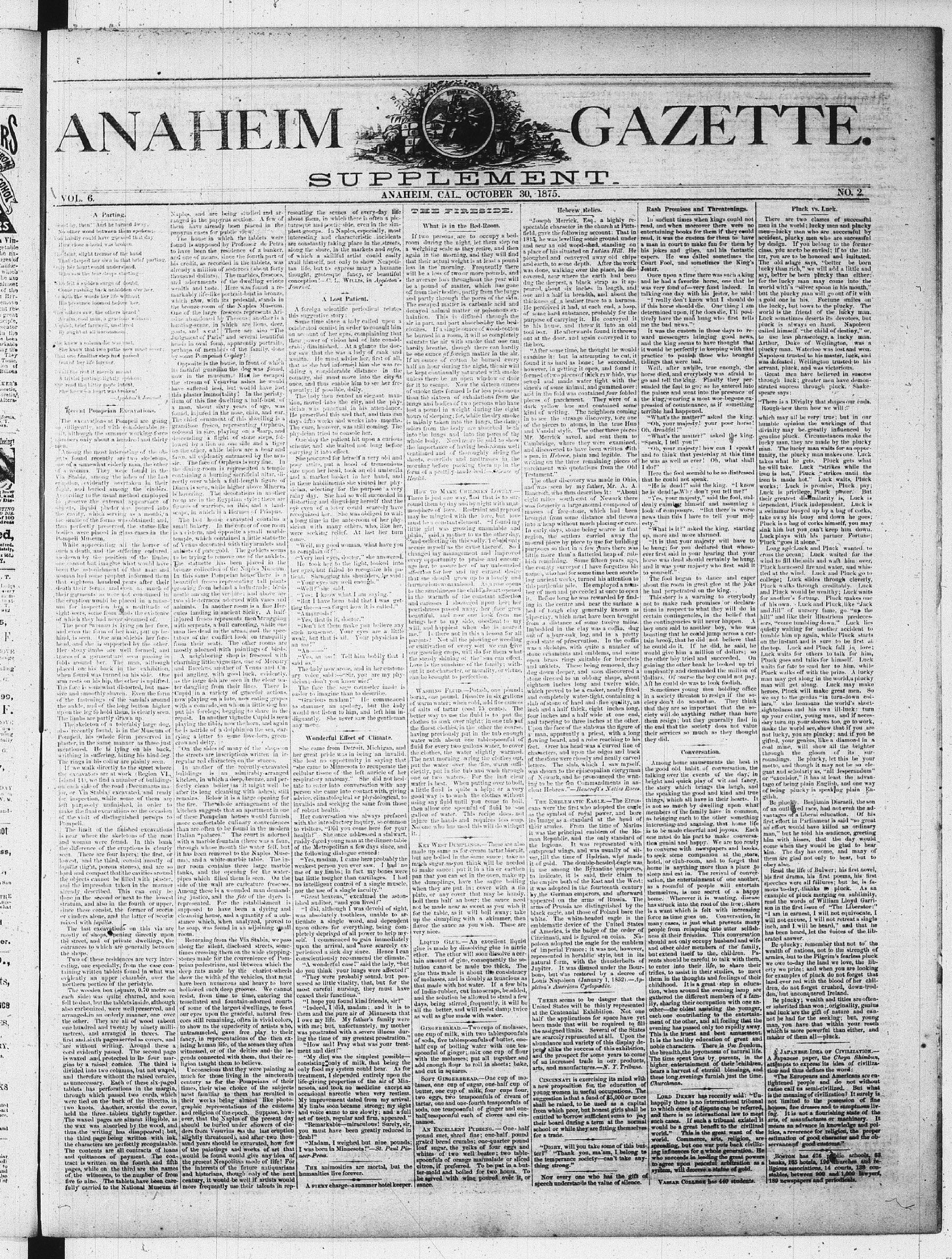
Searchable text
ANAHEIM
VOL. 6.
A Parting.
Good by then! And he turned away.
No other word between them spoken;
You hardly could have guessed that day.
How close a bond was broken.
The faint, slight tremor of the hand.
That clasped her own in that brief parting.
Only her heart could understand.
Who saw the tear drops starting—
Who felt a sudden surge of doubt.
Come rushing back unhidden over her,
With the words her life without.
Has presence formed before her.
The others saw, the others heard!
A calm, cool man, a gracious woman.
Applet, brief farewell, unstirred.
By night at all uncommon.
She knew a solamn die was cost.
She know that two paths now must sever;
that one familiar step had passed
out of her life forever.
To all the rest it merely mounts.
A trivial parting lightly spoken;
She read the bitter quote intent,
She knew—a heart was broken!
Recent Pompeian Excavations.
The excavations at Pompeii are going
on diligently, and with considerable research, although the summer working force
numbers only about a hundred and thirty
men.
Among the most interesting of the objects found recently are two skeletons,
one of a somewhat elderly man, the other
of a somewhat younger man, the other
of a somewhat elderly man, the other
of a somewhat elderly man, the other
of a somewhat elderly man, the other
of a somewhat elderly man, the other
of a somewhat elderly man, the other
of a somewhat elderly man, the other
of a somewhat elderly man, the other
of a somewhat elderly man, the other
of a somewhat elderly man, the other
of a somewhat elderly man, the other
of a somewhat elderly man, the other
of a somewhat elderly man, the other
of a somewhat elderly man, the other
of a somewhat elderly man, the other
of a somewhat elderly man, the other
of a somewhat elderly man, the other
of a somewhat elderly man, the other
of a somewhat elderly man, the other
of a somewhat elderly man, the other
of a somewhat elderly man, the other
of a somewhat elderly man, the other
of a somewhat elderly man, the other
of a somewhat elderly man, the other
of a somewhat elderly man, the other
of a somewhat elderly man, the other
of a somewhat elderly man, the other
of a somewhat elderly man, the other
of a somewhat elderly man, the other
of a somewhat elderly man, the other
of a somewhat elderly man, the other
of a somewhat elderly man, the other
of a somewhat elderly man, the other
of a somewhat elderly man, the other
of a somewhat elderly man, the other
of a somewhat elderly man, the other
of a somewhat elderly man, the other
of a somewhat elderly man, the other
of a somewhat elderly man, the other
of a somewhat elderly man, the other
of a somewhat elderly man, the other
of a somewhat elderly man, the other
of a somewhat elderly man, the other
of a somewhat elderly man, the other
of a somewhat elderly man, the other
of a somewhat elderly man, the other
of a somewhat elderly man, the other
of a somewhat elderly man, the other
of a somewhat elderly man, the other
of a somewhat elderly man, the other
of a somewhat elderly man, the other
of a somewhat elderly man, the other
of a somewhat elderly man, the other
of a somewhat elderly man, the other
of a somewhat elderly man, the other
of a somewhat elderly man, the other
of a somewhat elderly man, the other
of a somewhat elderly man, the other
of a somewhat elderly man, the other
of a somewhat elderly man, the other
Of Naples, and are being studied and arranged in the papyrus section. A few of them have already been placed in the papyrus cases for public view!
The house in which the tablets were found is supposed by Professor de Petra to have been the residence of a banker,
and one of means since the fourth part of his credit, as recorded in the tablets, was already a million of sesteres (about forty thousand dollars). The marbles, frescoes,
and adornments of the dwelling evince wealth and taste. Here was found a remarkably life-like portrait-bust in bronze,
which now, with its pedestal, stands in the bronze-room of the Naples Museum.
One of the large frescoes represents Arisidne abandoned by Thessens; another is a hunting-scene, in which are lions, deer,
goats, and a cat! There are also "The Judgment of Paris" and several beautiful heads in oval form, apparently portraits,
perhaps of members of the family, done by some Pompeian Copley!
Opposite is the house, in front of which its faithful guardian the dog was found,
now in the museum. Had he escaped the stream of Vesuvius ashes he would have suffered less, but would have lost this plaster immortality! In the peristyrium of this fine dwelling a half-bust of a man, about sixty years of age, was found, injured in the nose, chin, and ear. The chief ornament of this dwelling is a grandiose fresco, representing Orpheus,
colossal in size, playing on a harp, and descending a flight of stone steps followed by a lion on one side and a tiger on another, while below are a boar and fawn. All evidently entranced by the music. The face of Orpheus is very fine. In the dining-room is refreshed by a temple presenting the scenes of about them in which they turesque and poetic side,
plest groups. In Naples,
interesting and character are constantly taking place along the shore, in the midst of which a skillful art avail himself not only to tan life but to express thought; grotesque fan conception!—C. L. Writ.
Journal.
A Lost Patron:
A foreign scientific pity this suggestive story:
Some time since a lady celebrated ocunist in order on account of her eyes,
their power of vision has eradicated diminished. At tor saw that she was as l wealth. He must advise that as she had informed siding considerable country,she must move once,and thus enable h quently:if possible,dislike.The lady then rented session,moved into e ci sician was punctual.In He prescribed this and t days into weeks and wee The cure,h however.was s physician tried to conson One day,the patient h scheme,and she waited carrying it into effect.
She procured for herself poor attire.puta hoo
Recent Pompeian Excavations.
The excavations at Pompeii are going on diligently, and with considerable result, although the summer working force numbers only about a hundred and thirty men.
Among the most interesting of the objects found recently are two skeletons, one of a somewhat elderly man, the other of a woman. They were found in the Via Stabia, among the ashes of the last eruption, evidently overtaken in their flight, and buried among the cinders. According to the usual method employed to preserve the external appearance of objects, liquid plaster was poured into the cavity, which serving as a mould, the smile of the forms was obtained; and, thus perfectly preserved, the statue-like bodies were placed in glass cases in the Pompeii Museum.
While appreciating all the horror of such a death, and the suffering endured as shown by the position of the limbs, one cannot but imagine what would have been the astonishment of that man and woman had some prophet informed them that eighteen hundred years after their death their forms and even as much of their garments as were not consumed in the eruption would be placed in a museum for inspection by a multitude of sight seers, some from lands the existence of which they had never dreamed of.
The poor woman is lying on her face, and even the form of her hair, put up behind, is seen. One arm shields her forehead, and she is supported by the other. Her stony limbs are well formed, and traces of a garment are seen passing in folds around her. The man, although placed on his back in the exhibition, when found was turned on his side. One arm rests on his hip, the other is uplifted. The face is somewhat distorted, but massive and smoothly shaven. Even the form of the fastenings of the sandals around the ankle, and of the long button higher up on the leg to hold them, is clearly seen. The limbs are partly drawn up.
The skeleton of a tolerably large dog, also recently found, is in the Museum of Pompeii, his whole form preserved in plaster, in the same manner as those just mentioned. He is lying on his back, writhing in suffering, biting his hind-leg. The rings in his collar are plainly seen.
If we walk directly to the street where the excavators are at work (Region VI., island 14), we find a number of buildings on each side of the road (Decumanus major, or Via Stabia) excavated, and ready for inspection, while some of them are left purposely unfinished, in order to make the final excavations on the occasion of the visit of distinguished persons to Pompeii.
The limit of the finished excavations is near where the skeletons of the man and woman were found. In this bank the difference of the eruptions is clearly seen. There are four layers: the first, or lowest, and the third, consist mostly of tapir (light, porous stones), and are so hard and compact that the cavities around the objects cannot be filled with plaster, and the impression taken in the manner its latent guardian the dog was found now in the museum. Had he escaped the stream of Vesuvius ashes he would have suffered less, but would have lost this plaster immortality! In the peristylum of this fine dwelling a half-bust of a man, about sixty years of age, was found, injured in the nose, cain, and ear. The chief ornament of this dwelling is a grandiose fresco, representing Orpheus, colossal in size, playing on a harp, and descending a flight of stone steps, followed by a lion on one side and a tiger on the other, while below are a boar and fawn, all evidently entranced by the music. The face of Orpheus is very fine. In the dining room is represented a temple containing a burning sacrificial altar, directly over which a full-length figure of Diana is seen, while higher above Minerva is hovering. The decorations in another room are in the Egyptian style; there are figures of warriors, an ibis and a landscape, in which is a Hermes of Priapus.
The last house excavated contains a small bakery. In the corner of one room is a cistern, and opposite a small marble temple, which contained a little statuette of Venus decorated with tiny armlets and ankets of pure gold. The goddess seems to be trying to remove one of the anklets. The statuette has been placed in the bronze collection of the Naples Museum. In this same Pompeian house there is a beautiful fresco representing tall plants growing from behind a balustrade; birds nestle among the verdure; and above are two side-terraces adorned with vases and animals. In another room is a fine Hercules landing in ancient Sicily. A half-injured fresco represents men struggling with serpents, a bull careering, while one man lies dead in the arena; and the spectators of the conflict look on tranquilly from their seats. The other rooms are mostly adorned with paintings of birds.
A neighboring shop is frescoed with charming little vignettes, one of Mercury and Bacchus, another of Venus and Cupid angling, with good luck, evidently as large fish are seen in the clear water dangling from their lines. There is Cupid in a variety of graceful actions; now playing on a lute, now eating grapes with a comrade, on whom a little dog has put his forelegs, begging to share in the repast. In another vignette Cupid is seen playing the tibia, nowthe horn,and again he is astride of a dolphin on the sea, carrying a letter to some love-lorn green-crowned deity.
On the sides of many of the shops on the streets are inscriptions written in irregular red characters on the stucco.
In another of the recently-excavated kitchen, in which a deep bronze, and perfectly clean boiler as it might well be after its long cleansing with ashes), still remains. Below it is a large opening for the fire. The whole arrangement of the kitchen suggests that an apartment in one of these Pompeian houses would furnish more comfortable culinary conveniences than are often to be found in the modern Italian "palaces." The court is adorned with a marble fountain (there was a faun, through whose mouth the water fell), but it has been removed to the Naples Museum), and a white-marble table. The inner room contains three large marble tanks, and the opening for the water-pipes which filled them is seen. On the side of the wall are caricature frescoes.
Her conversation was with the introductory interview to visitors. "Did you come health?" She once added rudely-faced young man of the Metropolitan area; she following dialogue.
"Yes, madam I came weakest person you ever use of my limbs; in fact but little tougher than no intelligent control..."
The limit of the finished excavations is near where the skeletons of the man and woman were found. In this bank the difference of the eruptions is clearly seen. There are four layers; the first, or lowest, and the third, consist mostly of lapillar (light, porous stones), and are so hard and compact that the cavities around the objects cannot be filled with plaster, and the impression taken in the manner already described. This can only be done in the second or next to the lowest stratum, and also in the fourth or upper, since these consist, the former of scoria or cinders alone, and the latter of scoria mixed with lapilla.
The last excavations on this via are mostly of shops, opening directly upon the street, and of private dwellings, the entrances to which are generally between the shops.
Two of these residences are very interesting, one especially, from the case containing written tablets found in what was evidently an upper chamber, over the northern portico of the peristyle.
The wooden box (square, 0.70 metre on each side) was quite charred, and soon fell to dust, but the tablets inside, although also carbonized, were well preserved, and arranged in an orderly manner, one over the other. They are all of wood (about one hundred and twenty by ninety millimetres), and arranged in threes. The first and sixth pages served as covers, and are without writing. Around these a cord evidently passed. The second page is waxed and protected in its four margins by a raised cornice. The third is divided into two columns, but not waxed, and therefore without the raised cornice, as unnecessary. Each of these six-paged tablets has perforations in the margin, through which passed two cords, which were tied on the back of the libretto, in two knots. Another, around the cover, held the three tablets tightly together. The waxed pages are almost illegible, as the wax was absorbed by the wood, and thus the writing has disappeared; but, the third page being written with ink, the characters are perfectly recognizable. The contents are all contracts of loans and quittances of payment. The contract is written on the fourth and fifth pages, while on the third are the names of the witnesses, to the number of from five to nine. The tablets have been carefully carried to the National Museum at
Unconscious that they were painting as much for those living in the nineteenth century as for the Pompeians of their times, their wise choice of the subjects most familiar to them has resulted in their works being almost like photographic representations of the customs and religion of the epoch. Suppose, however, that the Naples of the present day should be buried under showers of cinders from Vesuvius as the last eruption slightly threatened), and after two thousand years should be excavated, how few of the paintings and works of art that would be found would give any idea of the present Neapolitan mode of life! For the interests of the future antiquarians and historians, though only of the next century, it would be well if artists would more frequently use their talents in repairing its long cleansing with ashes), still remains. Below it is a large opening for the fire. The whole arrangement of the kitchen suggests that an apartment in one of these Pompeian houses would furnish more comfortable culinary conveniences than are often to be found in the modern Italian "palaces." The court is adorned with a marble fountain (there was a faun, through whose mouth the water fell, but it has been removed to the Naples Museum), and a white-marble table. The inner room contains three large marble tanks, and the opening for the water pipes which filled them is seen. On the side of the wall are caricature frescoes. Among these is a wounded man demanding justice, and the fete of the dryers is represented. For the establishment is supposed to have been a dyeing and cleansing house, and a quantity of a substance which, when analyzed, proved to be soap, was found in an adjoining small room.
Returning from the Via Stabia, we pass along the silent, disclosed streets, sometimes crossing them on the wide stepping-stones made for the convenience of Pompeian pedestrians, and between which the deep rats made by the chariot-wheels show the width of the vehicles, that must have been numerous and heavy to have hollowed such deep grooves. We cannot resist, from time to time, entering the tessellated and fountain-adorned courts of some of the largest dwellings, to feast our eyes upon the graceful, natural frescoes still remaining, often in vivid colors, to show us the superiority of artists who, untrammeled, gave free play to their fancy, in representations of the then existing human life, of the scenes they often witnessed, or of the deities and the legends connected with them, that their religion taught them to believe.
My diet was the consisting only of only food my system treatment. I depended life-giving properties nesota, and took no occasional narcotic My improvement date My limbs soon became and voice came to me set of teeth, regular
"Remarkable—minor you must have been desh!"
"Madam, I weigh I was born in Minneapolis."
"The animosities humanities live forever."
A fiery charge-
resenting the scenes of every-day life about them, in which there is often a picturesque and poetic side, even in the simplest groups. In Naples, especially, most interesting and characteristic incidents are constantly taking place in the streets, along the shore, in the markets and cafes, of which a skillful artist could easily avail himself, not only to show Neapolitan life, but to express many a humane thought, grotesque fancy, or beautiful conception!—C. L. Willis, in Appleton's Journal.
A Lost Patient.
A foreign scientific periodical relates this suggestive story:
Some time since a lady called upon a celebrated oenist in order to consult him on account of her eyes, complaining that their power of vision had of late considerably diminished. At a glance the doctor saw that she was a lady of rank and wealth. He must advise her, first of all, that as she had informed him she was residing a considerable distance in the country, she must move into the city at once, and thus enable him to see her frequently; if possible, daily.
The lady then rented an elegant mansion, moved into the city, and the physician was punctual in his attendance. He prescribed this and that, and thus ran days into weeks and weeks into months. The cure, however, was still coming. The physician tried to console her.
One day the patient hit upon a curious scheme, and she waited not long before carrying it into effect.
She procured for herself a very old and poor attire, put a hood of tremendous resentment the scenes of everyday life about them, in which there is often a picturesque and poetic side, even in the simplest groups. In Naples, especially, most interesting and characteristic incidents are constantly taking place in the streets, along the shore, in the markets and cafes, of which a skillful artist could easily avail himself, not only to show Neapolitan life, but to express many a humane thought, grotesque fancy, or beautiful conception!—C. L. Willis, in Appleton's Journal.
THE FIRESIDE.
What is in the Bed-Room.
If two persons are to occupy a bedroom during the night, let them step on a weighing scale as they retire, and then again in the morning, and they will find that their actual weight is at least a pound less in the morning. Frequently there will be a loss of two or more pounds, and the average loss throughout the year will be a pound of matter, which has gone off from their bodies, partly from the lungs and partly through the pores of the skin. The escaped matter is carbonic acid and decayed animal matter or poisonous exhalation. This is diffused through the air in part, and part absorbed by the bed-clothes. If a single ounce of wood-cotton be burned in a room, it will so completely saturate the air with smoke that one can hardly breathe, though there can hardly be one ounce of foreign matter in the air. If an ounce of cotton be burned every half an hour during the night, the air will be kept continually saturated with smoke unless there be an open window or door for it to escape. Now the sixteen ounces of smoke thus formed is far less poisonous than the sixteen of exhalations from the lungs and bodies of two persons who have lost a pound in weight during the eight hours of sleeping; for, while the dry smoke is mainly taken into the lungs, the damp odors from the body are absorbed both into the lungs and into the pores of the whole body. Need more be said to show the importance of having bed-rooms well ventilated and of thoroughly airing the sheets, coverlids and mattresses in the morning before packing them up in the
Hebrew Relics.
"Joseph Merrick, Esq., a highly respectable character in the church at Pittsfield, gave the following account: That in 1815, he was levelling some ground under and near an old wood-shed, standing on a place of his situated on Indian Hill. He ploughed and conveyed away old chips and earth, to some depth. After the work was done, walking over the place, he discovered, near where the earth had been dug the deepest, a black strap as it appeared, about six inches in length, and one and a half in breadth, and about the thickness of a leather trace to a harness. He perceived it had, at each end, a loop, of some hard substance, probably for the purpose of carrying it. He conveyed it to his house, and threw it into an old tool box. He afterwards found it thrown out at the door, and again conveyed it to the box.
"After some time, he thought he would examine it; but in attempting to cut, it found it as hard as bone; he succeeded, however, in getting it open, and found it formed of two pieces of thick raw hide, was sewed and made water tight with the sinews of some animal, and gummed over; and in the fold was contained four folded pieces of parchment. They were of a dark yellow hue and contained some kind of writing. The neighbors coming in to see the strange discovery, toore one of the pieces to atoms, in the true Hunt and Vandal style. The other three pieces Mr. Merrick saved, and sent them to Cambridge, where they were examined, and discovered to have been written with a pen in Hebrew, plain and legible. The writing on the three remaining pieces of parchment was quotations from the Old Rash Preacher.
In ancient read, and woven entertaining read, it was very for talking one.
"I really if this horse determined tively have me the bad."
It was the ward messy and the king it would be practice to tidlings that.
Well, aff horse died, go and tell sundered the palace to king pressure of terrible had.
"What's t' Oh you Oh,dreadful."
"What's t' Speak, I t'
"Oh you and to think he was as we do?"
siding a considerable distance in the country, she must move into the city once, and thus enable him to see her frequently; if possible, daily.
The lady then rented an elegant mansion, moved into the city, and the physician was punctual in his attendance. He prescribed this and that, and thus ran days after weeks and weeks into months. The cure, however, was still coming. The physician tried to console her.
One day the patient hit upon a curious scheme, and she waited not long before carrying it into effect.
She procured for herself a very old and poor attire, put a hood of tremendous size upon her head, took an old umbrella and a market basket in her hand, and in these habitiments she visited her physician, selecting for the purpose a very rainy day. She had so well succeeded in distorting and disguising herself that the eye even of a lover could scarcely have recognized her. She was obliged to wait a long time in the ante-room of her physician with many others, who, like her, were seeking relief. At last her turn came.
"Well, my good woman, what have you to complain of?"
"Very bad eyes, doctor," she answered.
He took her to the light, looked into her eyes, but failed to recognize his patient. Struggling his shoulders, he said:
"Your eyes are well enough."
"Well?" she said.
Yes: I know what I am saying.
But I have been told that I was getting the—a forget how it is called."
"Amanrosis?"
Yes, that is it, doctor."
Don't let them make you believe any such nonsense. Your eyes are a little weak, but that is all. Your physician is an ass."
"An——"
"Yes, an ass! Tell him boldly that I said so."
The lady now arose, and in her customary voice said—"Sir, you are my physician; don't you know me?"
The face the sage counselor made is easier to imagine than to describe.
"Gracious madam!" He commenced to stammer an apology, but the lady would not listen to him, and left him indignantly. She never saw the gentleman any more.
Wonderful Effect of Climate.
She came from Detroit, Michigan, and her great pride was in being an invalid. She lost no opportunity in saying that "she came to Minnesota to recuperate the cellular tissue of the left auricle of her respirator anatomy." She did not hesitate to enter into conversation with any person she came into contact with, giving advice, climatological or physiological, to invalids and seeking the same from those of robust health.
Her conversation was always prefaced with the introductory inquiry, so common to visitors. "Did you come here for your health?" She once addressed a stalwart, ruddy-faced young man at the dinner-table of the Metropolitan a few days since, and the following dialogue ensued:
"Yes, madam. I came here probably the weakest person you ever saw. I had no use of my limbs; in fact my bones were but little tougher than cartilages. I had no intelligent control of a single muscle,
the one of a single result."
How to Make Children Lovely
There is just one way, and that is to surround them by day and night with an atmosphere of love. Restraint and reproof may be mingled with the love, but love must be a constant element. "I found my little girl was growing unmaniable and plain," said a mother to us the other day, "and collecting on this sally. I could only accuse myself as the cause thereof. So I changed my management and improved every opportunity to praise and encourage her, to assure her of my unbounded affection for her and my earnest desire that she should grow up to a lovely and harmonious womanhood. As a rose opens to the sunshine so the child's heart opened in the warmth of the constant affection and caresses I showed upon her; her peevishness passed away, her face grew beautiful, and now one look from me brings her to my side, obedient to my will and happiest when she is nearest me." Is there not in this a lesson for all parents? Not all the plowing or weeding or cultivation of every sort we can give our growing crops, will do for them what the steady slining of the sun can effect. Love is the sunshine of the family; without it not character, or morality, or virtue, can be brought to perfection.
Washing Fleid — Potash, one pound; borax one pound; Dissolve in six gallons of warm water; when cold, add five ounces of salt of tartar (cost 75 cents). The better way to use the fluid is to put the clothes to soak over night; in one tub put the finest clothes, in the other the coarse having previously put in the tub enough water with about one tablespoonful of fluid for every two gallons water, to cover the clothes, the water slightly warmed. The next morning wring the clothes out, put the water over the fire, warm sufficiently, put in the tub and wash through one or two waters. For the last clear water is best. When putting over boil a little fluid is quite a help; or a very good way is to wash the clothes without using any fluid until you come to boil; then allow one spoonful of fluid to one gallon of water. This recipe does not injure the hands and requires less soap. No one who has used this will do without it.
Key West Demplings — These are also made up same as for cream tartar biscuit, but are boiled in the same sauce; take as much sugar as you think will be needed to make sauce; put it in a tin or earthen pan that you can set in the oven, make up the dumplings, have the sagge boiling when they are put in; cover with a tin kept continually saturated with smoke unless there be an open window or door for it to escape. Now the sixteen ounces of smoke thus formed is far less poisonous than the sixteen of exhalations from the lungs and bodies of two persons who have lost a pound in weight during the eight hours of sleeping; for while the dry smoke is mainly taken into the lungs, the damp colors from the body are absorbed both into the lungs and into the pores of the whole body. Need more be said to show the importance of having bedrooms well ventilated and of thoroughly airing the sheets, coverslips and mattresses in the morning before packing them up in the form of a pretty-made book — Science of Health.
How To Make Children Lovely
There is just one way, and that is to surround them by day and night with an atmosphere of love. Restraint and reproof may be mingled with the love, but love must be a constant element. "I found my little girl was growing unmaniable and plain," said a mother to us the other day, "and collecting on this sally. I could only accuse myself as the cause thereof. So I changed my management and improved every opportunity to praise and encourage her, to assure her of my unbounded affection for her and my earnest desire that she should grow up to a lovely and harmonious womanhood. As a rose opens to the sunshine so the child's heart opened in the warmth of the constant affection and caresses I showed upon her; her peevishness passed away, her face grew beautiful, and now one look from me brings her to my side, obedient to my will and happiest when she is nearest me." Is there not in this a lesson for all parents? Not all the plowing or weeding or cultivation of every sort we can give our growing crops, will do for them what the steady slining of the sun can effect. Love is the sunshine of the family; without it not character, or morality, or virtue, can be brought to perfection.
Washing Fleid — Potash, one pound; borax one pound; Dissolve in six gallons of warm water; when cold, add five ounces of salt of tartar (cost 75 cents). The better way to use the fluid is to put the clothes to soak over night; in one tub put the finest clothes, in the other the coarse having previously put in the tub enough water with about one tablespoonful of fluid for every two gallons water, to cover the clothes, the water slightly warmed. The next morning wring the clothes out, put the water over the fire, warm sufficiently, put in the tub and wash through one or two waters. For the last clear water is best. When putting over boil a little fluid is quite a help; or a very good way is to wash the clothes without using any fluid until you come to boil; then allow one spoonful of fluid to one gallon of water. This recipe does not injure the hands and requires less soap. No one who has used this will do without it.
Key West Demplings — These are also made up same as for cream tartar biscuit but are boiled in the same sauce; take as much sugar as you think will be needed to make sauce; put it in a tin or earthen pan that you can set in the oven, make up the dumplings, have the sagge boiling when they are put in; cover with a tin kept continually saturated with smoke unless there be an open window or door for it to escape. Now the sixteen ounces of smoke thus formed is far less poisonous than the sixteen of exhalations from the lungs and bodies of two persons who have lost a pound in weight during the eight hours of sleeping; for while the dry smoke is mainly taken into the lungs, the damp colors from the body are absorbed both into the lungs and into the pores of the whole body. Need more be said to show the importance of having bedrooms well ventilated and of thoroughly airing the sheets, coverslips and mattresses in the morning before packing them up in the form of a pretty-made book — Science of Health.
The other discovery was made in Ohio,and was seen by my father, Mr.A.A.Bancroft,who thus describes it: "About eight miles south-east of Newark there was formerly a large mound composed of masses of free-stone which had been brought from some distance and thrown into a heap without much placing or care.In early days, stone being scarce in that region,the settlers carried awaythe mound piece by piece to use for building purposes so that in a few years there was little more than a flattened heap of rubish remaining. Some fifteen years ago,the county surveyor (I have forgotten his name),who had for some time been searching ancient works,turned his attention to this particular pile.He employed a number of men and proceeded at once to open it.Before long he was rewarded by finding in the centre and near the surfacea bedof tough clay generally known as pipe-claywhich must have been broughtfrom a distance of some twelve milesImbedded in the clay was a coffin,dugoutof a burr-oak log,and in a pretty good state of preservation.In The coffinwas a skeletonwith quite a number of stone ornaments and emblems,and some open brass rings suitable for braceletsandanklets.These being removed,the dogdown deeper,and soon discovereda stone dressed in an oblong shape,aabout eighteen inches long and twelve widewhich proved to be a casket,nearly fittedand completely water-tight,c containinga slab of stone of hard and fine qualityan inchand a half thick,eight inches long,four inches half wide at one end,and taperingto three inches atthe other.Uponthe faceofthe slabwasthe figureofa manapparentlya priest,以a long flowing beard,anda robe reachingto his feet.OVERhis headwasa curved lineofcharacters,andupontheedgesandbackofthestonewerecloselyandnearlycarvedletters.The slabwhichI sawmyselfwas showntotheepiscopalian clergymanofNewark,andhe pronouncedthewritingtobethefenCommandmentsinancientHebrew."—Bancroft's Native Races.
The Emblematic Eagle — The Etruscans were first who adoptedthe cagleas symbolof royal power,andboreitsimageasastandardattheheadoftheirarmies.FromthetimeofMariusitwasthe principal emblemoftheRomanRepublic,andtheonlystandardofthelegions。它代表了出spread wings,andwas usuallyofsilver,fillthetimeofHadrian whotheitsimageasastandardattheheadoftheirarmies.FromthetimeofMariusitwasthe principal emblemoftheRomanRepublic,andtheonlystandardofthelegions。
person she came into contact with, giving advice, climatological or physiological, to invalids and seeking the same from those of robust health.
Her conversation was always prefaced with the introductory inquiry, so common to visitors. "Did you come here for your health?" She once addressed a stalwart, ruddy-faced young man at the dinner-table of the Metropolitan a few days since, and the following dialogue ensued:
"Yes, madam, I came here probably the weakest person you ever saw. I had no use of my limbs; in fact my bones were but little tougher than cartilages. I had no intelligent control of a single muscle, nor the use of a single faculty."
"Great heavens," exclaimed the astonished auditor, "and you lived?"
"I did, although I was devoid of sight, was absolutely toothless, unable to articulate a single word, and dependent upon others for everything, being completely deprived of all power to help myself. I commenced to gain immediately upon the arrival, and have scarcely experienced a sick day since. Hence I can consciously recommend the climate."
"A wonderful case!" said the lady, "but do you think your lungs were affected?"
"The were probably sound, but possessed so little vitality, that, but for the most careful nursing, they must have ceased their functions."
"I hope you found kind friends, sir?"
"Indeed, I did, madam; and it is to them and the pure air of Minnesota that I owe my life. My father's family were with me; but, unfortunately, my mother was prostrated with a severe illness during the time of my greatest prostration."
"How sad! Pray what was your treatment and diet?"
"My diet was the simplest possible—consisting only of milk, that being the only food my system could bear. As for treatment, I depended entirely upon the life-giving properties of the air of Minnesota, and took no medicine except an occasional narcotic when very restless. My improvement dated from my arrival. My limbs soon became strong; my sight and voice came to me slowly; and a full set of teeth, regular and firm, appeared."
"Remarkable—miraculous! Surely, sir, you must have been greatly reduced in flesh?"
"Madam, I weighed but nine pounds; I was born in Minnesota." — St. Paul Pioneer-Press.
The animosities are mortal, but the humanities live forever.
A fiery charge—a summer hotel keeper.
THE EMBLEMATIC EAGLE.—The Etruscans were the first who adopted the eagle as the symbol of royal power, and bore its image as a standard at the head of their armies. From the time of Marius it was the principal emblem of the Roman Republic, and the only standard of the legions. It was represented with outspread wings, and was usually of silver, till the time of Hadrian, who made it gold. The double-headed eagle was in use among the Byzantine emperors, to indicate it is said, their claim to the empire both of the East and the West; it was adopted in the fourteenth century by the German emperors, and afterward appeared on the arms of Russia. The arms of Prussia are distinguished by the black eagle, and those of Poland bere the white. The white-headed eagle is the emblematic device of the United States of America, is the badge of the order of Cincinnati, and is figured on coins. Napoleon adopted the eagle for the emblem of imperial France; it was not, however, represented in heraldic style, but in its natural form, with the thunderbolts of Jupiter. It was disused under the Bourbons, but was restored by a decree of Louis Napoleon (January 1, 1852).—Appleton's American Cyclopodia.
THERE seems to be danger that the United States will be thinly represented at the Centennial Exhibition. Not one half the applications for space have yet been made that will be required to fill the assigned limits. Several of the States are scarcely represented at all. Upon the abundance and variety of this display depend alika the success of this exhibition, and the prospect for some years to come of an increased trade in our products, arts, and manufactures.—N. Y. Tribune.
CINCINNATI is exercising its mind with a new proposition for the education of young women in useful occupations. The suggestion is that a fund of $5,000 or more shall be raised, to be used as a capital from which poor, but honest girls shall be entitled to borrow sufficient sums to pay their board during a term at the normal school or while they are fitting themselves for a trade.
"Diary, will you take some of this butter?" "Thank you, ma'am, I belong to the temperance society—can't take anything strong."
Not every one who has the gift of speech understands the value of silence.
GAZETTE.
NO. 2
Rash Promises and Threatenings.
In ancient times when kings could not read, and when moreover there were no entertaining books for them if they could read, it was the custom for them to have a man in court to make fun for them by his jokes and gibes, and his fantastic capers. He was called sometimes the Court Fool, and sometimes the King's Jester.
Once upon a time there was such a king and he had a favorite horse, one that he was very fond of—very fond indeed. In talking one day with his jester, he said:
"I really don't know what I should do if this horse should die. One thing I am determined upon, if he does die, I'll positively have the man hung who first tells me the bad news."
It was the custom in those days to reward messengers bringing good news, and the king seems to have thought that it would be perfectly in keeping with that practice to punish those who brought tidings that were bad.
Well, after awhile, true enough, the horse died, and everybody was afraid to go and tell the king. Finally they persuaded the fool to go; so he entered into the palace and went into the presence of the king, wearing a most woe-begone expression of countenance, as if something terrible had happened.
“What's the matter?” asked the king.
“Oh, your majesty! your poor horse! Oh, dreadful!”
“What's the matter?” asked the king.
“Speak, I tell you!”
“Oh, your majesty! how can I speak! and to think that yesterday at this time he was as well as ever! Oh, what shall I do?”
Pluck vs. Luck.
There are two classes of successful men in the world: lucky men and plucky men—lucky men who are successful by accident, plucky men who are successful by design. If you belong to the former class, you are to be envied; if to the latter, you are to be honored and imitated. The old adage says, “better be born lucky than rich,” we will add a little and say, better be born plucky than either; for the lucky man may come into the world with a "silver spoon in his mouth," but the plucky man will go out of it with a gold one in his. Fortune smiles on the lucky, but bows to the plucky. The world is the friend of the lucky man. Luck sometimes deserts its devotees, but pluck is always on hand. Napoleon called himself “the child of destiny,” or, to use less phraseology, a lucky man. Arthur, Duke of Wellington, was a plucky man. Waterloo was lost and won. Napoleon trusted to his master, luck, and was defeated; Wellington trusted to his servant, pluck, and was victorious.
Great men have believed in success through luck; greater men have demonstrated success through pluck. Shakespeare says:
“There is a Divinity that shapes our ends. Rough-hew them how we will.”
which may all be very true; but in our humble opinion the workings of that divinity may be greatly influenced by genuine pluck. Circumstances make the lucky man, they are made by the plucky man. The lucky man waits for an opportunity, the plucky man makes one. Luck takes what he gets. Pluck gets what he will take. Luck “strikes while the
made in Ohio, Herer Mr. A. A. does it: "About Newark there and composed of which had been once and thrown up or care. scarce in that died away the house for building years there was dead heap of rubbish years ago, have forgotten his name been searched his attention to employed a number at once to openwarded by finder the surface is really known as have been brought twelve miles was a coffin, dug and in a pretty In the coffin be a number of items, and some for bracelets removed, they soon discovered a shape, about twelve wide, neatly fitted right, containing a fine quality, an eight inches long, made at one end, lies at the other, was the figure of best, with a long reaching to his curved line of edges and back and neatly carved I saw myself, Italian clergyman announced the writings in an Indian Race.
THE Etrusci adopted the eagle power, and bore at the head of the time of Mariusblem of the Roonly standard of represented with us usually of silurian, who made headed eagle was antine temperors, their claim to fast and the West; nineteenth century horse died, and everybody was afraid to go and tell the king. Finally they persuaded the fool to go; so he entered into the palace and went into the presence of the king, wearing a most woe-begone expression of countenance, as if something terrible had happened.
"What's the matter?" asked the king. "Oh, your majesty! your poor horse! Oh, dreadful!"
"What's the matter?" asked the king. "Speak, I tell you."
"Oh, your majesty! how can I speak! and to think that yesterday at this time he was as well as ever! Oh, what shall I do?"
Here the fool seemed to be so distressed that he could not speak.
"He is dead!" said the king. "I know he is dead! Why don't you tell me?"
"Yes, your majesty," said the fool, suddenly calming himself and assuming a look of composure. "But there is worse news than this I have to tell your majesty."
"What is it?" asked the king, starting up, more and more alarmed.
"It is that your majesty will have to be hung; for you declared that whosoever first said in your hearing that your horse was dead should certainly be hung, and it was your majesty who first said it to yourself."
The fool began to dance and caper about the room in great glee at the joke he had perpetrated on the king.
This story is a warning to everybody not to make rash promises or declarations in respect to what they will do in certain contingencies, in the belief that the contingencies will never happen. A boy once said to another boy, who was boasting that he could jump across a certain brook, that he did not believe that he could do it. If he did, he said, he would give him a million of dollars; so the other boy tried and succeeded. On gaining the other bank he looked up triumphantly and demanded the million of dollars. Of course the boy could not pay All he could do was to look foolish.
Sometimes young men holding office in a society threaten to resign if the society don't do so-and-so. They think that they are so important that the society will do anything rather than have them resign; but they generally find in the end that the society does not value their services so much as they thought they did.
Conversation.
Among home amusements the best is the good old habit of conversation, the talking over the events of the day, in bright and quick play of wit and fancy, the story which brings the laugh, and the speaking the good and kind and true things, which all have in their hearts. It is not so much by dwelling upon what members of the family have in common, as bringing each to the other something interesting and amusing, that home life is to be made cheerful and joyous. Each one must do his part to make conversation genial and happy. We are too ready to converse with newspapers and books, to seek some companion at the store, hotel, or club-room, and to forget that home is anything more than a place to sleep and eat in. The revival of conversation, the entertainment of one another, as a roomful of people will entertain Great men have believed in success through luck; greater men have demonstrated success through pluck. Shakespeare says:
"There is a Divinity that shapes our ends. Rough-hew them how we will:"
which may all be very true; but in our humble opinion the workings of that divinity may be greatly influenced by genuine pluck. Circumstances make the lucky man, they are made by the plucky man. The lucky man waits for an opportunity, the plucky man makes one. Luck takes what he gets. Pluck gets what he-will take. Luck "strikes while the iron is hot," Pluck "strikes until the iron is made hot." Luck waits, Pluck works; Luck is promise, Pluck pay; Luck is privilege, Pluck power. But their greatest dissimilarity is, Luck is dependent, Pluck independent. Luck is a swimmer buoyed up by a bag of corks, take away his buoy and down he goes; Pluck is a bag of corks himself, you may sink him but you can't keep him down. Luck plays with his partner Fortune; Pluck "goes it alone."
Long ago Luck and Pluck wanted to cross the ocean; Luck waited for the wind to fill the sails and waft him over. Pluck harnessed fire and water, and whistled at the wind. Luck and Pluck go to college; Luck slides through cleverly. Pluck walks through creditably. Luck and Pluck would be wealthy; Luck waits for another's fortune. Plucker makes one of his own. Luck and Plück like "Jack and Jill" of nursery fame, go "up the hill" and like their illustrious predecessors, "come tumbling down." Luck lies quietly waiting for another accident to tumble him up again, while Plück starts on the instant and is sure to be first at the top. Luck and Plück fall in love; Luck waits for others to talk for him. Plück goes and talks for himself. Luck waits for fate to send her to him, while Plück walks off with the prize. A lucky man may get along in the world,a plucky man will get along. Luck may make heroes. Plück will make great men. So we say to the genius "in turn-down collars," who bemoans the world's short-sightedness and his own ill-luck: turn up your collar, young man, and if necessary turn up your sleeves too, go to work, make the world see, show that if you are not lucky, you are plucky; and if you be gifted, your genius, like a diamond in a coal mine, will show all the brighter through the gloom of its surroundings. Be plucky, let this be your motto, and though it may not be so elegant and scholarly as, "nil lesperandum" or "excelsior," it has at least the advantage of being plain English,and one way of being plucky is speaking plain English.
Be plucky. Benjamin Disraeli,the son of an outlier race,had not even the advantages of a liberal education.Of his first effort in Parliamentis said "so great an effort would have killed an ordinary man,"but he told his audience,greeting him with hisses,that the day would come when they would be glad to hear him.The day has come,and many of them are glad not only to hear,but to obey also.
Read the life of Bulwer;his first novel,his first drama,his first poems,his first speeches were all failures;but he is famous today thanks pluck.As an
The Etruscan adopted the eagle power, and bore at the head of the time of Marius problem of the Roemerian who made headed eagle was antine emperors, and their claim toust and the West; fourteenth century empires, and afterward of Russia. The enunciated by the Polish bere the feuded eagle is the one United States state of the order of gold on coins. Name for the emblem was not, however, style, but in its thunderbolts of mind under the Bourbon by a decree of January 1, 1852).—Apudia.
danger that the highly represented exhibition. Not one or space have yet required to fill several of the States at all. Upon the of this display de- of this exhibition, some years to come in our products.—N. Y. Tribune.
using its mind with the education of occupations. The lof $5,000 or more used as a capital honest girls shall be evident sums to pay them at the normal fitting themselves
some of this but-am, I belong to—can't take anyo has the gift of value of silence.
Lord Derby has recently said: "Unhappily there is no international tribunal to which cases of dispute can be referred, and there is no international law to meget such cases. If such a tribunal existed it would be a great benefit to the civilized world." This is the great want of the world. Commerce, arts, religion, are spreading, but one war puts back civilizing influences for a whole generation. He who succeeds in leading the great powers to agree upon peaceful arbitration as a system, will deserve a staine of gold.
Vassar College has 440 students.
Be plucky. Benjamin Disraeli, the son of an outlier race, had not even the advantages of a liberal education. Of his first effort in Parliament is said "so great an effort would have killed an ordinary man," but he told his audience, greeting him with hisses, that the day would come when they would be glad to hear him. The day has come, and many of them are glad not only to hear, but to obey also.
Read the life of Bulwer; his first novel, his first drama, his first poems, his first speeches were all failures; but he is famous to-day, thanks pluck. As an example of pluck merging on sublimity, read the words of William Lloyd Garrison in the first issue of "The Liberator: "I am in earnest, I will not equivocate, I will not excuse, I will not retreat a single inch, and I will be heard," and that he has been heard, let the voices of the liberated answer.
Be plucky; remember that not to the wealth of nations, not to the strength of armies, but to the Pilgrim's fearless pluck we owe to-day the land we love, the liberty we prize; and when you are looking for examples of pluck do not forget that land ever red with the blood of her children, do not forget crushed, down-trodden, but unconquered Ireland.
Be plucky; wealth and titles are often inherited than won; originality, genius and luck are the gift of nature and cannot be had for the seeking; but young man, you have that within your reach which is more powerful than either, and master of them all—pluck.
JAPANESE IDEA OF CIVILIZATION. A Japanese paper, the Choya Shimbun, attempts to express its idea of civilization and thus defines the word:
"The Europeans and Americans are enlightened people and do not without cause call us semi-civilized. But what is the meaning of civilization? It surely is not limited to the possession of fine houses, fine dresses and to sumptuous living. It is not a flourishing state of the arts, of manufactures or machinery. It means an advance in knowledge and politics, a reverence for religion, the proper estimation of good character and the observance of good customs."
Boston has 476 public schools, 63 banks, 165 hotels, 196 churches and religious associations, 14 courts, 138 constables, between 900 and 1,000 lawyers, 189 newspapers and periodicals.