anaheim-gazette 1875-10-30
Scanned page
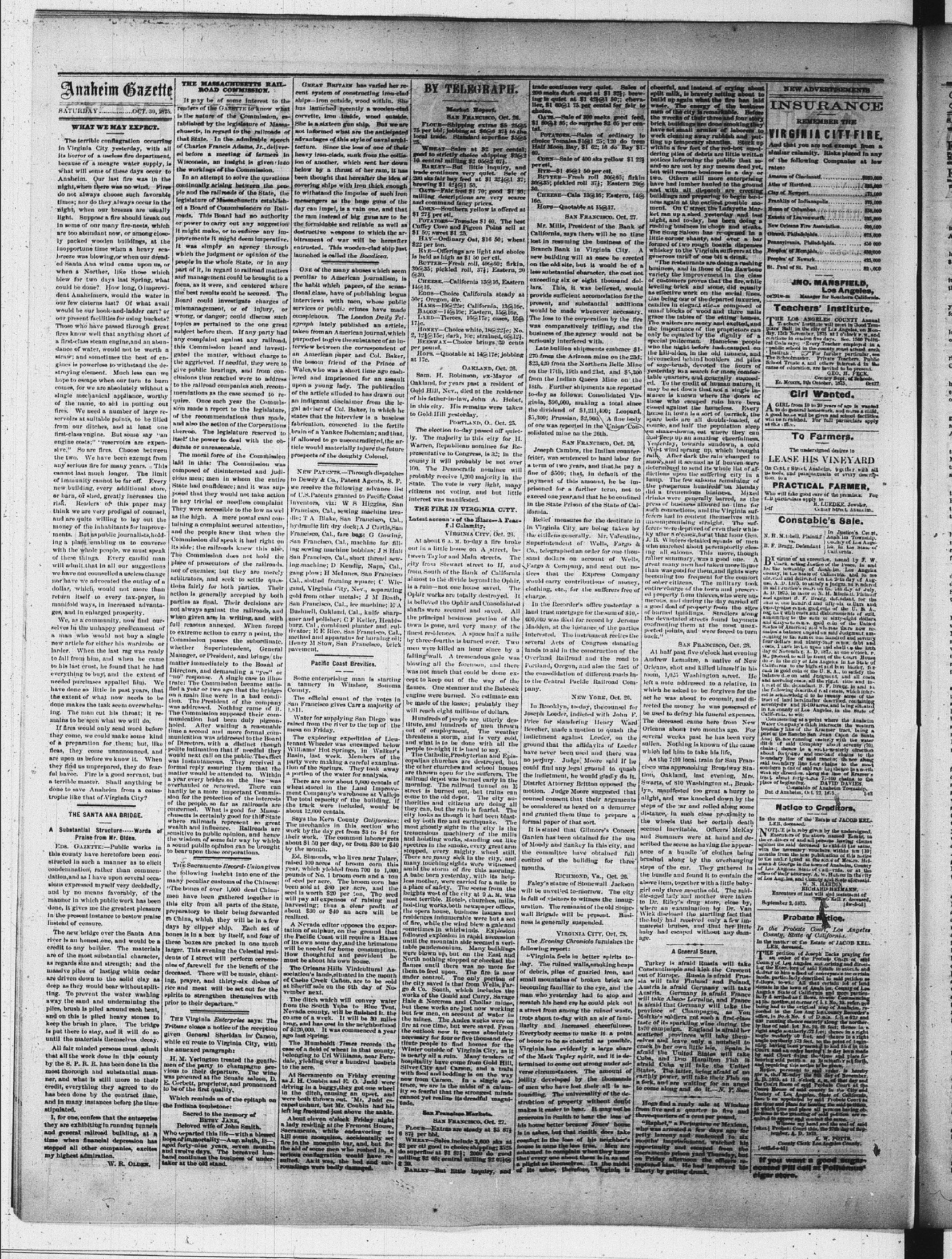
Searchable text
Anaheim Gazette
SATURDAY ... OCT. 30, 1875.
WHAT WE MAY EXPECT.
The terrible conflagration occurring in Virginia City yesterday, with all its horror of a useless fire department, because of a meagre water supply, is what will some of these days occur to Anaheim. Our last fire was in the night, when there was no wind. Fires do not always choose such favorable times; nor do they always occur in the night, when our breezes are usually light. Suppose a fire should break out in some of our many fire-nests, which are too abundant now, or among closely packed wooden buildings, at the inopportune time when a heavy sea-breeze was blowing, or when our dreaded Santa Ana wind came upon us, or when a Norther, like those which blew for two days last Spring, what could be done? How long, O improvident Anaheimers, would the water in our few cisterns last? Of what avail would be our hook-and-ladder cart? or our present facilities for using buckets? Those who have passed through great fires know well that anything short of a first-class steam engine, and an abundance of water, would not be worth a straw; and sometimes the best of engines is powerless to withstand the destroying element. Much less can we hope to escape when our turn to burn comes, for we are absolutely without a single mechanical appliance, worthy of the name, to aid in putting out fires. We need a number of large reservoirs at suitable points, to be filled from our ditches, and at least one first-class engine. But some say "an engine costs;" "reservoirs are expensive." So are fires. Choose between the two. We have been exempt from any serious fire for many years. This
THE MASSACHUSETTS RAIL-ROAD COMMISSION.
It may be of some interest to the readers of the Gazette to know what is the nature of the Commission, established by the legislature of Massachusetts, in regard to the railroads of that State. In the admirable speech of Charles Francis Adams, Jr., delivered before a meeting of farmers in Wisconsin, an insight is given into the workings of the Commission.
In an attempt to solve the questions continually arising between the people and the railroads of the State, the legislature of Massachusetts established a Board of Commissioners on Railroads. This Board had no authority or power to carry out any suggestion it might make, or to enforce any improvements it might deem imperative. It was simply an agency through which the judgment or opinion of the people in the whole State, or in any part of it, in regard to railroad matters and management could be brought to a focus, as it were, and centered where the best results could be secured. The Board could investigate charges of mismanagement, or of injury, or wrong, or danger; could discuss such topics as pertained to the one great subject before them. If any party had any complaint against any railroad, this Commission heard and investigated the matter, without charge to the aggrieved. If needful, they were to give public hearings, and from conclusions thus reached were to address to the railroad companies such recommendations as the case seemed to require. Once each year the Commission made a report to the legislature, of the recommendations thus made, and also the action of the Corporations thereon. The legislature reserved to itself the power to deal with the obdurate or unreasonable.
The moral force of the Commission laid in this: The Commission was central system of consular ships—iron outside has launched recent corvette, iron inside. She is a sixteen gun not informed what advantages of this structure. Since the heavy iron-clad sunion of another, which below by a thrust been thought that he covering ships with him to withstand the impressengers as the day can impel, is a view the rain instead of blight the formidable and destructive weapons bitrament of war wrought. This wood-launched is called the ONE of the many peculiar to America; the habit which paper national class, have of public interviews with more services or public erroneous. The Legislature lately published taken from an American purported to give the interview between the American paper bosom friend Wales, who was a shoerier and imprisoned upon a young lady. Of the article alluded to an indignant disclaiming legal adviser of Col. Bass states that the interviewee fabrication, concocted brain of a Yankee Boh if allowed to go unconstricted would materially prospects of the dough
stroying element. Much less can we hope to escape when our turn to burn comes, for we are absolutely without a single mechanical appliance, worthy of the name, to aid in putting out fires. We need a number of large reservoirs at suitable points, to be filled from our ditches, and at least one first-class engine. But some say "an engine costs;" "reservoirs are expensive." So are fires. Choose between the two. We have been exempt from any serious fire for many years. This cannot last much longer. The limit of immunity cannot be far off. Every new building, every additional store, or barn, or shed, greatly increases the risk. Readers of this paper may think we are very prodigal of counsel, and are quite willing to lay out the money of the inhabitants for improvements. But as public journalists, holding a place enabling us to converse with the whole people, we must speak of these things. Every candid man will admit that in all our suggestions we have not counseled a useless change nor have we advocated the outlay of a dollar, which would not more than return itself to every tax-payer, in manifold ways, in increased advantages, and in enlarged prosperity.
We, as a community, now find ourselves in the unhappy predicament of a man who would not buy a single new article for either his wardrobe or larder. When the last rag was ready to fall from him, and when he came to his last crust, he found that he had everything to buy, and the extent of needed purchases appalled him. We have done so little in past years, that the extent of what now needs to be done makes the task seem overwhelming. The man cut his throat; it remains to be seen what we will do.
If fires would only send word before they come, we could make some kind of a preparation for them; but, like fleas, they come unannounced, and are upon us before we know it. When they find us unprepared, they do fearful havoc. Fire is a good servant, but a terrible master. Shall anything be done to save Anaheim from a catastrophe like that of Virginia City?
THE SANTA ANA BRIDGE.
A Subatantial Structure——Words of Praise from Mr. Olden.
EDS. GAZETTE:—Public works in this county have heretofore been constructed in such a manner as to elicit condemnation, rather than commendation, and as I have upon several occasions expressed myself very decidedly,
THE Sacramento Record-Union gives the following insight into one of the many peculiar customs of the Chinese:
"The bones of over 1,000 dead China give public hearings, and from conclusions thus reached were to address to the railroad companies such recommendations as the case seemed to require. Once each year the Commission made a report to the legislature, of the recommendations thus made, and also the action of the Corporations thereon. The legislature reserved to itself the power to deal with the obdurate or unreasonable."
The moral force of the Commission laid in this: The Commission was composed of disinterested and judicious men; men in whom the entire State had confidence; and it was supposed that they would not take action in any trivial or needless complaint They were accessible to the low as well as the high. A mere postal card containing a complaint secured attention, and the people knew that when the Commission did speak it had right on its side; the railroads knew this also. The Commission does not hold the place of prosecutors of the railroads. Nor of enemies; but they are merely arbitrators, and seek to settle questions fairly for both parties. Their action is generally accepted by both parties as final. Their decisions are not always against the railroads, and when given are in writing, and with full reasons annexed. When forced to extreme action to carry a point, the Commission passes the subordinate, whether Superintendent, General Manager, or President, and brings the matter immediately to the Board of Directors, and demanding a "yes" or "no" response. A single case to illustrate: The Commission became satisfied a year or two ago that the bridges on a main line were in a bad condition. The President of the company was addressed. Nothing came of it. The Commission supposed their communication had been duly pigeon-hooled. After waiting a reasonable time a second and more formal communication was addressed to the Board of Directors, with a distinct though polite intimation that if needful they would next call on the public.The effect was instantaneous. They received a formal reply assuring them that the matter would be attended to. Within a year every bridge on the line was overhauled or renewed. There can hardly be a more important Commission for the protection of the interests of the people, so far as railroads are concerned. What is good for Massachusetts is certainly good for this State where railroads represent so great wealth and influence. Railroads are sensitive to public opinion, and hence the wisdom of some fair way by which a sound public opinion can be brought to bear upon these corporations.
NEW PATENTS.-Thus to Dewey & Co., Patent we receive the following of U.S.Patents granted inventors,viz: W S Francisco, Cal., sewing machine; T A Blake, San Francisco lift dry dock Francisco, Cal., fare borer San Francisco, Cal., mining sewing machine borer San Francisco, Cal., shaping machine; D Kendall gang plow; H McInnes Cal., slotted framing gaud, Virginia City, N gold from other metals San Francisco, Cal., lee Bushnell, Oakland, Caerner and publisher; C F burg, Cal., combined potentiator; E E Rice, San method and apparatus Henry M Stow, San F pavement.
Pacific Coast B
Some enterprising masters in Winslow County.
The official count of San Francisco gives California 1,811.
Water for supplying water raised from the river to mesa on Friday.
The exploring expert Wheeler was en route Williams' Hot Springs Basin, last week. Mr party were making a caution of the Springs. That a portion of the water fountain there are now about 12,000 centals.
Says the Kern County The mechanics in this work by the day get from their work. The commute about $1.50 per day, or by the month.
Ed Simonds, who lived raised 100 acres of brook year, which yielded from pounds of No. 1 broom oil of seed per acre. The broom been sold at $80 per acre.
THE SANTA ANA BRIDGE.
A Substantial Structure—Words of Praise from Mr. Olden.
Eds. GAZETTE:—Public works in this county have heretofore been constructed in such a manner as to elicit condemnation, rather than commendation, and as I have upon several occasions expressed myself very decidedly, and by no means favorably, of the manner in which public work has been done, it gives me the greatest pleasure in the present instance to bestow praise instead of censure.
The new bridge over the Santa Ana river is an honest one, and would be a credit to any builder. The materials are of the most substantial character, as regards size and strength; and the massive piles of lasting white cedar are driven down to the solid clay as deep as they would bear without splitting. To prevent the water washing away the sand and undermining the piles, brush is piled around each bent, and on this is piled heavy stones to keep the brush in place. The bridge is put there to stay, and it will do so until the materials themselves decay.
All fair minded persons must admit that all the work done in this county by the S. P. R. R. has been done in the most thorough and substantial manner, and what is still more to their credit, everything they agreed to do has been done by the contract time, and in many instances before the time stipulated.
I, for one, confess that the enterprise they are exhibiting in running tunnels and general railroad building, at a time when financial depression has stopped all other companies, excites my highest admiration.
W. R. OLDEN.
GREAT BRITAIN has varied her recent system of constructing iron-clad ships—iron outside, wood within. She has launched recently a wooden-clad corvette, iron inside, wood outside. She is a sixteen gun ship. But we are not informed what are the anticipated advantages of this style of naval architecture. Since the loss of one of their heavy iron-clads, sunk from the collision of another, which sent her down below by a thrust of her ram, it has been thought that hereafter the idea of covering ships with iron thick enough to withstand the impulse of such iron messengers as the huge guns of the day can impel, is a vain one, and that the ram instead of big guns are to be the formidable and reliable as well as destructive weapons to which the arbitrament of war will be hereafter entrusted. This wooden-clad ship just launched is called the Boadicea.
One of the many abuses which seem peculiar to American journalism, is the habit which papers, of the sensational class, have of publishing bogus interviews with men, whose public services or public crimes have made conspicuous. The London Daily Telegraph lately published an article, taken from an American Journal, which purported to give the substance of an interview between the correspondent of an American paper and Col. Baker, the bosom friend of the Prince of Wales, who was a short time ago cashiered and imprisoned for an assault upon a young lady. The publication of the article alluded to has drawn out an indignant disclaimer from the legal adviser of Col. Baker, in which he states that the interview is a baseless fabrication, concocted in the fertile brain of a Yankee Bohemian; and that, if allowed to go uncontradicted, the article would materially injure the future prospects of the doughy Colonel.
BY TELEGRAPH.
Market Report.
SAN FRANCISCO, Oct. 28.
FLOUR—Shipping extra $5 25@575 per btl; jobbing at $6@6 37} to the local trade. Standard superfine $5@525.
WHEAT—Sales at $2 per cental; good to strictly choice shipping $2@210 central milling $2 05@2 07].
BARLEY—But little inquiry, and trade continues very quiet. Sale of 200 skis fair hay feed at $1 32@1 37; brewing $1 42@1 50.
OATH—Fair feed $1 70; good $1 80; milling descriptions are very scarce and command fancy prices.
CORN—Southern yellow is offered at $1 27} per ctl.
POTATOES—Tomales $1 40. The best Cuffey Cove and Pigeon Point sell at $1 50; sweet $1 25.
HAY—Ordinary Oat, $16 50; wheat $22 per ton.
Rye—Offerings are light and choice is held as high as $1 50 per ctl.
BUTTER—Fresh roll, 40@60; firkin, 30@25; pickled roll, 37}; Eastern, 20@30.
CHEESE—California 13@16, Eastern 14@16.
EGGS—Choice California steady at 50c; Oregon, 40c.
HAMS—19@22c; California, 13@16c.
BACON—14@16c; Eastern, 15@16c.
LARD—Thereos, 16@17c; cases, 16@17c.
HONEY—Choice white, 18@22c; No. 2, 12@15c; dark, 10c; strained, 6@12].
BEESWAX—Choice brings 30 cents per pound.
HOPS. —Quotable at 14@17e; jobbing at 17c.
OAKLAND, Oct. 26.
Sam. H. Robinson, ex-Mayor of Oakland, for years past a resident of Gold Hill, Nev., died at the residence of his father-in-law, John A. Hobet, in this city. His remains were taken to Gold Hill yesterday.
PORTLAND, O., Oct. 25.
The election to-day passed off quietly. The majority in this city for H. Warren, Republican nominee for Representative to Congress, is 32; in the county it will probably be not over 100. The Democratic nominee will trade continues very quiet. Sales of 200 macks dark coast at $1 82}; brewing is quiet at $1 42@1 80;; cheveller, $1 60@1 75 per cental for fair to choles.
OATS—Sale of 300 macks good feed, $1 80@1 85; do surprise $2 05 per cental.
POTATOES—Sales of ordinary to choice Tomales $1@1 25; 120 do from Half Moon Bay, $1 62; 16 do Bay $1-60.
CORK—Sale of 400 skis yellow $1 22} per ctl.
RYE—$1 45@1 50 per ctl.
BUTTER—Fresh roll 20@65; firkin 20@35; pickled roll 37}; Eastern 20@30.
CHEESE—Cala 13@16; Eastern, 14@16c.
HOPS—Quotable at 15@17.
SAN FRANCISCO, Oct. 27.
Mr. Mills, President of the Bank of California, says there will be no time lost in resuming the business of the Branch Bank in Virginia City. A new building will at once be erected on the old site, but it would be of a less substantial character, the cost not exceeding six or eight thousand dollars. This, it was believed, would provide sufficient accommodation for the present, and substantial additions would be made whenever necessary. The loss to the corporation by the fire was comparatively trifling, and the business of the agency would not be seriously interfered with.
Late bullion shipments embrace $1-270 from the Arizona mine on the 23d; $23,420 from the Northern Belle Mine on the 17th, 19th and 21st, and $5,300 from the Indian Queen Mine on the 18th. Further shipments are reported to-day as follows: Consolidated Virginia, $96,000, making a total since the dividend of $1,211,400; Leopard, $5,300; Prussian, $2,900. A fine body of ore was reported in the Union Consolidated mine on the 26th.
SAN FRANCISCO, Oct. 28.
Joseph Cambran, the Italian counterfeiter, was sentenced to hard labor for a term of two years, and that he pay a cheerful split man build up waste men of the wreck brick bed have seen work clenching up within dering notice not so but will two. O have had and with building ness agreement. "The business variety to customers levelling as effectual Gas belts candles in small blanks grace that The loss the impact only be a special price who they the hill-bivouacof sage-yesterday table qualed To may be a distance lane those who closed agreed house in spare course here course on shaken and reep Yesterday West with rail A snow and determining
NEW PATENTS.—Through dispatches to Dewey & Co., Patent Agents, S.F. we receive the following advance list of U.S. Patents granted to Pacific Coast inventors, viz: W S Higgins, San Francisco, Cal., sewing machine treasure; T A Blake, San Francisco, Cal., hydraulic lift dry dock; A J Curtis, San Francisco, Cal., fare bag; G Gowing, San Francisco, Cal., machine for filling sewing machine bobbins; J S Halt San Francisco, Cal., short thread sewing-machine; D Kendig, Napa, Cal., gang plow; H Melmes, San Francisco Cal., slotted framing square; C Wiegand, Virginia City, Nev., separating gold from other metals; J M Beath, San Francisco, Cal., ice machine; E A Bushnell, Oakland, Cal., knife sharpener and polisher; C F Keller, Healdsburg, Cal., combined planter and cultivator; E E Rice, San Francisco, Cal., method and apparatus for burning oil; Henry M Stow, San Franisco, brick pavement.
Pacific Coast Brevities.
Some enterprising man is starting a tannery in Windsor, Sonoma County.
The official count of the votes in San Francisco gives Carr a majority of 1,811.
Water for supplying San Diego was raised from the river to the top of the mesa on Friday.
The exploring expedition of Lieutenant Wheeler was encamped below Williams' Hot Springs, in Walker's Basin, last week. Members of the party were making a careful examination of the Springs. They took away a portion of the water for analysis.
There are now about 9,000 centals of wheat stored in the Land Improvement Company's warehouse at Vallejo. The total capacity of the building, if the track were included, would be about 12,000 centals.
Says the Kern County Californian: The mechanics in this section who work by the day get from $3 to $4 for their work. The common laborer gets about $150 per day, or from $30 to $40 by the month.
Ed. Simonds, who lives near Tulare, raised 100 acres of broom corn this year, which yielded from 700 to 1,000 pounds of No. 1 broom corn and a ton of seed per acre. The broom corn has been sold at $30 per acre, and the Sam. H. Robinson, ex-Mayor of Oakland, for years past a resident of Gold Hill, Nev., died at the residence of his father-in-law, John A. Hobet, in this city. His remains were taken to Gold Hill yesterday.
PORTLAND, O.. Oct. 25.
The election to-day passed off quietly. The majority in this city for H. Warren, Republican nominee for Representative to Congress, is 32; in the county it will probably be not over 100. The Democratic nominee will probably receive 1,200 majority in the State. The vote is very light, many citizens not voting, and but little interest was manifested.
THE FIRE IN VIRGINIA CITY.
Latest accounts of the blaze—A Fearful Calamity.
VIRGINIA CITY, Oct. 23.
At about 6 A.M. to-day a fire broke out in a little house on A street, between Taylor and Main streets. The city from Stewart street to H, and from South of the Bank of California almost to the divide beyond the Ophir, is a ruin—not one house saved. The Ophir works are totally destroyed. It is believed the Ophir and Consolidated shafts were secured and saved. All the principal business portion of the town is gone, and very many of the finest residences. A space half a mile by three-fourths is burned over. Two men were killed an hour since by a falling wall. A tremendous gale was blowing all the forenoon, and there was not much that could be done except to keep out of the way of the flames. One steamer and the Babcock engine were burned. No estimate can be made of the losses; probably they will reach eight millions of dollars.
Hundreds of people are utterly destitute, and hundreds of men thrown out of employment. The weather threatens a storm, and is very cold, and what is to be done with all the people to-night it is hard to say.
The Catholic Presbyterian and Episcopal churches are destroyed, but the other churches and school houses are thrown open for the sufferers. The railroad depot was burned early in the morning. The railroad tunnel on E street is burned out, but trains can come to the old depot. The city authorities and citizens are doing all they can, but the rain is fearful. The city looks as though it had been blasted by both fire and earthquake. The most ghostly sight in the city is the tremendous machinery of the mills and hoisting works, standing out like spectres in the smoke, every great arm stopped, every mighty wheel still. There are many sick in the city, and many touching sights were witnessed amid the storm of fire this morning. A babe born yesterday, with its helpless mother, were carried for a mile to a place of safety. The scene from the
SAN FRANCISCO, Oct. 26.
Joseph Cambra, the Italian counterfeiter, was sentenced to hard labor for a term of two years, and that he pay a fine of $500; that, in default of the payment of this amount, he be imprisoned for a further term, not to exceed one year,and that he be confined in the State Prison of the State of California.
Relief measures for the destitute in Virginia City are being taken by the citizens generally. Mr. Valentine Superintendent of Wells, Fargo & Co., telegraphed an order for one thousand dollars on account of Wells, Fargo & Company,and sent out noticees that the Express Company would carry contributions of money, clothing,ect.,for the sufferers free of charge.
In the Recorder's office yesterday a land trust mortgage for the sum of $10,-000,000 was filed for record by Jerome Maiden; at the instance of the parties interested.The instrument recites the several Acts of Congress donating lands to aid in the construction of the Overland Railroad and the road to Portland, Oregon,and also the fact of the consolidation of different roads into the Central Pacific Railroad Company.
NEW YORK, Oct. 26.
In Brooklyn,to-day,the counsel for Joseph Loeder indicted with John F. Price for slandering Henry Ward Beecher,made a motion to quash the indictment against Loeder on the ground that the affidavitits of Loeder have never been used and there was no perjury.Judge Moore said if he could find any legal ground to quash the indictment,他 would gladly do it.District Attorney Britton opposed the motion.Judge Moore suggested that counsel consent that their arguments be considered as heard on a demurrer and granted them time to prepare a formal paper of that sort.
It is stated that Gilmore's Concert Garden has been obtained for the use of Moody and Sankey in this city,and the committee have obtained full control of the building for three months.
RICHMOND,Va.,Oct.26.
Faley's statue of Stonewall Jackson will stand on the 17th,19th and 21st,and $5,300 from the Indian Queen Mine on the 18th.Further shipments are reported to-day as follows:Consolidated Virginia,$90,000,making a total since the dividend of $1,211,400; Leopard,$5,300; Prussian,$2,900.A fine body of ore was reported in the Union Consolidated mine on the 26th.
YESTERDAY.West will raise.A snow and determine fictions.Lump.The presp did a trunk drinks wiress press wi such com ferers have uncompetes weeks after J.B.Will who marry all s rather great man than was becoming of sober entire charf merous,a good desi de burnedthe devast confronting poled back."
At half Andrew I Orleans,s room,1,0 left a note which he act he waived rectetedbe used to.The deceen Orleans are several w sullen.No which led
As the 7 cisco was a station.Oak Swartz.of Lyn,main alight,and steps of th distance.lbthe wheel seemed in and Summa scribed th eance o af brushed al steps of ththe bundle above item,girl only
Says the Kern County Californian: The mechanics in this section who work by the day get from $3 to $4 for their work. The common laborer gets about $150 per day, or from $30 to $40 by the month.
Ed. Simonds, who lives near Tulare, raised 100 acres of broom corn this year, which yielded from 700 to 1,000 pounds of No. 1 broom corn and a ton of seed per acre. The broom corn has been sold at $80 per acre, and the seed is worth $20 per ton. The seed will pay all expenses of raising and harvesting; thus a clear profit of about $30 or $40 an acre will be realized.
A Nevada editor opposes the exportation of sulphur, on the ground that the Pacific Coast will require a Haines of its own some day, and the brimstone will be needed for home consumption. How thoughtful and provident he must be about his own house.
The Orleans Hills Vinicultural Association's lands, situated in the mouth of Casche Creek Caillon, are to be sold at Sheriff sale on the 6th day of November next.
The ditch which will convey water from the South Yuba to Blue Tent, Nevada county, will be finished it. The course of a wreck. It will be 30 miles long, and has cost in the neighborhood of $120,000. It was commenced a year ago last Spring.
The Humboldt Times records the case of a field of wheat in that county, belonging to Url Williams, near Ferndale, yielding over a hundred bushels to the acre.
At Sacramento on Friday evening as J. H. Coubin and E. O. Judd were driving in a buggy, they got one wheel in the ditch, causing an upset, and were both thrown out. Mr. Judd escaped unhurt, but Mr. Coubin had his left leg fractured just above the ankle.
About eleven o'clock Friday night a lady residing at the Fremont House, Sacramento, while endeavoring to kill some mosquitoes, accidentally set fire to the mosquito bar, and, but for the aid of some men who rushed in, a serious conflagration would have resulted. As it was, the bed and surroundings were badly damaged.
San Francisco, Oct. 27.
FLOUR—Extras are steady at $5 87] 6 87] per bbl.
WHEAT—Sales include 3,000 skins at $2 per eel good to choice shipping; 2525 do superfine at $1 87]; 2000 do good milling $2 05; central milling $2 07]@ $2.
BARLEY—But little inquiry, and motion. Judge Moore suggested that counsel consent that their arguments be considered as heard on a demurrer and granted them time to prepare a formal paper of that sort.
It is stated that Gilmore's Concert Garden has been obtained for the use of Moody and Sankey in this city, and the committee have obtained full control of the building for three months.
RICHMOND, Va., Oct. 26.
Faley's statue of Stonewall Jackson will be unveiled to morrow. The city is full of visitors to witness the inauguration. The remnant of the old Stonewall Brigade will be present. Business is generally suspended.
VIRGINIA CITY, Oct. 28.
The Evening Chronicle furnishes the following report:
"Virginia feels in better spirits today. The ruined walls, smoking heaps of debris, piles of guarled iron, and small mountains of broken brick are becoming familiar to the eye, and the man who yesterday had to stop and scratch his head ere he could pick out a street from among the ruined waste, trots about to-day with an air of familiarity and increased cheerfulness. Everybody seems to make it a point of honor to be as cheerful as possible. Virginia has evidently a large share of the Mark Tapley spirit, and it is determined to come out strong under adverse circumstances. The amount of jollity developed by the thousands of men who have lost their all is astounding. The universality of the destruction of property without doubt makes it easier to bear. It may not be generous in Smith to hear the loss of his house better because Jones' house is in ashes, but that Smith does take comfort in the loss of his neighbor's house is none the less true. Men are ashamed to complain when they know that every one about them is in as and a plight as themselves. In the midst of its ashes, therefore, Virginia is..."
NEW ADVERTISEMENTS
INSURANCE
REMEMBER THE
VIRGINIA CITY FIRE,
And that you are not exempt from a similar calamity. Risks placed in any of the following Companies at low rates:
Amazon of Cincinnati... $200,000
Atlas of Hartford... $50,000
Clay of Newport... $75,000
Franklin of Indianapolis... $75,000
Home of Columbus... $38,000
Kansas of Leavenworth... $25,000
New Orleans Fire Association... $50,000
Glennk Philadelphia... $75,000
Pennsylvania, Philadelphia... $45,000
People's of Memphis... $45,000
Peoples' of Newark... $42,000
St. Paul of St. Paul... $21,000
JNO. MANSFIELD,
Los Angeles,
Manager for Southern California.
Teachers' Institute.
THE LOS ANGELES COUNTY Annual Teachers' Institute will meet in Good Templars Hall in the city of Los Angeles on Monday, 13th November, 1875 at 1 o'clock p.m., and continue in session five days. See: 1569 Political Code says; "Every Teacher employed in a public school in the county must attend such Institution." For further particular see The Schoolmaster. Private Teachers. Public School Trustee, and others interested in the cause of education, are invited to be present.
GEO. H. PECK,
County Sept. of Schools.
E. Moxxx, 9th October, 1823.
Girl Wanted.
A GIRL from 10 to 20 years of age is wanted to do general homework, and nurse a child. A good house will be given and school facilities will be furnished. For full particulars apply at this office.
To Farmers.
The undersigned desires to
LEASE HIS VINEYARD
On Center Street Analog, together with all
At half past five o'clock last evening Andrew Lemaitre, a native of New Orleans, shot and killed himself in his room, 1,025 Washington street. He left a note addressed to a relative, in which he asked to be forgiven for the act he was about to commit, and directed the money he was possessed of be used to defray his funeral expenses. The deceased came here from New Orleans about two months ago. For several weeks past he has been very sullen. Nothing is known of the cause which led him to take his life.
As the 7:10 local train for San Francisco was approaching Broadway Station, Oakland, last evening, Mrs. Swartz, of 810 Washington st., Brooklyn, manifested too great a hurry to alight, and was knocked down by the steps of the car and rolled along some distance, in such close proximity to the wheels that her certain death seemed inevitable. Officers McKay and Summers were at hand and described the scene as having the appearance of a bundle of clothes being brushed along by the overhanging steps of the car. They gathered in the bundle and found it to contain the above item, together with a little baby-irish only three months old. The day afterward, towards sundown, a cold West wind sprang up, which brought rain. After dark the rain changed to snow, and it seemed as if heaven were determined to send its whole list of afflictions upon the suffering city in a lump. The few saloons remaining of the prosperous hundreds on Monday did a tremendous business. Mixed drinks were generally barred, as the press of business allowed no time for such connections, and the Virginia sufferers had to content themselves with uncompromising straight. The sufferers were deprived of even their whisky after 8 o'clock, for at that hour Gen. J.B. Winters detailed squads of men who marched about peremptorily closing all saloons. This move, though rather summary, was a good one. A great many men had taken more liquor than was good for them, and fights were becoming too frequent for the comfort of sober citizens. The military took entire charge of the town and preserved property from thieves, who were numerous, and during the day carried off a good deal of property from the sites of burned buildings. Strollers along the devastated streets found bayonets confronting them at the most unexpected points, and were forced to turn back."
SAN FRANCISCO, Oct. 28.
At half past five o'clock last evening Andrew Lemaitre, a native of New Orleans, shot and killed himself in his room, 1,025 Washington street. He left a note addressed to a relative, in which he asked to be forgiven for the act he was about to commit, and directed the money he was possessed of be used to defray his funeral expenses. The deceased came here from New Orleans about two months ago. For several weeks past he has been very sullen. Nothing is known of the cause which led him to take his life.
As the 7:10 local train for San Francisco was approaching Broadway Station, Oakland, last evening, Mrs. Swartz, of 810 Washington st., Brooklyn, manifested too great a hurry to alight, and was knocked down by the steps of the car and rolled along some distance, in such close proximity to the wheels that her certain death seemed inevitable. Officers McKay and Summers were at hand and described the scene as having the appearance of a bundle of clothes being brushed along by the overhanging steps of the car. They gathered in the bundle and found it to contain the above item, together with a little baby-irish only three months old. The day afterward, towards sundown, a cold West wind sprang up, which brought rain. After dark the rain changed to snow, and it seemed as if heaven were determined to send its whole list of afflictions upon the suffering city in a lump. The few saloons remaining of the prosperous hundreds on Monday did a tremendous business. Mixed drinks were generally barred, as the press of business allowed no time for such connections, and the Virginia sufferers had to content themselves with uncompromising straight. The sufferers were deprived of even their whisky after 8 o'clock, for at that hour Gen. J.B. Winters detailed squads of men who marched about peremptorily closing all saloons. This move, though rather summary, was a good one. A great many men had taken more liquor than was good for them, and fights were becoming too frequent for the comfort of sober citizens. The military took entire charge of the town and preserved property from thieves, who were numerous, and during the day carried off a good deal of property from the sites of burned buildings. Strollers along the devastated streets found bayonets confronting them at the most unexpected points, and were forced to turn back."
A General Scare.
Turkey is afraid Russia will take Constantinople and kick the Crescent out of Europe. Russia is afraid Prussia will take Finland and Poland, Austria is afraid Germany will take Austria, Germany is afraid France will take Alsace Larraine, and France is afraid that Germany will take the province of Champagne, as Von Moltke's soldiers got such a first-class taste of its sparkling wine during the 1870 campaign. England is afraid her scattered provinces will take themselves and leave only a nutshell to crack in her own little hide. Spain is afraid the United States will take Cuba, and Don Hamilton Fish is afraid Cuba will take the United States. The latter, being afraid of no earthly power, will take their Fish on a fork, and are waiting for an angel to come along and do it.—N. Y. Sane.
Hogs find a ready sale at Winchester from five and a quarter to five and three-quarters of a cent per pound.
"Raphel," a Portuguese or Mexican, who was arrested a few days ago for petty larceny and sentenced to six months' imprisonment, watched his opportunity and escaped from the Sacramento prison yard Thursday, but on Friday afternoon the officers recaptured him. He had improved his liberty by getting drunk.
Notice to Creditors.
In the matter of the Estate of JACOB KELLER, deceased.
NOTICE is hereby given by the undersigned, Executors of the above named Estate, to the creditors of all persons having claims against the said deceased to exhibit the same, with the necessary vouchers within ten [10] months from the first publication of this notice to the under-signed at the sio. o. of Means. Helmann & George in the town of Anaheim, County of Los Angeles State of California, or at the office of their attorney, A. W. Hutton in the city of Los Angeles, and County and State offices.
W. N. HARDIN
Richard Heimann,
Executors of last will and testament of JACOB KELLER r. deceased,
September 2, 1875.
Probate Notice.
In the Probate Court, Los Angeles County, State of California.
In the matter of the Estate of JACOB KELLER, deceased.
THE petition of Joseph Eacks praying for an order of the Probate Court of said County of Los Angeles, authorizing and directing the Executors of said Estate to execute and deliver to him a deal of conveyance for certain lands, particularly described in said petition as follows: to-will; "All that certain lot of land slants in the town of Anaheim, County of Los Angeles State of California and more particularly a fellows, to-write Commencing as the northwest at corner of I. t. No. 10, refer me being had to the original map of Anaheim, recorded in the Los Angles County Recorder's office, in Book No. 4 of D. Davis. L. Lilz 622 and 629 running thence easterly along the northerly line of said No. 10, 60 feet; thence in a right angle southerly 272 feet; thence in a right angle masterly 40 feet; and thence in a right angle northerly 272 feet; to the point of beginning having been pressed to and filed in this Court, and an order having it in day been made by said Court fixing the time and place for hearing said petition as herinafter a forth, and requiring this notice to be given.
Notice pursuant to said order, is hereby givn that Monday the fifth day of November,
A. D. 1875, at 11 o'clock a.m., of that day and the Court room of said Probate Court at the County House of said county in the City and County of Los Angeles State of California, have been appointed by said Probate Court as the time and place for hearing the said petition, at which time and place all persons having objections to the granting of said petition are required to appear and contain the name.
Williams my hand and the seal of said [shax.] Probate Court this, the 27th day of September, A. D. 1875.
A. W. POTTER.
County Clark Los Angeles County.
[official-delivery]