anaheim-gazette 1875-10-16
Scanned page
Searchable text
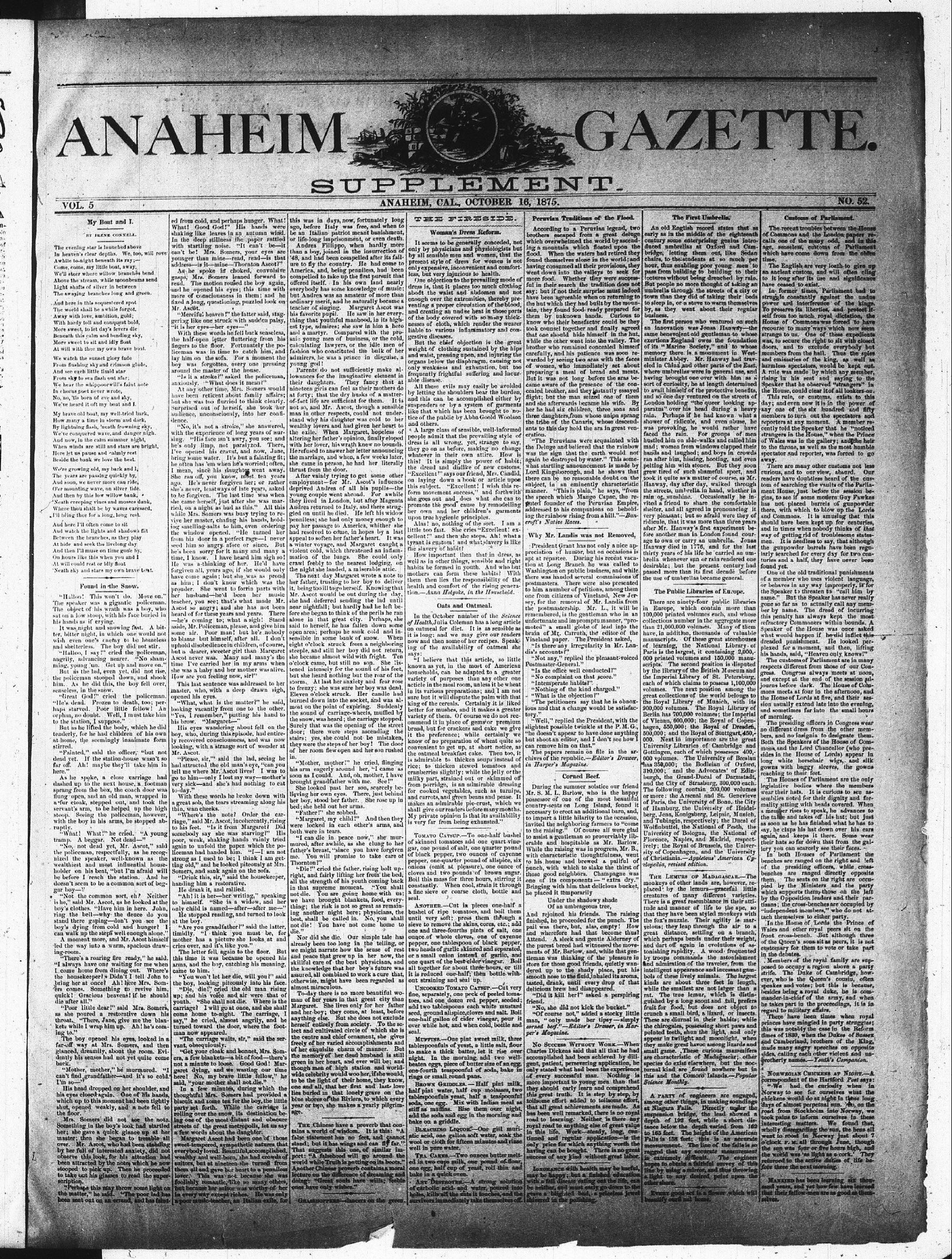
ANAHEIM
VOL. 5
My Boat and I.
BY IRENE CONNELL.
The evening star is launched above
In heaven's clear depths. We, too, will rove
Awhile to-night beneath its ray;—
Come, come, my little boat, away,
We'll steer where willow branches bend
Above the stream, while moonbeams send
Light shafts of silver in between
The awaying branches long and green.
And here in this sequestered spot
The world shall be awhile forgot,
Away with love, ambition, gold;
With hardy toll and conquest bold,
More sweet, to let day's fevers die
Beneath this calm and bending sky,
More sweet to sit and idly float
At will with thee my own brave boat.
We watch the sunset glory fade
From flushing sky and crimson glade,
And see each little timid star
From sky to sea flash out afar;
We hear the whippoorwill's faint note
In chorus poet never wrote,
No, no, 'tis born of eve and sky,
We've heard it oft my boat and I.
My brave old boat, my well-tried bark,
How many a time in storm and dark,
By lightning flash, 'neath frowning sky,
We've conquered wave, and danger nigh.
And now, in the calm summer night,
When winds are still and stars are bright,
Here let us pause and calmly rest
Beside the bank we love the best.
We're growing old, my bark and I.
ed from cold, and perhaps hunger. What!
What! Good God!" His hands were
shaking like leaves in an autumn wind.
In the deep stillness the paper rattled
with startling noise. "It can't be—it
can't be! Mrs. Somers, your eyes are
younger than mine—read, read—is that
address—is it—mine—Thornton Ascot?"
As he spoke in choked, convulsive gasps, Mrs. Somers leaned forward to read. The motion roused the boy again,
and he opened his eyes; this time with more of consciousness in them; and he fixed a long, questioning, puzzled look on Mr. Ascot.
"Merciful heaven!" the latter said, staggering like one struck with sudden palsy,
"It is her eyes—her eyes—"
With these words he fell back senseless,
the half-open letter fluttering from his fingers to the floor. Fortunately the policeman was in time to catch him, and lay him on the sofa. For a moment the boy was forgotten, every one pressing around the master of the house.
"Is it a stroke?" asked the policeman, anxiously. "What does it mean?"
At any other time, Mrs. Somers would have been reticent about family affairs; but she was too flurried to think clearly. Surprised out of herself, she took her audience, unconsciously, into her confidence.
"No, it's not a stroke," she answered, with the experience of long years of nursing. "His face isn't awry, you see; and he's only limp, not paralyzed. There I've opened his cravat, and now, Jane, bring some water. It's but a fainting fit; he often has 'em when he's worried; often this was in days, now ago, before Italy was be an Italian patriot mourn or life-long imprisonment."
Andrea Filippo, who than a boy, joined in the '48, and had been compelled to take up the offered itself. In his everybody has some knob but Andrea was an amazing ordinary merit, and he no teacher of singing. Mr. his favorite pupil. He thing that youthful manest type, admires; she sings and a martyr. Compare sale young men of business calculating lawyers, or fashion who constituted admirers, he was a prince young god!
Parents do not suffice lowances for the imagination their daughters. The nineteen girls can feel at forty; that the dry hair of fact life are sufficient not so, and Mr. Ascot, man in other respects, can stand why his daughter wealthy lovers and had the exile. When Margaret altering her father's opinion with her lover, his wrath He refused to answer her the marriage, and when she came in person, he thrust from the door.
And see each little timid star
From sky to sea flash out afar;
We hear the whippoorwill's faint note
In chorus poet never wrote,
No, no, 'tis born of eve and sky,
We've heard it off my boat and I.
My brave old boat, my well-tried bark,
How many a time in storm and dark,
By lightning dash, 'neath frowning sky,
We've conquered wave, and danger nigh.
And now, in the calm summer night,
When winds are still and stars are bright,
Here let us pause and calmly rest.
Beside the bank we love the best.
We're growing old, my bark and I.
The years are passing quickly by,
And soon, we never more can ride,
O'er mounting wave, on silver tide.
And then by this low willow bank,
Neath creeping vines and mosses dank,
Where thou shalt be by waves caressed,
I'll bring thee for a long, long rest.
And here I'll often come to sit
And watch the lights and shadowa flit
Between the branches, as they play
At hide and seek the livelong day
And then I'll muse on time gone by,
On hours like this when you and I
At will could rest or idly float
Neath sky and stars my own brave boat.
Found in the Snow.
"Halloo! This won't do. Move on."
The speaker was a gigantic policeman.
The object of his wrath was a boy, who sat on a low stoop, with his face buried in his hands as if crying.
It was night and snowing fast. A bitter, bitter night, in which one would not wish even one's enemy to be homeless and shelterless. The boy did not stir.
"Halloo, I say!" cried the policeman, angrily, advancing nearer. "No shamming, young'un. Get up and move on."
But as the lad, even yet, did not rise, the policeman stooped down, and shook him. As he did this, the boy fell over, senseless, in the snow.
"Great God!" cried the policeman. "He's dead. Frozen to death, too; perhaps starved. Poor little fellow! An orphan, no doubt. Well, I must take him to the station, I suppose."
But as he lifted the body, which he did tenderly, for he had children of his own at home, the seemingly inanimate form stirred.
"Fainted," said the officer; "but not dead yet. If the station-house wasn't so far off. Ah! maybe they'll take him in here."
As he spoke, a close carriage had dashed up to the next house, a footman sprang from the box, the coach door was flung open, and an old man, wrapped in a fur cloak, stepped out, and took the servant's arm, to be helped up the high stoop. Seeing the policeman, however, with the boy in his arms, he stopped abruptly.
"What! What!" he cried. "A young tramp. A beggar. Not dead—"
"No, not dead yet, Mr. Ascot," said the policeman, respectfully, as he recognized the speaker, well-known as the wealthiest and most influential householder on his beat, "but I'm afraid will be before I reach the station. And he doesn't seem to be a common sort of begrencher—"
"Is it a stroke?" asked the policeman, anxiously. "What does it mean?"
At any other time, Mrs. Somers would have been reticent about family affairs; but she was too flurried to think clearly. Surprised out of herself, she took her audience, unconsciously, into her confidence.
"No, it's not a stroke," she answered, with the experience of long years of nursing. "His face isn't awry, you see; and he's only limp, not paralyzed. There I've opened his cravat, and now, Jane, bring some water. It's but a fainting fit; he often has 'em when he's worried; often, I mean, since his daughter went away.
She ran off, you know, most ten years ago. He's never forgiven her; or rather she's never leastways of late years, asked to be forgiven. The last time was when she came herself, just after she was married, on a night as bad as this." All this while Mrs. Somers was busy trying to revive her master, chafing his hands, holding smelling-salts to him, even ordering the window opened. He turned her from his door in a perfect rage—I never seed him so angry afore or since. But he been sorry for it many and many a time, I know. I have heard him sigh so! He was a-thinking of her. He'd have forgiven all, years ago; if she would only have come again; but she was as proud as him; I don't know which was the prouder. She went to forrin parts with her husband—he'd been her music teacher, you see; that's what made Mr. Ascot so angry; and she has not been heard of for these years and years. There—he's coming to; what a sigh! Stand aside, Mr. Policeman, please, and give him some air. Poor man! but he's nobody to blame but himself, after all. I don't uphold disobedience in children of course, but a dearer, sweeter girl than Margaret Ascot never was. Many and many's the time I've carried her in my arms when she was a baby and her mother was alive. How are you feeling now, sir?
This last sentence was addressed to her master, who, with a deep drawn sigh, opened his eyes.
"What, what is the matter?" he said, looking vacantly from one to the other. "Yes, I remember," putting his hand to his brow. "Margaret—"
His eyes wandering about fell on the boy, who during this episode, had entirely recovered consciousness, and was now looking with a strange sort of wonder at Mr. Ascot.
"Please,sir," said the lad, seeing he had attracted the old man's eye, "can you tell me where Mr. Ascot lives? I was to go to him—only I lost my way—mother's very sick—and she's had nothing to eat to-day."
With these words he broke down with a great sob, the tears streaming along his thin, wan cheeks.
"Where's the note? Order the carriage," said Mr. Ascot, incoherently, rising to his feet. "Is it from Margaret? Did somebody say she was starving?" His poor, weak, shaking hands vainly tried again to unfold the paper which the policeman had handed him. "I—I am not strong as I used to be; I think I am getting old," and he looked piteously at Mrs. Somers, and sank again on the sofa.
"Drink this,sir," said the housekeeper, handling him a restorative.
"Is it a stroke?" asked the policeman, anxiously. "What does it mean?"
At any other time, Mrs. Somers would have been reticent about family affairs; but she was too flurried to think clearly. Surprised out of herself, she took her audience, unconsciously, into her confidence.
"No,它不是 a stroke," she answered with the experience of long years of nursing. "His face isn't awry,你 see; and he's only limp,不 paralyzed。There I've opened his cravat,and now,jane,bring some water.It's but a fainting fit; he often has 'em when he's worried; often,imean,since his daughter went away.She ran off,you know,most ten years ago.He's never forgiven her; or rather she's never leastways of late years,asked to be forgiven.The last time was when she came herself,just after she was married,on a night as bad as this." All this while Mrs. Somers was busy trying to revive her master,chafing his hands,holding smelling-salts to him,even ordering the window opened.He turned her from his door in a perfect rage—I never seed him so angry afore or since。但他 been sorry for it many and many a time.I know.I have heard him sigh so!He was a-thinking of her.Hed'd have forgiven all,years ago;if she would only have come again;but she was as proud as him;I don't know which was the prouder.She went to forrin parts with her husband—he'd been her music teacher,you see;that's what made Mr.Ascot so angry;and she has not been heard of for these years and years.Nhere—he's coming to;what a sigh!Stand aside,Mr.Policeman,please,and give him some air.Poor man!but he's nobody to blame but himself,after all.I don't uphold disobedience in childrenOf,course,but a dearer,sweeter girl than Margaret Ascot never was.Many and many's the time I've carried her in my arms when she was a baby and her mother was alive.How are you feeling now,sir?"
This last sentence was addressed to her master,who,with a deep drawn sigh,opened his eyes.
"What,what is the matter?" he said,looking vacantly from one to the other.“Yes,我 remember,"putting his hand to his brow.“Margaret—"
His eyes wandering about fell on the boy,who,during this episode,had entirely recovered consciousness,and was now looking.with a strange sort of wonder at Mr.Ascot.
"Where's the note? Order the carriage," said Mr.Ascot,incoherently,rising to his feet.“Is it from Margaret?Did somebody say she was starving?”His poor,weak,shaking hands vainly tried again to unfold the paper which the policeman had handed him.“I—I am not strong as I used to be;I think I am getting old,"and he looked piteously at Mrs.Somers,and sank again on the sofa.
"Drink this,sir," said the housekeeper,handling him a restorative.
"Is it a stroke?" asked the policeman,anxiously.“What does it mean?"
At any other time,Mrs.Somers would have been reticent about family affairs;but she was too flurried to think clearly. Surprised out of herself,她 took her audience,unconsciously,into her confidence.
"No,它不是 a stroke," she answered with the experience of long years of nursing.“His face isn't awry,你 see;and he's only limp,不 paralyzed。There I've opened his cravat,and now,jane,bring some water.It's but a fainting fit; he often has 'em when he's worried; often,imean,since his daughter went away.She ran off,you know,most ten years ago.He's never forgiven her; or rather she's never leastways of late years,asked to be forgiven.The last time was when she came herself,just after she was married,on a night as bad as this." All this while Mrs.Somers was busy trying to revive her master,chaffing his hands,holding smelling-salts to him,even ordering the window opened.He turned her from his door in a perfect rage—I never seed him so angry afore or since。但他 been sorry for it many and many a time.I know.I have heard him sigh so!He was a-thinking of her.Hed'd have forgiven all,years ago;if she would only have come again;but she was as proud as him;I don't know which was the prouder.She went to forrin parts with her husband—he'd been her music teacher,you see;that's what made Mr.Ascot so angry;and she has not been heard of for these years和 years.Nhere—he's coming to;what a sigh!Stand aside,Mr.Policeman,please,and give him some air.Poor man!but he's nobody to blame but himself,after all.I don't uphold disobedience in childrenOf,course,but a dearer,sweeter girl than Margaret Ascot never was.Many and many's the time I've carried her in my arms when she was a baby and her mother was alive.How are you feeling now,sir?"
This last sentence was addressed to her master,who,with a deep drawn sigh,opened his eyes.
"What,what is the matter?" he said,looking vacantly from one to the other.“Yes,我 remember,"putting his hand to his brow.“Margaret—"
His eyes wandering about fell on the boy,who,during this episode,had entirely recovered consciousness,and was now looking.with a strange sort of wonder at Mr.Ascot.
"Where's the note? Order the carriage," said Mr.Ascot,incoherently,rising to his feet.“Is it from Margaret?Did somebody say she was starving?"His poor,weak,shaking hands vainly tried again to unfold the paper which the policeman had handed him.“I—I am not strong as I used to be;I think I am getting old,"and he looked piteously at Mrs.Somers,and sank again on the sofa.
"Drink this,sir," said the housekeeper,handling him a restorative.
"Is it a stroke?" asked the policeman,anxiously.“What does it mean?"
At any other time,Mrs.Somers would have been reticent about family affairs;but she was too flurred to think clearly. Surprised out of herself,她 took her audience,unconsciously,into her confidence.
"No,它不是 a stroke," she answered with the experience of long years of nursing.“His face isn't awry,你 see;and he's only limp,不 paralyzed。There I've opened his cravat,and now,jane,bring some water.It's but a fainting fit; he often has 'em when he's worried; often,imean,since his daughter went away.She ran off,you know,most ten years ago.He's never forgiven her; or rather she's never leastways of late years,asked to be forgiven.The last time was when she came herself,just after she was lowered in her hands.The ninety girls can feel at forty; that the dry hair-of-fact life are sufficient not so,and Mr.Ascot,
man in other respects,cannot stand why his daughter is wealthy lovers and shelterless.The boy did not stirl,
but as he lifted the body,the boy did not tenderly,forsheld in his hands at home,the seemingly inanimate form stirred.
"Fainted," said the officer;"but not dead yet.If the station-house wasn't so far off.Ah!maybe they'll take him in here."
As he spoke,a close carriage had dashed up to the next house,a footman sprang from the box,the coach door was flung open,and an old man wrapped in a fur cloak,the stepped out,and took the servant's arm,tothe help upthe high stoop.Seeing the policeman,however,village at his in his arms,the boy in his arms,his stopped abruptly.
"What! What!" he cried.“A young tramp.A beggar.Not dead—"
No,not dead yet,Mr.Ascot,”said the policeman,rrespectfully,\nas he recognized the speaker Well-known as the wealthiest and most influential householder on his beat,"but I'm afraid will be before I reach the station.Addh
With these words he broke down with a great sob, the tears streaming along his thin, wan cheeks.
"Where's the note? Order the carriage," said Mr. Ascot, incoherently, rising to his feet. "Is it from Margaret? Did somebody say she was starving?" His poor, weak, shaking hands vainly tried again to unfold the paper which the policeman had handed him. "I—I am not strong as I used to be; I think I am getting old," and he looked piteously at Mrs. Somers, and sank again on the sofa.
"Drink this, sir," said the housekeeper, handing him a restorative.
He drank it, and rallied.
"Ah! it is her—her writing," speaking to himself. "She is a widow, and her only child is named—after-after me—"
He stopped reading, and turned to look at the boy.
"Are you grandfather?" said the latter, timidly. "I think you must be, for mother has a picture she looks at and cries over, and it's like you."
The letter fell again to the floor. But this time it was because he opened his arms, and the boy, catching his meaning, came to him.
"You won't let her die, will you?" said the boy, looking pitiously into his face.
"Die, die!" cried the old man rising up; and his voice and air were that of youth. "She shall not die. Where is the carriage? I will go at once, and she shall come home to-night. The carriage, I say," he cried, almost angrily, and he turned toward the door, where the footman now appeared.
"The carriage waits, sir," said the servant, obsequiously.
"Get your cloak and bonnet, Mrs. Somers, a few blankets—a bit of food—there's not a minute to loose. Good God! Margaret dying, and we wasting our time here! No, my brave little fellow," he said, "your mother shall not die."
In a few minutes, during which the thoughtful Mrs. Somers had provided a biscuit and some tea for the boy, the little party set forth. While the carriage is rolling over the snow, its destination being one of the most distant and obscure streets of the great metropolis, let us say a few words about the daughter.
Margaret Ascot had been one of those sweet-tempered, sympathetic natures that everybody loved. Beautifully accomplished, wealthy and well-born, she had crowds of suitors, but at nineteen she turned from them all and gave her heart to a peniless lover. This was not because she was foolishly romantic, like so many others, but because her sailor was worthy of her in every way except riches. He was only a poor music-teacher, an Italian exile, for believing her own eyes.
Her boy stood her father bed; she held out her arm.
"Father!" she sobbed.
"Margaret, my child! We were locked in each other both were in tears.
"I can die in peace mured, after awhile, as father's breast," since ye me. You will promise Thornton?
"Die!" cried the father right, and fairly lifting all the strength of his yea in that supreme moment not die. You are going we have brought blamthing; the risk is not so ing another night her best, shall be called in not die! You have no die."
Nor did she die. Our already been too long we might narrate how t and peace that grew up skillful care of the best knowledge that her assured, all combined to otherwise might have almost miraculous.
To-day there is no man of her years in that Margaret. She lives on and her boy; they come anything else. But she herself entirely from so lect and cultivated circ the centre and chief orn freely of her varied accents of her exquisite charm the memory of her dead green in her heart, and though men of high wide celebrity would wo to be the light of their one and all, that her flies buried in that long blue shores of the Riviera year or two, she makes age.
The Chinese have a tains a world of wisdom false statement has no stand; but it has winged That suggests this one port: "A falsehood will world while Truth is pure Another Chinese proverb lecture on the difference doing: 'Great souls hones have only wishes.'
this was in days, now, fortunately long ago, before Italy was free, and when to be an Italian patriot meant banishment, or life-long imprisonment, or even death.
Andrea Fillippo, when hardly more than a boy, joined in the insurrection of '48, and had been compelled after its failure to fly the country. He had come to America, and, being penniless, had been compelled to take up the first pursuit that offered itself. In his own land nearly everybody has some knowledge of music; but Andrea was an amateur of more than ordinary merit, and he naturally became a teacher of singing. Margaret Ascot was his favorite pupil. He saw in her everything that youthful manhood, in its highest type, admires; she saw in him a hero and a martyr. Compared with the prosaic young men of business, or the cold, calculating lawyers, or the idle men of fashion who constituted the bulk of her admirers, he was a prince in disguise, a young god!
Parents do not sufficiently make allowances for the imaginative element in their daughters. They fancy that at nineteen girls can feel as their mothers do at forty; that the dry husks of a matter-of-fact life are sufficient for them. It is not so, and Mr. Ascot, though a sensible man in other respects, could not understand why his daughter was cold to her wealthy lovers and had given her heart to the exile. When Margaret, hopeless of altering her father's opinion, finally eloped with her lover, his wrath knew no bounds. He refused to answer her letter announcing the marriage, and when, a few weeks later, she came in person, he had her literally thrust from the door.
THE FIRESIDE.
Woman's Dress Reform.
It seems to be generally conceded, not only by physicians and physiologists but by all sensible men and women, that the present style of dress for women is not only expensive, inconvenient and comfortless, but very injurious to health.
One objection to the prevailing mode of dress is, that it places too much clothing about the waist and abdomen and not enough over the extremities, thereby preventing a proper circulation of the blood, and creating an undue heat in those parts of the body covered with so many thicknesses of cloth, which render the wearer liable to various inflammatory and congestive diseases.
But the chief objection is the great weight of clothing sustained by the hips and waist, pressing upon, and injuring the organs below the diaphragm, causing not only weakness and exhaustion, but too frequently frightful suffering and incurable disease.
All these evils may easily be avoided by letting the shoulders bear the burden, and this can be accomplished either by suspenders or by a system of garments like that which has been brought to notice of the public by Abba Goold Woolson and others.
A large class of sensible, well-informed people admit that the prevailing style of dress is all wrong, yet, strange to say, they go on as before, making no change whatever in their own attire. How is this? It is simply the power of habit; the dread and dislike of new customs.
Peruvian Traditions of the Flood.
According to a Peruvian legend, two brothers escaped from a great deluge which overwhelmed the world by ascending a mountain which floated upon the flood. When the waters had retired they found themselves alone in the world; and having consumed all their provisions, they went down into the valleys to seek for more food. Whether they were successful in their search the tradition does not say: but if not their surprise must indeed have been agreeable when on returning to the hut which they had built by the mountain, they found food ready prepared for them by unknown hands. Curious to know who their benefactor could be they took counsel together and finally agreed that one should hide himself in the hut while the other went into the valley. The brother who remained concealed himself carefully, and his patience was soon rewarded by seeing two aras with the faces of women, who immediately set about preparing a meal of bread and meats. But it was not long before the aras became aware of the presence of the concealed brother, and they instantly essayed flight; but the man seized one of them and she afterwards became his wife. By her he had six children, three sons and three daughters, from whose union sprang the tribe of the Canaris, whose descendants to this day hold the ara in great veneration.
"The Peruvians were acquainted with the Deluge and believed that the rainbow was the sign that the earth would not again be destroyed by water." This somewhat startling announcement is made by an old man early as in ancient times so duced nam bridge, le chairs, to hour, thus having consumed all their provisions, they went down into the valleys to seek for more food. Whether they were successful in their search the tradition does not say: but if not their surprise must indeed have been agreeable when on returning to the hut which they had built by the mountain, they found food ready prepared for them by unknown hands. Curious to know who their benefactor could be they took counsel together and finally agreed that one should hide himself in the hut while the other went into the valley. The brother who remained concealed himself carefully, and his patience was soon rewarded by seeing two aras with the faces of women, who immediately set about preparing a meal of bread and meats. But it was not long before the aras became aware of the presence of the concealed brother, and they instantly essayed flight; but the man seized one of them and she afterwards became his wife. By her he had six children, three sons and three daughters from whose union sprang the tribe of the Canaris, whose descendants to this day hold the ara in great veneration.
The first an innova same bene exertions Lof its "M memory th minister A ed in Ch where umb having bro sort of curi hi tand so one London ho paratus" o rain. Peruvian shower of was provoce faced the hustled him mad; women hands and ran after his pelting him.
Patents do not sufficiently make allowances for the imaginative element in their daughters. They fancy that at nineteen girls can feel as their mothers do at forty; that the dry husks of a matter-of-fact life are sufficient for them. It is not so, and Mr. Ascot, though a sensible man in other respects, could not understand why his daughter was cold to her wealthy lovers and had given her heart to the exile. When Margaret, hopeless of altering her father's opinion, finally eloped with her lover, his wreat knew no bounds. He refused to answer her letter announcing the marriage, and when, a few weeks later, she came in person, he had her literally thrust from the door.
After vainly trying to get some other employment—for Mr. Ascot's influence deprived Andrea of all his pupils—the young couple went abroad. For awhile they lived in London, but after Magenta Andrea returned to Italy, and there struggled on until he died. He left his widow penniless; she had only money enough to pay her passage to America, whither she had resolved to come, in hopes by a last appeal to soften her father's heart. It was a winter voyage, and Margaret caught a violent cold, which threatened an inflammation of the lungs. She could only crawl feebly to the nearest lodging, on the night she landed, a miserable attic.
The next day Margaret wrote a note to her father, trusting to her boy to deliver it, being too ill to go herself. Knowing that Mr. Ascot would be out during the day, she had deferred sending the lad until near nightfall; but hardly had he left before she began to think of the perils he ran alone in that great city. Perhaps, she said to herself, he has fallen down some open area; perhaps he hanked cold and insensible in some bank of snow. When eight o'clock struck from a neighboring steeple, and still her boy did not return, she became almost wild with fright. Ten o'clock came, but still no son. She listened intensely for the sound of his feet, but she heard nothing but the roar of the storm. At last her anxiety and fear rose to frenzy; she was sure her boy was dead. Eleven o'clock struck. Her candle had burned down into the socket, and was almost on the point of expiring. Suddenly the sound of carriage-wheels, muffled by the snow, was heard; the carriage stopped. Surely that was the opening of the street door; there were steps ascending the stairs; yes, she could not be mistaken, they were the steps of her boy! The door of her room flew open and her son rushed in.
"Mother, mother!" he cried, flinging his arm eagerly around her, "I came as soon as I could. And, oh, mother, I have brought grandfather with me. See!"
She looked past her son, scarcely believing her own eyes. There, just behind her boy, stood her father. She rose up in bed; she held out her arms.
"Father!" she sobbed.
"Margaret, my child!" And then they were locked in each other's arms, and both were in tears.
"I can die in peace now," she murmured, after awhile, as she clung to her father's breast, "since you have forgiven me. You will promise to take care of Thornton?"
"Die!" cried the father, rising bolt upright, and fairly lifting her from the bed, all the strength of his youth coming back in that supreme moment.
"You shall frequently frightful suffering and incurable disease."
All these evils may easily be avoided by letting the shoulders bear the burden, and this can be accomplished either by suspenders or by a system of garments like that has been brought to notice of the public by Abba Goold Woolson and others.
A large class of sensible, well-informed people admit that the prevailing style of dress is all wrong, yet, strange to say, they go on as before, making no change whatever in their own attire. How is this? It is simply the power of habit; the dread and dislike of new customs.
"Excellent!" says our friend, Mrs. Candid, on laying down a book or article upon this subject. "Excellent! I wish this form movement success," and forthwith she goes out and does what she can to promote the good cause by remodelling her own and her children's garments upon true hygienic principles.
Alas! no, nothing of the sort. I am a little too fast. She cries "Excellent! excellent!" and then she stops. Ah! what a tyrannist is custom! and what slavery is like the slavery of habit?
How important then that in dress, as well as in other things, sensible and right habits be formed in youth. And who but mothers can form these habits? With them then lies the responsibility of the health and comfort of the rising generation.
Anna Holyoke, in the Household.
Oats and Oatmeal.
In the October number of the Science of Health Julia Coleman has a long article on oatmeal for diet. It is as sensible as it is long; and we may give our readers now and then some of her recipes. Speaking of the availability of oatmeal she says:
"I believe that this article, so little known as yet, in the most of American households, can be adapted to a greater variety of purposes than any other one article in the meal room, unless it be wheat in its various preparations; and I am not sure but it will dispute the palm with that king of the cereals. Certainly it is liked better for mushes, and it makes a greater variety of them. Of course we do not recommend it in place of gems or premium bread, but for crackers and cake we give it the preference; while certainly we know of no preparation of wheat quite so convenient to get up, at short notice, as the oatmeal breakfast cake. Then too, it is admirable to thicken soups instead of rice; to thicken stewed tomatoes and cranberries slightly; while the jelly or the milky part, strained out or skimmed off from porridge, is an admirable dressing for cooked vegetables, such as turnips and carrots, and green beans and pea. It makes an admirable pie-crust, which we shall give our readers before many months. My private opinion is that its availability is very far from being exhausted."
Tomato Catsup.—To one-half bushel of skinned tomatoes add one quart vinegar, one pound of salt, one quarter pound of black pepper, two ounces of cayenne pepper, one-quarter pound of allspice, six onions (omit at pleasure), one ounce of cloves and two pounds of brown sugar. Boil this mass for three hours, stirring it constantly. When cool, strain it through preparing a meal of bread and meats. But it was not long before the aras became aware of the presence of the concealed brother, and they instantly essayed flight; but the man seized one of them and she afterwards became his wife. By her he had six children, three sons and three daughters, from whose union sprang the tribe of the Canaris, whose descendants to this day hold the ara in great veneration.
"The Peruvians were acquainted with the Deluge and believed that the rainbow was the sign that the earth would not again be destroyed by water." This somewhat startling announcement is made by Lord Kingsborough, and he shows that there can be no reasonable doubt on the subject, in an eminently characteristic manner.
"This is plain," he says, "from the speech which Mango Capac, the reputed founder of the Peruvian Empire, addressed to his companions on beholding the rainbow rising from a hill."—Bancroft's Native Races.
Why Mr. Landis was not Removed.
President Grant has not only a nice appreciation of humor, but on occasions is apt at repatriatee. During his recent vacation at Long Branch he was called to Washington on public business, and while there was handed several commissions of postmasters. There were also presented to him an number of petitions among them one from citizens of Vineland, New Jersey; for the removal of Mr. Landis from the postmastership. Mr. L., it will be remembered, is the gentleman who in an fortunate and impromptu manner," promoted" a small globe of lead into the brain of Mr. Carruth, the editor of the Vineland paper. The President asked,
"Is there any irregularity in Mr. Landis's accounts?"
"Not any," replied the pleasant-voiced Postmaster-General."
"Is the office well conducted?"
"No complaint on that score."
"Intemperate habits?"
"Nothing of the kind charged."
"What is the objection?"
"The petitioners say that he is obnoxious and that a change would be satisfactory."
"Well," replied the President, with the slightest possible twinkle at the P.M.G., "he doesn't appear to have done anything but shoot an editor, and I don't see how I can remove him on that."
The papers remain on file in the archives of the republic.
Editor's Drawer,
in Harper's Magazine.
Corned Beef.
During the summer solstice our friend Mr. S.M.L. Barlow, who is the happy possessor of one of the most beautiful country-seats on Long Island, found it necessary to erect an additional barn,and,to impart a little hilarity to the occasion,v invitedthe neighboring farmersto"come totheraising."OfcourseallweregladtosassistagentlesovereiablyliberableandhospitaliseasMr.Barlow.Willtheraisingwasinprogress,Mr.B.withcharacteristicthoughtfulnesswenttohishouseandbrewedapailofpunchwithwhichtolakethethirstofthosegoodneighbors。Champagnewasoneofitscomponents—"extradry."Bringingwithhimthatdeliciousbucket,
whereuntilthereunbringsortcurrencyshortavihimandsoonehoneyhotparatus".orrain.Perkisshowoffoundhereunbringsortcurrencyshortavihimandsoonehoneyhotparatus".orrain.Perkisshowoffoundhereunbringsortcurrencyshortavihimandsoonehoneyhotparatus".orrain.Perkisshowoffoundhereunbringsortcurrencyshortavihimandsoonehoneyhotparatus".orrain.Perkisshowoffoundhereunbringsortcurrencyshortavihimandsoonehoneyhotparatus".orrain.Perkisshowoffoundhereunbringsortcurrencyshortavihimandsoonehoneyhotparatus".orrain.Perkisshowoffoundhereunbringsortcurrencyshortavihimandsoonehoneyhotparatus".orrain.Perkisshowoffoundhereunbringsortcurrencyshortavihimandsoonehoneyhotparatus".orrain.Perkisshowoffoundhereunbringsortcurrencyshortavihimandsoonehoneyhotparatus".orrain.Perkisshowoffoundhereunbringsortcurrencyshortavihimandsoonehoneyhotparatus".orrain.Perkisshowoffoundhereunbringsortcurrencyshortavihimandsoonehoneyhotparatus".orrain.Perkisshowoffoundhereunbringsortcurrencyshortavihimandsoonehoneyhotparatus".orrain.Perkisshowoffoundhereunbringsortcurrencyshortavihimandsoonehoneyhotparatus".orrain.Perkisshowoffoundhereunbringsortcurrencyshortavihimandsoonehoneyhotparatus".orrain.Perkisshowoffoundhereunbringsortcurrencyshortavihimandsoonehoneyhotparatus".orrain.Perkisshowoffoundhereunbringsortcurrencyshortavihimandsoonehoneyhotparatus".orrain.Perkisshowoffoundhereunbringsortcurrencyshortavihimandsoonehoneyhotparatus".orrain.Perkisshowoffoundhereunbringsortcurrencyshortavihimandsoonehoneyhotparatus".orrain.Perkisshowoffoundhereunbringsortcurrencyshortavihimandsoonehoneyhotparatus".orrain.Perkisshowoffoundhereunbringsortcurrencyshortavihimandsoonehoneyhotparatus".orrain.Perkisshowoffoundhereunbringsortcurrencyshortavihimandsoonehoneyhotparatus".orrain.Perkisshowoffoundhereunbringsortcurrencyshortavihimandsoonehoneyhotparatus".orrain.Perkisshowoffoundhereunbringsortcurrencyshortavihimandsoonehoneyhotparatus".orrain.Perkisshowoffoundhereunbringsortcurrencyshortavihimandsoonehoneyhotparatus".orrain.Perkisshowoffoundhereunbringsortcurrencyshortavihimandsoonehoneyhotparatus".orrain.PerkisshowoffOUNDHERE.
The Lemon monkeys placed nearby
living her own eyes. There, just behind her boy, stood her father. She rose up in bed; she held out her arms.
"Father!" she sobbed.
"Margaret, my child!" And then they were locked in each other's arms, and both were in tears.
"I can die in peace now," she murmured, after awhile, as she clung to her father's breast, "since you have forgiven me. You will promise to take care of Thornton?"
"Die!" cried the father, rising bolt upright, and fairly lifting her from the bed, all the strength of his youth coming back in that supreme moment. "You shall not die. You are going home with us; we have brought blankets, food, everything; the risk is not so great as remaining another night here; physicians, the best, shall be called in. No, you shall not die! You have not come home to die."
Nor did she die. Our simple tale has already been too long in the telling, or we might narrate how the sense of rest and peace that grew up in her now, the skillful care of the best physicians, and the knowledge that her boy's future was assured, all combined to work a cure that, otherwise, might have been regarded as almost miraculous.
To-day there is no more beautiful woman of her years in that great city than Margaret. She lives only for her father and her boy; they come, at least, before anything else. But she does not exclude herself entirely from society. To the select and cultivated circle of which she is the centre and chief ornament, she gives freely of her varied accomplishments and of her exquisite charm of manner. But the memory of her dead husband is still green in her heart, and ever will be; and though men of high station and worldwide celebrity would woo her, if she would, to be the light of their home, they know, one and all, that her first and last love lies buried in that lonely grave on the blue shores of the Riviera, to which every year or two, she makes a yearly pilgrimage.
The Chinese have a proverb that contains a world of wisdom. It is this: "A false statement has no feet, and cannot stand; but it has wings and can fly far." That suggests this one, of similar import: "A falsehood will go around the world while Truth is putting on its boots." Another Chinese proverb containan moral lecture on the difference of dreaming and doing: "Great souls have wills; feeble ones have only wishes."
GRASSHOFFERS—dances on the green.
GAZETTE.
NO. 52.
Of the Flood.
A man legend, two years great deluge in world by ascendance, coated upon the world; and provisions, they ways to seek for day were success-condition does not arise must indeed on returning to hilt by the moun-ndly prepared for falls. Curious to or could be they finally agreed self in the hut, the valley. The uncealed himself was soon re-lies with the faces totally set about head and meats. More the areas be-ace of the constantly essayed one of them his wife. By three sons and one union sprang whose descend-ra in great ven-quaunted with that the rainbow earth would not ever." This some-ment is made by
The First Umbrella.
An old English record states that as early as in the middle of the eighteenth century some enterprising genius introduced umbrellas at Oxford and Cambridge, letting them out, like Sedan chairs, to the students at so much per hour, thus enabling poor young men to pass from building to building to their lectures without being drenched by rain. But people no more thought of taking an umbrella through the streets of a city or town than they did of taking their beds to sleep in, or a stove to warm themselves by, as they went about their regular business.
The first person who ventured on such an innovation was Jonas Hanway—the same benevolent old gentleman to whose exertions England owes the foundation of its "Marine Society," and to whose memory there is a monument in Westminster Abbey. Mr. Hanway had traveled in China and other parts of the East, where umbrellas were in general use, and having brought one over with him as a sort of curiosity, he at length determined to avail himself of the protective benefits, and so one day ventured on the streets of London holding "the queer looking apparatus" over his head during a heavy rain. Perhaps if he had known what a shower of ridicule, and even abuse, he was provoking, he would rather have faced the rain. For groups of men hustled him on side-walks and called him mad; women from windows clapped their hands and laughed; and boys in crowds ran after him, hissing, hooting, and even pelting him with stones. But they soon
Customs of Parliament.
The recent troubles between the Honors of Commons and the London papers recalls one of the many odd, and in this age, senseless, customs of Parliament which have come down from the oldest time.
The English are very loath to give up an ancient custom, and will often cling to it long after its use and significance have ceased to exist.
In former times, Parliament had to struggle constantly against the undue power and interference of the kings. To preserve its liberties, and protect itself from too much royal dictation, the House of Commons was forced to have recourse to many ways which now seem strange to us. One of these expedients was, to secure the right to sit with closed doors, and to exclude everybody but members from the hall. Thus the spies and emissaries of the king, as well as harmless spectators, would be kept out. A rule was made by which any member, rising in his seat and saying to the Speaker that he observed "strangers" in the House, could clear it of all lookers-on.
This rule, or customs, exists to this day; and even now it is in the power of any one of the six hundred and fifty members to turn out the spectators and reporters at any moment. A member recently told the Speaker that he "noticed strangers in the House," when the Prince of Wales was in the gallery; and the heir to the throne, as well as the most humble spectator and reporter, was forced to go away.
There are many other customs not less
acquainted with what the rainbow earth would not bear." This somewhat is made by the shows that she doubt on the characteristic she says, "from Capac, the reeuvian Empire, sons on behold in a hill."—Bannot Removed,
only a nice appoinment occasions is this recent vacancy was called to business, and while commissions of also presented ones, among them land, New JerMr. Landis from L., it will be man who in an unmanner, "pro- lead into the editor of the president asked, city in Mr. Lanpleasant-voiced
quoted?" score."
charged."
that he is obnoxious be satisfacpresident, with the at the P.M.G., do done anything don't see how I file in the arditor's Drawer,
justice our friend so is the happy most beautiful island, found it national barn, and, to the occasion,armers to "come all were gird reproviably librars Mr. Barlow progress, Mr. B., delightfulness, went a pailful of like the thirst of champagne was "extra dry." delicious bucket,
where umbrellas were in general use, and having one over with him as a sort of curiosity, he at length determined to avail himself of the protective benefits, and so one day ventured on the streets of London holding "the queer looking apparatus" over his head during a heavy rain. Perhaps if he had known what a shower of ridicule, and even abuse, he was provoking, he would rather have faced the rain. For groups of men hustled him on side-walks and called him mad; women from windows clapped their hands and laughed; and boys in crowds ran after him, hissing, hooting, and even pelting him with stones. But they soon grew tired of such shameful sport, and took it quite as a matter of course, as Mr. Hanway, day after day, walked through the streets, umbrella in hand, whether in rain or sunshine. Occasionally he invited a friend to share the comfortable shelter, and all agreed in pronouncing it very pleasant; but so afraid were they of ridicule, that it was more than three years after Mr. Hanway's first experiment before another man in London found courage to own or carry an umbrella. Jonas Hanway died in 1776, and for the last thirty years of his life he carried an umbrella whenever sun or rain rendered one desirable; but the present century had passed more than its first decade before the use of umbrellas became general.
The Public Libraries of Europe.
There are ninety-four public libraries in Europe, which contain more than 100,000 printed volumes each, and whose collections number in the aggregate more than 21,000,000 volumes. Many of them have in addition, thousands of valuable manuscripts. Of these great storehouses of learning, the National Library of Paris is the largest, it containing 2,000,000 printed volumes and 150,000 manuscripts. The second position is disputed by the library of the British Museum and the Imperial Library of St. Petersburg, each of which claims to possess 1,100,000 volumes. The next position among the great collections of the world belongs to the Royal Library of Munich, with its 900,000 volumes. The Royal Library of Berlin has 700,000 volumes; the Imperial of Vienna, 600,000; the Royal of Copenhagen, 550,000; the Royal of Dresden, 500,000; and the Royal of Stuttgart, 450,000. Next in importance are the great University Libraries of Cambridge and Gottingen, each of which possesses 400,000 volumes. The University of Breslau has 359,000; the Bodleian of Oxford, 310,000; and the Advocates' of Edinburgh, the Grand-Ducal of Darmstadt, and the City of Strasburg, 300,000 each. The following contain 200,000 volumes or more: the Arsenal and St. Genevieve of Paris, the University of Bonn, the City of Hamburg, the University of Heidelberg, Jena, Konigsberg, Leipzig, Munich, and Tubingin, respectively; the Ducal of Wolfinbuttel, the National of Pesth, the University of Bologna, the National of Florence, Naples, and Madrid, respectively; the Royal of Brussels, the University of Copenhagen, and the University of Christiania.—Appletons' American Cyclopedia, revised edition.
The Lemurs of Madagascar.—The monkeys of other lands are, however replaced by the lemurs—grateful little
A rule was made by which any member rising in his seat and saying to the Speaker that he observed "strangers" in the House could clear itof all lookors-on.
This rule, or customs exists to this day; and even now it is in the power of any one of the six hundred and fifty members to turn out the spectators and reporters at any moment. A member recently told the Speaker that he "noticed strangers in the House," when the Prince of Wales was in the gallery; andthe heir to the throne, as well as the most humble spectator and reporter, was forced to go away.
There are many other customs not less curious, and to our view, absurd. Our readers have doubtless heard of the custom of searching the vaults of the Parliament House; just before the session begins, to see if some modern Guy Fawkes has not placed barrels of gunpowder there, with which to blow up the Lords and Commons. It is amusing that this should have been kept up for centuries,and in times when nobody thinks of that way of getting rid of troublesome statesmen. It is needless to say that although the gunpowder barrels have been regularly searched for every day for two centuries and a half,they have never been found yet.
One of the old traditional punishments of a member who uses violent language,或 behaves in any way improperly,是for the Speaker to threaten to "call him by name." But the Speaker has never really gone so far as to actually call any member by name. The dread of incurring this penalty has always kept the most refractory Commoners within bounds.A Speaker of the House was once asked what would happen if he did inflict this dreaded punishment. He looked perplexed for a moment,and then lifting his hands,said,"Heaven only knows!"
The customs of Parliament are in many respects different from those of our Congress.Congress always meets at noon,and except at the end of the session adjourns before dark.The House of Commons meets at four in the afternoon,and the House of Lords at five,and their session usually extend late into the evening,and sometimes far into the small hours of morning.
The presiding officers in Congress wear no different dress from the other members,and no insignia to designate them.Both the Speakers of the House of Commons,and the Lord Chancellor (who presides in the House of Lords) appear in long white horsehair wigs,and silk gowns with baggy sleeves,the gowns reaching to their feet.
The Houses of Parliament are the only legislative bodies where the members wear their hats.It is curious to seesemblies noted for their dignity and formality sitting with heads covered.When a member rises to speak,his advances tothe tableand takes off his hat;but just as soon as he has finished what he has to say,他 claps his hat down over his ears again,and keeps it there.Some wear their hats so far down that from the gallery you can scarcely see their faces.
In both Houses of Parliament the benches are ranged on the right and leftof the presiding officers,而 cross-benches are ranged directly opposite them.The seats on the right are occupied by the Ministers and the party
THE LEMURS OF MADAGASCAR.—The monkeys of other lands are, however, replaced by the lemurs—graceful little creatures of many different varieties. There is a great resemblance in their attitude and manner of life to the ape, so that they have been styled monkeys with the fox's muzzle. Their agility is marvelous; they leap through the air to a great distance, settling on a branch, which perhaps bends under their weight, and dart off again in evolutions of astonishing rapidity. A wood-frequented by troops commands the astonishment and admiration of the traveler, from the intelligent appearance and incessant gambols of these lively animals. The largest kinds are about three feet in length, while the smallest are not larger than a rat. The true lemur, which is distinguished by a long snout and tail, prefers fruit for food, but does not object to crunch a small bird, a lizard, or insects. These are diurnal in their habits; while the chirogales, possessing short paws and pointed teeth, shun the light, and only appear in twilight and moonlight, when they make great havoc among lizards and small game. These curious mammifers are characteristic of Madagascar; other species do exist elsewhere, but the nocturnal kind are found nowhere but in this and the Comoro Islands.—Popular Science Monthly.
A party of engineers are engaged, among other things, in making soundings at Niagara Falls. Directly under the suspension bridge, the lead showed a depth of 192 feet, while a short distance below the depth varied from 162 to 185 feet. The height of the American Falls is 158 feet; this is an accurate measurement. The line of the falls is so rugged that any accurate measurement is extremely difficult. The engineer hopes to obtain a faithful survey of this line by using a mirror, and thus throwing a light to any desired point upon the other shore.
Every good act is a flower which will beautify our natural home.
In both Houses of Parliament the benches are ranged on the right and left of the presiding officers, while cross-benches are ranged directly opposite them. The seats on the right are occupied by the Ministers and the party which supports them, those on the left by the Opposition leaders and their partisans; the cross-benches are occupied by "independent members," who do not attach themselves to either party.
In the House of Lords the Prince of Wales and other royal peers sit on the front cross-bench. But although three of the Queen's sons sit as peers, it is not customary for them to vote or take part in the debates.
Members of the royal family are supposed to occupy a region above a party strife. The Duke of Cambridge, however, who is the Queen's cousin, often speaks and votes; but this is because, besides being a royal duke, he is commander-in-chief of the army, and when he takes part in the proceedings, it is in regard to military affairs.
There have been times when royal princes have mingled in party struggles; this was notably the case in the Reform times of 1830, when the Dukes of Sussex and Cumberland, brothers of the King, made many angry speeches on opposite sides, calling each other violent and unbrotherly names.—Youth's Companion.
NORWEGIAN CHICKENS AT NIGHT.—A correspondent of the Hartford Post says: "We had the curiosity when in Norway to see for ourselves what the chickens would do at night in these long days of almost perpetual sun." On the road from Stockholm into Norway, we took paints to inform ourselves in these interesting matters. We found that wholly disregarding the sun, the hens all went to roost in Norway just about 7 o'clock P.M. all through June, though the sun was four or five hours high, and the world was 'as light as a cork.' They returned to the active duties of life before three the next morning.
Mankind has been learning six thousand years, and yet how few have learned that their fellow-men are as good as themselves."