anaheim-gazette 1875-10-09
Scanned page
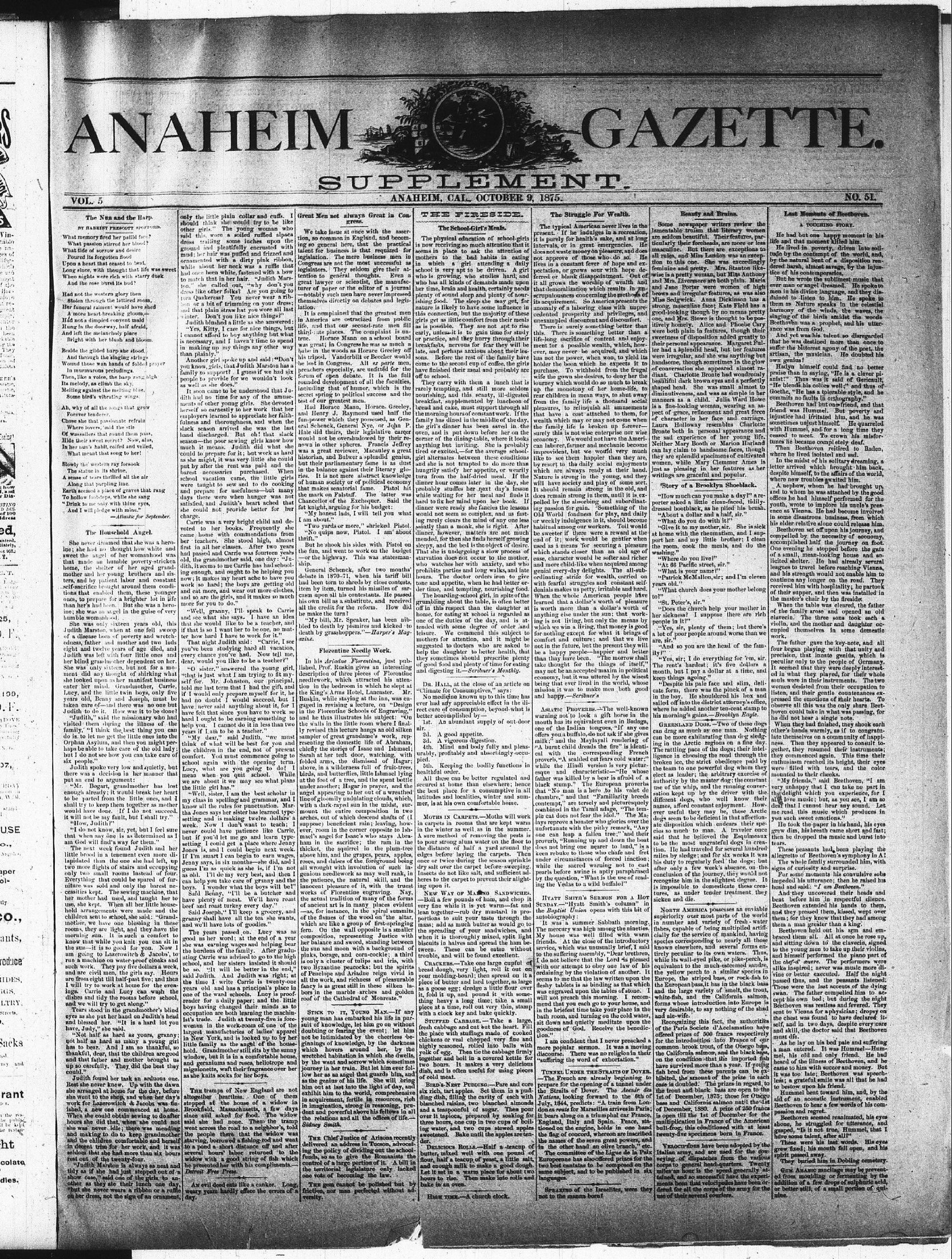
Searchable text
The Nun and the Harp
BY HARRIET PRESCOTT SPORTORD.
What memory fired her palid face?
What passion stirred her blood?
What tide of sorrow and desire
Poured its forgotten flood
Upon a heart that ceased to beat,
Long since, with thought that life was sweet
When nights were rich with starry dusk
And the rose burst its bud?
Had not the western glory then
Stolen through the latticed room,
Her funeral raiment would have shed
A more heart-breaking gloom—
Had not a dimpled convent maid
Hung in the doorway, half afraid,
And left the melancholy place
Bright with her blush and bloom.
Beside the gilded harp she stood,
And through the singing strings
Wound those wan hands of folded prayer
In murmurous preludings.
Then, like a voice, the harp rang high
Its melody, as climb the sky.
Melting against the melting blue,
Some bird's vibrating wings.
Ah, why of all the songs that grow
Forever tenderer.
Chose she that passionate refrain
Where lovers, 'mid the stir
Of wassailers that round them pass,
Hide their sweet secret? Now, alas,
In her nun's habit, coiffed and veiled,
What meant that song to her!
Slowly the western ray forsook
only the little plain collar and cuffs. I should think she would try to be like other girls." The young woman who said this, wore a soiled ruffled alpaca dress trailing some inches upon the ground and plentifully encrusted with mud; her hair was puffed and frizzed and ornamented with a dirty pink ribbon, while about her neck was a ruffle that had once been white, fastened with a bow to match that in her hair. "Judith Marston," she called out, "why don't you dress like other folks? Are you going to turn Quakeress? You never wear a ribbon or a bit of trimming on your dress; and that plain straw hat you wore all last winter. Don't you like nice things?"
Judith blushed a little as she answered:
"Yes, Kitty, I care for nice things, but I cannot afford to buy anything but what is necessary, and I haven't time to spend in making up my things any other way than plainly."
Another girl spoke up and said: "Don't you know, girls, that Judith Marston has a family to support? I guess if we had six people to provide for we wouldn't look as well as she does."
It soon came to be understood that Judith had no time for any of the amusements of other young girls. She devoted herself so earnestly to her work that her employers learned to appreciate her faithfulness and thoroughness, and when the slack season arrived she was the last hand discharged. But oh! that slack season—the poor sewing girls know how much it means. Judith did what she could to prepare for it; but work as hard as she might, it was very little she could put by after the rent was paid and the Great Men not always great.
We take issue at our tion, so common in E ing so general here, talent for business is legislation. The men Congress are not the legislators. They sentention to general great lawyer or scien turer of paper or ther—notably such men b themselves directly o lation.
It is complained tha in America are ostrac life, and that our se third-state places. The true. Horace Mann was great; in Congre babe in the woods as his tripod. Vanderbilt be lost in Congress. preachers especially, forum of open debate rounded development including that of hu secret spring to politi test of our greatest m Had Horace Mann and Henry J. Rayn fun-power which ther eral Schenck, Genera Hale did theirs, they would not be overshown in other sphere was a great reviewer historian, and Bulwe but their parliaments in the balance again.
In murmurous preludings.
Then, like a voice, the harp rattles high
Its melody, as climb the sky.
Melting against the melting blue,
Some bird's vibrating wings.
Ah, why of all the songs that grow
Forever tenderer.
Chose she that passionate refrain
Where lovers, mid the stir.
Of wassailers that round them pass,
Hide their sweet secret? Now, alas,
In her nun's habit, coiffed and velled,
What meant that song to her!
Slowly the western ray forsook
The statue in its shrine.
A sense of tears thrilled all the air
Along that purplling line.
Earth seemed a place of graves that rang
To hollow footsteps, while she sang
"Drink to me only with thine eyes,
And I will pledge with mine."
—Atlantic for September.
The Household Angel.
She never dreamed that she was a heroine; she had no thought how white and sweet the angel of her womanhood was that made an humble poverty-stricken home, the shelter of her aged grandmother and her young brothers and sisters, and by patient labor and constant self-sacrifice brought around them conditions that enabled them, these younger ones, to prepare for a brighter lot in life than her's had been. But she was a heroine; she was an angel in the guise of very humble womanhood.
She was only sixteen years old, this Judith Marston, when at one fell swoop of a disease born of poverty and wretchedness, father and mother and two lads eight and twelve years of age died, and Judith was left with four little ones and her blind grandmother dependent on her. She was only sixteen, but not for a moment did any thought of shirking what she looked upon as her manifest business enter her mind. Grandmother, Carrie, Lucy, and the little twin boys, only five years old, Benny and Joseph, must be taken care of—and there was no one but Judith to do it. How was it to be done?
"Judith," said the missionary who had visited them during the illness of the family, "I think the best thing you can do is to let me get the little ones into the Orphan Asylum, and then you might perhaps be able to take care of the old lady; but I do not see how you can take care of six people."
Judith spoke very low and quietly, but there was a decision in her manner that put an end to argument:
"Mr. Bogart, grandmother has lost enough already; it would break her heart to be parted from the little ones, and I shall try to keep them together as mother would have done. If I do not succeed, it will not be my fault, but I shall try."
"How, Judith!"
"I do not know, sir, yet, but I feel sure that when any one is as determined as I am God will find a way for them."
The next week found Judith and her little brood in a tenement even more dilapidated than the one she had left, up two more flights of stairs and occupying only two small rooms instead of four. Everything that could be spared of furniture was sold and only the barest ne
family to support? I guess if we had six people to provide for we wouldn't look as well as she does."
It soon came to be understood that Judith had no time for any of the amusements of other young girls. She devoted herself so earnestly to her work that her employers learned to appreciate her faithfulness and thoroughness, and when the slack season arrived she was the last hand discharged. But oh! that slack season—the poor sewing girls know how much it means. Judith did what she could to prepare for it; but work as hard as she might, it was very little she could put by after the rent was paid and the barest necessaries purchased. When school vacation came, the little girls were taught to sew and to do cooking and prepare for usefulness—but many days there were when hunger was not satisfied, and Judith's heart ached that she could not provide better for her charge.
Carrie was a very bright child and devoted to her books. Frequently she came home with commendations from her teachers. She stood high, almost first in all her classes. After two years had passed and Carrie was fourteen years old, the grandmother said, one day: "Judith, it seems to me Carrie has had schooling enough, and ought to be helping you now; it makes my heart ache to have you work so hard; the boys are getting old and eat more, and wear out more clothes, and so are the girls, and it makes so much more for you to do."
"Well, granny, I'll speak to Carrie and see what she says." I have an idea that she would like to be a teacher, and if that is so I want her to be one, no matter how hard I have to work for it.
That night Judith said: "Carrie, I see you've been studying hard all vacation, every chance you've had. Now tell me, dear, would you like to be a teacher?"
"O sister," answered the young girl, "that is just what I am trying to fit myself for. Mr. Johnston, our principal, told me last term that I had the gift, and if I would only prepare myself for it, he had no doubt I would succeed, but I have never said anything about it, for I have felt that since you have to work so hard I ought to be earning something to help you. I cannot do it in less than two years if I am to be a teacher."
"My dear," said Judith, "we must think of what will be best for you and the children in the end, not of present comfort. You must commence going to school again with the opening term. Lucy, what are you going to do? I mean when you quit school. While we are about it we may see what plans the little girl has."
"Well, sister, I am the best scholar in my class in spelling and grammar, and I know all the rules for punctuation. Martha Jones says her sister has learned type-setting and is making twelve dollars a week. Now I don't want to teach; I never could have patience like Carrie, but if you'd let me go and learn type-setting I could get a place where Jenny Jones is, and I could begin next week. If I'm smart I can begin to earn wages. Jenny says, in six months—she did, and I guess I'm as quick as she is, if I'm not as old. I'll do my very best, and then I can help you take care of granny and the boys. I wonder what the boys will be!"
enough already; it would break her heart to be parted from the little ones, and I shall try to keep them together as mother would have done. If I do not succeed, it will not be my fault, but I shall try."
"How, Judith?"
"I do not know, sir, yet, but I feel sure that when any one is as determined as I am God will find a way for them."
The next week found Judith and her little brood in a tenement even more dilapidated than the one she had left, up two more flights of stairs and occupying only two small rooms instead of four. Everything that could be spared of furniture was sold and only the barest necessities kept. The sewing machine, that her mother had used, and taught her to use, she kept. When all her little household arrangements were made and the children sent to school, she said: "Grandmother, we have one blessing in these rooms, they are light, and they have the morning sun. It is such a comfort to know that while you knit you can sit in the sun—it is so good for you. Now I am going to Lazerowitch & Jacobs', to run a machine on water-proof cloaks and such work. They pay five dollars a week, and are civil men, the girls say. Hours are from eight till half-past five; and then I will try to work at home for the evenings. Carrie and Lucy can wash the dishes and tidy the rooms before school, and we will try to get along."
Tears stood in the grandmother's blind eyes as she put her hand on Judith's head and blessed her. "It is a hard lot you have, Judy," she said.
"Not half as hard as yours, granny; not half as hard as many a young girl has to bear. And I am so thankful, so thankful, dear, that the children are good and that father and mother brought us up so carefully. They did the best they could."
Judith found her task an arduous one. Rest she never knew. Up with the dawn she arranged at home for the day, before she went to the shop, and when her day's work for Lazerowitch & Jacobs was finished, a new one commenced at home. When she could obtain sewing to do after hours she did that, when she could not she was never idle; there was mending and making to do to keep grandmother and the children comfortable and herself in decent trim for her work, and it was seldom that she had more than six hours rest out of the twenty-four.
"Judith Marston is always as neat and tidy as if she had just stepped out of a show case," said one of the girls to another as they ate their lunch one day, "but she never wears a ribbon or a ruffle on her dress, not the sign of an ornament,
"Well, sister, I am the best scholar in my class in spelling and grammar, and I know all the rules for punctuation. Martha Jones says her sister has learned type-setting and is making twelve dollars a week. Now I don't want to teach; I never could have patience like Carrie, but if you'd let me go and learn type-setting, I could get a place where Jenny Jones is, and I could begin next week. If I'm smart I can begin to earn wages, Jenny says, in six months—the she did, and I guess I'm as quick as she is, if I'm not as old. I'll do my very best, and then I can help you take care of granny and the boys. I wonder what the boys will be!"
Said Benny, "I'll be a butcher and have plenty of meat. We'll have roast beef and roast turkey every day."
Said Joseph," I'll keep a grocery, and granny shall have all the tea she wants, and we'll have lots of goodies."
The years passed on. Lucy was as good as her word; at the end of a year she was earning wages and helping bear the burdens of the family. After graduating Carrie was advised to go to the high school, and her sisters insisted it should be so. "It will be better in the end," said Judith. And Judith was right; at the time I write Carrie is twenty-one years old and has a principal's place in one of the ward schools. Lucy is proof-reader for a daily paper; and the little boys having changed their minds as to occupation are both learning the machinist's trade. Judith at twenty-five is forewoman in the work-room of one of the largest manufactories of ladies' apparel in New York, and is looked up to by her little family as the angel of the household. Grandmother still sits by the sunny window, but it is in a comfortable house, and geraniums and roses, heliotrope and magnionette, waft their fragrance over her as she knits socks for her boys.
The tramps of New England are not altogether heartless. One of them stopped at the house of a widow in Brookfield, Massachusetts, a few days since asked for food. The widow said she had none. Then the tramp went across the road to a neighbor's, told the people there that the widow was starving, borrowed a fishing-rod and went to a pond a short distance off and after several hours' labor returned to the widow with a good string of fish which he presented her with his compliments.
Detroit Free Press.
An evil deed eats like a canker. Long, weary years hardly afface the errors of a day.
angel appearing to line of gloomily undulate with a dark-rayed sun mount the entire arches, out of which suppose) beneficient ever, room in the coalmal's angel for Isaiah ham in the sacrifice thicket, the squirrel above him, and the girasses, and daises of tails wrought with invading genious needlework; the patience,the naiinnocent pleasure of works of Florentine actual tradition of ancient art is in re-read-as, for instance, in of the flames of the which are like a groern. On the wall composition, repress her balance and swow the sun and moon wink pinks,borage,and is only a cluster of two Byzantine peace of Penelope and Aristia all the work,and rich fancy is as great still bors in the marble roof of the Cathedral.
Stick to it, Y young man has embark suit of knowledge,b doubting or fearing not be intimidated by gnittings of knowledge which hovers are wretched habitation by the want and sorrow journey in her train low her as an angel-as the genius of his him out at last into exhibit him to the view in acquirement,fertility in imagination,troubled dent and powerful actionthe relations and Sidney Smith.
The Chief Justice delivered an address ing the policy of div funds,so as to give control of a large p power of becoming
The gem cannot friction,nor man perverity.
Great Men not always Great in Congress.
We take issue at once with the assertion, so common in England, and becoming so general here, that the practical talent for business is that required for legislation. The mere business men in Congress are not the most successful as legislators. They seldom give their attention to general thoughts. Even a great lawyer or scientist, the manufacturer of paper or the editor of a journal — notably such men have never impressed themselves directly on debates and legislation.
It is complained that the greatest men in America are ostracized from public life, and that our second-rate men fill third-rate places. The complaint is untrue. Horace Mann on a school board was great; in Congress he was as much a babe in the woods as Horace Greeley off his tripod. Vanderbilt or Beecher would be lost in Congress. All ex parte men, preachers especially, are unfitted for the forum of open debate. It is the full rounded development of all the faculties, including that of humor, which is the secret spring to political success and the test of our greatest men.
Had Horace Mann, Horace Greeley, and Henry J. Raymond used half the fun-power which they possessed, as General Schenck, General Nye, or John P. Hale did theirs, their legislative career would not be overshadowed by their renown in other spheres. Francis Jeffrey was a great reviewer, Macauley a great historian, and Bulwer a splendid genius, but their parliamentary fame is as dust in the balance against their literary glamour.
THE FIRESIDE.
The School-Girl's Meals.
The physical education of school-girls is now receiving so much attention that it seems in place to ask the attention of mothers to the bad habits in eating in which a girl attending a daily school is very apt to be driven. A girl who is growing, who studies hard, and who has all kinds of demands made upon her time, brain and health, certainly needs plenty of sound sleep and plenty of nourishing food. The sleep she may get, for nature is likely to have some influence in this connection, but the majority of these girls get as little comfort from their meals as is possible. They are not apt to rise early, unless it is to gain time for study or practice, and they hurry through their breakfasts, nervous for fear they will be late, and perhaps anxious about their lessons. Before the rest of the family have come to the second cup of coffee, the girls have finished their meal and probably are off to school.
They carry with them a lunch that is rarely tempting, and still more seldom nourishing, and this scanty, ill-digested breakfast supplemented by luncheon of bread and cake, must support through all the morning hours of constant work. If the family has dined in the middle of the day, the girl's dinner has been saved in the oven, and is put down before her on the corner of the dining-table, where it looks anything but inviting. She is probably tired or excited,—for the average school-girl alternates between these conditions and she is not tempted to do more than hungrily settle on an appetite or wearily eat.
The Struggle For Wealth.
The typical American never lives in the present. If he indulges in a recreation, it is purely for health's sake, and at long intervals, or in great emergencies. He does not waste money on pleasure, and does not approve of those who do so. He lives in a constant fever of hope and expectation, or grows sour with hope deferred or blank disappointment. Out of it all grows the worship of wealth and that demoralization which results in unscrupulousness concerning the methods of its acquirement. So America presents the anomaly of a laboring class with unprecedented prosperity and privileges, and unexamplied discontent and discomfort.
There is surely something better than this. There is something better than a life-long sacrifice of content and enjoyment for a possible wealth, which, however, may never be acquired, and which has not the power, when won, to yield its holder the boon which he expects it to purchase. To withhold from the frugal wife the gown she desires, to deny her journey which would do so much to break up the monotony of her home-life, to rear children in mean ways, to shut away from the family life a thousand social pleasures that have a cost attached to them, for wealth which may or may not come when the family life is broken up forever—surely this is not wise enterprise nor wise economy. We would not have the American laborer, farmer and mechanic become improvident, but we would very much like to see them happier than they are, by resort to the daily social enjoyments women just as usual.
Some lamentations are sold tienerlarly masculine all rules tion to feminine wise is a and Mrs. and Jan brows at Miss Seymour strong, good-loving one, and itively lately were both sweetnear their pet had were irritated handsome of convict diant. beautiful shaped diminutive manner is a final aspect of charm Laura Bronte in the said Neither can lay they are always ready at their hand.
At Junise-veoted but her faiththe last slack how she hard could I the When girls taking many is not that the fat knight, arguing for his budget:
"My honest lads, I will tell you what I am about."
"Two yards or more," shrieked Pistol.
"No quips now, Pistol. I am about thrift."
But he shook his sides with Pistol on the fun, and went to work on the budget—or the highway. This was statesmanship.
General Schenck, after two months' debate in 1870–71, when his tariff bill had been torn to shreeds by close contests, item by item, turned his missiles of sarcasm upon all his contestants. He passed his own bill as a substitute, and received all the credit for the reform. How did he make the turn?
"My bill, Mr. Speaker, has been nibled to death by pismires and kicked to death by grasshoppers."—Harper's Magazine.
Florentine Needle Work.
In his Ariadne Florentina, just published, Prof. Ruskin gives an interesting description of three pieces of Florentine needlework, which attracted his attention in the bedroom in which he slept at the King's Arms Hotel, Lancaster. Mr. Ruskin, while staying at the inn, was engaged in revising a lecture, on "Design in the Florentine Schools of Engraving," and he thus illustrates his subject: "On the walls in the little room where I finally revised this lecture hangs an old silken sampler of great grandame's work, representing the domestic life of Abraham, chiefly the stories of Isaac and Ishmael; Sarah at her tett door, watching, with folded arms, the dismissal of Hagar; above, in a wilderness full of fruit-trees, birds, and butterflies, little Ishmael lying at the foot of a tree, and the spent bottle under another; Hugar in prayer, and the angel appearing to her out of a wreathed line of gloomily undulating clouds, which, with a dark-rayed sun in the midst, surmount the entire composition in two arches, out of which descend shafts of (I suppose) beneficent rain; leaving, however, room in the corner opposite to Ishmael's angel for Isaac's who stays Abraham in the sacrifice; the ram in the thicket, the squirrel in the plum-tree above him, and the grapes, pears, apples, roses, and daises of the foreground being all wrought with involution of such ingenious needlework as may well rank, in the patience, the natural skill, and the innocent pleasure of it, with the truest
They carry with them a lunch that is rarely tempting, and still more seldom nourishing, and this scanty, ill-digested breakfast, supplemented by luncheon of bread and cake, must support through all the morning hours of constant work. If the family has dined in the middle of the day, the girl's dinner has been saved in the oven, and is put down before her on the corner of the dining-table, where it looks anything but inviting. She is probably tired or excited,—for the average school-girl alternates between these conditions and she is not tempted to do more than hungrily satisfy her appetite, or wearily turn from the half-dried meal. If the dinner hour comes later in the day, she probably studies her next day's lesson while waiting for her meal and finds it hard to fix her mind upon her book. If dinner were ready she fancies the lessons would not seem so complex, and as fasting rarely clears the mind of any one less saintly than a monk, she is right. After dinner, however, matters are not much mended, for then she finds herself growing sleepy, and the bed is the object of desire. That she is undergoing a slow process of starvation does not occur to the mother, who watches her with anxiety, and who prohibits parties and long walks, and late hours. The doctor orders iron to give tone and appetite, when he had better order time, and tempting, nourishing food.
The boarding-school girl, in spite of the grumbling about the table, is often better off in this respect than the daughter at home, for eating at school is regarded as one of the duties of the day, and is attended with some degree of order and leisure. We commend this subject to mothers for attention, and it might be suggested to doctors who are asked to help the daughter to better health, that they sometimes should prescribe plenty of good food and plenty of time for eating and digesting it.—Scribner's Monthly.
Dr. Hall, at the close of an article on "Climate for Consumptives," says:
No medicine known up to this time has ever had any appreciable effect in the direct cure of consumption beyond what is better accomplished by—
1st. An abundant supply of out-door air.
2d. A good appetite.
3d. A vigorous digestion.
4th. Mind and body fully and pleasurably, profitably and absorbingly occupied.
5th. Keeping the bodily functions in healthful order.
All these can be better regulated and secured at home than elsewhere; hence the best place for a consumptive in all latitudes and localities, winter and summer, is at his own comfortable home.
Moths in Carpets.—Moths will work in carpets in rooms that are kept warm in the winter as well as in the summer. A sure method of removing the pests is to pour strong acid water on the floor to the distance of half a yard around the edges before laying the carpets. Then once or twice during the season sprinkle dry salt over the carpet before sweeping. Insects do not like salt, and sufficient adheres to the carpet to prevent their alighting upon it.
To withhold from the trug wife the gown she desires, to deny her journey which would do so much to break up the monotony of her home-life, to rear children in mean ways, to shut away from the family life a thousand social pleasures that have a cost attached to them, for wealth which may or may not come when the family life is broken up forever—surely this is not wise enterprise nor wise economy. We would not have the American laborer, farmer and mechanic become improvident, but we would very much like to see them happier than they are, by resort to the daily social enjoyments which are always ready at their hand. Nature is strong in the young, and they will have society and play of some sort. It should remain strong in the old, and does remain strong in them, until it is expelled by the absorbing and subordinating passion for gain. Something of the Old World fondness for play,and daily or weekly indulgence in it,应 become habitual among our workers. Toil would be sweeter if there were a reward at the end of it; work would be gentler when used as a means for securing a pleasure which stands closer than an old age of ease,character would be softer and richer and more child-like when acquired among genial every-day delights. The all-subordinating strife for wealth,carried on with fearful struggles and constant self-denials makes us petty,irritable and hard. When the whole American people have learned that a dollar's worth of pleasure is worth more than a dollar's worth of anything else under the sun; that working is not living,但 only the means by which we win a living,that money is good for nothing except for what it brings of comfort and culture;and that we live not in the future,但the present they will be a happy people—happier and better than they have been.
"The morrow shall take thought for the things of itself," may not be an accepted maxim in political economy,但它 was uttered by the wisest being that ever lived in the world,whose mission it was to make men both good and happy.—Scribner's
ASIATIC PROVERNS.—The well-known warning not to look a gift horse in the mouth has its equivalent even in Badaga,一one of the Indian tongues,“If any one offers you a buffalo,downtake my means by which we win a living,that money is good for nothing except for what it brings of comfort and culture;and that we live not in the future,但the present they will be a happy people—happier and better than they have been.
"The morrow shall take thought for the things of itself," may not be an accepted maxim in political economy,但它 was uttered by the wisest being that ever lived in the world,whose mission it was to make men both good and happy.—Scribner's
GREAT can draw can be in The rat ligence broken tea glect as authorize use of saction lion different names,ever use dogs seate distices so said to be tion.I miles b his dusk after o conclusion recognis is imp
angel appearing to her out of a wreathed line of gloomily undulating clouds, which, with a dark-rayed sun in the midst, surmount the entire composition in two arches, out of which descend shafts of (I suppose) beneficient rain; leaving, however, room in the corner opposite to Ishmael's angel for Isaac's who stays Abraham in the sacrifice; the ram in the thicket, the squirrel in the plum-tree above him, and the grapes, pears, apples, roses, and daisies of the foreground being all wrought with involution of such ingenious needlework as may well rank, in the patience, the natural skill, and the innocent pleasure of it, with the truest works of Florentine engraving. Nay, the actual tradition of many of the forms of ancient art is in many places evident—as, for instance, in the spiral summits, of the flames of the wood on the altar, which are like a group of first-springing fern. On the wall opposite is a smaller composition, representing Justice with her balance and sword, standing between the sun and moon with a background of pinks, borage, and corn-cockle; a third is only a cluster of tulips and iris, with two Byzantine peacocks; but the spirits of Penelope and Ariadne reign vivid in all the work, and richness of pleasurable fancy is as great still in these silken labors in the marble arches and golden roof of the Cathedral of Moncree."
STICK TO IT, YOUNG MAN.—If any young man has embarked his life in pursuit of knowledge, let him go on without doubting or fearing the event; let him not be intimidated by the cheerless beginnings of knowledge, by the darkness which hovers around her, by the wretched habitation in which she dwells, by the want and sorrow which sometimes journey in her train. But let him ever follow her as an angel that guards him, and as the genius of his life. She will bring him out at last into the light of day, and exhibit him to the world, comprehensive in acquirement, fertile in resources, rich in imagination, strong in reasoning, prudent and powerful above his fellows in all the relations and all the offices of life.
Sidney Smith.
The Chief Justice of Arizona recently delivered an address in Tucson, advocating the policy of dividing out the school-funds, so as to give the Romanists the control of a large portion of it. A bill in the territorial legislature only lacked one vote of becoming the law.
The gem cannot be polished but by friction, nor man perfected without adversity.
MOTHS IN CARPETS.—Moths will work in carpets in rooms that are kept warm in the winter as well as in the summer. A sure method of removing the pests is to pour strong alum water on the floor to the distance of half a yard around the edges before laying the carpets. Then once or twice during the season sprinkle dry salt over the carpet before sweeping. Insects do not like salt, and sufficient adheres to the carpet to prevent their alighting upon it.
NEW WAY OF MARING SANDWICHES.—Boil a few pounds of ham, and chop it very fine while it is yet warm—fat and lean together—rub dry mustard in proportions to suit your taste through the mass; add as much butter as would go to the spreading of your sandwiches, and when it is thoroughly mixed, split light biscuits in halves and spread the ham between. These can be eaten without trouble, and will be found excellent.
CRACKERS.—Take one large cupful of bread dough, very light, roll it out on your molding-board; then spread on it a piece of butter and lard together, as large as a goose egg; dredge a little flour over it, fold it up, and pound it with something heavy a long time; take a small piece at a time, roll out very thin, stamp with a clock key and bake quickly.
STUFFED CABBAGE.—Take a large, fresh cabbage and cut but the heart. Fill the place with stuffings made of cooked chickens or veal chopped very fine and highly seasoned, rolled into balls with yolk of egg. Then tie the cabbage firmly together and boil in a covered kettle for two hours. It makes a very delicious dish, and is often useful for using pieces of cold meat.
BIRD'S-NEST PUDDING.—Pare and core six rich, tart apples. Set them in a pudding dish, filling the cavity of each with blanched raisins, two blanched almonds and a teaspoonful of sugar. Then pour over it tapioca, prepared by soaking for three hours, one cup in two cups of boiling water, and two cups stewed apples sweetened. Hake until the apples are tender.
DELICIOUS ROLLS.—Half a teacup of butter, mixed well with one pound of flour, half a teacup of yeast, a little salt, and enough milk to make a good dough. Let it set in a warm place for about two hours to rise. Then make into rolls and bake in an oven.
HIER TIME.—A church clock.
HYATT SMITH'S SERMON FOR A HOT SUNDAY.—"Hyatt Smith's column" in the Baptist Union opens with this bit of autobiography:
It was a summer Sabbath morning. The mercury was high among the nineties. My house was well filled with warm friends. At the close of the introductory service, which was unusually brief, I said to the suffering assembly, "Dear brethren, I do not believe that the Lord is pleased with our attempt to obey one law of his ordaining by the violation of another. It seems to me that the law written upon the fleshy tablets is as binding as that which was engraved upon the tables of stone. I will not preach this morning. I recommend that you each go to your house, and in the brieffest time take your place in the bath room, and turning on the cold water, sit down and quietly meditate upon the goodness of God. Receive the benedicition."
I am confident that I never preached a more popular sermon. It was a moving discourse. There was no religion in their "suffering the word of exhortation."
TUNNEL UNDER THE STRAITS OF DOVER.—The French are already beginning to prepare for the opening of a tunnel under the Straits of Dover. The Avenue des Nations, looking forward to the 8th of July, 1844, predicts: "A train from London en route for Marseilles arrives in Paris; it bears along on a triumphal car France, England, Italy and Spain. Peace, stationed on the engine, holds in one hand the flag of concord, whereon are inscribed the names of the seven great powers, and in the other hand an olive branch." etc.
The committee of the Ligue de la Paix Européenne has also offered prizes for the two best cantatas to be composed on the same subject, and to be published in six languages.
SPRANKING OF THE ISRAELITES, were they not to the munna born?
GAZETTE.
NO. 51.
Nor Wealth.
In never lives in the ages in a recreation, a sake, and at long emergencies. He is pleasure, and does who do so. He her of hope and ex-our with hope de-ointment. Out of ship of wealth and which results in un-ning the methods of America presents the class with unpre- and privileges, and it and discomfort. Nothing better than a content and enjoy-health, which, how-required, and which won, to yield its he expects it to lead from the frugal lives, to deny her the so much to break her home-life, to always, to shut away a thousand social all amusements reached to them, for may not come when taken up forever—enterprise nor wise not have the Ameri-mechanic become world very much older than they are, social enjoyments order at their hand.
Beauty and Bruins.
Some newspaper writers review the lamentable trulam that literary women are seldom beautiful. Their features, particularly their foreheads, are more or less masculine. But there are exceptions to all rules, and Miss Landon was an exception to this one. She was exceedingly feminine and pretty. Mrs. Stanton likewise is a pretty woman, but Miss Anthony and Mrs. Lavermore are both plain. Maria and Jane Porter were women of high brows and irregular features, as was also Miss Sedgwick. Anna Dickinson has a strong, masculine face; Kate Field has a good-looking though by no means pretty one, and Mrs. Stowe is thought to be positively homely. Alice and Phoebe Cary were both plain in features, though their sweetness of disposition added greatly to their personal appearance. Margaret Fuller had a splendid head, but her features were irregular, and she was anything but handsome, though sometimes in the glow of conversation she appeared almost radiant. Charlotte Bronte had wondrously beautiful dark brown eyes and a perfectly shaped head. She was small almost to diminutiveness, and was as simple in her manners as a child. Julia Ward Howe is a fine-looking woman, wearing an aspect of grace, refinement and great force of character in her face and carriage. Laura Holloway resembles Charlotte Bronte both in personal appearance and the sad experience of her young life. Neither Mary Booth or Marion Harland can lay claim to handsome faces, though they are splendid specimens of cultivated women, while Mary Clemmer Ames is just as pleasing in her features as her
Last Moments of Beethoven.
A TOUCHING STORY.
He had but one happy moment in his life and that moment killed him.
He lived in poverty, driven into solitude by the contempt of the world, and by the natural bent of a disposition rendered harsh, almost savage, by the injustice of his contemporaries.
But he wrote the sublimest music that ever man or angel dreamed. He spoke to men in his divine language, and they disdained to listen to him. He spoke to them as Nature speaks in the celestial harmony of the winds, the waves, the singing of the birds amidst the woods. Beethoven was a prophet, and his utterance was from God.
And yet was his talent so disregarded that he was destined more than once to suffer the bitterest agony of the poet, the artisan, the musician. He doubted his own genius!
Hadyn himself could find no better praise than in saying, "He is a clever pianist!" Thus was it said of Gericault, "He blends his colors well;" and thus of Goethe, "He has a tolerable style, and he commits no faults in orthography."
Beethoven had but one friend, and that friend was Hummel. But poverty and injustice had irritated him, and he was sometimes unjust himself. He quarreled with Hummel, and for a long time they ceased to meet. To crown his misfortunes he became completely deaf.
Then Beethoven reitired to Baden, where he lived isolated and sad.
In the midst of his solitary dreaming, a letter arrived which brought him back.
from the fragrant wines, to deny her the so much to break her home-life, to always, to shut away a thousand social all amusements attached to them, for may not come when taken up forever—enterprise nor wise not have the American mechanic become would very much older than they are, social enjoyments body at their hand. He young, and they play of some sort. Sing in the old, and them, until it is exaggerated subordinat-Something of the for play, and daily in it, should become workers. Toil would here a reward at the end be gentler when encountering a pleasure than an old age of the softer and richer men acquired among others. The all-subwealth, carried on and constant self-irritable and hard. American people have worth of pleasure dollar's worth of the sun; that work-only the means by that money is good what it brings of and that we live the present they will happier and better "The morrow shall things of itself," he maxim in political matter by the wisest in the world, whose men both good
The well-known gift horse in the rent even in Badaga,agues, "If any one not ask if she gives royal rendering of the fire" is identi-sponding French at fears cold water;" vision is very pictur-istic—"He whose bear is afraid of a European proverbs so to his valet de Familiarity breeds and picturesquely adage, "The teme-idol." The Ma-who glories over the witty remark, "Any en tree;" and their land down the boat carrier to land," is a who chafe and fret of forced inaction; warning not to cast aptly paraphrased it is the use of read-buffalo?"
Story of a Brooklyn Shoeblack.
"How much can you make a day?" a reporter asked a little clean-faced, tidily-dressed boothblack, as he plied his brush. "About a dollar and a half, sir." "What do you do with it?" "Give it to my mother, sir. She is sick at home with the rheumatism, and I support her and my little brother; I clean the room, cook the meals, and do the washing." "Where do you live?" "At 66 Pacific street, sir." "What is your name?" "Patrick McMallon, sir; and I'm eleven years old." "What church does your mother belong to?" "St. Peter's, sir." "Does the church help your mother in her sickness? I suppose there are rich people in it?" "Yes, sir, plenty of them; but there's a lot of poor people around worse than we are, sir." "And so you are the head of the family?" "Yes, sir; I do everything for 'em, sir. The rent's hardest; it's five dollars a month, but I pay a dollar at a time, and keep things agoing."
"Despite his pale face and slim, delicate form, there was the pluck of a man in the boy. He shouldered his box and sailed off into the district attorney's office, where he added another ten-cent stamp to his morning's gains."—Brooklyn Eagle.
GREENLAND Dogs. Two of these dogs can drag as much as one man. Nothing can be more exhilarating than dog sledging in the Arctic regions on a fine day. The rattling pace of the dogs; their intelligence in choosing the road through the broken ice, the strict obedience paid by the team to one powerful dog whom they elect as leader; the arbitrary exercise of authority by the master dog; the constant use of the whip, and the running conversation kept up by the driver with the different dogs, who well know their names, afford constant enjoyment. However useful they may be, these Arctic dogs seem to be deficient in that affectionate disposition which endears their species so much to man. A traveler once said that he believed the Esquimeaux to be the most ungrateful dogs in creation. He had traveled for several hundred miles by sledge; and for six weeks it was his duty to regularly feed the dogs; but after only a few week's absence, on the conclusion of the journey, they would not recognize him in the slightest degree. It is impossible to domesticate these crea-praise than in saying, "He is a clever pianist!" Thus it is said of Gericault, "He blends his colors well;" and thus of Goethe, "He has a tolerable style, and he commits no faults in orthography."
Beethoven had but one friend, and that friend was Hummel. But poverty and injustice had irritated him, and he was sometimes unjust himself. He quarreled with Hummel, and for a long time they ceased to meet. To crown his misfortunies he became completely deaf.
Then Beethoven reitired to Baden, where he lived isolated and sad.
In the midst of his solitary dreaming, a letter arrived which brought him back, despite himself, to the affairs of the world, where new troubles awaited him.
A nephew, whom he had brought up, and to whom he was attached by the good offices he had himself performed for the youth, wrote to implore his uncle's presence at Vienna. He had become involved in some disastrous business, from which his elder relative alone could release him.
Beethoven set off upon his journey, and compelled by the necessity of economy, accomplished half the journey on foot. One evening he stopped before the gate of a small, mean-looking house and solicited shelter. He had already several leagues to travel before reaching Vienna, and his strength would not enable him to continue any longer on the road. They received him with hospitality; he partook of their supper, and then was installed in the master's chair by the fireside.
When the table was cleared, the father of the family arose and opened an old clavecin. The three sons took each a violin, and the mother and daughter occupied themselves in some domestic work.
The father gave the key-note, and all four began playing with that unity and precision, that innate genius, which is peculiar only to the people of Germany. It seemed that they were deeply interested in what they played, for their whole souls were in their instruments. The two women desisted from their occupation to listen, and their gentle countenances expressed the emotions of their hearts. To observe all this was the only share Beethoven could take in what was passing, for he did not hear a single note.
When they had finished, they shook each other's hands warmly, as if to congratulate themselves on a community of happiness. Then they appeared to consult together, they resumed their instruments; they commenced again. This time their enthusiasm reached its height, their eyes were filled with tears, and the color mounted to their cheeks.
My friends," said Beethoven, "I am very unhappy that I can take no part in the delight which you experience, for I also love music; but as you see, I am so dear that I cannot hear any sound. Let me read this music which produces in you such sweet emotions."
He took the paper in his hand, his eyes grew dim, his breath came short and fast; then he dropped the music and burst into tears.
These peasants had been playing the allegretto of Beethoven's symphony in Al!
The whole family surrounded him, with signs of curiosity and surprise.
For some moments his convulsive sobs impeded his utterance; then he raised his head and said: "I am Beethoven."
Familiarity breeds and picturesque adage, "The teme ne idol." The Mawho glories over the mythy remark, "Any en tree;" and their hand down the boat carer to land," is a who chafe and fret of forced inaction; warning not to cast aptly paraphrased it is the use of read-ful buffalo."
North America possesses an enviable superiority over most parts of the world in number and variety of fresh-water fishes, capable of being multiplied artificially for the service of mankind, having species corresponding to nearly all those known elsewhere, and several forms entirely peculiar to its own waters. Thus, while its wall-eyed pike, or pike-perch, is equivalent to the much-estimated sandre, the yellow perch to a similar species in Europe, the striped bass, or rock-fish to the European bass, it has in the black bass and the large variety of smelt, the trout, white-fish, and the California salmon, forms whose introduction into Europe is very desirable, to say nothing of the shad and ale-wife.
Recognizing this fact, the authorities of the Paris Societe d'Acclamation have offered prizes of 500 francs respectively for the introduction into France of our common brook trout, of the Otsego bass, the California salmon, and the black bass, on the condition that the imported fish have survived more than a year. If young fish bred from these parents can be exhibited, the amount of the prize in each case is doubled: The prizes in regard to the trout and black bass are open to the 1st of December, 1875; those for Otsego bass and California salmon until the 1st of December, 1880. A prize of 250 francs is open till the 1st of December for the multiplication in France of the American bull-frog, this conditioned with at least twenty-five specimens born in France.
Velocipedes have been adopted by the Italian army, and are used for conveying of dispatches from the various corps to general headquarters. Twenty miles an hour is the speed generally attained, and so successful have the experiments been that velocipedes have been ordered for all the corps of the army for the use of their several couriers.