anaheim-gazette 1875-09-18
Scanned page
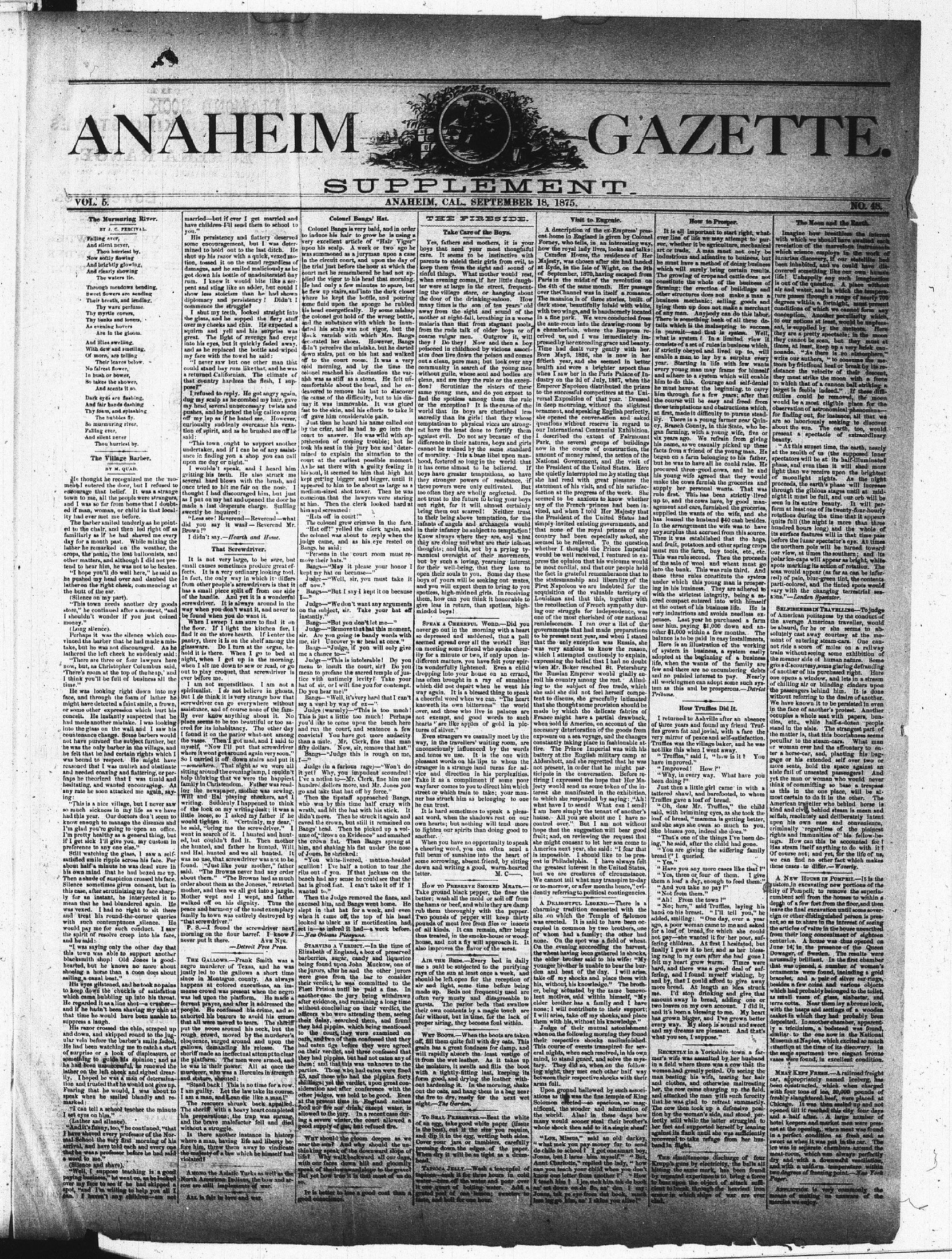
Searchable text
The Murmuring River.
BY J. C. PERCIVAL.
Falling ever,
And silent never,
Thou hurriest by,
Now softly flowing
And brightly glowing,
And clearly showing
The waters lie.
Through meadows bending,
Sweet flowers are sending
Their breath, and lending,
Thy wave perfume.
Thy myrtle covers,
Thy banks and lovers,
As evening hovers
Are in the gloom.
And illies swelling,
With dew and smelling,
Of morn, are telling
Their leaves below.
No falrest flower,
In bush or bower,
So takes the shower,
And scents it so.
Dark eyes are flashing.
And fair hands dashing
Thy foam, and splashing
The bubbles fly.
So murmuring river,
Falling ever,
And silent never
Thou hurriest by.
The Village Barber.
BY M. QUAD.
married—but if ever I get married and have children I'll send them to school to you."
His persistency and flattery deserved some encouragement, but I was determined to hold out to the last ditch. He shut up his razor with a quick, vexed motion, tossed it on the stand regardless of damages, and he smiled maliciously as he got down his bottle of unadulterated bay rum. I knew it would bite like a serpent and sting like an adder, but could I show less stoicism than he had shown diplomacy and persistence? Didn't I commence the struggle?
I shut my teeth, looked straight into the glass, and heopped the fiery stuff over my cheeks and chin. He expected a squirm and yell and his surprise was great. The light of revenge had crept into his eyes, but it quickly faded away, and as he replaced the bottle and wiped my face with the towel he said:
"I never saw but one other man that could stand bay rum like that, and he was a returned Californian. The climate of that country hardens the flesh, I suppose."
I refused to reply. He got angry again, dug my scalp as he combed my hair, gave my head several unnecessary twists and pushes, and he jerked the big calico apron off my lap as if he hated me. However, curiosity suddenly overcame his vexation of spirit, and as he brushed me off he said:
"This town ought to support another undertaker, and if I can be of any assistance in finding you a shop you can call upon me day or night."
I wouldn't speak, and I heard him
Colonel Bangs is to induce his hair very excellent art upon his scalp. A was summoned as a in the circuit court, the trial just before court met he remembered plied the vigor to him. He had only a few flew up stairs, and where he kept some fluid upon his head energetically the colonel got hold and the substance dated his scalp was black varnish with decorated her shoes didn't perceive the down stairs, put one off to the court room cold morning, and colonel reached his nish was as stiff as comfortable about to deavoured to remove the cause of the diff may it was immovable fast to the skin, and off gave him consid.
Just then he heard by the crier, and he court to answer. I prehension of com took his seat in the mined to explain court at the earlier As he sat there with
The Village Barber.
BY M. QUAD.
He thought he recognized me the moment I entered the door, but I refused to encourage that belief. It was a strange town to me, all the people were strangers, and I was so far from home that I doubted if man, woman, or child in that locality had ever met me before.
The barber smiled tenderly as he pointed to the chair, and then led right off as familiarly as if he had shaved me every day for a month past. While mixing the lather he remarked on the weather, the crops, the panic, the lost balloonists, and other matters, and although I did not pretend to hear him, he was not to be beaten.
"I hope you'll do well here," he said as he pushed my head over and dabbed the lather on the right cheek, commencing at the butt of the ear.
(Silence on my part).
"This town needs another dry goods store," he continued after a moment, "and I shouldn't wonder if you just coined money."
(Long silence).
Perhaps it was the silence which convinced the barber that he had made a mistake, but he was not discouraged. As he lathered the left cheek he suddenly said:
"There are three or four lawyers here now, but, as Christopher Columbus said, 'There's room at the top of the heap,' and I think you'll be full of business all the time."
He was looking right down into my face, and through the foam of lather he might have detected a faint smile, a frown, or some other expression which hurt his conceit. He instantly suspected that he had made another mistake. I was looking into the glass on the wall and I saw his countenance change. Some barbers would not have pursued the subject further, but he was the only barber in the village, and he felt that he had certain rights which I was bound to respect. He might have reasoned that I was mulish and obstinate and needed coaxing and flattering, or perhaps he theorized that I was timid and hesitating, and wanted encouraging. At any rate he soon attacked me again, saying:
"This is a nice village, but I never saw so much sickness in my life as we have had this year. Our doctors don't seem to know enough to manage the diseases and I'm glad you're going to open an office. I'm pretty healthy as a general thing, but if I get sick I'll give you my custom in preference to any one else."
Still watching the glass, I saw a self-satisfied smile ripple across his face. For about half a minute he was dead sure in his own mind that he had boxed me up. Then a shade of suspicion crossed his face. Silence sometimes gives consent, but in a returned Californian. The climate of that country hardens the flesh, I suppose!
I refused to reply. He got angry again, dug my scalp as he combed my hair, gave my head several unnecessary twists and pushes, and he jerked the big calico apron off my lap as if he hated me. However, curiosity suddenly overcame his vexation of spirit, and as he brushed me off he said:
"This town ought to support another undertaker, and if I can be of any assistance in finding you a shop you can call upon me day or night."
I wouldn't speak, and I heard him gritting his teeth. He also struck me several hard blows with the brush, and once tried to hit me fair on the nose. I thought I had discouraged him, but just as I put on my hat and opened the door he made a last desperate charge. Smiling sweetly he inquired:
"Less see! Reverend—Reverend—what did you say it was? — Reverend Mr. Brown!"
I didn't say.—Hearth and Home.
That Screwdriver.
It is not very large, to be sure, but small causes sometimes produce great effects. It is a very ordinary looking tool. In fact, the only way in which it differs from other people's screwdrivers is that it has a small piece split off from one side of the handle. And yet it is a wonderful screwdriver. It is always around in the way when you don't want it, and never to be found when you do want it.
When I sweep I am sure to find it on the floor. If I light the kitchen fire, I find it on the stove hearth. If I enter the pantry, there it on the shelf among the glassware. Do I turn at the organ, behold it is there. When I go to bed at night, when I get up in the morning, when I sit me down to sew or read, or go out to play croquet, that screwdriver is ever before me.
I am not superstitious. I am not a spiritualist. I do not believe in ghosts, but I do think it is very strange how that screwdriver can go everywhere without assistance, and of course none of the family ever know anything about it. No place seems to be too beautiful or too sacred for its inhabitancy. The other day I found it on the parlor what-not among the vases. Then I got mad, and I said to myself, "Now I'll put that screwdriver where it won't get around again very soon." So I carried it off down stairs and put it somewhere. That night as we were all sitting around the evening lamp, I couldn't help thinking that we were the happiest family in Christendom. Father was reading the newspaper mother was sewing Will and Hal playing checkers, and I writing. Suddenly I happened to think of the lock on my writing desk; it was a little loose, so I asked my father if he would tighten it. "Certainly, my dear," he said, "bring me the screwdriver." I went in search of it. I hunted and hunted, but couldn't find it. Then mother she hunted, and father she hunted, Will and Hal hunted and we all hunted. It was no use, that screwdriver was not to be found. "Just like your mother," father said. "The Browns never had any order about them." "The Browns had as much order about them as the Joneses," retorted mother and then all hunted.
I refused to reply. He got angry again, dug my scalp as he combed my hair, gave my head several unnecessary twists and pushes, and he jerked the big calico apron off my lap as if he hated me. However, curiosity suddenly overcame his vexation of spirit, and as he brushed me off he said:
"This town ought to support another undertaker, and if I can be of any assistance in finding you a shop you can call upon me day or night."
I wouldn't speak, and I heard him gritting his teeth. He also struck me several hard blows with the brush, and once tried to hit me fair on the nose. I thought I had discouraged him, but just as I put on my hat and opened the door he made a last desperate charge. Smiling sweetly he inquired:
"Less see! Reverend—Reverend—what did you say it was? — Reverend Mr. Brown!"
I didn't say.—Hearth and Home.
That Screwdriver.
It is not very large, to be sure, but small causes sometimes produce great effects. It is a very ordinary-looking tool. In fact, the only way in which it differs from other people's screwdrivers is that it has a small piece split off from one side of the handle. And yet it is a wonderful screwdriver. It is always around in the way when you don't want it, and never to be found when you do want it.
When I sweep it off down stairs and put it somewhere. That night as we were all sitting around the evening lamp, I couldn't help thinking that we were the happiest family in Christendom. Father was reading the newspaper mother was sewing Will and Hal playing checkers, and I writing. Suddenly I happened to think of the lock on my writing desk; it was a little loose, so I asked my father if he would tighten it. "Certainly, my dear," he said, "bring me the screwdriver." I went in search of it. I hunted and hunted, but couldn't find it. Then mother she hunted, and father she hunted, Will and Hal hunted and we all hunted.
I refused to reply. He got angry again, dug my scalp as he combed my hair, gave my head several unnecessary twists and pushes, and he jerked the big calico apron off my lap as if he hated me. However, curiosity suddenly overcame his vexation of spirit, and as he brushed me off he said:
"This town ought to support another undertaker, and if I can be of any assistance in finding you a shop you can call upon me day or night."
I wouldn't speak, and I heard him gritting his teeth. He also struck me several hard blows with the brush, and once tried to hit me fair on the nose. I thought I had discouraged him, but just as I put on my hat and opened the door he made a last desperate charge. Smiling sweetly he inquired:
"Less see! Reverend—Reverend—what did you say it was? — Reverend Mr. Brown!"
I didn't say.—Hearth and Home.
That Screwdriver.
It is not very large, to be sure, but small causes sometimes produce great effects. It is a very ordinary-looking tool. In fact, the only way in which it differs from other people's screwdrivers is that it has a small piece split off from one side of the handle. And yet it is a wonderful screwdriver. It is always around in the way when you don't want it, and never to be found when you do want it.
When I sweep it off down stairs and put it somewhere. That night as we were all sitting around the evening lamp, I couldn't help thinking that we were the happiest family in Christendom. Father was reading the newspaper mother was sewing Will and Hal playing checkers, and I writing. Suddenly I happened to think of the lock on my writing desk; it was a little loose, so I asked my father if he would tighten it. "Certainly, my dear," he said, "bring me the screwdriver." I went in search of it. I hunted and hunted, but couldn't find it. Then mother she hunted, and father she hunted, Will and Hal hunted and we all hunted.
I refused to reply. He got angry again, dug my scalp as he combed my hair, gave my head several unnecessary twists and pushes, and he jerked the big calico apron off my lap as if he hated me. However, curiosity suddenly overcame his vexation of spirit, and as he brushed me off他 heard with his soul; it seemed to keep getting bigger; appeared to him by medium-sized shot; conscious that they at him. Then the cried him and screamed:
"Hats off in court! The colonel grew up! Hat off!" yelled for the colonel was about judge came; and Bangs; he said:
"Persons in the colonel move their hats."
Bangs—"May it kept my hat on because Judge—'Well,' sir off now."
Bangs—"But I say-I—Judge—'We don't on the subject,' sir instantly."
Bangs—"But you owe Judge—'Remove'the sir! Are you going with me? Uncover your Bangs—'Judge if me chance to—Judge—'This is in mean to insult them; mean to profane them with untimely hat of sir; or will fiill Do you hear me!"
Bangs—"Well,' it's say a word by way of judge (warmly)—This is just a little tilt you'd like to come up and run the court; convicts? You have than a mule; Mr., C fifty dollars. Now; Bangs—'Judge tha-I—Judge (in a furious it yet?) Why; you injure I've a notion to—Mr., hundred dollars more go and take that hat! Then the tipstaff who was by this time wrath; and hit the hat didn't move. Then he cavalled the crown; but Bangs' head: Then lume of 'Brown on Evil' crown flat: The him; and shaking his hoof of Jones; he shrieked 'You white-liver scullion! I've half a ribs out of you.' If they bench had any sense that is glued fast...
This is a nice village, but I never saw so much sickness in my life as we have had this year. Our doctors don't seem to know enough to manage the diseases and I'm glad you're going to open an office. I'm pretty healthy as a general thing, but if I get sick I'll give you my custom in preference to any one else.
Still watching the glass, I saw a self-satisfied smile ripple across his face. For about half a minute he was dead sure in his own mind that he had boxed me up. Then a shade of suspicion crossed his face. Silence sometimes gives consent, but in this case, after scrutinizing my face sharply for an instant, he interpreted it to mean that he had blundered again. He was vexed. I had no right to sit there and treat his round-the-corner queries with such contemptuous silence. He would pay me for such conduct. I saw the spirit of resolve creep into his face, and he said:
"I was saying only the other day that this town was able to support another blacksmith shop! Old Jones is good-hearted, but he knows no more about shooting a horse than a coon does about sailing, a canal boat."
His eyes glistened, and he took no pains to keep down the chuckle of satisfaction which came bubbling up into his throat. He regarded it as a line shot—a crusher—and if he hadn't been shaving my chin at that time he would have been unable to suppress a laugh.
His razor crossed the chin, scraped up and down, and skipped round to the jugular vein before the barber's smile faded. He had been watching me to catch a start of surprise or a look of displeasure, or something to guide his opinion; and as he had been unsuccessful, he renewed the lather on the left cheek and sighed drearily. I hoped he was a man of determination and trusted that he would not give up. Fearing that he would, I was about to speak when he smiled blandly and remarked:
"I can tell a school teacher the minute I set eyes on him."
(Lathert and allence).
"And it's funny, too," he continued, "that I have shaved every professor of the Normal School the very first morning of his arrival, and have told each and every one that he was a professor before he had said a word to me."
(Silence and shave).
"Well, I suppose teaching is a good paying business," he went on, as he looked over my face to see if he had skipped a spot, "and I'm willing to help you all I can. I haven't any children—am not the newspaper, mother was sewing, Will and Hal playing checkers, and I writing. Suddenly I happened to think of the lock on my writing desk; it was a little loose, so I asked my father if he would tighten it. "Certainly, my dear," he said, "bring me the screwdriver." I went in search of it. I hunted and hunted, but couldn't find it. Then mother she hunted, and father he hunted, Will and Hal hunted and we all hunted. It was no use, that screwdriver was not to be found. "Just like your mother," father said. "The Browns never had any order about them." "The Browns had as much order about them as the Joneses," retorted mother, and then we all got into a jangle. Mother wept and I wept, and father walked off on his dignity. Thus the peace and harmony of the most exemplary family in town was entirely destroyed by "that screwdriver."
P. S.—I found the screwdriver next morning on the flour barrel. I know I never put it there.
AVE NIK.
—Detroit Free Press.
THE GALLOWS.—Frank Smith was a negro murderer of Texas, and he was justly led to the gallows a short time since in Montague county. As always happens at colored executions, an immense crowd was present when the negro was led upon the platform. He made a fervent prayer, and after it addressed the people. He confessed his crime, and so exhorted his bearers to avoid his errors that all were moved to tears. The sheriff put the noose around his neck, but the rough crowd, moved by the murderer's eloquence, surged around and upon the gallows, demanding his release. The sheriff made an ineffectual attempt to clear the platform. The men were armed, and he was in their power. All at once the murderer, who was a Hercules in strength and stature, shouted:
"Stand back! This is no time for a row. I am guilty. Let the law take its course. I am a man, and lean die like a man."
The rescuer shrunk appalled. The sheriff with a heavy heart completed his preparations; the trap was sprung, and the brave malefactor fell and died without a struggle.
Is there another instance in history where a man, having life and liberty before him, throw them away to vindicate the majesty of a law which he himself had violated!
AMONG THE AUATIC TURKS as well as the North American Indians, the bow and arrow are still implements of war.
ALL is fair in love and war.
Then the tipstaff who was by this time wrath, and hit the hand didn't move. Then he caved the crown, but Bangs' head. Then he hummed of: "Brown on Evie the crown flat. The him, and shaking his of Jones, he shrieked.
"You white-livered scullion! I've half of ribs out of you. If you bench had any sense hat is glued fast. I wanted to."
Then the Judge remexcused him, and Bar slept in that hat for when it came off, it looked as black as it set in—as indeed it had New Orleans Pieces.
STARVING A VERDON Elizabeth of England barberries, sugar, being found upon Joan the jurors, after he am were gone from their verdict, he was Fleet Prison until he another case the jury after evidence, and rewithout concluding officers who were att their delay, searched they had pippins, whit to the court, they oath, and two of them had eaten figs before on their verdict, and they had pippins, but them; and that this w parties. Those who £5, and those who had shillings; yet the yere sideration and after other judges, was held at the present time in food nor fire nor drilled allowed to the jury.
Ing a severe winter, good supply of gas,
Why should the gree near the sun? And why thinking speak of the life! Why walk back with our faces dawn speak of the downward But yet how true it no.
It is better to lose good conscience.
CIM GA
SUPPLEMENT.
ANAHEIM, CAL., SEPTEMBER 18, 1875.
Colonel Bangs' Hat.
Colonel Bangs is very bald, and in order to induce his hair to grow he is using a very excellent article of "Hair Vigur" upon his scalp. A week or two ago he was summoned as a juryman upon a case in the circuit court, and upon the day of the trial just before the hour at which the court met he remembered he had not applied the vigor to his head that morning. He had only a few minutes to spare, but he flew up stairs, and into the dark closet where he kept the bottle, and pouring some fluid upon the sponge he rubbed his head energetically. By some mishap the colonel got hold of the wrong bottle, and the substance with which he inundated his scalp was not vigor, but the black varnish with which Mrs. Bangs decorated her shoes. However, Bangs didn't perceive the mistake, but he darted down stairs, put on his hat and walked off to the court room. It was a very cold morning, and by the time the colonel reached his destination the vanish was as stiff as a stone. He felt uncomfortable about the head, and he endeavored to remove his hat to discover the cause of the difficulty, but to his dismay it was immovable. It was glued fast to the skin, and his efforts to take it off gave him considerable pain.
Just then he heard his name called out by the crier, and he had to go into the court to answer. He was wild with apprehension of coming trouble; but he took his seat in the jury box and determined to explain the situation to the court at the earliest possible moment. As he sat there with a guilty feeling in
THE FIRESIDE.
Take Care of the Boys.
Yes, fathers and mothers, it is your boys that need your most thoughtful care. It seems to be instinctive with parents to shield their girls from evil, to keep them from the sight and sound of sinful things. What mother would rest when evening comes, if her little daughter were at large in the street, frequenting the village store, or hanging about the door of the drinking-saloon. How many times is the son of ten years' old away from the sight and sound of the mother at night-fall, breathing in a worse malaria than that from stagnant pools from the rude talk of older boys or of coarse vulgar men. Outgrow it, will they? Do they? Now and then a boy poisoned in childhood by vicious associates does live down the poison and comes out a clean, pure man; but look over any community in search of the young men without guile, whose soul and bodies are clean, and are they the rule or the exception? Serutinize the sisters of these same young men, and do you expect to find the spotless among them the rule or the exception? It is the curse of the world that its boys are cherished less sacredly than its girls! that they whose temptations to physical vices are strongest have the least done to fortify them against evil. Do not say because of the difference in their natures, boys and girls cannot be trained by the same standard of morality. It is a base libel upon manhood, fostered so long in the world that it has come almost to be believed.
Visit to Englebe.
A description of the ex-Empress' present home in England is given by Colonel Forney, who tells in an interesting way how the royal lady lives, looks and talks: Camden House, the residence of Her Majesty, was chosen after she had landed at Ryde, in the Isle of Wight, on the 9th of September, 1870, having escaped from Paris in the midst of the revolution on the 4th of the same month. Her passage over the Channel was in itself a romance. The mansion is of three stories, built of dark stone, beautifully inflaid with white, with two wings, and is handsomely located in a fine park. We were conducted from the ante-room into the drawing-room by a chamberlain, where the Empress received us, and I was immediately impressed by her exceeding grace and beauty. Time had dealt very gently with her. Born May5, 1826, she is now in her fifteenth year, and she seemed in better health and wore a brighter aspect than when I saw her in the Paris Palace of Industry on the 2d of July, 1867, when the Emperor Napoleon distributed the prizes to the successful competitors at the Universal Exposition of that year. Dressed in deep mourning, without the slightest ornament, and speaking English perfectly, she opened the conversation and asked questions without reserve in regard to our International Centennial Exhibition. I described the extent of Fairmount Park, the several groups of buildings now in the course of construction, the amount of money raised, the action of the National Government, and the visit of the President of the United States. Here
colonel reached his destination the vanish was as stiff as a stone. He felt uncomfortable about the head, and he endeavored to remove his hat to discover the cause of the difficulty, but to his dismay it was immovable. It was glued fast to the skin, and his efforts to take it off gave him considerable pain.
Just then he heard his name called out by the crier, and he had to go into the court to answer. He was wild with apprehension of coming trouble; but he took his seat in the jury box and determined to explain the situation to the court at the earliest possible moment. As he sat there with a guilty feeling in his soul, it seemed to him that high hat kept getting bigger and bigger, until it appeared to him to be about as large as medium-sized shot tower. Then he was conscious that the lawyers were staring at him. Then the clerk looked hard at him and screamed:
"Hats off in court!"
The colonel grew crimson in the face.
"Hat off!" yelled the clerk again, and the colonel was about to reply when the judge came, and as his eye rested on Bangs, he said:
"Persons in the court room must remove their hats."
Bangs—"May it please your honor I kept my hat on because—"
Judge—"Well, sir, you must take it off now."
Bangs—"But I say I kept it on because I—"
Judge—"We don't want any arguments on the subject, sir. Take your hat off instantly."
Bangs—"But you don't let me—"
Judge—"Remove that hat this moment, sir. Are you going to bandy words with me, sir? Uncover your head at once."
Bangs—"Judge, if you will only give me a chance to—"
Judge—"This is intolerable! Do you mean to insult the court, sir? Do you mean to profane the sacred temple of justice with untimely levity? Take your hat of, sir, or I will fine you for contempt. Do you hear me?"
Bangs—"Well, it's very hard that I can't say a word by way of ex—"
Judge (warmly)—"This is too much! This is just a little too much! Perhaps you'd like to come upon the bench here and run the court, and sentence a few convicts! You have got more audacity than a mule. Mr. Clerk, fine that man fifty dollars. Now, sir, remove that hat."
Bangs—"Judge this is rough on me, I—"
Judge (in a furious rage)—"Won't do it yet? Why, you impudent scoundrel! I've a notion to—Mr. Clerk, fine him one hundred dollars more, and Mr. Jones you go and take that hat off by force."
Then the tipstaff approached Bangs, who was by this time half crazy with wrath, and hit the hat with his stick. It didn't move. Then he struck it again and caved the crown, but still it remained on Bangs' head. Then he picked up a volume of "Brown on Evidence" and smashed the crown flat. Then Bangs sprang at him, and shaking his flat under the nose of Jones, he shrieked:
"You white-livered, mutton-headed scullion! I've half a notion to tear the ribs out of you. If that jackass on the bench had any sense he could see that the hat is glued fast. I can't take it off if I without guile, whose soul and bodies are clean, and are they the rule or the exception? Scrutinize the sisters of these same young men, and do you expect to find the spotless among them the rule or the exception? It is the curse of the world that its boys are cherished less sacredly than its girls! that they whose temptations to physical vices are strongest have the least done to fortify them against evil. Do not say because of the difference in their natures, boys and girls cannot be trained by the same standard of morality. It is a base libel upon manhood, fostered so long in the world that it has come almost to be believed. If boys have greater temptations, so have they stronger powers of resistance, if these powers were only cultivated. But too often they are wholly neglected. Do not trust to the future to bring your boys out right, for it will almost certainly bring them out scarred! Neither trust to their being above temptation, for the infants of angels and archangels would in their infancy be subject to temptation! Know always where they are, and what they are doing and what are their innest thoughts; and this, not by a prying tyrannical oversight of their movements, but by such a loving, yearning interest for their well-being, that they love to open their souls to you. Some day these boys of yours will be seeking out mates, and you will expect them to bring to you spotless, high-midned girls. In receiving them, how can you think it honorable to give less in return, than spotless, high-minded boys!
SPEAK A CHEERFUL WORD—Did you never go out in the morning with a heart so depressed and saddened, that a pall seemed spread over all the world? But on meeting some friend who spoke cheerily for a minute or two, if only upon different matters, you have felt your spirits wonderfully lightened. Even a child dropping into your house on an errand, has often brought in a ray of sunshine which did not depart when he went his way again. It is a blessed thing to speak a cheerful word when we can. "The heart knowits its own bitterness" the world over, and those who live in palaces are not exempt, and good words to such hearts "are like apples of gold in pictures of silver."
Even strangers we casually meet by the way, in the travellers' waiting room, are unconsciously influenced by the words and tones we use. It is the one with pleasant words on his lips to whom the stranger in a strange land turns for advice and direction in his perplexities. Tako it as a compliment if some poor wayfarer comes to you to direct him which street or which train to take; your manner has struck him as belonging to one he can trust.
It is hard sometimes to speak a pleasant word, when the shadows rest on our own hearts; but nothing will tend more to lighten our spirits than doing good to another.
When you have no opportunity to speak a cheering word, you can often send a full beam of sunshine into the heart of some sorrowing, absent friend, by sitting down and writing a good, warm-hearted letter.
M.C.
How TO PRESERVE SMOKED MEATS...
Then the tipstaff approached Bangs, who was by this time half crazy with wrath, and hit the hat with his stick. It didn't move. Then he struck it again and caved the crown, but still remained on Bangs' head. Then he picked up a volume of "Brown on Evidence" and smashed the crown flat. Then Bangs sprang at him, and shaking his fist under the nose of Jones, he shrieked:
"You white-livered, mutton-headed scullion! I've half a notion to tear the ribs out of you. If that jackass on the bench had any sense he could see that the hat is glued fast. I can't take it off if I wanted to."
Then the Judge removed the fines, and excused him, and Bangs went home. He slept in that hat for a week, and even when it came off, the top of his head looked as black as if mortification had set in—as indeed it had—a week before.
New Orleans Picayune.
STARVING A VERDICT. In the time of Elizabeth of England, a box of preserved barberries, sugar, candy and liquorice being found upon John Muckow, one of the jurors, after he and the other jurors were gone from the bar to consider their verdict, he was committed to the Fleet Prison until he paid a fine. In another case the jury being withdrawn after evidence, and remaining a long time without concluding on their verdict, the officers who were attending them, seeing their delay, searched them, and found they had pippins, which being mentioned to the court, they were examined on oath, and two of them confessed that they had eaten figs before they were agreed on their verdict, and three confessed that they had pippins, but had not eaten any of them; and that this was unknown to the parties. Those who had eaten were fines £5, and those who had the pippins forty shillings; yet the verdict, upon great consideration and after conference with the other judges, was held to be good. Even at the present time in England neither food nor fire nor drink, except water, is allowed to the jury. In a recent case during a severe winter, the court allowed a good supply of gas, but refused fire.
Why should the gloom deepen as we near the sun? And why should the unthinking speak of the downward slope of life? Why walk backward all our days, with our faces down hill and gloomily speak of the downward slope to the gravel? But yet how true it is that most of us do so.
It is better to lose a good coat than a good condition.
How TO PRESERVE SMOKED MEATS. Take ground black pepper, the finer the better; wash all the mold or soil off from the hams or beef, and while they are damp rub them thoroughly with the pepper. Two pounds of pepper will keep thirty pounds of meat free from flies or insects of all kinds. It can remain, after being thus treated, in the smoke-house or wood-house, and not a fly will approach it. It also improves the flavor of the meat.
AIR THE BEDS. Every bed in daily use is used subjected to the purifying rays of the sun at least once a week, and should be left open for the reception of air and light, some time before being made up. Beds not frequently used are often very musty and disagreeable to guests. The parlor beds that swallow their own contents by a magic touch are fair without, but in time, for the lack of proper airing, they become foul within.
WET BOOTS. When the boots are taken off, fill them quite full with dry oats. This grain has a great fondness for damp, and will rapidly absorb the least vestige of it from the wet leather. As it takes up the moisture, it swells and fills the boot with a tightly-fitting last, keeping its form good, and drying the leather without hardening it. In the morning, shake out the oats, and hang them in a bag near the fire to dry, ready for the next wet night. The Garden.
To SEAL PREPAREVER. Beat the white of an egg, take good white paper (tissue is best), cut it the size you require, and dip it in the egg, wetting both sides. Cover your jars or tumblers carefully pressing down the edges of the paper. When dry it will be as tight as a drumhead.
TAPIOCA JELLY. Wash a feacupful of tapiocs—snake it for three hours in cold water—turn off the water and pour over it one quart of boiling water. Add a grated peel of one lemon; swather to taste, and boil for one hour.
terest she manifested in the exhibition, to which she responded by saying: "Ah! what have I to send? What can I send? I am here simply the tenant of another's house. All you see about me I have no control over." But I am not without hope that the suggestion will bear good fruit; and, on reviewing the request that she might consent to let her son come to America next year, she said: "I fear that is impossible. I should like to be present in Philadelphia. I have always felt the greatest interest in the United States, but we are creatures of circumstance. We cannot tell what may transpire to-day or to-morrow, or a few months hence," evidently referring to political contingencies.
A DELIGHTFUL LEGEND. There is a charming tradition connected with the site on which the Temple of Solomon was erected. It is said to have been occupied in common by two brothers, one of whom had a family; the other had none. On the spot was a field of wheat. On the evening succeeding the harvest, the wheat having been gathered in shocks, the elder brother said to his wife: "My younger brother is unable to bear the burden and heat of the day. I will arise, take off my shocks and place them with his without his knowledge." The brother, being actuated by the same benevolent motives, said within himself: "My elder brother has a family and I have none; I will contribute to their support; I will arise, take off my shocks, and place them with his without his knowledge."
Judge of their mutual astonishment when on the following morning they found their respective shocks undiminished. This course of events transpired for several nights, when each resolved in his own mind, to stand guard, and solve the mystery. They did so, when on the following night; they met each other half way between their respective shocks with their arms full.
Upon ground hallowed by such associations as this was the fine temple of King Solomon erected—so spacious, so magnificent, the wonder and admiration of the world. Alas! in these days how many would sooner steal their brother's whole shock then add to it a single sheaf:
"Lov., Missus," said an old darkey,
"whatmekyoupaymoneyfurto send dechileto school? I got one smart boy;
Jonasbutlarnemyself." "But,
AuntCharlotte," repliedthe lady,"how can you teach your child when you don't know one letter from another?" "How
I teach him? I jenmekhim takde bookan'setdownondefo,san'denI say: Jonas,takyeeyefromdatbook,muchhuggehim,san'Iskinsyoualize!"
GAZETTE.
NO. 48
Engenie.
The ex-Empress' pression is given by Colonel
an interesting way,
lives, looks and talks:
the residence of Her
after she had landed
of Wight, on the 9th
having escaped from
the revolution on
month. Her passage
in itself a romance.
Free stories, built of
any inlaid with white,
handsomely located
were conducted from
the drawing-room by
the Empress reimmediately immigrating grace and beauty.
Gently with her.
She is now in her
seemed in better
brighter aspect than
Paris Palace of Innuly, 1867, when the
distributed the prizes
opetitors at the Unithat year. Dressed
without the slightest
English perfectly,
operation and asked
serve in regard to
annual Exhibition.
Cent of Fairmount
groups of buildings
of construction, the
and, the action of the
and the visit of
United States. Here
How to Prosper.
It is all important to start right, whatover line of life we may attempt to pursue, whether it be agriculture, mechanical
art or trade. A man must not only be
industrious and attentive to business, but
he must have a method of doing business
which will surely bring certain results.
The growing of crops and cattle does not
constitute the whole of the business of
farming; the erection of buildings and
other structures does not make a man a
business mechanic; selling goods and
tying them up does not make a merchant
of any man. Anybody can do this labor.
There is something back of all these detatails which is the mainspring to success
in pursuit—and that is system. Well,
what is system? In a limited view it
consists of a set of rules in business which,
if strictly obeyed and lived up to, will
enable a man to lay by a surplus every
year. Starting in life with few wants
every young man may frame for himself
and adhere to a system which will enable
him to do this. Courage and self-denial
he must have at the beginning, to carry
him through for a few years; after that
the course will be easy and freed from
those temptations and obstructions which,
at first, made it difficulty to pursue steadily.
There is a young farmer near Quincy,
Branch County, in this State, who began farming, with a young wife, five or six years ago. We refrain from giving his name, as we casually picked up these facts from a friend of the young man. He began on a farm belonging to his father, but he was to have all he could raise. He procured three good coats and he and
The Moon and the Earth.
Imagine how breathless the interest
with which we should have awaited each revelation of the marvelous instruments which science employs in the work of lunarian discovery, if our satellite had been inhabited, and we could have discovered something like our own human life! Unhappyly any such imagination is out of the question. A place without air and water, and in which the temperature passes through a range of nearly 700 degrees within a fortnight, must present conditions of which we cannot form any conception. Another peculiarity which,
to our notions at least, would be unpleasant, is supplied by the meteor. Here they are a pretty spectacle; in the moon they cannot be seen, but they must at times, at least, keep up a very brisk cannonade. "As there is no atmosphere," write our authors, "to consume the meteors by frictional heat or break by its resistance the velocity of their descent, they must strike the moon with a force to which that of a cannon ball striking a target is feeble indeed." If these difficulties could be removed, the moon would be a most eligible place for the observation of astronomical phenomena—for finding out, for instance, all that we are so laboriously seeking to discover about the sun. The earth, too, would present a spectacle of extraordinary beauty.
At this sunset time, the earth, nearly at the zenith of us (the supposed inner spectators will be at its half-illuminated phase, and even then it will shed more
Paris Palace of Inauguration, 1867, when the distributed the prizes spectators at the Uni-that year. Dressed without the slightest English perfectly, orientation and asked serve in regard to continental Exhibition. Cent of Fairmount groups of buildings of construction, the old, the action of the man, and the visit of United States. Here I am by stating that great pleasure the land of his satisfac- of the work. She is to know whetherances had been in Her Majesty that United States had governments, and special princes of any especially asked, she To the question the Prince Imperial I, ventured to ex-his welcome would that our people hold rememberance that to liberality of the indebted for the durable territory of this, together with much sympathy durindependence, was used of our national over a list of the made preparations and when I stated on was Russia, she know the reason, intentionly to explain, that I had no doubt St. Petersburg would gladly en- the rest.' Allud-free trade, which itself herself compete- peacefully intimated provision should be delicate fabrics of partial drawback, on account of the goods from Europe, and the changes in fashionable attireial was with his military camp at retarded that he was that he might parapation. Before re-hope that Her Ma-nme token of the in- exhibition, by saying: "Ah! What can I send? tenant of another's out me I have no am not without son will bear good request that but her son come to said: "I fear that and like to be pres- I have always felt the United States, of circumstance. may transpire to-day months hence," evi-
in the exhibition,
by saying: "Ah!
What can I send?
tenant of another's
about me I have no
am not without
son will bear good
the request that
at her son come to
said: "I fear that
and like to be presI have always felt
the United States,
of circumstance.
may transpire to-day
months hence," evicational contingencies.
END—There is a
connected with the
sample of Solomon
to have been octwo brothers, one
y; the other had
is a field of wheat.
adding the harvest,
gathered in shocks,
to his wife: "My
hole to bear the burday. I will arise,
place them with
dge." The broththe same benevohimself, "My
family and I have
to their support;
my shocks, and place
this knowledge."
Virtual astonishment
morning they found
kinds undiminished.
transpired for sevresolved, in his own
and solve the mysmen on the followsuch other half way
the shocks with their
led by such assocition temple of King
spacious, so magand admiration of
these days how
real their brother's
so it a single sheaf!
I an old darkey,
money fur to send
got one smart boy;
myself." "But,
and the lady, "how
old when you don't
another?" "How
him tek de book,
an' den I say;
that book, much
knows you alive."
Oh, dear Mr. Truffles, the child said, with brimming eyes, as she took the loaf of bread, "mamma is getting better, and she says she owes so much to you. She blesses you, indeed she does."
"That's one of the things I've been doing," he said, after the child had gone.
"You are giving the suffering family bread?" I queried.
"Yes."
"Have you any more cases like that?"
"Yes, three or four of them. I give them a loaf a day, enough to feed them."
"And you take no pay!"
"Not from them."
"Ah! From the town?"
"No; here," said Truffles, laying his hand on his breast. "I'll tell you," he added, smiling: "One day, over a year ago, a poor woman came to me and asked for a loaf of bread, for which she could not pay—she wanted it for her poor, suffering children. At first I hesitated, but finally I gave it to her, and as her blessing rang in my cars after she had gone I felt my heart grow warm. Times were hard, and there was a good deal of suffering, and I found myself wishing, by and by, that I could afford to give away more bread. At length an idea struck me. I'd stop drinking and give that amount away in bread, adding one or two leaves on my own account. I did it, and it's been a blessing to me. My heart has grown bigger, and I've grown better every way. My sleep is sound and sweet and my dreams are pleasant. And that's what you see, I suppose."
Recently in a Yorkshire town a farmer's wife was assaulted by her husband in a field where there was a cow that the woman had greatly petted. On seeing the man beating his wife, tearing her hair and clothes, and otherwise maltreating her, the cow came charging up the field, and attacked the man with such ferocity that he was glad to retreat summarily. The cow then took up a defensive position by the woman's side, and stood perfectly still while the latter struggled to her feet and supported herself by leaning against its flank until she was sufficiently recovered to take refuge from her husband in flight.
The simultaneous discharge of four Knapp's guns by electricity, the balls all hitting the same mark, has been found by repeated experiments to bring a force to bear upon the object of attack sufficient to break through the heaviest iron armor in which ships of war are ever eluded.
A New House in Pompeii.—It is the custom, in excavating new portions of the city of Pompeii, to remove the superincumbent soil from the houses to within a depth of a few feet from the floor, and then leave the final excavation until some sovereign or other distinguished person is present, so as to share in the interest of seeing the articles of value in the house unearthed from their long concealment of eighteen centuries. A house was thus opened on June 14; in the presence of the Queen Dowager, of Sweden. The results were unusually brilliant. In the first chamber that was opened, a number of women's ornaments were found, including a gold bracelet, and a pair of silver ear-rings, besides a few coins and various objects which had probably belonged to the toilet, as small vases of glass, slabaster, and terra cotta. Near them lay a bronze lock, with the haps and settings of a wooden casket in which they had probably been deposited. In another chamber, apparently a triclinium, a bedstead was found, similar to the one now in the National Museum at Naples, which excited so much attention at the time of its discovery. In the same apartment two elegant bronze vases were found, in excellent condition.
Meat kept fresh.—A railroad freight car, appropriately named Iceberg, has been constructed, which when charged with four tons of ice, 20,000 pounds of freshly slaughtered beef, were placed at Chicago. It was then sealed up and not opened till it reached this city four days and a half after. A large number of hotel keepers and market men were present at the opening, when meat was found in a perfect condition as fresh and as sweet as when it was put in the car. The ice was in separate chambers around the meat-room, which was always perfectly dry and with a downward ventilation, and with a uniform temperature within two degrees of freezing point.—New York Paper.
Applicaition is very commonly the means of making us unaware of the marbles we enjoy.