anaheim-gazette 1875-07-03
Scanned page
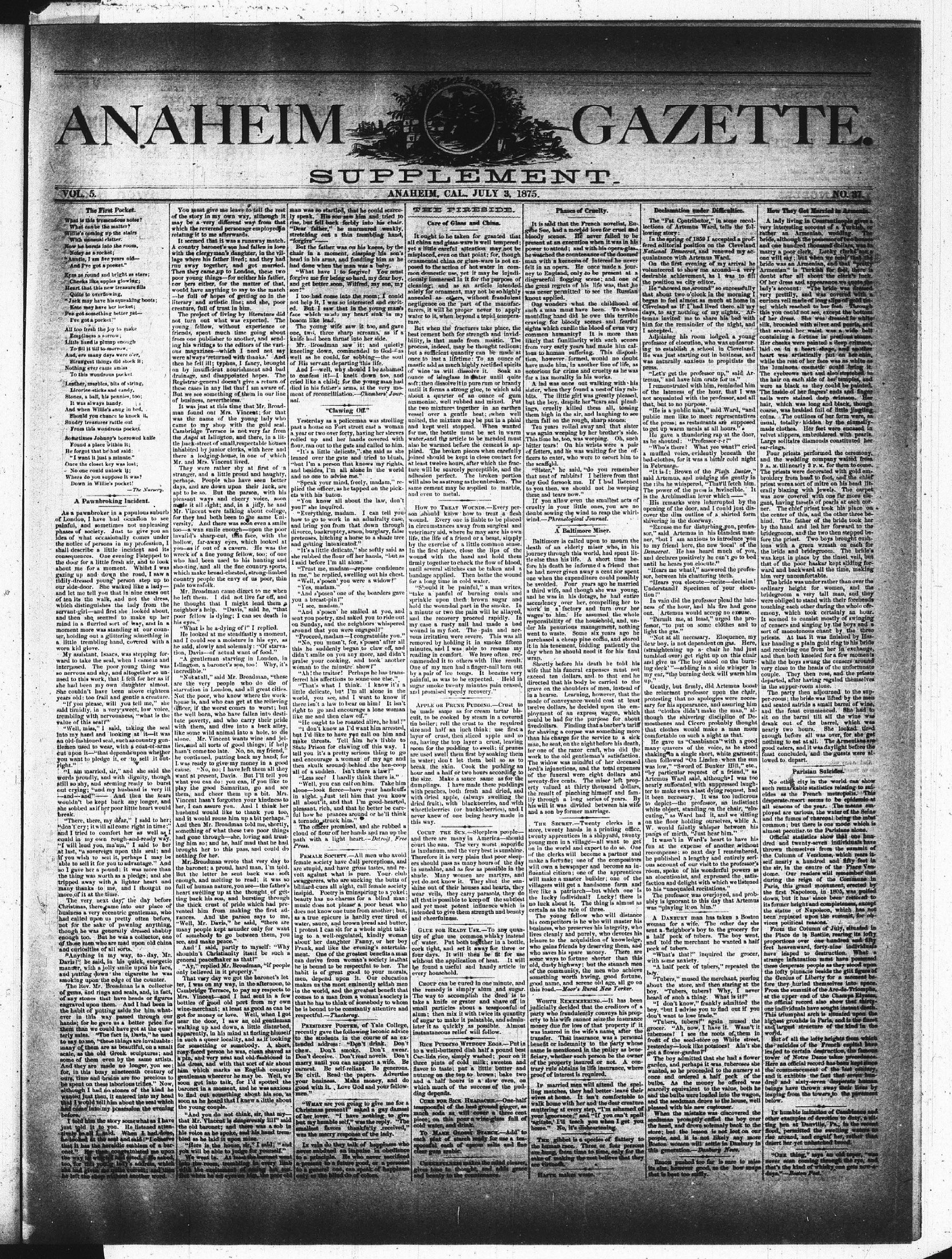
Searchable text
ANAHEIM
VOL. 5.
The First Pocket.
What is this tremendous noise?
What can be the matter?
Willie's coming up the stairs
With unusual clatter.
Now he bursts into the room,
Notey as a rocket;
"Annie, I am five years old—
And I've got a pocket."
Zynn as round and bright as stars;
Checks like apples glowing;
Heart that this new treasure fills
Quite to overflowing.
"Jack may have his squeaking boots;
Kate may have her locket;
Pwe got something better yet—
I've got a pocket!"
All too fresh the joy to make
Empliness a sorrow;
Little hand is plump enough
To fill it till to-morrow.
And, ere many days were over,
Strangest things did stock it;
Nothing ever came amiss
To this wondrous pocket.
Leather, marbles, bits of string,
Licorice sticks and candy.
Stones, a ball, his pennies, too;
It was always handy.
And when Willie's anug in bed,
Should you chance to knock it,
Sundry treasures rattle out
From this wondrous pocket.
Sometimes Johnny's borrowed knife
Found a place within it;
He forgot that he had said:
"I want it just a minute."
Once the closet key was lost;
You must give me leave to tell the rest
of the story in my own way, although it
may be a very different way from that
which the reverend personage employed in
relating it to me afterwards.
It seemed that it was a runaway match.
A country baronet's son had fallen in love
with the clergyman's daughter, in the village where his father lived; and they had run away together, and got married.
Then they came up to London, these two poor young things—for neither his fatlier, nor hers either, for the matter of that, would have anything to say to the match—the full of hopes of getting on in the literary and artistic line; and she, poor creature, full of trust in him.
The project of living by literature did not turn out what was expected. The young fellow, without experience or friends, spent much time going about from one publisher to another, and sending his writings to the editors of the various magazines—which I need not say were always returned with thanks.' And then he fell ill; typhus, I fancy, brought on by insufficient nourishment and bad drainage, and disappointed hopes. The Registrar-general doesn't give a return of these cases in any list that I am aware of. But we see something of them in our line of business, nevertheless.
It was just at this time that Mr. Broadman found out Mrs. Vincent: for that was the name of the young lady who came to my shop with the gold seal. Cambridge Terrace is not very far from the Angel at Islington, and there, in a little back-street of small, respectable houses inhabited by junior clerks, with here and there a lodging-house, in one of which Mr. and Mrs. Vincent lived.
They were rather shy at first of a man was so startled, that ly speak. His son saw rise, but fell back feeble "Dear father," he must stretching out a thin "forgive"——
But the father was on chair in a moment, care head in his arms, and for had done when the man "What have I to forgive me for being so bad and get better soon, Wilson!" I too had come into the not help it, I was so inted. But I saw that in face which made my bosom like lead.
The young wife saw one, two, three sharp knife had been thrust in Mr. Broadman saw kneeling down, comin well as he could, for so of His servant departing And I—well, why should confess it?—I knelt cried like a child; for th died in his father's armament of reconciliation-nal.
"Clawing"
Yesterday as a police past a house on Fort strata year or two over forty, rolled up and her ha flour, ran out to the gate "It's a little delicate leaned over the gate and but I'm a person that
A Pawnbroking Incident.
As a pawnbroker in a populous suburb of London, I have had occasion to see painful, and sometimes not unpleasing phases of society. Just to give you an idea of what occasionally comes under the notice of persons in my profession, I shall describe a little incident and its consequences. One evening I stepped to the door for a little fresh air, and to look about me for a moment. Whilst I was gazing up and down the road, I saw a tidily-dressed young person step up to our side-door. She walked like a lady—and let me tell you that in nine cases out of ten its the walk, and not the dress, which distinguishes the lady from the servant-girl—and first she looked about, and then she seemed to make up her mind in a flurried sort of way, and in a moment more was standing at our counter, holding out a glittering something in a little trembling hand, covered with a worn kid glove.
My assistant, Isaacs, was stepping forward to take the seal, when I came in and interposed. The poor young thing was so nervous and shy, and altogether so unused to this work, that I felt for her as if she had been my own daughter almost. She couldn't have been above eighteen years old: too frail and gentle a creature.
"If you please, will you tell me," she said timidly, in a very sweet, low voice, trembling with nervousness, "what is the value of this seal?"
"Well, miss," I said, taking the seal into my hand and looking at it—it was an old-fashioned seal, such as country gentlemen used to wear, with a coat-of-arms cut upon it—that depends upon whether you want to pledge it, or to sell it but right."
"I am married, sir," said she said the words proudly, and with dignity, though still so shy, and seeming ready to burst out crying; "and my husband is very ill—and—and" And then the tears wouldn't be kept back any longer, and she sobbed as if her poor little heart would break.
"There, there, my dear," I said to her; "don't cry; it will all come right in time;" and I tried to comfort her as well as I could in my own rough-and-ready way. "I will lend you, ma'am," I said to her at last, "a sovereign upon this seal; and if you wish to sell it, perhaps I may be able to sell it for you to advantage." And so I gave her a pound; it was more than the thing was worth as a pledge; and she tripped away with a lighter heart and many thanks to me, and I thought no
It was just at this time that Mr. Broadman found out Mrs. Vincent: for that was the name of the young lady who came to my shop with the gold seal. Cambridge Terrace is not very far from the Angel at Islington, and there, in a little back-street of small, respectable houses inhabited by junior clerks, with here and there a lodging-house, in one of which Mr. and Mrs. Vincent lived.
They were rather shy at first of a stranger, and a little proud and haughty, perhaps. People who have seen better days, and are down upon their luck, are apt to be so. But the parson, with his pleasant ways and cheery voice, soon made it all light; and, in a jiffy, he and Mr. Vincent were talking about college, for they had both been to the same University. And there was soon even a smile too—a wan smile enough—upon the poor invalid's sharp-cut, thin face, with the hollow, far-away eyes, which looked at you—as if out of a cavern. He was the wreck of a fine young fellow, too; of one who had been used to his hunting and shooting, and all the fine country sports, which make broad-heated, strong-limbed country people the envoy of us poor, thin pale townsfolk.
Mr. Broadman came direct to me when he left them. I did not live far off, and he thought that I might lend them a neighbor's help. "Davis," said he, "that poor fellow is dying; I can see death in his eyes."
"What is he a-dying of?" I replied.
He looked at me steadfastly a moment, and I could see a moisture in his eye, as he said, slowly and solemnly: "Of starvation, Davis—of actual want of food."
"A gentleman starving in London, in Islington, a baronet's son, too! Why, it's incredible."
"Not atall," said Mr. Broadman, "these are the very people who do die of starvation in London, and all great cities. Not the poor, who know where the workhouse is, and who can get at the relieving officer, if the worst comes to worst; but the well born, who have fallen into destitute poverty, and who carry their pride with them, and dive into a back alley, like some wild animal into a hole, to die alone. Mr. Vincent wants wine and jellies, and all sorts of good things; if help hasn't come too late. No, no, my friend," he continued, putting back my hand; for I was ready to give my money in a good cause. "No, no; I have left them all they want at present, Davis. But I'll tell you what you can do: you can, if you like to play the good Samaritan, go and see them, and cheer them up a bit. Mrs. Vincent hasn't forgotten your kindness to her. I can assure you. And I think her husband would like to thank you too, and it would rouse him up a bit perhaps." And then Mr. Broadman told me shortly, something of what these two poor things had gone through—the she loving and trusting him so; and he half mad that he had brought her to this pass, and could do nothing for her.
Mr. Broadman wrote that very day to the baronet; a proud, hard man. I'm told. But the letter he sent back was soft enough, and melting to read; it was so full of human nature, you see—the father's drainage, and disappointed hopes. The Registrar-general doesn't give a return of these cases in any list that I am aware of. But we see something of them in our line of business, nevertheless.
It was just at this time that Mr. Broadman found out Mrs. Vincent: for that was the name of the young lady who came to my shop with the gold seal. Cambridge Terrace is not very far from the Angel at Islington, and there, in a little back-street of small, respectable houses inhabited by junior clerks, with here and there a lodging-house, in one of which Mr. and Mrs. Vincent lived.
They were rather shy at first of a stranger, and a little proud and haughty, perhaps. People who have seen better days, and are down upon their luck are apt to be so. But the parson, with his pleasant ways and cheery voice, soon made it all light; and in a jiffy, he and Mr. Vincent were talking about college, for they had both been to the same University. And there was soon even a smile too—a wan smile enough—upon the poor invalid's sharp-cut, thin face, with the hollow, far-away eyes, which looked at you—as if out of a cavern. He was the wreck of a fine young fellow, too; of one who had been used to his hunting and shooting, and all the fine country sports, which make broad-heated, strong-limbed country people the envoy of us poor, thin pale townsfolk.
Mr. Broadman came direct to me when he left them. I did not live far off, and he thought that I might lend them a neighbor's help. "Davis," said he, "that poor fellow is dying; I can see death in his eyes."
"What is he a-dying of?" I replied.
He looked at me steadfastly a moment, and I could see a moisture in his eye as he said, slowly and solemnly: "Of starvation, Davis—of actual want of food."
"A gentleman starving in London, in Islington, a baronet's son, too! Why, it's incredible."
"Not atall," said Mr. Broadman, "these are the very people who do die of starvation in London, and all great cities. Not the poor, who know where the workhouse is,and who can get at the relieving officer,如果他来到了圣保罗市,他会去那里帮助那些需要帮助的人。他会去那里帮助那些需要帮助的人。他会去那里帮助那些需要帮助的人。他会去那里帮助那些需要帮助的人。他会去那里帮助那些需要帮助的人。他会去那里帮助那些需要帮助的人。他会去那里帮助那些需要帮助的人。他会去那里帮助那些需要帮助的人。他会去那里帮助那些需要帮助的人。他会去那里帮助那些需要帮助的人。他会去那里帮助那些需要帮助的人。他会去那里帮助那些需要帮助的人。他会去那里帮助那些需要帮助的人。他会去那里帮助那些需要帮助的人。他会去那里帮助那些需要帮助的人。他会去那里帮助那些需要帮助的人。他会去那里帮助那些需要帮助的人。他会去那里帮助那些需要帮助的人。他会去那里帮助那些需要帮助的人。他会去那里帮助那些需要帮助的人.他会去那里帮助那些需要帮助的人.他会去那里帮助那些需要helping人.他会去那里helping人.他会去那里helping人.她会去那里helping人.她会去那里helping人.她会去那里helping人.她会去那里helping人.她会去那里helping人.她会去那边helping人.她会去那边helping人.她会去那边helping人.她会去那边helping人.她会去那边helping人.她会去那边helping人.她会去那边helping人.她会去那边helping人.她会去那边helping人.她会去那边helping人.她会去那边helping人.她会去那边helping人.她会去那边helping人.她会去那边helping人.她会去那边helping人.她会去那边helping人.她会去那边helping人.她会去那边helping人.她会去那边helping人.她会去那边helping人.她会去那边helping人.她会去那边helping人.她会去那边helping人.她会去那边helping人.她会去那边helping人.她会去那边helping人.她会去那边helping人.她会去那边helping人.她会去那边helping人.她会去那边helping人.她会去那边helping人.她会去那边helping人.她会去那边helping人.她会去那边helping人.她会去那边helping人.她会去那边helping人.她会去那边helping人.她会去那边helping人.她会去那边helping人.她会去那边helping人.她会去那边helping人.她会去这边helping人.她会去这边helping人.她会去这边helping人.她会去这边helping人.她会去这边helping人.她会去这边helping人.她会去这边helping人.她会去这边helping人.她会去这边helping人.她会去这边helping人.她会去这边helping人.她会去这边helping人.她会去这边helping人.她会去这边helping人.她会去这边helping人.她会去这边helping人.她会去这边helping人.她会去这边helping人.她会去这边helping人.她会去这边helping人.她会去这边helping人.她会去这边帮着她,会去看她,会去看她,会去看她,会去看她,会去看她,会去看她,会去看她,会去看她,会去看她,会去看她,会去看她,会去看她,会去看她,会去看她,会去看她,会去看她,会去看她,会去看她,会去看她,会看看她,会看看她,会看看她,会看看她,会看看她,会看看她,会看看她,会看看她,会看看她,会看看她,会看看她,会看看她,会看看她,会看看她,会看看她,会看看她,会看看她,会看看她,会看看她,会看看她,会看看她,会看看她,会看看她,会看看她,会看看她,会看看她,会看看她,会看看她,会看看她,会看看她,会看看她,会看看她,会看看她,会看看她,会看看她,会看看她,会看看她,会看看她,会看看她,会看看她,会看看她,会看看她,会看看她,会看看她,会看看她,会看看她,会看看她,会看看她,会看看她,会来看看她,会看看她,会看看她,会看看她,会看看她,会看看她,会看看她,会看看她,会看看她,会看看她,会看看她,会看看她,会查看她,会查看她,会查看她,会查看她,会查看她,会查看她,会查看她,会查看她,会查看她,会查看她,会查看她,会查看她,会查看她,会查看她,会查看她,会查看她,会查看她,会查看她,会查看她,会查看她,会查看地,她会给她的礼物,送给她的礼物,送给她的礼物,送给她的礼物,送给她的礼物,送给她的礼物,送给她的礼物,送给她的礼物,送给她的礼物,送给她的礼物,送给她的礼物,送给她的礼物,送给她的礼物,送给她的礼物,送给她的礼物,送给她的礼物,送给她的礼物,送给她的礼物,送给她的礼物,送给她的礼物,送给她的礼物,送给她的礼物,送给她的礼物,送给她的礼物,送给她的礼物,送给她的礼物,送给她的礼物,送给她的礼物,送给她的礼物,送给她的礼物,送给她的礼物,送给她的礼物,送给她的礼物,送给她的礼物,送给她的礼物,送给她的礼物,送给她的礼物,送给她的礼物,送给她的礼物,送给她的礼物,送给她的礼物,送给她的礼物,送给她的礼物,送给她的礼物,送给她的礼物,送给她的礼物,送给她的礼物,送给她的礼物,送给她的礼物,送给她,给给她,给给她,给给她,给给她,给她们,给她们,给她们,给她们,给她们,给她们,给她们,给她们,给她们,给她们,给她们,给她们,给她们,给她们,给她们,给她们,给她们,给她们,给她们,给她们,给她们,给她们,给她们,给她们,给她们,给她们,给她们,给她们,给她们,给她们,给她们,给她们,给她们,给她们,给她们,给她们,给她们,给她们,给她们,给她们,给她们,给她们,给她们,给她们,给她们,给她们,给她们,给她们,给她们,给她们,给她们,给她们,给她们,给她们,给她们,给她们,给她们,给她们,给她们,给她们,给她们,给她们,给她们,给她们给她们给她们给她们给她们给她们给她们给她们给她们给她们给她们给她们给她们给她们给她们给她们给她们给她们给她们给她们给她们给她们给她们给她们给她们给她们给她们给她们给她们给她们给她们给她们给她们给她们给她们给她们给她们给她们给你们给你们给你们给你们给你们给你们给你们给你们给你们给你们给你们给你们给你们给你们给你们给你们给你们给你们给你们给你们给你们给你们给你们给你们给你们给你们给,你们给他们给他们给他们给他们给他们给他们给他们给他们给他们给他们给他们给他们给他们给他们给他们给他们给他们给他们给他们给他们给他们给他们让他们给他们.他们.他们.他们.他们.他们.他们.他们.他们.他们.他们.他们.他们.他们.他们.他们.他们.他们.他们.他们.他们.他们.他们.他们.他们.他们.他们.他们.他们.他们.他们.他们.他们.他们.他们.他们.他们.他们.他们.他们.他们.他们.他们.他们.他们.他们.他们.他们.他们.他们.他们.他们.他们.他们.他们.他们.他们.他们.他们.他们.他们.他们.他们.他们.他们.他们.他们.他.他.他.他.他.他.他.他.他.他.他.他.他.他.他.他.他.他.他.他.他.他.他.他.他.他.他.他.他.他.他.他.他.他.他.他.他.他.他.他.他.他.他.他.他.他.他.他.他.他.他.他.他.他.他.该.该.该.该.该.该.该.该.该.该.该.该.该.该.该.该.该.该.该.该.该.该.该.该.该.该.该.该.该.该.该.该.该.该.该.该.该.该.该.该.该.该.该.该.该.该.该.该。该。该。该。该。该。该。该。该。该。该。该。该。该。该。该。该。该。该。该。该。该。该。该。该。该。该。该。该。该。该。该。该。该。该。该。该。该。该。该。该。该.The.The.The.The.The.The.The.The.The.The.The.The.The.The.The.The.The.The.The.The.The.The.The.The.The.The.The.The.The.The.The.The.The.The.The.The.The.The.The.The.The.The.The.The.The.The.The.The.The.The.The.The.The.The>The>The>The>The>The>The>The>The>The>The>The>The>The>The>The>The>The>The>The>The>The>The>The>The>The>The>The>The>The>The>The>The>The>The>The>The>The>The>The>The>The>The>The>The>The>The>The>The>The>The>The>The>The>The>The>The>The>The>The>The>The>The>The>The>The>TheThe>TheTheTheTheTheTheTheTheTheTheTheTheTheTheTheTheTheTheTheTheTheTheTheTheTheTheTheTheTheTheTheTheTheTheTheTheTheTheTheTheTheTheTheTheTheTheTheTheTheTheTheTheTheTheTheTheTheTheTheTheTheTheTheTheTheTheTheTheTheTheTheTheTheTheTheTheTheTheTheTheTheTheTheTheTheThe TheThat TheThat TheThat TheThat TheThat TheThat TheThat TheThat TheThat TheThat TheThat TheThat TheThat TheThat TheThat TheThat TheThat TheThat TheThat TheThat TheThat TheThat TheThat TheThat TheThat TheThat The That The That The That The That The That The That The That The That The That The That The That The That The That The That The That The That The That The That The That The That The That The That The That The That The That The That The That The That The That The That The That The That The That The That The That The That The That The That The That The That THE THAT THE THAT THE THAT THE THAT THE THAT THE THAT THE THAT THE THAT THE THAT THE THAT THE THAT THE THAT THE THAT THE THAT THE THAT THE THAT THE THAT THE THAT THE THAT THE THAT THE THAT THE THAT THE THAT THE THAT THE THAT THE THAT THE THAT THE THAT THE THAT THE THAT THE THAT THE THAT THE THAT THE THAT THE THAT THE THAT THE THAT THE THAT THE THAT THE THAT THE THAT THE THAT THE THAT THE THAT THE THAT THE THAT THE THAT THE THAT THE THAT THE THAT THE ThAt ThAt ThAt ThAt ThAt ThAt ThAt ThAt ThAt ThAt ThAt ThAt ThAt ThAt ThAt ThAt ThAt ThAt ThAt ThAt ThAt ThAt ThAt ThAt ThAt ThAt ThAt ThAt ThAt ThAt ThAt ThAt ThAt ThAt ThAt ThAt ThAt ThAt ThAt ThAt ThAt ThAt ThAt ThAt ThAt ThAt ThAt ThAt ThAt ThAt ThAt ThAt ThAt ThAt thAt thAt thAt thAt thAt thAt thAt thAt thAt thAt thAt thAt thAt thAt thAt thAt thAt thAt thAt thAt thAlt thAlt thAlt thAlt thAlt thAlt thAlt thAlt thAlt thAlt thAlt thAlt thAlt thAlt thAlt thAlt thAlt thAlt thAlt thAlt thAlt thAlt thAlt thAlt thAlt thAlt thAlt thAlt thAlt thAlt thAlt thAlt thAlt thAlt thAlt thAlt thAlt thAlt thAlt thAlt thAlt thAlt thAlt thAlt thAlt thALT thALT thALT thALT thALT thALT thALT thALT thALT thALT thALT thALT thALT thALT thALT thALT thALT thALT thALT thALT thALT thALT thrALT thrALT thrALT thrALT thrALT thrALT thrALT thrALT thrALT thrALT thrALT thrALT thrALT thrALTER thrALTER thrALTER thrALTER thrALTER thrALTER thrALTER thrALTER thrALTER thrALTER thrALTER thrALTER thrALTER thrALTER thrALTER thrALTER thrALTER thrALTER thrALTER thrALTER thrALTER thrALTER thrALTER thrALTER thrALTER thrALTER thrALTER thrALTER thrALTER thrALTER thrALTER thrALTER thrALTER thrALTER thrALTER thrALTER thrALTER thrALTER thrALTER thrALTER thrALTER thrALTER thrALTER thrALTER thrALTER thrALTER thrALTER thrALTER thrALTER thrALTER thrALTER thrALTER thrALTER thrALTER thrALTER thrALTER thrALTER thrALTER thrALTER thrALTER thrALTER thrALTER thrALTER trALTERN trALTERN trALTERN trALTERN trALTERN trALTERN trALTERN trALTERN trALTERN trALTERN trALTERN trALTERN trALTERN trALTERN trALTERN trALTERN trALTERN trALTERN trALTERN trALTERN trALTERN trALTERN trALTERN trALTERN trALTERN trALTERN trALTERN trALTERN trALTERN trALTERN trALTERN trALTERN trALTERN trALTERN trALTERN trALTERN trALTERN trALTERN trALTERN trALTERN trALTERN trALTERN trALTERN trALTERN trALTERN trALTERN trALTERN trALTERN trALTERN trAlTERN trAlterntrAlterntrAlterntrAlterntrAlterntrAlterntrAlterntrAlterntrAlterntrAlterntrAlterntrAlterntrAlterntrAlterntrAlterntrAlterntrAlterntrAlterntrAlterntrAlterntrAlterntrAlterntrAlterntrAlterntrAlterntrAlterntrAlterntrAlterntrAlterntrAlterntrAlterntrAlterntrAlterntrAlterntrAlterntrAlterntrAlterntrAlterntrAlterntrAlterntrAlterntrAlterntrAlterntrAlterntrAlterntrAlterntrAlterntrAlterntrAlterntrAlterntr AlterntrAlterntrAlterntrAlterntrAlterntrAlterntrAlterntrAlterntrAlterntrAlterntrAlterntrAlterntrAlterntrAlterntrAlterntrAlterntrAlterntrAlterntrAlterntrAlterntrAlterntrAlterntrAlterntrAlterntrAlterntrAlterntrAlterntrAlterntrAlterntrAlterntrAlterntrAlterntrAlternt Altentrontrontrontrontrontrontrontrontrontrontrontrontrontrontrontrontrontrontrontrontrontrontrontrontrontrontrontrontrontrontrontrontrontrontrontrontrontrontrontrontrontrontrontrontrontrontrontrontrontrontrontrontrontrontrontrontrontrontrontrontrontrontrontrontrontrontrontrontrontrontrontrontrontrontrontrontrontrontrontrontrontrontrontrontrontrontrontrontrontronchronstonfonzonfonzonfonzonfonzonfonzonfonzonfonzonfonzonfonzonfonzonfonzonfonzonfonzonfonzonfonzonfonzonfonzonfonzonfonzonfonzonfonzonfonzonfonzonfonzonfonzonfonzonfonzonfonzonfonzonfonzonfonzonfonzonfonzonfonzonfonzonfonzonfonzonfonzonfonzonfonzonfonzonfonzonfonzonfonzonfonzonfonzionfonzonfonzonfonzonfonzonefonzonefonzonefonzonefenzonefenzonefenzonefenzonefenzonefenzonefenzonefenzonefenzonefenzonefenzonefenzonefenzonefenzonefenzonefenzonefenzonefenzonefenzonefenzonefenzonefenzonefenzonefenzonefenzonefenzonefenzonefenzonefenzonefenzonefenzonefenzonefenzonefenzonefenzonefenzonefenzonefenzonefenzonefenzonefenzonefenzonefenzonefenzonefen zone fenzonefen zonefen zonefen zoneifen zoneifen zoneifen zoneifen zoneifen zoneifen zoneifen zoneifen zoneifen zoneifen zoneifen zoneifen zoneifen zoneifen zoneifen zoneifen zoneifen zoneifen zoneifen zoneifen zoneifen zoneifen zoneifen zoneifen zoneifen zoneifen zoneifen zoneifen zoneifen zoneifen zoneifen zoneifen zoneifen zoneifen zoneifen zoneifen zoneifen zoneifen zoneifen zoneifen zoneifen zoneifen zoneifen zones fen Zone fen Zone fen Zone fen Zone fen Zone fen Zone fen Zone fen Zone fen Zone fen Zone fen Zone fen Zone fen Zone fen Zone fen Zone fen Zone fen Zone fen Zone fen Zone fen Zone fen Zone fen Zone fen Zone fen Zone fen Zone fen Zone fen Zone fen Zone fen Zone fen Zone fen Zone fen Zone fen Zone fen Zone fen Zone fen Zone fen Zone fen Zone fen Zone fen Zone fen Zone fen Zone fen Zone fen Fen Fen Fen Fen Fen Fen Fen Fen Fen Fen Fen Fen Fen Fen Fen Fen Fen Fen Fen Fen Fen Fen Fen Fen Fen Fen Fen Fen Fen Fen Fen Fen Fen Fen Fen Fen Fen Fen Fen Fen Fen Fen Fen Fen Fen Fen Fen Fen Fen Fen Fen Fen Fen Fen Fen Fen Fen Fen Fen Fen Fen Fen Fen Fen Fen Fen Fen Fen Fen Fen Fen Fen Fen Fen Fen Fen Fen Fen Fen Fen Fen Fen Fen Fen Fen Fen Fen Fen Fen Fen Fen Fen FEN FEN FEN FEN FEN FEN FEN FEN FEN FEN FEN FEN FEN FEN FEN FEN FEN FEN FEN FEN FEN FEN FEN FEN FEN FEN FEN FEN FEN FEN FEN FEN FEN FEN FEN FEN FEN FEN FEN FEN FEN FEN FEN FEN FEN FEN FEN FEN FENFENFENFENFENFENFENFENFENFENFENFENFENFENFENFENFENFENFENFENFENFENFENFENFENFENFENFENFENFENFENFENFENFENFЕНЕНЕНЕНЕНЕНЕНЕНЕНЕНЕНЕНЕНЕНЕНЕНЕНЕНЕНЕНЕНЕНЕНЕНЕНЕНЕНЕНЕНЕНЕНЕНЕНЕНЕНЕНЕНЕНЕНЕНененененененененененененененененененененененененененененененененененененененененененненненненненненненненненненненненненненненненненненненненненненненненненненненненненненненненненненненненненненненненненненненненненненненнеñññññññññññññññññññññññññññññññññññññññññññññññññññññññññññññññññññññññňňňňňňňňňňňňňňňňňňňňňňňňňňňňňůَََََََََََََََََََََََََََ́́́́́́́́́́́́́́́́́́́́́́́́́́́́́́́́́́́́́́́́́́́́́́́́́́②②②②②②②②②②②②②②②②②②②②②②②②②②②②②②②②②②②②②②②②②②②②②②②②②②②②②②②②②②②②②②②
"The officer promised cloud of flour of flour her path with a light her Press."
female society have cuu st against what is swaggerers rich brittle-cues all night,
female society have cuu st against what is swaggerers rich brittle-cues all night,
female society have cuu st against what is swaggerers
"There, there, my dear," I said to her; "don't cry; it will all come right in time;" and I tried to comfort her as well as I could in my own rough-and-ready way. "I will lend you, ma'am," I said to her at last, "a sovereign upon this seal; and if you wish to sell it, perhaps I may be able to sell it for you to advantage." And so I gave her a pound: it was more than the thing was worth as a pledge; and she tripped away with a lighter heart and many thanks to me, and I thought no more of it at the time.
The very next day, the day before Christmas, there came into our place of business a very eccentric gentleman, who had called upon us pretty often before, not for the sake of pawning anything, though he was generally dressed shabby enough too. But he was a collector, one of those men who are mad upon old china and curiosities of all sorts.
Anything in my way, to-day, Mr. Davis!" he said, in his quick, energetic manner, with a jolly smile upon his face, and putting down the cigarette he was smoking upon the edge of the counter.
The lev. Mr. Broadman is a collector of gems, and rings and seals, and in fact, of any stones that have heads or figures engraved upon them. And I had been in the habit of putting aside for him whatever in this way passed through our hands; for he gave us a better price for them than we could have got at the quarterly sales. "The fact is, Davis," he used to say to me, "these things are invaluable: many of them are as beautiful, on a small scale, as the old Greek sculptures; and some of them even by the same artists. And they are made no longer, you see; for in this busy nineteenth century of ours, time and brains are too precious to be spent on these laborious trifles." Now, although I had no stones of the kind he wanted just then, it entered into my head that I would tell him about the seal which had come into my possession the evening before.
I told him the story somewhat as I have just told it to you. He listened attentively as all I said. When I had done, he looked at the seal and said: "Love serve that it has the haraldie emblem of a baronet."
Her then congratulated me upon the way in which I had acted. He asked, too, for this young lady's address, which she had given me online course; and then he left the shop without another word.
Mr. Vincent hasn't forgotten your kindness to her, I can assure you. And I think her husband would like to thank you too, and it would rouse him up a bit perhaps."
And then Mr. Broadman told me, shortly, something of what these two poor things had gone through—she, loving and trusting him so; and he, half mad that he had brought her to this pass, and could do nothing for her.
Mr. Broadman wrote that very day to the baronet; a proud, hard man, I'm told. But the letter he sent back was soft enough, and melting to read; it was so full of human nature, you see—the father's heart swelling up at the thought of getting back his son, and bursting through the thick crust of pride which had prevented him from making the first advances. And the parson says to me, "Well, Mr. Davis," he said, "there are many people kept asunder only for want of somebody to go between them, you see, and make peace."
And I said, partly to myself: "Why shouldn't Christianity itself be such a general peacemaker as that!"
"Ay," replied Mr. Broadman, "if people only believed in it properly."
That vary day we got the baronet's letter, I was on my way, in the afternoon, to Cambridge Terrace, to pay my respects to Mrs. Vincent—and I had sent in a few bottles of good old port from my own wine merchant; at least as good as can be got for money or love. Well, when I got near the door, I saw an old gentleman walking up and down a little disturbed, apparently, in his mind at finding himself in such a queer locality, and as if looking for something or somebody. A short, rosy-faced person he was, clean shaved as a pin, and very neat and old-fashioned in his dress, and with that sort of air about him which marks an English country gentleman wherever he may be. Well, we soon got into talk, for I'd spotted the baronet in a moment, and he was anxious to find out something about his son, as soon as he heard that I knew a little about the young couple.
"And you do not think, sir, that my—that Mr. Vincent is dangerously ill!" said the old baronet; and there was a sob in his voice as he spoke, and his hand trembled as he laid it upon mine.
"Here is the house, sir," I said; "and you will be able to judge for yourself."
We went in. At least the baronet went into the room, trembling in every limb with the emplacement of senior his son. But when he set eyes on him, the poor old them, and cheer them up a bit. Mrs. Vincent hasn't forgotten your kindness to her, I can assure you. And I think her husband would like to thank you too, and it would rouse him up a bit perhaps."
And then Mr. Broadman told me, shortly, something of what these two poor things had gone through—she, loving and trusting him so; and he, half mad that he had brought her to this pass, and could do nothing for her.
Mr. Broadman wrote that very day to the baronet; a proud, hard man, I'm told. But the letter he sent back was soft enough, and melting to read; it was so full of human nature, you see—the father's heart swelling up at the thought of getting back his son, and bursting through the thick crust of pride which had prevented him from making the first advances. And the parson says to me, "Well, Mr. Davis," he said, "there are many people kept asunder only for want of somebody to go between them, you see,and make peace."
And I said partly to myself: "Why shouldn't Christianity itself be such a general peacemaker as that!"
"Ay," replied Mr. Broadman, "if people only believed in it properly."
That vary day we got the baronet's letter, I was on my way, in the afternoon, to Cambridge Terrace, to pay my respects to Mrs. Vincent—and I had sent in a few bottles of good old port from my own wine merchant; at least as good as can be got for money or love. Well, when I got near the door, I saw an old gentleman walking up and down a little disturbed, apparently, in his mind at finding himself in such a queer locality, and as if looking for something or somebody. A short, rosy-faced person he was,clean shaved as a pin,and very neat and old-fashioned in his dress,and with that sort of air about him which marks an English country gentleman wherever he may be. Well,we soon got into talk,for I'd spotted the baronet in a moment,and he was anxious to find out something about his son,as soon as he heard that I knew a little about the young couple.
"And you do not think, Sir,that my—that Mr. Vincent is dangerously ill!" said the old baronet; and there was a sob in his voice as he spoke,and his hand trembled as he laid it upon mine.
"Here is the house, Sir,”I said;“and you will be able to judge for yourself.”
We went in. At least the baronet went into the room,trembling in every limb with the emplacement of senior his son. But when he set eyes on him,the poor old them,and cheer them up a bit.Mrs. Vincent hasn't forgotten your kindness to her,I can assure you. And I think her husband would like to thank you too,and it would rouse him up a bit perhaps."
And then Mr. Broadman told me,shortly,something of what these two poor things had gone through—she,loving and trusting him so;and he,half mad that he had brought her to this pass,and could do nothing for her.
Mr. Broadman wrote that very day to the baronet; a proud,hard man,I'm told. But the letter he sent back was soft enough,and melting to read; it was so full of human nature,you see—the father's heart swelling up at the thought of getting back his son,and bursting through the thick crust of pride which had prevented him from making the first advances. And the parson says to me,"Well,Mr. Davis,”he said,“there are many people kept asunder only for want of somebody to go between them,你 see,和 make peace."
And I said partly to myself: "Why shouldn't Christianity itself be such a general peacemaker as that!"
"Ay," replied Mr. Broadman,“if people only believed in it properly.”
That vary day we got the baronet's letter,I was on my way,in the afternoon,to Cambridge Terrace,to pay my respects to Mrs. Vincent—and I had sent in a few bottles of good old port from my own wine merchant;at least as good as can be got for money or love。Well,when I got near the door,我 saw an old gentleman walking up and down,a little disturbed,apparently,在his mind at finding himself in such a queer locality,and as if looking for something or somebody.A short,rosy-faced person he was,清亮 shaved as a pin,and very neat and old-fashioned in his dress,and with that sort of air about him which marks an English country gentleman wherever he may be.Well,我们 got into talk,对于 I'd spotted the baronet in a moment,and he was anxious to find out something about his son,所以,当他 heard that 我 knew a little about the young couple。
"And you do not think, Sir,that my—that Mr. Vincent is dangerously ill!" said the old baronet; and there was a sob in his voice as he spoke,and his hand trembled as he laid it upon mine.
"Here is the house, Sir,”I said;“and you will be able to judge for yourself.”
We went in. At least the baronet went into the room,trembling in every limb with the emplacement of senior his son.But when he set eyes on him,the poor old them,and cheer them up a bit.Mrs. Vincent hasn't forgotten your kindness to her,I can assure you. And I think her husband would like to thank you too,and it would rouse him up a bit perhaps."
And then Mr. Broadman told me,shortly,something of what these two poor things had gone through—she,loving and trusting him so;and he,half mad that he had brought her to this pass,and could do nothing for her.
Mr. Broadman wrote that very day to the baronet; a proud,hard man,I'm told. But the letter he sent back was soft enough,and melting to read; it was so full of human nature,you see—the father's heart swelling up at the thought of getting back his son,and bursting through the thick crust of pride which had prevented him from making the first advances.And the parson says to me,"Well,Mr. Davis,”he said,“there are many people kept asunder only for want of somebody to go between them,你 sees,和 make peace."
And I said partly to myself: "Why shouldn't Christianity itself be such a general peacemaker as that!"
"Ay," replied Mr. Broadman,“if people only believed in it properly.”
That varies day we got the baronet's letter,I was on my way,in the afternoon,to Cambridge Terrace,to pay my respects to Mrs. Vincent—and I had sent in a few bottles of good old port from my own wine merchant;at least as good as can be got for money or love。Well,when I got near the door,我 saw an old gentleman walking up and down,a little disturbed,apparently,在his mind at finding himself in such a queer locality,and as if looking for something or somebody.A short,rosy-faced person he was,清亮 shaved as a pin,and very neat and old-fashioned in his dress,and with that sort of air about him which marks an English country gentleman wherever he may be.Well,我们 got into talk,对于 I'd spotted the baronet in a moment,and he was anxious to find out something about his son,所以,当他 heard that 我 knew a little about the young couple。
"And you do not think, Sir,that my—that Mr. Vincent is dangerously ill!" said the old baronet; and there was a sob in his voice as he spoke,and his hand trembled as he laid it upon mine.
"Here is the house, Sir,”I said;“and you will be able to judge for yourself.”
We went in. At least the baronet went into the room,trembling in every limb with the emplacement of senior his son.But when he set eyes on him,the poor old them,and cheer them up a bit.Mrs. Vincent hasn't forgotten your kindness to her,I can assure you. And I think her husband would like to thank you too,and it would rouse him up a bit perhaps."
IM GAZ
SUPPLEMENT.
ANAHEIM, CAL., JULY 3, 1875.
man was so startled, that he could scarcely speak. His son saw him and tried to rise, but fell back feebly into his chair. "Dear father," he murmured weakly, stretching out a thin trembling hand, "forgive"——
But the father was on his knees, by the chair in a moment, clasping his son's head in his arms, and fondling him as he had done when the man was a baby.
"What have I to forgive? You must forgive me for being so hard, my dear boy, and get better soon, Wilfred, my son, my son!"
I too had come into the room; I could not help it, I was so interested and excited. But I saw that in the young man's face which made my heart sink in my bosom like lead.
The young wife saw it too, and gave one, two, three sharp screams, as if a knife had been thrust into her side.
Mr. Broadman saw it; and quietly kneeling down, commended to God—as well as he could, for sobbing—the soul of His servant departing this life.
And I—well, why should I be ashamed to confess it? I knelt down too, and cried like a child; for the young man had died in his father's arms, at the very moment of reconciliation.—Chambers' Journal.
"Clawing Off."
Yesterday as a policeman was strolling past a house on Fort street east a woman a year or two over forty, having her sleeves rolled up and her hands covered with flour, ran out to the gate and called to him.
"It is a little delicate," she said as she leaned over the gate and tried to blush, "but I'm a person that knows my rights, and has always all alone in the world."
THE FIRESIDE.
Care of Glass and China.
It ought to be taken for granted that all china and glass-ware is well tempered; yet a little careful attention may not be misplaced, even on that point; for, though ornamental china or glass-ware is not exposed to the action of hot water in common domestic use, yet it may be injudiciously immersed in it for the purpose of cleaning; and as an article intended solely for ornament, may not be so highly annealed as others, without fraudulent negligence on the part of the manufacturers, it will be proper never to apply water to it, when beyond a tepid temperature.
But when the fractures take place, the best cement both for strength and invisibility, is that made from mastic. The process, indeed, may be thought tedious; but a sufficient quantity can be made at once to last a lifetime: To an ounce of mastic add as much highly rectified spirits of wine as will dissolve it. Soak an ounce of isinglass in water until quite soft; then dissolve it in pure rum or brandy until it forms a strong glue, to which add about a quarter of an ounce of gum ammoniac, well rubbed and mixed. Put the two mixtures together in an earthen vessel over a gentle heat; when well united, the mixture may be put in a phial and kept well stopped. When wanted for use, the bottle must be set in warm water—and the article to be mended must also be warmed before the cement is applied. The broken pieces when carefully joined should be kept in close contact for at least twelve hours, after which the fracture will be scarcely perceptible and the
Phases of Cruelty.
It is said that the French novelist, Eugene Sue, had a morbid love for cruel and bloody scenes. He never failed to be present at an execution when it was in his power to attend; and with his opera-glass he watched the countenance of the doomed man with a keenness of interest he never felt in an opera. He once made a journey to England, only to be present at a disgraceful flogging scene; and one of the great regrets of his life was, that he was never permitted to see the Russian knout applied.
Ong wonders what the childhood of such a man must have been. To whose moulding hand did he owe this terrible craving for bloody scenes and fearful sights which curdle the blood of even very common humanity! It is more than likely that familiarity with such scenes from very early years had made him callous to human suffering. This disposition, however formed, would no doubt have made him, in another line of life, as notorious for crime and cruelty as he was for a lax morality in his works.
A lad was once out walking with his sister, when they found a nest of tiny rabbits. The little girl was grently pleased, but the boy, despite her tears and pleadings, cruelly killed them all, tossing them high in the air, and laughing to see them fall on the rough, sharp stones:
Ten years rolled away and that sister was again weeping by her brother's side. This time he, too, was weeping. Oh, such bitter tears! On his wrists were a pair of fetters, and he was waiting for the officers to enter, who were to escort him to the scaffold.
The "Fat" lections of lowing stock. In the apical edifice National Museum quaintance. On the first volunteer desirable at the position. He "show" that about eight began to feel Cleveland days; to say temus invite him for the accepted. Adjoining professor ofology. He was just was natural press.
"Let's get temus," and I remonstrate of the late not acquainted that, but to "He is a public member of the press to get up with." He gave as he shouted: "Who's't a muffled bed-clothes in February."
"Clawing Off."
Yesterday as a policeman was strolling past a house on Fort street cast a woman a year or two over forty, having her sleeves rolled up and her hands covered with flour, ran out to the gate and called to him.
It's a little delicate," she said as she leaned over the gate and tried to blush, "but I'm a person that knows my rights, and besides, I'm all alone in the world and no one to advise me."
Speak your mind, freely, madam," replied the officer, as he tapped on the pickets with his baton.
You know all about the law, don't you?" she inquired.
Everything madam. I can tell you how to go to work in an admiralty case, and bring you from that down through divorce, bankruptcy, arson, burglary, false pretenses, hitching a horse to a shade tree and getting intoxicated."
It is a little delicate," she softly said as she rubbed the flour off her hands, "but as I said before I'm all alone."
Trust me, madam—repose confidence in me," he replied, swelling out his chest.
Well, s'posen you were a widow?
Yes, madam.
And s'posen' one of the boarders gave you a breast-pin!
I see, madam.
And s'posen' he smiled at you, and sent you poetry, and asked you to ride out on Sunday, and the neighbors whispered around that you were engaged?
Proceed, madam—I congratulate you.
No, you mumn't, for s'posen' after all this he suddenly began to claw off, and didn't smile on you any more, and didn't praise your cooking, and took another woman to the minstre show?
Ah! the traitor! Perhaps he has transferred his affections to some-one else.
That's what I think. I know it's a little delicate, but I'm all alone in the world, you see, and I want to know if there isn't a law to bear on him? It isn't right to go and encourage a lone woman like me and then claw off.
He ought to be roasted alive, he had!
I don't know as I'd want him arrested, but I'd like to have you call on him and make threats. Tell him he's liable to State Prison for clawing off this way. I tell you it's a pretty serious thing to go and encourage a woman of my age and then skulk around behind the hen-coop all of a sudden. Isn't there a law?
Less see? I hardly think there is.
Well, you can call on him. Take him alone—look fierce—have your handcuffs in sight. Just tell him that you know all about it, and that I'm good-hearted, pleasant, rich, and that he better be careful how he prances around or he'll think a tornado struck him.
The officer promised, and she rubbed a cloud of flour off her hands and ran up the path with a light heart. Detroit Free Press.
Female Society. All men who avoid female society have dull perceptions, and are stupid, and have gross tastes, and revolt against what is pure. Your club swaggerers, who are sucking the butts of billiard-cues all night, call female society of wine as will dissolve it. Soak an ounce of laising glass in water until quite soft; then dissolve it in pure rum or brandy until it forms a strong glue, to which add about a quarter of an ounce of gum ammoniac, well rubbed and mixed. Put the two mixtures together in an earthen vessel over a gentle heat; when well united, the mixture may be put in a phial and kept well stopped. When wanted for use, the bottle must be set in warm water, and the article to be mended must also be warmed before the cement is applied. The broken pieces when carefully joined should be kept in close contact for at least twelve hours, after which the fracture will be scarcely perceptible, and the adhesion perfect. The broken portion will also be as strong as the unbroken. The same cement may be applied to marble, and even to metal.
How to Treat Wounds. Every person should know how to treat a flesh wound. Every one is liable to be placed in circumstances away from surgical and veterinary aid, where he may save his own life, the life of a friend or a beast, simply by the exercise of a little common sense. In the first place, close the lips of the wound with the hand and hold them firmly together to check the flow of blood, until several stitches can be taken and a bandage applied. Then bathe the wound for a long time in cold water.
Should it be painful," a man writes, "take a panful of burning coals and sprinkle upon their brown sugar and hold the wounded part in the smoke. In a minute or two the pain will be allayed, and the recovery proceed rapidly. In my case a rusty nail had made a bad wound in my foot. The pain and nervous irritation were severe. This was all removed by holding it in smoke fifteen minutes, and I was able to resume my reading in comfort. We have often recommended it to others with like result. One of my men had a finger-nail torn out by a pair of ice tongs. It became very painful, as was to be expected. Held in sugar smoke twenty minutes pain ceased, and promised speedy recovery."
Apple or Prune Pudding. Crust to be made same as for cream tartar biscuit, to be cooked by steam in a covered tin boiler; roll the crust to the required size and half an inch think; use first a layer of crust, then sliced apple and so on, having the top layer a crust, leaving room for the pudding to swell; if prunes are used swell them first by soaking them in water; don't let them boil so as to break the skin. Cook the pudding an hour and a half or two hours according to the size. Make a sauce same as for the dumplings. I have made these puddings with peaches, both fresh and dried, and with dried apple (always swelling the dried fruit), with blackberries, and with whortleberries (or huckleberries), and I never knew of one being heavy made in this way.
Court The Sun. Sleepless people—and there are many in America—should court the sun. The very worst soporific is laudanum, and the very best is sunshine. Therefore it is very plain that poor sleepers should pass as many hours of the day in sunshine, and as few as possible in the shade. Many women are martyrse,and yet do not know it. They slut the sunshine out of their houses and hearts,they notorious for crime and cruelty as he was for a lax morality in his works.
A lad was once out walking with his sister, when they found a nest of tiny rabbits. The little girl was greatly pleased, but the boy, despite her tears and pleadings,cruelly killed them all,tossing them high in the air,and laughing to see them fall on the rough sharp stones:
Ten years rolled away and that sister was again weeping by her brother's side. This time he, too, was weeping. Oh such bitter tears! On his wrists were a pair of fetters,and he was waiting for the officers to enter,who were to escort him to the scaffold.
"Sister," he said,"do you remember that nest of rabbits? I believe from that day God forsook me. If I had listened to you then,the we should not be weeping these sad tears now."
If you allow even the smallest acts of cruelty in your little ones,你 are no doubt sowing the wind to reap the whirlwind.—Phrenological Journal.
A Baltimore Miser.
Baltimore is called upon to mourn the death of an elderly miser who,在 his journey through this world,had spent little else than his life.A short time before his death he informed a friend that he had never given away a cent nor spent one when the expenditure could possibly be avoided.Four years ago he married a third wife,and though she was young,and he was in his dotage,had entire ascendency over her compelling her to work in a factory and turn over her wages to him.He assumed the whole responsibility of the household,and under his penurious management,nothing went to waste.Some six years ago he purchased a cheap pine coffin,and stored it in his tenement,bidding patiently the day when he should need it for his final wrap.
Shortly before his death he told his wife that his funeral expenses must not exceed ten dollars,and to that end he directed that his body be carried to the grave on the shoulders of men,introduced in a hearse.Learning,hhowever,the mode of conveyance would cost at least twelve dollars,他 decided upon the employment of an express wagonwhich could be had for the purpose for about fivedollars.Finding that a barber's tariff for shaving a corpse was something than his charge for the service to a sick man,Hes sent.on the night before his death.for one of the razor craft,谁 did the work to the old gentleman's satisfaction.The widow was mindful of her deceased lord's injunctions,and the total expenses of the funeral were eight dollarsand seventy-five cents.The miser left property valued at thirty thousand dollars,the result of pinching himself and family through a long series of years.By his will it was divided between his wife and a son by former marriage.
The Secret—Twenty clerks in a store,twenty hands in a printing office,twenty apprentices in a shipyard,twenty young men in a village-all want to get on in the world and expect to do so.One of the clerks will become a partner and make a fortune;one of the compositors will own a newspaper and become an influential citizen;one of the apprentices will make a master builder;one of the villagers will get a handsome farm and enjoy their life."
FEMALE SOCIETY.—All men who avoid female society have dull perceptions, and are stupid, and have gross tastes, and revolt against what is pure. Your club swaggerers, who are sucking the butts of billiard-cues all night, call female society insipid. Poetry is uninspiring to a yokel; beauty has no charms for a blind man; music does not please a poor beast who does not know one tune from another; but, as a true epicure is hardly ever tired of water, sauce, and brown bread and butter, I protest I can sit for a whole night talking to a well-regulated, kindly woman about her daughter Fanny, or her boy Frank, and like the evening's entertainment. One of the greatest benefits a man can derive from woman's society is that he is bound to be respectful to her. The habit is of great good to your morals, men, depend upon it. Our education makes us the most eminently selfish men in the world, and the greatest benefit that comes to a man from a woman's society is that he has to think of somebody to whom he is bound to constantly attentive and respectful.—Thackeray.
PRESIDENT PORTER, of Yale College, recently gave the following laconic advice to the students in the course of an extended address: "Don't drink. Don't chew. Don't smoke. Don't swear. Don't deceive. Don't read novels. Don't marry until you can support a wife. Be earnest. Be self-reliant. Be generous. Be civil. Read the papers. Advertise your business. Make money, and do good with it." Love God and your fellowmen."
"What are you going to give me for a Christmas present?" asked a gay damselflower of her lower. "I have nothing to give but my humble self," was the reply. "The smallest favors thankfully received," was the merry response of the lady.
In vain do they talk of happiness who never subdued an impulse in oblivience to a principle. He who never sacrificed a present to a future good, or a personal to a general one, can speak of happiness only as the blind do of color.
COURT THE SUN.—Sleepless people—and there are many in America—should court the sun. The very worst soporific is laudanum, and the very best is sunshine. Therefore it is very plain that poor sleepers should pass as many hours of the day in sunshine, and as few as possible in the shade. Many women are martyrs, and yet do not know it. They shut the sunshine out of their houses and hearts, they wear vells, they carry parasols, they do all that is possible to keep off the subtlest and yet most potent influence which is intended to give them strength and beauty and cheerfulness.
GLUE FOR READY USE.—To any quantity of glue use common whisky instead of water. Put both together in a bottle, cork tight, and set it away for three or four days. It will then be fit for use without the application of heat. It will be found a useful and handy article in every household.
CHOP can be cured in one minute, and the remedy is simply alum and sugar. The way to accomplish the deed is to take a knife or grater and shave off in small particles about a teaspoonful of alum; then mix it with twice its quantity of sugar to make it palatable, and administer it as quickly as possible. Almost instantaneous relief will follow.
RICE PUDDING WITHOUT Eggs.—Put in to a well-buttered dish half a pound best Canlida rice, simply washed; pour on it three pints of cold milk; sweeten and flavor to taste; put a little butter and nutmeg on the top to brown; bake two and a half hours in a slow oven, on which much of the success of the pudding depends.
CURE FOR SICK HEADACHEN.—One-half teaspoonful of the best ground ginger, as much soda as will cover a three cent piece; on this pour a wine-glass full of cold water, and drink.
TO MAKE GLOUS STARCH.—Add to each pint of starch ready for use a teaspoonful each of spoon salts and fine clear gum arabi.
CREAMWAXES makes the mind clearer, gives time to thought, and adds grace and beauty to the countenance.
THE SECRET.—Twenty clerks in a store, twenty hands in a printing office, twenty apprentices in a shipyard, twenty young men in a village—all want to get on in the world and expect to do so. One of the clerks will become a partner and make a fortune; one of the compositors will own a newspaper and become an influential citizen; one of the apprentices will make a master builder; one of the villagers will get a handsome farm and live like a patriarch—but which one is the lucky individual? Lucky! there is no luck about it. The thing is almost as certain as the rule of three.
The young fellow will distance his competitors is he who will master his business, who preserves his integrity, who lives cleanly and purely, who devotes his leisure to the acquisition of knowledge, who gains friends by deserving them, and who saves his spare money. There are some ways to fortune shorter than this old, dusty highway; but the staunch men of the community, the men who achieve something worth having, good fortune, good name, and serene old age, all go on this road.—Moor's Rural New Yorker.
WORTH REMEMBERING.—It has been judicially decided that the creditors of a party who fraudulently conveys his property to his wife cannot seize the insurance money due for loss of that property if it was insured in the wife's name after the transfer. That insurance was a personal benefit or indemnity to the party whose name is mentioned in the policy as beneficiary, whether such person be the owner of the property insured or not. A contrary rule obtains in life insurance, where proof of interest is required.
If married men will attend the spelling matches, they had better leave their wives at home. It isn't comfortable to walk home with her and the dear creature muttering at every step, "I'm ashamed of your ignorance;" and "If you can't spell 'agitate,' I'll teach you when I get you home." No, it's disheartening.
The gibbet is a species of flattery to the human race. Three or four persons are hung from time to time only for the sake of making the rest believe that they are virtuous.
HARTE makes waste.
GAZETTE.
NO. 27.
Declaration under Difficulties.
The "Fat Contributor," in some recollections of Artemus Ward, tells the following story:
In the spring of 1859 I accepted a profiled editorial position on the Cleveland National Democrat, and renewed my acquaintance with Artemus Ward.
On the first evening of my arrival he volunteered to show me around—a very desirable achievement, as I was to fill the position as city editor.
He "showed me around" so successfully that about two o'clock in the morning I began to feel almost as much at home in Cleveland as if I had lived there all my days, to say nothing of my nights. Artemus invited me to share his bed with him for the remainder of the night, and I accepted.
Adjoining his room lodged a young professor of clocution, who was endeavoring to establish a school in Cleveland. He was just starting out in business, and was naturally anxious to propitiate the press.
"Let's get the professor up," said Artemus, and have him orate for us.
I remonstrated with him, reminded him of the lateness of the hour, that I was not acquainted with the professor, and all that, but to no purpose.
"He is a public man," said Ward, "and public men like to meet representatives of the press; as restaurants are supposed to get up warm meals at all hours."
He gave a thundering rap at the door, as he shouted: "Professor-r-r-i"
"Who's there? What yee want?" cried a muffled voice, evidently beneath the bed-clothes, for it was a bitter cold night in February.
How They Get Married in Armenia.
A lady living in Constantinople gives a very interesting account of a Turkish or rather an Armenian wedding. The bride, although the possessor of two husbands and one hundred thousand dollars, was to marry a poor clerk. Lucky clerk son one will say; but when we read that the bride was an Armenian, and that "pretty Armenian" is Turkish for fool, there is doubt after all about the clerk's luck. Of her dress and appearance we quote the lady's account: "The bride was dressed very prettily, and was covered with a curious veil made of long slips of gold tinsel which reached to her feet. Through this you could not see, except the bottom of her dress. She was dressed in white silk, brocaded with silver and pearls, and that around her waist was a wide belt containing a fortune in precious stones. Her cheeks were painted a deep crimson, laid on in a heart shape, and another heart was artistically put on her chin, while the rest of her face was as white as the luminous cosmetic could bring it. The eyebrows met and also strained to the hair on each side of her temples, and were as black as they could be painted. The inside of her fingers ends and finger nails were stained deep crimson. Her hair, which was long and black, though coarse, was braided full of little jingling colns. The outlines of her form were, as usual, totally hidden by the elumally-made clothes. Her feet were encased in velvet slippers, embroidered with pearls. Large solitaire diamonds constituted her ear-rings.
Four priests performed the ceremony, and the wedding company waited from 9 A.M. till nearly 2 P.M. for them to come.
"Let's get the professor up," said Artemus, and have him orate for us.
I remonstrated with him, reminded him of the lateness of the hour, that I was not acquainted with the professor, and all that, but to no purpose.
He is a public man," said Ward, "and public men like to meet representatives of the press; as restaurants are supposed to get up warm meals at all hours."
He gave a thundering rap at the door, as he shouted: "Professor-r-r!"
Who's there? What yee want?" cried a muffled voice, evidently beneath the bed-clothes, for it was a bitter cold night in February.
"It is I; Brown of the Plain Dealer," said Artemus, and nudging the gently in the ribs he whispered, "That'll fetch him. The power of the press is invincible. It is the Archimedean lever which——"
His remarks were interrupted by the opening of the door, and I could just discover the dim outline of a shirted form shivering in the doorway.
"Excuse me for disturbing you, professor," said Artemus in his blandest manner, "but I am anxious to introduce you to my friend here, the new 'local' of the Democrat. He has heard much of you, and declares positively he can't go to bed until he hears you elocute."
"Hears me what?" answered the professor, between his chattering teeth.
"Hears you elocute—recite—declaim! Understand? Specimen of your elocation!"
In vain did the professor plead the lateness of the hour, and his fire had gone out. Artemus would accept no excuse.
"Permit me, at least," urged the professor, "to put on some clothes and to light the gas."
"Not at all necessary. Eloquence, my dear boy, is not dependent on gas. Here, (straightening up a chair he had just tumbled over) get right up on this chair and give us 'The boy stood on the burning deck'"—adding in a side whisper in my ear, "the burning deck will warm him up."
Gently, but firmly, did Artemus boost the reluctant professor upon the chair, protesting that no apologies were necessary for his appearance, and assuring him that "clothes didn't make the man," although the shivering discipline of Demosthenes and Cicero probably thought that clothes would make a man more comfortable on such a night as that.
He gave us "Cassabianca" with a good many quavers of the voice, as he stood shaking in a single short, white garment; then followed "On Linden when the sun was low," "Sword of Bunker Hill," etc., by particular request of a friend," as Artemus Ward said, although I was too nearly suffocated with suppressed laughter to make even a last dying request, had it been necessary. It was too ludicrous to depict—the professor, an indistinct white object, standing on the chair, "elocuting," as Ward had it, and we sitting on the floor holding ourselves, while A. W. would faintly whisper between his pangs of mirth. "Just hear him."
It wasn't in Ward's heart to have his fun at the expense of another without recompense; so next day I remembered, he published a lengthy and entirely serious account of our visit to the professor's room, spoke of his wonderful powers as an elocutionist, and expressed the satisfaction and delight with which we listened to his "unnealed recitations."
The eyebrows met and also stretched to the hair on each side of her temples, and were as black as they could be painted. The inside of her fingers' ends and finger nails were stained deep crimson. Her hair, which was long and black, though coarse, was braided full of little jingling colons. The outlines of her form were, as usual, totally hidden by the clumsily-made clothes. Her feet were encased in velvet slippers, embroidered with pearls. Large solitaire diamonds constituted her ear-rings.
Four priests performed the ceremony, and the wedding company waited from 9 A.M. till nearly 2 P.M. for them to come. The priests were decorated with gold embroidery from head to foot, and the chief priest wore a sort of mitre on his head literally blazing with jewels. The carpet was now covered with one far more elegant, having tassels of pearls at each corner. The chief priest took his place on the center of this, and the other three behind. The father of the bride took her by the hand and led her forward to the bridegroom, and the two then stepped before the priest. Two boys brought cushions with a green wreath on each for the bride and bridegroom. The bride's was kept in place by the tinsel veil, but that of the poor haskar kept sliding forward and backward all the time, making him very uncomfortable.
The bride was under rather than over the ordinary height for women, and the bridgroom a very tall man, and they were obliged to stand with their foreheads touching each other during the whole ceremony, which took certainly an hour. It seemed to consist mostly of swinging of censors and singing by the boys and a sort of monotonous chant by the three priests. At last it was finished by Haskar handling a plain gold ring to his bride and receiving one from her in exchange, and then both kneeled for a few moments while the boys swung the censors around very close to the heads of the unfortunate couple. They then rose, and the priests departed, after having regaled themselves in the supper-room alone.
The party then adjourned to the supper-room; the bride was lifted by the men and seated astride a small barrel of wine, and the feast commenced. She had to sit on the barrel till all the wine was drank out of the barrel, which was nearly two hours. She looked tired enough before all was over, for she got nothing to eat at all. The Armenians are good eaters, and it was daylight before the feast concluded, and the guests were allowed to depart.
Parisian Suicides.
No other city in the world can show such remarkable statistics relating to suicides as the French metropolis. This desperate resort seems to be epidemic at all seasons of the year. The means employed are various; the water of the Seine and the fumes of charcoal being the most common; but there is one mode which is almost peculiar to the Parisians alone.
Official statistics show that one hundred and twenty-seven individuals have thrown themselves from the summit of the Column of Vendome, which tears itself nearly a hundred and fifty feet in the air, in the centre of the Place Vendome. Our readers will remember that during the reign of the Commune in Paris, this grand monument, erected by
who will distance to will master his integrity, who who devotes his man of knowledge, serving them, and they. There are shorter than this the staunch men men who achieve good fortune, old age, all go on New Yorker.
It has been the creditors of a convoys his proprise the insurance that property if it name after the party whose policy as benefactor be the owner or not. A con- insurance, where tend the spell-better leave their comfortable to the dear creature "I'm ashamed of if you can't spell when I get you pertaining."
Les of flattery to or four persons time, only for the believe that they ter to make even a fast dying request, but it been necessary. It was too ludicrous to depict—the professor, an indistinct white object, standing on the chair, "elocuting," as Ward had it, and we sitting on the floor holding ourselves, while A. W. would faintly whisper between his pangs of mirth, "Just hear him."
It wasn't in Ward's heart to have his fun at the expense of another without recompense; so next day I remembered, he published a lengthy and entirely serious account of our visit to the professor's room, spoke of his wonderful powers as an elocutionist, and expressed the satisfaction and delight with which we listened to his "unequaled recitations."
The professor was overjoyed, and probably is ignorant to this day that Artemus was "playing it on him."
A Danbury man has taken a Boston woman for a wife. The other day she sent a neighbor's boy to the grocery for a half peck of tubers. The boy went, and told the merchant he wanted a half peck of tubers.
"What's that?" inquired the grocer, with some anxiety.
"A half peck of tubers," repeated the boy.
"Tubers," mused the merchant, peering about the store, and then staring at the boy. "Tubers, tubers? Why, I never heard of such a thing. What is it?"
"I don't know," frankly admitted the boy, "but I advise you to find out if you don't want to lose trade."
"Tubers, tubers?" again mused the grocer. "Ah, now, I have it. Wasn't it tuberoses? I see the roots of them in profit of the seed-store on White street, yesterday—look like potatoes? Ain't she got a flower-garden?"
The boy admitted that she had a flower garden, and perhaps it was tuberoses she wanted, so he proceeded to the nursery at once and ordered a half peck of the bulbs. As the money he offered was scarcely equivalent to the value, both he and the bulbs were loaded into the wagon, and the seedsman drove to the house, well pleased with his new customer.
When the mistake was discovered the seedsman promptly cuffed the boy over the head, and drove solemnly back to the store; but the lesson is not lost on our people, and it is not likely any more Boston women will settle in Danbury in this generation—Danbury News.
Inon pushed too far is sure to miss its aim, however good, as the how snaps that is heat too stiffly.
Official statistics show that one hundred and twenty-seven individuals have thrown themselves from the summit of the Column of Vendome, which rears itself nearly a hundred and fifty feet in the air, in the centre of the Place Vendome. Our readers will remember that during the reign of the Commune in Paris, this grand monument erected by the first Napoleon, in 1805, was pulled down, but it has since been restored to its former height and completeness, except the statue of Napoleon, which has not been replaced upon the summit, for obvious political reasons.
From the Column of July, situated in the Place de la Bastile, rearing its lofty proportions over one hundred and fifty feet heavenward, forty-nine individuals have leaped to destruction. What a strange infatuation must have penned these desperate people as they stood upon the lofty pinnacle beside the gilt figure of the Genius of Liberty for a moment before they hurled themselves into space. From the summit of the Arc-de-Triomphe, at the upper end of the Champs Elysees, the official record also show that thirty-one individuals have sought instant death. This triumphal arch is situated upon the highest groundhds in Paris, and is the finest and largest structure of the kind in the world.
But of all the lofty heights from which the suicides of the French capital have leaped to certain destruction, the famous tower of Notre Dame takes precedence. Here an official record has been kept since the commencement of the last century, and it exhibits the fact that seven hundred and sixty-seven desperate human beings have thrown away their lives by leaping from the towers to the pavement below.
In humble imitation of Damblenan and other examples of devotion to duty, a sitting hen at Danville, Pa., in the recent flood, permitted the swelling waters to rise around, and engulf her, rather than desert her yet unhatched broad.
"One thing," says an old teper, "was never seen coming through the rye, and that's the kind of whisky one gets now-a-day."—Boston Post.