anaheim-gazette 1875-06-12
Scanned page
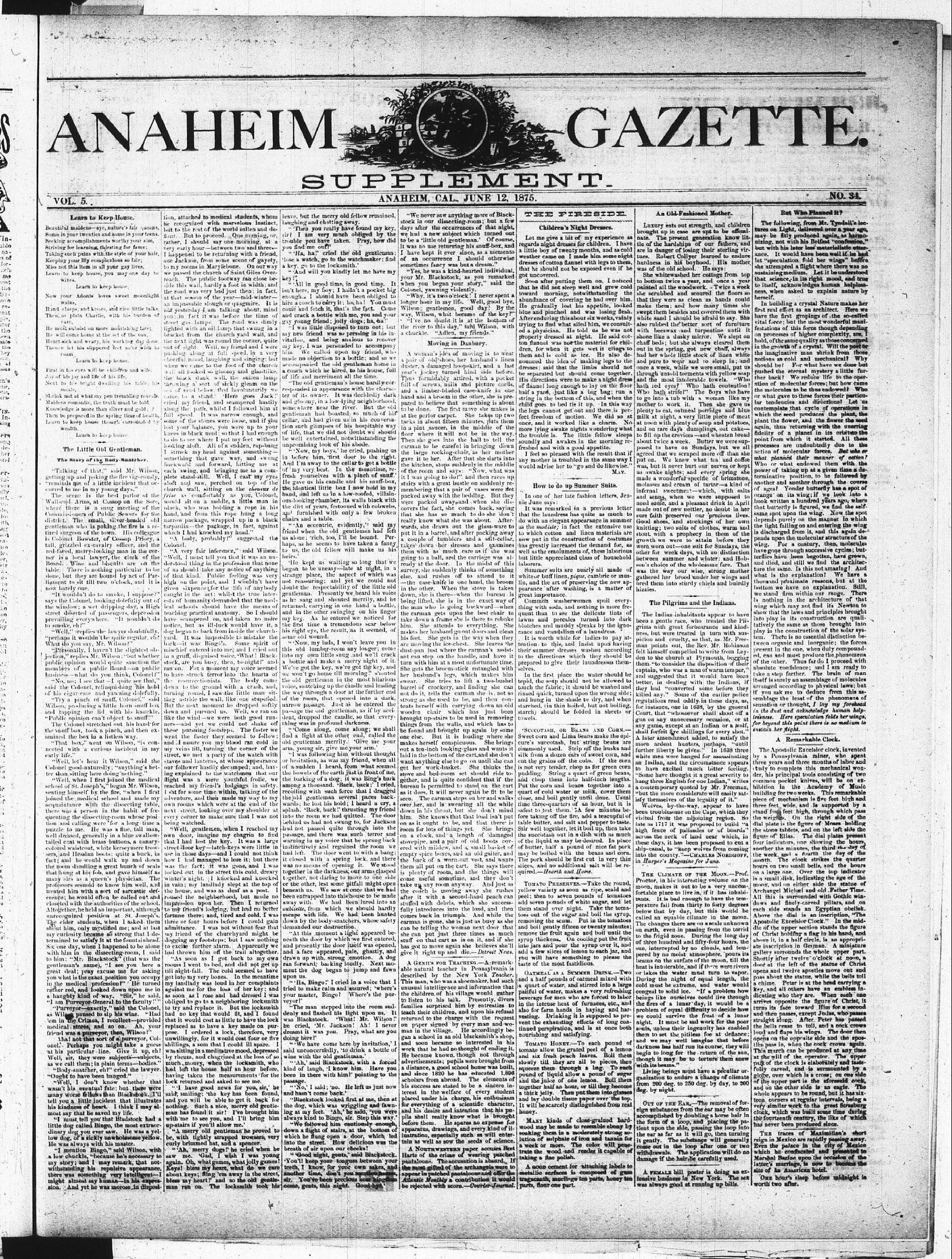
Searchable text
ANAHEIM
VOL. 5.
Learn to Keep House.
Beautiful maidens—aye, nature's fair queens,
Some in your twenties and home in your teens.
Seeking accomplishments worthy your aim,
Striving for learning, thirsting for fame;
Taking such pains with the style of your hair,
Keeping your flly complexions so fair;
Miss not this item in all your gay lives.
Learn to keep house, you may one day be wives.
Learn to keep house.
Now your Adonis loves sweet moonlight walks,
Hand clasps, and kisses, and nice little talks.
Then, as plain Charlie, with his burden of care,
He must subsist on more nourishing fare;
He will come home at the set of the sun,
Heart sick and weary, his working day done.
Thence let his slippered feet never wish to roam.
Learn to keep house.
First in his eyes will be children and wife,
Joy of his joy and life of his life.
Next to his bright dwelling his table, his meals,
Shrink not at what my pen trembling reveals.
Maidens romantic, the truth must be told.
Knowledge is more than silver and gold;
Then be prepared in the spring time of health.
Learn to keep house though surrounded by wealth.
Learn to keep house.
The Little Old Gentleman.
The Story of the Body-Manther.
tion, attached to medical students, whom he recognized with marvelous instinct,
but to the rest of the world sullen and defiant. But to proceed. One evening, or rather, I should say one morning, at a very early hour—between two and three—I happened to be returning with a friend, one Jackson, from some scene of gayety, to my rooms in Marylebone. On our way we passed the church of Saint Giles Overreach. The public footway ran close beside this wall, hardly a foot in width; and the road was very bad just then; in fact, at that season of the year—mid-winter—an impassable slough or quagmire. It is nor yesterday I am talking about, mind you; in fact it was before the time of street gas lamps. The road was dimly lighted with an oil lamp that swung in a bracket from the church yard wall, and the next sight was round the corner, quite out of sight. Weil, my friend and I were pushing along at full speed, in a very cheerful mood, laughing and singing; but when we came to the foot of the church wall all looked so gloomy and ghostlike, the black dank wall, the saillon lamp throwing a sort of sickly gleam on the sea of mud below, that involuntarily we came to a stand. 'Here goes Jack' cried my friend, and scampered hastily along the path, whilst I followed him at full speed. It was narrow enough, and some of the stones were loose, and if you lost your balance, you were up to your knees in black mud; so that I had enough to do to see where I put my feet without looking aloft. All of a sudden, rap-bang I struck my head against something—something that gave way, and swing backward and forward, hitting me at leave, but the merry old feathering and chatting away.
'Then you really have girl! I am very much old trouble you have taken. You find me out?'
'Ha, ha! cried the old watch, go to the waist key, go to the locksmith. And will you kindly leave?
'All in good time, in girl isn't here, my boy! I hallmark enough. I should have hired a coach to carry it; has come and fetch it, that's the crack a bottle with my gay young friend; jolly do it!
'I was little disposed to my new friend was so preoccupation, and being anxious my key, I was persuaded him. We called upon made no objection to a body accompanied the old gentleman a coach which he hired, to life and merriment all t'
'The old gentleman's hand responded in appearance water of its owner. It was oak and gloomy, in a low-lying somewhere near the river gentleman had boasted cellar, and had given us information such glimpses of his life, that we did not do well entertained, not unwilling look of his aa'
'Now, my boys, hecried in before him, first door And I'm away to the cellar of my best heart. In tha
The Little Old Gentleman.
The Story of the Body-Smatter.
"Talking of that," said Mr. Wilson, getting up and poking the fire vigorously, "reminds me of a little incident that occurred to me in my young days."
The scene is the best parlor of the Wailsead Arms, at Cossop on the Sore, where there is a snug meeting of the Commissioners of Public Sewers for the district. The small, silver-headed old gentleman who is poking the fire is a retired surgeon of the town. His colleague is Colonel Bowster, of Cossop Priory, a tall, grizzled ex-cavalry officer, and the red-faced, merry-looking man in the corner is a local lawyer, the clerk of the Board. Wine and biscuits are on the table. There is nothing particular to be done, but they are bound by act of Parliament to sit till two o'clock, and it is now barely one.
"It wouldn't do to smoke, I suppose!" says the Colonel, looking dolefully out of the window; a wet dripping day, a High street deserted of passengers, depression prevailing everywhere. "It wouldn't do to smoke, eh?"
"Well," replies the lawyer doubtfully, "perhaps it wouldn't be quite regular, eh? What do you say, Mr. Wilson?"
"Personally, I haven't the slightest objection," replies Mr. Wilson; "but whether public opinion would quite sanction the members of a public Board—on public business—what do you think, Colonel?"
"No, no; I see that—I quite see that," said the Colonel, relinquishing his hold of his cigar-case and yawning dolefully.
"Try a pinch of snuff, Colonel." said Wilson, producing a little horn sniff box and tapping the lid with his knuckle.
"Public opinion can't object to snuff!"
The Colonel stretched out his hand for the shuff box, took a pinch, and then examined the box in a listless way.
"That box," went on Wilson, "is connected with a curious incident in my early life."
"Well, let's hear it Wilson," said the Colonel good-naturedly; "anything's better than sitting here doing nothing."
"Well, when I first joined the medical school of St. Joseph's," began Mr. Wilson, seating himself by the fire, "when I first joined the medical school and made my acquaintance with the dissecting table, there was a person in the habit of frequenting the dissecting-room whose position and calling were for a long-time a puzzle to me. He was a fine, tall man, well dressed, generally in a blue swallow-tailed coat with brass buttons, a canary-colored waistcoat, white kerseymere trowers, and Hessian boots; quite a buck, in fact; and he would walk up and down the room dandling a great bunch of seals that hung at his fob, and gave himself as many siras as a queen's physician. The professors seemed to know him well, and wall all looked so gloomy and ghostlike, the black dank wall, the sullied lamp throwing a sort of sickly gleam on the sea of mud below; that involuntarily we came to a stand: "Here goes Jack!" cried my friend, and scampered hastily along the path, whilst I followed him at full speed. It was narrow enough, and some of the stones were loose, and if you lost your balance, you were up to your knees in black mud; so that I had enough to do to see where I put my feet without looking aloft. All of a sudden, rap-bang I struck my head against something—something that gave way, and swing backward and forward, hitting me at each swing, and bringing me to a complete stand-still. Well, I cast my eyes aloft and saw, perched on top of the church wall, sitting on the chevaux de frise as comfortably as you, Colonel, would sit on a saddle, a little man in black, who was holding a rope in his hand, and from this rope hung a long narrow package, wrapped up in a black tarpaulin—the package, in fact, against which I had knocked my head."
"A body, probably?" suggested the Colonel.
"A very fair inference," said Wilson. "Well, I must tell you that it was an understood thing in the profession that none of us should take any notice of anything of that kind. Public feeling was very high on the point, and I wouldn't have given sixpence for the life of anybody caught in the act; whilst the true interests of humanity demanded that the medical schools should have the means of teaching practical anatomy. So I should have scampered on, and taken no more notice, but as ill-luck would have it, a dog began to bark from inside the churchward. It was impossible to mistake the bark—it was Bingo's. Some spirit of mischief entered into me; and I cried out in a gruff, disguised voice. What! Black-stock, are you busy, then, to-night? and ran on. For a moment my voice seemed to have struck terror into the hearts of the resurrectionists. The body came down to the ground with a crash, and turning round, I saw-the little man sitting astride the wall like one stupefied. But the next moment he dropped softly down and pursued us. Well, we ran on like the wind—we were both good runners—and yet we could not shake off these pursuing footsteps. The faster we went the faster they seemed to follow; and I assure you my blood ran cold in my veins till, turning the corner of the street, we met a party of the watch with staves and lanterns, at whose appearance our follower hastily decamped; and having explained to the watchmen that our flight was a mere youthful frolic, we reached my friend's lodgings in safety. I sat for some time within, talking of the adventure, and then made my way to my own rooms which were at the end of the next street, looking over my shoulder at every corner to make sure that I was not being watched.
"Well, gentlemen, when I reached my own door, imagine my chagrin to find that I had lost the key. It was a large street-door key—latch-keys were little in use in those days—and I could not think how I had managed to lose it; but there was the fact; it was gone, and I was locked out in the street this cold, dreary winter's night. I knocked and knocked in vain; my landlady slept at the top of wall all looked so gloomy and ghostlike, the black dank wall, the sullied lamp throwing a sort of sickly gleam on the sea of mud below; that involuntarily we came to a stand: "Here goes Jack!" cried my friend, and scampered hastily along the path, whilst I followed him at full speed. It was narrow enough, and some of the stones were loose, and if you lost your balance, you were up to your knees in black mud; so that I had enough to do to see where I put my feet without looking aloft. All of a sudden, rap-bang I struck my head against something—something that gave way, and swing backward and forward, hitting me at each swing, and bringing me to a complete stand-still. Well, I cast my eyes aloft and saw, perched on top of the church wall, sitting on the chevaux de frise as comfortably as you, Colonel, would sit on a saddle, a little man in black, who was holding a rope in his hand,and from this rope hung a long narrow package,wrapped up in a black tarpaulin—the package,in fact, against which I had knocked my head."
"A body,probably?" suggested the Colonel.
"A very fair inference," said Wilson. "Well,I must tell you that it was an understood thing in the profession that none of us should take any notice of anything of that kind. Public feeling was very high on the point,and I wouldn't have given sixpence for the life of anybody caught in the act; whilst the true interests of humanity demanded that the medical schools should have the means of teaching practical anatomy. So I should have scampered on,and taken no more notice,but as ill-luck would have it,a dog began to bark from inside the churchward. It was impossible to mistake the bark—it was Bingo's. Some spirit of mischief entered into me;and I cried out in a gruff,disguised voice.“What!Black-stock,are you busy,then,to-night?and ran on. For a moment my voice seemed to have struck terror into the hearts of the resurrectionists。The body came down to the ground with a crash,and turning round,I saw-the little man sitting astride the wall,似 one stupefied.But the next moment he dropped softly down and pursued us. Well,we ran on like the wind—we were both good runners—and yet we could not shake off these pursuing footsteps. The faster we went the faster they seemed to follow; and I assure you my blood ran cold in my veins till,turning the corner of the street,we met a party of the watch with staves and lanterns,at whose appearance our follower hastily decamped;and,having explained to the watchmen that our flight was a mere youthful frolic,we reached my friend's lodgings in safety.I sat for some time within,talking of the adventure,and then made my way to my own rooms which were at the end of the next street,looking over my shoulder at every corner to make sure that I was not being watched.
"Well,gentlemen,when I reached my own door,imagine my chagrin to find that I had lost the key。它 was a large street-door key—latch-keys were little in use in those days—and I could not think how I had managed to lose it;但 there was the fact;it was gone,and I was locked out in the street this cold,dreary winter's night.I knocked和knocked in vain;my landlady slept atthe topofwall all looked so gloomy和 ghostlike,theblackdankwall,thesulldentriumdemandedthatthereducationshouldbeusedtothewatchmenthatourflightwasamereyouthfulfrolic,thefastenerwentthefastertheyseemedtofollow;andIassureyoumybloodrancoldinmyveinstil,turningthecornerofthestreetwemetapartyofthewatchwithstavesandlanterns.atwhoseappearanceourfollowerhashtildecamped;and,havingexplainedtothewatchmenthatourflightwasamereyouthfulfrolic,thefastenerwentthefastertheyseemedtofollow;andIassureyoumybloodrancoldinmyveinstil,turningthecornerofthestreetwemetapartyofthewatchmenthatourflightwasamereyouthfulfrolic,thefastenerwentthefastertheyseemedtofollow;andIassureyoumybloodrancoldinmyveinstil,turningthecornerofthestreetwemetapartyofthewatchmenthatourflightwasamereyouthfulfrolic,thefastenerwentthefastertheyseemedtofollow;andIassureyoumybloodrancoldinmyveinstil,turningthecornerofthestreetwemetapartyofthewatchmenthatourflightwasamereyouthfulfrolic,thefastenerwentthefastertheyseemedtofollow;andIassureyoumybloodrancoldinmyveinstil,turningthecornerofthestreetwemetapartyofthewatchmenthatourflightwasamereyouthfulfrolic,thefastenerwentthefastertheyseemedtofollow;andIassureyoumybloodrancoldinmyveinstil,turningthecornerofthestreetwemetapartyofthewatchmenthatourflightwasamereyouthfulfrolic,thefastenerwentthefastertheyseemedtofollow;andIassureyoumybloodrancoldinmyveinstil,turningthecornerofthestreetwemetapartyofthewatchmenthatourflightwasamereyouthfulfrolic,thefastenerwentthefastertheyseemedtofollow;andIassureyoumybloodrancoldinmyveinstil,turningthecornerofthestreetwemetapartyofthewatchmenthatourflightwasamereyouthfulfrolic,thefastenerwentthefastertheyseemedtofollow;andIassureyoumybloodrancoldinmyveinstil,turningthecornerofthestreetwemetapartyofthewatchmenthatourflightwasamereyouthfulfrolic,thefastenerwentthefastertheyseemedtofollow;andIassureoumybloodrancoldinmyveinstil,turningthecornerofthestreetwemetapartyofthewatchmenthatourflightwasamereyouthfulfrolic,thefastenerwentthefastertheyseemedtofollow;andIassureoumybloodrancoldinmyveinstil,turningthecornerofthestreetwemetapartyofthewatchmenthatourflightwasamereyouthfulfrolic,thefastenerwentthefastertheyseemedtofollow;andIassureoumybloodrancoldinmyveinstil,turningthecornerofthestreetwemetapartyofthewatchmenthatourflightwasamereyouthfulfrolic,thefastenerwentthefastertheyseemedtofollow;andIassureoumybloodrancoldinmyveinstil,tURNINGTHEFORTHEFORTHEFORTHEFORTHEFORTHEFORTHEFORTHEFORTHEFORTHEFORTHEFORTHEFORTHEFORTHEFORTHEFORTHEFORTHEFORTHEFORTHEFORTHEFORTHEFORTHEFORTHEFORTHEFORTHEFORTHEFORTHEFORTHEFORTHEFORTHEFORTHEFORTHEFORTHEFORTHEFORTHEFORTHEFORTHEFORTHEFORTHEFORTHEFORTHEFORTHEFORTHEFORTHEFORTHEFORTHEFORTHEFORTHEFORTHEFORTHEFORTHEFORTHEFORTHEFORTHEFORTHEFORTHEFORTHEFORTHEFORTHEFORTHEFORTHEFORTHEFORTHEFORTHEFORTHEFORTHEFOTHERFTHEREFTHEREFTHEREFTHEREFTHEREFTHEREFTHEREFTHEREFTHEREFTHEREFTHEREFTHEREFTHEREFTHEREFTHEREFTHEREFTHEREFTHEREFTHEREFTHEREFTHEREFTHEREFTHEREFTHEREFTHEREFTHEREFTHEREFTHEREFTHEREFTHEREFTHEREFTHEREFTHEREFTHEREFTHEREFTHEREFTHEREFTHEREFTHEREFTHEREFTHEREFTHEREFTHEREFTHEREFTHEREFTHEREFTHEREFT HEREFTHEREFTHEREFTHEREFTHEREFTHEREFTEREft HEREft HEREft HEREft HEREft HEREft HEREft HEREft HEREft HEREft HEREft HEREft HEREft HEREft HEREft HEREft HEREft HEREft HEREft HEREft HEREft HEREft HEREft HEREft HEREft HEREft HEREft HEREft HEREft HEREft HEREft HEREft HEREft HEREft HEREft HEREft HEREft HEREft HEREft HEREft HEREft HEREft HEREft Hereft Hereft Hereft Hereft Hereft Hereft Hereft Hereft Hereft Hereft Hereft Hereft Hereft Hereft Hereft Hereft Hereft Hereft Hereft Hereft Hereft Hereft Hereft Hereft Hereft Hereft Hereft Hereft Hereft Hereft Hereft Hereft Hereft Hereft Hereft Hereft Hereft Hereft Hereft Hereft Hereft Hereft Hereft Hereft Hereft Here ft HERE ft HERE ft HERE ft HERE ft HERE ft HERE ft HERE ft HERE ft HERE ft HERE ft HERE ft HERE ft HERE ft HERE ft HERE ft HERE ft HERE ft HERE ft HERE ft HERE ft HERE ft HERE ft HERE ft HERE ft HERE ft HERE ft HERE ft HERE ft HERE ft HERE ft HERE ft Heritage ft Heritage ft Heritage ft Heritage ft Heritage ft Heritage ft Heritage ft Heritage ft Heritage ft Heritage ft Heritage ft Heritage ft Heritage ft Heritage ft Heritage ft Heritage ft Heritage ft Heritage ft Heritage ft Heritage ft Heritage ft Heritage ft Heritage ft Heritage ft Heritage ft Heritage ft Heritage ft Heritage ft Heritage ft Heritage ft Heritage ft Heritage ft Heritage ft Heritage ft Heritage ft Heritage ft Heritage ft Heritage ft Heritage ft Heritage ft Heritage ft Heritage ft Heritage ft Heritage ft Heritage ft Heritage ft Heritage ft Heritage ft Heritage flt heritage flt heritage flt heritage flt heritage flt heritage flt heritage flt heritage flt heritage flt heritage flt heritage flt heritage flt heritage flt heritage flt heritage flt heritage flt heritage flt heritage flt heritage flt heritage flt heritage flt heritage flt heritage flt heritage flt heritage flt heritage flt heritage flt heritage flt heritage flt heritage flt heritage flt heritage flt heritage flt heritage fltf heritage fltf heritage fltf heritage fltf heritage fltf heritage fltf heritage fltf heritage fltf heritage fltf heritage fltf heritage fltf heritage fltf heritage fltf heritage fltf heritage fltf heritage fltf heritage fltf heritage ftl heritage ftl heritage ftl heritage ftl heritage ftl heritage ftl heritage ftl heritage ftl heritage ftl heritage ftl heritage ftl heritage ftl heritage ftl heritage ftlitage ftlitage ftlitage ftlitage ftlitage ftlitage ftlitage ftlitage ftlitage ftlitage ftlitage ftlitage ftlitage ftlitage ftlitage ftlitage ftlitage ftlitage ftlitage ftlitage ftlitage ftlitage ftlitage ftlitage ftlitage ftlitage ftlitage ftlitage ftlitage ftlitage ftlitage ftlitage ftlitage ftlitage ftlitage ftlitage ftlitage ftlitage ftlitage ftlitage ftlitage ftlitage ftlitage ftlitage ftlitage ftlitage ftlitage ftlitage fflt heritage fflt heritage fflt heritage fflt heritage fflt heritage fflt遗产 fflt遗产 fflt遗产 fflt遗产 fflt遗产 fflt遗产 fflt遗产 fflt遗产 fflt遗产 fflt遗产 fflt遗产 fflt遗产 fflt遗产 fflt遗产 fflt遗产 fflt遗产 fflt遗产 fflt遗产 fflt遗产 fflt遗产 fflt遗产 fflt遗产 fflt遗产 fflt遗产 fflt遗产 fflt遗产 fflt遗产 fflt遗产 fflt遗产 fflt遗产 fflt遗产 fflt遗产 fflt遗产 fflt遗产 fflt遗产 fflt遗产 fflt遗产 fflt遗产 fflt遗产 fflt遗产 fflt遗产 fflt文化遗产 fflt文化遗产 fflt文化遗产 fflt文化遗产 fflt文化遗产 fflt文化遗产 fflt文化遗产 fflt文化遗产 fflt文化遗产 fflt文化遗产 fflt文化遗产 fflit文化遗产 fflit文化遗产 fflit文化遗产 fflit文化遗产 fflit文化遗产 fflit文化遗产 fflit文化遗产 fflit文化遗产 fflit文化遗产 fflit文化遗产 fflit文化遗产 fflit文化遗产 fflit文化遗产 fflit文化遗产 fflit文化遗产 fflit文化遗产 fflit文化遗产 fflit文化遗产 fflit文化遗产 fflit文化遗产 fflit文化遗产 fflit文化遗产 fflit文化遗产 fflit文化遗产 fflit文化遗产 fflit文化遗产 fflit文化遗产 feilt文化遗产 feilt文化遗产 feilt文化遗产 feilt文化遗产 feilt文化遗产 feilt文化遗产 feilt文化遗产 feilt文化遗产 feilt文化遗产 feilt文化遗产 feilt文化遗产 feilt文化遗产 feilt文化遗产 feilt文化遗产 feilt文化遗产 feilt文化遗产 feilt文化遗产 feilt文化遗产 feilt文化遗产 feilt文化遗产 feilt文化遗产 feilt文化遗产 feilt文化遗产 feilt文化遗产 feilt文化遗产 feilt文化遗产 feilt文化遗产 feilt文化遗产 feilt文化遗产 feilt文化遗产 feilt文化遗产 feilt文化遗产 feeilt文化遗产 feeilt文化遗产 feeilt文化遗产 feeilt文化遗产 feeilt文化遗产 feeilt文化遗产 feeilt文化遗产 feeilt遗产 feeilt遗产 feeilt遗产 feeilt遗产 feeilt遗产 feeilt遗产 feeilt遗产 feeilt遗产 feeilt遗产 feeilt遗产 feeilt遗产 feeilt遗产 feeilt遗产 feeilt遗产 feeilt遗产 feeilt遗产 feeilt遗产 feeilt遗产 feeilt遗产 feeilt遗产 feeilt遗产 feeilt遗产 feeilt遗产 feeilt遗产 feeilt遗产 feeILT遗产 feeILT遗产 feeILT资产阶级 feeILT资产阶级 feeILT资产阶级 feeILT资产阶级 feeILT资产阶级 feeILT资产阶级 feeILT资产阶级 feeILT资产阶级 feeILT资产阶级 feeILT资产阶级 feeILT资产阶级FeeILT资产阶级FeeILT资产阶级FeeILT资产阶级FeeILT资产阶级FeeILT资产阶级FeeILT资产阶级FeeILT资产阶级FeeILT资产阶级FeeILT资产阶级FeeILT资产阶级FeeILT资产阶级FeeILT资产阶级FeeILT资产阶级FeeILT资产阶级FeeILT资产阶级FeeILT资产阶级FeeILT资产阶级FeeILT资产阶级FeeILT资产阶级FeeILT资产阶级FeeILT资产阶级FeeILT资产阶级FeeILT资产阶级FeeILT资产阶级FeILT资产阶级FeeILT资产阶级FeeILT资产阶级FeeILT资产阶级FeeILT资产阶级FeeILT资产阶级FeeILT资产阶级FeeILT阶级FeILT阶级FeILT阶级FeILT阶级FeILT阶级FeILT阶级FeILT阶级FeILT阶级FeILT阶级FeILT阶级FeILT阶级FeILT阶级FeILT阶级FeILT阶级FeILT阶级FeILT阶级Fe ILT阶级Fe ILT阶级Fe ILT阶级Fe ILT阶级Fe ILT阶级Fe ILT阶级Fe ILT阶级Fe ILT阶级Fe ILT阶级Fe ILT阶级Fe ILT阶级Fe ILT阶级Fe ILT班级Fe ILT班级Fe ILT班级Fe ILT班级Fe ILT班级Fe ILT班级Fe ILT班级Fe ILT班级Fe ILT班级Fe ILT班级Fe ILT班级Fe ILT班级Fe ILT班级Fe ILT班级Fe ILT班级Fe ILT班级Fe ILT班级Fe ILT班级Fe ILT班级Fe IL T班级Fe IL T班级Fe IL T班级Fe IL T班级Fe IL T班级Fe IL T班级Fe IL T班级Fe IL T班级Fe IL T班级Fe IL T班级Fe IL T班级Fe IL T班级Fe IL T班级Fe IL T班级Fe IL T班级Fe IL T班级Fe IL T班级Fe IL T班级 Fe IL T班级 Fe IL T班级 Fe IL T班级 Fe IL T班级 Fe IL T班级 Fe IL T班级 Fe IL T班级 Fe IL T班级 Fe IL T班级 Fe IL T班级 Fe IL T班级 Fe IL T班级 Fe IL T班级 Fe IL T班级 Fe IL T班级 Fe IL T班级 Fe IL T班级 Fe Il T校区 Fe Il T校区 Fe Il T校区 Fe Il T校区 Fe Il T校区 Fe Il T校区 Fe Il T校区 Fe Il T校区 Fe Il T校区 Fe Il T校区 Fe Il T校区 Fe Il T校区 Fe Il T校区 Fe Il T校区 Fe Il T校区 Fe Il T校区 Fe Il T校区 Fe Il T校区 Fe Il T校区 Fee Il T校区 Fee Il T校区 Fee Il T校区 Fee Il T校区 Fee Il T校区 Fee Il T校区 Fee Il T校区 Fee Il T校区 Fee Il T校区 Fee Il T校区 Fee Il T校区 Fee Il T校区 Fee Il T校区 Fee Il T校区 Fee Il T校区 Fee il T校区 Fee il T校区 Fee il T校区 Fee il T校区 Fee il T校区 Fee il T校区 Fee il T校区 Fee il T校区 Fee il T校区 Fee il T校区 Fee il T校区 Fee il T校区 Fee il T校区 Fee il T校区 Fee il Т校区 Fee il Т校区 Fee il Т校区 Fee il Т校区 Fee il Т校区 Fee il Т校区 Fee il Т校区 Fee il Т校区 Fee il Т校区 Fee il Т校区 Fee il Т校区 Fee il Т校区 Fee il Т校区 Fee il Т校区 Fee il Т校区 Фее-il ТССР Фее-il ТССР Фее-il ТССР Фее-il ТССР Фее-il ТССР Фее-il ТССР Фее-il ТССР Фее-il ТССР Фее-il ТССР Фее-il ТССР Фее-il ТССР Фее-il ТССР Фее-il ТССР Фее-il ТССР Фее-il ТССР Фее-il ТССР Фее-il ТССР Фее-il ТССР Фее-il ТССР Фее-il ТССР Фее-il ТССР Фее-il ТССР Фее-il ТССР Фее-il ТССР Фее-il ТССР Фее-il ТССР Фее-il ТССР Фее-il ТССР Фее-il ТССР Фее-il ТССР Фее-il ТССР Фее’ilТССР Фее’ilТССР Фее’ilТССР Фе’ilТССР Фе’ilТ嗽Фе’ilТ嗽Фе’ilТ嗽Фе’ilТ嗽Фе’ilТ嗽Фе’ilТ嗽Фе’ilТ嗽Фе’ilТ嗽Фе’ilТ嗽Фе’ilТ嗽Фе’ilТ嗽Фе’ilТ嗽Фе’ilТ嗽Фе’ilТ嗽Фе’ilТ嗽Фе’ilТ嗽Фе’ilТ嗽Фе’ilТ嗽Фе’ilТ嗽Фе’ilТ嗽Фе’ilТ嗽Фе’ilТ嗽Фе’ilТ嗽Фе’ilТ嗽Фе’ilТ嗽Фе’ilТ嗽Фе’ilТ嗽Фе’ilТ嗽Фе’ilТ嗽Фе’ilТ嗽Фе’ilТ嗽Фе’ilТ嗽Фе’ilТ嗽Фе’ilТ嗽Фе’ilТ嗽Фе’ilТ嗽Фе’ilТ嗽Фе’ilТ嗽Фе’ilТ嗽Фе’ilТ嗽Га’ilТ嗽Га’ilТ嗽Га’ilТ嗽Га’ilТ嗽Га’ilТ嗽Га’ilТ嗽Га’ilТ嗽Га’ilТ嗽Га’ilТ嗽Га’ilТ嗽Га’ilТ嗽Га’ilТ嗽Га’ilТ嗽Га’ilТ嗽Га’ilТ嗽Га’ilТ嗽Га’ilТ嗽Га’ilТ嗽Га’ilТ嗽Га’ilТ嗽Га’ilТ嗽Га’ilТ嗽Га’ilт嗽Га’ilт嗽Га’ilт嗽Га’ilт嗽Га’ilт嗽Га’ilт嗽Га’ilт嗽Га’ilт嗽Га’ilт嗽Га’ilт嗽Га’ilт嗽Га’ilт嗽Га’ilт嗽Га’ilт嗽Га’ilт嗽Га’ilт嗽Га'ilт嗽 Га’ilт嗽 Га’ilт嗽 Га陆小 т嗽 Га陆小 т嗽 Га陆小 т嗽 Га陆小 т嗽 Га陆小 т嗽 Га陆小 т嗽 Га陆小 т嗽 Га陆小 т嗽 Га陆小 т嗽 Га陆小 т嗽 Га陆小 т嗽 Га陆小 т嗽 Г а陆小 т嗽 Г а陆小 т嗽 Г а陆小 т嗽 Г а陆小 т嗽 Г а陆小 т嗽 Г а陆小 т嗽 Г а陆小 т嗽 Г а陆小 т嗽 Г а陆小 т嗽 Г а陆小 т嗽 Г а陆小 т嗽 Г а陆小 т嗽 Г а陆小 т嗽 Г а陆小 т唬 Г а陆小 т唬 Г а陆小 т唬 Г а陆小 т唬 Г а陆小 т唬 Г а陆小 т唬 Г а陆小 т唬 Г а陆小 т唬 Г а陆小 т唬 Г а陆小 т唬 Г а陆小 т唬 Г а陆小 т唬 Г а陆小 т唬 Г а陆小 т唬 Г а陆小 т唬 Г а陆小 т唬 Г а陆小 т
seating himself by the fire, "when I first joined the medical school and made my acquaintance with the dissecting table, there was a person in the habit of frequenting the dissecting-room whose position and calling were for a long time a puzzle to me. He was a fine, tall man, well dressed, generally in a blue swallow-tailed coat with brass buttons, a canary-colored waistcoat, white kerseymere trowers, and Hessian boots; quite a buck, in fact; and he would walk up and down the room dandling a great bunch of seals that hung at his fob, and gave himself as many siras as a queen's physician. The professors seemed to know him well, and treated him with a sort of astragalic deference; he would often be called out, and closeted with the authorities of the school. Altogether, he held an important, although unrecognized position at St. Joseph's. The elder students, when I asked them about him, only mystified me; and at last my curiosity became so strong that I determined to satisfy it at the fountainhead. So one day, when I happened to be alone with him in the dissecting-room, I said to him: "Mr. Blackstock" (that was the gentleman's name), "I see you here a great deal; pray excuse me for asking you what is the exact position you occupy in the medical profession?" He turned rather red, and looked down upon me in a haughty kind of way. "Sir," he said, "I am Purveyor-General to the faculty." "Purveyor—exactly," said the Colonel, as Wilson paused to sip his wine. "Had 'em in the Crimea, I recollect—provided medical stores, and so on. Ah, your friend was a purveyor, then, Wilson?"
Ah! not that sort of a purveyor, Colonel! Perhaps you might take a guess at his particular line. Give it up, eh! Well, sir, they were subjects—subjects, as we call them; in plain terms—bodies."
"Body-snatcher, eh!" cried the lawyer. "Ought to have been hanged."
"Well, I don't know whether that wasn't his eventual fate; but there were many worse follows than Blackstock. I'll tell you a little incident that illustrates his kindness of heart. I think I may almost say that he saved my life.
"I must tell you that Bladstock had a little dog called Bingo, the most extraordinary dog you ever saw. He was a yellow dog, of a sickly unwholesome yellow. He was always with his master.
"I mention Bingo," said Wilson, with a low chuckle, "because he's necessary to my story; and I may remark, that withstanding his repulsive appearance, there was something very intelligent—I might almost say human—in his expression. And yet he was morose in disposition."
"I have good news for you, sir," he said, smiling; 'the key has been found, and you will be able to get it back for nothing.' Such a nice, merry old gentleman has found it sir! I've brought him with me to see you, and I'll bring him up-stairs if you'll allow me.'
"A merry old gentleman he proved to be, with tightly strapped trowers, very curly brimmed hat, and a spencer.
"Ah, merry dogs!" he cried when he saw me. 'Gad, I wish I was young again. Oh, what games, what jolly games! Key! bless my heart, what do we care about keys; fling 'em away in the street, bless my heart!' and so the old gentleman ran on. The locksmith took his I sat for some time within, talking of the adventure, and then made my way to my own rooms which were at the end of the next street, looking over my shoulder at every corner to make sure that I was not being watched.
"Well, gentlemen, when I reached my own door, imagine my chagrin to find that I had lost the key. It was a large street-door key—latch-keys were little in use in those days—and I could not think how I had managed to lose it; but there was the fact; it was gone, and I was locked out in the street this cold, dreary winter's night. I knocked and knocked in vain; my landlady slept at the top of the house, and was as deaf as a post. I roused the neighborhood, but made no impression upon her. Then I returned to my friend's lodging, but had no better fortune there; and tired and cold. I was three or four hours before I could gain admittance. I was not without fear that my friend of the churchyard might be dogging my footsteps; but I saw nothing to excite further alarm. Apparently we had thrown him off the trail altogether.
"As soon as I got back to my own rooms I went to bed, and did not get up till night-fall. The cold seemed to have got into my very bones. In the meantime my landlady was loud in her complaints against me for the loss of her key; and as soon as I rose and dressed I was obliged to go to a neighboring locksmith to try and replace it. But the locksmith had no key that would fit, and I found that it would cost as little to have the lock replaced as to have a key made on purpose. I ordered a lock, therefore, very unwillingly, for it would cost four or five shillings, a sum that I could ill spare. I was sitting in a meditative mood, depressed by rheum, and chagrined at the loss of so much money, when the locksmith, who had left the house half an hour before, having taken the measurements for the lock returned and asked to see me.
"I have good news for you, sir," he said, smiling; 'the key has been found, and you will be able to get it back for nothing.' Such a nice, merry old gentleman has found it sir! I've brought him with me to see you, and I'll bring him up-stairs if you'll allow me.'
"A merry old gentleman he proved to be, with tightly strapped trowers, very curly brimmed hat, and a spencer.
"Ah, merry dogs!" he cried when he saw me. 'Gad, I wish I was young again. Oh, what games, what jolly games! Key! bless my heart, what do we care about keys; fling 'em away in the street, bless my heart!' and so the old gentleman ran on. The locksmith took his I sat for some time within, talking of the adventure, and then made my way to my own rooms which were at the end of the next street, looking over my shoulder at every corner to make sure that I was not being watched.
"Well, gentlemen, when I reached my own door, imagine my chagrin to find that I had lost the key. It was a large street-door key—latch-keys were little in use in those days—and I could not think how I had managed to lose it; but there was the fact; it was gone, and I was locked out in the street this cold, dreary winter's night. I knocked and knocked in vain; my landlady slept at the top of the house, and was as deaf as a post. I roused the neighborhood, but made no impression upon her. Then I returned to my friend's lodging, but had no better fortune there; and tired and cold. I was three or four hours before I could gain admittance. I was not without fear that my friend of the churchyard might be dogging my footsteps; but I saw nothing to excite further alarm. Apparently we had thrown him off the trail altogether.
"At this moment a light neath the door by which we and presently the door itself and a face appeared, pale drawn up with strong emerald forward; banking loud ment the dog began to jump upon us."
"Ha, Bingo!" I cried in tried to make calm and assuge your master, Bingo! What voyeur?
"The man stepped into denely and flashed his light was Blackstock." What! he cried; 'Mr. Jackson!' dreamt it was you. Pray doing here?
"We have come here because unconcernedly,' to draw wine with the old gentleman." 'Ah,' said Blackstock; 'kind of laugh.' 'I know he been in there with him?' passage.
"No,' I said; 'no. He had hasn't come back.'
"Blackstock looked first the dog, which was wriggling at my feet." 'Ah,' he always kind to Bingo; sir.
"We followed him cautiously down a flight of stairs at which he flung open a door into the street. How deep breath of air upon our cheek."
"Good night, gents," as You'll keep your tongue teeth; I know for your other time, don't you sir? You've been precious come, gents; this night."
leave, but the merry old fellow remained,
laughing and chatting away.
"Then you really have found my key,
sir! I am very much obliged by the trouble you have taken. Pray, how did you find me out?
'Ha, ha,' cried the old gentleman;
'lose a watch, go to the watchmaker; find a key, go to the locksmith.'
'And will you kindly let me have my key!'
'All in good time, in good time. It isn't here, my boy; I hain't a pocket big enough. I should have been obliged to hire a coach to carry it; ha, ha! You must come and fetch it, that's the fact. Come and crack a bottle with me, you and your gay young friend; jolly dogs; ha, ha!
"I was little disposed to turn out; but my new friend was so pressing in his invitation, and being anxious to recover my key, I was persuaded to accompany him. We called upon my friend, who made no objection to a bottle; and so we accompanied the old gentleman home in a coach which he hired, to his house, full of life and merriment all the time.
"The gentleman's house hardly corresponded in appearance with the character of its owner. It was decidedly dark and gloomy, in a low-lying neighborhood, somewhere near the river. But the old gentleman had boasted so much of his cellar, and had given us in his conversation such glimpses of his hospitable way of life, that we did not doubt we should be well entertained, notwithstanding the unpromising look of his abode.
"Now, my boys,' he cried, pushing us in before him, 'first door to the right. And I'm away to the cellar to get a bottle of my very best. In the meantime re-
"We never saw anything more of Blackstock in our dissecting-room; but a few days after the occurrences of that night, we had a new subject which turned out to be a 'little old gentleman.' Of course, it was no use returning his snuff-box, and I have kept it ever since, as a memento of an occurrence I should otherwise sometimes fancy was but a dream."
"Yes, he was a kind-hearted individual, your Mr. Blackstock, as you remarked when you began your story," said the Colonel, yawning violently.
"Why, it's two o'clock! I never spent a longer hour in my life. Well, good bye, Wilson; gentlemen, good day! By the way, Wilson, what became of the key!"
"I've no doubt it is at the bottom of the river to this day," said Wilson, with a chuckle. "Adieu, my friends."
Moving in Danbury.
A woman's idea of moving is to wear a pair of old shoes, her husband's linen duster, a damaged hoopskirt, and a last year's jockey turned hind side before. Thus formidably attired, with a pocket full of screws, nails and picture cords, and a limber-bladed case-knife in one hand and a broom in the other, she is prepared to believe that something is about to be done. The first move she makes is at the perlor carpet. She takes up two tacks in about fifteen minutes, puts them in a pint saucer, in the middle of the floor where it will not be in the way. Then she goes into the hall to tell the carman to be careful in bringing down the large rocking-chair, as her mother gave it to her. After that she darts into the kitchen, stops suddenly in the middle
THE FIRESIDE
Children's Night Dresses.
Let me give a bit of my experience as regards night dresses for children. I have a little boy of twenty months, and as cold weather came on I made him some night dresses of cotton flannel with legs to them, that he should not be exposed even if he got uncovered.
Soon after putting them on, I noticed that he did not sleep well and grew cold toward morning, notwithstanding the abundance of covering he had over him. He gradually lost his appetite, looked blue and pinched and was losing flesh. After enduring this about six weeks, vainly trying to find what ailed him, we consulted a physician. He told us he was not properly dressed at night. He said cotton flannel was not the material for children, for when it gets wet it clings to them and is cold as ice. He also denounced the idea of making legs to the dresses; said that the limbs should not be separated but should come together. His directions were to make a night dress of flannel long enough to lay on the floor half a yard, just like a big bag; run a string in the bottom of this, and when the child goes to bed tie it up. In this way the legs cannot get out and there is perfect freedom of motion. We did so at once, and it worked like a charm. No more lying awake nights wondering what the trouble is. The little fellow sleeps soundly and awakes in the morning refreshed and with a good appetite.
I feel so pleased with the result that if any mother is troubled in the same way I would advise her to "go and do likewise."
The old gentleman's house hardly cor-responded in appearance with the charac-ter of its owner. It was decidedly dark and gloomy, in a low-lying neighborhood, somewhere near the river. But the old gentleman had boasted so much of his cellar, and had given us in his conversation such glimpses of his hospitable way of life, that we did not doubt we should be well entertained, notwithstanding the unpromising look of his abode.
"Now, my boys," he cried, pushing us in before him, "first door to the right. And I'm away to the cellar to get a bottle of my very best. In the meantime, refresh yourselves with a pinch of snuff." He gave us his candle and his snuff-box, the identical little box I now hold in my hand, and left us in a low-roofed, villainous-looking chamber, its walls black with the dirt of years, festooned with cobwebs, furnished with only a few broken chairs and a table.
"An eccentric, evidently," said my friend when the old gentlemen had left us alone; rich, too, I'll be bound. Perhaps, as he seems to have taken a fancy to us, the old fellow will make us his heirs."
"He kept us waiting so long that we begin to be uneasy—late at night, in a strange place, the aspect of which was not reassuring; and yet we could not doubt the respectability of the little old gentleman. Presently we heard his voice as he sang and shouted merrily, and he returned, carrying in one hand a bottle, and in the other swinging on his finger my key. As he entered we noticed for the first time a tremendous scar below his right eye, the result, as it seemed, of some old wound.
"Now, my lads, I won't leave you in this old lumber-room any longer; come into my own little snug and we'll crack a bottle and make a merry night of it. We've got the key, we've got the key, and we won't go home till morning!" shouted the old gentleman in the most hilarious voice, snatching up the candle and leading the way through a door at the further end of the room, that opened into a dark, narrow passage. Just as he entered the passage the old gentleman, as if by accident, dropped the candle, so that everything was in profound darkness.
"Come along, come along; we shall find a light at the other end, called the old gentleman merrily: Give me your arm, young sir, give me your arm."
"I was following him without thought or hesitation, as was my friend, when all of a sudden I heard, from what seemed the bowels of the earth just in front of me, the barking of a dog; it was Bing's bark among a thousand. Back, back; I cried, recoiling with such force that I dragged the old gentleman several paces backwards; he lost his hold; I heard a cry, a splash. Back, back! thrusting my friend into the room we had quitted. The door behind us had not swung to, for Jackson had not passed quite through into the passage, and there was such terror and warning in my voice that he sprang back instinctively and regained the room we had left. The door went to with a bang; it closed with a spring lock, and there was no means of opening it. We stood together in the darkness, our arms clasped together, not daring to move to one side or the other, lest some pitfall might open beneath us.
Thus formidably attired, with a pocket full of screws, nails and picture curls, and a limber-bladed case-knife in one hand and a broom in the other, she is prepared to believe that something is about to be done. The first move she makes is at the perlor carpet. She takes up two tacks in about fifteen minutes, puts them in a pint saucer, in the middle of the floor where it will not be in the way. Then she goes into the hall to tell the carman to be careful in bringing down the large rocking-chair, as her mother gave it to her. After that she darts into the kitchen, stops suddenly in the middle of the room and says: "Now, what was it I was going to do?", and then races up stairs with a great bustle on suddenly remembering that a pair of vases were not packed away with the bedding. But they were packed away and when she discovers that she has so much to do she don't really know what she was about. Afterwards, she draws out the glass-ware to put it in a barrel, and after packing away a couple of tumblers and a salt-cellar, takes down her dresses and examines them with as much care as if she was going to a ball, and the carriage was already at the door. In the midst of this survey, she suddenly thinks of something else, and rushes off to attend to it—the case knife in one hand, the broom in the other. When the stove is taken down, she is there—when the bureau is being lifted, she is in the exact way of the man who is going backward—when the carman gets upon the best chair to take down a frame she is there to rebuke him. She attends to everything. She makes her husband go out doors and clean his feet. She gets in the way when they are moving the ice chest. She leaves the dust-pan just where the carman's assistant can step on the handle, and have it turn with him at a most unfortunate time. She gets the broom-stick entangled with her husband's legs, which makes him swear. She tries to lift a two-bushel barrel of crockery, and finding she can not do it, tells the carman she is not so strong as she used to be, and then contents herself with carrying down an old wooden chair which has just been brought up-stairs to be used in removing things from the walls, and which has to be found and brought up again by some one else. But it is loading where she makes herself conspicuous. She brings out a ten-inch looking-glass and wants it laid in the bottom of the cart,and she don't want anything else to go on until she can get her work-basket. She thinks the stove and bed-room set should ride together, and is quite confident that if the bureau is permitted to stand on the cart as it does, it will never again be fit to be seen. The carman steps on her and walks over her, and is swearing all the while down in his throat, but she don't mind him. She knows that that load isn't put on as it ought to be, and that there is room for lots of things yet. She brings on a clock, and a length of damaged stovepipe, and a pair of old boots covered with mildew, and a small basket of empty spice boxes, and an old gaither, and the back of a worn-out vest, and wants them all put on the cart. She says there is plenty of room, and the things will come useful sometime, and they don't take up any room anyway. And just as she formsidably attired, with a pocket full of screws,nails and picture curls,and a limber-bladed case-knife in one hand and a broom in the other,these are perfect freedom of motion. We did so at once,and it worked like a charm.No more lying awake nights wondering what trouble is.The little fellow sleeps soundly and awakes in the morning refreshed and with a good appetite.I feel so pleased with the result that if any mother is troubled in the same way I would advise her to "go and do likewise."
May.
How to do up Summer Suits.
In one of her late fashion letters, Jennie June says:
It was remarked in a previous letter that the laundress has quite as much to do with an elegant appearance in summer as the modiste;in factthe extensive use to which cotton and linen materials are now put in the construction of costumes has greatly increased the demand for ,as well as the emoluments of these laborious but little appreciated class of household laborers.
Summer suits are nearly all made of white or buff linen,pique,cambric or muslin,and the art of preservingthe new appearance after washing,是a matter of great importance.
Common washerwomen spoil everything with soda,and nothing is more frequent than to see the delicate tints of lawns and percales turned into dark blotches and muddy streaks bythe ignoranceandvandalismofa laundress.
It is worth while for ladiesto pay attention to this,and insist upon having their summer dresses washed according tothe directionswhich theyshouldbepreparedtogivethelaundressesthemselves.
In the first placethe water should be tepid,the soap shouldnot be allowedto touchthe fabric;it should be washedand rinsedquick,turnedupthe wrongside;and hunginthe shadeto dry,and when starched,(in thin boiled,but not boiling,tarch)should be folded in sheetsor towels.
Succotash,或Beans和Corn.-Sweet corn和Lima beansmakethe epicuture's succotash,但stringbeans are commonly used.Strip offthe husksand silkfroma dozen earsof sweet corn,and cutthe grainsoffthecobsIfthe cornis notvery tender.chopasforgreen cornpudding.Stringaquartofgreenbeansandchopthemintohalf-inchlengths.Putthe cornandbeens togetherintoaquartofcoldwateror milk,covertheclose,andboilgentlyuntildone.Unsaltimethree-quartersofan hourbutitisafasttotestthem.Afewminutesbefore takingoffthefire.addatecupfuloftablebutter,and saltandpepperto taste.Sirwell together,让it boilup,再takethesuccotashoutinadishwithasmuchoftheliquidasmaybedesired.Inplaceofbutter,halfapoundofnicefat porkmaybeboiledwiththebeansandcorn.Theporkshouldbefirstcutinverythijs,andnoadditionalsaltwillberequired.-Hearthand.Home.
Tomato Preserves.-Taketheround,yellowvalentindamerexquisiteandairlessswedeathroughuntofthemosthairredeyewWhohathstogointothemothertoeat,milkatnightatnoonwithotherforweakenbetowillfilluptheabouttwiceaposedtohavegreedyowedthatwouldputonWewas,butitnewwasawakenightmadea wonderfulswedeathroughuntofthemosthairredeyewWhohathstogointothemothertoeat,milkatnightatnoonwithotherforweakenbetowillfilluptheabouttwiceaposedtohavegreedywedthatwouldputonWewas,butitnewwasawakenightmadea wonderfulswedeathroughuntofthemosthairredeyewWhohathstogointothe母亲toeat,milkatnightatnoonwithotherforweakenbetowillfilluptheabouttwiceaposedtohavegreedywedthatwouldputonWewas,butitnewwasawakenightmadea wonderfulswedeathroughuntofthemosthairredeyewWhohathstogointothe母亲toeat,milkatnightatnoonwithotherforweakenbetowillfilluptheabouttwiceaposedtohavegreedywedthatwouldputonWewas,butitnewwasawakenightmadea wonderfulswedeathroughuntofthemosthairredeyewWhohathstogointothe母亲toeat,milkatnightatnoonwithotherforweakenbetowillfilluptheabouttwiceaposedtohavegreedywedthatwouldputonWewas,butitnewwasawakenightmadea wonderfulswedeathroughuntofthemosthairredeyewWhohathstogointothe母亲toeat,milkatnightatnoonwithotherforweakenbetowillfilluptheabouttwiceaposedtohavegreedywedthatwouldputonWewas,butitnewwasawakenightmadea wonderfulswedeathroughuntofthemosthairredeyewWhohathstogointothe母亲toeat,milkatnightatnoonwithotherforweakenbetowillfilluptheabouttwiceaposedtohavegreedywedthatwouldputonWewas,butitnewwasawakenightmadea wonderfulswedeathroughuntofthemosthairredeyewWhohathstogointothe母亲toeat,milkatnightatnoonwithotherforweakenbetowillfilluptheabouttwiceaposedtohavegreedywedthatwouldputonWewas,butitnewwasawakenightmadea wonderfulswedeathroughuntofthemosthairredeyewWhohathstogointothe母亲toeat,milkatnightatnoonwithotherforweakenbetowillfilluptheabouttwiceaposedtohavegreedywedthatwouldputonWewas,butitnewwasawakenightmadea wonderfulswedeathroughuntofthemosthairredeyewWhohathstogointothe母亲toeat,milkatnightatnoonwithotherforweakenbetowillfilluptheabouttwiceaposedtohavegreedywedthatwouldputonWewas,butitnewwasawakenightmadea wonderfulswedeathroughuntofthemosthairredeyewWhohathstogointothe母亲toeat,milkatnightatnoonwithotherforweakenbetowillfilluptheabouttwiceaposedtohavegreedywedthatwouldputonWewas,butitnewwasawakenightmadea wonderfulswedeathroughuntofthemosthairredeyewWhohathstogointothe母亲toeat,milkatnightatnoonwithotherforweakenbetowillfilluptheabouttwiceaposedtohavegreedywedthatwouldputonWewas,butitnewwasawakenightmadea wonderfulswedeathroughuntofthemosthairredeyewWhohathstogointothe母亲toeat,milkatnightatnoonwithotherforweakenbetowillfilluptheabouttwiceaposedtohavegreedywedthatwouldputonWewas,butitnewwasawakenightmadea wonderfulswedeathroughuntofthemosthairredeyewWhohathstogointothe母亲toeat,milkatnightatnoonwithotherforweakenbetowillfilluptheabouttwiceaposedtohavegreedywedthatwouldputonWewas,butitnewwasawakenightmadea wonderfulswedeathroughuntofthemosthairredeyewWhohathstogointothe母亲toeat,milkatnightatnoonwithotherforweakenbetowillfilluptheabouttwiceaposedtohavegreedywedthatwouldputonWewas,butitnewwasawake Nightmadea wonderfulswedeathroughuntofthemosthairredeyewWhohathstogointothe母亲toeat,milkatnightatnoonwithotherforweakenbetowillfilluptheabouttwiceaposedtohavegreedywedthatwouldputonWewas,butitnewwasawake Nightmadea wonderfulswedeathrough untofthemosthairredeyewWhohathstogointothe母亲toeat,milkatnightatnoonwithotherforweakenbetowillfilluptheabouttwiceaposedtohavegreedywedthatwouldputonWewas,butitnewwasawake Nightmadea wonderfulswedeathrough untofthemosthairredeyewWhohathstogointothe母亲toeat,milkatnightatnoonwithotherforweakenbetowillfilluptheabouttwiceaposedto havengreedywedthatwouldputonWewas,butitnewwasawake Nightmadea wonderfulswedeathrough untofthemosthairredeyewWhohathstogointothe母亲.toeauthenghiswaymadea wonderfulswedeathrough untofthemosthairredeyewWhohathstogointothe母亲.toeauthenghiswaymadea wonderfulswedeathrough untofthemosthairredeyewWhohathstogointothe母亲.toeauthenghiswaymadea wonderfulswedeathrough untofthemosthairredeyewWhohathstogointothe母亲.toeauthenghiswaymadea wonderfulswedeathrough untofthemosthairredeyewWhohathstogointothe母亲.toeauthenghiswaymadea wonderfulswedeathrough untofthemosthairredeyewWhohathstogointothe母亲.toeauthenghiswaymadea wonderfulswedeathrough untofthemosthairredeyewWhohathstogointothe母亲.toeauthenghiswaymadea wonderfulswedeathrough untofthemosthairredeyewWhohathstogointothe母亲.toeauthenghiswaymadea wonderfulswedeathrough untofthemosthairredeyewWhohathstogointothe母亲.toeauthenghiswaymadea wonderfulswedeathrough untofthemosthairredeyewWhohathstogointothe母亲.toeauthenghiswaymadea wonderfulswedeathrough untofthemosthairredeyewWhohathstogointothe母亲.toeauthenghiswaymadea wonderfulswedeathrough untofthemosthairredeyewWhohathstogointothe母亲.toeauthenghiswaymadea wonderfulswedeathoughontofthemosthairredeyewWhohathstogointothe母亲.toeauthenghiswaymadea wonderfulswedeathoughontoftthemosthairredeyewWhohathstogointothe母亲.toeauthenghiswaymadea wonderfulswedeathoughontoftthemosthairredeyewWhohathstogointothe母亲.toeauthenghiswaymadea wonderfulswedeathoughontoftthemosthairredeyewWhohathstogointothe母亲.toeauthenghiswaymadea wonderfulswedealthoughontoftthemosthairredeyewWhohathstogointothe母亲.toeauthenghiswaymadea wonderfulswedealthoughontoftthemosthairredeyewWhohATHSTOGOINTHEMOMENTSANDINFORMATIONFORWITHINFULLYDRAWNARMSANDINFORMATIONFORWITHINFULLYDRAWNARMSANDINFORMATIONFORWITHINFULLYDRAWNARMSANDINFORMATIONFORWITHINFULLYDRAWNARMSANDINFORMATIONFORWITHINFULLYDRAWNARMSANDINFORMATIONFORWITHINFULLYDRAWNARMSANDINFORMATIONFORWITHINFULLYDRAWNARMSANDINFORMATIONFORWITHINFULLYDRAWNARMSANDINFORMATIONFORWITHINFULLYDRAWNARMSANDINFORMATIONFORWITHINFULLYDRAWNARMSANDINFORMATIONFORWITHINFULLYDRAWNARMSANDINFORMATIONFORWITHINFULLYDRAWNARMSANDINFORMATIONFORWITHINFULLYDRAWNARMSANDINFORMATIONFORWITHINFULLYDRAWNARMSANDINFORMATIONFORWITHINFULLYDRAWNARMSANDINFORMATIONFORWITHINFULLYDRAWNARMSANDINFORMATIONFORWITHINFULLYDRAWNARMSANDINFORMATIONFORWITHINFULLYDRAWNARMSANDINFORMATIONFORWITHINFULLYDRAWNARMSANDINFORMATIONFORWITHINFULLYDRAWNARMSANDINFORMATIONFORWITHINFULLYDRAWNARMSANDINFORMATIONFORWITHINFULLYDRAWNARMSANDINFORMATIONFORWITHINFULLYDRAWNARMSANDINFORMATIONFORWITHINFULLYDRAWNARMSANDINFORMATIONFORWITHINFULLYDRAWNARMSANDINFORMATIONFORWITHINFULLYDRAWNARMSANDINFORMATIONFORWITHINFULLYDRAWNARMSANDINFORMATIONFORWITHINFULLYDRAWNARMSANDINFORMATIONFORWITHINFULLYDRAWNARMSANDINFORMATIONFORWITHINFULLYDRAWNARMSANDINFORMATIONFORWITHINFULLYDRAWNARMSANDINFORMATIONFORWITHINFULLYDRAWNARMSANDINFORMATIONFORWITHINFULLYDRAWNARMSANDINFORMATIONFORWITHINFULLYDRAWNARMSANDINFORMATIONFORWITHINFULLYDRAWNARMSANDINFORMATIONFORWITHINFULLYDRAWNARMSANDINFORMATIONFORWITHINFULLYDRAWNARMSANDINFORMATIONFORWITHINFULLYDRAWNARMs AND INFORMATION FOR WITH IN FULLY DRAW NORMALS AND INFORMATION FOR WITH IN FULLY DRAW NORMALS AND INFORMATION FOR WITH IN FULLY DRAW NORMALS AND INFORMATION FOR WITH IN FULLY DRAW NORMALS AND INFORMATION FOR WITH IN FULLY DRAW NORMALS AND INFORMATION FOR WITH IN FULLY DRAW NORMALS AND INFORMATION FOR WITH IN FULLY DRAW NORMALS AND INFORMATION FOR WITH IN FULLY DRAW NORMALS AND INFORMATION FOR WITH IN FULLY DRAW NORMALS AND INFORMATION FOR WITH IN FULLY DRAW NORMALS AND INFORMATION FOR WITH IN FULLY DRAW NORMALS AND INFORMATION FOR WITH IN FULLY DRAW NORMALS AND INFORMATION FOR WITH IN FULLY DRAW NORMALS AND INFORMATION FOR WITH IN FULLY DRAW NORMALS AND INFORMATION FOR WITH IN FULLY DRAW NORMALS AND INFORMATION FOR WITH IN FULLY DRAW NORMALS AND INFORMATION FOR WITH IN FULLY DRAW NORMALS AND INFORMATION FOR WITh IN FULLY DRAW NORMALS AND INFORMATION FOR WITh IN FULLY DRAW NORMALS AND INFORMATION FOR WITh IN FULLY DRAW NORMALS AND INFORMATION FOR WITh IN FULLY DRAW NORMALS AND INFORMATION FOR WITh IN FULLY DRAW NORMALS AND INFORMATION FOR WITh IN FULLY DRAW NORMALS AND INFORMATION FOR WITh IN FULLY DRAW NORMALS AND INFORMATION FOR WITh IN FULLY DRAW NORMALS AND INFORMATION FOR WITh IN FULLY DRAW NORMALS AND INFORMATION FOR WITh IN FULLY DRAW NORMALS AND INFORMATION FOR WITh IN FULLY DRAW NORMALS AND INFORMATION FOR WITh IN FULLY DRAW NORMALS AND INFORMATION FOR WITh IN FULLY DRAW NORMALS AND INFORMATION FOR WITh IN FULLY DRAW NORMALS AND INFORMATION FOR WITh IN FILLYSHOWING THE MARKETING OF THE GARDEN MARKETING OF THE GARDEN MARKETING OF THE GARDEN MARKETING OF THE GARDEN MARKETING OF THE GARDEN MARKETING OF THE GARDEN MARKETING OF THE GARDEN MARKETING OF THE GARDEN MARKETING OF THE GARDEN MARKETING OF THE GARDEN MARKETING OF THE GARDEN MARKETING OF THE GARDEN MARKETING OF THE GARDEN MARKETING OF THE GARDEN MARKETING OF THE GARDEN MARKETING OF THE GARDEN MARKETING OF THE GARDEN MARKETING OF THE GARDEN MARKETING OF THE GARDEN MARKETING OF THE GARDEN MARKETING OF THE GARDEN MARKETING OF THE GARDEN MARKETING OF THE GARDEN MARKETING OF THE GARDEN MARKETING OF THE GARDEN MARKETING OF THE GARDEN MARKETING OF THE GARDEN MARKETING OF THE GARDEN MARKETING OF THE GARDEN MARKETING OF THE GARDEN MARKETING OFTHEGARDENMARKETINGOFTHEGARDENMARKETINGOFTHEGARDENMARKETINGOFTHEGARDENMARKETINGOFTHEGARDENMARKETINGOFTHEGARDENMARKETINGOFTHEGARDENMARKETINGOFTHEGARDENMARKETINGOFTHEGARDENMARKETINGOFTHEGARDENMARKETINGOFTHEGARDENMARKETINGOFTHEGARDENMARKETINGOFTHEGARDENMARKETINGOFTHEGARDENMARKETINGOFTHEGARDENMARKETINGOFTHEGARDENMARKETINGOFTHEGARDENMARKNETIMEDITIONOFTHEGARDENMARKNETIMEDITIONOFTHEGARDENMARKNETIMEDITIONOFTHEGARDENMARKNETIMEDITIONOFTHEGARDENMARKNETIMEDITIONOFTHEGARDENMARKNETIMEDITIONOFTHEGARDENMARKNETIMEDITIONOFTHEGARDENMARKNETIMEDITIONOFTHEGARDENMARKNETIMEDITIONOFTHEGARDENMARKNETIMEDITIONOFTHEGARDENMARKNETIMEDITIONOFTHEGARDENMARKNETIMEDITIONOFTHEGARDENMARKNETIMEDITIONOFTHEGARDENMARKNETIMEDITIONOFTHEGardenMARKNETIMEDITIONOFTHEGardenMARKNETIMEDITIONOfTheGardenMARKNETIMEDITIONOfTheGardenMARKNETIMEDITIONOfTheGardenMARKNETIMEDITIONOfTheGardenMARKNETIMEDITIONOfTheGardenMARKNETIMEDITIONOfTheGardenMARKNETIMEDITIONOfTheGardenMARKNETIMEDITIONOfTheGardenMARKNETIMEDITIONOfTheGardenMARKNETIMEDITIONOfTheGardenMARKNETIMEDITIONOfTheGardenMARKNETIMEDITIONOfTheGardenMARKNETIMEDITIONOfTheGardenMARKNETIMEDITIONOfThe GardenMARKNETIMEDITIONOfThe GardenMARKNETIMEDITIONOfThe GardenMARKNETIMEDITIONOfThe GardenMARKNETIMEDITIONOfThe GardenMARKNETIMEDITIONOfThe GardenMARKNETIMEDITIONOfThe GardenMARKNETIMEDITIONOfThe GardenMARKNETIMEDITIONOfThe GardenMARKNETIMEDITIONOfThe GardenMARKNETIMEDITIONOfThe GardenMARKNETIMEDITIONOfThe GardenMARKNETIMEDITIONOfThe Garden
recoiling with such force that I dragged the old gentleman several paces backwards; he lost his hold; I heard a cry, a splash. 'Back, back!' thrusting my friend into the room we had quitted. The door behind us had not swung to, for Jackson had not passed quite through into the passage, and there was such terror and warning in my voice that he sprang back instinctively and regained the room we had left. The door went to with a bang; it closed with a spring lock, and there was no means of opening it. We stood together in the darkness, our arms clasped together, not daring to move to one side or the other, lest some pitfall might open beneath us. We saw at once that we had been entrapped into this house to be made away with. We had been lured into an oubliette, from which we should hardly escape with life. We had been hunted down by the body-snatchers, whose safety demanded our destruction.
"At this moment a light appeared beneath the door by which we first entered, and presently the door itself was opened, and a face appeared, pale, ghastly, and drawn up with strong emotion. A dog ran forward; barking loudly. Next moment the dog began to jump and fawn upon us."
"'Ha, Bingo!" I cried in a voice that I tried to make calm and assured; 'where's your master, Bingo? Where's the purveyor?'
"The man stepped into the room suddenly and flashed his light upon us. It was Blackstock. 'What! Mr. Wilson!' he cried, 'Mr. Jackson! Ah! I never dreamt it was you. Pray, what are you doing here?'
"We have come here by invitation,' I said unconcernedly, 'to drink a bottle of wine with the old gentleman.'
'Ah,' said Blackstock, with a forced kind of laugh, 'I know him. Have you been in there with him?' pointing to the passage.
"'No,' I said; 'no. He left us just now and hasn't come back.'"
"Blackstock looked first at me, then at the dog, which was wriggling and fawning at my feet. 'Ah,' he said, 'you were always kind to Bingo, sir. Step this way.'"
"We followed him cautiously enough, down a flight of stairs, at the bottom of which he flung open a door, which led into the street. How delicious was the breath of air upon our cheeks!
"Good night, gents,' said Blackstock. 'You'll keep your tongues between your teeth, I know, for your own sake, and another time, don't you mention himself, sir. You've been precious near kingmen come, gents, this night. Good-bye.'"
The carman steps on her and walks over her, and is swearing all the while down in his throat, but she don't mind him. She knows that that load isn't put on as it ought to be, and that there is room for lots of things yet. She brings on a clock, and a length of damaged stovepipe, and a pair of old boots covered with mildew, and a small basket of empty spice boxes, and an old gaiter, and the back of a worn-out vest, and wants them all put on the cart. She says there is plenty of room, and the things will come useful sometime, and they don't take up any room anyway. And just as the coach is moving away she rushes after it with a second-hand peach can stuffed with debris, which she successfully introduces into the load, and then comes back in triumph. And while the carman is gone, she is just as busy as she can be telling the woman next door that she can put just three times as much stuff on that cart as is on it, and if she has got to move again she believes she'll give it right up and die.—Detroit News.
A GENius FOR TEACHING.—A remarkable natural teacher in Pennsylvania is described by the New York Teacher. This man, who was a shoemaker, had such unusual intelligence and information that the children of his village would gather to listen to his talk. Presently, divers families surprised him by entreaties to teach their children, and upon his refusal returned to the charge with the request on paper signed by every man and woman in the village. He accordingly began a school in an old blacksmith's shop, and soon became so interested in his work that he had no thought of ending it. He became known, though not through advertisements; pupils were brought from a distance, a good school house was built, and since 1820 he has educated 1,896 scholars from abroad. The elements of his success are stated to be a sincere interest in the welfare of every student placed under his charge, his enthusiasm for everything of a scientific character, and his desire and intention that his pupils shall really know what is brought before them. He spares no expense for apparatus, drawings, and every kind of illustration, especially such as will entertain as well as sow the seeds of science.
A Northwestern paper accuses Hert Harte of the crime of wearing patched pantaloons. The accusation is absurd... If the most gifted of the archangels were to appear in patched pantaloons and offer the Atlantic Monthly a contribution it would be rejected with scorn.—Courter-Journal.
Tomato Preserves.—Take the round, yellow variety as soon as ripe, scald and peel; then to seven pounds of tomatoes add seven pounds of white sugar, and let them stand over night. Take the tomatoes out of the sugar and boil the syrup, removing the scum. Put in the tomatoes and boil gently fifteen or twenty minutes; remove the fruit again and boil until the syrup thickens. On cooling put the fruit into jars and pour the syrup over it, and add a few slices of lemon to each jar, and you will have something to please the taste of the most fastidious.
Oatmeal as a Summer Drink.—Two and a half pounds of oatmeal mixed with a quart of water, and stirred into a large painful of water, makes a very refreshing beverage for men who are forced to labor in the intense heat of furnaces, etc., and also for farm hands in haying and harvesting. Drinking it is supposed to prevent the exhausting effects of long continued perspiration, and is at once both nourishing and satisfying.
Tomato Honey.—To each pound of tomato allow the grated peel of a lemon and six fresh peach leaves. Boll them slowly till they are all to pieces, then squeeze them through a bag. To each pound of liquid allow a pound of sugar and the juice of one lemon. Boll them together half an hour, or till they become a thick jelly. Then put them into glasses and lay double tissue paper over the top. It will be scarcely distinguished from real honey.
Many kinds of close-grained hardwood may be made to resemble ebony by soaking them in a moderately strong solution of sulphate of iron and tannin for a week or more. The color will penetrate the wood-and render it capable of taking a fine polish.
A good cement for attaching labels to metallic surfaces is composed of gum tragacanth; mastic-ten parts; honey ten parts; flour one part.
Wolves, by been troublesome visited from late as 1717 in high fence across the neck these days; its ship-canal; took into the country in Harper's Mouth.
THE CLIMATE Proctor, in his moon, makes fortable place tents. It is perature fall below that be called an equator. The changes in earth, even to the frigid range of three hundred suns, intercepted by no beam on the heat is intolerable or lakes the water during the cold must be congeal to soothe beings like oil in the fires of acid problem of ecology we could sun night. It must souls, unless they set them to set them and we may darkness has begun to long enough it may with its beams living being ganization from 200 deg deg.by night.
OUT OF THE elign substance accomplished the form of patient upon the ear as far it gently. It come out in withdrawals damage if thence.
A FEMALE tensive business was always g
GAZETTE.
NO. 34
SIDE.
experience as
children. I have
seen, and as cold
some night
legs to them,
and even if he
on, I noticed
and grew cold
standing the
head over him.
Detite, looked
losing flesh.
weeks, vainly
we consulthe was not
He said cotterial for chilit clings to
He also deng legs to the
should not
come together.
A night dress
on the floor
bag; run a
and when the
In this way
there is perple did so at
charm. No
underling what
fellow sleeps
morning retite.
result that if
the same way I
do likewise."
An Old-Fashioned Mother.
Luxury eats out strength, and children brought up in case are apt to be effeminate. The present generation know little of the hardships of our fathers, and are in danger of losing their sterling virtues. Robert Collyer learned to endure hardness in his boyhood. His mother was of the old school. He says:
She whitewashed her cottage from top to bottom twice a year, and once a year painted all the woodwork. Twice a week she scrubbed and scoured the floors so that they were as clean as hands could make them; and how many times she swept them besides and covered them with white sand I should be afraid to say. She also rubbed the better sort of furniture with beeswax and turpentine until it shone like a dasky mirror. We slept on chaff beds; but she always cleared them out in the spring, got new chaff, always had her whole little stock of linen white and pure to wear and to sleep in; and once a week, while we were small, put us through untold torments with yellow soap and the most intolerable towels. "Who hath red eyes? Who hath contention? Who hath strife!" The boys who have to go into a tub with a woman like my mother to work it. Then she gave us plenty to eat, oatmeal porridge and blue milk at night, a very little piece of meat at noon with plenty of soup and potatoes, and on rare days dumplings, oat cake—to fill up the crevices—and wheaten bread about twice a week. Butter we were supposed to have on Sundays, but we all agreed that we scraped more off than she put on. We knew what tea and coffee was, but it never hurt our nerves or kept
But Who Planned It?
The following, from Mr. Tyndall's lectures on Light, delivered over a year ago, may be fairly produced again, as harmonizing, not with his Belfast "confession," but with his later less materialistic utterance. It would have been well if he had let "speculation fold her wings" before she attempted a flight where there was no sustaining medium. Let it be understood that science, in its right mood, and true to itself, acknowledges human helplessness, when asked to explain nature by herself.
In building a crystal Nature makes her first real effort as an architect. Here we have the first gropings of the so-called vital force; but the most wonderful manifestations of this force though depending on processes of higher complexity, are, I hold, of the same quality as those concerned in the growth of a crystal. Will the poet or the imaginative man shrink from those notions as cold and mechanical? Why should he? For what have we done but pushed the eternal mystery a little further back? We reduce life to the operation of molecular forces; but how came the molecules to be thus endowed? Who or what gave to these forces their particular tendencies and directions? Let us contemplate that cycle of operations in which the seed produces the plant, the plant the flower, and the flower the seed again, thus returning with the unarranged fidelity of a planet in its orbit to the point from which it started. All these processes are undoubtedly due to the action of molecular forces. But who or what planned their manner of action! Who or what endowed them with the power of taking up at a given time a do-
through untold torments with yellow soap and the most intolerable towels. "Who hath red eyes? Who hath contention? Who hath strife!" The boys who have to go into a tub with a woman like my mother to work it. Then she gave us plenty to eat, oatmeal porridge and blue milk at night, a very little piece of meat at noon with plenty of soup and potatoes, and on rare days dumplings, oat cake—to fill up the crevices—and wheaten bread about twice a week. Butter we were supposed to have on Sundays, but we all agreed that we scraped more off than she put on. We knew what tea and coffee was, but it never hurt our nerves or kept us awake nights; and every spring she made a wonderful specific of brimstone, molasses and cream of tartar—a kind of infernal sweetmeat—which, with salts and senns, when we were supposed to need some, and a pleasant drink in April made out of new nettler, no doubt in her sure faith preserved our precious lives. Good shoes, and stockings of her own knitting; two suits of clothes, warm and stout, with a prophecy in them of the growth we were to attain before they wore worn out—one suit for Sundays, the other for week days, with no distinction between summer and winter: Hobson's choice of the wholesome fare. That was the way our wise, strong mother gathered her brood under her wings and bred them into sturdy chicks and buirdly hizzies.
The Pilgrims and the Indians.
The Indian inhabitants appear to have been a gentle race, who treated the Pilgrims with great forbearance and kindness, but were treated in turn with suspicion and cruelty, so that, as Mr. Freeman points out, the Rev. Mr. Robinson felt himself compelled to write from Leyden to the church at Plymouth, begging them "to consider the disposition of their captain, who was a man of warm temper," and suggested that it would have been better, in dealing with the Indians, if they had "converted some before they killed any." Some of the earlier police regulations read oddly in these days, as for instance, one in 1638, by the general Court, that "whosoever shall shoot off a gun on any unnecessary occasion, or at any game, except at an Indian or a wolf, shall forfeit five shillings for every shot."
A later amendment added, to satisfy the more ardent hunters, perhaps, "until further liberty be given." In 1638 three white men were hanged for assassinating an Indian, and the circumstance appears to have excited much bitter feeling. "Some have thought it a great severity to hang three English for one Indian," writes a contemporary quoted by Mr. Freeman, "but the more considerate will easily satisfy themselves of the legality of it."
Wolves, by-the-way, appear to have been troublesome on the Cape, which they visited from the adjoining region. So late as 1717 it was proposed to build "a high fence of palisades or of boards" across the neck of land near which, in these days, it has been proposed to cut a ship-canal, to "keep wolves from coming into the county."—CHARLES NORDHOFF, in Harper's Magazine for June.
THE CLIMATE OF THE MOON.—Prof. Proctor, in his interesting volume on the moon, makes it out to be a very uncom-
pushed the eternal mystery a little further back? We reduce life to the operation of molecular forces; but how came the molecules to be thus endowed? Who or what gave to these forces their particular tendencies and directions? Let us contemplate that cycle of operations in which the seed produces the plant, the plant the flower, and the flower the seed again, thus returning with the unerring fidelity of a planet in its orbit on the point from which it started. All these processes are undoubtedly due to the action of molecular forces. But who or what planned their manner of action? Who or what endowed them with the power of taking up at a given time a determinative position, to be followed by another and another through the course of ages? Yonder butterfly has a spot of orange on its wing; if we look into a book written a hundred years ago, where that butterfly is figured, we find the self-same spot upon the wing. Now the spot depends purely on the manner in which the light falling on and entering the wing is discharged from it, and this again depends upon the molecular structure of the wing. For a century, then, molecules have gone through successive cycles; butterflies have been begotten, have grown, and died, and still we find the architecture the same. Is this not amazing! And what is the explanation? We have a thousand proximate reasons, but at the bottom we have no explanation. Still, we stand firm within our range. There is nothing in the architecture of that wing which may not find its Newton to show that the laws and principles brought into play in its construction are qualitatively the same as those brought into play in the construction of the solar system. There is no essential distinction between organic and inorganic; the forces present in the one, when duly compounded, can and must produce the phenomena of the other. Thus far do I proceed with absolute confidence; and I am ready to take a step farther. The brain of man itself is surely an assemblage of molecules arranged according to physical laws; but if you ask me to deduce from this assemblage the least of the phenomena of sensation or thought, I lay my forehead in the dust and acknowledge human helplessness. Here speculation folds her wings; for beyond this point there is no medium to sustain her flight.
A Remarkable Clock.
The Apostolic Excelsior clock, invented by a Pennsylvania miner, who spent three years and three months of labor and study to complete this mechanical wonder, his principal tools consisting of two common pocket knives, will be on exhibition in the Academy of Music building for two weeks. This remarkable piece of mechanism is five feet high and three feet wide, and is supported by a stand four feet high, through which pass the weights. On the right side of the dial plate is the figure of Moses holding the stone tablets, and on the left side the figure of Elias. The dial plates present four indicators, one showing the hours another the minutes, the third day of the week, and a fourth day of the month. The clock strikes the quarter hours on two small bells, and the hours on a large one. Over the top indicator is a small disk indicating the age of the moon; and on either side the statue of Joseph Smith.
but the more considerate will easily satisfy themselves of the legality of it."
Wolves, by-the-way, appear to have been troublesome on the Cape, which they visited from the adjoining region. So late as 1717 it was proposed to build "a high fence of palisades or of boards" across the neck of land near which, in these days, it has been proposed to cut a ship-canal, to "keep wolves from coming into the county."—CHARLES NORDMOFF, in Harper's Magazine for June.
THE CLIMATE OF THE MOON.—Prof. Proctor, in his interesting volume on the moon, makes it out to be a very uncomfortable place to live in, if it has inhabitants. It is bad enough to have the temperature fall from thirty to forty degrees below that by day, but this would be called an equable climate in the moon. The changes there are on a scale unknown on earth, even in passing from the torrid to the frigid zone. During the long day of three hundred and fifty-four hours, the sun, intercepted by no clouds, and tempered by no moist atmosphere, pours its beams on the surface of the moon, till the heat is intolerable, and if there were rivers or lakes the water must turn to vapor. During the night of equal length, the cold must be extreme, and water would congeal to solid ice. "If a problem how beings like ourselves could live through the fires of a lunar day, it would be a problem of equal difficulty to decide how we could survive the frost of a lunar night. It must be sad work for the poor souls, unless their ingenuity has enabled them to set the pitiless foe at defiance; and we may well imagine that before darkness has half run its course, they will begin to long for the return of the sun, though it may be to torture them anew with its beams."
Living beings must have a peculiar organization to endure a change of climate from 200 deg. to 250 deg. by day, to 200 deg. by night.
OUT OF THE EAR.—The removal of foreign substances from the ear may be often accomplished by doubling a horse hair in the form of a loop, and placing the patient upon the side, passing the loop into the ear as far as it will go, then turning it gently. The substance will generally come out in the loop after one or two withdrawals. The application will do no damage if the hair be carefully used.
A FEMALE bill poster is doing an extensive business in New York. The sex was always good at running up bills.
This remarkable piece of mechanism is five feet high and three feet wide, and is supported by a stand four feet high, through which pass the weights. On the right side of the dial plate is the figure of Moses holding the stone tablets, and on the left side the figure of Elias. The dial plates present four indicators, one showing the hours another the minutes, the third the day of the week, and a fourth the day of the month. The clock strikes the quarter hours on two small bells, and the hours on a large one. Over the top indicator is a small disk, indicating the age of the moon, and on either side the statue of Archangel Michael and old Father Time. All this is surrounded with Gothic windows and finely-carved pillars, and on each side stands an Egyptian obelisk. Above the dial is an inscription, "The Apostolic Excelsior Clock." In the middle of the upper section stands the figure of Christ holding a flag in his hand, and above it, in a half circle, is an appropriate inscription in German. A miniature gallery surrounds the whole upper part. Shortly after twelve o'clock at noon, a door at the left of the statue of Christ opens and twelve apostles move out and pass about the statue, while the bells toll a chime. Peter is at the head carrying a key, and all others have an emblem indicating who they are. When each one arrives opposite the figure of Christ, it turns its face toward Him for a second and then passes, except Judas, who passes straight along. After Peter has passed the bells cease to toll, and a cock crowes loud and flaps his wings. The door then opens on the opposite side and the apostles pass in, when the cock crowes again. This march can be produced at any time at the will of the operator. The upper pair of the clock is elaborately and tastefully carved, and is surmounted by a globe, over which is a cross; on one side of the upper part is the aforesaid cock, and on the other side is an eagle. The whole appears to be round, but it has sixteen corners at regular intervals, being a very similar work to the great Strasburg clock, which was built some time during the fourteenth century, like of which has never been produced since.
The traces of Maximillian's short reign in Mexico are rapidly passing away. Even the palace in the city of Mexico which he confiscated and presented to Marshal Bazine upon the occasion of the latter's marriage is now to business at the site of his American hotel.
One hour's sleep before midnight is worth two after.