anaheim-gazette 1875-06-05
Scanned page
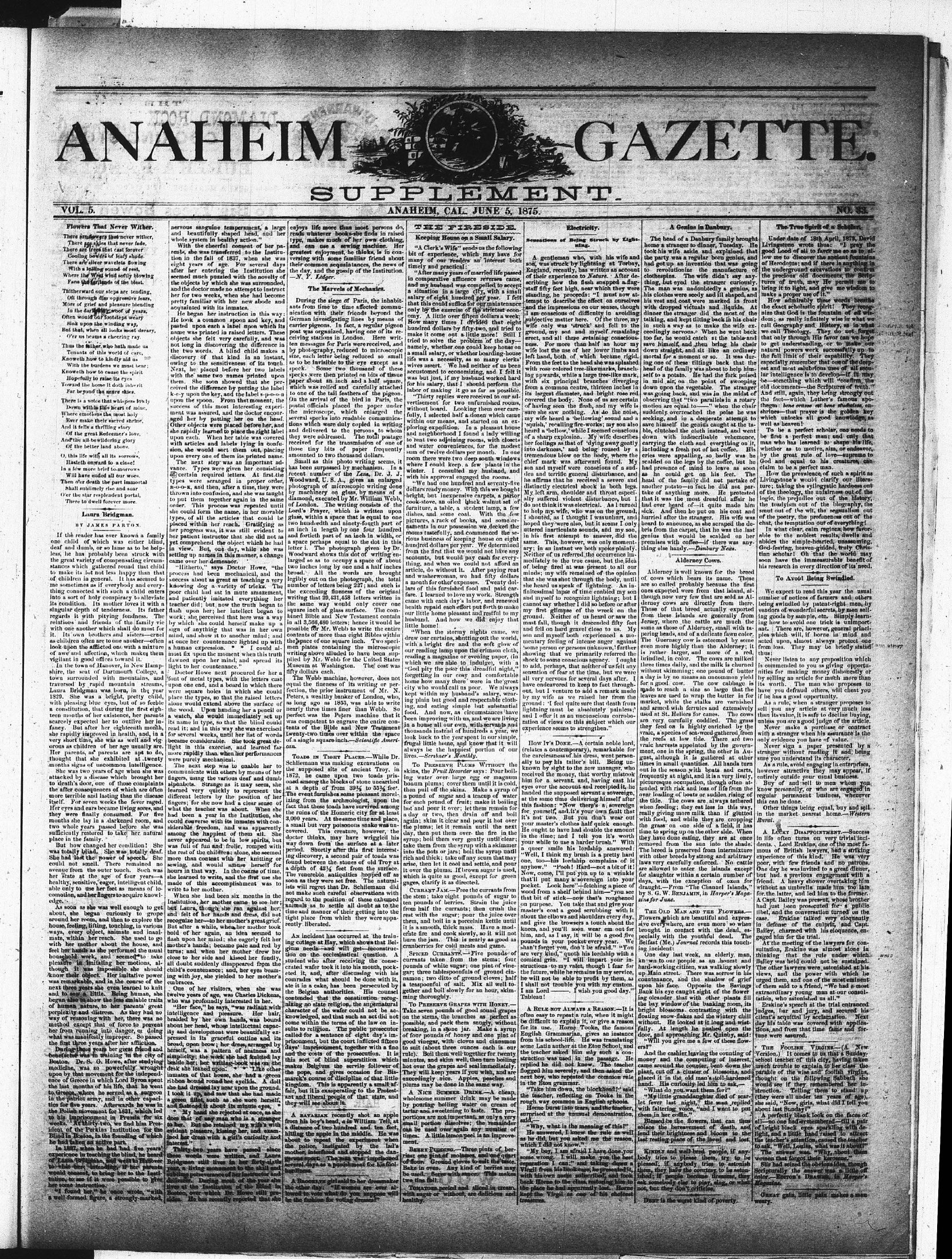
Searchable text
ANAHEIM
VOL. 5.
Flowers That Never Wither.
There are flowers that never wither,
There are skies that never fade.
There are trees that cast forever
Cooling browns of leafy shade.
There are silver waves flowing
With a soiling sound of rest,
Where the West wind softly blowing
Fans the far lands of the bleast.
Thitherward our steps are tending,
Oft through dim oppressive fears,
More of grief and pleasure blending
In the darkening wool of years.
Often would our footsteps weary
Sink upon the winding way,
But that, when all looks most dreary,
O'er us beams a cheering ray.
Thus the father, who hath made us
Tenants of this world of care,
Knoweth how to kindly aid us
With the burdens we must bear;
Knoweth how to cause the spirit
Hopefully to raise its eyes
Toward the home it doth inherit
Far beyond the azure skies.
There is a voice that whispers lowly
Down within this heart of mine,
Where emotions the most holy
Ever make their sacred shrine,
And it tells a thrilling story
Of the great Redeemer's love,
And the all-be wildering glory
Of the better land above.
O, this life with all its sorrows,
Hasteth onward to a close!
In a few more brief to morrows
nervous sanguine temperament, a large and beautifully shaped head, and her whole system in healthy action."
With the cheerful consent of her parents, she was transferred to the Institution in the fall of 1837, when she was eight years of age. For several days after her entering the Institution she seemed much puzzled with the novelty of the objects by which she was surrounded, and the doctor made no attempt to instruct her for two weeks, when she had become pretty familiar with her new abode and acquainted with its inmates.
He began her instruction in this way:
He took a common spoon and key, and pasted upon each a label upon which its name was printed in raised letters. These objects she felt very carefully, and was not long in discovering the difference in the two words. A blind child makes a discovery of that kind in an instant, owing to the sensitiveness of its touch.
Next, he placed before her two labels with the same two names printed upon them. She soon showed that she perceived the difference by putting the label k-e-y upon the key, and the label s-p-o-n upon the spoon. From that moment, the success of this most interesting experiment was assured, and the doctor encouraged her by patting her on the head.
Other objects were placed before her, and she rapidly learned to place the right label upon each. When her table was covered with articles and labels lying in confusion, she would sort them out, placing upon every one of them its printed name.
The next step was an important advance. Types were given their consisting enjoys life more than reads whatever books type, makes much of life and can use a sewing greatest enjoyment, he verses with some family their common acquaintance the day, and the gossip —N. Y. Ledger.
The Marvels of M
During the siege of Hants from time to time mention with their friend German investigating life carrier pigeons. In fact, post was organized, having receiving stations in London ten messages for Paris while by photography, reduced size, each letter being reas to be invisible to the speck. Some two thieves specks were then printed paper about an inch across which was rolled and cut to one of the tail feathers. On the arrival of the postal officials placed to the microscope, which several specks into readings which were duly carried and delivered to the printer they were addressed. Received for the transmission those tiny bits of paper amounted to two thousand.
Small as this photo w has been surpassed by my
Knoweth how to cause the spirit
Hopefully to raise its eyes
Toward the home it doth inherit
Far beyond the nature skies.
There is a voice that whispers lowly
Down within this heart of mine,
Where emotions the most holy
Ever make their sacred shrine,
And it tells a thrilling story
Of the great Redeemer's love,
And the all-bewildering glory
Of the better land above.
O, this life with all its sorrows,
Hasteth onward to a close!
In a few more brief to-morrows
Will have ended all our woes.
Then o'er death the part immortal
Shall sublimely rise and soar
O'er the star resplendent portal,
There to dwell forever more.
Laura Bridgman.
BY JAMES PARTON.
If the reader has ever known a family one child of which was either blind, deaf and dumb, or so lame as to be helpless, he has probably been struck with the great variety of compensating circumstances which gathered round that child to make its lot not less happy than that of children in general. It has seemed to me sometimes as if everybody and everything connected with such a child enters into a sort of holy conspiracy to alleviate its condition. Its mother loves it with a singular depth of tenderness. Its father regards it with pitying fondness. The relations and friends of the family vie with one another which shall do most for it. Its own brothers and sisters—cruel as children often are to one another—often look upon the afflicted one with a mixture of awe and affection, which makes them vigilant in good offices toward it.
In the town of Hanover, in New Hampshire, the seat of Dartmouth College, a town surrounded with mountains, and traversed by rapid mountain streams, Laura Bridgman was born, in the year 1829. She was a bright, pretty child, with pleasing blue eyes, but of so feeble a constitution, that during the first eighteen months of her existence, her parents scarcely expected her to outlive her infancy. But after her eighteenth month, she rapidly improved in health, and, in a very short time, she was as well and vigorous as children of her age usually are. Her parents, as parents are apt to do, thought that she exhibited at twenty months signs of uncommon intelligence.
She was two years of age when she was attacked by a disease which brought her to death's door, one of those complaints the after consequences of which are often more terrible and lasting than the disease itself. For seven weeks the fever raged. Her eyes and ears became living sores, and they were finally consumed. For five months she lay in a darkened room, and two whole years passed before she was sufficiently restored to take her natural place in the family.
But how changed her condition! She was totally blind. She was totally deaf. She had lost the power of speech. She could not smell. There remained no avenue from the outer touch. Such was her state at the age of four years—a healthy, sensitive, eager, intelligent child, able only to use her feet as means of lo-
Next, he placed before her two labels with the same two names printed upon them. She soon showed that she perceived the difference by putting the label k-e-y upon the key, and the label s-p-o-n upon the spoon. From that moment; the success of this most interesting experiment was assured, and the doctor encouraged her by patting her on the head. Other objects were placed before her, and she rapidly learned to place the right label upon each. When her table was covered with articles and labels lying in confusion, she would sort them out, placing upon every one of them its printed name.
The next step was an important advance. Types were given her consisting certain required letters. At first the types were arranged in proper order, B-O-O-K, and then, after a time, they were thrown into confusion, and she was taught to put them together again in the same order. This process was repeated until she could form the name, in her movable types, of all the articles that could be placed within her reach. Gratifying as her progress was, it was still evident to her patient instructor that she did not as yet comprehend the object which he had in view. But, one day, while she was setting up names in this manner, a change came over her demeanor.
"Hitherto," says Doctor Howe, "the process had been mechanical, and the success about as great as teaching a very knowing dog a variety of tricks. The poor child had sat in mute amazement, and patiently imitated everything her teacher did; but now the truth began to flash upon her; her intellect began to work; she perceived that here was a way by which she could herself make up a sign of anything that was in her own mind, and show it to another mind; and at once her countenance lighted up with a human expression."
I could almost fix upon the moment when this truth dawned upon her mind, and spread its light to her countenance."
Doctor Howe next procured for her a font of metal types, with the letters cast upon one end, and a board in which there were square holes in which she could place the types, so that the raised letters alone would extend above the surface of the wood. Upon handing her a pencil or a watch, she would immediately set up its name in type, so that the blind could read it; and in this way she was exercised for several weeks, until her list of words became considerable. She took great delight in this exercise, and learned far more rapidly than when her performances were purely mechanical.
The next step was to enable her to communicate with others by means of her fingers, using the various deaf and dumb alphabets. Strange as it may seem, she learned very quickly to represent the different letters by the position of her fingers; for she now had a clear sense of what the teacher was about. When she had been a year in the Institution, she could converse with its inmates with considerable freedom, and was apparently among the happiest of them all. She never appeared to be in low spirits, but was full of fun and frolic; romped with the rest of the children; alone, she seemed more than content with her knitting or sewing, and would amuse herself for hours in that way. In the course of time, she learned to write, and the first use she made of this accomplishment was to write to her mother.
Small as this photo we has been surpassed by my recent number of the Woodward, U.S.A., giving photograph of microscope by machinery on glass diamond, executed by Mr. London. The writing Lord's Prayer, which he glass within a space that two hundredth and ninety-fourth inches long by one broad. All the words legibly out on the photos number of letters being 20 exceeding fineness writing that 20,431,458 lines the same way would be square inch of glass surfaced Bible and New Testament for Mr. Webb to possible for Mr. Webb to contents of more than eight pages of one square inch men plates containing writing above alluded to by Mr. Webb for the Museum at Washington.
fifty dollars each.
The Webb machine, hot equal the fineness of its fection, the prior instrument Peters, a wealthy banker as long ago as 1855, was nearly three times finer than perfect was the Peters it was competent to engrave tents of the Bible and twenty-two times over width of a single square inch... can.
TOADS IN TIGHT PLACE
Schliermann was making his supposed site of an 1872, he came upon them on the blocks off at a depth of from 300 feet furnishes someizing from the archnose fact that these toads have ruins of the Homeric 3,000 years. At these small but very poisonous covered. This creature doctor thinks may have way down from the sun period. Shortly after this ing discovery, a second person found between the stones a depth of 43% feet from The venerable antiquities soon as they were set freeists will regret that Dr. S...
the after consequences of which are often more terrible and lasting than the disease itself. For seven weeks the fever raged. Her eyes and ears became living sores, and they were finally consumed. For five months she lay in a darkened room, and two whole years passed before she was sufficiently restored to take her natural place in the family.
But how changed her condition? She was totally blind. She was totally deaf. She had lost the power of speech. She could not smell. There remained no avenue from the outer touch. Such was her state at the age of four years—a healthy, sensitive, eager, intelligent child, able only to use her feet as means of locomotion, and her fingers to acquire knowledge.
As soon as she was well enough to get about, she began curiously to grope around her room, and then to explore the house, feeling, lifting, touching, in various ways, every object, animate and inanimate, within her reach. She used to go with her mother about the house, and feel her hands as she performed the usual household work, and seemed to take pleasure in limiting her motions, although it was impossible she should know their object. Her imitative power was remarkable, and in the course of the next three years she even learned to knit and to sew a little. Being human, she began also to show the less available traits of human nature, to her parents' great perplexity and distress. As they had no way of reasoning with her, there was no method except that of force to prevent her from running into danger or doing what was manifestly improper. So passed the first three years after her affliction.
During those years her great friend and benefactor was in training in the city of Boston, Dr. S. G. Howe, after studying medicine, was so powerfully wrought upon by that movement for the independence of Greece in which Lord Byron spent the last months of his life, that he went to Greece, where he served as a surgeon in the patriot army, and in other capacities for five years. Afterwards he was in the Polish movement for 1831, which led to his imprisonment in Prussia for six weeks. At thirty-two, we find him President of the Perkins Institution for the Blind in Boston, in the founding of which he had taken an active part.
In 1837 when he had had five years' experience in teaching the blind, he heard of Laura Bridgman, and went to Hanover to visit them, intending: If her parents would consent to bring her to the Institution, treasure if it were possible to give her some instruction.
"I found her," he once wrote, "with a well-formed figure, a strongly-marked,
learned very quickly to represent the different letters by the position of her fingers; for she now had a clear sense of what the teacher was about. When she had been a year in the Institution, she could converse with its inmates with considerable freedom, and was apparently among the happiest of them all. She never appeared to be in low spirits, but was full of fun and frolic, romped with the rest of the children; alone, she seemed more than content with her knitting or sewing, and would amuse herself for hours in that way. In the course of time, she learned to write, and the first use she made of this accomplishment was to write to her mother.
When she had been six months in the Institution, her mother came to see her; but Laura, though she ran against her; and felt of her hands and dress, did not recognize her—to her mother's great grief. But after a while, when her mother took hold of her again, an idea seemed to flash upon her mind; she eagerly felt her mother's hands; became pale and red by turns; and when her mother drew her close to her side and kissed her fondly, all doubt suddenly disappeared from the child's countenance; and, her eyes beaming with joy, she yielded to her mother's embraces.
One of her visitors, when she was twelve years of age, was Charles Dickens, who was profoundly interested in her.
"Her face," he says, "was radiant with intelligence and pleasure. Her hair braided by her own hands, was bound about her head, whose intellectual capacity and development were beautifully expressed in its graceful outline and its broad, open brow; her dress arranged by herself, was a pattern of neatness and simplicity; the work she had knitted lay beside her; her writing-book was on the desk she leaned upon."
Like other inmates of that house, she had a green ribbon bound round her eyelids. A doll she had dressed lay near upon the ground. I took it up, and saw that she had made a green fillet such as she wore herself, and fastened it about its minute eyes.
My hand she rejected at once, as she does that of any man who is a stranger to her. But she retained my wife's with evident pleasure, kissing her, and examined her dress with a girl's curiosity and interest."
Thirty-two years have passed since these words were written, and Laura Bridgeman still lives in her forty-sixth year, a living monument to the skill and sublime perseverance of her instructor and deliners. During most of the year she lives at the Institution of the Blind in Boston over which Dr. Howe still presides. He has recently reported that she
The event furnishes someizing from the archvale fact that those toads have ruined the Homeric period 3,000 years. At the same small but very poisonous covered.
This creature doctor thinks, may have way down from the sun period. Shortly after this discovery, a second pearl found between the stones a depth of 43½ feet deep. The venereble antiquities soon as they were set freeists will regret that Dr. S. not make such careful objection to the position of these animals as to settle all time and manner of their tight place from which they revert liberated.
An incident occurs during college at Hay, which gium needs—and will give on the ecclesiastical student who after receiving created wafer took it into his etered it, and after discus comrades what should be ate it in a cake, has been Belgian authorities.
contended that the constaining no state religion; the character of the wafer co-knownledged, and that such come within the terms of sults to religion. The pupil called for a sentence of prisonment, but the court days' imprisonment, together with the costs of the prosecution makes Belgium the servant pope; and gives occurrences marck's course of disciplinary kingdom. This is apparent fair, but it is exasperating ant and liberal people of which they will see about it.
A BAVARIAN recently visited from his boy's head,a la distance of two hundred miles hitting the apple in the midst about to repeat the entire police instigated mother,intended and also gerous sport.The man several days as a punishment hardiness.
A Booneys girl said to the other day: "If you want lowed to vote what do you be the fashion for voting
enjoys life more than most persons do,
reads whatever books she finds in raised
type, makes much of her own clothing,
and can use a sewing machine. Her
greatest enjoyment, he thinks, is in conversing with some familiar friend about
their common acquaintances, the news of
the day, and the gossip of the Institution.
N.Y. Ledger
The Marvels of Mechanics.
During the siege of Paris, the inhabitants from time to time affected communication with their friends beyond the German investigating lines by means of carrier pigeons. In fact, a regular pigeon post was organized, having one of its receiving stations in London. Here written messages for Paris were received, and by photography, reduced to microscopic size, each letter being reduced so small as to be invisible to the eye except as a speck. Some two thousand of these specks were then printed on bits of tissue paper about an inch and a half square, which was rolled and carefully attached to one of the tail feathers of the pigeon. On the arrival of the bird in Paris, the postal officials placed the paper under the microscope, which enlarged the several specks into readable communications which were duly copied in writing and delivered to the persons to whom they were addressed. The total postage received for the transmission of one of those tiny bits of paper frequently amounted to two thousand dollars.
Small as this photo writing seems, it has been surpassed by mechanism. In a
THE FIRESIDE.
Keeping House on a Small Salary.
"A Clerk's Wife" sends us the following bit of experience, which may have for many of our readers an interest both timely and practical:
"After many years of married life passed in comparative affluence reverses came, and my husband was compelled to accept a situation in a large city, with a small salary of eight hundred per year. I felt that this could suffice for our maintenance only by the exercise of the strictest economy. A little over fifteen dollars a week; How many times I divided that eight hundred dollars by fifty-two, and tried to make it come out a little more! Still I tried to solve the problem of the day—namely, whether one could keep house on a small salary, or whether boarding-house life was a necessity, as so many clerks' wives assert. We had neither of us been accustomed to economizing, and I felt it was but just, if my husband worked hard for his salary, that I should perform the labor of making it go as far as possible.
"Thirty replies were received to our advertisement for two unfurnished rooms, without board. Looking them over carefully, I selected half a dozen which came within our means, and started on an exploration expedition. In a pleasant house and neighborhood I found a lady willing to rent two adjoining rooms, with closets and water conveniences, for the modest sum of twelve dollars per month. In one room there were two deep south windows where I could keep a few plants in the electricity.
Sensations of Being Struck by Lightning.
A gentleman who, with his wife and son, was struck by lightning at Torbay, England, recently, has written an account of their experience to Nature. After describing how the flash snapped a flagstaff fifty feet high, near which they were standing, he proceeds: "I must now attempt to describe the effect on ourselves and the impressions on our senses, though I am conscious of difficulty in avoiding subjective matter here. Of the three, my wife only was 'struck' and fell to the ground, my son and myself remaining erect, and all three retaining consciousness. For more than half an hour my wife lost the use of her lower limbs and left hand, both of which became rigid. From the feet to the head she was splashed with rose colored tree-like marks, branching upwards, while a large tree-like mark, with six principal branches diverging from a common centre, thirteen inches in its largest diameter, and bright rose red covered the body. None of us are certain of having seen the flash, and my wife is sure she saw nothing. As to the noise, my wife heard a 'bellowing' sound and a 'squish,' recalling fire-works; my son also heard a 'bellow,' while I seemed conscious of a sharp explosion. My wife describes her feelings as that of 'dying away gently into darkness,' and being roused by a tremendous blow on the body, where the chief mark was afterward found. My son and myself were conscious of a suddle down with carrying them including cries were scalded on had presently..."
The head home a stright took his wrist the party wore had got up to revolve clothespins thing, but The man his clothes his vest and with dropp dinner the talking, and in such a ceedingly too far he save himself down strait mortal for one of head of the self to a poin mid alm down upon was going observing motion are suddenly ooze seeking, and save himself able, clutch down with carrying them including cries were scalded on had presently...
specks were then printed on bits of tissue paper about an inch and a half square, which was rolled and carefully attached to one of the tail feathers of the pigeon. On the arrival of the bird in Paris, the postal officials placed the paper under the microscope, which enlarged the several specks into readable communications which were duly copied in writing and delivered to the persons to whom they were addressed. The total postage received for the transmission of one of those tiny bits of paper frequently amounted to two thousand dollars.
Small as this photo writing seems, it has been surpassed by mechanism. In a recent number of the Lena, Dr. J. J. Woodward, U. S. A., gives an enlarged photograph of microscopic writing done by machinery on glass, by means of a diamond, executed by Mr. William Webb, of London. The writing consists of the Lord's Prayer, which is written upon glass, within a space that is equal to one two hundredth and ninety-fourth part of an inch in length by one four hundred and fortyth part of an inch in width, or a space perhaps equal to the dot in this letter i. The photograph given by Dr. Woodward shows this dot of writing enlarged so as to occupy a space of about two inches long by one and a half inches broad. All the words are brought legibly out on the photograph, the total number of letters being 227; and such is the exceeding fineness of the original writing that 20,431,458 letters written in the same way would only cover one square inch of glass surface. The combined Bible and New Testament contain in all 3,566,480 letters; hence it would be possible for Mr. Webb to write the entire contents of more than eight Bibles within the space of one square inch. Two specimens plates containing the microscopic writing above alluded to have been supplied by Mr. Webb for the United States Museum at Washington. The cost was fifty dollars each.
The Webb machine, however, does not equal the fineness of its writing or perfection, the prior instrument of Mr. N. Peters, a wealthy banker of London, who, as long ago as 1855, was able to write nearly three times finer than Webb. So perfect was the Peters machine that it was competent to engrave the entire contents of the Bible and New Testament twenty-two times over within the space of a single square inch.—Scientific American.
TOADS IN TIGHT PLACES.—While Dr. Schliemann was making excavations on the supposed site of ancient Troy, in 1872, he came upon two toads prisoned among the blocks of stone unearthed at a depth of from 30% to 55% feet. The event furnishes some pleasant moralizing from the archaeologist, upon the fact that these toads have survived among the ruins of the Homeric city for at least 3,000 years. At the same time and place, a small but very poisonous snake was uncovered. This creature, however, the doctor thinks, may have wriggled his way down from the surface at a later period. Shortly after this first interesting discovery, a second pair of toads was found between the stones of old Troy at a depth of 43% feet from the surface. The venerable antiquities hopped off as soon as they were set free. The naturalists will regret that Dr. Schliemann did accustomed to economizing, and I felt it was just but, if my husband worked hard for his salary, that I should perform the labor of making it go as far as possible.
"Thirty replies were received to our advertisement for two unfurnished rooms, without board. Looking them over carefully, I selected half a dozen which came within our means, and started on an exploring expedition. In a pleasant house and neighborhood I found a lady willing to rent two adjoining rooms, with closets and water conveniences, for the modest sum of twelve dollars per month. In one room there were two deep south windows where I could keep a few plants in the winter. I consulted my husband, and with his approval engaged the rooms.
"We had one hundred and seventy-five dollars ready money. With this we bought bright, but inexpensive carpets, a parlor cook-stove, an oiled black walnut set of furniture, a table, a student lamp, a few dishes, and some coal. With the few pictures, a rack of books, and some ornaments in our possession we decked the rooms tastefully, and commenced the serious business of keeping house on eight hundred dollars per year. We determined from the first that we would not have any accounts, but would pay cash for everything, and when we could not afford an article, do without it. After paying rent and washerwoman, we had fifty dollars a month for other expenses. Twenty dollars of this furnished food and paid carriage. I learned to love my work. Strength came with each day's labor, and renewed health repaid each effort put forth to make our little home pleasant and resful to my husband. And how we did enjoy that little home!
"When the stormy nights came, we drew our curtains, shutting out the world, with a bright fire and the soft glow of our reading lamp upon the crimson cloth, reading a magazine or evening paper, (in which we are able to indulge), with a "God pity the poor this dreadful night." Forgetting in our cosy and comfortable home how many there were in the great city who would call us poor. We always kept within my husband's salary, wearing plain but good and respectable clothing, and eating simple but substantial food. And now, as circumstances have been improving with us, and we are living in a house all our own, with servants and thousands instead of hundreds a year, we look back to the year spent in our simple frugal little home, and know that it will always be the happiest portion of our lives.—Scrubner's Monthly.
To Preserve Plums Without the skins, the Fruit Recorder says: Pour boiling water over large egg or magnum bonum plums; cover them until it is cold, then pull off the skins. Make a syrup of a pound of sugar and a teacup of water for each pound of fruit; make it boiling hot and pour it over; let them remain for a day or two, then drain off and boil again; skim it clear and pour it hot over the plums; let it remain until the next day; then put them over the fire in the syrup; boil them very gently until clear; take them from the syrup with a skimmer into the pots or jars; boil the syrup until rich and thick; take off any scum that may arise; then let cool and settle, and pour it over the plums. If brown sugar is used, which is quite as good, except for green gages, clarify it as directed.
How It's Done.—A certain noble lord (relates a contemporary), remarkable for the carelessness of his dress, went personally to pay his tailor's bill. Being unknown by sight to the new manager, who received the money, that worthy mistook him for a servant, and having cast his eyes over the account and receipted it, he handed the supposed servant a sovereign, at the same time delivering himself after this fashion: "Now pity's a sovereign for yourself, and it's your own fault that it's not two. But you don't wear out your master's clothes half quick enough. He ought to have had double the amount in the time; and I tell you it's worth while up at mid afternoon or in mid afternoon was going to observe that motion are suddenly on save himself clutching down with carrying them including cries were scalded on head head of that another took take of any that it was had ever sick. And hurried after heard to answer bris from that genius thus premises what else he
Alderney's wife are so called ones exported though now deranged cow Those of them from these Jersey, where same as those poring head The Guernsey even more lily is rather brindled, in three times without skipping a day is by for a good made to read leaves are used market wharf armed used at St. are very care they feed on vraia, a vraic harvestment one ingust although times in summer out in the se frequently a picturesque tended with over loading tide When feeding really giving with food at grass time to spring they have done removed The breed is with other baws very care allowed for slaughter days with draught—P
The event furnishes some pleasant morelizing from the archmologist, upon the fact that these toads have survived among the ruins of the Homeric city for at least 3,000 years. At the same time and place, a small but very poisonous snake was uncovered. This creature, however, the doctor thinks, may have wriggled his way down from the surface at a later period. Shortly after this first interesting discovery, a second pair of toads was found between the stones of old Troy at a depth of 43½ feet from the surface. The venereble antiquities hopped off as soon as they were set free. The naturalists will regret that Dr. Schliemann did not make such careful observations with regard to the position of these exhumed animals as to settle all doubt as to the time and manner of their getting into the tight place from which they were apparently liberated.
An incident has occurred at the training college at Hay, which shows that Belgium needs—and will get—reconstruction on the ecclesiastical question. A student who after receiving the consecrated wafer took it into his mouth, pocketed it, and, after discussing with his comrades what should be done with it, ate it in a cake, has been persecuted by the Belgian authorities. His counsel contended that the constitution recognizing no state religion, the supernatural character of the wafer could not be acknowledged, and that such an act did not come within the terms of the law on insults to religion. The public prosecutor called for a sentence of eight day's imprisonment, but the court inflicted fifteen days' imprisonment, together with a fine and the costs of the prosecution. It is this sort of blind superstition which makes Belgium the servile follower of the pope, and gives occasion for Bismarck's course of discipline of that little kingdom. This is apparently a small affair, but it is exasperating to the Protestant and liberal people of that state, and they will see about it.
A BAVARIAN recently shot an apple from his boy's head, as William Tell, at a distance of two hundred and ten feet, hitting the apple in the middle. He was about to repeat the experiment when the police, instigated by the lad's mother, interfaced and stopped the dangerous sport. The man was imprisoned several days as a punishment for his foolishness.
A Brooklyn girl said to her drummaker the other day: "If women are ever allowed to vote what do you suppose will be the fashion for voting dreams!"
GAZETTE.
NO. 83.
A Genius in Danbury.
The head of a Danbury family brought home a stranger to dinner, Tuesday. He took his wife aside and explained that the party was a regular born genius, and had got up an invention that was going to revolutionize the manufacture of clothespins. The wife didn't say anything, but eyed the stranger curiously. The man was undoubtedly a genius, as his clothes were seedy and ill shaped, and his vest and coat were marked in front with dropped victuals and liquids. At dinner the stranger did the most of the talking, and kept tilting back in his chair in such a way as to make the wife exceedingly nervous. When he went back too far, he would catch at the table and save himself, and then bring his chair down straight, and sit like an ordinary mortal for a moment or so. It was during one of these tilings back that the head of the family was about to help himself to a potato. He had the fork poised in mid air, on the point of swooping down upon the vegetable. The stranger was going back, and was in the midst of observing that "two parallels in a rotary motion are equal to——" when the chair suddenly overreached the poise he was seeking, and in a desperate attempt to save himself the genius caught at the table, clutched the cloth instead, and went down with indescribable vehemence, carrying the cloth and everything on it, including a fresh pot of hot coffee. His cries were appalling, so badly was he scalded on the legs by the coffee, but he had presence of mind to leave as soon
The True Spirit of a Scholar.
Under date of 18th April, 1879, David Livingstone wrote thus: "I pray the good Lord of all to favor me so as to allow me to discover the ancient fountains of Herodotus; and if there is anything in the underground excavations to confirm the precious old documents, the Scriptures of truth, may He permit me to bring it to light, and give me wisdom to make a proper use of it."
How admirably these words breathe the exact scholastic spirit! They recognize that God is the fountain of all wisdom; as really infinitely wise in what we call Geography and History, as in what we call Theology. They do not forget that only through His favor can we hope to get understanding, or to make our natural powers work successfully up to the full limit of their capability. They especially remember that one of the deepest and most salubrious uses of all secular intelligence is to develop—if it may be—something which will "confirm the old documents—the Scriptures of truth." And still, again, they bring strongly out the fact—which Luther's famous apothegm: bene ornasse est bene studente, enshrines—that prayer is the golden key which unlocks all good knowledge, as well as heaven!
To be a perfect scholar, one needs to be first a perfect man; and only that man who has learned so shape his life, whether as to motive, aim, or endeavor, by the great rule of love—supreme to God and equal to his creatures, can claim to be a perfect man.
Alderney Cows.
Alderney is well known for the breed of cows which bears its name. These are so called probably because the first ones exported were from that island, although now very few that are sold as Alderney cows are directly from there. Those of that breed actually exported from these islands are generally from Jersey, where the cattle are much the same as those of Alderney, small with tapering heads, and of a delicate fawn color. The Guernsey cow is esteemed by some even more highly than the Alderney; it is rather larger, and more of a red, brindled, in color. The cows are milked three times daily, and the milk is churned without skimming; one pound of butter a day is by no means an uncommon yield for a good cow. The cow cabbage is made to reach a size so large that the leaves are used to wrap the butter in for market, while the stalks are varnished and armed with ferrucles and extensively used at St. Heliers for canes. The cows are very carefully coddled. The grass they feed on is highly enriched by the vraic, a species of seaweed gathered from the reefs at low tide. There are two vraic harvests appointed by the government, one in the spring, the other in August, although it is gathered at other times in small quantities. All hands turn out in the season with boats and carts, frequently at night, and it is a very lively, picturesque occupation, though often attended with risk and loss of life from the over loading of boats or sudden rising of the tide. The cows are always tethered when feeding; they eat less in this way, really giving more milk than if glutted with food, and while they are cropping the grass on one side of a field, it has time to spring up on the other side. When they have done eating, they are at once removed from the sun into the shade. The breed is preserved from intermixture with other breeds by strong and arbitrary laws very carefully enforced. No cattle are allowed to enter the islands except for slaughter within a certain number of days, with the exception of oxen for draught.—From "The Channel Islands."
A Lucky Disappointment.—Success in life often turns on very trivial incidents. Lord Erskine, one of the most famous of British lawyers, had a striking experience of this kind. He was very poor, with few friends and no patrons. One day he was invited to a great dinner, but had a previous engagement with a friend. A heavy shower overtaking him without an umbrella made him too late self-to-a potato. He had the fork poised in mid air, on the point of swooping down upon the vegetable. The stranger was going back, and was in the midst of observing that "two parallels in a rotary motion are equal to——" when the chair suddenly overreached the poise he was seeking, and in a desperate attempt to save himself the genius caught at the table, clutched the cloth instead, and went down with indescribable vehemence, carrying the cloth and everything on it, including a fresh pot of hot coffee. His cries were appalling, so badly was he scalded on the legs by the coffee, but he had presence of mind to leave as soon as he could get on his feet. The head of the family did not partake of another potato—in fact he did not partake of anything more. He protested that it was the most dreadful affair he had ever heard of—it quite made him sick. And then he put on his coat and hurried after the stranger. His wife was heard to announce, as she scraped the debris from the carpet, that he was the last genius that would be scalded on her premises with coffee—if there was anything else handy.—Danbury News.
To be a perfect scholar, one needs to be first a perfect man; and only that man who has learned to shape his life, whether as to motive, aim, or endeavor, by the great rule of love—supreme to God and equal to his creature, can claim to be a perfect man.
How the prevalence of such a spirit as Livingstone's would clarify our literature; taking the syllogistic hardness out of the theology, the unfairness out of the logic, the prejudice out of the history, the toadyism out of the biography, the smut out of the wit, the sensualism out of the poetry, the profaneness out of the chat, the temptation out of everything!
In what clear, calm regions how favorable to the noblest results, dwells and abides the simple-hearted, unassuming, God-fearing, heaven-gilded, truly Christian scholar! Oh that world may soon have the immeasurable benefit of his research in every direction of its need.
To Avoid Being Swindled.
We expect to read this year the usual number of notices of farmers and others being swindled by patent-right men, by vendors of wonderful secrets, by men selling goods by sample, etc. Simply learning how to avoid one trick is unimportant. There are, however, general principles which will, if borne in mind and acted upon, almost always protect one from loss. They may be briefly stated thus:
Never listen to any proposition which is commended to you as giving opportunities for making money dishonestly or by selling an article for much more than its worth. The man who proposes to have you defraud others will cheat you if he has a good opportunity.
As a rule; when a stranger proposes to sell you any article at very much less than its value, it is safe to decline buying, unless you are a good judge of the article.
Never make a purchase or contract with a stranger when his assurance is the only evidence you have of value.
Never sign a paper presented by a stranger without reading it and being sure you understand its character.
As a rule, avoid engaging in enterprises however attractive they may appear, if entirely outside your usual business.
Buy of and sell to men whom you know personally, or who are engaged in regular permanent business, whenever this can be done.
Other things being equal, buy and sell in the market nearest home—Western Rural.
A LOCKY DISAPPOINTMENT.—Success in life often turns on very trivial incidents. Lord Erskine, one of the most famous British lawyern, had a striking experience of this kind. He was very poor, with few friends and no patrons. One day he was invited to a great dinner, but had a previous engagement with a friend. A heavy shower overtaking him without an umbrella made him too late for the latter, and led him to the former. A Capt. Bailey was present, whose brother had just been prosecuted for a public libel, and the conversation turned on the case. Erskine talked very eloquently in defense of the culprit, and Capt. Bailey, charmed with his eloquence, engaged him for the trial.
At the meeting of the lawyers for consultation, Erskine was almost alone in thinking that the rule under which Bailey was held could not be sustained. The other lawyers were astonished at his views, and the power with which he urged them, and one of the most eminent of them said to a friend, "We had a most extraordinary young man at our consultation, who astonished us all."
Erskine's speech at the trial entranced judges, bar and jury, and secured his client's acquittal by acclamation. Next day his table was covered with applications, and from that time fame and fortune were assured.
THE FOOLISH VIRGINIA—(A New Version.) It comes to us that a Sunday-school teacher of this city, having taken much trouble to explain to her class the parable of the wine and foolish virgins, thought on the following Sabbath she would see if they remembered her instruction. Telling them to stand up (they were all under ten years of age), she said, "Now, girls, what did I tell you about last Sunday?"
A perfectly blank look on the faces of all—no one had remembered—fill a pair of bright black eyes sparkling with delight, and a little hand raised to attract the teacher's attention, caused the teacher to ask, "Well, Louis, what was it about?"
The answer was: "Why, about them women that forgot their kerosene."
She had seized the obvious idea, though Scripturally the answer was a little off color—Horron's DRAWN, in Harper's Magazine.
GREAT gain, little pain makes a man weary.