anaheim-gazette 1875-05-01
Scanned page
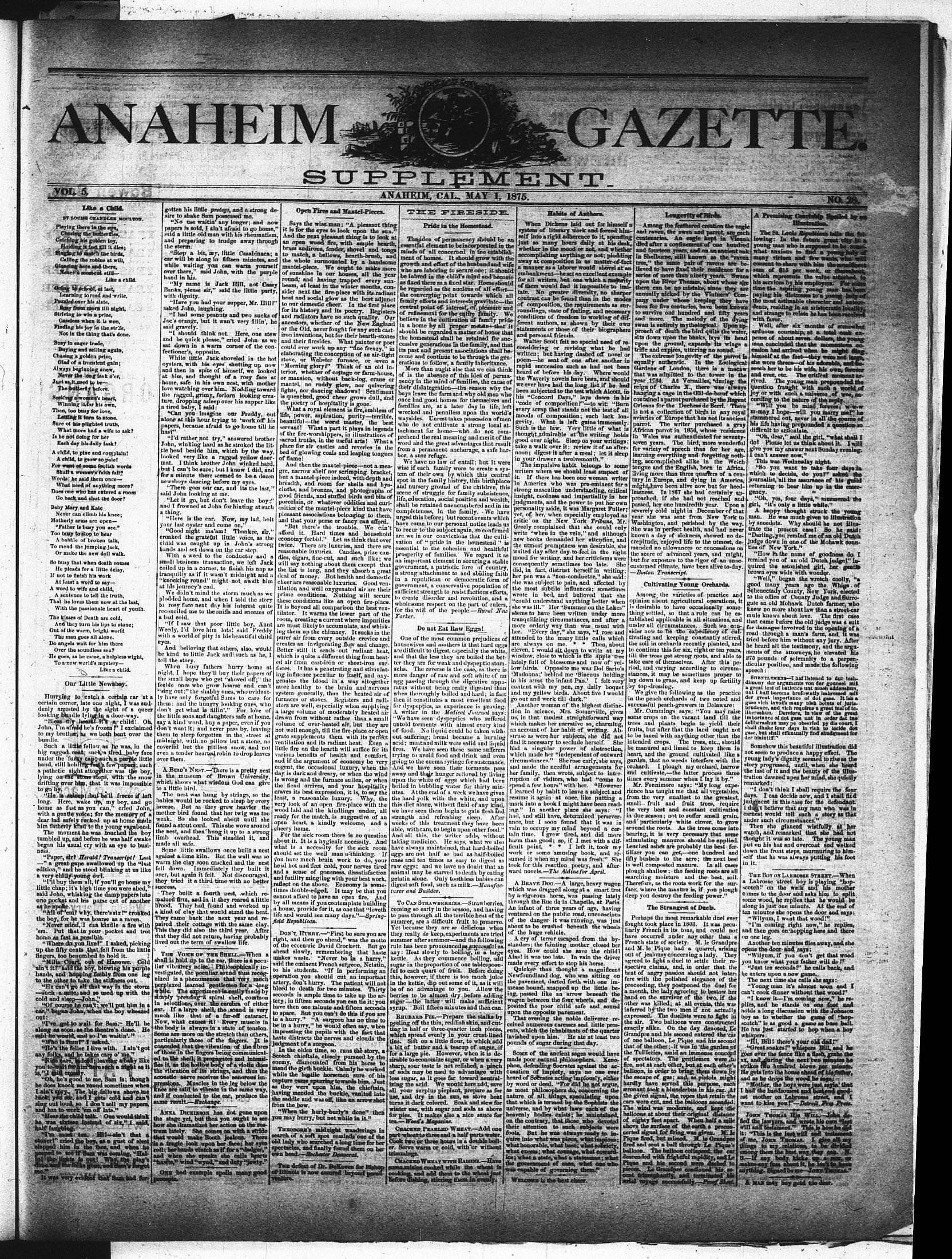
Searchable text
ANAHEIM
VOL. 5.
Like a Child.
BY LOUISE CHANDLER MOULTON.
Playing there in the sun,
Chasing the butterflies,
Catching his golden toy,
Holding it fast till it dies;
Singing to match the birds,
Calling the robins at will,
Glancing here and there,
Never a moment still—
Like a child.
Going to school, at last,
Learning to read and write,
Puzzled over his slate,
Busy from morn till night,
Striving to win a prize,
Careless when it is won,
Finding his joy in the stride,
Not in the thing that's done.
Busy in eager trade,
Buying and selling again,
Chasing a golden prize,
Glad of a transient gain;
Always beginning anew,
Never the long task o'er,
Just a task used to be—
The butterfly before.
Seeking a woman's heart,
Winning lily for his own,
Then, too busy for love,
Loving it turn to stone.
Sure of his plighted truth,
What more had a wife to ask?
Is he not doing for her
Each day his daily task?
A child, to pine and complain!
A child, to grow so pale!
For want of some foolish words
gotten his little protege, and a strong desire to shake Sam possessed me.
"No use waitin' any longer; and now papers is sold, Iain't afraid to go home," said a little old man with his rheumatism, and preparing to trudge away through the storm.
"Stop a bit, my, little Casabina; a car will be along in fifteen minutes, and while waiting you can warm yourself over there," said John, with the purple hand in his.
"My name is Jack Hill, not Cassy Banks, please sir," said the little party, with dignity.
"Have you had your supper, Mr. Hill?" asked John, laughing.
"I had some peanuts and two sucks of Joe's orange, but it wan't very fillin', he said gravely.
"I should think not. Here, one stew and be quick please," cried John as we sat down in a warm corner of the confectioner's, opposite.
While little Jack shoveled in the hot oysters, with his eyes shutting up now and then in spite of himself, we looked at him, and thought of a rosy face at home, safe in his own nest, with mother love watching over him. Nodding toward the ragged, grimy, forlorn looking creature, dropping asleep over his supper like a tired baby, I said:
"Can you imagine our Freddy, out alone at this hour trying to 'work off' his papers, because afraid to go home till he has?"
"I'd rather not try," answered brother John, winking hard as he stroked the little head beside him, which by the way, looked very like a ragged yellow doormat. I think brother John winked hard, but I can't be sure; but I know I did and
Open Fires and Mansions
Says the wise man: "A life is for the eyes to look up. And the next pleasant thing is an open wood fire, with brass and irons, fender, shear to match, a bellows, hearth the whole surmounted by mantel-piece. We ought to of sunshine in our houses round; and having trapped beam, at least in the winter sider next the fire-place with heat and social glow as they to our domestic cheer. In for its history and its poetry and radiators have no such ancestors, whether of the Old or the Old, never fought for iron inventions, but for their and their firesides. What could ever work up any "fire" elaborating the conception of a stove, or Webster furnace? Morning glory!" Think interior, whether of cottage or mansion, without back mantel, no ruddy glow, no lights, nor dancing shadowes is quenched, good cheer grows the poetry of hospitality is."
What a royal element is for life, power, aspiration, pure beauty—the worst master servant! What a part it plays of the fire-worshippers, in its sacred truths, in the useful place for air castles and reed bed of glowing coals and leafless! And then the mantel-piece.
Never the long task over,
Just as it need to be—
The butterfly before.
Seeking a woman's heart,
Winning in his own,
Then, too busy for love,
Letting it turn to stone.
Sure of his plighted truth,
What more had a wife to ask?
Is he not doing for her
Each day his daily task?
A child, to pine and complain!
A child, to grow so pale!
For want of some foolish words
Shall a woman's faith fall?
Words! he said them once—
What need of anything more?
Does one who has entered a room
Go back and shut the door?
Baby Mary and Kate
Never can climb his knee;
Motherly arms are open—
"Father is busy you see."
Too busy to stop to hear
A babble of broken talk,
To mend the jumping jack,
Or make the new doll walk.
So busy that when death comes
He pleads for a little delay,
If not to finish his work
At least a word to say—
A word to wife and child,
A sentence to tell the truth,
That he loves them now at the last,
With the passionate heart of youth.
The kisses of Death are cold,
And they turn his lips to stone;
Out of the warm, bright world
The man goes all alone.
Do angels wait for him there
Over the soundless sea?
He goes, as he came, a helpless wight,
To a new world's mystery—
Like a child.
Our Little Newsboy.
Hurrying to catch a certain car at a certain corner, late one night, I was suddenly arrested by the sight of a queer looking bundle lying in a door-way.
"Bless my heart! it's a child! Oh, John, I'm afraid he's frozen!" I exclaimed to my brother, as we both bent over the bumle.
Such a little fellow as he was, in the big ragged coat; such a tired baby face under the furry cap; such a purple little hand, still holding that few papers; such a pathetic sight altogether was the boy, lying on the stone steps, with the snow drifting over him, that it was impossible to go by.
"He is sleepy; but he'll freeze if left long. Here, wake up, my boy, and go home as fast as you can," cried John, with a gentle voice; for the memory of a dear lad safely fucked up at home made him fatherly kind to the young vagabond.
The moment he was touched the boy tumbled up, and before he was half awake began his usual cry with an eye to business.
"Paper, air? Herald / Transcript! Last —" a great gape swallowed up the "last edition," and he stood blinking at us like a very chilly young owl.
"I'll buy them all, if you'll go home my little chap; it's high time you were abed."
Can you imagine our Freddy, out alone at this hour trying to 'work off' his papers, because afraid to go home till he has?
"I'd rather not try," answered brother John, winking hard as he stroked the little head beside him, which by the way, looked very like a ragged yellow door-mat. I think brother John winked hard, but I can't be sure; but I know I did, and for a minute there seemed to be a dozen newsboys dancing before my eyes.
"There goes our car, and its the last," said John looking at me.
"Let it go, but don't leave the boy;" and I frowned at John for hinting at such a thing.
"Here is the car. Now, my lad, bolt your last oyster and come on."
"Good night ma'am! Thankeee, sir," croaked the grateful little voice, as the child was caught up in John's strong hands and set down on the car step.
With a word to the conductor and a small business transaction, we left Jack coiled up in a corner, to finish his nap as tranquilly as if it wasn't midnight and a "knocking round" might not await him at his journey's end.
We didn't mind the storm much as we plodded home, and when I told the story to rosy face next day his interest quite reconciled me to the sniffs and sneezes of a bad cold.
“If I saw that poor little boy, Aunt Weedy, I'd love him lots!” said Freddy with a world of pity in his beautiful child eyes.
And believing that others, also, would be kind to little Jack and such as he, I tell the story.
When busy fathers hurry home at night, I hope they'll buy their papers of the small boys who get "shoved off;" the feeble ones who grow hoarse and can't "sing out;" the shabby ones, who evidently have only forgetful Sams to care for them; and the hungry looking ones, who don't get what is illin'.” For love of the little sons and daughters safe at home, say a kind word, buy a paper, even if you don't want it; and never pass by, leaving them to sleep forgotten in the street at midnight, with no pillow but a stone, no coverlid but the pitiless snow, and not even a tender hearted robin to drop leaves over them.
A Bird's Nest. There is a pretty nest in the museum of Brown University, which shows what wisdom God can give to a little bird.
The nest was hung by strings, so the babies would be rocked to sleep by every breeze. But as they grew heavier the mother bird found that her twig was too weak. So she looked about until she found a stout cord. This she wove around the nest, and then hung it up to a strong limb overhead. This steadied it, and made all safe.
Some little swallows once built a nest against a lime kiln. But the wall was so warm the clay soon cracked and the nest fell down. Immediately they built it over, but again it fell. Not discouraged, they tried it a third time with no better success.
What a royal element is life, power, aspiration, beauty—the worst master servant! What a part it plays of the fire-worshippers, in life sacred truths, in the useful place for air castles and reeds bed of glowing coals and leaf of flame!
And then the mantel-piece grease, narrow shelf nor scrimpit but a mantel-piece indeed, with breadth, and room for shinecints, and bronzes, and plaid good friends, and stuffed birch porcelain, or whatever oddities of the mantel-piece keep pleasant associations belonged and that your purse or fancy "But there's the trouble afford it. Hard times and economy forbid." Let us thus twice. There are luxuries, reasonable luxuries. Candles dies, cigars fine-cut, and suns will say nothing about them—the list is long, and they are deal of money. But health cheer are reasonable luxuries; tilation and well oxygenated prime conditions. Nothing these conditions like an open It is beyond all comparison or titulator. It warms the lower room, creating a current where are most likely to accumulate ingenates the blood in a waistmore healthy to the brain system generally, than the furnaces or stoves. Registerators are well, especially when a large volume of moderately drawn from without rather than volume of over-heated air; but not well enough, till the fire-pressure supplements them with ventilation and its radiant heat little fire on the hearth will save various benefits of health and if the argument of economic cognent, the occasional luxury day is dark and dreary, or which is wrong and the furnace sullies the fiend arrives, and your craves its best expression, it is least, a reasonable luxury. Very look of an open fire-plait wood laid and the kindlings ready for the match, is suggest open heart, a kindly welcoming cheery home.
For the sick room there is about it. It is a hygienic necessity what is a necessity for them should set the well man at-the-middle you have much brain work head hot and feet cold, your nails and a sense of goneness, disgraceful futility mingling with your reflect on the above. Economical time doubled adown.
"He is askup; but he'll freeze if left long. Here, wake up, my boy, and go home as fast as you can," cried John, with a gentle voice; for the memory of a dear lad safely tucked up at home made him fatherly kind to the young vagabond.
The moment he was touched the boy tumbled up, and before he was half awake began his usual cry with an eye to business.
"Paper, sir! Herald! Transcript! Last —" a great gape swallowed up the "last edition," and he stood blinking at us like a very chilly young owl.
"I'll buy them all, if you'll go home my little chap; it's high time you were abed," said John, whisking the damp papers into one pocket and his purse out of another as he spoke.
"All of 'em! why, there's six!" croaked the boy, for he was hoarse as a raven.
"Never mind, I can kindle a fire with 'em. Put that in your pocket and trot home as fast as possible.
"Where do you live?" I asked, picking up the fifty cents that fell from the little fingers, too benumbed to hold it.
"Mills Court, out of Hanover. Cold isn't it!" said the boy, blowing his purple hands, and hopping leebly from one leg to the other to take the stiffness out.
"He can't go all that way in the storm—such a mite, and so used up with the cold and sleep—John."
"Of course he can't; we'll put him in a car," began John, when the boy wheezed out:
"I've got to wait for Sam. He'll be along as soon as the theatre's done. He said he would, and so I'm waitin'."
"Who is Sam?" I asked.
"He's the felter I live with. I can't get any folks, and he takes care of me."
"Now care, indeed; leaving a baby like you to wait for him here such a night as it is." I said crisply.
"Oh, he's good to me, Sam is; though he does knock me round sometimes when I can't apry. The big follows above me back; you see, and I gets cold and can't sing out loud, so I don't sell my papers, and has to work 'em off late."
"Heas the child talk. One would think he was sixteen instead of six," I said, half laughing.
"I'm most ten. Hill—sincnt that a stoner!" cried the boy, as a gust of sleet slapped him in the face, and when he peeped to see if Sam was coming, "Hal-fol the lights is out! Why, the play's fine and the folks gone; and hasn't forgot man."
It was very evident that Sam had for
The nest was hung by strings, so the babies would be rocked to sleep by every breeze. But as they grew heavier the mother bird found that her twig was too weak. So she looked about until she found a stout cord. This she wove around the nest, and then hung it up to a strong limb overhead. This steadied it, and made all safe.
Some little swallows once built a nest against a lime kiln. But the wall was so warm the clay soon cracked and the nest fell down. Immediately they built it over, but again it fell. Not discouraged, they tried it a third time with no better success.
They built a fourth nest, which remained firm, and in it they reared a little brood. They had found and worked up a kind of clay that would stand the heat. They came back the next year and repaired their cottage with the same clay. This they did also the third year. After that they did not return, having probably lived out the term of swallow life.
THE VOICE OF THE SHELL—When a shell is held up to the ear, there is a peculiar vibratory noise. Philosophically investigated, the peculiar sound thus recognized is a phenomenon that very much perplexed learned gentlemen for a long while. The experiment is easily made by simply pressing a spiral shell, common in selections, over the cerebra of either ear. If a large shell, the sound is very much like that of a far-off cataract. Now, what causes it? Every muscle in the body is always in a state of tension. Some are more on the stretch than others, particularly those of the fingers. It is conceded that the vibration of the fibres of those in the fingers being communicated to the shell; it propagates and intensifies it, as the hollow body of a violin does the vibration of its strings, and thus the acoustic nerve receives the sonorous impressions. Muscles in the leg below the knee are said to vibrate in the same way, and if conducted to the ear, produce the same result—Exchange.
ANNA DICKINSON has not gone upon the stage yet, but then you ought to see how she dramatizes her action on the rostrum lately. She comes on with a stride that would make Booth jealous. There is a tragic look upon her face; her eyes roll; her hands clutch as if for a "dadger," and when she speaks she calls hearts "hawin," wind "wynd," and duty "jewty."
One had example spoils many good precepts.
The nest was hung by strings, so the babies would be rocked to sleep by every breeze. But as they grew heavier the mother bird found that her twig was too weak. So she looked about until she found a stout cord. This she wove around the nest, and then hung it up to a strong limb overhead. This steadied it, and made all safe.
Some little swallows once built a nest against a lime kiln. But the wall was so warm the clay soon cracked and the nest fell down. Immediately they built it over, but again it fell. Not discouraged, they tried it a third time with no better success.
They built a fourth nest, which remained firm, and in it they reared a little brood. They had found and worked up a kind of clay that would stand the heat. They came back the next year and repaired their cottage with the same clay. This they did also the third year. After that they did not return, having probably lived out the term of swallow life.
THE VOICE OF THE SHELL—When a shell is held up to the ear, there is a peculiar vibratory noise. Philosophically investigated, the peculiar sound thus recognized is a phenomenon that very much perplexed learned gentlemen for a long while. The experiment is easily made by simply pressing a spiral shell, common in selections, over the cerebra of either ear. If a large shell, the sound is very much like that of a far-off cataract. Now, what causes it? Every muscle in the body is always in a state of tension. Some are more on the stretch than others, particularly those of the fingers. It is conceded that the vibration of the fibres of those in the fingers being communicated to the shell; it propagates and intensifies it, as the hollow body of a violin does the vibration of its strings, and thus the acoustic nerve receives the sonorous impressions. Muscles in the leg below the knee are said to vibrate in the same way, and if conducted to the ear, produce the same result—Exchange.
ANNA DICKINSON has not gone upon the stage yet, but then you ought to see how she dramatizes her action on the rostrum lately. She comes on with a stride that would make Booth jealous. There is a tragic look upon her face; her eyes roll; her hands clutch as if for a "dadger," and when she speaks she calls hearts "hawin," wind "wynd," and duty "jewty."
One had example spoils many good precepts.
The nest was hung by strings, so the babies would be rocked to sleep by every breeze. But as they grew heavier the mother bird found that her twig was too weak. So she looked about until she found a stout cord. This she wove around the nest, and then hung it up to a strong limb overhead. This steadied it, and made all safe.
Some little swallows once built a nest against a lime kiln. But the wall was so warm the clay soon cracked and the nest fell down. Immediately they built it over, but again it fell. Not discouraged, they tried it a third time with no better success.
They built a fourth nest, which remained firm, and in it they reared a little brood. They had found and worked up a kind of clay that would stand the heat. They came back the next year and repaired their cottage with the same clay. This they did also the third year. After that they did not return, having probably lived out the term of swallow life.
THE VOICE OF THE SHELL—When a shell is held up to the ear, there is a peculiar vibratory noise. Philosophically investigated, the peculiar sound thus recognized is a phenomenon that very much perplexed learned gentlemen for a long while. The experiment is easily made by simply pressing a spiral shell, common in selections, over the cerebra of either ear. If a large shell, the sound is very much like that of a far-off cataract. Now, what causes it? Every muscle in the body is always in a state of tension. Some are more on the stretch than others, particularly those of the fingers. It is conceded that the vibration of the fibres of those in the fingers being communicated to the shell; it propagates and intensifies it, as the hollow body of a violin does the vibration of its strings, and thus the acoustic nerve receives the sonorous impressions. Muscles in the leg below the knee are said to vibrate in the same way, and if conducted to the ear, produce the same result—Exchange.
ANNA DICKINSON has not gone upon the stage yet, but then you ought to see how she dramatizes her action on the rostrum lately. She comes on with a stride that would make Booth jealous. There is a tragic look upon her face; her eyes roll; her hands clutch as if for a "dadger," and when she speaks she calls hearts "hawin," wind "wynd," and duty "jewty."
One had example spoils many good precepts.
The nest was hung by strings, so the babies would be rocked to sleep by every breeze. But as they grew heavier the mother bird found that her twig was too weak. So she looked about until she found a stout cord. This she wove around the nest, and then hung it up to a strong limb overhead. This steadied it, and made all safe.
Some little swallows once built a nest against a lime kiln. But the wall was so warm the clay soon cracked and the nest fell down. Immediately they built it over, but again it fell. Not discouraged, they tried it a third time with no better success.
They built a fourth nest, which remained firm, and in it they reared a little brood. They had found and worked up a kind of clay that would stand the heat. They came back the next year and repaired their cottage with the same clay. This they did also the third year. After that they did not return, having probably lived out the term of swallow life.
THE VOICE OF THE SHELL—When a shell is held up to the ear, there is a peculiar vibratory noise. Philosophically investigated, the peculiar sound thus recognized is a phenomenon that very much perplexed learned gentlemen for a long while. The experiment is easily made by simply pressing a spiral shell, common in selections, over the cerebra of either ear. If a large shell, the sound is very much like that of a far-off cataract. Now, what causes it? Every muscle in the body is always in a state of tension. Some are more on the stretch than others, particularly those of the fingers. It is conceded that the vibration of the fibres of those in the fingers being communicated to the shell; it propagates and intensifies it, as the hollow body of a violin does the vibration of its strings, and thus the acoustic nerve receives the sonorous impressions. Muscles in the leg below the knee are said to vibrate in the same way, and if conducted to the ear, produce the same result—Exchange.
ANNA DICKINSON has not gone upon the stage yet, but then you ought to see how she dramatizes her action onthe rostrum lately.She comes on with a stride that would make Booth jealous.Here is some reasonable luxury.
very look at an open fire-plane wood laid and an kindlings ready forthe match.is suggrent open heart,a kindly welcoming cheery home.
Forthe sick room there is aboutit.it Isa hygienic necesitwhatis an necessity forthe should setthe well mana-thiyou have much brain workthe head hotand feet cold,your nenad sense of goneness,discand futility minglingwithyour reflectonthe above.Economytimes double-edged.I may cannot affordto have an openby all meansif you contempla house,provideforit.asone tifelifeandwouldseemanydays.fieldRepublican.
DON'T HURRY.-"First be right,and then go ahead,"wasofthe eccentric David Crockerahead slowly,rememberingmake waste.“Neverbeinaidsaidthe eminent French surgeontohis students.“Ifinperoperationyoushouldcutanartery,donthurry.Thepaticleblecdto deathfortwo minutessecondesisampletimetotaketery;in fifteen secondsyoucanhavethen one minuteandfifteentospare.Butyoucan'tdothisin'a hurry.”“A surgeonhasbeeninahurry,”hewouldoftenimpressingthepupilswiththistastedistractsthe nervesandjudgmentofa surgeon.
Intheoldtentime,soultershowthedocchieftaincloselypurusenemy,dismountedfromhimmendthegirth buckle.Calmlywhilethe hostilehorsemenacapturecame spurringtowardsastheywereuponhim,thehavingmendedthebuckle,vothesaddleandwasoff,andanfromthebow.
"Whenthe hurly-burly'doyoumayhurrybutnotwhilei"
Theodoren'smidnightwantsearchofasoftspotremindsold ladywho searchedalongthetpectacles,and finallyfoundtheownhead"BachelorDamnation.
ThedefenseofDr.DoKovenisnowassuredbeyondvegeture."
Open Fires and Mantel-Pieces.
Says the wise man: "A pleasant thing it is for the eyes to look upon the sun."
And the next pleasant thing is to look at an open wood fire, with ample hearth, brass andirons, fender, shovel and tongs to match, a bellows, hearth-brush, and the whole surmounted by a handsome mantel-piece. We ought to make more of sunshine in our houses, all the year round, and having trapped every sunbeam, at least in the winter months, consider next the fire-place with its radiant heat and social glow as the best adjunct to our domestic cheer. In the first place for its history and its poetry. Registers and radiators have no such quality. Our ancestors, whether of the New England or the Old, never fought for any such cast iron inventions, but for their hearth-stones and their firesides. What painter or poet could ever work up any "fine frenzy," in elaborating the conception of an air-tight stove, or Webster furnace, or even a "Morning glory!" Think of an old interior, whether of cottage or farm-house, or mansion, without back-log, crane or mantel, no ruddy glow, nor quivering lights, nor dancing shadows! Sentiment is quenched, good cheer grows dull, and the poetry of hospitality is gone.
What a royal element is fire, emblem of life, power, aspiration, purity—terrible, beautiful—the worst master, the best servant! What a part it plays in legends of the fire-worshippers, in illustrations of sacred truths, in the useful arts! What a place for air castles and reveries in the bed of glowing coals and leaping tongues of flame!
And then the mantel-piece—not a mea-
THE PIRESIDE.
Pride in the Homestead.
The idea of permanency should be an essential element to be incorporated in the minds of all concerned in the establishment of homes. It should grow with the growth and effort of the husband and wife who are laboring to secure one; it should be infred in the child's mind and become as fixed there as a fixed star. Home should be regarded as the nucleus of all effort—the converging point towards which all family efforts and interests gravitate—the central point of interest, of pleasure and of refinement for the entire family. We believe in the cultivation of family pride in a home by all proper means—that it should be regarded a matter of honor that the homestead shall be retained for successive generations in the family, and that its past and present associations shall become and continue to be through the generations to follow, a family inheritance.
More than aught else that we can think of is the absence of this idea of permanency in the mind of families, the cause of their disintegration—the reason why the boys leave the farm and why old men who once had good homes for themselves and families are, at a later day in life, left wrecked and penniless upon the world's waysides. Unrest takes possession of men who do not cultivate a strong local attachment for home—who do not comprehend the real meaning and merit of the word and the great advantages that result from a permanent anchorage, a safe harbor, a sure refuge.
We have no law of entail; but it were wise if each family were to create a sys-
Habits of Authors.
When Dickens laid out for himself a system of literary work and forced himself into a rigid adherence to it, spending just so many hours daily at his desk, whether in the mood or not, and whether accomplishing anything or not; plodding away at composition in as matter-of-fact a manner as a laborer would shovel at an embankment—he set an excellent example for all writers, but one which a majority of them would find it impossible to imitate. No greater diversity, no sharper contrast can be found than in the modes of composition, the requirements as surroundings, state of feeling, and necessary conditions of freedom in working of different authors, as shown by their own statements or those of their biographers and personal friends.
Walter Scott felt no special need of considering or revising what he had written; but having dashed off novel or poem—he sent off one after another in rapid succession such as had not been heard of before his day. Where would the Waverly novels have been, and should we ever have had the long list if he had been subjected to the test which Alcott, in his "Concord Days," lays down in his "code of composition?"—to wit: "Burn every scrap that stands not the test of all moods of composition; such lack longevity. What is left gains immensely. Such is the law. Very little of what is thought admirable at the writing holds good over night. Sleep on your writings; take a walk over it; review it of an afternoon; digest it after a meal; let it sleep in your drawer a twelfemonth."
The impulsive habit belongs to some Leo.
Among these and raven, they died after a coward fourteen in Shelborne tree," the said lieved to have series of more upon the River there can be annually nickey pany under been for five o'clock to survive one and more." Swan is entirely proach of deserts down upon the grotiflue and expi-
The extreme equally author Gardens of Leth was admired year 1764. reign of Charlton hanging a cage contained apart Orleans for there is not a collector aviaries of Einhar parrot. The African parrot in Wales was seven years. For variety of learning every ing, accomplish tongue and thou
interior, whether of cottage or farm-house, or mansion, without back-log, crane or mantel, no ruddy glow, nor quivering lights, nor dancing shadows! Sentiment is quenched, good cheer grows dull, and the poetry of hospitality is gone.
What a royal element is fire, emblem of life, power, aspiration, purity—terrible, beautiful—the worst master, the best servant! What a part it plays in legends of the fire-worshippers, in illustrations of sacred truths, in the useful arts! What a place for air castles and reveries in the bed of glowing coals and leaping tongues of flame!
And then the mantel-piece—not a meagre, narrow shelf nor scrimping bracket, but a mantel-piece indeed, with depth and breadth, and room for shells and hyacinths, and bronzees, and photographs of good friends, and stuffed birds and bits of porcelain, or whatever oddities and curiosities of the mantel-piece kind that have pleasant associations belonging to them, and that your purse or fancy can afford.
"But there’s the trouble. We can’t afford it. Hard times and household economy forbid." Let us think that over twice. There are luxuries, and there are reasonable luxuries. Candles, prize candies, cigars, fine-cut, and such like; we will say nothing about them except that the list is long, and they absorb a great deal of money. But health and domestic cheer are reasonable luxuries. Good ventilation and well oxygenated air are their prime conditions. Nothing will secure these conditions like an open fire-place. It is beyond all comparison the best ventilator. It warms the lower part of the room, creating a current where impurities are most likely to accumulate, and whisking them up the chimney. It sucks in the surer air from every outside crevice and creates an invigorating flow and change. Better still it sends out radiant heat, which is quite a different thing from heated air from cast-iron or sheet-iron surfaces. It has a penetrating and stimulating influence peculiar to itself, and oxygenates the blood in a way altogether more healthy to the brain and nervous system generally, than the heated air of furnaces or stoves. Registers and radiators are well, especially when supplying large volume of moderately heated air drawn from without rather than a small volume of over-heated air, but they are not well enough, till the fire-place or open rate supplements them with its perfect ventilation and its radiant heat. Even a little fire on the hearth will suffice for its various benefits of health and comfort, and if the argument of economy be very urgent, the occasional luxury, when the day is dark and dreary, or when the wind wrong and the furnace sullen, or when he fiend arrives, and your hospitality leaves its best expression, it is, to say the last, a reasonable luxury. Why, the very look of an open fire-place with theood laid and the kindlings under, all lady for the match, is suggestive of anopen heart, a kindly welcome, and a seeyery home.
For the sick room there is no question about it. It is a hygienic necessity. And that is a necessity for the sick room could set the well man a thinking. If you have much brain work to do, your sad hot and feet cold, your nerves tired and a sense of goneness, dissatisfaction and fatality mingling with your best work, affect on the above. Economy is some
that might ease that we can think of is the absence of this idea of permanency in the mind of families, the cause of their disintegration—the reason why the boys leave the farm and why old men who once had good homes for themselves and families are, at a later day in life, left wrecked and penniless upon the world’s waysides. Unrest takes possession of men who do not cultivate a strong local attachment for home—who do not comprehend the real meaning and merit of the word and the great advantages that result from a permanent anchorage, a safe harbor, a sure refuge.
We have no law of entail; but it were wise if each family were to create a system of their own by which this central spot in the family history, this birthplace and nursery ground of the children, this scene of struggle for family subsistence, life, education, social position and wealth shall be retained unencumbered and in its completeness, in the family. We have urged this before; but recent events which have come to our personal notice leads us to recur to the subject again, so confirmed are we in our convictions that the cultivation of “pride in the homestead” is essential to the cohesion and healthful prosperity of families. We regard it as an important element in securing a stable government, a patriotic love of country, a strong attachment to and abiding faith in a republican or democratic form of government, a conservative population of sufficient strength to resist factious efforts, to create disorder and revolution, and a wholesome respect on the part of rulers, for the will of the people.—Rural New Yorker.
Do not Eat Raw Eggs!
One of the most common prejudices of housewives and mothers is that hard eggs are difficult to digest, especially the white, and that the less they are boiled the better they are for weak and dyspeptic stomachs. The reverse is the case; as there is more danger of raw and soft white of an egg passing through the digestive apparatus without being really digested than when thoroughly boiled and hard; in fact then it constitutes a most excellent food for dyspeptics, as experience is proving. A writer in the Medical Journal says: "We have seen dyspeptics who suffered untold tormentments with almost every kind of food. No liquid could be taken without suffering; bread became a burning meat and milk were solid and liquid fires. We have seen these same sufferers trying to avoid food and drink and even going to the enema syringe for sustenance. And we have seen their tormentions pass away and their hunger relieved by living upon the white of eggs which had been boiled in bubbling water for thirty minutes. At the end of a week we have given the hard yolk with the white, and upon this diet alone, without fluid of any kind, we have seen them begin to gain flesh and strength and refreshing sleep. After weeks of this treatment they have been able, with care, to begin upon other food."
And all this, the writer adds, without taking medicine. He says, what we also have always maintained, that hard-boiled eggs are not half so bad as half-boiled ones and ten times as easy to digest as raw eggs; and we have no doubt that an animal may be starved to death by eating gelatin alone. Only toothless babies can digest soft food, such as milk.—Manufacturer
The impulsive habit belongs to some writers whom we should least suspect of it. If there has been one woman writer in America who pre-eminent for a strong masculine understanding, critical insight, coolness and impartiality in her judgments, and the power to put her own personality aside, it was Margaret Fuller; yet, of her, when especially employed as critic on the New York Tribune, Mr. Greely complained that she could only write“when in the vein,” and although new books demanded her attention, and the utmost promptness was desirable, she waited day after day to feel in the right mood for writing; and her criticisms were consequently sometimes too late. She did in fact, distrust herself in writing; her pen was a“non-conductor,” she said; she was subject to pain,and affected by the most subtile influences; sometimes wrote in bed,and believed that she“could understand anything better when she was ill.” Her“Summer on the Lakes” seems to have been written under more tranquilizing circumstances,and after a more orderly way than was usual with her.“Every day,”she says,i“I rose and attended to the many little calls which are always on me.* Then about eleven I would sit down to write at my window.close to which is the apple tree lately full of blossoms and now of yellow birds.Opposite me was Dol Sarto’s‘Madonna’:behind me‘Sinenus holding in his armsthe infant Pan.’I felt very content with my pen,mydaily boquet and my yellow birds.About five I would go out和work till dark.”
Another woman of the highest distinction in science,Mrs.Somerville,gives us,在that modest straightforward waywhich makes her narrative so charming,naccountofherhabitofwriting.Absurseaswerethesubjecttointerruptionofvisitorswhohad“cometospendafewhours”withher.“HoweverIlearnedbyhabittoleaveasubjectandresumeitagainatonce,plettakingamarkintoabookImighthavebeenreading.”Inanotherplaceshe says:“Iinhad,andstillhavedeterminedperseverance,bbutIsofoundthatitwasin vaintooccupymymindbeyondacertaintime.Igrewtired,anddidmoreharmthangood;so,fImetwitha dificultpoint.*Ileftit,tokettwormorsomeamusingbook,andresumeditwhenmymindwasfresh.”She tookforthis reactionpoetry,andafterwardnovels.—TheAldineforApril.
A Brave Dog—a large heavy wagon which was dragged along at a smart trot
leaves its best expression, it is, to say the last, a reasonable luxury. Why, the very look of an open fire-place with the good laid and the kindlings under, all lady for the match, is suggestive of an open heart, a kindly welcome, and a cheerful home.
For the sick room there is no question about it. It is a hygienic necessity. And that is a necessity for the sick room would set the well man a thinking. If you have much brain work to do, your sad hot and feet cold, your nerves tired and a sense of goneness, dissatisfaction and futility mingling with your best work, affect on the above. Economy is sometimes double-edged. It may be that you cannot afford to have an open fire. And all means if you contemplate building house, provide for it, as one that "loveth the earth and would see many days."—Springfield Republican.
Don't hurry.—"First be sure you are right, and then go ahead," was the motto of the eccentric David Crockett. But goead slowly, remembering that haste makes waste. "Never be in a hurry," did the eminent French surgeon, Nelatin, his students. "If in performing an operation you should cut an important tery, don't hurry. The patient will not need to death for two minutes. Thirty seconds is ample time to take up the artery; in fifteen seconds you can tie it; you ve then one minute and fifteen seconds spare. But you can't do this if you are a hurry." "A surgeon has no time to in a hurry," he would often say, when pressing the pupils with the fact that stale distracts the nerves and clouds the judgment of a surgeon.
In the olden time, so runs the story, a patch chieftain, closely pursued by the emy, dismounted from his horse and the girth buckle. Calmly he worked till the hostile horsemen sure of his future came spurring towards him. Just they were upon him, the chieftain, wing mended the buckle, vaulted into a saddle and was off, like an arrow shot on the how.
"When the hurly-burly's done" then a may hurry, but not while in it."
Theodore's midnight wanderings in arch of a soft spot reminds one of the lady who searched a long time for her octacles, and finally found them on her head.—Rochester Democrat.
The defeat of Dr. DeKoven for Bishop Illinois is now assured beyond persecution.
To CAN STRAWBERRIES.—Strawberries, coming so early in the season, and having to pass through all the terrible heat of the summer, are a difficult fruit to preserve. Yet because they are so delicious when they really do keep experiments are tried summer after summer—and the following rule has been pronounced as successful as any: Heat slowly to boiling, in a large kettle. As they commence boiling, add sugar in the proportion of one tablespoonful to each quart of fruit. Before doing this, however, if there is too much juice in the kettle, dip out some of it, as it will be of no advantage to you. Allow the berries to be almost dry before adding sugar—the latter will make sufficient syrup. Boil fifteen minutes and then can.
RHUBARB PIE.—Prepare the stalks by peeling off the thin, reddish skin, and cutting in half or three-quarter inch pieces, which spread evenly in your crust-lined tins. Sift on a little flour, to which add a bit of butter and a teacup of sugar, if for a large pie. However, when it is desirable to economize sugar, or when a very sharp, sour taste is not relished, a pinch of soda may be used to advantage with less sugar, as it goes far toward neutralizing the acid. We would here add, save all your surplus pieplant, prepare as for use, and dry in the sun, as stove heat turns it dark colored. Soak and stew for winter use, with sugar and soda as above for pies. It makes also a nice sauce for tea.—Wood's Magazine.
Cracked PEARLED WHEAT.—Add one part wheat to three and a half parts water. Cook two or three hours in a double boiler. Serve warm or cold, with or without trimmings.
Cracked WHEAT WITH RAISINS.—Have some raisins cooked while the wheat is cooking, and add them to the wheat just before dishing, stirring them in evenly.
I learned by habit to leave a subject and resume it again at once, like putting a mark into a book I might have been reading.” In another place she says: “I had, and still have, determined perseverance, but I soon found that it was in vain to occupy my mind beyond a certain time. I grew tired, and did more harm than good; so if I met with a difficult point, * I left it, took my work or some amusing book, and resumed it when my mind was fresh.” She took for this reaction poetry, and afterward novels.—The Aldine for April.
A BRAVE DOG.—A large, heavy wagon which was dragged along at a smart trot by a vigorous horse, was passing lately through the Rue de la Chapelle, at Paris. An infant of three years of age, having ventured on the public road, unconscious of the danger it was running, was just about to be crushed beneath the wheels of the huge vehicle.
A cry of terror escaped from the standers; the fainting mother closed her eyes. How could she save the child? Alas! it was too late. In vain the driver made every effort to stop his horse.
Quicker than thought a magnificent Newfoundland dog, who was sitting on the pavement, darted forth with one immense bound, snapped up the little being, passed like an arrow beneath the wagon between the four wheels, and deposited the poor child safe and sound upon the opposite pavement.
That evening the noble deliverer received numerous caresses and little presents which the inhabitants of the quarter lavished upon him. He ate at least two pounds of sugar during that day.
Some of the ancient sages would have made poor natural philosophers. Xanophon, defending Socrates against the accusation of impiety, says no one ever heard of Socrates acting impiously either by word or deed. "For did he not argue, as most philosophers do, concerning the nature of all things, speculating upon that which is termed by the Sophists the universe, and by what laws each of the heavenly bodies exists; he maintained, on the contrary, that those who devoted their attention to such subjects were fools. But he was always ready to inquire into what was plauso; what implores; what honorable; what base; what sobriety; what excess; what courage; what cowardice; what a state; what a statesman; what the government of men; what one who was capable of governing them."
Welcome is the best cheer.
I learned by habit to leave a subject and resume it again at once, like putting a mark into a book I might have been reading.” In another place she says: “I had, and still have, determined perseverance, but I soon found that it was in vain to occupy my mind beyond a certain time. I grew tired, and did more harm than good; so if I met with a difficult point, * I left it, took my work or some amusing book, and resumed it when my mind was fresh.” She took for this reaction poetry, and afterward novels.—The Aldine for April.
The Stray
Perhaps most fought took place liarly French in it have occurred under French state of seconde M.le Pique out of jealousy coagreed to fight ouspective claims; heat of angry passere with the poise proceeding; they lay a month, the lady hand on the survive other was killed; inferred by the two expressed. The duke the air. Two balloons exactly alike. On Grandpre and his of one balloon. Lest that of the other: The Tuilleries, among spectators. The fire not at each o balloon in order to escape of gas hardly have served sirenant took a blub given signal; cars were cut; and The wind was malloons at about eight foot space above the surface certified signal for fi Fique fired; but man fired and sent a balloon. The balloon descended with fright Fique and his pieces. Le Grandcent triumphantly marial voyage succes
GAZETTE.
NO. 28.
Longevity of Birds.
Among the feathered creation the eagle and raven, the swan and parrot, are each centenaries. An eagle kept in Vienna died after a confinement of one hundred and fourteen years, and on an ancient oak in Shelborne, still known as the "raven tree," the same pair of ravens are believed to have fixed their residence for a series of more than ninety years. Swans upon the River Thames, about whose age there can be no mistake, since they are annually nicked by the Vintners' Company under whose keeping they have been for five centuries, have been known to survive one hundred and fifty years and more. The melody of the dying swan is entirely mythological. Upon approach of death the bird quits the water, sits down upon the banks, lays its head upon the ground, expands its wings a trifle and expires, uttering no sound.
The extreme longevity of the parrot is equally authentic. In the Zoological Gardens of London, there is a macaw that was admitted to the tower in the year 1764. At Versailles, during the reign of Charles X., there was always hanging a cage in the Ell-de-boeuf which contained a parrot purchased by the Regent Orleans for the Duchess de Berri. There is not a collection of birds in any royal aviaries of Europe that has not its ancient parrot. The writer purchased a gray African parrot in 1830, whose residence in Wales was authenticated for seventy-seven years. The bird, more wonderful for variety of speech than for her age, learning everything and forgetting nothing, accomplished alike in the Weich tongue and the English, born in Africa.
A Promising Courship Spelled by an Illustration.
The St. Louis Reputation tells the following: In the future great city is a young man who is supposed to be somewhat anxious to find a young lady of many virtues and few wants, who will consent to share with him the magnificent sum of $15 per week, or thereof, which represents the value attached to his services by his employers. For some time the aspiring young man has been paying his distresses to a young lady of the most estimable character and antecedents, residing in an aristocratic locality, and strange to relate he has been received with favor.
Well, after six months of somewhat arduous courtship, at a total cash expense of about seven dollars, the young man concluded that the momentous occasion had arrived when he might fling himself at the feet—they were not large she wore three—of his adorable, and beseech her to be his wife, his own favorite and ever, etc. The critical moment arrived. The young man propounded the question fraught with such a world of joy or with such a universe of woe, according to the nature of the reply.
"Will you be mine forever; w-w-may I hope—will you marry me?" he stammered out, never in all the course of his life having propounded a question so difficult to articulate.
"Oh, dear," said the girl, "what shall I dot? Please let us think about it. I will give you my answer next Sunday evening. I can't answer now."
This was Wednesday night.
"So you want to take four days in..."
Where would it be if he had such longevity in his writings; of what is writing holds our writings; of an after-let it sleep.
Begs to some suspect of human writer, employed as Murbuna, Mr. could only alight although attention, and desirable, she the right ecisms were late. She on writing; she said; effected by sometimes that she better when the Lakes' under more and after a usual with I rose and calls which then, about date at my apple tree now of yellow Sarto's is holding felt very boquitive I would
est distinc- ville, gives award way charming, writing. Ab- did not self. She obstruction, off outward she says,ments for to inter- come to However object and outting a seen read-says: "I persever- it was in and a cer- lid more with a dif- took my and re- shish." She and after- aril.
Cultivating Young Orchards.
Among the varieties of practice and opinion about agricultural operations, it is desirable to have occasionally something settled, so that a rule can be established applicable in all situations, and under all circumstances. Such we consider now to be the expediency of cultivating and keeping constantly stirred, the soil in orchards recently planted, and to continue this for six, eight or ten years, till the trees got strong roots, and able to take care of themselves. After this period, and varying according to circumstances, it may be sometimes proper to lay down grass, and keep up fertility by top-dressing.
We give the following as the practice in the peach orchards of two noted and successful peach-growers in Delaware:
Mr. Cummings says: "You may raise some crops on the vacant land till the trees and plants begin to yield their fruits, but after that the land ought not to be taxed with anything other than the intended crops. The trees, etc., should be manured and limed to keep them in heart, and the ground cultivated like a garden, that no weeds interfere with the orchard. I plough my orchard, harrow and cultivate—the latter process three times every summer when I lay it by."
Mr. Fennimore says: "My long experience has taught me that all vegetables, from the very smallest to the greatest, small fruit and fruit trees, require the very best and constant cultivation in due season; not to suffer small grain, and particularly white clover, to grow around the roots. As the trees come into bearing, it is very necessary that some stimulating manures should be applied. Leached ashes are probably the best fertilizer you can get—one hundred and fifty bushels to the acre; the next best is well composted manure. In all cases plough shallow; the feeding roots are all searching moisture and the best soil. Therefore, as the roots work for the surface where the manure is if von plough
The critical moment arrived. The young man propounded the question fraught with such a world of joy or with such a unisex of was, according to the nature of the reply.
"Will you be mind forever; w-w-may I hope—will you marry mal," he stammered out, never in all the course of his life having propounded a question so difficult to articulate.
"Oh, dear," said the girl, "what shall I dot Please let us think about it. I will give you my answer next Sunday evening. I can't answer now."
This was Wednesday night.
"So you want to take four days in which to decide, do you!" asked the journalist, all the assurance of his guild returning to bear him up in the emergency.
"Oh, yes, four days," murmured the girl, "it's only a little while."
A happy thought struck the young man. He was much given to illustration by anecdote. Why should he not illustrate the present case! So he said: "Darling, you remind me of an old Dutch judge down in one of the Mohawk counties of New York."
"How in the name of goodness do I remind you of an old Dutch judge!" insisted the astonished girl, her gentle brown eyes wide with wonder.
"Well," began the wretch coolly, "a good many years ago the Whigs of Schenectady County, New York, elected to the office of County Judge and Surrogate an old Mohawk Dutch farmer, who knew no more about law than a street-car mule knows about love. The first case that came before the old judge was a suit for damages involved in the opening of a road through a man's farm, and it was tried before him without any jury. After he heard all the testimony, and the arguments of the attorneys, he elevated his 275 pounds of solemnity to a perpendicular position, and made the following speech:
Shentlemen—I haf llistened to dur leahdimony der arguments von der gounsel milk a great teal of baltience unt much addendum, unt I half become brofowntly imbressed mit der great importance of dot gase. It lah a gase vich involfs many nlash boins of jarbraudence, and vich requires a great teal of teliberashun. Derefore, in view of the great importance of dot gase unt in order dat the dellberashun may be observed py dis court, I shall shake four days in vich to excide dot gase, but shall effentially find shudgment for der blaintiff"
Somehow this beautiful illustration did not seem to produce a happy effect. The young lady's dignity seemed to rise as the story progressed, until when she heard the last of it and the beauty of the illustration dawned upon her mind, she quietly remarked:
"I don't think I shall require the four days. I can decide now, and I shall find judgment in this case for the defendant. I don't believe that any man who was in earnest would tell such a story as that under such circumstances."
Then she glanced wistfully at her watch, and remarked that she had not thought it was so late. The young man put on his hat and overcoat and walked down the front steps, murmuring to himself that he was always putting his foot in it.
The Boy on Labrosse Street.—When a Labrosse street boy is playing "hop-scotch" on the walk and his mother
The Strangest of Duels.
Perhaps the most remarkable duel ever fought took place in 1803. It was peculiarly French in its tone, and could not have occurred under any other than a French state of society. M. le Grandpre and M. le Pique had a quarrel, arising out of jealousy concerning a lady. They agreed to fight a duel to settle their respective claims, and, in order that the heat of angry passion should not interfere with the polished elegance of the proceeding, they postponed the duel for a month, the lady agreeing to bestow her hand on the survivor of the two, if the other was killed; at all events, this was inferred by the two men if not actually expressed. The duelists were to fight in the air. Two balloons were constructed exactly alike. On the day denoted, Le Grandpre and his second entered the car of one balloon, Le Pique and his second that of the other; it was in the garden of the Tuilleries, amid an immense concord of spectators. The gentlemen were to fire, not at each other, but at each other's balloon, in order to bring them down by the escape of gas; and, as pistols might hardly have served this purpose, each aronant took a blunderbus in his car. At the given signal, the ropes that retain the cars were cut, and the balloons ascended. The wind was moderate, and kept the balloons at about their original distance of eighty feet apart. When half a mile above the surface of the earth a preconcerted signal for firing was given. M. le Pique fired, but missed. M. le Grandpre fired and sent a ball through Le Pique's balloon. The balloon collapsed, the car descended with frightful rapidity, and Le Pique and his second were dashed to pieces. Le Grandpre continued his accent triumphantly, and terminated hiserial voyage successfully—Proof sheet.
The Boy on Labrosse Street.—When a Labrosse street boy is playing "hop-scotch" on the walk and his mother comes to the door and asks him to split some wood, he replies that he would be along in just one minute. At the end of ten minutes she opens the door and says:
"Wilyum, I want that wood!"
"I'm coming right now," he replies, and then goes on hopping here and there on one leg.
Another ten minutes flies away, and she opens the door and says:
"Wilyum, if you don't get that wood you know what your father will do!"
"Just ten seconds!" he calls back, and he enters upon a new game.
The next time she calls she says:
"Young man it's almost noon and I can't cook dinner without that wood!"
"I know it—I'm coming now," he replies, and he stands on one foot and holds a long discussion with the Johnson boy as to whether the game of "hop-scotch" is as good a game as base ball. He has just started to hop when a boy whispers:
"Hi, Bill! there's your old dad!"
"Great snakes!" whispers Bill, and he goes over the fence like a flash, grabs the ax, and during the next two minutes he strikes two hundred blows per minute. He gets into the house ahead of his father, and as he drops the wood he sags:
"Mother, the boys were just sayin' that I had the handsome and best-gest mother on Labrosse street, and I want to kiss you."—Detroit Free Press.
John Thomas His Will.—John defied the lawyers, and wrote his own "last will and testament." This is how he did it: "This is the last will and testament of me, John Thomas. I give all my things to my relations, to be divided among them the best way they can see. H.B.-If any body kicks up a snow, or makes any fun about it, he isn't to harm anything. Signed by me—John Thomas."
A man may buy gold too dear.