anaheim-gazette 1875-01-02
Scanned page
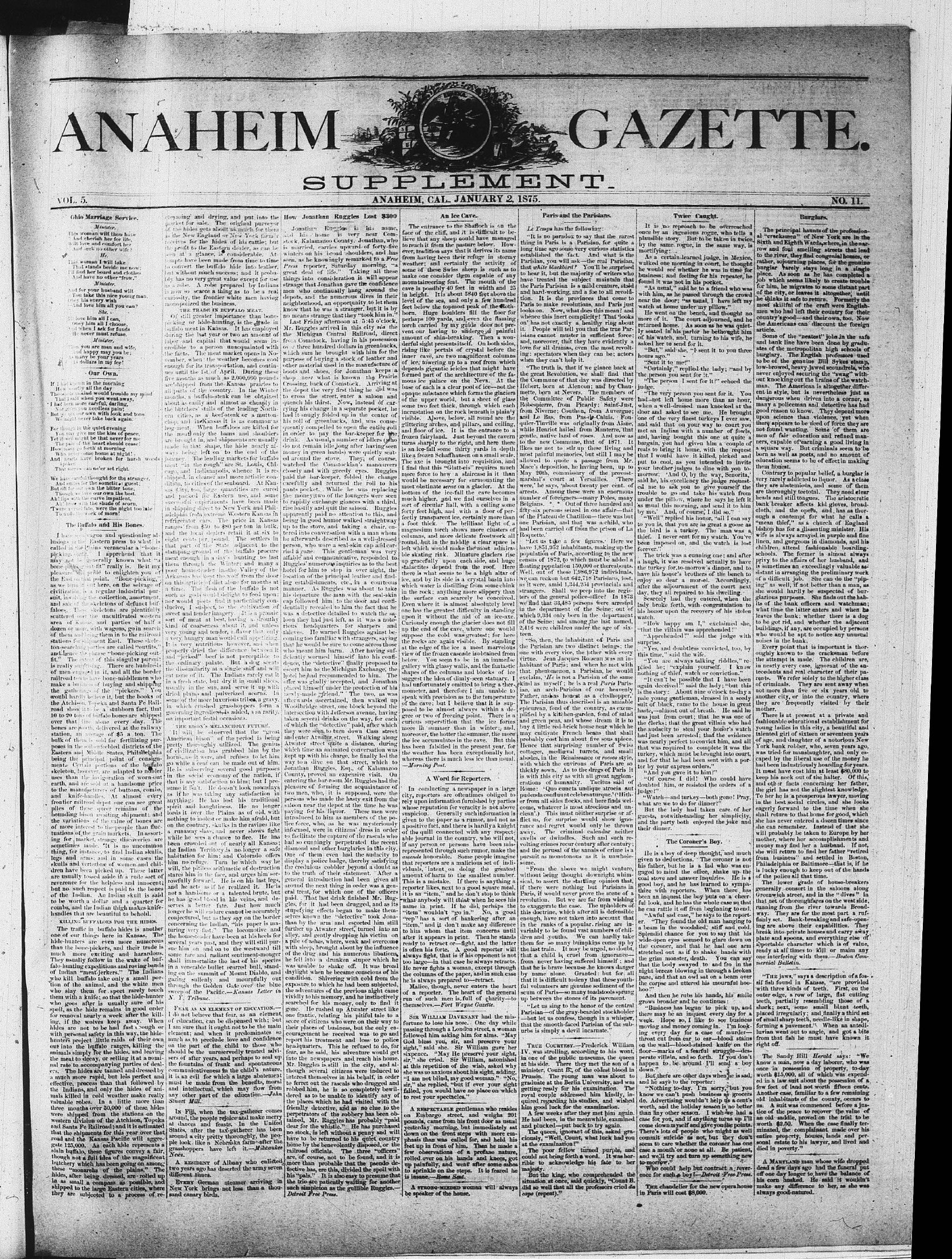
Searchable text
ANAHEIM
VOL. 5.
Ohio Marriage Service.
Minister.
This woman wilt thou have
And cherish her for life,
Wilt love and comfort her
And seek no other wife?
He.
This woman I will take
That stands beside me now;
I will find her board and clothes
And have no other "frow."
Minister.
And for your husband wilt
You take this nice young man,
Okey his every wish
And love him all you can?
She.
I love him all I can,
Obey him all I choose,
And when I ask for funds
He never must refuse.
Minister.
Then you are man and wife,
And happy may you be;
As many be your years
As dollars in my fee!
Our Own.
If I had known in the morning
How nearly all the day
The world might trouble my mind
That I sait when you went away
I had been more careful, darling,
Not given you needless pain;
But as we own with look and tone
We might never take back again.
For though in the quiet evening
You may give me the kiss of peace,
Yet it well might be that never for me
The pain of the heart should cease!
How many go forth at morning
Who never come home at night!
And hearts have broken for harsh words spoken
That sorrow can never set right.
Preparing and drying, and put into the market for sale. The original purveyor of the hides gets about as much for them as the New England or New York farm receives for the hides of his cattle; but the profit to the Eastern dealer, as can be seen at a glance, is considerable. Attempts have been made from time to time to convert the buffalo hide into leather, but without much success; and it probably has no very great value except for use as a robe. A robe prepared by Indians is now so scarce a thing as to be a real curiosity, the frontier white men having monopolized the business.
THE TRADE IN BUFFALO MEAT.
Of still greater importance than bone-picking or hide-hunting, is the grade in buffalo meat in Kansas. It has employed during the last year or two an amount of labor and capital that would seem incredible to a person unacquainted with the facts. The meat market opens in November, when the weather becomes cool enough for its transportation, and continues until the 1st of April. During these five months as much as 2,000,000 pounds are shipped from the Kansas prairies to all parts of the country. In the Winter months, a buffalo-steak can be obtained about as easily and almost as cheaply in the bitchers' stalls of the leading Northern cities, as a beef-steak or a mutton-chop, and in Kansas it is as common as hog meat. When buffaloes are killed for the meat only the bams and shoulders are brought in, and shipments are usually made in that shape, the hide nearly always being left on to the end of the journey. The leading markets for buffalo meat "in the rough" are St. Louis, Chicago, and his home is very stock, Kalamazoo County, is married, carries upward winters on his broad shoots, as he knowingly remembers Press reporter, Saturday, great deal of life." Things into consideration strange that Jonathan gave men who continually hand depots, and the numerous neighborhood, an opportunity know that he was a strange no means strange that they last Friday afternoon at Mr. Ruggles arrived in the Michigan Central Railroad from Comstock, having in over three hundred dollars which sum he brought with purpose of buying a stock other material used in the boots and shoes, for Jon shop near what is known Crossing, back of Comstock, the depot the very first thru cross the street, enter quench his thirst. Now, crying his change in a sepa had it snugly folded up in his roll of greenbacks, and frequently compelled to open in order to pay the bar-drink. As usual, a number do not remain idle Jong af money in green hands) wed around the stove. The watched the Comstocklin
Our Own.
If I had known in the morning how nearly all the day
The world kind would trouble my mind that I said when you went away,
I had been more careful, darling,
Not given you needless pain;
But your own with look and tone
We might never take back again.
For though in the quiet evening
You may give me the kiss of peace,
Yet it will might be that never for me
The pain of the heart should cease!
How many go forth at morning
Who never come home at night!
And hearts have broken for harsh words spoken
That sorrow can never set right.
We have careful thought for the stranger,
And amends for the sometime guest;
But oft for our own the bitter tone,
Though we have our own the best.
All lips with the curve impatient,
All brow with the shade of seorn,
Twere a cruel fate, were the night too late
To make the work of morn!
The Buffalo and His Bones.
I have so vague and questioning allusions on the Eastern press to what is called in the Plains vernacular a "bone-picking outfit." I apprehend that it may not be generally known what a bone picking out-fit really is. Be it my pleasure or pride to enlighten you of the Easton that point. "Bone-picking," as we turn it out here, on the selvage of civilization, is a regular industrial pursuit, involving the collection, assortment, and sale of the skeletons of defunct buffaloes. These skeletons are plentifully scattered over the uncultivated western area of Kansas, and parties of half a dozen or more, with wagons, go in search of them and bring them in to the railroad stations for shipment East. These skeleton-searching parties are called "countits," and hence the phrase "bone-picking outfit." The extent of this singular pursuit is really suffiting. There are hundreds of men engaged in it, and all the border railroad towns have bone-middlemen who make a business of buying and shipping the gatherings of the "pickers." You would hardly believe it, but the books of the Atchison, Topeka and Santa Fe Railroad show it to be a stubborn fact, that 10 to 20 tons of buffalo bones are shipped over that line done every day. The bones are worth delivered at the railway station, an average of $5 a ton. The bulk of them is sold for fertilizing purposes in the softened districts of the Eastern and Middle States, Philadelphia being the principal point of consignments. Certain portions of the buffalo skeleton, however, are adapted to nobler uses than the invigoration of worn-out earth, and are sold at a handsome price to the manufacturers of buttons, combs, and knife-handles. At almost every frontier railroad depot one can see great piles of these queer remains of the bounding bison awaiting shipment; and the variations of the value of bones are of more interest to the people than fluctuations of the grain markets. In assorting for market, strange discoveries are sometimes made. It is no uncommon thing, for instance, to find Indian skulls, legs and arms; and in some cases the skulls and vertebrae of women and children have been picked up. These latter are usually tossed aside in a rude sort of reverence for the helpless and innocent; but no such resuscitate is paid to the bones until the last of April. During these five months as much as 2,000,000 pounds are shipped from the Kansas prairies to all parts of the country. In the Winter months, a buffalo-stek can be obtained about as easily and almost as cheaply in the bitchers' stalks of the leading Northern cities, as a beef-stek or a mutton-chop, and in Kansas it is as common as hog meat. When buffaloes are killed for the meat only the hams and shoulders are brought in, and shipments are usually made in that shape, the hide nearly always being left on to the end of the journey. The leading markets for buffalo meat "in the rough" are St. Louis, Chicago, and Indianapolis, whence it is shipped in cleaner and more artistic condition, to cities of the senboard. At Kansas City, too large quantities are cured and packed for Eastern use, and some successful experiments have been made in shipping direct to New York and Philadelphia from extreme Western Kansas in refrigerator cars. The price in Kansas ranges from $50 to $80 per ton in bulk, and the local dealers retail it at six to eight cents per pound. The settlers in that part of the State adjacent to the stamping-ground of the buffalo procure meat enough in a day's hunting to last them through the Winter; and many a poor home-teacher in—the Valley of Arkansas has kept the wolf from the door on this article of diet alone for months at a time. The flesh of the buffalo is not such as goods would delight to feed upon; nor would poets find it particularly conducive. I suspect, to the cultivation of sweet and tender imagery, it is a prassic sort of meat at best, having a drouthy kind of coarseness about it, and unless very young and tender, a flavor that only a very hungry man would call appetizing. It is very nutritious however, and when properly dried the difference between it and "jerked" beef is not perceptible to the ordinary palate. But a dog scents the dissimilarity at a single sniff and will eat none of it. The Indians rarely eat it in a fresh state, but dry it in small slices, usually in the sun, and serve it up with dried plums and pulverized acorns. In some of the more luxurious tribes a gravy, in which crushed grasshoppers form a governing ingredient is added, a sa rarity, on important festal occasions.
THE HISON'S MELANCHOLY FUTURE.
"It will be observed that the "great American bison" of the period is being pretty thoroughly utilized. The genius of civilization has grabbed him by the horns, as it were, and refuses to let him go while a cent can be made out of him. He is subserving several good purposes in the social economy of the nation, if that is any satisfaction to him; but I presume it isn't. He doesn't look nowadays as if he was taking any satisfaction in anything. He has lost his traditional spirit and haughtiness. He no longer tords it over the Plains as of old, with nothing to indolest or make him afraid, but on the contrary, skulks in the ravines like a runaway slave, and never shows fight while he sees a chance to flee. He has been crowded out of nearly all Kansas; the Indian Territory is no longer a safe habitation for him; and Colorado offers him no refuge. Turn he which way he will, the pitiless arithmetic of destruction stares him in the face, and urges him sorrowfully forward. He is on his last legs, and he acts as if he realized it. He is unable to turn down and enter Atwater street.
Atwater street quite a day which time an animated cow kept up with his charge, he way to a dive on that side Jonathan Ruggles, Esq., County, proved an expense entering the bar-room Mr. J pleasure of forming the two men, whet it is supp persons who made the hastle saloon near the depot at their paying for his liquor.
Introduced to him as memorie force, who, as he was informed, were in citizens to facilitate the capture of one had sounningly perpetrated diamond and other burglary. One of them even had display a police badge, then credulous cobbler boy to the truth of their state general introduction had around the next thing in o
KILLING BUFFALOES FOR THE HIDES.
The traffic in buffalo hides is another one of our things here in Kansas. The hide-hunters are even more numerous than the bone-pickers, and their trade is much more exciting and hazardous. They usually follow in the wake of buffalo hunting expeditions and roving bands of Indian "meat-jerkers." The Indians who kill buffalo take only a small portion of the animal, and the white men who slay them for sport rarely touch them with a knife; so that the hide-hunter who goes after is usually sure of his spot, as the hide remains in good order for removal nearly a week after the killing, if the wolves keep away. When hides are not to be had fast enough or with personal safety in this way, the hide-hunters project little raids of their own out into the buffalo ranges, killing the animals simply for the hides, and leaving the meat to decay, or selling it at a nominal rate to accompanying parties of dealers. The hides are tanned and dressed by a much more rapid, but less perfect and effective process than that followed by the Indians, and only the hides of animals killed in cold weather make really valuable robes. In a little more than three months over 50,000 of these hides were shipped from the stations on the western division of the Atchison, Topeka and Santa Fe Railroad; and it is estimated that the shipments for this year over that road and the Kansas Pacific will aggregate 125,000. As each hide represents a slain buffalo, these figures convey a fair, though not a full idea of the magnificent butchery which has been going on among these "monarchs of the plains." The hides, after being dressed, are rolled up in as small a compass as possible, and shipped to the large Eastern cities, where they are subjected to a process of re-
FEAR AS AN ELEMENT OF EDUCATION.—I do not believe that fear, as an element of education, can be dispensed with; but I am sure that it ought not to be the main element; and when it predominates so much as to preclude love and confidence on the part of the child to those who should be the unreservedly trusted advisers of after years, and perhaps to seal up the fountains of frank and spontaneous communicativeness in the child's nature, it is an evil for which a large abatement must be made from the benefits, moral and intellectual, which may flow from any other part of the education.—John Stuart Mill.
In Fiji, when the tax-gatherer comes around, the people rejoice and make merry at dances and feasts. In the United States, after the tax-gatherer has been around a city pretty thoroughly, the people look like a Nebraska farm after the grasshoppers have left it.—Milwaukee News.
A RESIDENT of Albany who enlisted two years ago has deserted the army seven different times.
Every German steamer arriving in New York brings not less than a thousand canary birds.
as if he was taking any satisfaction in anything. He has lost his traditional spirit and haughtiness. He no longer lords it over the Plains as of old, with nothing to molest or make him afraid, but on the contrary, skulls in the ravines like a runaway slave, and never shows fight while he sees a chance to flee. He has been crowded out of nearly all Kansas; the Indian Territory is no longer a safe habitation for him; and Colorado offers him no refuge. Turn he which way he will, the pitiful arithmetic of destruction stares him in the face, and urges him sorrowfully forward. He is on his last legs, and he acts as if he realized it. He is not a handsome or a talented brute, but he has good blood in his veins, and deserves a better fate. Just how much longer he will endure cannot be accurately conjectured, but as they say on the border concerning the Indian, "his paper is maturing very fast." The locomotive and the homesteader have been at his heels for several years past, and they will still pursue him on and on to the westward till some rare and radiant sentiment-monger shall immortalize the last of his species in a venerable bullet scarred bull, standing on the summit of Mount Diablo, and gazing sollenly and mournfully out through the Golden Gate over the blue sweep of the Pacific.—Kansas Letter in N.Y. Tribune.
Shivering with exposure to which he had the adventures of the previous vividly to his memory, and searched for his money gone. He rushed up Atwater street, alley, and gently dropping a pile of ashes, where, weave with sleep, brought about of the drag and his numb he fell into a drunken sack was unable to shake off daylight when he became condition. Shivering with exposure to which he had the adventures of the previous vividly to his memory, and searched for his money gone. He rushed up Atwater street, alley, and gently dropping a pile of ashes, where, weave with sleep, brought about of the drag and his numb he fell into a drunken sack was unable to shake off daylight when he became condition. Shivering with exposure to which he had the adventures of the previous vividly to his memory, and searched for his money gone. He rushed up Atwater street, alley, and gently dropping a pile of ashes, where, weave with sleep, brought about of the drag and his numb he fell into a drunken sack was unable to shake off daylight when he became condition. Shivering with exposure to which he had the adventures of the previous vividly to his memory, and searched for his money gone. He rushed up Atwater street, alley, and gently dropping a pile of ashes, where, weave with sleep, brought about of the drag and his numb he fell into a drunken sack was unable to shake off daylight when he became condition. Shivering with exposure to which he had the adventures of the previous vividly to his memory, and searched for his money gone. He rushed up Atwater street, alley, and gently dropping a pile of ashes, where, weave with sleep, brought about of the drag and his numb he fell into a drunken sack was unable to shake off daylight when he became condition. Shivering with exposure to which he had the adventures of the previous vividly to his memory, and searched for his money gone. He rushed up Atwater street, alley, and gently dropping a pile of ashes, where, weave with sleep, brought about of the drag and his numb he fell into a drunken sack was unable to shake off daylight when he became condition. Shivering with exposure to which he had the adventures of the previous vividly to his memory, and searched for his money gone. He rushed up Atwater street, alley, and gently dropping a pile of ashes, where, weave with sleep, brought about of the drag and his numb he fell into a drunken sack was unable to shake off daylight when he became condition. Shivering with exposure to which he had the adventures of the previous vividly to his memory, and searched for his money gone. He rushed up Atwater street, alley, and gently dropping a pile of ashes, where, weave with sleep, brought about of the drag and his numb he fell into a drunken sack was unable to shake off daylight when he became condition. Shivering with exposure to which he had the adventures of the previous vividly to his memory, and searched for his money gone. He rushed up Atwater street, alley, and gently dropping a pile of ashes, where, weave with sleep, brought about of the drag and his numb he fell into a drunken sack was unable to shake off daylight when he became condition. Shivering with exposure to which he had the adventures of the previous vividly to his memory, and searched for his money gone. He rushed up Atwater street, alley, and gently dropping a pile of ashes, where,weave with sleep,brought about ofthe dragandhis numbhe fellintoa drunken sackwasunabletoshakeoffdaylightwhenhebecamecondition.Shiveringwithexposuretowhichhehadtheadventuresofthepreviousvividlytohismemory,andsearchedforhismoneygone.Hereisofcoursenottobemorethanprobablethatfectivehas erethisdividhis"pals."ItisalsoeasythetrioarepatientallywaitsuchsimpletonasguildDetroitFreePress.
How Jonathan Ruggles Lost $300
Jonathan Ruggles is his name, and his home is very near Comstock, Kalamazoo County. Jonathan, who is married, carries upward of forty-five winters on his broad shoulders, and has seen, as he knowingly remarked to a Free Press reporter, Saturday morning, "a great deal of life." Taking all these things into consideration it will appear strange that Jonathan gave the confidence men who continually hang around the depots, and the numerous dives in their neighborhood, an opportunity to let them know that he was a stranger, but it is by no means strange that they "took him in."
Last Friday afternoon at 5:45 o'clock, Mr. Ruggles arrived in this city via the Michigan Central Railroad, direct from Comstock, having in his possession over three hundred dollars in greenbacks, which sum he brought with him for the purpose of buying a stock of leather and other material used in the manufacture of boots and shoes, for Jonathan keeps a shop near what is known the Prairie Crossing, back of Comstock. Arriving at the depot the very first thing he did was to cross the street, enter a saloon and quench his thirst. Now, instead of carrying his change in a separate pocket, he had it snugly folded up in the center of his roll of greenbacks. And, was consequently compelled to open the entire roll in order to pay the bar-keeper for the drink. As usual, a number of idlers (who do not remain idle long after having seen money in green hands) were quietly seated around the stove. They, of course, watched the Comstockian's maneuvers.
An Ice Cave.
The entrance to the Shaffoch is on the face of the cliff, and it is difficult to believe that any sheep could have managed to reach it from the pasture below. However, tradition says that it derives its name from having been their refuge in stormy weather; and certainly the activity of some of these Swiss sheep is such as to make one consider them capable of any mountaineering feat. The mouth of the cave is possibly 40 feet in width and 25 in height. It is about 5840 feet above the level of the sea, and only a few hundred feet below the topmost peak of the Rothborn. Huge boulders fill the floor for perhaps 100 yards, and even the flaming torch carried by my guide does not prevent our having to undergo a painful amount of shin-breaking. Then a wonderful sight presents itself. On both sides, rising like portals of crystal before the inner cave, are two magnificent columns of ice; towering up to a roof from which depends gigantic icicles that might have formed part of the architecture of the famous ice palace on the Neva. At the base of each is a clear pool of ice—not the opaque substance which forms the glaciers of the upper world, but a sheet of glass some two feet thick, through which each incrustation on the rock beneath is plainly visible. Above, below, all round are the glittering arches, and pillars, and ceiling, and floor of ice. It is the entrance to a frozen fairyland. Just beyond the cavern turns sharply to the right, and here there is an ice-fall some thirty yards in depth like a frozen Schaffhausen on a small scale. The axe is brought into requisition, and I find that this "Glatt-eis" requires much
Paris and the Parisians.
Le Temps has the following:
"It is no paradox to say that the rarest thing in Paris is a Parisian, for quite a long time ago some very curious statistics established the fact. And what is the Parisian, you will ask—the real Parisian, that white blackbird? You'll be surprised to hear it, but the majority of writers who have treated the subject maintain that the Paris Parisiian is a mild creature, staid and hard-working, and a foe to all revolition. It is the provinces that come to Paris to make revolutions, and Paris just looks on. Now, what does this mean? and whence this inert complicity? That 'looks on' has not exactly a healthy ring about it. People will tell you that the true Parisians cannot muster in sufficient force; and, moreover, that they have evidently a love for all dramas, even the most revolting: spectators when they can be; actors when they can't help it.
"The truth is, that if we glance back at the great Revolution, we shall find that the Commune of that day was directed by Hebert, born at Alencon; and by Chaumette, born at Nevers. The members of the Committee of Public Safety were Robespierre, from Picardy; Saint-Just, from Niverne; Couthen, from Auvergne; and Le Bas, from Pas-de-Calais. Fournier-Tinville was originally from Aisne, while Henriot hailed from Manterre, that gentle, native land of roses. And now as to the new Commune, that of 1871. It likes me not to stir up these living and most painful memories, but still I may be allowed to quote a passage from Mr. Mace's deposition, he having been, up to
It is no once by an unplausible story by the same mortifying:
As a certis walked one way he would see business; and found it was:
"As usual, with him, as near the door watch at home.
He went on more of it. returned honestly seated infinitely of his watch asked her to "But," said hours ago."
"Sent it to Certainly the person you "The perse judge.
The very had—not left when a well-door and ask one of the veil and said that met an Indian and having bargain, you reals to bring that I would put to cool your brother."
Boots and shoes, for Jonathan keeps a shop near what is known the Prairie Crossing, back of Comstock. Arriving at the depot the very first thing he did was to cross the street, enter a saloon and quench his thirst. Now, instead of carrying his change in a separate pocket, he had it snugly folded up in the center of his roll of greenbacks. And, was consequently compelled to open the entire roll in order to pay the bar-keeper for the drink. As usual, a number of illers who do not remain idle long after having seen money in green hands) were quietly seated around the stove. They, of course, watched the Comstockian's maneuvers closely and with greedy eyes. Ruggles paid the bar-keeper, folded the change carefully and returned the roll to his pants pocket. While he was replacing the money two of the loungers were seen to rapidly exchange glances with a third, rise hastily and quit the saloon. Ruggles apparently paid no attention to this, and being in good humor walked straightway up to the stove, and taking a chair, entered into conversation with a man whom he afterwards described as a well-dressed person, who wore a seal-skin cap and carried a cane. This gentleman was very affable and communicative, responded to Ruggles' numerous inquiries as to the best hotel for him to stop in over night, the location of the principal leather and finding establishments, etc., in a courteous manner. As Ruggles was about to take his departure the man with the seal-skin cap followed him to the door and confidentially revealed to him the fact that he was a detective detailed to watch the saffon they had just left, as it was a notorious headquarters for sharpers and thieves. He warned Ruggles against becoming too familiar with strangers, saving that he would be sure to come across those who meant him harm. After having sufficiently wormed himself into his confidence, the "detective" finally proposed to escort him to the Michigan Exchange, the hotel he had recommended to him. The offer was gladly accepted, and Jonathan placed himself under the protection of his newly-made friend." The two, as was afterwards ascertained, then walked up Woodbridge street, one block beyond the intersection with Jefferson avenue, having taken several drinks on the way, for each of which the "detective" paid, after which they were seen to turn down Cass street and enter Atwater street. Walking along Atwater street quite a distance, during which time an animated conversation was kept up with his charge, he finally led the way to a dive on that street, which to Jonathan Ruggles, Esq., of Kalamazoo County, proved an expensive visit. On entering the bar-room Mr. Ruggles had the pleasure of forming the acquaintance of two men, who, it is supposed, were the persons who made the hasty exit from the saloon near the depot at the time he was paying for his liquor. These men were introduced to him as members of the police force, who, as he was mysteriously informed, were in citizens' dress in order to facilitate the capture of the rascals who had so cunningly perpetrated the recent diamond and other burglaries in this city. One of them even had the audacity to display a police badge, thereby satisfying the credulous cobbler beyond a doubt as to the truth of their statement. After a general introduction had been given all around the next thing in order was a genboots and shoes, for Jonathan keeps a shop near what is known the Prairie Crossing, back of Comstock. Arriving at the depot the very first thing he did was to cross the street, enter a saloon and quench his thirst. Now, instead of carrying his change in a separate pocket, he had it snugly folded up in the center of his roll of greenbacks. And, was consequently compelled to open the entire roll in order to pay the bar-keeper for the drink. As usual, a number of illers who do not remain idle long after having seen money in green hands) were quietly seated around the stove. They, of course, watched the Comstockian's maneuvers closely and with greedy eyes. Ruggles paid the bar-keeper, folded the change carefully and returned the roll to his pants pocket. While he was replacing the money two of the loungers were seen to rapidly exchange glances with a third, rise hastily and quit the saloon. Ruggles apparently paid no attention to this, and being in good humor walked straightway up to the stove, and taking a chair, entered into conversation with a man whom he afterwards described as a well-dressed person, who wore a seal-skin cap and carried a cane. This gentleman was very affable and communicative, responded to Ruggles' numerous inquiries as to the best hotel for him to stop in over night, the location of the principal leather and finding establishments, etc., in a courteous manner. As Ruggles was about to take his departure the man with the seal-skin cap followed him to the door and confidentially revealed to him the fact that he was a detective detailed to watch the saffon they had just left, as it was a notorious headquarters for sharpers and thieves. He warned Ruggles against becoming too familiar with strangers, saving that he would be sure to come across those who meant him harm. After having sufficiently wormed himself into his confidence, the "detective" finally proposed to escort him to the Michigan Exchange, the hotel he had recommended to him. The offer was gladly accepted, and Jonathan placed himself under the protection of his newly-made friend." The two, as was afterwards ascertained, then walked up Woodbridge street, one block beyond the intersection with Jefferson avenue, having taken several drinks on the way, for each of which the "detective" paid, after which they were seen to turn down Cass street and enter Atwater street. Walking along Atwater street quite a distance, during which time an animated conversation was kept up with his charge, he finally led the way to a dive on that street, which to Jonathan Ruggles, Esq., of Kalamazoo County, proved an expensive visit. On entering the bar-room Mr. Ruggles had the pleasure of forming the acquaintance of two men, who, it is supposed, were the persons who made the hasty exit from the saloon near the depot at the time he was paying for his liquor. These men were introduced to him as members of the police force, who, as he was mysteriously informed, were in citizens' dress in order to facilitate the capture of the rascals who had so cunningly perpetrated the recent diamond and other burglaries in this city. One of them even had the audacity to display a police badge, thereby satisfying the credulous cobbler beyond a doubt as to the truth of their statement. After a general introduction had been given all around the next thing in order was a genboots and shoes, for Jonathan keeps a shop near what is known the Prairie Crossing, back of Comstock. Arriving at the depot the very first thing he did was to cross the street, enter a saloon and quench his thirst. Now, instead of carrying his change in a separate pocket, he had it snugly folded up in the center of his roll of greenbacks. And, was consequently compelled to open the entire roll in order to pay the bar-keeper for the drink. As usual, a number of illers who do not remain idle long after having seen money in green hands) were quietly seated around the stove. They, of course, watched the Comstockian's maneuvers closely and with greedy eyes. Ruggles paid the bar-keeper, folded the change carefully and returned the roll to his pants pocket. While he was replacing the money two of the loungers were seen to rapidly exchange glances with a third, rise hastily and quit the saloon. Ruggles apparently paid no attention to this, and being in good humor walked straightway up to the stove, and taking a chair, entered into conversation with a man whom he afterwards described as a well-dressed person, who wore a seal-skin cap and carried a cane. This gentleman was very affable and communicative, responded to Ruggles' numerous inquiries as to the best hotel for him to stop in over night, the location of the principal leather and finding establishments, etc., in a courteous manner. As Ruggles was about to take his departure the man with the seal-skin cap followed him to the door and confidentially revealed to him the fact that he was a detective detailed to watch the saffon they had just left, as it was a notorious headquarters for sharpers and thieves. He warned Ruggles against becoming too familiar with strangers, saving that he would be sure to come across those who meant him harm. After having sufficiently wormed himself into his confidence, the "detective" finally proposed to escort him tothe Michigan Exchange,the hotel he had recommended to him.The offer was gladly accepted,and Jonathan placed himself undertheprotectionofhisnewlymadefriend."The two,aswasafterwardsascertained,thenwalkedupWoodbridgestreetoneblockbeyondtheintersectionwithJeffersonavenue,havingtakenseveraldrinksontheway,forkeachofthe“detective”paid,afterwhichtheywereseentoturndownCassstreetandenterAtwaterstreet.WalkingalongAtwaterstreetquitea distance,duringwhichtimeananimatedconversationwaskeptupwithhischarge,thefinallyledthewaytoa diveonthatstreet,whichtoJonathanRuggles,Esq.,ofKalamazooCounty,provedanexpensivevisit.Onenteringthebar-roomMr.Ruggleshadthepleasureofformingtheacquaintanceoftwomenwho,itissupposed.werethepersonswhomadehastyexitfromthesaloonnearthedepotatthetimehewaspayingforhisliquorThesemenwereintroducedtohimasmembersofthepoliceforcewho,ashewasmysteriouslyinformed.wereincitizens'dressinordertoc facilitatethecaptureoftherascalswhohadsocunninglyperpetratedtherecentdiamondandotherburglariesinthiscityOneofthemenevenhadtheaudacitytodisplayapolicebadtheresultifyingthecredulouscobblerbeyonda doubtastofthetruthofthestatement.AfterageneralintroductionhadbeengivenallaroundthenextthinginorderwasagenetworksformedpartofthearchitectureofthefamousicepalceontheNeva.Atthebaseofeachisclearpoolofice—nottheopaquesubstancewhichformsglaciersoftheupperworld,buta sheetofglasssometwofeetthickthroughwhicheachincrustationontherockbeneathisplainlyvisible.Above,belowallroundaretheglitteringarches,andpillars,andceiling,and floorofice.Itsinthe entrancetoafrozenfairyland.Justbeyondthecavernonthesmallcolumnsandmoredelicatefrostworkallround,bbutinmiddleclearcesthisleftwhichwouldmakethemostadmirableskatingrink.Minatureglaciersriseupgracefullyupeachside,andhighestalternateforsurmountingthemostobstructseriaonaclaiacerat.Atbottomoftheicefallthe cave becomesmuchhigher,andwefindourselvesinasideofcircularhallwitha ceilingsomefortyeffecthigh,andwitha floorofperfecttransparent ice,certainlymorethanafoot thick.Thebrilliantlightofamagnesiumtorchshowsmoreclustersofcolumns,andmoredelicatefrostworkallround,bbutinmiddleclearcesthisleftwhichwouldmakethemostadmirableskatingrink.Minatureglaciersriseupgracefullyupeachside,andhighestalternateforsurmountingthemostobstructseriaonaclaiencerat.Atbottomoftheicefallthe cave becomesmuchhigher,andwefindourselvesinpartialcirclehallwitha ceilingsomefortyeffecthigh,andwitha floorofperfecttransparent ice,certainlymorethanafoot thick.Thebrilliantlightofamagnesiumtorchshowsmoreclustersofcolumns,andmoredelicatefrostworkallround,bbutinmiddleclearcesthisleftwhichwouldmakethemostadmirableskatingrink.Minatureglaciersriseupgracefullyupeachside,andhighestalternateforsurmountingthemostobstructseriaonaclaiencerat.Atbottomoftheicefallthe cave becomesmuchhigher,andwefindourselvesinpartialcirclehallwitha ceilingsomefortyeffecthigh,andwitha floorofperfecttransparent ice,certainlymorethanafoot thick.Thebrilliantlightofamagnesiumtorchshowsmoreclustersofcolumns,andmoredelicatefrostworkallround,bbutinmiddleclearcesthisleftwhichwouldmakethemostadmirableskatingrink.Minatureglaciersriseupgracefullyupeachside,andhighestalternateforsurmountingthemostobstructseriaonaclaiencerat.Atbottomoftheicefallthe cave becomesmuchhigher,andwefindourselvesinpartialcirclehallwitha ceilingsomefortyeffecthigh,andwitha floorofperfecttransparent ice,certainlymorethanafoot thick.Thebrilliantlightofamagnesiumtorchshowsmoreclustersofcolumns,andmoredelicatefrostworkallround,bbutinmiddleclearcesthisleftwhichwould makethe mostadmirableskatingrink.Minatureglaciersriseupgracefullyupeachside,andhighestalternateforsurmountingthemostobstructseriaonaclaiencerat.Atbottomoftheicefallthe cave becomesmuchhigher,andwefindourselvesinpartialcirclehallwitha ceilingsomefortyeffecthigh,andwitha floorofperfecttransparent ice,certainlymorethanafoot thick.Thebrilliantlightofamagnesiumtorchshowsmoreclustersofcolumns,andmoredelicatefrostworkallround,bbutinmiddleclearcesthisleftwhichwould makethe mostadmirableskatingrink.Minatureglaciersriseupgracefullyupeachside,andhighestalternateforsurmountingthemostobstructseriaonaclaiencerat.Atbottomoftheicefallthe cave becomesmuchhigher,andwefindourselvesinpartialcirclehallwitha ceilingsomefortyeffecthigh,andwitha floorofperfecttransparent ice,certainlymorethanafoot thick.Thebrilliantlightofamagnesiumtorchshows moreclustersofcolumns,andmoredelicatefrostworkallround,bbutinmiddleclearcesthisleftwhichwould makethe mostadmirableskatingrink.Minatureglaciersriseupgracefullyupeachside,andhighestalternateforsurmountingthemostobstructseriaonaclaiencerat.Atbottomoftheicefallthe cave becomesmuchhigher,andwefindourselvesinpartialcirclehallwitha ceilingsomefortyeffecthigh,andwitha floorofperfecttransparent ice,certainlymorethanafoot thick.Thebrilliantlightofamagnesiumtorchshows moreclustersofcolumns,andmoredelicatefrostworkallround,bbutinmiddleclearcesthisleftwhichwould makethe mostadmirableskatingrink.Minatureglaciersriseupgracefullyupeachside,andhighestalternateforsurmountingthemostobstructseriaonaclaiencerat.Atbottomoftheicefallthe cave becomesmuchhigher,andwefindourselvesinpartialcirclehallwitha ceilingsomefortyeffecthigh,andwitha floorofperfecttransparent ice,certainlymorethanafoot thick.Thebrilliantlightofamagnesiumtorchshows moreclustersofcolumns,andmoredelicatefrostworkallround,bbutinmiddleclearcesthisleftwhichwould makethe mostadmirableskatingrink.Minatureglaciersriseupgracefullyupeachside,andhighestalternateforsurmountingthemostobstructseriaonaclaiencerat.Atbottomoftheicefallthe cave becomesmuchhigher,andwefindourselvesinpartialcirclehallwitha ceilingsomefortyeffecthigh,andwitha floorofperfecttransparent ice,certainlymorethanafoot thick.Thebrilliantlightofamagnesiumtorchshows moreclustersofcolumns,andmoredelicatefrostworkallround,bbutinmiddleclearcesthisleftwhichwould makethe mostadmirableskatingrink.Minatureglaciersriseupgracefullyupeachside,andhighestalternateforsurmountingthemostobstructseriaonaclaiencerat.Atbottomoftheicefallthe cave becomesmuchhigher,andwefindourselvesinpartialcirclehallwitha ceilingsome fortyeffecthigh,andwitha floorofperfecttransparent ice,certainlymorethanafoot thick.Thebrilliantlightofamagnesiumtorchshows moreclustersofcolumns,andmoredelicatefrostworkallround,bbutinmiddleclearcesthisleftwhichwould makethe mostadmirableskatingrink.Minatureglaciersriseupgracefullyupeachside,andhighestalternateforsurmountingthemostobstructseriaonaclaiencerat.Atbottomoftheicefallthe cave becomesmuchhigher,andwefindourselvesinpartialcirclehallwitha ceilingsome fortyeffecthigh,andwitha floorOfperfecttransparent ice,certainlymorethanafoot thick.Thebrilliantlightofamagnesiumtorchshows moreclustersofcolumns,andmoredelicatefrostworkallround,bbutinmiddleclearcesthisleftwhichwould makethe mostadmirableskatingrink.Minatureglaciersriseupgracefullyupeachside,andhighestalternateforsurmountingthemostobstructseriaonaclaiencerat.Atbottomoftheicefallthe cave becomesmuchhigher,andwefindourselvesinpartialcirclehallwitha ceilingsome fortyeffecthigh,andwitha floorOfperfecttransparent ice,certainlymorethanafoot thick.Thebrilliantlightofamagnesiumtorchshows moreclustersofcolumns_andmoredelicatefrostworkallround,bbutinmiddleclearcesthisleftwhichwould makethe mostadmirableskatingrink.Minatureglaciersriseupgracefullyupeachside_andhighestalternateforsurmountingthemostobstructseriaonaclaiencerat.Atbottomoftheicefallthe cave becomesmuchhigher_andwefindourselvesinpartialcirclehallwitha ceilingsome fortyeffecthigh_andwefindourselvesinpartialcirclehallwitha ceilingsome fortyeffecthigh_andwefindourselvesinpartialcirclehallwitha ceilingsome fortyeffecthigh_andwefindourselvesinpartialcirclehallwitha ceilingsome fortyeffecthigh_andwefindourselvesinpartialcirclehallwitha ceilingsome fortyeffecthigh_andwefindourselvesinpartialcirclehallwitha ceilingsome fortyeffecthigh_andwe findourselvesinpartialcirclehallwitha ceilingsome fortyeffecthigh_andwe findourselvesinpartialcirclehallwitha ceilingsome fortyeffecthigh_andwe findourselvesinpartialcirclehallwitha ceilingsome fortyeffecthigh_andwe findourselvesinpartialcirclehallwitha ceilingsome fortyeffecthigh_andwe findourselvesinpartialcirclehallwitha ceilingsome fortyeffecthigh_andwe findourselvesinpartialcirclehallwitha ceilingsome fortyeffecthigh_andwe findourselvesinpartialcirclehallwitha ceilingsome fortyeffecthigh_andwe findourselvesinpartialcirclehallwitha ceilingsome fortyeffect high_andwe findourselvesinpartialcirclehallwitha ceilingsome fortyeffect high_andwe findourselvesinpartialcirclehallwitha ceilingsome fortyeffect high_andwe findourselvesinpartialcirclehallwitha ceilingsome fortyeffect high_andwe findourselvesinpartialcirclehallwitha ceilingsome fortyeffect high_andwe findourselvesinpartialcirclehallwitha ceilingsome fortyeffect high_andwe findourselvesinpartialcirclehall WITH A FOUNDATION OF THE ARMENIAN ARE TWO DISTINCT BEINGS; THE ONE WITH EVERY VICE; JEAN Jacques RoeseAN IS AN HIPTEN OF PARIS; AND WHEN HE MET WITH THAT PHENOMENON; THE WERE EXHALTING A PARKERIAN; HE WOULD EXPELIAMENT OF PARIS; AND WHEN HE MET WITH THAT PHENOMENON; THE WERE EXHALTING A PARKERIAN; HE WOULD EXPELIAMENT OF PARIS; AND WHEN HE MET WITH THAT PHENOMENON; THE WERE EXHALTING A PARKERIAN; HE WOULD EXPELIAMENT OF PARIS; AND WHEN HE MET WITH THAT PHENOMENON; THE WERE EXHALTING A PARKERIAN; HE WOULD EXPELIAMENT OF PARIS; AND WHEN HE MET WITH THAT PHENOMENON; THE WERE EXHALTING A PARKERIAN; HE WOULD EXPELIAMENT OF PARIS; AND WHEN HE MET WITH THAT PHENOMENON; THE WERE EXHALTING A PARKERIAN; HE WOULD EXPELIAMENT OF PARIS; AND WHEN HE MET WITH THAT PHENOMENON; THE WERE EXHALTING A PARKERIAN; HE WOULD EXPELIAMENT OF PARIS; AND WHEN HE MET WITH THAT PHENOMENON; THE WERE EXHALTING A PARKERIAN; HE WOULD EXPELIAMENT OF PARIS; AND WHEN HE MET WITH THAT PHENOMENON; THE WERE EXHALTING A PARKERIAN; HE WOULD EXPELIAMENT OF PARIS; AND WHEN HE MET WITH THAT PHENOMENON; THE WERE EXHALTING A PARKERIAN; HE WOULD EXPELIAMENT OF PARIS; AND WHEN HE MET WITH THAT PHENOMENON; THE WERE EXHALTING A PARKERIAN; HE WOULD EXPELIAMENT OF PARIS; AND WHEN HE MET WITH THAT PHENOMENON; THE WERE EXHALTING A PARKERIAN; HE WOULD EXPELIAMENT OF PARIS; AND WHEN HE MET WITH THAT PHENOMENON; THE WERE EXHALTING A PARKERIAN; HE WOULD EXPELIAMENT OF PARIS; AND WHEN HE MET WITH THAT PHENOMENON; THE WERE EXHALTING A PARKERIAN; HE WOULD EXPELIAMENT OF PARIS; AND WHEN HE MET WITH THAT PHENOMENON; THE WERE EXHALTING A PARKERIAN; HE WOULD EXPELIAMENT OF PARIS; AND WHEN HE MET WITH THAT PHENOMENON; THE WERE EXHALTING A PARKERIAN; HE WOULD EXPELIAMENT OF PARIS; AND WHEN HE MET WITH THAT PHENOMENON; THE WERE EXHALTING A PARKERIAN; HE WOULD EXPELIAMENT OF PARIS; AND WHEN HE MET WITH THAT PHENOMENON; THE WERE EXHALTING A PARKERIAN; HE WOULD EXPELIAMENT OF PARIS; AND WHEN HE MET WITH THAT PHENOMENON; THE WERE EXHALTING A PARKERIAN; HE WOULD EXPELIAMENT OF PARIS; AND WHEN HE MET WITH THAT PHENOMENON; THE WERE EXHALTING A PARKERIAN; HE WOULD EXPELIAMENT OF PARIS; AND WHEN HE MET WITH THAT PHENOMENON; THE WERE EXHALTING A PARKERIAN; HE WOULD EXPELIAMENT OF PARIS; AND WHEN HE MET WITH THAT PHENOMENON; THE WERE EXHALTING A PARKERIAN; HE WOULD EXPELIAMENT OF PARIS; AND WHEN HE MET WITH THAT PHENOMENON; THE WERE EXHALTING A PARKERIAN; HE WOULD EXPELIAMENT OF PARIS; AND WHEN HE MET WITH THAT PHENOMENON; THE WERE EXHALTING A PARKERIAN; HE WOULD EXPELIAMENT OF PARIS; AND WHEN HE MET WITH THAT PHENOMENON; THE WERE EXHALTING A PARKERIAN;HEWOLLISHEDA GREATERTHANTHESEWORDERSINTACTURESTHERESULTANTACTURESTHERESULTANTACTURESTHERESULTANTACTURESTHERESULTANTACTURESTHERESULTANTACTURESTHERESULTANTACTURESTHERESULTANTACTURESTHERESULTANTACTURESTHERESULTANTACTURESTHERESULTANTACTURESTHERESULTANTACTURESTHERESULTANTACTURESTHERESULTANTACTURESTHERESULTANTACTURESTHERESULTANTACTURESTHERESULTANTACTURESTHERESULTANTACTURESTHERESULTANTACTURESTHERESULTANTACTURESTHERESULTANTACTURESTHERESULTANTACTURESTHERESULTANTACTURESTHERESULTANTACTURESTHERESULTANTACTURESTHERESULTANTACTURESTHERESULTANTACTURESTHERESULTANTACTURESTHERESULTANTACTURESTHERESULTANTACTURESTHERESULTANTACTURESTHERESULTANTACTURESTHERESULTANTACTURESTHERESULTANTACTURESTHERESULTANTACTURESTHERESULTANTACTURESTHERESULTANTACTURESTHERESULTANTACTURESTHERESULTANTACTURESTHERESULTANTACTURESTHERESULTANTACTURESTHERESULTANTACTURESTHERESULTANTACTURESTHERESULTANTACTURESTHERESULTNT ACTURCETHERESULTNT ACTURCETHERESULTNT ACTURCETHERESULTNT ACTURCETHERESULTNT ACTURCETHERESULTNT ACTURCETHERESULTNT ACTURCETHERESULTNT ACTURCETHERESULTNT ACTURCETHERESULTNT ACTURCETHERESULTNT ACTURCETHERESULTNT ACTURCETHERESULTNT ACTURCETHERESULTNT ACTURCETHERESULTNT ACT
two men, who, it is supposed, were the persons who made the hasty exit from the saloon near the depot at the time he was paying for his liquor. These men were introduced to him as members of the police force, who, as he was mysteriously informed, were in citizens' dress in order to facilitate the capture of the rascals who had so cunningly perpetrated the recent diamond and other burglaries in this city. One of them even had the audacity to display a police badge, thereby satisfying the credulous cobbler beyond a doubt as to the truth of their statement. After a general introduction had been given all around the next thing in order was a general treat, for which one of the officers paid. That last drink finished Mr. Ruggles, for it had been drugged, and as its stupefying effects began to make themselves known the "detective" took Jonathan by the arm and escorted him still further up Atwater street, turned into an alley, and gently dropping his victim on a pile of ashes, where, weak and overcome with sleep, brought about by the influence of the drug and his numerous libations, he fell into a drunken stupur which he was unable to shake off. It was broad daylight when he became conscious of his condition. Shivering with cold from the exposure to which he had been subjected, the adventures of the previous night came vividly to his memory, and he instinctively searched for his money, only to find it gone. He rushed at Atwater street like one frantic, relating his pitiful tale to a score of citizens who were on their way to their places of business, but the only encouragement he received was to go and report his treatment and loss to police headquarters. This he refused to do, for fear, as he said, his adventure would get into the newspapers and reach his home. Mr. Ruggles is still in the city, and although several citizens were induced to interest themselves in his behalf, in order to ferret out the rascals who drugged and robbed him, he is so completely bewildered as to be unable to identify any of the places which he had visited with the friendly detective, and as no clue to the perpetrators of the robbery has been obtained. Mr. Ruggles has probably "paid dear for the whistle." He has purchased no stock, is left without a penny and will have to be returned to his quiet country home by the benevolently disposed, or the railroad officials. The three "officers" are, of course, not to be found, and it is more than probable that the pseudo detective has, ere this, divided the spoil with his "pals." It is also easy to presume that the trio are patiently waiting for another such simpleton as the gullible Ruggles.
Detroit Free Press.
A respectable gentleman who resides on Embargo street, and weighs 201 pounds, came from his front door as usual yesterday morning, but immediately sat down on the front steps with more emphasis than was called for, and held his feet up in front of him. Then he made a few observations of a profane nature, rolled over on his hands and knees, got up painfully, and went after some ashes to sprinkle on the steps. It is feared he is insane.
Rome Sent.
A strong-minded woman will always be speaker of the house.
In conducting a newspaper in a city, reporters are oftentimes obliged to parties whose reputation for veracity is not above suspicion. Generally such information is given to the paper as a rumor, and not as a positive fact, and there is hardly a knight of the quill connected with any respectable journal in the country, who will not, if any person or persons have been misrepresented through such rumor, make the amende honorable. Some people imagine that reporters are a malicious set of individuals, intent on doing the greatest amount of harm to the smallest number. This is a mistake. If there is anything a reporter likes, next to a good square meal, it is an "item," and he don't stop to think what anybody will think when he sees his name in print. If he did, perhaps the "item" wouldn't "go in." No, a good "rep" has a sort of hankering after an "item," and it don't make any difference to him whom that item concerns until after it appears in print. Then he stands ready to retract or fight, and the latter is often his forte. A good reporter will always fight, that is if his opponent is not too large—in that case he always retracts. He never fights a woman, except through the columns of the paper, and in such case he is always prepared to—retract.
Malice, though, never enters the heart of a reporter. The heart of the general run of such men is full of charity—to themselves.
Fort Wayne Gazette.
SIR WILLIAM DAVENANT had the misfortune to lose his nose. One day while passing through a London street, a woman followed him asking him for alms. "May God bless you, sir, and preserve your sight," said she. Sir William gave her sixpence. "May He preserve your sight, sir," she cried. Sir William, astonished at this repetition of the wish, asked why she was so anxious about his sight, adding: "I am not blind, my good woman." "No, sir," she replied, "but if ever your sight failed, you would have no place on which to rest your spectacles."
TRUE COURTESY. Frederick William IV. was strolling, according to his wont, in one of the public museums, the queen at his side. There they met the son of a minister, Count B., of the oldest blood in Prussia. The young man was about to graduate at the Berlin University, and was getting ready for his examination. The royal couple addressed him kindly, inquired regarding his studies, and wished him good luck for the examination.
A few weeks after they met him again. He had been, in the meanwhile, examined and plucked—put back to try again.
The queen, ignorant of this, asked graciously: "Well, Count, what luck had you at the examination?"
The poor fellow turned purple, and could not bring forth a word. It was horrible to acknowledge his fate to her majesty.
But the king, who comprehended the situation at once, said quickly: "Count B. did so well that all the professors cried da capo (repeat)."
"From the above we might venture without being thought downright whimical, to assert the startling opinion that if there were nothing but Parisians in Paris, if would never prove the scene of a revolution. But we are far from wishing to exaggerate the case. The upholders of this doctrine, which after all is defensible enough, have not taken into account that in the ranks of a popular rising are invariably to be found vast numbers of children and youths. We can hardly take them for so many bumpkins come up by the last train. It may be urged, no doubt that a child is cruel from ignorance—from never having suffered himself; and that he is brave because he knows danger by name alone. Granted: but for all that it is difficult to deny that these youthful volunteers are genuine sediment of the scum of Paris—so many toadstools sprung up between the stones of its pavement.
"Let us sing to the honor of the central Parisian—of the gray-bearded stockholder—but let us confess, though in a whisper, that the smooth-faced Parisian of the suburbs is simply a devil incarnate."
Business there may be week. Hope moving every day throat cut frost floor—marker perate villain happen down."
But there and he says: "Nothing know we can do. Advertis worth,and tha than any other case for you.come down there's lots commit suit seem to care case a month and we'll try to-morrow."
Who could ence for sucker
The change in Paris will
GAZETTE.
NO. 11.
Burglar
The principal haunts of the professional "cracksmen" of New York are in the Sixth and Eighth Wards, where, in the narrow and foul smelling streets that lead to the river, they find congenial homes, or rather, sojourning places, for the genuine burglar rarely stays long in a single place. As soon as he has completed a job which seems likely to create trouble for him, he migrates to some distant part of the city, or leaves it altogether, until he thinks it safe to return. Formerly the most skillful of the craft were Englishmen who had left their country for their country's good—and their own, too. Now the Americans can discount the foreign article.
Some of the "neatest" jobs in the safe and bank line have been done by graduates of the metropolitan high schools of burglary. The English professors used to be of the genuine Bill Sykes stamp, low-browed, heavy-jawed scoundrels, who never enjoyed securing the "swag" without knocking out the brains of the watchman. The American is altogether different in style, but is nevertheless just as dangerous when driven into a corner, as many a policeman and detective has had good reason to know. They depend more upon science than violence, yet when there appears to be need of force they are not found wanting. Some of them are men of fair education and refined manners, capable of earning a good living in a square way. But criminals seem to be born as well as poets, and no amount of education seems to be of effect in making them honest.
The person I sent for it.” echoed the judge.
“The very person you sent for it. You had not left home more than an hour, when a well-dressed man knocked at the door and asked to see me. He brought one of the very finest turkeys I ever saw, and said that on your way to court you met an Indian with a number of fowls, and having bought this one at quite a bargain, you had given him a couple of reals to bring it home, with the request that I would have it killed, picked and put to cool, as you intended to invite your brother judges to dine with you tomorrow: ‘And O, by the way, Senorita,’ said he, his excellency the judge requested me to ask you to give yourself the trouble to go and take his watch from under the pillow, where he says he left it as usual this morning, and send it to him by me.’ And, of course, I did so.”
“Well” replied his honor, “all I can say to you is that you are as great a goose as the bird is a turkey. The man was a thief. I never sent for my watch. You’ve been imposed on, and the watch is lost forever.”
The trick was a cunning one; and after a laugh, it was resolved actually to have the turkey for to-morrow’s dinner, and to have his honor’s brothers of the bench to enjoy so dear a mor-el. Accordingly, after the adjournment of the court next day, they all repaired to his dwelling.
Scarcely had they entered, when the lady broke forth, with congratulation to his honor upon the recovery of his stolen watch.
“How happy am I,” exclaimed she, “that the villain was apprehended!”
“Apprehended!” said the judge with surprise.
“Yes, and doubtless convicted, too, by this time,” said the wife.
“You are always talking riddles,” replied he; “explain yourself. I know nothing of thief, watch or conviction.”
“It can't be possible that I have been again deceived!” said the lady; “but this is the story: About nine o'clock to-day a pale young gentleman, dressed in a seedy suit of black, came to the house in great haste—almost out of breath. He said he was just from court; that he was one of the clerks; that the great villain who had the audacity to steal your honor's watch had just been arrested; that the evidence was nearly perfect to convict him, and all that was required to complete it was the turkey, which must be brought into court, and for that he had been sent with a porter by your express orders.”
“And you gave it to him?”
“Of course I did! Who could have doubted him, or resisted the orders of a judge?”
“Watch—and turkey—both gone! Pray, what are we to do for dinner?”
But the lady had taken care of her guests, notwithstanding her simplicity, and the party both enjoyed the joke and their dinner.
The Coroner's Boy.
He is a boy of deep thought, and much given to deductions. The coroner is not his father, but he is a lad who was engaged to mind the office, shake up the coal stove and answer inquiries. He is a good boy, and he has learned to sympathize with others. When there has never enjoyed securing the “swag” without knocking out the brains of the watchman. The American is altogether different in style, but is nevertheless just as dangerous when driven into a corner, as many a policeman and detective has had good reason to know. They depend more upon science than violence, yet when there appears to be need of force they are not found wanting. Some of them are men of fair education and refined manners, capable of earning a good living in a square way. But criminals seem to be born as well as poets, and no amount of education seems to be of effect in making them honest.
Contrary to popular belief, a burglar is very rarely addicted to liquor. As a class they are abstemious, and some of them are thoroughly teetotal. They need clear heads and still tongues. The aristocratic bank breaker affects kid gloves, broadcloth, and the opera, and has as thorough a contempt for what he calls a "mean thief," as a church of England bishop has for a dissenting minister. His wife is always arrayed in purple and fine linen, and gorgeous in diamonds, and his children attend fashionable boarding-schools. The former is almost always privy to the affairs of her husband, and is sometimes an exceedingly valuable assistant in arranging the preliminary work of a difficult job. She can do the "piping" as well, if not better than a man, as she would hardly be suspected of burglarious purposes. She finds out the habits of the bank officers and watchman; what time the latter enters and when he leaves the bank; whether there is a dog to be got rid, and whether the adjacent buildings, if any, are occupied by persons who would be apt to notice any unusual noises in the bank.
Every point that is important is thoroughly known to the cracksman before the attempt is made. The children are, in nearly every case, ignorant of the antecedents and real character of their parents. We refer solely to the higher class of criminals. They are sent away when not more than five or six years old to another city, or into the country, where they are frequently visited by their mother.
There is at present at a private and fashionable educational establishment for young ladies in this city, a beautiful and talented girl of sixteen or seventeen years of age, and daughter of a notorious New York bank robber, who seven years ago was tried for manslaughter, and only escaped by the liberal use of the money he had been industriously hoarding for years. It must have cost him at least $80,000 to keep his neck out of the halter. Of this, and other facts concerning her father, the girl has not the slightest knowledge. To her he is a prosperous lawyer, moving in the best social circles, and she looks eagerly forward to the time when she shall return to that home for good, which she has never entered a dozen times since she can remember. Instead of that she will probably be taken to Europe by her mother, where her accomplishments and money may find her a husband. If not, she will return to find her father "retired from business" and settled in Boston, Philadelphia or Baltimore—that is, if he is lucky enough to keep out of the hands of the police all that time.
The lower grade of house-breakers generally consort in the saloons along
The Coroner's Boy.
He is a boy of deep thought, and much given to deductions. The coroner is not his father, but he is a lad who was engaged to mind the office, shake up the coal stove and answer inquiries. He is a good boy, and he has learned to sympathize with reporters. When there has been an inquest the boy puts on a cheerful look, and he has the whole case so that he can rattle it off from beginning to end.
"Awful sad case," he says to the reporter. "They found the old man hanging to a beam in the woodshed; stiff and cold. Splendid chance for you to say that his wide-open eyes seemed to glare down on the coroner, and that he had one arm stretched out as if to shake hands with the grim monster, death. You can say that the body swayed to and fro in the night breeze blowing in through a broken pane, and that an owl sat on a beam over the corpse and uttered his mournful hoooo!"
And then he rubs his hands, his smile grows broader and he continues:
"Business has begun to pick up, and there may be an inquest every day for a week. Hope so, I like to see business moving and money coming in. I'm looking every day for a case of murder—throat cut from ear to ear—blood stains on the wall—blood-stained knife on the floor—marks of a fearful struggle—desperate villain, and so forth. If you don't happen to be around I'll send a boy down."
But there are other days when he is sad, and he says to the reporter:
"Nothing to-day. I'm sorry, but you know we can't push business as grocers do. Advertising wouldn't help us a cent's worth, and the holiday season is no better than any other season. I wish we had a case for you, and if anything turns up I'll come down myself and give you the points. There's lots of people who might as well commit suicide as not, but they don't seem to care whether the coroner has one case a month or none at all. Be patient, and we'll try and turn up something new to morrow."
Who could help but contract a reverence for such a boy?—Detroit Free Press.
The chandelier for the new opera house in Paris will cost $8,000.
To her he is a prosperous lawyer, moving in the best social circles, and she looks eagerly forward to the time when she shall return to that home for good, which she has never entered a dozen times since she can remember. Instead of that she will probably be taken to Europe by her mother, where her accomplishments and money may find her a husband. If not, she will return to find her father "retired from business" and settled in Boston, Philadelphia or Baltimore—that is, if he is lucky enough to keep out of the hands of the police all that time.
The lower grade of house-breakers generally consort in the saloons along Greenwich street, and in the "dives" in that net of thoroughfares on the west side, running from the river towards Broadway. They are for the most part a ruffian set. Bank-breaking and safe-opening are above their capabilities. They break into private houses and carry away plate and spoons, and everything else of a portable character which is of value, ready at all times to kill or main any one interfering with them.—Boston Commercial Bulletin.
"The jaws," says a description of a fossil fish found in Kansas, "are provided with three kinds of teeth. First, on the outer edge, a row of large, flat cutting teeth, partially resembling those of a shark; next, some small blunt teeth, placed irregularly; and finally a third set of small sharp teeth, needle-like in shape, forming a pavement." When an antediluvian went out to angle, and got a bite from that fish he must have known it right off.
The Sandy Hill Herald says: "We know a man, now a day laborer, who was once in possession of property, to-day worth $15,000, all of which was expended in a law suit about the possession of a few feet of land not worth fifteen cents. Another case, familiar to a few remaining old inhabitants of the county, occurs to us. A suit was commenced before a justice of the peace to recover the value of an old saddle, proved on the trial to be worth $2.50. When the case finally terminated, the complainant made over his entire property, houses, lands and personal estate to his lawyer, and lived and died in poverty."
A MARYLAND man whose wife dropped dead a few days ago had the funeral put off one day longer to have the balance of his corn husked. He said it wouldn't make any difference to her, as she was always good-natured.