anaheim-gazette 1874-09-05
Scanned page
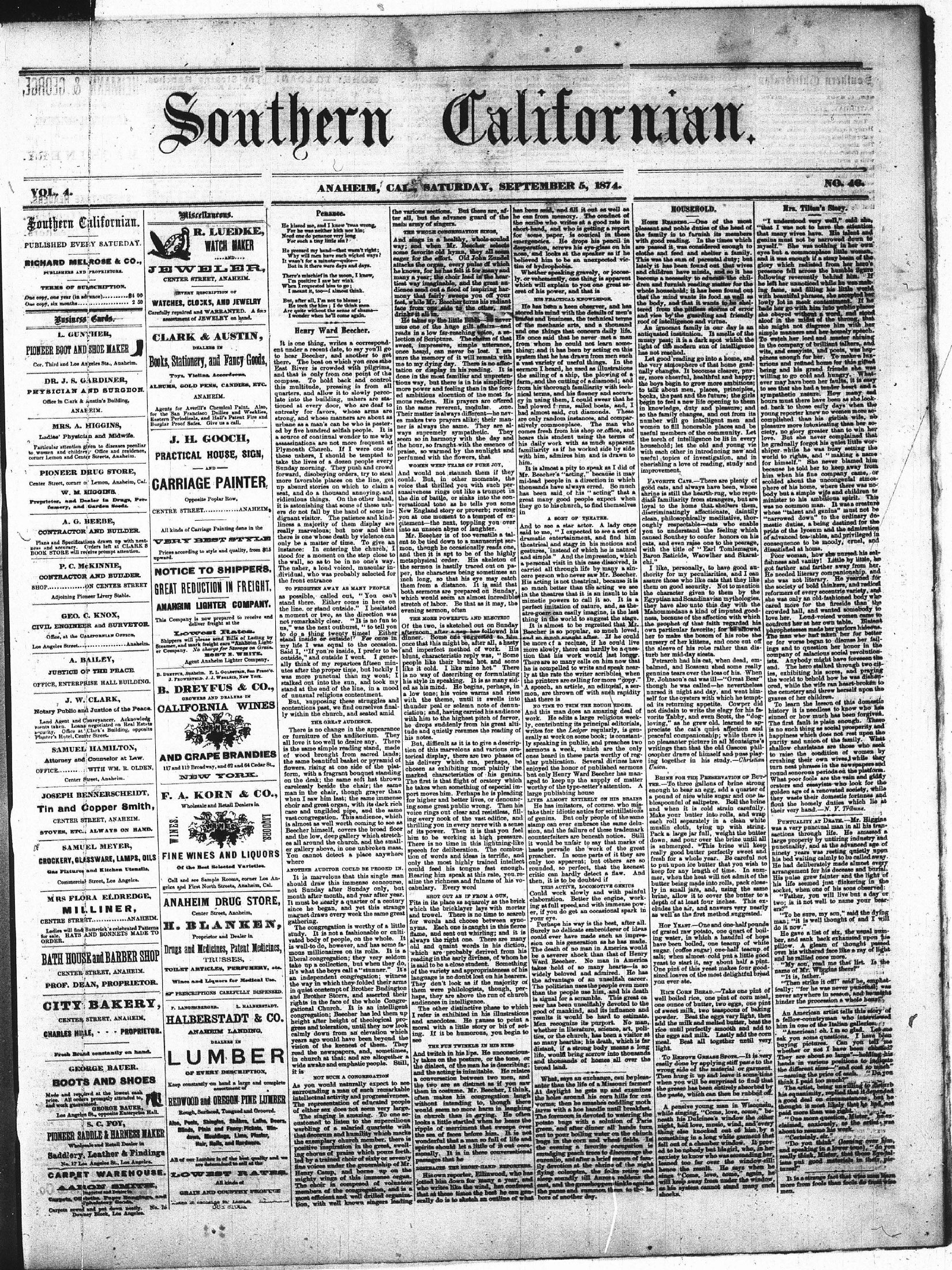
Searchable text
VOL. 4.
Southern Californian.
PUBLISHED EVERY SATURDAY.
RICHARD MELROSE & CO., PUBLISHERS AND PROPRIETORS.
TERMS OF SUBSCRIPTION.
One copy, one year (in advance).....$4 00
One copy, six months.....2 50
Business Cards.
L. GUNTHER,
PIONEER BOOT AND SHOE MAKER
Cor. Third and Los Angeles Sts., Anaheim.
DR. J. S. GARDINER,
PHYSICIAN AND SURGEON.
Office in Clark & Austin's Building,
ANAHEIM.
MRS. A. HIGGINS,
Ladies' Physician and Midwife.
Particular attention given to diseases peculiar to women and children. Office and residence, corner Lemon and Center Streets, Anaheim.
PIONEER DRUG STORE,
Miscellaneous.
R. LUEDKE,
WATCH MAKER
AND
JEWELER,
CENTER STREET, ANAHEIM.
EVERY DESCRIPTION OF
WATCHES, CLOCKS, AND JEWELRY
Carefully repaired and WARRANTED. A first assortment of JEWELRY on hand.
CLARK & AUSTIN,
DEALERS IN
Books, Stationery, and Fancy Goods,
Toys, Viellins, Accordeons,
ALBUMS, GOLD PENS, CANDIES, ETC.
ANAHEIM.
Agenta for Averill's Chemical Paint. Also, for the San Francisco Dailies and Weeklies, Eastern Periodicals, and Hall's Patent Fire and Burglar Proof Safes. Give us a call.
J. H. GOOCH,
PRACTICAL HOUSE, SIGN,
AND
Penance.
He kissed me, and I knew 'twice.
For he was neither kith nor new.
Need one do penance very long.
For such a tiny little am?
He pressed my hand—that wink.
Why will men have such wink?
It wasn't for a minute—quite—but in it there were days and
There's mischief in the moon.
I'm positive I saw her wink.
When I requested him to go;
I meant it, too—I almost threw
But after all, I'm not to blame.
He took the kiss; I do think
Are quite without the sense of I wonder when he'll come again.
Henry Ward Beeck
It is one thing, writes a sentent under a recent date, to hear Beecher, and and there. The boat on which yestery River is crowded with and that is only from one compass. To hold back this multitude, pressing quarters, and allow it to slate into the building, ushioned at every door, who entreaty for favors, who strong, and whose manners urbane as a man's can be wiled by five hundred selfish pains a source of continual wonders assassinations are not more Plymouth Church. If I these ushers, I should be take the lives of a dozen Sunday morning. They pu
DR. J. S. GARDINER,
PHYSICIAN AND SURGEON.
Office in Clark & Austin's Building,
ANAHEIM.
MRS. A. HIGGINS,
Ladies' Physician and Midwife.
Particular attention given to diseases peculiar to women and children. Office and residence, corner Lemon and Center Streets, Anaheim.
PIONEER DRUG STORE,
Center Street, corner of Lemon, Anaheim, Cal.
W. M. HIGGINS.
Proprietor, and Dealer in Drugs, Perfumery, and Garden Seeds.
A. G. BEEBE,
CONTRACTOR AND BUILDER.
Plans and Specifications drawn up with neatness and accuracy. Orders left at CLARK'S BOOK STORE will receive prompt attention.
P. C. McKINNIE,
CONTRACTOR AND BUILDER.
SHOP...ON CENTER STREET
Adjoining Pioneer Livery Stable.
GEO. C. KNOX,
CIVIL ENGINEER and SURVEYOR.
Office, at the California Office, Los Angeles Street...Anaheim.
A. BAILEY,
JUSTICE OF THE PEACE.
OFFICE, ENTERPRISE HALL BUILDING.
J. W. CLARK,
Notary Public and Justice of the Peace.
Land Agent and Conveyancer. Acknowledgments taken. Loans negotiated on Real Estate security. Office at Clark's Building, opposite Planter's Hotel, Center Street.
SAMUEL HAMILTON,
Attorney and Counselor at Law.
OFFICE...WITH WM. R. OLDEN, Center Street, Anaheim.
JOSEPH BENNERSCHEIDT,
Tin and Copper Smith,
CENTER STREET, ANAHEIM.
STOVES, ETC., ALWAYS ON HAND.
SAMUEL MEYER,
CROCKERY, GLASSWARE, LAMPS, OILS
Gas Fixtures and Kitchen Utensils,
Commercial Street, Los Angeles.
TOYS, VIOLINS, ACCORDIONS,
ALBUMS, GOLD PENS, CANDIES, ETC.
ANAHEIM.
Agents for Averill's Chemical Paint. Also, for the San Francisco Dallies and Weeklies, Eastern Periodicals, and Hall's Patent Fire and Burglar Proof Safes. Give us a call.
J. H. GOOCH,
PRACTICAL HOUSE, SIGN,
AND
CARRIAGE PAINTER,
Opposite Poplar Row,
CENTRE STREET...ANAHEIM.
All kinds of Carriage Painting done in the VERY BEST STYLE
Prices according to style and quality, from $15 upward.
NOTICE TO SHIPPERS.
GREAT REDUCTION IN FREIGHT.
AMAHEIM LIGHTER COMPANY.
This Company is now prepared to receive and deliver freight at the Lowest Rates.
Shippers will please send Bills of Lading by Steamer, and mark freight care "Anabaime Lighter Company." No charge for Storage on Grains.
BOSTH. WEITE.
Agent Anabaime Lighter Company.
B. DREYFUS & CO., GROWERS AND DEALERS IN CALIFORNIA WINES
AND CRAPE BRANDIES
117 and 119 Broadway, and 62 and 64 Cedar St., NEW YORK.
F. A. KORN & CO., Wholesale and Retail Dealers in
FINE WINES AND LIQUORS
Of the Best Selected Varieties.
Call and see Sample Rooms, corner Los Angeles and First North Streets, Anaheim, Cal.
TO FRIGHTEN AWAY AS MANAS IS possible, called out, stand there. Either come the line or stand outside a moment or two, as the not remarkably clear. "Us," was the next outburst to do a thing twenty times stand inside or outside! my life I was equal to Said I, "If you're inside, outside," and outside I wally think of my repartitions after the proper time was more punctual than stalked into the sunstand at the end of the list of unusual religious contests.
But, supposing these contentions past, we find only within the church, and THE GREAT AUDITOR There is no change in or furniture of the auditor all love it too well to desire is the same simple reading of wood brought from the same beautiful baskets flowers, rising at one side form, with a fragrant body on the desk; the same carelessly beside the chair, though when I saw him last; the choir and great organ, with case and ungilded pipes vast congregation. This is almost as well worth Beecher himself, covers and the low, deep galleries all around the church or gallery above, in one You cannot detect a where ANOTHER AUDITOR COULD It is marvelous that should draw this immature Sunday after Sunday month after month, and that is only from one compass. To hold back this multitude, pressing quarters, and allow it to shine into the building, usually entreaty for favors, whose strong, and whose manners urbane as a man's can be weighed by five hundred selfish pigs a source of continual wonders assassinations are not more Plymouth Church. If I take the lives of a dozen Sunday morning. They put forward, disobeying orders more favorable places on up absurd stories on which seat, and do a thousand ridiculous things. On the it is astonishing that some ers do not fall by the hand dignant visitor. The patience liness a majority of them really marvelous; but there is one whose death be only be a matter of time instance: In entering the stood for a moment on the wall, so as to be in mind The usher, a loud voiced dividing who was probably the front entrance
TO FRIGHTEN AWAY AS MANAS IS possible, called out, stand there. Either come the line or stand outside a moment or two, as the not remarkably clear. "Us," was the next outburst to do a thing twenty times stand inside or outside! my life I was equal to Said I, "If you're inside, outside," and outside I wally think of my repartitions after the proper time was more punctual than stalked into the sunstand at the end of the list of unusual religious contests.
But, supposing these contentions past, we find only within the church, and THE GREAT AUDITOR There is no change in or furniture of the auditor all love it too well to desire is the same simple reading of wood brought from the same beautiful baskets flowers, rising at one side form, with a fragrant body on the desk; the same carelessly beside the chair, though when I saw him last; the choir and great organ, with case and ungilded pipes vast congregation. This is almost as well worth Beecher himself, covers and the low, deep galleries all around the church or gallery above, in one You cannot detect a where ANOTHER AUDITOR COULD It is marvelous that should draw this immature Sunday after Sunday month after month,and
Tin and Copper Smith,
CENTER STREET, ANAHEIM.
STOVER, ETC., ALWAYS ON HAND.
SAMUEL MEYER,
CROCKERY, GLASSWARE, LAMPS, OILS
Gas Fixtures and Kitchen Utemalls,
Commercial Street, Los Angeles.
MRS FLORA ELDREDGE,
MILLINER,
CENTRE STREET...ANAHEIM.
Ladies will find Butterick's celebrated Patterns for sale. HATS AND BONNETS MADE TO ORDER.
BATH HOUSE and BARBER SHOP
CENTER STREET, ANAHEIM.
PROF. DEAN, PROPRIETOR.
CITY BAKERY,
CENTER STREET, ANAHEIM.
CHARLES MILE, ... PROPRIETOR.
Fresh Brand constantly on hand.
GEORGE BAUER.
BOOTS AND SHOES
Made and repaired at the lowest cash price. All orders promptly attended to, and work guaranteed.
GEORGE BAUER,
Los Angeles St., opposite Enterprise Hall.
S. C. FOY,
PIONEER SADDLE & HARNESS MAKER
Wholesale and Retail Dealer in Saddlery, Leather & Findings
No. 17 Los Angeles St., Los Angeles.
CARPET WAREHOUSE.
AARON SMITH,
Importer and Dealer in Carpets, Oilstates, Paper Hangings, and Upholstery Goods.
Carpets sold and put down nearly. No. 76 Dewey Block, Los Angeles.
FINE WINES AND LIQUORS
Of the Best Selected Varieties.
Call and see Sample Rooms, corner Los Angeles and First North Streets, Anaheim, Cal.
ANAHEIM DRUG STORE,
Center Street, Anaheim,
H. BLANKEN,
Proprietor and Dealer in Drugs and Medicines, Patent Medicines,
TRUSSES,
TOILET ARTICLES, PERFUMERY, etc.
Wines and Liquors for Medical Use.
PRESCRIPTIONS CAREFULLY DISPENSED.
P. LANGENBERGER.
L. HALBERSTADT.
HALBERSTADT & CO.
ANAHEIM LANDING,
DEALERS IN
LUMBER
OF EVERY DESCRIPTION,
Keep constantly on hand a large and complete assortment of REDWOOD and OREGON-PINE LUMBER
Rough, Surfaced, Tongued and Grooved.
Alna, Peaks, Shingles, Slabs, Lathes, Doors,
Blinds, Plains and Fancy Pieces, Windows,
Hoodings, Lines, Plaster,
Hair, Hails, and Hardware.
All of our Lumber is of the best quality and we are determined to sell at the LOWEST RATE.
All kinds of GRAIN AND COUNTER PRODUCTS
When I saw him last; the choir and great organ, with case and ungilded pipe vast congregation. This is almost as well worth Beecher himself, covering and the low, deep galleries all around the church or gallery above. In one You cannot detect a where ANOTHER AUDITOR COULD It is marvelous that should draw this immature not Sunday after Sunday month after month, and It must be nearly a quaise since he began, and magnet draws every week gathering.
The congregation is very study. It is not a fashional body of people, it is well-to-do, however, mous millionaires on liberal congregation; it takes up a collection, but it's what the boys call an independent congregation the way in which they live in quiet contempt of Bread Brother Storrs, and rights in the face of the gational Church. It congregation; Beecher height after height of grass and toleration, un calmly down from any years ago would have vision of the keenest read the newspapers in church at that; an wide awake and emphatic it is NOT SUCK A COOL As you would naturally surrounding a man or intellectual activity The representation of either sex does not The singing is amusing to listen to warbling of a malaria that decorum and hung the exemplary church positive inspiration ling chorus of praise led by a trained choir fine voices under the Henry Camp, and mighty wings of the The choir is composed members of the most efficient and wielding, with well know
ANAHEIM, CAL., SATURDAY, SEPTEMBER 5, 1874.
Penance.
He kissed me, and I knew 'twas wrong.
For he was neither kith nor kin;
Need one do penance very long.
For such a tiny little sin?
He pressed my hand—that wasn't right;
Why will men have such wicked ways?
It wasn't for a minute—quite—
But in it there were days and days.
There’s mischief in the moon, I know,
I’m positive I saw her wink
When I requested him to go;
I meant it, too—I almost think.
But, after all, I’m not to blame;
He took the kiss; I do think man
Are quite without the sense of shame—
I wonder when he’ll come again.
Henry Ward Beecher.
It is one thing, writes a correspondent under a recent date, to say you’ll go hear Beecher, and another to get here. The boat on which you cross the East River is crowded with pilgrims, and that is only from one point of the compass. To hold back and control his multitude, pressing in from all quarters, and allow it to slowly percute into the building, ushers are stationed at every door, who are deaf to treaty for favors, whose arms are strong, and whose manners are about as urbane as a man’s can be who is pestered by five hundred selfish people. It is source of continual wonder to me why assassinations are not more frequent at Lymouth Church. If I were one of these ushers, I should be tempted to take the lives of a dozen people every Sunday morning. They push and crowd disobeying orders try to steal the various sections. But these are, after all, but the advance guard of the main army of singers.
THE WHOLE CONGENATION MINOS,
And sings in a healthy, whole-souled way; and when Mr. Beecher selects some favorite old hymn, they all seem eager for the effort. Old John Zandel attacks the organ, every pulse off which he knows, for he has felt it for many and many a year; the choir lead in the heartiest way imaginable, and the greatest audience and out a flood of inspiring harmony that fairly sweeps you off your feet, while Mr. Beecher turns his radiant face from one side to the other, and drinks it all in.
He takes up the little Bible—he never uses one of the huge gilt affairs—and reads in a low far-reaching voice, a selection of Scripture. The charm of that sweet, impressive, simple utterance, once heard, can never be lost. I am sure the memory of it will remain with me to my dying day. There is no affectation or display in his reading. It is done in the most familiar and unpretentious way, but there is in his simplicity more power and feeling than in the forced ambitious elocution of the most famous readers. His prayers are offered in the same reverent, modular one. Their matter is always different—the he never makes two prayers alike; their manner is always the same. They are always supremely sympathetic. They seem so in harmony with the day and the hour, so fraught with the essence of praise, so warmed by the sunlight and perfumed with the flowers, that
WOMEN WEER TEARS OF PURE JOY,
And would not stamble them if they has been said, and fill it out as well as he can from memory. The conduct of the scribe who writes at a good rate in short-hand, and who is getting a report for some paper, is comical in these emergencies. He drops his pencil in desperation, screws his eye-glass on his nose, and looks at the speaker as if he believed him to be an unexpected victim of hydrophobia.
Whether speaking gravely, or jocosely, or vehemently, one thing is apparent which will explain to you one great secret of his power, and that is
HIS PRACTICAL KNOWLEDGE.
He has been a keen observer, and has stored his mind with the details of men’s wisdom and business, the technical terms of the mechanic arts, and a thousand and one things that concern daily life. He once said that he never met a man from whom he could not learn something; and it has been by acting on this system that he has drawn from men such as vast variety of useful things. In the sermon I heard, he used as illustrations the sailing of a ship, the plowing of a farm, and the cutting of a diamond; and from his thorough familiarity with technical terms, and his fluency and accuracy in using them, I could swear that he had plowed farms, sailed boats, and, I had almost said, cut diamonds. These are only random instances, and comparatively commonplace. The man who comes fresh from his shop or office, he hears this student using the terms of his daily work with as much apparent familiarity as if he worked side by side with him, admires him and is drawn to him.
It is almost a pity to speak as I did of Mr. Beecher’s testing: because it may
TO PHRIEN TEN AWAY AS MANY PEOPLE
as possible, called out, "You can't stand there. Either come in here on the line, or stand outside." I hesitated a moment or two, as the direction was not remarkably clear. "It is no fun to us," was the next outburst, "to tell you to do a thing twenty times! Either stand inside or outside!" For once in my life I was equal to the occasion. Said I, "If you're inside, I prefer to be outside," and outside I went. I generally think of my repartees fifteen minutes after the proper time, but luckily I was more punctual than my wont; I stalked out into the sun, and took my stand at the end of the line, in a mood of unusual religious contentment.
But, supposing these struggles and contentions past, we find ourselves finally within the church, and seated amid
THE GREAT AUDIENCE.
There is no change in the appearance or furniture of the auditorium. They all love it too well to desire any. There is the same simple reading stand, made of wood brought from sacred lands; the same beautiful basket or pyramid of flowers, rising at one side of the platform, with a fragrant bouquet standing on the desk; the same soft hat thrown carelessly beside the chair; the same man in the chair, though grayer than when I saw him last; the same immense choir and great organ, with its dark rich case and ungilded pipe, and the same vast congregation. This audience, which is almost as well worth coming to see as Beecher himself, covers the broad floor and the low, deep gallery which stretches all around the church, and the smaller gallery above, in one unbroken mass. You cannot detect a place anywhere where
ANOTHER AUDITOR COULD BE PEGGED IN.
It is marvelous that this single man should draw this immense concourse, not Sunday after Sunday only, but month after month, and year after year.
WOMEN WEEP TEARS OF PURE JOY,
And would not stanch them if they could. But, in other moments, the voice that thrilled you with such persuasiveness rings out like a trumpet in the din of battle, or sinks into the conversational tone as he tells you some New England story or proverb; rousing you at one moment to a tempest of excitement—the next, toppling you over into an unseen abyss of laughter.
Mr. Beecher is of too versatile a talent to be tied down to a manuscript sermon, though he occasionally reads one, and then it is apt to be of the highly metaphysical order. His skeleton of the sermon is hastily traced out on paper, the characters being sometimes an inch long, so that his eye may catch them from a distance. It is said that both sermons are prepared on Sunday, which would seem an almost incredible stretch of labor. Be that as it may, the evening sermon, often
THE MORE POWERFUL AND ELECTRIC
Of the two, is sketched out on Sunday afternoon, after a may has followed his dinner. Some one suggested to him once that might be, after all, a hasty and imperfect method of work. His blunt, characteristic reply was, "Some people like their bread hot, and some like it cold. I like mine hot." There is no way of describing or formulating his style in speaking. It is as many sided as his mind. He begins, perhaps, in a low tone; his voice warms and rises with the theme, until it swells into thunder peal or solemn note of denunciation; and having carried his audience with him to the highest pitch of fervor, he drops suddenly from his great altitude and quietly resumes the reading of his notes.
But, difficult as it is to give a description of this marvelous and various oratorial display, there are two phases of his delivery which can, perhaps, be chosen as exhibiting most plainly the marked characteristics of his genius. The first is that flight of oratory which he takes when something of especial import moves him. Perhaps he is pleading for higher and better lives, or denouncing some great public wrong. Then his voice rings out clear and resistless, filling every nook of the vast edifice, and thrilling you in every nerve with a sense of its power. Then it is that you feel him to be working at high pressure. There is no time in this lightning-like speech for deliberation. The combustion of words and ideas is terrific, and only the most highly trained intellect could feed his tongue fast enough. Hearing him speak at this rate, you realize the richness and fulness of his vocabulary. Every word
SHOT OUT AS IF FROM A GUN,
the sailing of a ship, the plowing of a farm, and the cutting of a diamond; and from his thorough familiarity with technical terms, and his fluency and accuracy in using them, I could swear that he had plowed forms, sailed boats, and I had almost said, cut diamonds. These are only random instances, and comparatively commonplace. The man who comes fresh from his shop or office, and hears this student using the terms of his daily work with as much apparent familiarity as if he worked side by side with him, admires him and is drawn to him.
It is almost a pity to speak as I did of Mr. Beecher's "acting," because it may mislead people in a direction in which thousands have always erred. So much has been said of his "acting" that a great many good people expect when they go to his church, to find themselves in
A SORT OF THEATRE.
And to see a star actor. A lady once said to me, "I expected to see a sort of dramatic entertainment, and find him theatrical and stagy in his motions and gestures, instead of which he is natural and simple." And the impression, which a personal visit in this case dissolved, is carried all through life by many a sincere person who never saw Mr. Beecher. His acting is not theatrical, because it is so much better than the acting we see in the theatres that it is an insult to his mimetic powers to call it so. It is a perfect imitation of nature, and, as theatre-goers can easily imagine, is the last thing in the world to suggest the stage.
It is almost to be regretted that Mr. Beecher is so popular, so much loved, and so much sought after. If he could be more of a recluse, if he could live more slowly, there can hardly be a question that his work would last longer. There are so many calls on him now that he is compelled to write and speak nearly at the rate the writer scribbles when the printers are calling for more "copy." A speech, an article, an editorial, a sermon, are thrown off with such rapidity that there is
NO TIME TO TRIM THE ROUGH EDges.
And this man does an amazing deal of work. He edits a large religious weekly, contributing its principal editorials, writes for the Ledger regularly, is generally at work on some book; is constantly speaking in public, and preaches two sermons a week, which are the only ones heard in these parts worthy of regular publication. Several divines have enjoyed the honor of published sermons but only Henry Ward Beecher has managed to keep up the supply of matter worthy of the type-setter's attention. A large publishing house
LIVES ALMOST ENTIELY ON HIS BRAINS
He has imitators, of course. Who mistake their idiotic antics for scintillations of genins. But only people of the same stamp can ever embrace the same delusion, and the failure of these trademark counterfeiters are beneath notice. Still it would be unfair to say that marks of haste pervade the work of the great preacher. In some parts of it they are only too apparent; but others are so rounded, so perfect, that the keenest critic can hardly detect a flaw. And then it is to be doubted if
THIS ACTIVE LOCOMOTIVE GENius
Could work slowly and with painful work
when I saw him last; the same immense choir and great organ, with its dark rich case and ungilded pipe, and the same vast congregation. This audience, which is almost as well worth coming to see as Beecher himself, covers the broad floor and the low, deep gallery which stretches all around the church, and the smaller gallery above, in one unbroken mass. You cannot detect a place anywhere where
ANOTHER AUDITOR COULD BE PEGGED IN.
It is marvelous that this single man should draw this immense concourse, not Sunday after Sunday only, but month after month, and year after year. It must be nearly a quarter of a century since he began, and yet this strange magnet draws every week the same great gathering.
The congregation is worthy of a little study. It is not a fashionable or cultivated body of people, on the whole. It is well-to-do, however, and has some famous millionaires on its rolls. It is a liberal congregation; they very seldom take up a collection, but when they do, it's what the boys call a "stunner." It's an independent congregation; witness the way in which they folded their arms in quiet contempt of Brother Budington and Brother Storrs, and asserted their rights in the face of the whole Congregational Church. It is an intelligent congregation; Beecher has led them up height after height of theological progress and toleration, until they now look calmly down from an elevation which years ago would have been beyond the vision of the keenest of them. They read the newspapers, and, sometimes, in church at that; and are altogether a wide awake and emphatic people. Still, it is
NOT SUCK A CONGREGATION
As you would naturally expect to see surrounding a man of such remarkable intellectual activity and progressiveness. The representation of educated people of either sex does not seem very large.
The singing is amazing. To one customed to listen to the supercilious warbling of a salaried quartette with that decorum and humility which marks the exemplary church member, there is positive inspiration in the great, swelling chorus of praise which pours forth by a trained choir of sixty or seventy fine voices under the generalship of Mr. Henry Camp, and horns up on the mighty wings of this immense organ.
The choir is composed of volunteer members of the congregation, and is a most efficient and well drilled organization, with well known singers leading
SHOT OUT AS IF FROM A GUN,
Fits in its place as squarely as the brick which the bricklayer lays with mortar and trowel. There is no time to search for words and choose between synonyms. Each one is caught in this fierce flame, and sent out whirling; and it is always the right one. There are many old and quaint words in his diction, which are probably derived from his reading in the early divines, of whom he is said to be a close student. Something of the variety and appropriateness of his language is no doubt lost on his hearers. They don't look as if the majority of them were philologists, though, perhaps, they are above the run of church audiences in intelligence.
The other distinctive phase to which I refer is exhibited in his illustrations and anecdotes. He pauses to point a moral with a little story or bit of acting. If it be humorous, you begin to see
THE FUN TWINKLE IN HIS EYES
And twitch in his lips. He unconsciously takes on the posture, or the tone, or the dialect, of the man he is describing; and the acting is imitable. He relates a conversation between two men, and the two are as distinct as if you saw them in costume. Mr. Beecher, I think often makes his congregation laugh without intending to, though there would seem no more harm in laughing in church than in grying. He often looks a little startled when he hears the ripple of merriment that sweeps over the sea of faces before him. It is not wonderful that a man so full of life and spirits should let a little of it out occasionally. It is in these conversational passages that he
INTERACTS THE SMOKER-HAND HEOPONIX.
His own reporter, Ellinwood, who has jotted him down for many a year, and who writes like the wind, has confessed that at these times the best he can generally do is to sketch an outline of what
LIVES ALMOST ENTIRELY ON HIS BRAINS
He has imitators, of course who mistake their idiotic antics for scintillations of genius. But only people of the same stamp can ever embrace the same delusion, and the failure of these trademark counterfeiters are beneath notice. Still it would be unfair to say that marks of haste pervade the work of the great preacher. In some parts of it they are only too apparent; but others are so rounded, so perfect, that the koenest critic can hardly detect a flaw. And then, it is to be doubted if
THIS ACTIVE LOCOMOTIVE GENIUS
Could work slowly and with painful elaboration. Better the engine, working at full speed and with immense power, if you do get an occasional spark in your eye.
Perhaps his way is the best, after all. Surely no delicate embroiderer of ideas could ever have made such an impression on his generation as he has made. The death of no man in America would be a severer shock than that of Henry Ward Beecher. No man in America takes hold of so many hearts—is so widely beloved and admired. He has the advantage of an unselfish career. The politician uses the people even more than the people use him, and his death signal for a scramble. This great career has been unselfishly devoted to the good of mankind, and its influence and results it would be hard to estimate. Men recognize its purport. No man whether in literature, science, art, politics, or the church, has been a visitor at so many hearths; his death, which is far distant, if a strong body means a long life, will bring sorrow into thousands and thousands of homes all over the broad land.
What says an exchange can be pleasant than the life of a Missouri farmer? At daylight he gets up and examines the holes around his corn hills for cut worms; then he smashes coddling moth larvae with a hoe handle until breakfast. The foremoon is devoted to watering the potato bugs with a solution of Paris green, and after dinner all hands turn out to pour boiling water on the chinch bugs in the corn and wheat fields. In the evening a favorite occupation is smudging peach trees to disincorpure the curculio, and after a brief season of family devotion at the shrine of the night flying colony, the folks retire and sleep soundly till Anora raddles the east, and the grasshopper flinkes against the panees and summons them to the labors of another day.
HOUSEHOLD.
Home Reamme.—One of the most pleasant and noble duties of the head of the family is to furnish its members with good reading. In the times which are passed it was considered enough to clothes and feed and shelter a family. This was the sum of parental duty; but lately it has been found out that wives and children have minds, and so it has become a necessity to educate the children and furnish reading matter for the whole household; it has been found out that the mind wants its food as well as the body, and that it wants to be sheltered from the pitiless storms of error and vice by the guarding and friendly roof of intelligence and virtue.
An ignorant family in our day is an antiquated institution. It smells of the musty past; it is a dark spot which the light of the modern sun of intelligence has not reached.
Let good reading go into a home, and the very atmosphere of that home gradually changes. It becomes clearer, purer, more cheerful, healthful and happy; the boys begin to grow more ambitious; to talk about men, places, principles, books, the past and the future; the girls begin to feel a new life opening to them in knowledge, duty and pleasure; and so the family changes, and out from its number will go intelligent men and women to fill honorable places and be useful members of the community. Let the torch of intelligence be lit in every household; let the old and young vie with each other in introducing new and useful topics of investigation, and in cherishing a love of reading, study and improvement.
Mrs. Tillian's Story.
"I understood very well," said she, "that I was not to have the attention that many wives have. His talent and genius must not be narrowed down to myself." She was nothing in her own eyes but a commonplace little woman, and it was enough if a stray beam of the glory which radiated from her hero's presence fell across the humble figure following reverently behind him. If he left her unnoticed while he was making fame, and filling his little world with beautiful phrases, she accepted her lowly lot in meek contentment. If he had her go with him into public place she obeyed without a word, and stood aloof in the midst of the throng, that she might not disgrace him with her simple manners and her homely speech. To watch her lord and master shining in the company of brilliant talkers, and wits, and essayists, and poets, was happiness enough for her. To make a luxurious and refined home for this gifted being and his grand friends she was willing to go cold and hungry. Whatever may have been her faults, it is easy to see that she had a tender heart and a sympathetic nature. How many hours must there have been as she looked back to those early days when the young reporter knew no women more accomplished than his girlish wife, no pleasure more intoxicating than her society, no glory greater than to win her love. But she never complained that he gradually forgot his quiet little worshiper while he was busy setting the world to rights, and "making a name for himself." She never blamed him because he told her to keep away from him.
following of a diamond; and with techand accuracy we wear that he boats, and, I bonds. These and compare the man who por office, and the terms of such apparent side by side is drawn to speak as I did because it may in which used. So much acting" that a expect when and themselves
A lady once so see a sort of and find him motions and he is natural depression, which are dissolved, is many a sinister Mr. Beecher. Because it is affecting we see insult to his so. It is a dee, and, as the nine, is the last greatest stage. Setted that Mr. too much loved. If he could live hardly be a question last longer.
In him now that and speak near describibles when more "copy." editorial, a serene such rapidity
A huge deal of religious week's editorials, regularly, is genook; is constant and preaches two are the only worthy of regal divines have published sarmons seacher has manly supply of matter's attention.
On his brains course, who misfor scintillations people of the same are the same delu these trademark with notice. Still why that marks of work of the great arts of it they are not others are so what the keenest act a flaw. And if motive genius and with painful work
er, more cheerful, healthful and happy; the boys begin to grow more ambitions; to talk about men, places, principles, books, the past and the future; the girls begin to feel a new life opening to them in knowledge, duty and pleasure; and so the family changes, and out from its number will go intelligent men and women to fill honorable places and be useful members of the community. Let the torch of intelligence be lit in every household; let the old and young vie with each other in introducing new and useful topics of investigation, and in cherishing a love of reading, study and improvement.
Favorite Cats.—There are plenty of good cats, and always have been, whose shrine is still the hearth-rug, who repudiate familiarity from strangers, but are loyal to the home that shelters them, discriminatingly affectionate, daintily clean, philosophically meditative, thoroughly respectable—cats who enable you to understand the feeling which caused Southey to confer honors on his cats, and even raise one to the peerage, with the title of "Earl Tomlemagne, Baron Raticide, Waowlher and Skaratchi."
I like personally, to have good authority for my peculiarities, and I can assure those who like cats that they like them on good security. Not to mention the character given to them by the Egyptian and Scandinavian mythologies, they have also unto this day with the Mahommedans a kind of imputed goodness, because of the affection with which the prophet of that faith regarded his own particular favorite; for he allowed her to make the bosom of his robe the nursery of her kittens, and once cut off the sleeve of his robe rather than disturb her mid-day siesta.
Petrarch had his cat, when dead, embalmed, and Rossean shed some really genuine tears over the loss of his. When Dr. Johnson's cat was ill—"Great Bear" though he was called—he nevertheless nursed it night and day, and went himself for the oysters with which he tempted its returning appetite. Cowper did not disdain to write the elegy for his favorite Tabby, and even Scott, the "dog-loving," as he grew old. learned to appreciate the cat's quiet affection and peaceful companionship; while there is no pleasanter picture in all Montaigne's writings than that the old Gascon philosopher draws of himself and puss playing together in his study.—Christian Union.
Brine for the Preservation of Butter.—To three gallons of brine strong enough to bear an egg, add a quarter of a pound of nice white sugar and one tablespoonful of saltpetre. Boil the brine and when it is cold strain carefully. Make your butter into rolls, and wrap each roll separately in a clean white muslin cloth, tying up with string. Pack a large jar full, weight the butter down, and pour over the brine until all is submerged.* This brine will keep really good butter perfectly sweet and fresh for a whole year. Be careful not to put upon ice butter that you wish to keep for any length of time. In summer, when the heat will not admit of the butter being made into rolls, pack closely in small jars, and using the same brine, allow it to cover the butter to a willing to go cold and hungry. What ever may have been her faults, it is easy to see that she had a tender heart and sympathetic nature. How many hours must there have been as she looked back to those early days when the young reporter knew no women more accomplished than his girlish wife, no pleasure more intoxicating than her society, no glory greater than to win her love. But she never complained that he gradually forgot his quiet little worshiper while he was busy setting the world to rights, and "making a name for himself." She never blamed him because he told her to keep away from him when his fine company came, or scolded about the uncongenial atmosphere of his home, where there was nobody but a simple wife and children to minister to his ambitions spirit. This was no common man. It was a creature whose "talent and genius" must not be "narrowed down" to the ordinary domestic duties, a being destined for the pride of the lyceum and the admiration of advanced tea-tables, and privileged in consequence to be moody, cruel, and disatisfied at home.
Poor woman, how she nured his selfishness and vanity! Little by little, he got farther and farther away from her. He needed literary companionship, and she was not literary. He yearned for the society of bold thinkers, and radical reformers of every societie variety, and she was only an old-fashioned body who cared more for the fireside than the crowded hall, and wanted somebody to love her. Loud-voiced women came to confront her at her own table. Blunt phropheteses made her parlor hidea. The man who hast taken her for better or for worse began to discuss her failings and to question her honor in the company of salacious social revolutionists. Anybody might have foreseen the end. The hero stalked through two cities, exhibiting his sores, and praying the world to behold how he was dishonored, while the wife ran heart-broken to the cemetery and threw herself upon the graves of her children.
To learn the lesson of this domestic history it is needless to know who has sinned or how much has been forgiven. The first fault is plain enough. There is no such thing as social prosperity and happiness which does not rest upon the purity and union of the family. What shallow charlatans are those who seek to raise the condition of women by crushing their own wives; while they turn neat phrases in the newspapers and round sonorous periods on the platform. What poor fools are the vain and giddy orators and essayists who look for the golden age of a renovated society, while they waste their domestic fortunes and flout the homely duties which lie at their very hand:—N. Y. Tribune.
PUNTUALITY AT DEATH.—Mr. Higgins was a very punctual man in all his transactions through life. He amassed a large property by untiring industry and punctuality, and at the advanced age of ninety years was resting quietly upon his bed waiting calmly to be called away. He had deliberately made almost every arrangement for his decease and burial. His pulse grew fainter and the light of his life seemed just flickering in the socket, when one of his sons observed: "Father you will live but a day or
THE BEST, after all,
provider of ideas such an improvsion he has made.
An America would
can that of Henry
man in America
any hearts—is so
admired. He has
an unselfish career.
People even more
him, and his death
is. This great caly devoted to the
its influence and
hard to estimate.
Airport. No man,
science, art, policies been a visitor at
death, which is far
body means a long
row into thousands
comes all over the
HOP YEAST—One and one-half pounds
of grated raw potato, one quart of boiling water, in which a handful of hops
have been boiled, one teacup of white sugar (coffee sugar) one-half teacup of salt; when almost cold put a little good
yeast to start it, say about half a pint. One pint of this yeast makes four good-sized loaves of the most delightful bread
you ever ate.
RICE CORN BREAD.—Take one pint of well boiled rice, one pint of corn meal,
one ounce of butter, two eggs, one pint of sweet milk, two teaspoons of baking powder. Beat the eggs very light, then add the milk and melted butter, beat the rice until perfectly smooth and add to
the eggs and milk. Lastly add the corn meal. Beat all together until very light.
To REMOVE GREASE SPOTS.—It is very easily done by applying stiff paste to the wrong side of the material or garment. Then hang it up and leave it some time when you will be surprised to find that the grease has been entirely absorbed by the paste, which can then be rubbed off.
A pensive young man in Wisconsin, while singing, "Come, love, come," beneath his Dulcinea's window the other night, had love, music, wind, and every thing also knocked out of him by something in a long white garment that fall out of a chamber window. It proved to be nobody but his girl, who, in her anxiety to know who was screaming her, learned too far over the window-all-hence the result. He says when he sings "Come, love, some," again, he will keep away from under the window, as his system cannot stand many shocks.
PUNTUALITY AT DEATH.—Mr. Higgins was a very punctual man in all his transactions through life. He amassed a large property by untiring industry and punctuality, and at the advanced age of ninety years was resting quietly upon his bed waiting calmly to be called away. He had deliberately made almost every arrangement for his decease and burial. His pulse grew fainter and the light of his life seemed just flickering in the socket, when one of his sons observed:
"Father, you will live but a day or two; is it not well to name your bearers?"
"To be sure, my son," said the dying man; "it is well thought of and I will do it now."
He gave a list of six, the usual number, and sank back exhausted upon his pillow. A gleam of thought passed over his withered face like a ray of light and he rallied once more.
"My son, read me that list. Is the name of Mr. Higgins there?"
"It is, father."
"Then strike it off!" said he, emphatically; "for he was never punished; was never anywhere in season, and he might hinder the procession a whole hour."
An American artist tells this story of a fellow-countryman who interviewed him in one of the Italian galleries:
"American! oh. I'm so glad. Let me ask you some questions. I have been buying pictures. Can you tell me whether or not I have been abashed? They are about so large"—holding his hands in various positions to indicate the different sizes"—and cost so much"—naming the price of each. "Do you think I paid too much?
The artist, being unwilling to disturb his equanimity, replied that it depended on a good deal on circumstances, but he thought it most likely that he had not paid more than was right.
"One more question, Mister." he exclaimed, anxiously, as the artist was about to rename his work.
"Certainly, sir."
"Do you think?" (leaving over him, and speaking in a lower tone), "do you really think, Mister, that these Egg-balances put good materials in their picture."
It is a strange fact that wise men learn more from fools than fools do from wise men.