anaheim-gazette 1874-06-27
Scanned page
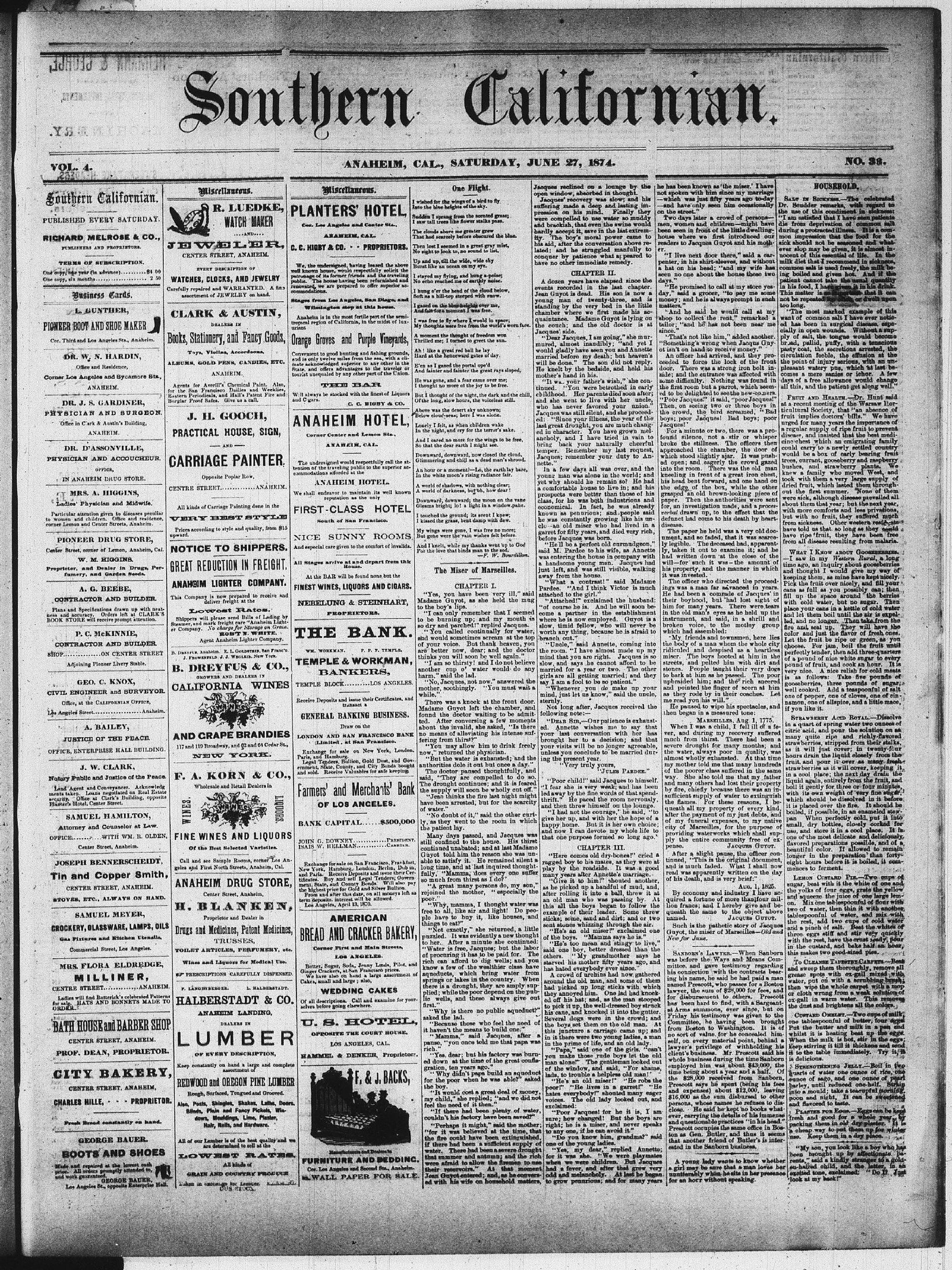
Searchable text
Southern Californian.
PUBLISHED EVERY SATURDAY.
RICHARD MELROSE & CO., PUBLISHERS AND PROPRIETORS.
TERMS OF SUBSCRIPTION.
One copy, one year (in advance)... $4.00
One copy, six months... 2.50
Business Cards.
L. GUNTHER,
PIONEER BOOT AND SHOE MAKER
Cor. Third and Los Angeles Sts., Anaheim.
DR. W. N. HARDIN,
Office and Residence,
Corner Los Angeles and Sycamore Sts.,
ANAHEIM.
DR. J. S. GARDINER,
PHYSICIAN AND SURGEON.
Office in Clark & Austin's Building,
ANAHEIM.
DR. D'ASSONVILLE,
PHYSICIAN AND ACCOUCHEUR.
OFFICE,
Miscellaneous.
R. LUEDKE,
WATCH MAKER
JEWELER,
CENTER STREET, ANAHEIM.
EVERY DESCRIPTION OF
WATCHES, CLOCKS, AND JEWELRY
Carefully repaired and WARRANTY. A fine assortment of JEWELRY on hand.
CLARK & AUSTIN,
DEALERS IN
Books, Stationery, and Fancy Goods,
Toys, Violins, Accordeons,
ALBUMS, GOLD PENS, CANDIES, ETC.
ANAHEIM.
Agents for Averill's Chemical Paint. Also,
for the San Francisco Dailles and Weeklies,
Eastern Periodicals, and Hall's Patent Fire and
Burglar Proof Safes. Give us a call.
J. H. GOOCH,
PRACTICAL HOUSE, SIGN,
AND
CARRIAGE PAINTER.
Corner Los Angeles and Sycamore St., Anaheim.
DR. J. S. GARDINER,
PHYSICIAN AND SURGEON.
Office in Clark & Austin's Building, Anaheim.
DR. D'ASSONVILLE,
PHYSICIAN AND ACCOUCHEUR.
OFFICE,
IN ANAHEIM DRUG STORE.
MRS. A. HIGGINS,
Ladies' Physician and Midwife.
Particular attention given to diseases peculiar to women and children. Office and residence, corner Lemon and Center Streets, Anaheim.
PIONEER DRUG STORE,
Center Street, corner of Lemon, Anaheim, Cal.
W. M. HIGGINS.
Proprietor, and Dealer in Drugs, Perfumery, and Garden Seeds.
A. G. BEEBE,
CONTRACTOR AND BUILDER.
Plans and Specifications drawn up with neatness and accuracy. Orders left at CLARK'S BOOK STORE will receive prompt attention.
P. C. McKINNIE,
CONTRACTOR AND BUILDER.
SHOP...ON CENTER STREET
Adjoining Pioneer Livery Stable.
GEO. C. KNOX,
CIVIL ENGINEER and SURVEYOR.
Office, at the CALIFORNIAN OFFICE, Los Angeles Street...Anaheim.
A. BAILEY,
JUSTICE OF THE PEACE.
OFFICE, ENTERPRISE HALL BUILDING.
J. W. CLARK,
Notary Public and Justice of the Peace.
Land Agent and Conveyancer. Acknowledgments taken. Loans negotiated on Real Estate security. Office at Clark's Building, opposite Plaster's Hotel, Center Street.
SAMUEL HAMILTON,
Attorney and Counselor at Law.
OFFICE...WITH WM. R. OLDEN, Center Street, Anaheim.
JOSEPH BENNERSCHEIDT,
Tin and Copper Smith,
CENTER STREET, ANAHEIM.
J. H. GOOCH,
PRACTICAL HOUSE, SIGN,
AND CARRIAGE PAINTER.
Opposite Poplar Row,
CENTRE STREET...ANAHEIM.
All kinds of Carriage Painting done in the VERY BEST STYLE.
Prices according to style and quality, from $15 upward.
NOTICE TO SHIPERS.
GREAT REDUCTION IN FREIGHT.
ANAHEIM LIGHTER COMPANY.
This Company is now prepared to receive and deliver freight at the Lowest Rates.
Shippers will please send Bills of Lading by Steamer, and mark freight care "Anaheim Lighter Company." No charge for Storage on Grains.
ROST N. WHITE.
Agent Anaheim Lighter Company.
B. DREYFUS, Anaheim. E. L. GOLDSTEIN, San Francisco.
J. POWENFIELD, J. J. WEGLIS, New York.
B. DREYFUS & CO., GROWERS AND DEALERS IN CALIFORNIA WINES
AND GRAPE BRANDIES
117 and 119 Broadway, and 62 and 64 Cedar St., NEW YORK.
F. A. KORN & CO., Wholesale and Retail Dealers in WINES.
FINE WINES AND LIQUORS
Of the Best Selected Varieties.
Call and see Sample Rooms, corner Los Angeles and First North Streets, Anaheim, Cal.
ANAHEIM DRUG STORE,
Center Street, Anaheim,
Agents for Averill's Chemical Paint. Also, for the San Francisco Dailies and Weeklies, Eastern Periodicals, and Hall's Patent Fire and Burglar Proof Safes. Give us a call.
THE I.
Will always be stocked wi
and Cigars.
ANAHEIM
Corner Center an
ANAHEIM
The undersigned would dention of the traveling pu commodations afforded at
ANAHEIM
We shall endeavor to ma reputation a
FIRST-CLAS
South of Na
NICE SUNN
And especial care given to
All Stages arrive at a Hou
At the BAR will be
FINEST WINES, LIQU
NEBELUNG &
PROPEI
SAMUEL HAMILTON,
Attorney and Counselor at Law.
OFFICE... WITH WM. R. OLDEN,
Center Street, Anaheim.
JOSEPH BENNERSCHEIDT,
Tin and Copper Smith,
CENTER STREET, ANAHEIM.
STOVES, ETC., ALWAYS ON HAND.
SAMUEL MEYER,
CROCKERY, GLASSWARE, LAMPS, OILS
Gas Fixtures and Kitchen Utensils.
Commercial Street, Los Angeles.
MRS. FLORA ELDREDGE,
MILLINER,
CENTRE STREET...ANAHEIM.
Ladies will find Butterick's celebrated Patterns for sale. HATS AND BONNETS MADE TO ORDER.
BATH HOUSE and BARBER SHOP
CENTER STREET, ANAHEIM.
PROF. DEAN, PROPRIETOR.
CITY BAKERY,
CENTER STREET, ANAHEIM.
CHARLES HILLE, ... PROPRIETOR.
Fresh bread constantly on hand.
GEORGE BAUER.
BOOTS AND SHOES
Made and required at the lowest cash price. All orders promptly attended to, and work guaranteed.
GEORGE BAUER.
Los Angeles St., opposite Enterprise Hall.
FINE WINES AND LIQUORS
Of the Best Selected Varieties.
Call and see Sample Rooms, corner Los Angeles and First North Streets, Anaheim, Cal.
ANAHEIM DRUG STORE,
Center Street, Anaheim,
H. BLANKEN,
Proprietor and Dealer in Drugs and Medicines, Patent Medicines, TRUSSES,
TOILET ARTICLES, PERFUMERY, etc.
Wines and Liquors for Medical Use.
OF PRESCRIPTIONS CAREFULLY DISPENSED.
P. LANGINBERGER.
L. HALBERSTADT.
HALBERSTADT & CO.
ANAHEIM LANDING,
DEALERS IN
LUMBER
OF EVERY DESCRIPTION.
Keep constantly on hand a large and complete assortment of REDWOOD and OREGON PINE LUMBER
Rough, Surfaced, Tongued and Grooved.
Also, Posts, Shingles, Shakes, Laths, Doors, Blinds, Plain and Fancy Pickets, Windows, Mouldings, Lime, Plaster, Hair, Nails, and Hardware.
All of our Lumber is of the best quality and we are determined to sell at the LOWEST RATES.
All kinds of GRAIN AND COUNTRY PRODUCE
Of Los Angeles, April 17
NORTHCALIFRONIA
ANAHEIM, CAL., SATURDAY, JUNE 27, 1874.
Miscellaneous.
PLANTERS' HOTEL,
Cev. Los Angeles and Center Sts.
ANAHEIM, CAL.
C. C. HIGBY & CO. - PROPRIETORS.
We, the undersigned, having leased the above well known house, would respectfully solicit the patronage of its former friends and the traveling public. The house having been refurbished and renovated, we are prepared to offer superior accommodations.
Stages from Los Angeles, San Diego, and Wilmington stop at this house.
Anaheim is in the most fertile part of the semi-tropical region of California, in the midst of luxuriant Orange Groves and Purple Vineyards.
Convenient to good hunting and fishing grounds, and is only twelve miles from the sea, with a climate acknowledged superior to any other in the State, and offers advantages to the traveler or tourist unequaled by any other part of the Union.
THE BAR
Will always be stocked with the finest of Liquors and Cigars.
C. C. HIGBY & CO.
ANAHEIM HOTEL,
Corner Center and Lemon Sts.
ANAHEIM, CAL.
The undersigned would respectfully call the attention of the traveling public to the superior accommodations afforded at the One Flight.
I wished for the wings of a bird to fly Into the blue heights of the sky.
Sudden I sprang from the scented grass; I saw tall trees like flower stalks pass.
The clouds above me greater grew That had scarcely before obscured the blue.
Then lost I seemed in a great gray mist, No sight to look to, no sound to list.
Up and up, till the wide, wide sky Burst like an ocean on my eye.
I stayed my flying, and hung a poise; No echo reached me of earthly noise.
I hung o’er the head of the cloud below, Soft as a hill-top steeped with snow.
I gazed on the blue heights over me, And faint for a moment I was free.
I was free to fly where I would in space; My thoughts were free from the world’s worn face.
A moment the thought of freedom won Thrilled me; I turned to greet the sun.
Ah! like a great red ball he lay Hard at the henceward gates of day.
E’en as I gazed the portal ope’d And fainter and fainter the great rays sloped,
He was gone, and a fear came over me;
I thought no more of the joy to be free.
But I thought of the night, the dark and the chill, Of the long, slow hours, the voiceless still.
Above was the desert sky unknown; Below cloud-seas; here I was alone.
Lonely I felt, as when children wake In the night, and cry for the terror’s sake.
And I cared no more for the wings to be free, So that dear earth I might see.
Downward, downward, now closed the cloud, Glimmering and chill as a dead man’s shroud.
An hour or a moment—Lo, the earth lay bare,
Jacques reclined on a lounge by the open window, absorbed in thought.
Jacques’ recovery was slow; and his suffering made a deep and lasting impression on his mind. Finally they were compelled to use water no muddy and brackish, that even the swine would hardly accept it, save in the last extremity. The boy’s moral power came to his aid, after the conversation above related; and he struggled manfully to conquer by patience what appeared to have no other immediate remedy.
CHAPTER II.
A dozen years have elapsed since the events recorded in the last chapter. Jean Guyot is dead. His son is now a young man of twenty-three, and is standing by the very bed in the little chamber where we first made his acquaintance. Madame Guyot is lying on the couch; and the old doctor is at Jacques’ side.
“Dear Jacques, I am going,” she murmured, almost inaudibly; “and yet I would gladly have seen you and Annette married before my death; but heaven’s will be done.” The son did not reply. He knelt by the bedside, and held his mother’s hand in his.
“It was your father’s wish,” she continued. “You were betrothed in early childhood. Her parents died soon after; and she went to live with her uncle, who has never favored your union.” Jacques was still silent, and she proceeded: “Since your illness, the year of the last great drought, you are much changed in character. You have grown melancholy, and I have tried in vain to bring back your naturally cheerful temper. Remember my last request, Jacques; remember your duty to Annette.”
In a few days all was over, and
THE BAR
Will always be stocked with the finest of Liquors and Cigars.
C. C. BIGBY & CO.
ANAHEIM HOTEL,
Corner Center and Lemon St..
ANAHEIM, CAL.
The undersigned would respectfully call the attention of the traveling public to the superior accommodations afforded at the
ANAHEIM HOTEL.
We shall endeavor to maintain its well known reputation as the only
FIRST-CLASS HOTEL
South of San Francisco.
NICE SUNNY ROOMS
And especial care given to the comfort of invalids.
All Stages arrive at and depart from thk House.
At the BAR will be found none but the FINEST WINES, LIQUORS AND CIGARS.
NEBELUNG & STEINHART,
PROPEIETORS.
THE BANK.
WM. WORKMAN. P. P. P. TEMPLE.
TEMPLE & WORKMAN, BANKERS,
TEMPLE BLOCK...LOS ANGLES.
Receive Deposits and issue their Certificates, and transact a
GENERAL BANKING BUSINESS.
Draw on the
LONDON AND SAN FRANCISCO BANK Limited, at San Francisco.
Exchange for sale on New York, London, Paris, and Hamburg.
Legal Tenders, Bullion, Gold Dust, and Government State, County, and City Bonds bought and sold. Receive Valuables for safe keeping.
Farmers' and Merchants' Bank OF LOS ANCELES.
BANK CAPITAL.....$500,000
JOHN G. DOWNEY...PRESIDENT.
ISAIS W. HELLMAN...CASHIER.
Exchange for sale on San Francisco, Frankfort, New York, Hamburg, London, Berlin, Dub in, and Paris. Receive Deposits and issue their Certificates. Buy and sell Legal Tenders; Government State, and County Bonds. Will also pay the highest price for Gold and Silver Bullion.
From and after this date, on all monies left as
He was gone, and a fear came over me;
I thought no more of the joy to be free.
But I thought of the night, the dark and the chill,
Of the long, slow hours, the voiceless still.
Above was the desert sky unknown;
Below cloud-seas; here I was alone.
Lonely I felt, as when children wake
In the night, and cry for the terror's sake.
And I cared no more for the wings to be free,
So that the dear earth I might see.
Downward, downward, now closed the cloud,
Glimmering and chill as a dead man's shroud.
An hour or a moment!—Lo, the earth lay bare,
In the white moon's rising radiance fair.
A world of shadows, with nothing clear;
A world of darkness, but bibh, how dear!
Downward, downward; but the moon on the vane
Gleams bright; lo! a light in a window.pahe.
I touched the ground; its scent I knew;
I kissed the grass, bent damp with dew.
My wings were gone; I was free no more;
But gone were the vain wishes felt before.
And I knelt, while my thanks went up to God
For the love that binds man to the sod.
—F. W. Bourdillon.
The Miser of Marseilles.
CHAPTER I.
"Yes, you have been very ill," said Madame Guyot, as she held the mug to the boy's lips.
"I can only remember that I seemed to be burning up; and my mouth is so dry and parched!" replied Jacques.
"You called continually for water, and would sometimes scream at the top of your voice. But thank heaven, you are better now, dear; and the doctor thinks you will soon be well again."
"I am so thirsty! and I do not believe another cup o' water would do any harm," said the lad.
"No, Jacques, not now." answered the mother, soothingly. "You must wait a while."
There was a knock at the front door. Madame Guyot left the chamber, and found the doctor waiting to be admitted. After conversing a few moments about the invalid, she asked, "Is there no means of alleviating his intense suffering from thirst?"
"You may allow him to drink freely now," returned the physician.
"But the water is exhausted; and the authorities do it out but once a day."
The doctor paused thoughtfully, and said, "They are compelled to do so. The drought continues; and it is feared the supply will soon be wholly cut off."
"Jean thinks the fire last night might have been arrested, but for the scarcity of water."
"No doubt of it," said the other curtly, as they went to the room in which the patient lay.
Many days passed, and Jacques was still confined to the house. His thirst continued unabated; and at last Madame Guyot told him the reason she was unable to satisfy it. He remained silent a long time, and at last inquired thoughtfully, "Mamma, does every one suffer so much from thirst as I do?"
"A great many persons do, my son," rejoined the mother, "especially the mother's hand in his."
"It was your father's wish," she continued. "You were betrothed in early childhood. Her parents died soon after; and she went to live with her uncle, who has never favored your union." Jacques was still silent, and she proceeded: "Since your illness, the year of the last great drought, you are much changed in character. You have grown melancholy, and I have tried in vain to bring back your naturally cheerful temper. Remember my last request, Jacques; remember your duty to Annette."
In a few days all was over, and the young man was alone in the world; and yet why should he remain so? He had a comfortable house to live in; and his prospects were better than those of his class, for he was both industrious and economical. In fact, he was already known as penurious; and people said he was constantly growing like his uncle—an old miser who had lived in a garret for fifty years, and died very rich, before Jacques was born.
"He'll be a perfect old curmudgeon," said M. Pardee to his wife, as Annette was entering the house in company with a handsome young man. Jacquet had just left, and was still visible, walking away from the house.
"What a contrast!" said Madame Pardee. "And I think Victor is much attached to the girl."
"Attached!" exclaimed the husband: "of course he is. And he will soon become a partner in the establishment where he is now employed. Jacquet is a slow, timid fellow, who will never be worth any thing, because he is afraid to branch out."
"Uncle," said Annette, coming into the room. "I have almost made up my mind that you are right. Jacquet is so slow, and says he cannot afford to be married for a year or two. The other girls are all getting married; and they say I am a fool to be so patient."
"Whenever you do make up your mind, just let us know," said the uncle, sternly.
Not long after, Jacques received the following note:
"DEAR SIR....Our patience is exhausted. Annette wishes me to say that your last conversation with her has brought her to a decision; and that your visits will be no longer agreeable, unless you conclude to be married during the present year."
"Very truly yours,
JULES PARDEE."
"Poor child!" said Jacques to himself. "I fear she is very weak, and has been led away by the fine words of that spendthrift." He paced the room nervously, and then threw himself on the lounge.
"I had not the courage," he said, "to give her up, and with her hope of a happy home. But it is her own choice; and now I can devote my whole life to that one purpose formed so long ago."
CHAPTER III.
"Here comes old dry-bones!" cried a ragged boy to his mates, as they were at play by the roadside. It was a good many years after Annette's marriage.
"Give it to him!" shouted another, as he picked up a handful of mud, and after rolling it into a ball, threw it at
OF LOS ANGELES.
BANK CAPITAL...$500,000
JOHN G. DOWNEY...PRESIDENT.
ISAIS W. HELLMAN...CASHIER.
Exchange for sale on San Francisco, Frankfort,
New York, Hamburg, London, Berlin, Dub in,
and Paris. Receive Deposits and issue their Certificates.
Buy and sell Legal Tenders; Government,
State, and County Bonds. Will also pay the highest price for Gold and Silver Bullion.
From and after this date, on all moneys left as term deposits. Interest will be allowed.
Los Angeles, April 13, 1870.
AMERICAN
BREAD AND CRACKER BAKERY,
Corner First and Main Streets,
LOS ANGELES.
Butter, Sugar, Soda, Jenny Lends, Pilot, and Ginger Crackers, at San Francisco prices.
We have also on hand a large assortment of Cakes, small and large; also.
WEDDING CAKES
Of all descriptions. Call and examine for yourselves before going elsewhere.
U. S. HOTEL,
OPPOSITE THE COURT HOUSE,
LOS ANGELES, CAL.
HAMMEL & DENKER, Proprietorz.
F. & J. BACKS,
Manufacturers and Dealers in FURNITURE AND BEDDING.
Cor. Los Angeles and Second St., Anaheim.
WALL PAPER FOR SALE.
Jean thinks the fire last night might have been arrested, but for the scarcity of water."
"No doubt of it," said the other curtly, as they went to the room in which the patient lay.
Many days passed, and Jacques was still confined to the house. His thirst continued unabated; and at last Madame Guyot told him the reason she was unable to satisfy it. He remained silent a long time, and at last inquired thoughtfully, "Mamma, does every one suffer so much from thirst as I do?"
"A great many persons do, my son," rejoined the mother, "especially the poor."
"Why, mamma, I thought water was free to all, like air and light! Do people have to buy it, like houses, and things to eat?"
"Not exactly," she returned, a little puzzled. It was evidently a new thought to her. After a minute she continued: "Water is free, Jacques; but the labor of procuring it has to be paid for. The rich can afford to dig wells; and you know a few of the wealthier class have aqueducts, which bring water from springs or lakes in the country. When there is a drought, they are amply supplied; while the poor depend on the public wells, and these always give out first."
"Why is there no public aqueduct?" asked the lad.
"Because those who feel the need of it haven't the means to build one."
"Mamma," said Jacques, after a pause, "you once told me that papa was rich."
"Yes, dear; but his factory was burned down at the time of the great conflagration, ten years ago."
"Why didn't papa build an aqueduct for the poor when he was able?" asked the boy.
"It would cost a great deal of money, my child," she replied; "and we did not feel the need of it then."
"If there had been plenty of water, couldn't his factory have been saved?"
"Perhaps it might," said the mother; "for it was believed at the time, that the fire could have been extinguished, if there had been a sufficient supply of water. There had been a severe drought that summer and autumn; and the rich were afraid to allow the fireman to use their reservoirs." At that moment Jean Guyot entered; and, as he conversed with his wife on household matters,
He paced the room nervously, and then threw himself on the lounge.
"I had not the courage," he said, "to give her up, and with her the hope of a happy home. But it is her own choice; and now I can devote my whole life to that one purpose formed so long ago."
CHAPTER III.
"Here comes old dry-bones!" cried a ragged boy to his mates, as they were at play by the roadside. It was a good many years after Annette's marriage.
"Give it to him!" shouted another, as he picked up a handful of mud, and after rolling it into a ball, threw it at an old man who was passing by. At this all the boys began to follow the example of their leader. Some threw sticks; some, sand and dirt; and or two sent stones whizzing through the air.
"He's an old miser!" exclaimed one of the boys. "Mamma says he is."
"He's too mean and stingy to live," said one boy, better dressed than the others.
"My grandmother says he starved his mother fifty years ago, and has hated everybody ever since."
A crowd of urchins had now gathered around the old man, and some of them had picked up long sticks with which they annoyed him. One lad had knocked off his hat; and, as the man stooped to pick it up, the well-dressed boy struck his cane, and knocked it into the gutter. Several dogs were in the crowd; and the boys set them on the old man. At this juncture a carriage came up; and in it there were two young ladies, a man in the prime of life, and an old lady.
"Papa," said one of the girls. "can't you make those rude boys let the old man alone?" The gentleman looked out of the window, and said, "For shame, lads, to trouble a helpless old man!"
"He's an old miser!" "He robs the poor!" "He lives in a garret!" "He hates everybody!" shouted many eager voices. The old lady looked out, and exclaimed:
"Poor Jacques! for he it is, I am sure; how changed! But the boys are right; he is a miser, and never speaks to any one, if he can avoid it."
"Do you know him, grandma?" said one of the young ladies.
"Yes, my dear," replied Annette; for it was she. "We were playmates when we were children. But Jacques had a fever, and after that grew very odd and malancholy. At last he began to grow penurious; and for many years
hornian.
NO. 38.
he has been known as 'the miser.' I have not spoken with him since my marriage—which was just fifty years ago to-day—and have only seen him occasionally on the street."
Two days later a crowd of persons—men, women and children—might have been seen in front of the little dwelling-house where we first introduced our readers to Jacques Guyot and his mother.
"I live next door there," said a carpenter, in his shirt-alleeves, and without a hat on his head; "and my wife has seen no one about the house these two days."
"He promised to call at my store yesterday," said a grocer, "to pay me some money; and he is always prompt in such matters."
"And he said he would call at my shop to collect the rent," remarked a tailor; "and he has not been near me since."
"That's not like him," added another. "Something's wrong when Jacques Guyot isn't on hand to receive money."
An officer had arrived, and they proceeded to force the lock of the front door. There was a strong iron bolt inside; and the entrance was affected with some difficulty. Nothing was found in the first room but a parrot, which seemed to be delighted to see the new co-owner.
"Poor Jacques!" it said, "poor Jacques!"
Then, on seeing two or three boys in the crowd, the bird screamed, "Bad boys; poor Jacques! Bad boys; poor Jacques!"
For a minute or two, there was a profound silence, not a stir or whisper broke the stillness. The officers then approached the chamber, the door of which stood slightly ajar. It was pushed open; and eagerly the crowd gazed into the room. There was the old man bruising in front of the iron chest.
HOUSEHOLD.
SALT IN SICKNESS.—The celebrated Dr. Seudder remarks, with regard to the use of this condiment in sickness:
"I am satisfied that I have seen patients die from deprivation of common salt during a protracted illness. It is a common impression that the food for the sick should not be seasoned and whatever slop may be given, it is almost innocent of this essential of life. In the milk diet that I recommend in sickness, common salt is used freely, the milk being boiled and given hot. And if the patient cannot take the usual quantity in his food, I have given it in his drink. This matter is so important that it can not be repeated so often or dwell upon too long.
"The most marked example of this want of common salt I have ever noticed has been in surgical disease, especially in open wounds. Without a supply of salt, the tongue would become broad, pallid, puffy, with a tenacious pasty coat, the secretions arrested, the circulation feeble, the effusion at the point of injury serious, with an unpleasant watery pus, which at last becomes a more sanic or ichorous. A few days of a free allowance would change all this, and the patient got along well."
FRUIT AND HEALTH.—Dr. Hunt said at a recent meeting of the Warsaw Horizontal Society, that "an absence of fruit implies doctors' bills." We have urged for many years the importance of a regular supply of ripe fruit to prevent disease, and insisted that the best medicine chest which an emigrating family could carry to a newly settled country would be a box of early bearing fruit trees, currant, gooseberry and raspberry bushes, and strawberry plants. We knew a family who moved West, and
A woman was over, and she in the world; and remain so? He had to live in; and his ear than those of his with industrious and act, he was already; and people said growing like his un-who had lived in a and died very rich, born.
It was old curmudgeon," this wife, as Annette use in company with man. Jacques had still visible, walking beast."
"Stell!" said Madameink Victor is much.
aimed the husband: And he will soon be the establishment employed. Guyot is a who will never be because he is afraid to annette, coming into almost made up my sight. Jacques is so cannot afford to be or two. The other girl married; and they are so patient."
Do make up your know," said the uncle, Jacques received the patience is exhaustes me to say thatation with her has decision; and that no longer agreeable, he to be married durer.yours,
"JULES PARDEE."
And Jacques to himself. We weak, and has been words of that spend-the room nervously, myself on the lounge. Courage," he said, "to with her the hope of a it is her own choice; note my whole life to formed so long ago."
TER III.
Old dry-bones!" cried a monate, as they were at aside. It was a good annette's marriage." shouted another, handful of mud, and, to a ball, threw it side; and the entrance was affected with some difficulty. Nothing was found in the first room but a parrot, which seemed to be delighted to see the new coermn. "Poor Jacques," it said, "poor Jacques!"
Then, on seeing two or three boys in the crowd, the bird screamed, "Bad boys; poor Jacques! Bad boys; poor Jacques!"
For a minute or two, there was a profound silence, not a stir or whisper broke the stillness. The officers then approached the chamber, the door of which stood slightly ajar. It was pushed open; and eagerly the crowd gazed into the room. There was the old man kneeling in front of a great iron chest, his head bent forward, and one hand on the edge of the box, while the other grasped an old brown-looking piece of paper. Then the authorities were sent for, an investigation made, and a process verbal drawn up, to the effect that the defunct had come to his death by heart disease.
The paper he held was a very old document, and so faded, that it was scarcely legible. The deceased had apparently taken it out to examine it; and he had written down at the close of the will—for such it was—the amount of his property, and the manner in which it was invested.
The officer who directed the proceedings was a man far advanced in years. He had been a comrade of Jacques' in their boyhood, but 'had lost sight of him for many years. There were tears in the old man's eyes as he held up the instrument, and said, in a shrill and broken voice, to the motley group which had assembled:
"My friends and townsmen, here lies the body of a man whom the whole city ridiculed and despised as a heartless miser. The boys hooted at him in the streets, and pelted him with dirt and stones. People taught their very dogs to bark at him as he passed. The poor upbraided him; and the rich aneered and pointed the finger of scorn at him as they rode by in their coaches. Let me read you his will."
He paused to wipe his spectacles, and then began in a measured tone:
MARSEILLES, Aug 1, 1775.
When I was a child, I fell ill of a fever, and during my recovery suffered much from thirst. There had been a severe drought for many months; and the water, always poor in quality, was almost wholly exhausted. At that time my mother told me that many hundreds of the poorer class suffered in the same way. She also told me that my father and many others had lost their property by fire, chiefly because there was an insufficient supply of water to extinguish the flames. For these reasons, I bequeath all my property of every kind, after the payment of my just debts, and of my funeral expenses, to my native city of Marseilles, for the purpose of providing waterworks which shall supply the entire community free of expense.
JACQUES GUYOT.
After a slight pause, the officer continued, "This is the original document, and is much faded. What I shall now read was apparently written on the day of his death, and is very brief:"
Aug. 1, 1825.
By economy and industry I have secede; and the entrance was affected with some difficulty. Nothing was found in the first room but a parrot, which seemed to be delighted to see the new coermn. "Poor Jacques," it said, "poor Jacques!"
Then, on seeing two or three boys in the crowd, the bird screamed, "Bad boys; poor Jacques! Bad boys; poor Jacques!"
For a minute or two, there was a profound silence, not a stir or whisper broke the stillness. The officers then approached the chamber, the door of which stood slightly ajar. It was pushed open; and eagerly the crowd gazed into the room. There was the old man kneeling in front of a great iron chest, his head bent forward, and one hand on the edge of the box, while the other grasped an old brown-looking piece of paper. Then the authorities were sent for, an investigation made, and a process verbal drawn up, to the effect that the defunct had come to his death by heart disease.
The paper he held was a very old document, and so faded, that it was scarce-ly legible. The deceased had apparently taken it out to examine it; and he had written down at the close of the will—for such it was—the amount of his property, and the manner in which it was invested.
The officer who directed the proceedings was a man far advanced in years. He had been a comrade of Jacques' in their boyhood, but 'had lost sight of him for many years. There were tears in the old man's eyes as he held up the instrument, and said, in a shrill and broken voice, to the motley group which had assembled:
"My friends and townsmen, here lies the body of a man whom the whole city ridiculed and despised as a heartless miser. The boys hooted at him in the streets, and pelted him with dirt and stones. People taught their very dogs to bark at him as he passed. The poor upbraided him; and the rich aneered and pointed the finger of scorn at him as they rode by in their coaches. Let me read you his will."
He paused to wipe his spectacles, and then began in a measured tone:
MARSEILLES, Aug 1, 1775.
When I was a child, I fell ill of a fever, and during my recovery suffered much from thirst. There had been a severe drought for many months; and the water, always poor in quality, was almost wholly exhausted. At that time my mother told me that many hundreds of the poorer class suffered in the same way. She also told me that my father and many others had lost their property by fire, chiefly because there was an insufficient supply of water to extinguish the flames. For these reasons, I bequeath all my property of every kind, after the payment of my just debts, and of my funeral expenses, to my native city of Marseilles, for the purpose of providing waterworks which shall supply the entire community free of expense.
JACQUES GUYOT.
After a slight pause, the officer continued, "This is the original document, and is much faded. What I shall now read was apparently written on the day of his death, and is very brief:"
Aug. 1, 1825.
By economy and industry I have secede; and the entrance was affected with some difficulty. Nothing was found in the first room but a parrot, which seemed to be delighted to see the new coermn. "Poor Jacques," it said, "poor Jacques!"
Then, on seeing two or three boys in the crowd, the bird screamed, "Bad boys; poor Jacques! Bad boys; poor Jacques!"
For a minute or two, there was a profound silence, not a stir or whisper broke the stillness. The officers then approached the chamber, the door of which stood slightly ajar. It was pushed open; and eagerly the crowd gazed into the room. There was the old man kneeling in front of a great iron chest, his head bent forward, and one hand on the edge of the box, while the other grasped an old brown-looking piece of paper. Then the authorities were sent for, an investigation made, and a process verbal drawn up, to the effect that the defunct had come to his death by heart disease.
The paper he held was a very old document, and so faded, that it was scarce-ly legible. The deceased had apparently taken it out to examine it; and he had written down at the close of the will—for such it was—the amount of his property, and the manner in which it was invested.
The officer who directed the proceedings was a man far advanced in years. He had been a comrade of Jacques' in their boyhood, but 'had lost sight of him for many years. There were tears in the old man's eyes as he held up the instrument, and said, in a shrill and broken voice, to the motley group which had assembled:
"My friends and townsmen, here lies the body of a man whom the whole city ridiculed and despised as a heartless miser. The boys hooted at him in the streets, and pelted him with dirt and stones. People taught their very dogs to bark at him as he passed. The poor upbraided him; and the rich aneered and pointed the finger of scorn at him as they rode by in their coaches. Let me read you his will."
He paused to wipe his spectacles, and then began in a measured tone:
MARSEILLES, Aug 1, 1775.
When I was a child, I fell ill of a fever, and during my recovery suffered much from thirst. There had been a severe drought for many months; and the water,always poor in quality,was almost wholly exhausted. At that time my mother told me that many hundreds of the poorer class suffered in the same way. She also told me that my father和 many others had lost their property by fire,chiefly because there was an insufficient supply of water to extinguishthe flames. For these reasons,I bequeath all my property of every kind,after the payment of my just debts,and of my funeral expenses,to my native city of Marseilles,for the purpose of providing waterworks which shall supplythe entire community freeof expense.
JACQUES GUYOT.
After a slight pause,the officer continued,"This istheoriginaldocument,andismuchfaded.Whatismuchrifeandstrawberries,sitwillcover,theywillgiveyouchoose.Forsambletolighten,theaddthree-quartersofa poundofnicewhitesugartoeverypoundoffruit,andcookanhour.Iisverynice.A nice relishforcoldestmeisasfollows:Take five poundsofgooseberries,twelvepoundsofsugarwellcooked.Adda teaspoonfulof saltoneofpepper,一oneofcloves,一oneofcinnamon,一oneofallspice,anda littlemaceifyoulikeit.
STRAWBERRY ACID ROYAL.-Dissolveinaquartofspringwatertwoouncesofcitricacid,andpourthesolutiononsamanyquiteripeandrichly-flavoredstrawberries,sitwillcover,theywillgiveyouchoose.Forsambletolighten,theaddthree-quartersofa poundofnicewhitesugartoeverypoundoffruit,andcookanhour.Iisverynice.A nice relishforcoldestmeisasfollows:Take five poundsofgooseberries,twelvepoundsofsugarwellcooked.Adda teaspoonfulof saltoneofpepper,一oneofcloves,一oneofcinnamon,一oneofallspice,anda littlemaceifyoulikeit.
LEMON CUSTARD PIE.-Two ouncesofsugar,batwithitthewhiteofoneandtheyolksof foureggs,gratetheyellowandsomezeezeoftheincleoseoftheincleoseoftheincleoseoftheincleoseoftheincleoseoftheincleoseoftheincleoseoftheincleoseoftheincleoseoftheincleoseoftheincleoseoftheincleoseoftheincleoseoftheincleoseoftheincleoseoftheincleoseoftheincleoseoftheincleoseoftheincleoseoftheincleoseoftheincleoseoftheincleoseoftheincleoseoftheincleoseoftheincleoseoftheincleoseoftheincleoseoftheincleoseoftheincleoseoftheincleoseoftheincleoseoftheincleoseoftheincleoseoftheincleoseoftheincleoseoftheincleoseoftheincleoseoftheincleoseoftheincleoseoftheincleoseoftheincleose ofthedirectlyflavoredpreparationspossible,andofabeautifulcolor.Isallowedtoremainlongerintherapitationthanfortyeighthoursbeforeitisboiled.itcommencestorment.
LEMON CUSTARD PIE.-Two ouncesofsugar,batwithitthewhiteofoneandtheyolksof foureggs,gratetheyellowandsomezeezeftheincleoseoftheincleose ofthedirectlyflavoredpreparationspossible,andofabeautifulcolor.Isallowedtoremainlongerintherapitationthanfortyeighthoursbeforeitisboiled.itcommencestorment."
dry-bones!" cried a man, as they were at inside. It was a good Annette's marriage.
"I shouted another, handful of mud, and, into a ball, threw it at was passing by. At began to follow the leader. Some threw and dirt; and two going through the air. Isner!" exclaimed one Annette says he is."
and stingy to live," better dressed than the grandmother says he for fifty years ago, and ever since."
Bins had now gathered man, and some of them being sticks with which One lad had knocked, as the man stooped well-dressed boy struck it into the gutter. In the crowd; and on the old man. At marriage came up; and two young ladies, a man wife, and an old lady. One of the girls, "can't brude boys let the old gentleman looked out and said, "For shame, helpless old man!"
Isner!" "He robs the man in a garret!" "He shouted many eager lady looked out, and for he it is, I am! But the boys are easier, and never speaks can avoid it."
him, grandma?" said ladies.
replied Annette;
"We were playmates children. But Jacques after that grew very well. At last he began; and for many years
A young lady wants to know whether a girl may be sure that a man loves her unattractably when he sits in her presence for an hour without speaking.
After a slight pause, the officer continued, "This is the original document, and is much faded. What I shall now read was apparently written on the day of his death, and is very brief."
Aug. 1, 1825.
By economy and industry I have acquired a fortune of more than four million francs; and I hereby give and bequeath the same to the object above named.
Jacques Guyot.
Such is the pathetic story of Jacques Guyot, the miser of Marseilles—Old and New for June.
Sanborn's Lawyer.—When Sanborn was before the Ways and Means Committee, and gave testimony regarding his connection with the contracts bearing his name, he said he had paid a man named Prescott, who passes for a Boston lawyer, the sum of $28,000 for fees, and for disbursement to others. Prescott has been hard to find, with a Sargeant-at Arms summons, ever since, but on Friday his testimony was given to the Committee, he having been brought from Boston to Washington. It is of no sort of value for he concealed himself, on every material point, behind a lawyer's privilege of withholding his client's business. Mr. Prescott said his whole business during the time Sanborn employed him was about $43,000, the time being about a year and a half. Of the $28,000 received from Sanborn, Prescott says he spent (being his fees and expenses) about $12,000, leaving $16,000 as the sum disbursed to other persons whose names he refuses to disclose. He said he kept no books whatever, carrying the details of his immense and questionable practices "in his head." Prescott occupies the same office in Boston as Gen. Butler, and thus it seems that another friend of Butler's is interested in the Sanborn business.
Lemon Custard Pie.—Two cups of sugar, beat with it the white of one and the yolks of four eggs, grate the yellow and squeeze the juice of one large lemon. Mix one tablespoonful of flour with two of water, then thin it with another tablespoonful of water, and mix with the rest, add two cups of cold water and a pinch of salt. Beat the whites of three eggs stiff and stir very quickly with the rest, have the crust ready, pour in the custard, and bake half an hour; this makes two good-sized pies.
To Cleanse TAPENTRY CARPETS.—Beat and sweep them thoroughly; remove all grease spots with ox-gall mixed with water, put on with a scrubbing brush; then wipe the whole carpet with a mop or cloth wrung from a weak solution of ox-gall in warm water. This removes the dust and brightens all the colors.
Custard Omelet.—Two cups of milk; one tablespoonful of butter; four eggs Put the butter and milk in a pan and whilst it is heating best up the eggs. When the milk is hot, stir in the eggs; keep stirring till it thickens and send it to the table immediately. Try it; it is delicious.
Stretchening Jelly.—Boil in two quarts of water one ounce of rice, one ounce of sago, and one ounce of pearl barley, until reduced one-half. Strain into a mould; take a teacupful morning, noon and night. It can be sweetened and flavored to taste.
Plaster for Eggs.—Eggs can be kept fresh and good for a whole year by packing them in old dry plaster. It is a cheap way to put them up for winter use. Keep them in a dry place.
My son, you look like a boy who has been brought up by affectionate parents," said a kindly stranger to a golden-hailed child, and the latter, in an excited tone, enclosed: "Do It. Just look at my back!"