anaheim-gazette 1874-06-13
Scanned page
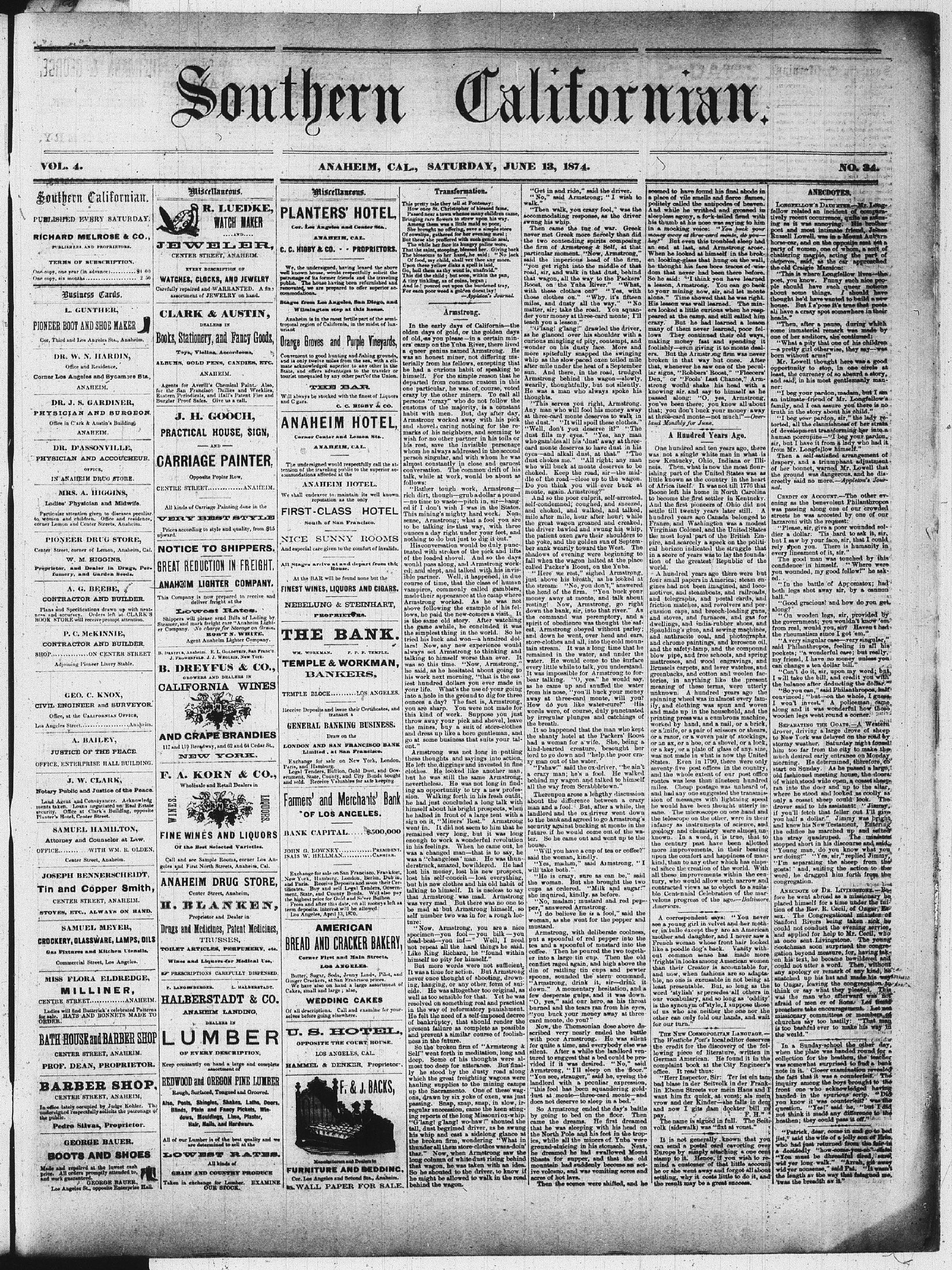
Searchable text
Southern Californian.
PUBLISHED EVERY SATURDAY.
RICHARD MELROSE & CO.,
PUBLISHERS AND PROFRIETORS.
TERMS OF SUBSCRIPTION.
One copy, one year (in advance)... $1.00
One copy, six months... 2.50
Business Cards.
L. GUNTHER,
PIONEER BOOT AND SHOE MAKER
Cor, Third and Los Angeles Sta., Anaheim.
DR. W. N. HARDIN,
Office and Residence,
Corner Los Angeles and Sycamore Sta.
ANAHEIM.
DR. J. S. GARDINER,
PHYSICIAN AND SURGEON.
Office in C'ark & Austin's Building
ANAHEIM.
DR. D'ASSONVILLE,
PHYSICIAN AND ACCOUCHEUR.
OFFICE,
Miscellaneous.
R. LUEDKE,
WATCH MAKER
AND...
JEWELER,
CENTER STREET, ANAHEIM.
EVERY DESCRIPTION OF
WATCHES, CLOCKS, AND JEWELRY
Carefully repaired and WARRANTED. A first assortment of JEWELRY on hand.
CLARK & AUSTIN,
DEALERS IN
Books, Stationery, and Fancy Goods,
Toys, Viellas, Accordeons,
ALBUMS, GOLD PENS, CANDIES, ETC.
ANAHEIM.
Agents for Averill's Chemical Paint. Also,
for the San Francisco Dailies and Weeklies,
Eastern Periodicals, and Hall's Patent Fire and
Burglar Proof Safes. Give us a call.
J. H. GOOCH,
PRACTICAL HOUSE, SIGN,
AND
CARRIAGE PAINTER.
Miscellaneous.
PLANTERS'
Cor. Los Angeles and
ANAHEIM,
C. C. HIGBY & CO.
We, the undersigned, having well known house, would respect patronage of its former friends public. The house having been renovated, we are prepared to commodalize.
Stages from Los Angeles,
Willmington step at
Anaheim is in the most fertile tropical region of California, in urient.
Orange Groves and Pu
Convenient to good hunting and is only twelve miles from the mate acknowledged superior to State, and offers advantages to tourist unequaled by any other.
THE BA
Will always be stocked with the and C gars.
ANAHEIM
Corner Center and Le
ANAHEIM, C
Corner Los Angeles and Sycamore Sta.
ANAHEIM.
DR. J. S. GARDINER,
PHYSICIAN AND SURGEON.
Office in C'ark & Austin's Building
ANAHEIM.
DR. D'ASSONVILLE,
PHYSICIAN AND ACCOUCHEUR.
OFFICE,
IN ANAHEIM DRUG STORE.
MRS. A. HIGGINS,
Ladies' Physician and Midwife.
Particular attention given to diseases peculiar
to women and children. Office and residence,
corner Lemon and Center Streets, Anaheim.
PIONEER DRUG STORE,
Center Street, corner of Lemon, Anaheim, Cal.
W. M. HIGGINS.
Proprietor, and Dealer in Drugs, Perfumery, and Garden Seeds.
A. G. BEEBE,
CONTRACTOR AND BUILDER.
Plans and Specifications drawn up with neatness and accuracy. Orders left at CLARK'S
BOOK STORE will receive prompt attention.
P. C. McKINNIE,
CONTRACTOR AND BUILDER.
SHOP...ON CENTER STREET
Adjoining Pioneer Livery Stable.
GEO. C. KNOX,
CIVIL ENGINEER and SURVEYOR.
Office, at the CALIFORNIAN OFFICE,
Los Angeles Street...Anaheim.
A. BAILEY,
JUSTICE OF THE PEACE.
OFFICE, ENTERPRISE HALL BUILDING.
J. W. CLARK,
Notary Public and Justice of the Peace.
Land Agent and Conveyancer. Acknowledgments taken. Loans negotiated on Real Estate
security. Office at Clark's Building, opposite
Planter's Hotel, Center Street.
SAMUEL HAMILTON,
Attorney and Counselor at Law.
OFFICE...WITH WM. R. OLDEN,
Center Street, Anaheim.
JOSEPH BENNERSCHEIDT,
Tin and Copper Smith,
ANAHEIM.
Agents for Averill's Chemical Paint. Also,
for the San Francisco Dailies and Weeklies,
Eastern Periodicals, and Hall's Patent Fire and
Burglar Proof Safes. Give us a call.
J. H. GOOCH,
PRACTICAL HOUSE, SIGN,
AND
CARRIAGE PAINTER.
Opposite Poplar Row,
CENTRE STREET...ANAHEIM.
All kinds of Carriage Painting done in the
VERY BEST STYLE
Prices according to style and quality, from $15
upward.
NOTICE TO SHIPERS.
GREAT REDUCTION IN FREIGHT.
ANAHEIM LIGHTER COMPANY.
This Company is now prepared to receive and
deliver freight at the
Lowest Rates.
Shippers will please send Bills of Lading by
Steamer, and mark freight care "Anahiem Lighter Company." No charge for Storage on GranHOST N. WHITE.
Agent Anahiem Lighter Company.
B. DREYFUS, Anaheim. E. L. GOLDSTEIN, San Franco'.
J. FROWENFELD. J. J. WEOLIN, New York.
B. DREYFUS & CO.,
GROWERS AND DEALERS IN
CALIFORNIA WINES
AND GRAPE BRANDIES
117 and 119 Broadway, and 62 and 64 Cedar St.
NEW YORK.
F. A. KORN & CO.,
Wholesale and Retail Dealers in
WINES.
FINE WINES AND LIQUORS
Of the Best Selected Varieties.
Call and see Sample Rooms, corner Los Angles and First North Streets, Anaheim, Cal.
ANAHEIM DRUG STORE,
Center Street, Anaheim,
tourist unequaled by any other
Land Agent and Conveyancer. Acknowledgments taken. Loans negotiated on Real Estate security. Office at Clark's Building, opposite Planter's Hotel, Center Street.
SAMUEL HAMILTON,
Attorney and Counselor at Law.
OFFICE... WITH WM. R. OLDEN,
Center Street, Anaheim.
JOSEPH BENNERSCHEIDT,
Tin and Copper Smith,
CENTER STREET, ANAHEIM.
STOVES, ETC., ALWAYS ON HAND.
SAMUEL MEYER,
GROCKERY, GLASSWARE, LAMPS, OILS
Gas Fixtures and Kitchen Utensils.
Commercial Street, Los Angeles.
MISS FLORA ELDREDGE,
MILLINER,
CENTRE STREET...ANAHEIM.
Ladies will find Butterick's celebrated Patterns for sale. HATS AND BONNETS MADE TO ORDER.
BATH HOUSE and BARBER SHOP
CENTER STREET, ANAHEIM.
PROF. DEAN, PROPRIETOR.
BARBER SHOP,
CENTER STREET, ANAHEIM.
In office lately occupied by Judge Kohler. The undersigned respectfully solicits the patronage of the public.
Pedro Silvas, Proprietor.
GEORGE BAUER.
BOOTS AND SHOES
Made and repaired at the lowest cash price. All orders promptly attended to, and work guaranteed.
GEORGE BAUER,
Los Angeles St., opposite Enterprise Hall.
FINE WINES AND LIQUORS
Of the Best Selected Varieties.
Call and see Sample Rooms, corner Los Angeles and First North Streets, Anaheim, Cal.
ANAHEIM DRUG STORE,
Center Street, Anaheim.
H. BLANKEN,
Proprietor and Dealer in
Drugs and Medicines, Patent Medicines,
TRUSSES,
TOILET ARTICLES, PERFUMERY, etc.
Wines and Liquors for Medical Use,
PRESCRIPTIONS CAREFULLY DISPENSED.
P. LANGENBERGER.
L. HALBERSTADT.
HALBERSTADT & CO.
ANAHEIM LANDING,
DEALERS IN
LUMBER
OF EVERY DESCRIPTION,
Keep constantly on hand a large and complete assortment of
REDWOOD and OREGON PINE LUMBER
Rough, Surfaced, Tongued and Grooved.
Also, Posts, Shingles, Shakes, Laths, Doors,
Blinds, Plain and Fancy Pickets, Windows, Mouldings, Lime, Plaster,
Hair, Nails, and Hardware.
All of our Lumber is of the best quality and we are determined to sell at the LOWEST RATES.
All kinds of GRAIN AND COUNTRY PRODUCE
Taken in exchange for Lumber. EXAMINE OUR STOCK.
NORTH CALIFORNIA
ANAHEIM, CAL., SATURDAY, JUNE 13, 1874.
Miscellaneous.
PLANTERS' HOTEL,
Cor. Los Angeles and Center Sts.
ANAHEIM, CAL.
C. C. HIGBY & CO. - PROPRIETORS.
We, the undersigned, having leased the above well known house, would respectfully solicit the patronage of its former friends and the traveling public. The house having been refurbished and renovated, we are prepared to offer superior accommodations.
Stages from Los Angeles, San Diego, and Wilmington step at this house.
Anaheim is in the most fertile part of the semitropical region of California, in the midst of luxuriant Orange Groves and Purple Vineyards, convenient to good hunting and fishing grounds, and is only twelve miles from the sea, with a climate acknowledged superior to any other in the State, and offers advantages to the traveler or tourist unequaled by any other part of the Union.
THE BAR
Will always be stocked with the finest of Liquors and C gars.
C. C. HIGBY & CO.
ANAHEIM HOTEL,
Corner Center and Lemon Sts.
ANAHEIM, CAL.
The undersigned would respectfully call the attention of the travelling public to the superior accommodation.
Transformation.
This pretty tale they tell at Fontemay:
How once St. Christopher of blessed fame,
Passed near a town where many children came,
Bringing rare flowers to strew upon his way.
Among them was a little maid so poor;
She brought no offering, save a simple store Of cowlips, gathered for her evening meal;
But these she proffered with such gentle seal,
The while her face its hungry pallor wore,
That the saint, stooping, blessed her. Giving back The blossoms to her hand, he said: "No jack Of food, my child, shall vex three any more. Upon these yellow disks a spell is laid,
Go, boil them as thy wont is, unafraid."
This did the child; but soon, within the pan, A tiny tinkling, as of coins, began;
And lo! poured out upon the burdened tray, For each poor weed a golden ducat lay!
—Appleton's Journal.
Armstrong.
In the early days of California—the olden days of gold, or the golden days of old, as you please—in a certain miners' camp on the Yuba River, there lived a queer genius named Armstrong. He was an honest miner, not differing materially from his fellows, excepting that he had a curious habit of speaking to himself. For the simple reason that he departed from common custom in this one particular, he was. of course, voted crazy by the other miners. To call all persons "crazy" who do not follow the customs of the majority, is a constant habit with men. But, day after day, Armstrong worked away with his pick and shovel, caring nothing for the remarks of his neighbors, and seeming to wish for no other partner in his toils or his rest, save the invisible personage whom he always addressed in the second person singular, and with whom he was almost constantly in close and earnest conversation. The common drift of his
"Get in and ride," said the driver.
"No," said Armstrong; "I wish to walk."
"Then walk, you crazy fool," was the accommodating response, as the driver swung his whip.
Then came the tug of war. Greek never met Greek more fiercely than did the two contending spirits composing the firm of Armstrong & Self, at that particular moment. "Now, Armstrong," said the imperious head of the firm, "you get right into the middle of that road, sir, and walk in that dust, behind that wagon, all the way to the Packers' Boost, on the Yuba River." "What, with these clothes on?" "Yes, with those clothes on." "Why, it's fifteen miles, and dusty all the way." "No matter, sir; take the road. You squander your money at three-card monte; I'll teach you a lesson."
"Glang! g'lang!" drawled the driver, as he glanced over his shoulder with a curious mingling of pity, contempt, and wonder on his dusty face. More and more spitefully snapped the swinging whip as the slow-paced oxen toiled mile after mile under the heat of a September sun. And there, in the road, trudged Armstrong behind the wagon—slowly, wearily, thoughtfully, but not silently. He was a man who always spoke his thoughts.
"This serves you right, Armstrong. Any man who will fool his money away at three-card monte deserves to walk in the dust." "It will spoil these clothes." "Well, don't you deserve it?" "The dust fills my eyes." "Yes, any man who gambles all his 'dust' away at three-card monte deserves to have dust in his eyes—and alkali dust, at that." "The dust chokes me." "All right; any man who will buck at monte deserves to be choked. Keep the road; sir—the mid-
many of lows T making foolish ers. But broken in that, whar ir signs Den., o strong w knowing passed you've b that; you at three-land Mor
THE BAR
Will always be stocked with the finest of Liquors and Cigars.
C. C. BIGBY & CO.
ANAHEIM HOTEL,
Corner Center and Lemon Sta.
ANAHEIM, CAL.
The undersigned would respectfully call the attention of the traveling public to the superior accommodations afforded at the
ANAHEIM HOTEL.
We shall endeavor to maintain its well known reputation as the only
FIRST-CLASS HOTEL
South of San Francisco.
NICE SUNNY ROOMS
And especial care given to the comfort of invalids.
All Stages arrive at and depart from this House.
At the BAR will be found none but the
FINEST WINES, LIQUORS AND CIGARS.
NEBELUNG & STEINHART,
PROPRIETORS.
THE BANK.
WM. WORKMAN. P. P. P. TEMPLE.
TEMPLE & WORKMAN, BANKERS,
TEMPLE BLOCK...LOS ANGELES.
Receive Deposits and issue their Certificates, and transact a
GENERAL BANKING BUSINESS.
Draw on the
LONDON AND SAN FRANCISCO BANK Limited, at San Francisco.
Exchange for sale on New York, London, Paris, and Hamburg.
Legal Tenders, Bullion, Gold Dust, and Government, State, Country, and City Bonds bought and sold. Receive Valuables for safe keeping.
Farmers' and Merchants' Bank
OF LOS ANCELES.
BANK CAPITAL.....$500,000
JOHN G. BOWNEY...PRESIDENT.
ISAIS W. HELLMAN...CASHIER.
Exchange for sale on San Francisco, Frankfort, New York, Hamburg, London, Berlin, Dublin, and Paris. Receive Deposits and issue their Certificates. Buy and sell Legal Tenders, Government, State, and County Bonds. Will also pay himself. For the simple reason that he departed from common custom in this particular, he was of course, voted crazy by the other miners. To call all persons "crazy" who do not follow the customs of the majority, is a constant habit with men. But, day after day, Armstrong worked away with his pick and shovel, caring nothing for the remarks of his neighbors, and seeming to wish for no other partner in his toils or his rest, save the invisible person whom he always addressed in the second person singular, and with whom he was almost constantly in close and earnest conversation. The common drift of his talk, while at work, would be about as follows:
"Rather tough work, Armstrong—rich dirt, though—grub a dollar a pound—no time to waste—pitch in, sir—hanged if I don't wish I was in the States. This mining's mighty hard work. Nonsense, Armstrong; what a fool you are to be talking in that way, with three ounces a day right under your feet, and nothing to do but just to dig it out."
His conversation would be duly punctured with strokes of the pick and lifts of the loaded shovel. And so the days would pass along, and Armstrong worked, and slept, and talked with his invisible partner. Well, it happened, in due course of time, that the class of human vampires, commonly called gamblers, made their appearance at the cann where Armstrong worked. As he was not above following the example of his fellows, he paid the new-comers a visit. It is the same old story. After watching the game awhile, he concluded it was the simplest thing in the world. So he tried his luck and won—a hundred dollars! Now, any new experience would always set Armstrong to thinking and talking to himself worse than ever. It was so this time. "Now, Armstrong," he said, as he hesitated about going to his work next morning, "that is the easiest hundred dollars you ever made in your life. What's the use of your going into a hole in the ground to dig for three ounces a day? The fact is, Armstrong, you are sharp. You were not made for this kind of work. Suppose you just throw away your pick and shovel, leave the mines, buy a suit of store-clothes and dress up like a born gentleman, and go at some business that suits your talent."
Armstrong was not long in putting these thoughts and sayings into action. He left the diggings and invested in fine clothes. He looked like another man, but he was still the same Armstrong, nevertheless. He was not long in finding an opportunity to try a new profession. Walking forth in his fresh outfit, he had just concluded a long talk with himself about his bright prospects, when he halted in front of a large tent with a sign on it, "Miners' Rest." Armstrong went in. It did not seem to him that he remained very long, but it was long enough to work a wonderful revolution in his feelings. When he came out, he was a changed man—that is to say, he was a "changeless" man. He was thunderstruck, amazed, bewildered. He had lost his money, lost his new prospect, lost his self-conceit—lost everything, but his new clothes and his old habit of talking to himself. It is useless to say that Armstrong was mad. Armstrong himself. For the simple reason that he departed from common custom in this particular, he was of course, voted crazy by the other miners. To call all persons "crazy" who do not follow the customs of the majority, is a constant habit with men. But, day after day, Armstrong worked away with his pick and shovel, caring nothing for the remarks of his neighbors, and seeming to wish for no other partner in his toils or his rest, save the invisible person whom he always addressed in the second person singular, and with whom he was almost constantly in close and earnest conversation. The common drift of his talk, while at work, would be about as follows:
"Rather tough work, Armstrong—rich dirt, though—grub a dollar a pound—no time to waste—pitch in, sir—hanged if I don't wish I was in the States. This mining's mighty hard work. Nonsense, Armstrong; what a fool you are to be talking in that way, with three ounces a day right under your feet, and nothing to do but just to dig it out."
His conversation would be duly punctured with strokes of the pick and lifts of the loaded shovel. And so the days would pass along, and Armstrong worked,and slept,and talked with his invisible partner. Well,它 happened,在due course of time,that the class of human vampires,commonly called gamblers,made their appearance at the cann where Armstrong worked。As he was not above following the example of his fellows,he paid the new-comers a visit。It is the same old story.After watching the game awhile,he concluded it was the simplest thing in the world.So he tried his luck and won—a hundred dollars!Now,any new experience would always set Armstrong to thinking and talking to himself worse than ever。它 was so this time.“Now,Armstrong,”he said,as he hesitated about going to his work next morning,“that is the easiest hundred dollars you ever made in your life.What's the use of your going into a hole in the ground to dig for three ounces a day?The fact is,Armstrong,you are sharp。You were not made for this kind of work。Suppose you just throw away your pick and shovel,leave the mines,buy a suit of store-clothes和dress up like a born gentleman,和go at some business that suits your talent.”
Armstrong was not long in putting these thoughts and sayings into action. He left the diggings and invested in fine clothes。他 looked like another man,但他 was still the same Armstrong,nevertheless。他 was not long in finding an opportunity to try a new profession.Walking forth in his fresh outfit,他 had just concluded a long talk with himself about his bright prospects,当他 halted in front of a large tent with a sign on it,“Miners' Rest。”Armstrong went in.It did not seem to him that he remained very long,但它 was long enough to work a wonderful revolution in his feelings。When he came out,他 was a changed man—that is to say,他 was a "changeless" man。他 was thunderstruck,amazed,bewildered。他 had lost his money,loss his new prospect,loss his self-conceit—lost everything,但他的新衣服和他旧衣服的对话让他自己变得更自信。
It so happened that the man who kept the shanty hotel at the Packers' Roost had a woman for a wife。她 being a kind-hearted creature,besought her lord to go down和“help the poor crazy man out of the water.”
"Pshaw!" said the owl-driver,“he isn't a crazy man;he's a fool。He walked behind my wagon and talked to himself all the way from Scrabbletown.”
Thereupon a lengthy discussion about the difference between a crazy man and a fool。但after a while,the landlord and the ox driver went down to the bank and agreed to go Armstrong's security against bucking at monte in the future.如果他 would come out of the water。所以他 came out和went up到the house.
"Will you have a cup of tea or coffee?" said the woman,kindly.
"Yes,madam," said Armstrong,"I will take both."
"He is crazy,sure as can be," said the woman.But she brought two cups as ordered."Milk and sugar:"she inquired kindly.as before.
One hour was not now Kennois.The settlement hundredFrance,Virginia,the most pire,and cal horizionin a score of world.
A hurry four small gines haw motives,and tell friction,cussion,and slow dwelling.Spauldiiand ant choreandthe blow pin mattress.Brusselsgreenbatteriesmeaning unknown spinning ily,andmadmprintingworkedoranamioranazoranaxoranaxoranaxoranaxoranaxoranaxoranaxoranaxoranaxoranaxoranaxoranaxoranaxoranaxoranaxoranaxoranaxoranaxoranaxoranaxoranaxoranaxoranaxoranaxoranaxoranaxoranaxoranaxoranaxoranaxoranaxoranaxoranaxoranaxoranaxoranaxoranaxoranaxoranaxoranaxoranaxoranaxoranaxoranахroranахrornanахrornanахrornanахrornanахrornanахrornanахrornanахrornanахrornanахrornanахrornanахrornanахrornanахrornanахrornanахrornanахrornanахrornanахrornanахrornanахrornanахrornanахrornanахrornanахrornanахrornanахrornanахrornanахrornanахrornanахrornanахrornanахrornanахrornanахrornanахrornanахrornanахrornanахrornanахrornanахror nanахrrornanахrrornanakherrornanakherrornanakherrornanakherrornanakherrornanakherrornanakherrornanakherrornanakherrornanakherrornanakherrornahkerrornahkerrornahkerrornahkerrornahkerrornahkerrornahkerrornahkerrornahkerrornahkerrornahkerrornahkerrornahkerrornahkerrornahkerrornahkerrornahkerrornahkerrornahkerrornahkerrornahkerrornahkerrornahkerrornahkerrornahkerrornahkerrornahkerrornahkerrornahkerrornahkerrornahkerrornahkerrornahk error nahk error nahk error nahk error nahk error nahk error nahk error nahk error nahk error nahk error nahk error nahk error nahk error nahk error nahk error nahk error nahk error nahk error nahk error nahk error nahk error nahk error nahk error nahk error nahk error nahk error nahk error nahk error nahk error nahk error nahk error nahk error nahk error nahkhError nahkhError nahkhError nahkhError nahkhError nahkhError nahkhError nahkhError nahkhError nahkhError nahkhError nahkhError nahkhError nahkhError nahkhError nahkhError nahkhError nahkhError nahkhError nahkhError nahkhError nahkhError nahkhError nahkhError nahkhError nahkhError nahkhError nahkhError nahkhError nahkhError nahkhError nahkhError nahkh Error nahkh Error nahkh Errornahkh Errornahkh Errornahkh Errornahkh Errornahkh Errornahkh Errornahkh Errornahkh Errornahkh Errornahkh Errornahkh Errornahkh Errornahkb Errornahkb Errornahkb Errornahkb Errornahkb Errornahkb Errornahkb Errornahkb Errornahkb Errornahkb Errornahkb Errornahkb Errornahkb Errornahkb Errornahkb Errornahkb Errornahkb Errornahkb Errornahkb Errornahkb Errornahkb Errornahkb Errornahkb Errornahme ERRORERRORERRORERRORERRORERRORERRORERRORERRORERRORERRORERRORERRORERRORERRORERRORERRORERRORERRORERRORERRORERRORERRORERRORERRORERRORERRORERRORERRORERRORERRORERRORERRORERRORERRORERRORERRORERRORERRORERRORERRORERRORERRORERRORERRORERRORERRORERRORERRORERRORERRORERRORERRORERRORERRORERRORERRORERRORERRORERRORERROR ERROR ERROR ERROR ERROR ERROR ERROR ERROR ERROR ERROR ERROR ERROR ERROR ERROR ERROR ERROR ERROR ERROR ERROR ERROR ERROR ERROR ERROR ERROR ERROR ERROR ERROR ERROR ERROR ERROR ERROR ERROR ERROR ERROR ERROR ERROR ERROR ERROR ERROR ERROR ERROR ERROR ERROR ERROR ERROR ERROR ERROR ERROR ERROR ERROR ERROR ERROR ERROR ERROR ERROR ERROR ERROR ERROR ERROR ERROR ERROR ERROR ERROR ERROR ERROR ERROR ERROR ERROR ERROR ERROR ERROR ERROR ERROR ERROR_ERROR_ERROR_ERROR_ERROR_ERROR_ERROR_ERROR_ERROR_ERROR_ERROR_ERROR_ERROR_ERROR_ERROR_ERROR_ERROR_ERROR_ERROR_ERROR_ERROR_ERROR_ERROR_ERROR_ERROR_ERROR_
AMERICAN
BREAD AND CRACKER BAKERY,
Corner First and Main Street,
LOS ANGELES.
Butter, Sugar, Soda, Jenny Lands, Pilot, and Ginger Crackers, at San Francisco prices.
We have also on hand a large assortment of Cakes, small and large; also,
WEDDING CAKES
Of all descriptions. Call and examine for yourselves before going elsewhere.
U. S. HOTEL,
OPPOSITE THE COURT HOUSE.
LOS ANGELES, CAL.
HAMMEL & DENKER, Proprietor.
F. & J. BACKS,
Manufacturers and Dealers in
FURNITURE AND BEDDING.
Cor. Los Angeles and Second St., Anaheim.
Walking form in his fresh coat,
he had just concluded a long talk with himself about his bright prospects, when he halted in front of a large tent with a sign on it, "Miners' Rest." Armstrong went in.
It did not seem to him that he remained very long, but it was long enough to work a wonderful revolution in his feelings. When he came out, he was a changed man—that is to say, he was a "changeless" man. He was thunderstruck, amazed, bowildered. He had lost his money, lost his new prospect, lost his self-conceit—lost everything, but his new clothes and his old habit of talking to himself. It is useless to say that Armstrong was mad. Armstrong was very mad. But there was no one to be mad at but Armstrong himself, so self number two was in for a rough lecture:
"Now, Armstrong, you are a nice specimen—you fool—you bilk—you dead-beat—you inf—" Well, I need not repeat all the hard things he said. Like King Richard, he "found within himself no pity for himself."
But mere words were not sufficient. It was a time for action. But Armstrong never once thought of shooting, drowning, hanging, or any other form of suicide. He was altogether too original, as well as too sensible for that. Yet he was resolved on something real and practical in the way of reformatory punishment. He felt the need of a self-imposed decree of bankruptcy, that should render the present failure as complete as possible and prevent a similar course of foolishness in the future.
So the broken firm of "Armstrong & Self" went forth in meditation, long and deep. Some of his thoughts were almost too deep for utterance. But finally he stood by the dusty road along which the great freighting wagons were hauling supplies to the mining camps up the Sacramento. One of these wagons, drawn by six yoke of oxen, was just passing. Snap, snap, snap, in slow, irregular succession, came the keen stinging reports of the long Missouri ox-whip: "G'lang! g'lang! wo-haw!" shouted the tall, dust begrimed driver, as he swung his whip and cast a sidelong glance at the broken firm, wondering "What in thunder all them store-clothes was-a-doin' thar." Now, when Armstrong saw the long column of white dust rising behind that wagon, he was taken with an idea. So he shouted to the driver, to know if he might be allowed to walk in the road behind the wagon.
Armstrong ended the day's battle by going to bed on the floor. Then came the dreams. He first dreamed that he was sleeping with his head on the North Pole and his feet in the tropics, while all the miners of Yuba were ground-slicing in his stomach. Next, he dreamed he had swallowed Mount Shasta for supper, and that the old mountain had suddenly become an active volcano, and was vomiting acres and acres of hot lava.
Then the scenes were shifted, and he about the difference between a crazy man and a fool. But after a while, the landlord and the ox driver went down to the bank and agreed to go Armstrong's security against bucking at monte in the future. If he would come out of the water. So he came out and went up to the house.
"Will you have a cup of tea or coffee?" said the woman, kindly.
"Yes, madam," said Armstrong, "I will take both."
He is crazy, sure as can be," said the woman. But she brought the two cups as ordered. "Milk and sugar:" she inquired, kindly, as before.
No, madam; mustard and red pepper," answered Armstrong.
"I do believe he is a fool," said the woman, as she went for the pepper and mustard.
Armstrong, with deliberate coolness, put a spoonful of red pepper into the tea and a spoonful of mustard into the coffee. Then he poured the two together into a large tin cup. Then the old conflict raged again, and high above the din of rattling tin cups and pewter spoons, sounded the stern command, "Armstrong drink it," sir--drink it down." A momentary hesitation, and a few desperate gulps, and it was down. "O, yes," said our hero, as his throat burned and the tears ran from his eyes, "you buck your money away at three-card monte, do you?"
Now, the Thomsonian dose above described very nearly ended the battle with poor Armstrong. He was silent for quite a time, and everybody else was silent. After a while the landlord ventured to suggest that a bed could be provided if it was desired. "No," said Armstrong, "I'll sleep on the floor." "You see, stranger," said he, eyeing the landlord with a peculiar expression, "this fool has been squandering gold-lust at monte-three-card monte—and does not deserve to sleep in a bed."
So Armstrong ended the day's battle by going to bed on the floor. Then came the dreams. He first dreamed that he was sleeping with his head on the North Pole and his feet in the tropics, while all the miners of Yuba were ground-slicing in his stomach. Next, he dreamed he had swallowed Mount Shasta for supper, and that the old mountain had suddenly become an active volcano, and was vomiting acres and acres of hot lava.
Then the scenes were shifted, and he
NO. 24.
seemed to have found his final abode in a place of vile smalls and fierce flames, politely called the antipodes of heaven. And while he writhed and groused in sleepless agony, a fork-tailed fiend with his thumb at his nose was saying to him in a mocking voice: "You buck your money away at three-card monte, do you—hey?" But even this troubled sleep had an end at last, and Armstrong arose. When he looked at himself in the broken looking-glass that hung on the wall, he thought his face bore traces of wisdom that never had been there before. So he said: "I think you have learned a lesson, Armstrong. You can go back to your mining now, air, and let monte alone." Time showed that he was right. His lesson was well learned. The miners looked a little curious when he reappeared at the camp, and still called him crazy. But he had learned a lesson many of them never learned, poor fellows. They continued their old ways, making money fast and spending it foolishly—even giving it to monte dealers. But the Armstrong firm was never broken in that way but once. After that, whenever he saw one of the peculiar signs, "Robbers' Roost," "Fleecers' Den," or "Fool's Last Chance," Armstrong would shake his head with a knowing air, and say to himself as he passed along: "O, yes, Armstrong, you've been there; you know all about that; you don't buck your money away at three-card monte—not much!" —Overland Monthly for June.
A Hundred Years Ago.
One hundred and ten years ago, there was not a single white man in what is now Kentucky, Ohio, Indiana or Illinois. Then, what is now the most flourishing part of the United States was as
ANECDOTES.
Longfellow's Daughter—Mr. Longfellow related an incident of comparatively recent occurrence, quite as annoying as it was annoying. His brother poet and most intimate friend, James Russell Lowell, was in a Mount Anburn horse-car, and on the opposite side got a party of women, one of whom, a sort of chattering magpie, acting the part of chaperon, said, as the car approached the old Craigie Manalon:
"This is where Longfellow lives—the poet, you know. Funny such nice people should have such queer notions about some things. I should have thought he'd have wanted to build a new house. But I'a-pose it's true that poets all have a crazy spot somewhere in their heads."
Then, after a pause, during which some immaterial remark was made by one of her auditors, she continued:
"What a pity that one of his children—a pretty girl otherwise, they say—was born without arms!"
Mr. Lowell thought here was a good opportunity to stop, in one circle at least, the currency of so absurd a story, and said, in his most gentlemanly manner:
"I beg your pardon, madam, but I am an intimate friend of Mr. Longfellow's family, and I can assure you there is no truth in the story about his child."
"I beg your pardon, sir," the lady retorted, all the claunishment of her strate of development transforming her into a human porcupine—"I beg your pardon, sir, but I have it from a lady who had it from Mr. Longfellow himself."
Then a self-satisfied arrangement of drapery, and a triumphant adjustment of her bonnet, warned Mr. Lowell that
A Hundred Years Ago.
One hundred and ten years ago, there was not a single white man in what is now Kentucky, Ohio, Indiana or Illinois. Then, what is now the most flourishing part of the United States was as little known as the country in the heart of Africa itself. It was not till 1776 that Boone left his home in North Carolina to become the first settler in Kentucky. And the first pioneers of Ohio did not settle till twenty years later still. A hundred years ago Canada belonged to France, and Washington was a modest Virginian Colonel, and the United States the most loyal part of the British Empire, and scarcely a speck on the political horizon indicated the struggle that in a score of years was to lay the foundation of the greatest Republic of the world.
A hundred years ago there were but four small papers in America; steam engines had not been imagined, and locomotives, and steamboats, and railroads, and telegraphs, and postal cards, and friction matches, and revolvers and percussion caps, and breech-loading guns, and stoves, and furnaces, and gas for dwellings, and india-rubber shoes, and Spaulding's glue, and sewing machines, and anthracite coal, and photographs, and chromo paintings, and kerosene oil, and the safety-lamp, and the compound blow pipe, and free schools, and spring mattresses, and wood engravings, and Brussels carpets, and lever watches, and greenbacks, and cotton and woolen factories, in anything like the present meaning of these terms, were utterly unknown. A hundred years ago the spinning wheel was in almost every family, and clothing was spun and woven and made up in the household, and the printing press was a cumbrons machine worked by hand, and a nail, or a brick, or a knife, or a pair of scissors or shears, or a razor, or a woven pair of stockings, or an ax, or a hoe, or a shovel, or a lock, or a key, or a plate of glass of any size, was not made in what is now the United States. Even in 1790, there were only seventy-five post offices in the country, and the whole extent of our post office routes was less than nineteen hundred miles. Cheap postage was unheard of, and had any one suggested the transmission of messages with lightning speed he would have been thought utterly insane. The microscope on one hand and the telescope on the other, were in their infancy as instruments of science, and geology and chemistry were almost unknown. In a word, it is true, that to the century past have been allotted more improvements, in their bearing upon the comfort and happiness of mankind, than to any other which has elapsed since the creation of the world. With all these improvements within the century, who would allow such narrow and contracted views as to object to a suitable Centennial Celebration of the marble?
A Hundred Years Ago.
One hundred and ten years ago, there was not a single white man in what is now Kentucky, Ohio, Indiana or Illinois. Then, what is now the most flourishing part of the United States was as little known as the country in the heart of Africa itself. It was not till 1776 that Boone left his home in North Carolina to become the first settler in Kentucky. And the first pioneers of Ohio did not settle till twenty years later still. A hundred years ago Canada belonged to France, and Washington was a modest Virginian Colonel, and the United States the most loyal part of the British Empire, and scarcely a speck on the political horizon indicated the struggle that in a score of years was to lay the foundation of the greatest Republic of the world.
A hundred years ago there were but four small papers in America; steam engines had not been imagined, and locomotives, and steamboats, and railroads, and telegraphs, and postal cards, and friction matches, and revolvers and percussion caps, and breech-loading guns, and stoves, and furnaces, and gas for dwellings, and india-rubber shoes, and Spaulding's glue, and sewing machines, and anthracite coal, and photographs, and chromo paintings, and kerosene oil, and the safety-lamp, and the compound blow pipe, and free schools, and spring mattresses, and wood engravings, and Brussels carpets, and lever watches, and greenbacks, and cotton and woolen factories, in anything like the present meaning of these terms, were utterly unknown. A hundred years ago the spinning wheel was in almost every family, and clothing was spun and woven and made up in the household, and the printing press was a cumbrons machine worked by hand, and a nail, or a brick, or a knife, or a pair of scissors or shears, or a razor, or a woven pair of stockings, or an ax, or a hoe, or a shovel, or a lock, or a key, or a plate of glass of any size, was not made in what is now the United States. Even in 1790 there were only seventy-five post offices in the country, and the whole extent of our post office routes was less than nineteen hundred miles. Cheap postage was unheard of, and had any one suggested the transmission of messages with lightning speed he would have been thought utterly insane. The microscope on one hand and the telescope on the other were in their infancy as instruments of science,and geologyandchemistrywere almostunknown.Inaword.itistrue,thattothecenturypasthavebeenallottedmoreimprovements,intheirbearinguponthecomfortandhappinessofmankind,thantoanyotherwhichhasclapedsincethecreationoftheworld.Withalltheseimprovementswithinthecentury,whowouldallowsuchnarrowandcontractedviewsastoobjecttoa SuitableCentennialCelebrationofthemarble
A Western drover,drivinga large droveof sheep to New Yorkwasdelayedoncroadbystormyweather.SaturdaynightfoundhimtofarfromthecitytomakethemuchdesiredearlyentranceMondaymorning.Hedefermined,theforeststostartonSunday.Ashpassalargeoldfashionedmeetinghouse,thedoorsofwhichstoodwideopen,acossetsheepranintothedooranduptothealtarwherehestoodandlookасoollyasonlyacossetsheepcouldlook.Thedroversaidtohisassistant:"Jimmyifyou'llfetchthatfalleroutI'llgiveyouhalldollar."JimmywasbrightandknewhisNewTestament.Enteringtheedificehemarchedupandseizedthestrayquadruped.Theministerstoppedshortinhisdiscourseandsaid:"Youngman,doyouknowwhatyouaredoing?" "Yes,sir,"replied Jimmy,"I'mseparatingthesheepfromthegoats!"and,suitingtheactiontotheword,hedragged him forthfromthecongregation.
ANECDOTOFDR.LIVINGSTONE.-Boehwewentabroadasmissionaryhe
A correspondent says: "You never see a young girl in velvet and her mother in tulle except they are an American mother and daughter, and I never saw a French woman whose front hair looked like a poodle dog's back. Vanity without common sense has made more frights in looks among American women than their Creator is accountable for, and now, when fashions are so adaptable, no one is excusable in not being at least presentable. But, so long as the word 'stylish' arpersedes all others in our vocabulary, and so long as 'oddity' is the synonym of style, I suppose those of us who are neither the one nor the other can only fold our hands, and wait for our turn."
The New Cormopolitan Language.—The Westliche Post's local editor deserves the credit for the discovery of the following piece of literature, written in German American. He found it in the complaint book at the City Engineer's office. It read thus:
"Herr Inspector, Sir: Ter ist ein tam bad blase in der Seitvolk in der Franklin Ebenu Streets vor mein Hans and I want him fix quick, at vonst; als mein vrow and der Kinder—she falls in dem and now I gits dam dockter bill zu pay.
F. H."
The name is signed in full. The Seitvolk (sidewalk) was "fixt at vonst."
It is not generally known that you can send a postal card cavorting over Europe by simply attaching a one cent stamp to it. Hence, if you wish to remind a customer of that little account he or she went away and forgot all about settling, why it costs little to do it, and the result may be a great success.
The driver said to his assistant: "Jimmy, if you'll fetch that faller out I'll give you half a dollar." Jimmy was bright and knew his New Testament. Entering the edifice he marched up and seized the stray quadruped. The minister stopped short in his discourse and said: "Young man, do you know what you are doing?" "Yes, sir," replied Jimmy. "I'm separating the sheep from the goats!" and, suiting the action to the word, he dragged him forth from the congregation.
ANECDOTE OF DR. LIVINGSTONE.—Before he went abroad as a missionary he placed himself for a time under the tuition of the Rev. R. Cecil, of Ongar, Essex. The Congregational minister of Sanford Rivers being taken sick he could not conduct the evening service, and applied for help to Mr. Cecil, who at once sent Livingstone. The young Scotchman soon surprised the congregation beyond measure, for having taken his text, he became bewildered and could not utter a word. Then, without any apology or remark of any kind, he snatched up his hat and made his way to Ongar, leaving the congregation to think or say what they pleased. This was the man who afterward was not afraid of men or of lions. Let further preachers take encouragement. Let missionary committees or members of churches say too hastily: "That man is too bashful ever to make his way in the world."
In a Sunday-school the other day, when the plate was handed round for a collection for the heathen, the teacher was somewhat surprised to find a bank note in it. Closer examination revealed the fact that it was a counterfeit. The inquiry among the boys brought to the front one who acknowledged having handed in the spurious script. "Did you know it was counterfeit?" was the question. "Yes!" said he, "but I did not think it made any difference to the heathen; they could pass it off."
"Patrick, dear, come in and go to had jist," said the wife of a jolly son of Erwin, who had just returned from the fair in a decidedly "how come-you-as"-affair. "You must be threadful thread," said wid yer long walk." "Arrah, get away wid yer nonsense," said Pat. "It wasn't the length av the way that fatigued me," "was the breadth av it."