anaheim-gazette 1874-05-09
Scanned page
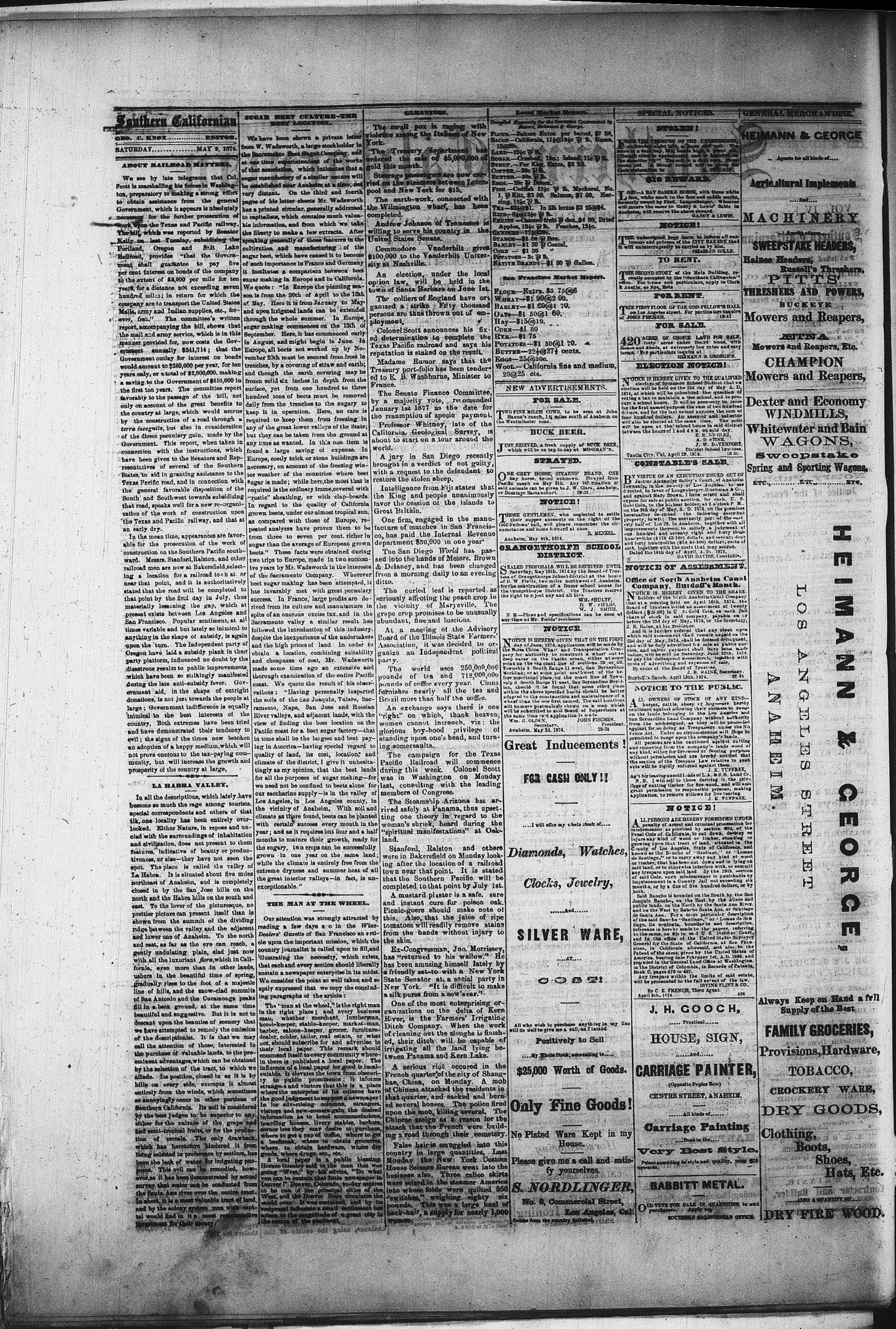
Searchable text
Southern California
GEO. C. KNOK... EDITOR.
SATURDAY,... MAY 9, 1874.
ABOUT RAILROAD MATTERS.
We see by late telegrams that Col. Scott is marshalling his forces in Washington, preparatory to making a strong effort to obtain assistance from the general Government, which it appears is absolutely necessary for the further promotion of work upon the Texas and Pacific railway. The bill, which was reported by Senator Kelly on last Tuesday, subsidizing the Portland, Oregon and Salt Lake Railroad, provides "that the Government shall guaranty to pay five per cent interest on bonds of the company to the extent of $2,000 per mile for ten years, for a distance not exceeding seven hundred miles; in return for which the company are to transport the United States Mail, army and Indian supplies, etc., forever, freely." The committee's written report, accompanying the bill, shows that the mail and army service, which is in this manner provided for, now costs the Government annually $341,714; that the Government outlay for interest on bonds would amount to $280,000 per year, for ten years only, or a total of $2,800,000, making a saving to the Government of $610,000 in the first ten years. The committee report favorably to the passage of the bill, not only on account of the great benefits to the country at large, which would accrue by the construction of a road through a terra incognita, but also in consideration of the direct pecuniary gain, made by the Government. This report, when taken in connection with the instructions, which have been given to the Senators and Representatives of several of the Southern States, to aid in granting assistance to the Texas Pacific road, and in connection with the general favorable disposition of the government, will be subsiding.
We have been shown a private from W. Wadsworth, a large stockholder of the Sacramento Best Sugar Company at one time superintendent of that association, which intimates sugar manufacture of a similar nature established near Anaheim at very distant. On the third page of his letter-sheets Mr. Wadsworth has a printed circular, generally to capitalists, which contains valuable information, and from which the liberty to make a few extra speaking generally of those features cultivation and manufacturing sugar beet, which have caused it of such importance in France and it institutes a comparison between sugar making in Europe and in We quote: "In Europe the planion is from the 20th of April to May. Here it is from January and upon irrigated lands can be through the whole summer. In sugar making commences on the September. Here, it has commenced in August, and might begin in Europe, all beets not worked until November 20th must be secured from trencles, by a covering of straw and though the earth covering frozen solid six inches in depth, yet from one hundred hundred tons of beets must be daily from the trenches to the keep it in operation. Here, required to keep them from any of the great lower valleys or but they can be taken from the any time as wanted. In this case found a large saving of Europe, costly brick or stone necessary, on account of the frater weather of the countries sugar is made; while here,the required is the ordinary frame.
favorably to the passage of the bill, not only on account of the great benefits to the country at large, which would accrue by the construction of a road through terra incognita, but also in consideration of the direct pecuniary gain, made by the Government. This report, when taken in connection with the instructions, which have been given to the Senators and Representatives of several of the Southern States, to aid in granting assistance to the Texas Pacific road, and in connection with the general favorable disposition of the South and Southwest towards subsidizing that road, speaks well for a new re-organization of the work of construction upon the Texas and Pacific railway, and that at an early day.
In the mean time, appearances are favorable for the prosecution of the work of construction on the Southern Pacific southward. Messrs. Stanford, Ralston, and other railroad men are now at Bakersfield, selecting a location for a railroad town at or near that point, and it is authoritatively stated that the road will be completed to that point by the first day in July, thus materially lessening the gap, which at present exists between Los Angeles and San Francisco. Popular sentiment, at all times variable and but lately so inimical to anything in the shape of subsidy, is again upon the turn. The Independent party of Oregon have laid a subsidy plank in their party platform, influenced no doubt by the disastrous results to public improvements, which have been so strikingly manifested during the late anti-subsidy fever. Government aid, in the shape of outright donations, is not just towards the people at large; Government indifference is equally inimical to the best interests of the country. Both extremes have been tried and have demonstrated their tendency to evil; the signs of the times now betoken an adoption of a happy medium, which will not prove onerous to the tax-paying community, but will increase the growth and prosperity of the country at large.
LA HABRA VALLEY.
In all the descriptions, which lately have become so much the rage among tourists, special correspondents and others of that ilk, one locality has been entirely overlooked. Either Nature, in repose and unclad with the surroundings of inhabitation and civilization, does not present to them features, indicative of beauty or produciveness, or else—they have not seen the spot. The place is called the valley of La Habra. It is situated about five miles northeast of Anaheim, and is completely closed in by the San Jose hills on the north and the Habra hills on the south and east. To the lover of the picturesque, no prettier picture can present itself than is shown from the summit of the dividing ridge between the valley and the adjacent and lower one of Anaheim. To the north hundred tons of beets must be daily from the trenches to their keep it in operation. Here, required to keep them from any of the great lower valleys or but they can be taken from there any time as wanted. In this case found a large saving of Europe, costly brick or stone necessary, on account of the frater weather of the countries sugar is made; while here,the required is the ordinary frame, "rustic" sheathing, or with In regard to the quality of grown beets, under our almost as compared with those of peated analyses have proven from three to seven per cent sugar than the average of Eurobeets." These facts were obtained two trips to Europe, made in five years by Mr. Wadsworth in of the Sacramento Company. Beet sugar making has been has invariably met with great success. In France, large prived from its culture and most spite of an onerous excise tax Sacramento valley a similar followed the introduction of despite the inexperience of this and the high prices of land obtain a location, combining and cheapness of cost. Mr. made some time ago an thorough examination of the coast. We quote the results: "Having personalised the soils of the San Joaquin rancho, Napa, San Jose River valleys, and adjacent view of finding the best low Pacific coast for a beet sugar in time shall be the largest thing in America—having speed quality of land, its cost, climate of the district, I give tingly as my opinion, that for all the purposes of sugar we need not be confined to our saccharine supply—is in Los Angeles, in Los Angeles, the vicinity of Anaheim, climate as there found, beets with certain success every year; and as it requires but months to mature their growthe sugary, two crops can grown in one year on this while the climate is entire extreme dryness and summa great interior valleys—exceptionable."
THE MAN AT THE
Our attention was strong reading a few days a Dealer's Gazette of San Fr
clad with the surroundings of inhabitation and civilization, does not present to them features, indicative of beauty or productivity, or else—they have not seen the spot. The place is called the valley of La Habra. It is situated about five miles northeast of Anaheim, and is completely closed in by the San Jose hills on the north and the Habra hills on the south and east. To the lover of the picturesque, no prettier picture can present itself than is shown from the summit of the dividing ridge between the valley and the adjacent and lower one of Anaheim. To the north and east; as far as the eye can reach, a gently undulating plain, clad just now with all the luxuriant flora, which in California, even more than in other lands, ushers in the beautiful time of spring, gradually rises to the foot of a majestic line of hills, and the snow-clad summits of San Antonio and the Cucamonga peaks fill in a back ground, at the same time beautiful and suggestive. But it is not to descent upon the beauties of scenery that we have attempted to remedy the omission of the descriptionist. It is that we may call the attention of those, interested in the purchase of valuable lands, to the prominent advantages, which can be obtained by the selection of the tract, to which we allude. Its position, closed in as it is by hills on every side, exempts it almost entirely from the winds, which sometimes so annoyingly occur in other portions of Southern California. Its soil is considered by the best judges to be superior to any, either for the culture of the grape and semi-tropical fruits, or for the production of cereals. The only drawback, which has heretofore hindered it from being selected in preference by settlers, has been the lack of water for irrigation purposes. This evil can be remedied, however, as it has been demonstrated by actual survey that water can be conducted from the Santa Ana river over the entire tract. In short, it is a most valuable tract of land, and by the colony system men with capital would find in it a most representative investment for their money.
Our attention was strong reading a few days ago Dealers' Gazette of San Francisco upon the important miscellaneous country journalist is called illustrating the necessity that each and every section sustain a newspaper enterprise. We consider the point so aptly expressed that we coining paragraphs of the article.
The 'man at the wheel.' In the right place; and a man, whether merchant hotel-keeper, stable-keeper barber, saloon-keeper, grader, cobler, tailor, real estate not should subscribe for their local paper. This command itself to every corner there is published a local influence of a local paper calable. It elevates the town to public prominence strange and visitors that where the enterprise of this good judgment to supply In its advertising column visitors and new-comers give information as to hotel boarding houses, livery corner lots they may desire where to get a cap of coffee a beefsteak, where to obtain hardware goods, where drugs, etc., A local paper is a Horace Greeley said to the going "West," by his son you can to sustain that little Denver. Denver Colorado to be one of the grinning West, and the Denver New world ever. It was sustai reproposal influence a small arsenal to the magnitude of the centre of the continent.
THE BEEF CULTURE—THE BEET LOCATION.
Have been shown a private letter to Wadsworth, a large stockholder in the manufacture of Beet Sugar Company, and time superintendent of the works association, which intimates that a manufactory of a similar nature will be established near Anaheim at a time, not instant. On the third and fourth of his letter-sheets Mr. Wadsworth printed circular, generally addressed to allists, which contains much valuation, and from which we take duty to make a few extracts. After being generally of those features in the nation and manufacturing of the beet, which have caused it to become important in France and Germany, it relates a comparison between beet making in Europe and in California.
Note: "In Europe the planting season from the 20th of April to the 15th. Here it is from January to May on irrigated lands can be extended with the whole summer. In Europe, making commences on the 15th of March. Here, it has commenced early August, and might begin in June. In all beets not worked up by No. 20th must be secured from frost inzes, by a covering of straw and earth; though the earth covering may be solid six inches in depth from the ice, yet from one hundred to three feet tons of beets must be removed from the trenches to the sugar to fit in operation. Here, no care is needed to keep them from freezing in the great lower valleys of the State; they can be taken from the ground at time as wanted. In this one item is a large saving of expense. In case, costly brick or stone buildings are necessary, on account of the freezing weather of the countries where beet is made; while here, the most that is desired is the ordinary frame, covered with plaster."
CLEARINGS.
The small porch is raging with violence among the Italianes of New York.
The Treasury department has ordered the sale of $5,000,000 of gold this month.
Steerage passengers are now carried on the steamers between Liverpool and New York for $15.
The earth-work, connected with the Wilmington wharf, has been completed.
Andrew Johnson of Tennessee is willing to serve his country in the United States Senate.
Commodore Vanderbilt gives $100,000 to the Vanderbilt University at Nashville.
An election, under the local option law, will be held in the town of Santa Barbara on June 1st.
The colliers of England have organized a strike. Ffty thousand persons are thus thrown out of employment.
Colonel Scott announces his fixed determination to complete the Texas Pacific railroad and says his reputation is staked on the result.
Madame Rumor says that the Treasury port-folio has been tendered to E. B. Washburne, Minister to France.
The Senate Finance Committee, by a majority vote, recommended January 1st 1877 as the date for the resumption of specie payment.
Professor Whitney, late of the California Geological Survey, is about to start on a tour around the world.
A jury in San Diego recently brought in a verdict of not guilty, with a request to the defendant to restore the stolen sheep.
Intelligence from Fiji states that the King and people unanimously
The Senate Finance Committee, by a majority vote, recommended January 1st 1877 as the date for the resumption of specie payment.
Professor Whitney, late of the California Geological Survey, is about to start on a tour around the world.
A jury in San Diego recently brought in a verdict of not guilty, with a request to the defendant to restore the stolen sheep.
Intelligence from Kijj states that King and people unanimously favor the cession of the islands to Great Britain.
One firm, engaged in the manufacture of matches in San Francisco, has paid the Internal Revenue department $50,000 in one year.
The San Diego World has passed into the hands of Messrs. Brown & Delaney, and has been changed from a morning daily to an evening ditto.
The curled leaf is reported as seriously affecting the peach crop in the vicinity of Marysville. The grape crop promises to be unusually abundant, fine and luscious.
At a meeting of the Advisory Board of the Illinois State Farmers' Association, it was decided to organize an Independent political party.
The world uses 250,000,000 pounds of tea and 718,000,000 pounds of coffee every year. China furnishes nearly all the tea and Brazil more than half the coffee.
An exchange says there is one "right" on which, thank heaven, women cannot intrench, viz: the glorious boyhood privilege of standing upon one's head, and turning somersaults.
The campaign for the Texas Pacific Railroad will commence during this week. Colonel Scott was in Washington on Monday last, consulting with the leading members of Congress.
The Steamship Arizona has arrived safely at Panama, thus upsetting one theory in regard to the woman's shriek, heard during the "spiritual manifestations" at Oakland.
Stanford, Ralston and others were in Bakersfield on Monday looking after the location of a railroad town near that point. It is stated that the Southern Pacific will be completed to that point by July 1st.
A mustard plaster is a safe, sure and instant cure for poison oak. Picnic-goers should make note of this. Also, that the juice of ripe tomatoes will readily remove stains from the hands without injury to
THE MAN AT THE WHEEL.
Our attention was strongly attracted by reading a few days ago in the *Wine-Realers' Gazette* of San Francisco an article upon the important mission, which the country journalist is called upon to fill, and illustrating the necessity, which exists, that each and every section should liberally sustain a newspaper enterprise in its midst. We consider the point so well taken and so aptly expressed that we copy the conclusion paragraphs of the article:
The 'man at the wheel,' is the right man in the right place; and every business man, whether merchant, lumberman, hotel-keeper, stable-keeper, market-man, barber, saloon-keeper, grocer, furniture-dealer, cobler, tailor, real estate, or what not, should subscribe for and advertise in their local paper. This remark should command itself to every community where there is published a local paper. The influence of a local paper for good is invaluable. It elevates the town from obscurity to public prominence; it informs strangers and visitors that this is a place where the enterprise of its citizens have the good judgment to support a newspaper! In its advertising columns, strangers visitors and new-comers gain the desired information as to hotel accommodations, boarding houses, livery stables, barbers, corner lots they may desire to purchase, where to get a cup of coffee, where to get a beefsteak, where to obtain groceries, where to obtain hardware, where dry goods, where drugs, etc., etc.
A local paper is a public blessing. Horace Grosley said to the man that was going "West," by his advice, "Do what you can sustain that little newspaper in Denver." Denver, Colorado, today admires to be one of the principal cities of the West, and the Denver News circulates the world over. It was sustained, and by its widespread influence a small settlement himars to the magnitude of a great city in the centre of the continent.
Stanford, Ralston and others were in Bakersfield on Monday looking after the location of a railroad town near that point. It is stated that the Southern Pacific will be completed to that point by July 1st.
A mustard plaster is a safe, sure and instant cure for poison oak. Picnic-goers should make note of this. Also, that the juice of ripe tomatoes will readily remove stains from the hands without injury to the skin.
Ex-Congressman, Jno. Morrissey, has "returned to his wallow." He has been amusing himself lately by a friendly set-to with a New York State Senator at a social party in New York. "It is difficult to make a silk purse from a sow's ear."
One of the most enterprising organizations on the delta of Kern River, is the Farmers' Irrigating Ditch Company. When the work of cleaning out the sloughs is finished, their ditch will be capable of irrigating all the land lying between Panama and Kern Lake.
A serious riot occurred in the French quarter of the city of Shanghai, China, on Monday. A mob of Chinese attacked the residents in that quarter, and sacked and burned several houses. The police fired upon the mob, killing several. The Chinese assign as a reason for the attack that the French were building a road through their cemetery.
False hair is smuggled into this country in large quantities. Last Monday the New York Custom House Seimure Bureau went into the business also. Three calico skirts were seized in the steamer America into whose folds were quilted 950 swifches." weighing eighty six pounds. This was a large haul of back-hair, a supply for nearly 1,000 women.
SPECIAL NOTICES.
STOLEN!
FROM THE PREMIERE OF THE UNDERSIGNER,
on Sunday night kill a horse and collt. The mare is a dark bay, 15 hands high, 8 years old
(though older in appearance) and in handed on the shoulder "0". The colt is a dark roan, three
weeks old. A blind reward will be given for their generation to A. MENCALF.
GIO REWARD.
LOSE—A BAY SADDLE HOUSE, with three white
feet, white mark in the face and saddle mark,
formerly owned by Paul Langenberger. Whoever
will return the same to Gaddy & Lewis' Sable in Anaheim, will receive the above reward.
GADDY & LEWIS.
NOTICE!
THE underwritten leases have to inform all customers and patrons of the CITY BAKERY that it will uninterruptedly be carried on by him.
CHARLES HILLE.
TO RENT.
THE SECOND STORY of the Meta Building, recently occupied by the "Southern Californian" office. For terms and particulars, apply to Clark & Austin, or Mrs. Meta.
FOR RENT.
THE FIRST FLOOR OF THE ODD FELLOW'S HALL
on Los Angeles street. For particulars inquire
of JOHN FISCHER.
FOR SALE.
420 ACRES OF CHOICE LAND FOR SALE,
forty acres under Board tenure, with
House and Sheds, at extremely low rates and easy
terms. For particulars inquire at
HEIMANN & GEORGE'S.
ELECTION NOTICE!
NOTICE IS HEREDY GIVEN TO THE QUALIFIED electors of Sycamore School-District that an election will be held on the 25d day of May A. D.
1874, at which will be submitted the question of voting a tax to maintain a free school, and to procure a school house. It will be necessary to raise for the first named purpose the sum of two hundred dollars, and for the last named purpose the sum of four hundred dollars. An assessor and collector will also be elected at the same time. The polls will be open at the school house in said district between the hours of 1 and 4 P.M. on said day.
E. R. NIOLLS,
A. D. STINE,
J. W. DAVENPORT,
District School Trustees.
Tustin City, Cal., April 28, 1874.
CONSTABLE'S SALE.
BY VIRTUE OF AN EXECUTION ISSUED OUT OF Justice Alexander Bailey's Court, of Anaheim Township, in the county of Los Angeles, to me directed, in favor of Langenberger, Bochman & Co., and against Mary Brown. I have seized and shall
Dexter and Economy
WINDMILLS,
Whitewater and Bain
WAGONS,
Sweepstake
Spring and Sporting Wagons.
NOTICE OF ASSESSMENT.
Office of North Anaheim Canal Company, Burdoff's Ranch.
Notice is hereby given to the share-holders of the North Anaheim Canal Company that at a meeting held on April 18th, 1874, the Board of Trustees briefed an assessment of twenty dollars ($20.00) in U.S. Gold Coin, on each full share of stock in said company, payable on or before the 23rd day of May, 1874, to the Secretary, J. B. Referee at his residence.
And it is further ordered that any stock upon which said assessment shall remain unpaid on the 23rd day of May, 1874, shall be deemed delinquent, and will be duly advertised for sale at public auction, and unless payment shall have been made before, will be sold on Saturday, June 27th, 1874, to pay the delinquent assessment, together with costs of advertising and expenses of sale.
By order of the Board of Trustees,
J. B. HAINE, Secretary.
Burdoff's Ranch, April 18th, 1874.
NOTICE TO THE PUBLIC.
All owners of stock of any kind—horses, cattle, sheep or hogs—are hereby cautioned against allowing their animals to move on the lands belonging to the Los Angeles and San Bernardino Land Company without authority from the undersigned, as they will be processed against for so doing as Treasurers under the No Fence Act. Under no circumstances will Boys be permitted to range upon the company's lands.
All persons are also cautioned against cutting and removing from the company's lands wood of any kind, either for firewood or feeding purposes without permission and are hereby notified that the section of the Trespass Law relative to such acts will be rigidly enforced against them.
J. K. TUFFREE.
Ag't for leasing unsold lands of L.A. & S.B. Land Co.
N.B. I will sell to those desiring it the privileges of cutting timber for firewood, and will also grant permission to responsible persons, making application, to remove willows for live seating.
J. K. TUFFREE.
NOTICE!
All persons are hereby forbidden under penalty of arrest and criminal prosecution for misdemeanor, as provided by section 609, of the Penal Code of California, to cut down, destroy or injure any kind of wood or timber, standing or growing upon that tract of land calculated in the County of Los Angeles, State of California, and known as the Rancho of "Santiago," or "Lomas de Santiago," or to carry away any kind of wood or timber, that has been cut down and lying on land, or to otherwise interfere with, or commit any trespass upon said land. By the 19th section of said Code, such misdemeanor is punishable by imprisonment in a County Jail not exceeding six months, or by a fine of five hundred dollars, or by both.
Said Rancho is bounded on the South by the San Joaquin Rancho, on the East by the Alamanda and public lands, on the North by the Santa Ana River, and on the West by Rancho Santa Ana, or Santiago de Santa Ana. For a more particular description of the said Rancho "Santiago," or "Lomas de Santiago," its contents, boundaries and description, reference is hereby made to the papers referring to the same, on file in U.S. District Court, and in the office of the United States Surveys.
Penal Code of California, to cut down, destroy or injure any kind of wood or timber, standing or growing upon that tract of land, situated in the County of Los Angeles, State of California, and known as the Rancho of "Santiago," or "Lomas de Santiago," or to carry away any kind of wood or timber, that has been cut down and is lying on said land, or to otherwise interfere with, or commit any trespass upon said land. By the 19th section of said Code, such misdemeanor is punishable by imprisonment in a County Jail not exceeding six months, or by a fine of five hundred dollars, or by both.
Said Rancho is bounded on the South by the San Joaquin Rancho, on the East by the Alpine and public lands, on the North by the Santa Ana River, and on the West by Rahcho Santa Ana, or Santiago de Santa Ana. For a more particular description of the said Rancho "Santiago," or "Lomas de Santiago," its contents, boundaries and description, reference is hereby made to the papers referring to the same, on file in said U.S. District Court, and in the office of the United States Surveyor General for the State of California, at San Francisco, in California aforesaid, and also to the Patent of the same, given by the United States of America, bearing date February 1st, A.D. 1868, and regarded in the General Land Office at Washington, in the District of Columbia, in Records of Patents, Book C, pages 479 to 487.
Any trespass within the limits of said estate will be prosecuted to the full extent of the law.
IRVINE FLINT & CO.
By C. E. FRENCH, Their Agent
April 9th, 1874.
J. H. GOOCH,
Pratical...
HOUSE, SIGN,
And...
CARRIAGE PAINTER,
(Opposite Poplar Row)
CENTRE STREET, ANAHEIM.
All kinds of...
Carriage Painting
Done in the...
Very Best Style.
Prices according to style and quality, from $15 upwards.
BABBITT METAL.
OLD TYPE FOR SALE IN QUANTITIES to sale purchaser.
Apply at SOUTHERN CALIFORNIA OFFICE.
Always Keep on Hand a full Supply of the Best
FAMILY GROCERIES,
Provisions, Hardware,
TOBACCO,
CROCKERY WARE,
DRY GOODS,
Clothing,
Boots,
Shoes,
Hats, Etc.
Also a quantity of... DRY FIRE WOOD.