anaheim-gazette 1874-12-26
Scanned page
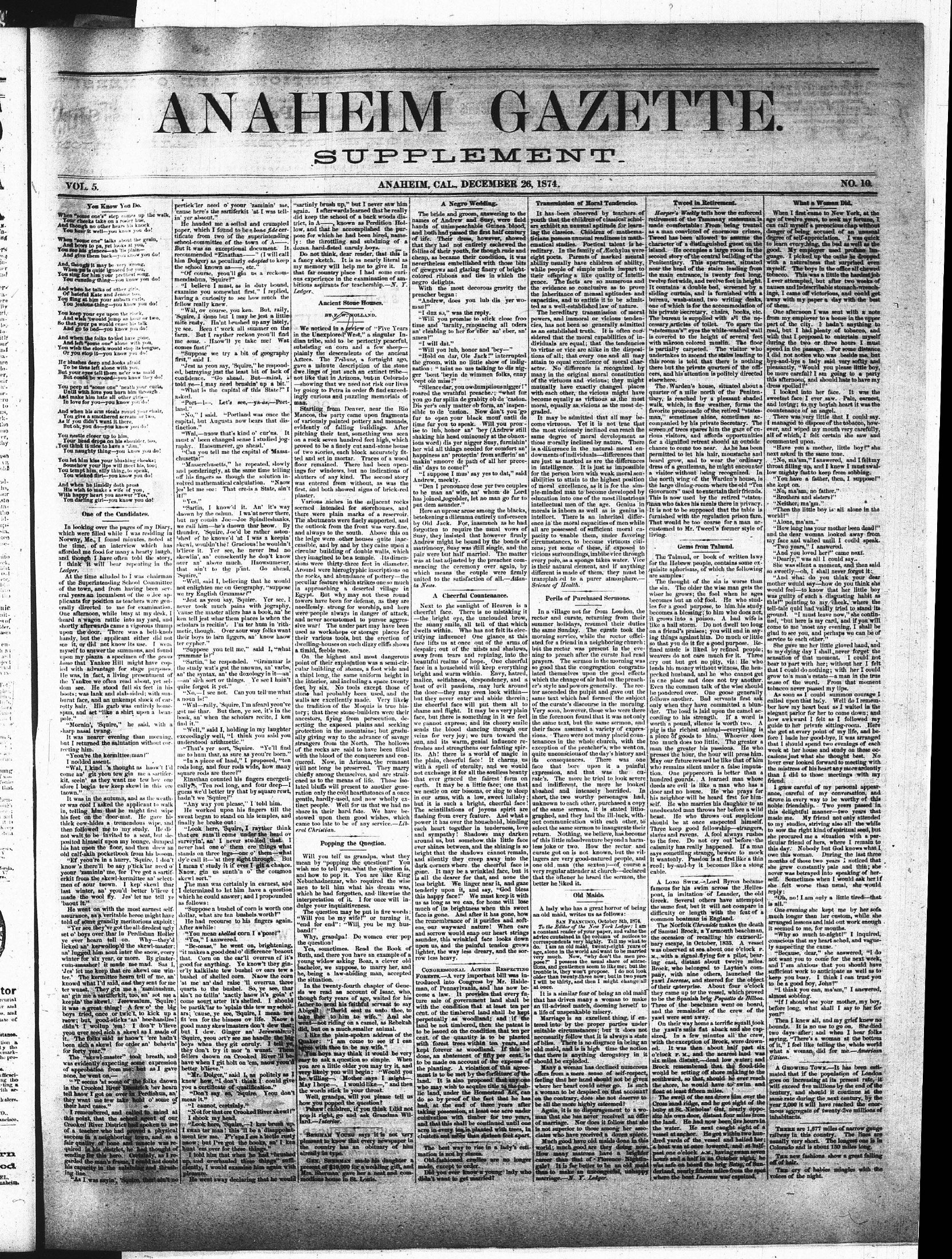
Searchable text
VOL. 5.
You Know You Do.
When "some one" step comes up the walk,
Your cheeks take on a rosier hue.
And though no other hears his knock
You hear it well—you know you do!
When "some one" talks about the grain,
And bows to pa, yet looks at you,
You see his glances—ah 'tis plain—
And give them back—you know you do!
And, though it may be very wrong,
When pa is quite ignored for you,
You sing for him your prettiest song,
You running thing—you know you do!
And when he talks of other girls,
Of hateful Kate and Jennie too,
You fling at him your auburn curls,
You jealous thing—you know you do!
You keep your eye upon the clock,
And wish 'twould jump an hour or two,
So that your pa would cease his talk
And go to bed—you know you do!
And when the folks to bed have gone,
And left "some one" alone with you,
You wish the clock would stop its tongue,
Or you stop it—you know you do!
He blushes deep and looks afraid
To be thus left alone with you.
But your eyes tell there ne'er was maid
But could be wooed—you know they do!
You peep at "some one" neath your curls,
Until with love you burn him through.
And make him hate all other girls—
In love for you—you know you do!
And when his arm steals round your chair,
You give a smothered scream or two,
As if you didn't want it there.
But oh, you do—you know you do!
You nestle closer up to him,
Your head drops on his shoulder, too,
You think it nice to have a "Jim."
You naughty thing—you know you do!
You let him kiss your blushing cheeks;
Somehow your lips will meet his, too;
pertick'ler need o' yeour 'zaminin' me,
cause here's the sartiferkit 'at I was tellin' yer aboot."
He handed me a soiled and crumpled paper, which I found to be a bona fide certificate from two of the superintending school-committee of the town of A——.
But it was an exceptional document. It recommended "Elnathan——" (I will call him Dolger) as peculiarly adapted to keep the school known as——, etc."
"Of course, yeou'll gin us a reckomendashun, 'Squire?"
"I believe I must, as in duty bound, examine you somewhat first," I replied, having a curiosity to see how much the fellow really knew.
"Wal, ov course, you ken. But, raily, 'Squire, I dono but I may be jest a little mite rusty. Ha'nt brushed up any lately, ye see. Been t' work all summer on the farm. But I rayther reckon yeu'll find me some. . Haow'll ye take me? Wat comes fust?"
"Suppose we try a bit of geography first," said I.
"Jest as yeou say, 'Squire,' he responded, betraying just the least bit of lack of confidence. 'Go ahead. But—mind, a told ye—I may need brushin' up a bit."
"What is the capital of this State?" I asked.
"Port-l---. Let's see,—ya-as,—Portland."
"No," I said. "Portland was once the capital, but Augusta now bears that distinction."
"Wal,—now that's kind o' cur'us. It must a' been changed sense I studied jography. Haosumever, go ahead."
"Can you tell me the capital of Massachusetts?"
"Massachusetts," he repeated, slowly
"sartinely brush up," but again. I afterwards learnt to keep the school of trict, in A——, known low, and that he acco pose for which he hadly: the throttling and dozen hard-fisted unruly.
Do not think, dear r a fancy sketch. It is my memory will help that far country place ous experience in the c bitious aspirants for te Ledger.
Ancient Stone
We noticed in a vee in the Unexplored We dian tribe, said to be subsisting on corn and plainly the descender Aztecs. The Tribune gave a minute descrip dwe.lings of just such not like that in Arizona—showing that we need by going to Petra in o ingly curious and puzza man.
Starting from Den Mancos, the party can of variously painted p evidently of falling pitching their tent, se on a rock seven hundre proved to be a finely c of two stories, each b ted and set in mortar. floor remained.
But your eyes tell there ne'er was maid
But could be—you know they do!
You peep at "some one" 'neath your curls,
Until with love you burn him through.
And make him hate all other girls—
In love for you—you know you do!
And when his arm steals round your chair,
You give a smothered scream or two.
As if you didn't want it there.
But oh, you do—you know you do!
You nestle closer up to him.
Your head drops on his shoulder, too.
You think it nice to have a "Jim."
You naughty thing—you know you do!
You let him kiss your blushing cheeks;
Somehow your lips will meet his, too;
You tempt him, ally thing, to speak.
You wicked flirt—you know you do!
And when he timidly doth press
His wish to make a wife of you,
With happy heart you answer "Yes."
You darling girl—you know you do!
One of the Candidates.
In looking over the pages of my Diary,
which were filled while I was residing in Norway, Me., I found minutes, noted at the time, of an interview which has afforded me food for many a hearty laugh,
and though I have often told the story,
I think it will bear repeating in the Ledger.
At the time alluded to I was chairman of the Superintending School Committee of the town, and from having been several years an incumbent of the o'lee applicants for position as teachers were generally directed to me for examination.
One afternoon, while busy at my desk, I heard a wagon rattle into my yard, and shortly afterwards came a vigorous thump upon the door. There was a bell-knob handy, but the applicant either did not see it, or did not know its use. I went myself to answer the summons, and found upon my piazza a specimen of the genus homo that Yankee Hill might have copied with advantage for stage purposes.
He was, in fact, a living presentment of the Yankee we often read about, yet seldom see. He stood full six feet in his boots; was lank and slab-sided; with sunburnt face, and an unkempt shock of carrotty hair. His garb was entirely home-spun, and set "like a shirt upon a bean-pole."
"Mornin', Squire," he said, with a sharp nasal twang.
It was nearer evening than morning, but I returned the salutation without correcting him.
"Yeou're the kermitttee man?"
I nodded assent.
Wal, I kind 'a thought as haw't I'd come an' git yeou tew gin me a sartiter kit, seein' as they want me tewhew one after I begin tew keep skewl in this ere taown."
It was in the autumn, and as the weather was cool I asked the applicant to walk in, telling him that he might first wipe his feet on the door-mat. He gave his thick cow-hides a tremendous wipe, and then followed me to my study. He did not wait to be invited to a seat, but deposited himself upon my lounge, dumped his hat upon the floor, and then drew an old calf-skin pocketbook from his bosom.
"Ef yeou're in a hurry', Squire, I don't know'a there'll be any p'tick'lar need o'yeur 'zaminln'me, for I've got a sartiferkit from the skewl-kermitttee an' selectmen of aur taown. I kep' skewl thar ed, betraying just the least bit of lack of confidence. "Go ahead. But—mind, I told ye—I may need brushin' up a bit."
"What is the capital of this State?" I asked.
"Port-l-. Let's see,-ya-az,-Port-land."
"No," I said. "Portland was once the capital, but Augusta now bears that distinction."
"Wal,-naow that's kind o' cur'ns. It must a' been changed sense I studied jography. Haosumever, go ahead."
"Can you tell me the capital of Massachusetta?"
"Masserechusetts," he repeated, slowly and ponderingly, at the same time telling off his fingers as though the solution involved mathematical calculation. "Naow jed' let me see: That ere-is a State, ain't it?
"Yes."
"Sartin, I know'd it. An' it's way daown by the oshun. I wan't never there, but my cousin Joe-Joe Spindleshanks, we call him—he's daown thar heow. By thunder, 'Squire, Joe'd be rather astonished of he knowed'd 'at I was a keepin' skewl, wouldn't he? Gracious! he wouldn't b'lieve it. Yer see, he never had no skewlin', an' consekently he don't know over an' above much. Haowsumever, that ain't to the p'int. Go ahead, 'Squire,'"
"Well, said I, believing that he would not enlighten me on Geography, "suppose we try English Grammar?"
"Jest as yeou say, Squire. Yer see, I never took much pains with jography,'cause the master allers has a book,'an' he ken tell jest whar them places is when the scholars is recitin'. I'm ter tum in 'rithmetic, though. Over our way folks want their boys to larn figgers, an' know haow ter cypher."
"Suppose you tell me," said I, "what grammar is?"
"Sartin,' he responded. "Grammar is the study wat's got the nawnows, an' varbs, an' the syntax, an' the doxology in it—an'—an' sich sort ov things. Ye see I hain't quite forgot it yet."
"No,-I see not. Can you tell me what a noun is?"
"Wal—raily, 'Squire, I'm afeard yeou've got me thar. But then, ye see, it's in the book, an' when the scholars recite, I ken find it."
"Well," said I, holding in my laughter exceedingly well, "I think you said you understood arithmetic."
"That's yer sort, 'Squire. "Ye'll find me to hum thar, as sure as yeou're born."
"In a piece of land," proposed, "ten rods long, and four rods wide, how many square rods are there?"
Elnathan counted his fingers energetically,"Ten rod long, and four deep—I guess we'd better try that by square rewt, hadn't we 'Squire?"
"Any way you please," I told him.
He worked upon his fingers till the sweat began to stand on his temples, and finally he broke out:
"Look here,' Squire, I rayther think that ere sum'l'll under the head ov surveyein', an' I never studied that. I never had one o' them ere things what stands on three legs—one o' them—what dy'e call it—at they sight through. But I mean t study it if ever I git a chance. Naow, gin us sunth'n o' the common skewl sort."
The man was certainly in earnest, and I determined to let him have a question betraying just the least bit of lack of confidence. "Go ahead. But mind, I told ye—I may need brushin' up a bit." "What is the capital of this State?" I asked.
"Port-l-. Let's see,-ya-az,-Port-land."
"No," I said. "Portland was once the capital, but Augusta now bears that distinction."
"Wal,-naow that's kind o' cur'ns. It must a' been changed sense I studied jography. Haosumever, go ahead."
"Can you tell me the capital of Massachusetta?"
"Masserechusetts," he repeated, slowly and ponderingly, at the same time telling off his fingers as though the solution involved mathematical calculation. "Naow jed' let me see: That ere-is a State, ain't it?
"Yes."
"Sartin, I know'd it. An' it's way daown by the oshun. I wan't never there, but my cousin Joe-Joe Spindleshanks, we call him—he's daown thar heow. By thunder, 'Squire, Joe'd be rather astonished of he knowed'd 'at I was a keepin' skewl, wouldn't he? Gracious! he wouldn't b'lieve it. Yer see, he never had no skewlin', an' consekently he don't know over an' above much. Haowsumever, that ain't to the p'int. Go ahead, 'SQUIRE,"
"Well," said I, believing that he would not enlighten me on Geography, "suppose we try English Grammar?"
"Jest as yeou say, Squire. Yer see, I never took much pains with jography,'cause the master allers has a book,'an' he ken tell jest whar them places is when the scholars is recitin'. I'm ter tum in 'rithmatic, though. Over our way folks want their boys to larn figgers, an' know haow ter cypher."
"Suppose you tell me," said I, "what grammar is?"
"Sartin,' he responded. "Grammar is the study wat's got the nawnows,an' varbs,an' the syntax,an' the doxology in it—an'—an'sich sort ov things. Ye see I hain't quite forgot it yet."
"No,-I see not. Can you tell me what a noun is?"
"Wal—raily,'Squire,I'm afeard yeou've got me thar. But then,ye see,it's in the book,an' when the scholars recite,I ken find it."
"Well," said I,holding in my laughter exceedingly well,“I think you said you understood arithmetic.”
“That’s yer sort,'Squire.“ “Ye'll find me to hum thar,as sure as yeou're born.”
“In a piece of land,” proposed,“ten rods long,and four rods wide,how many square rods are there?”
Elnathan counted his fingers energetically,"Ten rod long,and four deep—I guess we'd better try that by square rewt,hadn't we 'Squire?"
“Any way you please,” I told him.
He worked upon his fingers till the sweat began to stand on his temples,and finally he broke out:
“Look here,’ Squire,I rayther think that ere sum'l'll under the head ov surveyein」,an’ I never studied that. I never had one o' them ere things what stands on three legs—one o' them—what dy'e call it—at they sight through. But I mean t study it if ever I git a chance. Naow,gin us sunth'n o' the common skewl sort.”
The man was certainly in earnest,and I determined to let him have a question betraying just the least bit of lack of confidence. "Go ahead. But mind,I told ye—I may need brushin' up a bit." "What is the capital of this State?" I asked.
"Port-l-. Let's see,-ya-az,-Port-land."
"I said," Let’s see,-ya-az,-Port-land."
"We wait for them to tell us gme mean by 'popping ythe wish me to tell you wwe and how to pop it." Nebuchadnezzar,who men to tell him who
It was in the autumn, and as the weather was cool I asked the applicant to walk in, telling him that he might first wipe his feet on the door-mat. He gave his thick cow-hides a tremendous wipe, and then followed me to my study. He did not wait to be invited to a seat, but deposited himself upon my lounge, dumped his hat upon the floor, and then drew an old calf-skim pocketbook from his bosom.
"Ef yeou're in a hurry, 'Squire, I don't know's there'll be any p'tick'lar need o'yeour 'zaminln' me, for I've got a sartiferkit from the skewl-kermittee an' selectmen of aour taown. I kept skewl thar last winter, an' yeou'd better b'lieve I made the wool fly. Jes' let me tell ye 'baout it."
He went on with the most earnest self-assurance, as a veritable hero might have told of some grandly meritorious exploit:
"Yer see they've got the all-firedest ugly set o' boys over than in Perdishun Holler ye ever hear tell on. Why—they'd licked an' kervollop'd the skewl-master; an' lugged him out inter the snow, every winter for six year, or more. By ginter-cum-smasher! it made me mad. Sas I, Jes' let me keep that ere skewl one winter.' The kermittee hearn tell of me, an' knowd what I'd said, and they sent for me ter wunat. They gin me a 'zaminashun, an' gin me a sartiferkit, too, an' sot me a keepin' the skewl. Jerewalum, 'Squire' it was a great thing! A few o' the big boys tried, once or twice', to kick up a raow; but, good-sticks 'an' hoe-handles! didn't I wollup 'em! I don't b'lieve yeon ever seed such a skewl as I made of it. The folks said as hawot't ere hadn't been sich a skewl for order an' behavin' for forty year."
The "skewl-master" took breath, and was evidently expecting some expression of approbation from me; but as I gave none, he went on—
"I seems at some of the folks daown in the Crooked River Daintrick her hearn tell hawot I got on over in Perdishun, an' they want me tew take hold o' some of their hard cases."
I remembered, and called to mind at this point, that the school agent of our Crooked River District had spoken to me of a teacher who had proved a physical success in a neighboring town, and as a fair quality of home and muscle was required in his district, he had thought of sending for this hero. Certainly, as I regarded the man's frame, I could not doubt his capacity in the subduing and thrashing line.
"As I was sayin', 'Squire, that aln't no guess we'd better try that by square rewt, hadn't we 'Squire?"
"Any way you please," I told him.
He worked upon his fingers till the sweat began to stand on his temples, and finally he broke out:
"Look here, 'Squire, I rayther think that ere sum'll come under the head ov surveyin', an' I never studied that. I never had one o' them ere things what stands on three legs—one o' them—what dy'e call it—at they sight through. But I mean t' study it if ever I git a chance. Naow, gin us sunth'n o' the common skewl sort."
The man was certainly in earnest, and I determined to let him have a question which he could answer; and I propounded as follows:
"Suppose a bushel of corn is worth one dollar, what are ten bushels worth?"
He had recourse to his fingers again. After awhile:
"You mean shelled corn I a pose?"
"Yes," I answered.
"Be-cause," he went on, brightening, "it makes a good deal o' difference beaout that. Corn on the earl overrun ef it's good for anything. Ye knowt't they ginerly kalkilate tew bushel ov ears tew a bushel of shelled corn. Naow the corn at me an' dad raise 'll overrun three quarts to the bushel. So, ye see, thairn't no tellin' xactly hawot it's goin't come auort arter it's shelled. I should be partik'lar to 'splain this tew my scholars'; cause, ye see, 'Squire, I mean tew fit'm for the bisness ov life. Naow a good many skewlmasters don't dew that; but I dew. Ginger an' Jerawsalu! 'Squire, yeou ort're see me handle the big boys when they git onruly. I tell you they don't try it mor 'n wunst. Then fellers daown on Crooked River I'll behave when I git holt on'em, naow yeon'd better b'lieve."
"Mr. Dolger," said I, as politely as I knew how. "I don't think I could give you a certificate of qualification."
"Don't say so,' Squire. Yeou don't mean it."
"I cannot, certainly."
"Not for that ere Crooked River skewl!" I shook my head.
"Look here, 'Squire—I ken brush up. I swan ter man! this 'll be a disappoai-tment few me. Pr'apa I am a lactle rusty mow; but I've got the books, an' I ken hunt 'em over for these things."
I told him that when he had "brushed up, and overhaul ed these things" sufficiently, I would examine him again with pleasure.
He went away declaring that he would
"AHEIM GAZETT
SUPPLEMENT.
ANAHEIM, CAL., DECEMBER 26, 1874."
"sartinly brush up," but I never saw him again. I afterwards learned that he really did keep the school of a back woods district, in A——, known as Perdition Hollow, and that he accomplished the purpose for which he had been hired, namely: the throttling and subduing of a dozen hard-fisted unruly boys.
Do not think, dear reader, that this is a fancy sketch. It is as nearly literal as my memory will help me to give it. In that far country place I had some curious experience in the examination of ambitious aspirants for teachership.—N. Y. Ledger.
Ancient Stone Houses.
BY PETER HOLLAND.
We noticed in a review of "Five Years in the Unexplored West," a singular Indian tribe, said to be perfectly peaceful, subsisting on corn and a few sheep—plainly the descendants of the ancient Aztecs. The Tribune, a fortnight ago, gave a minute description of the stone dwellings of just such an extinct tribe—not like that in Arizona, but in Colorado—showing that we need not risk our lives by going to Petra in order to find exceedingly curious and puzzling memorials of man.
Starting from Denver, near the Rio Mancos, the party came upon fragments of variously painted pottery and mounds, evidently of falling buildings. After pitching their tent, something was seen on a rock seven hundred feet high, which proved to be a finely cut sand-stone house of two stories, each block accurately fitted and set in mortar. Traces of a wood floor remained. There had been openings there had been openings.
A Negro Wedding.
The bride and groom, answering to the names of Andrew and Susy, were field hands of unimpeachable Guinea blood, and both had passed the first half century of life. Their dress, however, showed that they had not entirely eschewed the follies of their youth, for though rude and cheap, as became their condition, it was nevertheless embellished with those bits of gewgaws and glaring finery of bright-colored ribbons and ties in which the negro delights.
With the most decorous gravity the preacher began:
"Andrew, does you lub dis yer woman?"
"I duz so," was the reply.
"Will you promise to stick close froo time and 'tarnity, renouncing all oders' cleabing to her for 'eber an' eber, an' amen?"
"I will dat."
"Will you lub, honor and 'bey—'"
"Hold on dar, Ole Jack!" interrupted the groom, with no little show of indignation: "taint no use talking to dis nigger 'bout beyin de wimmen folks, enny 'cept ole miss!"
"Silence dar, you owdumpious nigger!" roared the wrathful preacher; "what fur you go fur spilin de grabity ob de 'casion. Dis yer's only matter ob form, an' inspensible to de 'caston. Now don't you go fur to open your black mouf until de time fur you to speak. Will you promise to lub, honor an' bey (Andrew still shaking his head ominously at the obnoxious word) dis yer niger Susy, furnishin' her wid all things needed for comfort an' happiness an' protectin' from sufferin' an' makin' smove de path of all her precedin' days to come?"
Transmission of Moral Tendencies.
It has been observed by teachers of youth that the children of classical scholars exhibit an unusual aptitude for learning the classics. Children of mathematicians possess unusual readiness in mathematical studies. Poetical talent is hereditary. In the family of Eschylus were eight poets. Parents of marked mental ability usually have children of ability, while people of simple minds impart to their offspring a like quality of intelligence. The facts are so numerous and the evidence so conclusive as to prove the inheritance of mensal aptitudes and capacities, and to entitle it to be admitted as a well-established law of nature.
The hereditary transmission of moral powers, and immoral or vicious tendencies, has not been so generally admitted as an established truth. It is often considered that the moral capabilities of individuals are equal; that the tendencies to virtue or vice are alike in the dispositions of all; that every one and all may attain to equal excellence of moral character. No difference is recognized by many in the original moral constitution of the virtuous and vicious; they might mutually have exactly changed places with each other, the vicious might have become equally as virtuous as the most moral, equally as vicious as the most degraded.
It may be admitted that all may become virtuous. Yet it is not true that the most viciously inclined can reach the same degree of moral development as those morally inclined by nature. There is a difference in the natural moral endowments of individuals—differences that are just as marked as are the differences in intelligence. It is just as impossible
Harper retirement made coarse as a man. Tweed had character island. second staircase near the main twelve feet. It contains sliding doors bureau, one of which his private The burrow cessary pane "statements is covered with man's partial undertakings this room there but others, and elsewhere.
The W quarter o'clock is walk, white favorite pane," said company screen of various visions for a dog chance to permitted board dress of
Starting from Denver, near the Rio Mancos, the party came upon fragments of variously painted pottery and mounds, evidently of falling buildings. After pitching their tent, something was seen on a rock seven hundred feet high, which proved to be a finely cut sand-stone house of two stories, each block accurately fitted and set in mortar. Traces of a wood floor remained. There had been openings for windows, but no indications of shutters of any kind. The second story was entered from without, as was the first, and both showed signs of brick-red plaster.
Various niches in the adjacent rocks seemed intended for storehouses, and there were plain marks of a reservoir. The abutments were finely supported, and the outlook from the front was very-fine, and always to the south. Above this on the ledge were other houses quite inaccessible, and by and by they came upon a circular building of double walls, which they imagined to be a temple. Its dimensions were thirty-three feet in diameter. Around were hieroglyphic inscriptions on the rocks, and abundance of pottery—the peculiar feature which strikes one so much in approaching a deserted village in Egypt. But why may not these round towers have been for defense, as they are needlessly strong for worship, and here were people always in danger of attack, and never accustomed to pursue aggressive war? The under part may have been used as workshops or storage places for their various tools, but the erection of dwelling-houses on such dizzy cliffs shows a timid, feeble race.
On the highest and most dangerous point of their exploration was a semi-circular building of stones, a foot wide and a third long, the same uniform height in the interior, and including a space twenty feet by six. No tools except those of stone had probably been used, and the walls are excellently made. Very likely the tradition of the Moquis is true history; that these stone-builders were their ancestors, flying from persecution, deserting the exposed plains and seeking protection in the mountains; but gradually giving way to the advance of savage strangers from the North. The hollows of the rocks are said to have been filled with the blood of the conquerers and conquered. Now, in Arizona, the remnant will not long be preserved. They marry chiefly among themselves, and are straitened as to the means of life. Those isolated bluffs will present to another generation only the cold heartstones of a once gentle, hardly-used, and now wholly extinct people. Well for us that we had no share in their hard fate. We have bestowed upon them good wishes, which came too late to be of any service.
Popping the Question.
Will you tell us grandpa, what they mean by "popping the question?" You wish me to tell you what the question is, and how to pop it. You are like King Nebuchadnezzar, who required the wise men to tell him what his dream was.
Silence dar, you owdumptious nigger! roared the wrathful preacher; "what fur you go fur spilin de grabity ob de' casion. Dis yer's only matter ob form, an inspensable to de' casion. Now don't you go fur to open your black mouf until de time fur you to speak. Will you pronounce to lub, honor an' bey (Andrew still shaking his head ominously at the obnoxious word) dis yer niger Susy, furnishin' her wid all things needed for comfort an' happiness an' protectin' from sufferin' an' makin' smoove de path of all her precedin' days to come?
"I suppose I mus' say yes to dat," said Andrew, meekly.
"Den I pronounce dese yer two couples to be man an' wife, an' whom de' Lord has joined togedder, let no man go fur to put dem asunder."
Here an uproar arose among the blacks, betokening a dilemma entirely unforeseen by Old Jack. For inasmuch he had forgotten to require the usual vows of Susy, they insisted that however firmly Andrew might be bound by the bonds of matrimony, Susy was still single, and the pair were but half married. The matter was at last adjusted by the preacher commencing the ceremony over again, by which means the couple were firmly united to the satisfaction of all.
Atlanta News.
A Cheerful Countenance.
Next to the sunlight of Heaven is a cheerful face. There is no mistaking it—the bright eye, the unclouded brow, the sunny smile, all tell of that which dwells within. Who has not felt its electrifying influence? One glance at this lifts us at once out of the arms of despair; out of the mists and shadows, away from tears and repining, into the beautiful realms of hope. One cheerful face in a household will keep everything bright and warm within. Envy, hatred, malice, selfishness, despondency, and a host of evil passions, may lurk around the door—they may even look within—but they never enter and abide therein; the cheerful face will put them all to shame and flight. It may be a very plain face, but there is something in it we feel we cannot express; and its cheery smile sends the blood dancing through our veins for very joy; we turn toward the sun, and its warm, genial influence reshines and strengthens our fainting spirits. Ah! there is a world of magic in the plain, cheerful face! It charms us with a spell of eternity; and we would not exchange it for all the soulless beauty that ever graced the fairest form on earth. It may be a little face; one that we nestle on our bosoms, or sing to sleep in our arms, with a low, sweet lullaby; but it is such a bright, cheerful face! The scintillations of joyous spirit are flashing from every feature. And what a power it has over the household, binding each heart together in tenderness, love and sympathy! Shadows may darken around us, but somehow this little face ever shines between, and the shining is so bright that the shadows cannot remain, and silently they creep away into the dark corners where the cheerful face is gone. It may be a wrinkled face, but it is all the dearer for that, and none less bright. We linger near it, and gaze tenderly upon it and say "God bless
Perils of Purchased Sermons.
In a village not far from London, the rector and curate, returning from their summer holidays, resumed their duties the same Sunday. The curate took the morning service, while the rector officiated for a friend in a neighboring church; but the rector was present in the evening to preach after the curate had read prayers. The sermon in the morning was so good that the congregation congratulated themselves upon the good effects which the change of air had on the preacher's style and powers generally. The curator ascended the pulpit and gave out the same text which had formed the subject of the curate's discourse in the morning. Very soon, however, those who were there in the foremon found that it was not only the same text, but the same sermon, and their faces assumed a variety of expressions. There were not many placid countenances in the whole church, with the exception of the preacher's; who went on, quite unconscious of the day's history and its consequences. There was one face that bore upon it a painful expression, and that was the curate's. The more he tried to look severe and indifferent, the more he looked abashed and intensely horrified. In short, the two worthy personages had unknown to each other, purchased a copy of the same sermon, it is stated lithographed, and they had the ill-luck, without communication with each other, to select the same sermon to inaugurate their return. Nothing we believe has become of this little misadventure beyond a harmless joke or two. How the rector and curate got on is not known, but the villagers are very good-natured people, and one old man (the sexton)-of course a very regular attender at church-declared that the oftener he heard the sermon,the better he liked it.
The Tale for the Bless Quite Man is an example of how certain characters can be transformed into others.
The Tale for the Bless Quite Man is an example of how certain characters can be transformed into others.
The Tale for the Bless Quite Man is an example of how certain characters can be transformed into others.
The Tale for the Bless Quite Man is an example of how certain characters can be transformed into others.
The Tale for the Bless Quite Man is an example of how certain characters can be transformed into others.
The Tale for the Bless Quite Man is an example of how certain characters can be transformed into others.
The Tale for the Bless Quite Man is an example of how certain characters can be transformed into others.
The Tale for the Bless Quite Man is an example of how certain characters can be transformed into others.
The Tale for the Bless Quite Man is an example of how certain characters can be transformed into others.
The Tale for the Bless Quite Man is an example of how certain characters can be transformed into others.
The Tale for the Bless Quite Man is an example of how certain characters can be transformed into others.
The Tale for the Bless Quite Man is an example of how certain characters can be transformed into others.
The Tale for the Bless Quite Man is an example of how certain characters can be transformed into others.
The Tale for the Bless Quite Man is an example of how certain characters can be transformed into others.
The Tale for the Bless Quite Man is an example of how certain characters can be transformed into others.
The Tale for the Bless Quite Man is an example of how certain characters can be transformed into others.
The Tale for the Bless Quite Man is an example of how certain characters can be transformed into others.
The Tale for the Bless Quite Man is an example of how certain characters can be transformed into others.
The Tale for the Bless Quite Man is an example of how certain characters can be transformed into others.
The Tale for the Bless Quite Man is an example of how certain characters can be transformed into others.
The Tale for the Bless Quite Man is an example of how certain characters can be transformed into others.
The Tale for the Bless Quite Man is an example of how certain characters can be transformed into others.
The Tale for the Bless Quite Man is an example of how certain characters can be transformed into others.
The Tale for the Bless Quite Man is an example of how certain characters can be transformed into others.
The Tale for the Bless Quite Man is an example of how certain characters can be transformed into others.
The Tale for the Bless Quite Man is an example of how certain characters can be transformed into others.
The Tale for the Bless Quite Man is an example of how certain characters can be transformed into others.
The Tale for the Bless Quite Man is an example of how certain characters can be transformed into others.
The Tale for the Bless Quite Man is an example of how certain characters can be transformed into others.
The Tale for the Bless Quite Man is an example of how certain characters can be transformed into others.
The Tale for the Bless Quite Man is an example of how certain characters can be transformed into others.
The Tale forthe Bless Quite Man is an example of how certain characters can be transformed into others.
The Tale forthe Bless Quite Man is an example of how certain characters can be transformed into others.
The Tale forthe Bless Quite Man is an example of how certain characters can be transformed into others.
The Tale forthe Bless Quite Man is an example of how certain characters can be transformed into others.
The Tale forthe Bless Quite Man is an example of how certain characters can be transformed into others.
The Tale forthe Bless Quite Man is an example of how certain characters can be transformed into others.
The Tale forthe Bless Quite Man is an example of how certain characters can be transformed into others.
The Tale forthe Bless Quite Man is an example of how certain characters can be transformed into others.
The Tale forthe Bless Quite Man is an example of how certain characters can be transformed into others.
The Tale forthe Bless Quite Man is an example of how certain characters can be transformed into others.
The Tale forthe Bless Quite Man is an example of how certain characters can be transformed into others.
The Tale forthe Bless Quite Man is an example of how certain characters can be transformed into others.
The Tale forthe Bless Quite Man is an example of how certain characters can be transformed into others.
The Tale forthe BlessQuITE MAN IS AN EXAMPLE OF HOW THEY WERE ALLOWED TO USE THEIR FACULTIES IN A COMMON CASE OF LIFE AND HISTORY OF THEIR WORKS
A Loose Faith
A Loose Faith
A Loose Faith
A Loose Faith
A Loose Faith
A Loose Faith
A Loose Faith
A Loose Faith
A Loose Faith
A Loose Faith
A Loose Faith
A Loose Faith
A Loose Faith
A Loose Faith
A Loose Faith
A Loose Faith
A Loose Faith
A Loose Faith
A Loose Faith
A Loose Faith
A Loose Faith
A Loose Faith
A Loose Faith
A Loose Faith
A Loose Faith
A Loose Faith
A Loose Faith
A Loose Faith
A Loose Faith
A Loose Faith
A Loose Faith
A Loose Faith
A Loose Faith
A Loose Faith
A Loose Faith
A Loose Faith
A Loose Faith
A Loose Faith
A Loose Faith
A Loose Faith
A Loose Faith
A Loose Faith
A Loose Faith
A Loose Faith
A Loose Faith
A Loose Faith
A Loose Faith
A Loose Faith
A Loose Faith
A Loose Faith
A Loose Faith
A Loose Faith
A Loose Faith
A Loose Faith
A Loose Faith
A Loose Faith
A Loose Faith
A Loose Faith
A loo
Popping the Question.
Will you tell us grandpa, what they mean by "popping the question?" You wish me to tell you what the question is, and how to pop it. You are like King Nebuchadnezzar, who required the wise men to tell him what his dream was, which he had forgotten, and likewise the interpretation of it. I for once will indulge your inquisitiveness.
The question may be put in five words: "Will you be my wife!" or turning it, "end for end": "Will you be my husband?"
Why, grandpa! Do women ever pop the question?
Yes, sometimes. Read the Book of Ruth, and there you have an example of a young widow asking Boaz, a clever old bachelor, we suppose, to marry her, and he, being a law-abiding man, accepted the situation.
In the twenty-fourth chapter of Genesis we read an account of Isaac, who, though forty years of age, waited for his father to send his faithful servant to say Abigail: "David sent us unto thee, to take thee to him to wife." And she went—not riding on a camel, as Rebekah did, but on a much smaller animal.
I like the plain-spoken address of the Quaker: "I am come to see if I can agree with thee to be my wife."
You boys may think it would be very easy to ask a question so simple. When you are a little older you may try it, and very likely you will begin: "Would you be willing—Mother says I might—May I hope—I would like—," and then the words stick in your throat.
Well, grandpa, will you please tell us how you popped the question?
Phaw! children, if you think I did not pop it right, go and ask Grandma Willard.—Interior.
BISHAM YOUNG says it is not very pleasant to know that every newspaper in the country has an obituary of him already in type.
Gun, SHERMAN made his daughter a present of $10,000 for a weekling gift, and Mrs. SHARMAN gave her a neat and commodious house in St. Louis.
We nestle on our bosoms, or sing to sleep in our arms, with a low, sweet lullaby; but it is such a bright, cheerful face! The scintillations of joyous spirit are flashing from every feature. And what a power it has over the household, binding each heart together in tenderness, love and sympathy! Shadows may darken around us, but somehow this little face ever shines between, and the shining is so bright that the shadows cannot remain, and silently they creep away into the dark corners where the cheerful face is gone. It may be a wrinkled face, but it is all the dearer for that, and none the less bright. We linger near it, and gaze tenderly upon it, and say, "God bless this happy face!" We must keep it with us as long as we can, for home will lose much of its brightness when this sweet face is gone. And after it has gone, how the remembrance of it purifies and softens our wayward nature! When care and sorrow would snap our heart strings asunder, this wrinkled face looks down upon us, and the painful tension grows lighter, the way less dreary, and the sorrow less heavy.
CONGRESSIONAL ACTION RESPECTING FORESTER.—A very important bill was introduced into Congress by Mr. Haldeman, of Pennsylvania, and has now become a law. It provides that every future sale of government land shall be with the condition that at least ten per cent. of the timbered land shall be kept perpetually as woodland; and if the land be not timbered, then the patent is to be issued on the condition that ten per cent. of the quantity is to be planted with forest trees within ten years, and kept forever as woodland. If this be done, an abatement of fifty per cent. is to be made on account of the expense of the planting. A violation of this agreement is to be met by the forfeiture of the land. It is also proposed that any one who may wish to acquire title to this public land, under the Homestead Act, can do so by proof of the fact that he has had, at the end of three years after taking possession, at least one acre under cultivation with timber for two years, and that this shall be continued until one acre in every tan is planted with trees, in clusters and more than sixteen feet apart.
The best way to rise in a lady's estimation is not by stares.
Old-fashioned crudities are no longer made, except to order.
Did you ever know a young lady who didn't want to get married?
abashed and intensely horrined. In short, the two worthy personages had unknown to each other, purchased a copy of the same sermon, it is stated lithographed, and they had the ill-luck, without communication with each other, to select the same sermon to inaugurate their return. Nothing, we believe, has become of this little misadventure beyond a harmless joke or two. How the rector and curate got on is not known, but the villagers are very good-natured people, and one old man (the sexton)—of course a very regular attender at church—declared that the oftener he heard the sermon, the better he liked it.
Old Maids.
A lady who has a great horror of being an old maid, writes us as follows:
SAN FRANCISCO, October 8th, 1874.
To the Editor of the New York Ledger: I am a constant reader of your paper, and value the advice contained in the column of nocees to correspondents very highly. Tell me what to do. I am an old maid, twenty-eight years of age alone in the world and want to be married very much. Now, "why don't the men propose?" I possess the usual share of attractions, and gentlemen seem to like me; but the trouble is they won't propose. I do not look older than twenty-three now; but in two years I will be thirty, and then I might change all at once.
It is a similar fear of being an old maid that has driven many a woman to make an ill-advised match, dooming herself to a life of unspeakable misery.
Marriage is an excellent thing, if entered into by the proper parties under suitable circumstances; but it does not necessarily follow that it is always a state of bliss. There is no disgrace in being an old maid, and is high time the notion that there is anything derogatory in it should be exploded.
Many a woman has declined numerous offers from a mere sense of self-respect, feeling that her hand should not be given where her heart could never go. Is such a woman to be despised on that account? on the contrary, does she not deserve to be all the more highly esteemed?
Again, it is no disparagement to a woman that she has never received an offer of marriage. Nor does it follow that she is not superior to those among her associates who have received a dozen spice.
Much good have old maids done in this world; much good are they doing now. How many matrons have a brighter career than that of Florence Nightingale? It is far better to be an old maid than to make an uncongenial, unhappy marriage.—N.Y.Ledger.
TWETTE.
NO. 10.
Near Tendencies.
By teachers of classical scholarly aptitude for learner of mathematics and readiness in mathematical talent is held of Eschylus were marked mental children of ability, minds impart to equality of intellect so numerous and sensitive as to prove moral aptitudes and be it to be admitted law of nature.
Mission of moral vicious tenderness generally admitted
It is often corpulsibilities of interest the tendencies take in the disposition one and all may face of moral charisma recognized by moral constitutionious; they might changed places serious might have obvious as the most as the most demeaned that all may be is not true that need can reach the development as any nature. There natural moral endures—differences that are the differences must as impossible
Tweed in Retirement.
Harper's Weekly tells how the enforced retirement of the Tammany statesman is made comfortable: From being treated as a man convicted of enormous crimes, Tweed has been allowed to assume the character of a distinguished guest on the island. He occupies a large room in the second story of the central building of the Penitentiary. This apartment, situated near the head of the stairs leading from the main entrance, is twenty feet long, twelve feet wide, and twelve feet in height. It contains a double bed, screened by a sliding curtain, and is furnished with a bureau, wash-stand, two writing desks, one of which is for the accommodation of his private Secretary, chairs, books, etc. The bureau is supplied with all the necessary articles of toilet. To spare the "statesman's" eyes the white-washed wall is covered to the height of several feet with maroon colored muslin. The floor is partially carpeted. The visitor who undertakes to ascend the stairs leading to this room is told that there is nothing there but the private quarters of the officers, and his attention is politely directed elsewhere.
The Warden's house, situated about a quarter of a mile north of the Penitentiary, is reached by a pleasant shaded walk, which, in fine weather, forms the favorite promenade of the retired "statesman," sometimes alone, sometimes accompanied by his private Secretary. The screen of trees spares him the gaze of curious visitors, and affords opportunities for a dignified retreat should an outside chance to come too near. As he has been permitted to let his hair, moustache and beard grow, and to wear the ordinary dress of a gentleman, he might encounter
What a Woman Did.
When I first came to New York, at the age of twelve years, to seek my fortune, I can call myself a precocious chap without danger of being accused of an unusual degree of self-appreciation. I was quick to learn everything, the bad as well as the good. My employer used profane language. I picked up the oaths he dropped with a naturalness that surprised even myself. The boys in the office all chewed tobacco. This was a little the hardest job I ever attempted, but after two weeks of nausea and indescribable stomach-wrenchings, I came off victorious, and could get away with my paper a day with the best of them.
One afternoon I was sent with a note from my employer to a house in the upper part of the city. I hadn't anything to read, but I had plenty of tobacco, and with that I proposed to entertain myself during the two or three hours I must spend in the passage. For some distance I did not notice who was bealde me, but bye-and-bye a lady said very softly and pleasantly, "Would you please little boy, be more careful? I am going to a party this afternoon, and should hate to have my dress spoiled!"
I looked into her face. It was the sweetest face I ever saw. Pale, earnest, and loving; to my boyish heart it was the countenance of an angel.
There was very little that I could say. I managed to dispose of the tobacco, however, and wiped my mouth very carefully, all of which, I felt certain she saw and commented upon.
"Have you a mother, little boy!" she next asked in the same tone.
"No, ma'am," I answered, and I felt my throat filling up, and I knew I must swal-
natural constitution
cousins; they might
be changed places
nous might have
nous as the most
as the most dethat all may be
is not true that
can reach the
development as
boy nature. There
natural moral endirections that
are the differences
must as impossible
a weak moral sonthe highest position
it is for the simsome developed by
the most illustrious
age. Genius in
and as is genius in
inherited differities of men while
efficient moral caunder favoring
one virtuous citise, if exposed to
oblivious through
takes water. Vice
and if anything
they must be
other atmosphere.
Gems from Talmud.
The Talmud, or book of written laws for the Hebrew people, contains some exquisite aphorisms, of which the following are samples:
The thought of the sin is worse than the sin. The older the wise man gets the wiser he grows; the fool when he ages becomes but an old fool. He who studies for a good purpose, to him his study becomes a blessing; to him who does not, it grows into a poison. A bad wife is like a hail storm. Do not dwell too long on a friend's praises; you will end in saying things against him. Do much or little so that you do it for a good purpose. Refined music is liked by refined people; weavers do not care much for it. Three cry out but get no pity, viz: He who lends his money without witness, the henpecked husband, and he who cannot get in one place and does not try another. Even the common talk of the wise should be pondered over. One goose generally follows another. Bad servants first ask only when they have committed a blunder. The load is laid upon the camel according to his strength. If a word is worth a pound, silence is worth two. A pig is the richest animal—everything is a piece of goods to him. Whoever does too much does too little. The greater a man the greater his passions. He who presses the hour, the hour will press him. May our future reward be like that of him who remains silent under a false imputation. One peppercorn is better than a hundred gourds. A learned man whose deeds are evil is like a man who has a door and no house. He who prays for his neighbor will be heard first for himself. He who marries his daughter to an uneducated man throws her before a wild beast. He who throws out suspicions should be at once suspected himself. Three keep good fellowship—strangers, slaves and ravens. A fool always rushes to the fore. Do not cry out before the calamity has really happened. If a man says something strange, beware to mock it wantonly. Passion is at first like a thin reed; by-and-by it becomes like a strong cable.
A Long Swim.-Lord Byron became famous for his swim across the Helles-
be more careful? I am going to a party this afternoon, and should hate to have my dress spoiled?
I looked into her face. It was the sweetest face I ever saw. Pale, earnest, and loving; to my boyish heart it was the countenance of an angel.
There was very little that I could say. I managed to dispose of the tobacco, however, and wiped my mouth very carefully, all of which, I felt certain she saw and commented upon.
"Have you a mother, little boy!" she next asked in the same tone.
"No, ma'am," I answered, and I felt my throat filling up, and I knew I must swallow mighty fast to keep from sobbing.
"You have a father, then, I suppose?" she kept on.
"No, ma'am, no father."
"Brothers and sisters?"
"Neither, ma'am."
"Then the little boy is all alone in the world?"
"Alone, ma'am."
"How long has your mother been dead?" and the dear woman looked away from my face and waited until I could speak.
"Two years," I answered.
And you loved her?" came next.
Dearly," was all I could say.
She was silent a moment, and then said so sweetly—oh, I shall never forget it:
"And what do you think your dear mother would say—how do you think she would feel—to know that her little boy was guilty of such a disgusting habit as this?" pointing to my cheek, where the tell-tale quid had vainly tried to stand its ground.
"I must leave now," she continued, "but here is my card, and if you will come to me most any evening, I shall be glad to see you, and perhaps we can be of service to each other."
She gave me her little gloved hand, and to my dying day I shall never forget the sensation of that moment. I could not bear to part with her; without her I felt that I could do nothing; with her I could grow to a man's estate—a man in the true sease of the word. From that moment tobacco never passed my lips.
As soon as I could summon courage I called upon that lady. Well do I remember how my heart beat as I waited in the elegant parlor for her to come down; and how awkward I felt as I followed my guide to her private sitting-room. Here she got at every point of my life, and before I bade her good-bye, it was arranged that I should spend two evenings of each week at her house and study on these occasions just what she thought best. No lover ever looked forward to meeting with the mistress of his heart any more ardently than I did to those meetings with my friend.
I grew careful of my personal appearance, careful of my conversation, and strove in every way to be worthy of this noble friendship. Two years passed in this delightful manner—two years that made me. My friend not only attended to my studies, striving also all the while to sow the right kind of spiritual seed, but she procured me a situation with a particular friend of hers, where I remain to this day: Nobody but God knows what I owe this woman. During the last three months of those two years I noticed that she grew constantly pale and thin; she never was betrayed into speaking of herself. Sometimes when I would ask her if she felt worse than usual, she would
Great horror of being as follows:
October 8th, 1874. New York Ledger: I am paper, and value the column of notices to my. Tell what to twenty-eight years of want to be married don't the men pro-ual share of attraction to like me; but the pose. I do not look down; but in two years I might change all being an old maid a woman to make booming herself to misery.
A long swim—Lord Byron became famous for his swim across the Hellespont, in imitation of Leander, the old Greek. Several others have attempted the same feat, but it will not compare in difficulty or length with the feat of a common boatman in England.
The Norfolk Chronicle makes the death of Samuel Brock, a Yarmouth beachman, the occasion of recalling his extraordinary escape, in October, 1835. A vessel was observed at sea about one o'clock p.m., with a signal flying for a pilot, bearing east, distant about twelve miles. Brock, who belonged to Layton's company, with nine others, launched the yawl Increase, and steered for the object of their enterprise. About four o'clock they came up to the vessel, which proved to be the Spanish brig Pequetto de Bilboa. Three of the beachmen went on board, and the remainder of the crew of the yawl were sent away.
On their way home a terrific squall took the yawl's sails flat aback and she capsized. In a few minutes all the crew, with the exception of Brock, were drowned. It was then about half past six o'clock p.m., and the nearest land was six miles distant—dead low water; and Brock remembered that the flood-tide would be setting off shore making to the southward, so that should he ever reach the shore, he would have to swim and float at least fifteen miles.
The swell of the sea drove him over the Cross sand ridge, and he got sight of the buoy at St. Nicholas' Gat, nearly opposite his own door, distant four miles from the land. He had now been five hours in the water. He next caught sight of a vessel at anchor. He got within two hundred yards of the vessel and hailed her; a boat was at once lowered, and at half-past one o'clock a.m., having swam seven hours and a half in an October night; he was safe on board the brig Being, of Sunderland, nearly fifteen miles from the spot where the boat Increase was capsize.
ance, careful of my conversation, and strove in every way to be worthy of this noble friendship. Two years passed in this delightful manner—two years that made me. My friend not only attended to my studies, striving also all the while to sow the right kind of spiritual seed, but she procured me a situation with a particular friend of hers, where I remain to this day: Nobody but God knows what I owe this woman. During the last three months of those two years I noticed that she grew constantly pale and thin; she never was betrayed into speaking of herself. Sometimes when I would ask her if she felt worse than usual, she would reply:
"Oh, no! I am only a little tired—that is all."
One evening she kept me by her sofa much longer than her custom, while she arranged lessons and laid out work enough it seemed to me, for months.
"Why so much to-night?" I inquired, conscious that my heart ached, and vaguely suspecting the cause.
"Because, dear," she answered, "I do not want you to come for the next week, and I am anxious that you should have sufficient work to anticipate as well as to keep you busy. I think I can trust you to be a good boy, John?"
"I think you can, ma'am," I answered, almost sobbing.
"If I should see your mother, my boy, before long, what shall I say to her for you?"
Then I knew all, and my grief knew no bounds. It is no use to go on. She died two days after; and when I hear folks saying, "There's a woman at the bottom of it," I feel like telling the whole world what a woman did for me—American Citizen.
A Glowing Town—It has been estimated that if the population of London goes on increasing at its present rate, it will exceed five millions by the end of the century, and should it continue at the same rate during the next century, by the year 2,000 it will have reached the enormous aggregate of twenty-five millions of inhabitants.
There are 1,677 miles of narrow gauge railway in this country. The lines are manually very short. The longest one is in Colorado and is about 150 miles long.
The new fashions show a great falling off of hair.
The cry of babies mingles with the voices of the night.