anaheim-gazette 1872-03-16
Scanned page
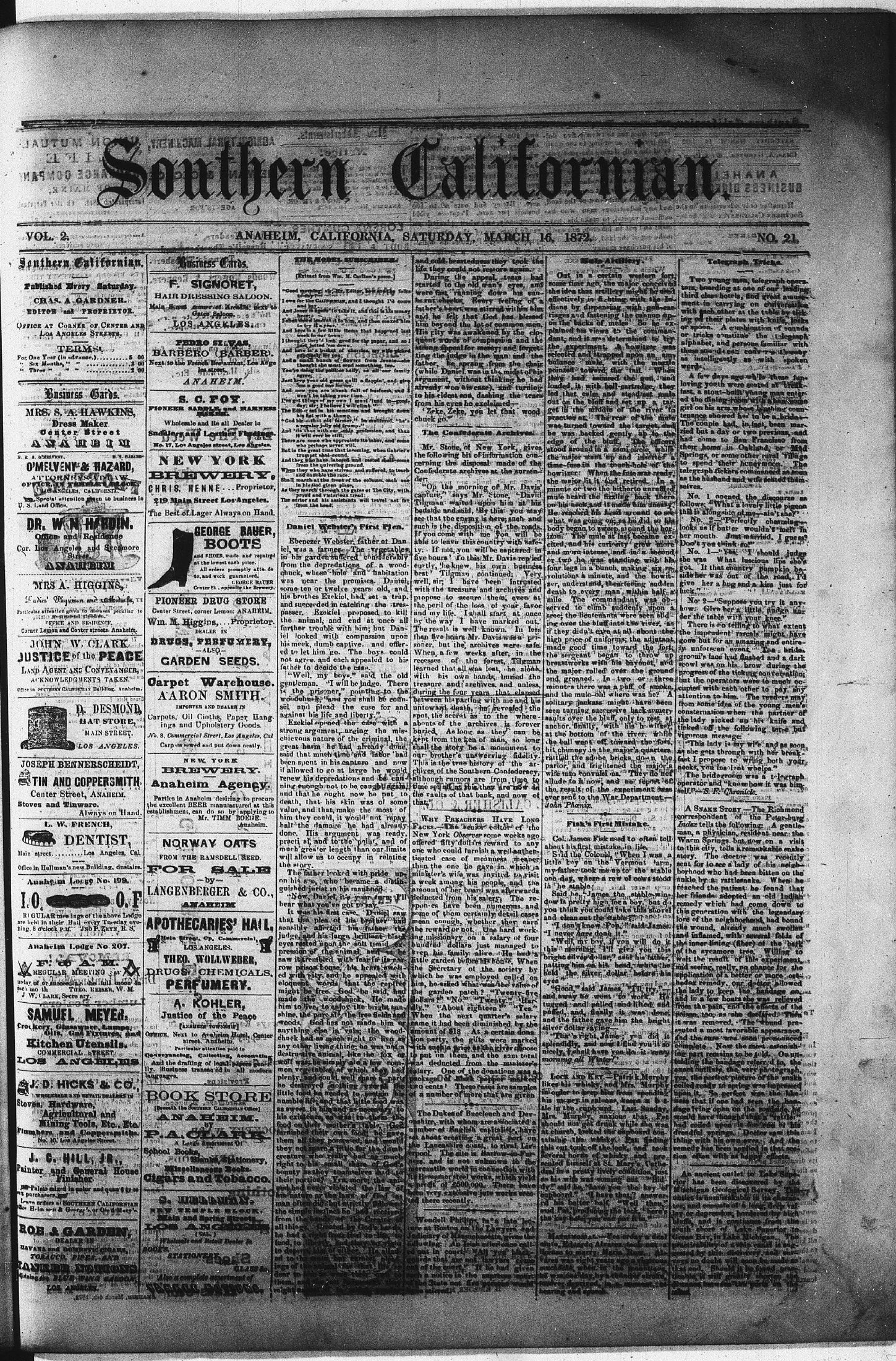
Searchable text
Southern California.
Published Every Saturday.
CHAS. A. GARDNER.
EDITOR and PROPRIETOR.
OFFICE AT CORNER OF CENTER AND
LOS ANGELES STREETS.
TERMS:
For One Year (in advance).....5 00
Six Months.....3 00
Three .....2 00
Business Cards.
MRS. S. A. HAWKINS,
Dress Maker
Center Street
ANAHEIM
O'MELVENY & HAZARD,
ATTORNEYS VOL. W.
OFFICE IN TEMPLE BLOOD
LOS ANGELES, CALIFORNIA.
Special attention given to business in
U.S. Land Office.
Business Cards.
F. SIGNORET,
HAIR DRESSING SALOON.
Main Street corner of Kroger next to
Gater Saloon.
LOS ANGELES.
PEDRO SILVA,
BARBERO (BARBER).
Next to the French Restaurant, Los Angele
los street.
ANAHEIM.
S. C. FOX.
PIONEER SADDLE and HARNESS
MAKER.
Wholesale and Re all Dealer in
Snailberg and Lotther Fludings.
No. 17, Los Angeles street, Los Angeles.
NEW YORK
BREWERY,
CHRIS. HENNE ... Proprietor,
219 Main Street Los Angeles.
MRS. S. A. HAWKINS,
Dress Maker
Center Street
ANAHEIM
M.K.S.O'MELVENY.
O'MELVENY & HAZARD,
ATTORNEYS OF W.
OFFICE IN TAMPA BAY,
LOS ANGELES, CALIFORNIA.
Special attention given to business in
U.S. Land Office.
DR. W N HARDIN.
Office and Residence
Cor. Los Angeles and Sycamore
Streets.
ANAHEIM
MRS A. HIGGINS,
Ladies' Physician and Attendant,
Particular attention given to diseases peculiar to
Women and Children.
OFFICE AND RESIDENCE.
Corner Lemon and Center streets. Anaheim.
JOHN W. CLARK
JUSTICE of the PEACE
LAND AGENT AND CONVEYANCER,
ACKNOWLEDGMENTS TAKEN.
Office in northern California Building. Anaheim.
D. DESMOND,
HAT STORE,
MAIN STREET,
LOS ANGELES.
JOSEPH BENNERSCHEIDT,
TIN AND COPPERSMITH
Center Street, Anaheim.
Stoves and Tinware.
Always on Hand.
L. W. FRENCH,
DENTIST,
Main street...Los Angeles, Cal.
Office in Hellman's new Building, dustrains.
Anaheim Lodge No. 192.
I.O. 0.F.
REGULAR meetings of the above Lodge are held in their Hall every Tuesday evening, 8 o'clock P.M."
Jno P. Zeyn R.S.
Anaheim Lodge No. 207.
NEW YORK
BREWERY.
CHRIS. HENNE...Proprietor,
219 Main Street Los Angeles.
The Best of Lager Always on Hand.
GEORGE BAUER,
BOOTS
and FHOER, made and repaired at the lowest cash price.
All orders promptly atta- do to, and work guaranteed.
GEORGE BAUER
Center St., opposite the Brewery.
PIONEER DRUG STORE
Center Street, corner Lemon: ANAHEIM.
Wm. M. Higgins,...Proprietor.
DEALER IN
DRUGS, PERFUMERY,
ALSOGARDEN SEEDS.
Carpet Warehouse.
AARON SMITH.
IMPORTER AND DEALER IN
Carpets, Oil Cloths, Paper Hangings and Upholstery Goods.
No. 8, Commercial Street, Los Angeles, Cal.
Carpets rewired and put down neatly.
NEW YORK
BREWERY.
Anaheim Agency.
Parties in Anaheim desiring to procure the excellent BEER manufactured at this establishment, can do so by applying to Mr. TIMM BOEGE.
Anaheim.
NORWAY OATS
FROM THE RAMSDELL SEED.
FOR SALE
byLANGENBERGER & CO., ANAHEIM
APOTHECARIES' HALL,
Main Street, Op., Commercial,
LOS ANGELES.
THEO. WOLLWEBER.
FROM THE RAMSDELL SEED.
FOR SALE
byLANGENBERGER & CO., ANAHEIM
APOTHECARIES' HALL,
Main Street, Op. Commercial,
LOS ANGELES.
THEO. WOLLWEBER,
DRUGS, CHEMICALS,
PERFUMERY.
A. KOHLER,
Justice of the Peace
[ANAHEIM TOWNSHIP]
OFFICE, Next to Anaheim Hotel, Center
street, Andhelm.
Particular attention paid to
Giveyneeling, Collecting, Accounting
And the drafting of legal papers generally.
Business transmitted in all modern languages.
BOOK STORE
[Beneath the Southern California Office]
ANAHEIM.
by
P.A. CLARK
A Large Armament Of School Books,
Glenn Stationery,
Miscellaneous Books.
Gigars and Tobacco.
S. HIDDANAN,
NEW TEMPLE BLOCK,
Main and Spring Streets,
LOS ANGELES
(CAL.)
Wholesale and Retail Dealer In BOOKS.
STATIONERY.
GLASS &
Also a complete armament of SAMUEL MEYER,
Crockery, Glassware, Lamps,
Oils, Gas Fixtures, and
Kitchen Utensils.
COMMERCIAL STREET,
LOS ANGELES
J. D. HICKS & CO.,
WHILESAK AND RETAIL DEALERS IN
Stoves, Hardware,
Agricultural and
Mining Tools, Etc., Eto.
Plumbers, and Coppersmiths.
No. 10, Los Angeles Street.
J. C. HILL, JR.,
Painter and General House
Finisher.
Leaves orders at SOUTHERN CALIFORNIAN
Helenson & George's or Old Mary's.
BOE & GARDEN,
DEALER IN
HAVANA AND DOMESTIC CIGARS,
TOBACCO, PIPES, AND
TANKEED NOMONDS
Solving the BLUE WING OF DOWNTOWN,
LOS ANGELES.
EVERN CALIFORNIA
HEIM, CALIFORNIA, SATURDAY, MARCH 16, 1872.
THE MODEL SUBSCRIBER
[Extract from Wm. M. Carlton's poem.]
"Good morning, Mr. Editor, how the folks to-day feel I owe for the Californian, and I thought I'd come and lay it down. And Jones is again to take it, and this is his money here. Jahn drew land in it to him, and then moved him to try it a year. And here is a few little items that happened last week in our town: I thought they'd look good for the paper, and so I just jotted them down. And here is a basket of cherries, my wife picked generously for you. And a small bunch of flowers from Jessie—the thought she must send something too. You're doing the pollination rally, and all our family agree. Just keep your old goose quill a sapphire, and give him a good one for me. And now you are thumb full of business, and I won't be taking your time. I've got things of my own. I must tend to—good day, air; I believe I will climb."
The Editor and in his minutes and brought down his fat with a thump.
"God bless that old farmer," he mattered, "he's a regular jolly old trump." And "his thus with our noble profession, and thus it will ever be still;"
There are some who appreciate the labor, and some who perhaps never will.
But in the great time that is coming, when Gabriel's trumpet shall sound, and they have laughed and roasted shall come from the quivering ground. When they have striven and suffered, to touch and ennoble the race. Shall march at the front of the column, each one in his fled given place, as they march through the gates of The City, with proud and victorious tread.
The editor and his assistants will travel not far from the head.
and cold-heatedness they took the life they could not restore again.
During the appeal teams had started to the old man's eyes, and were fast running down his sunburned cheeks. Every feeling of a father's heart was stirred within him and he felt that God has blessed him beyond the lot of common men. His pity was awakened by the eloquent words of compassion and the strong appeal for mercy; and forgetting the judge in the man and the father, he sprang from the chair (while Daniel was in the midst of his argument, without thinking he had already won his case), and turning to his eldest son, dashing the tears from his eyes he exclaimed—
"Zeke, Zeke, you let that wood chuck go."
The Confederate Archives
Mr. Stone, of New York, gives the following bit of information concerning the disposal made of the Confederate archives at the surrender:
"On the morning of Mr. Davis' capture," says Mr. Stone, "David Tilgman waited upon him at his mule heard the fizzling on his neck, and it made
Daniel Webster's First Plen.
Ebenezer Webster, father of Daniel, was a farmer. The vegetables in his garden suffered considerably from the depredations of a wood-chuck, whose hole and habitation was near the promises. Daniel, some ten or twelve years old, and his brothes Ezekiel, had set a trap, and succeeded in catching the trespasser. Ezekiel proposed to kill the animal; and end at once all further trouble with him; but Daniel looked with compassion upon his meek, dumb captive, and offered to let him go. The boys could not agree, and each appealed to his father to decide the case.
"Well, my boys," said the old gentleman. "I will be judge. There is the prisoner," pointing to the woodchuck, "and you shall be counsel and plead the case for and against his life and liberty."
Ezekiel opened the case with a strong argument, urging the mischievous nature of the criminal, the great harm he had already done, said that much time and labor had been spent in his capture and now if allowed to go at large he would renew his depredations and be canning enough not to be caught again, and that he ought now be put to death, that his skin was of some value, and that, make the most of him they could, it would not repay halt the damage he had already done. His argument was ready, practiced, and to the point, and of much greater length than our limits will allow us to occupy in relating the story.
The father looked with pride upon his son, who became a distinguished jurist in his manhood.
"Now, Daniel, it's your turn. I'll hear what you've got to say."
It was his first case. Daniel saw that the plea of his brother had sensibly affected his father: the judge, and his large brilliant black eyes rested upon the soft timid expression of the animal, and as he saw it trembled with fearful ill-nausea from his eyes he exclaimed—
"Zeke, Zeke, you let that wood chuck go."
The Confederate Archives
Mr. Stone, of New York, gives the following bit of information concerning the disposal made of the Confederate archives at the surrender.
"On the morning of Mr. Davis' capture," says Mr. Stone, "David Tilgman waited upon him at his bedside and said, 'By this you may see that the enemy is here; such and such is the disposition of the roads.' If you come with me you will be able to leave this country with safety. If not, you will be captured in five hours.' So this Mr. Davis replied entitlely, 'he knew his own business best.' Tilgman continued: Very well, sir; I have been intrusted with the treasure and archives and propose to secure them, even at the peril of the loss of your favor and my life. I shall start at once by the way I have marked out.' The result is well known. In less than five hours Mr. Davis was a prisoner, but the archives were safe. When a few weeks after in the recesses of the forest, Tilgman learned that all was lost, he alone, with his own hands, buried the treasure and archives, and unless during the four years that elapsed between his parting with me and his untoward death, he revealed the spot, the secret as to the whereabouts of the archives is forever buried. As long as they can be kept from the ken of man, so long shall the story be a monument to our brother's unwerving fidelity. This is true history of the archives of the Southern Confederacy, although rumors are from time to time set alight this they are now in the vaults of that bank, and now of that."
Why Preachers Have Long Faces—The senior editor of the New York Observer some weeks ago offered fifty dollars reward to any one who could furnish a well-authenticated case of meanness more than the one he gave in which a minister's wife was invited to visit a week among his people, and the amount of her board was afterwards deducted from his salary. The responses have been numerous and some of them certainly detail cases mean enough, whether they earn the reward or not. One hard working missionary on a salary of four hundred dollars just managed to keep his family alive. He had a little garden before his house. When from his eyes he exclaimed—
"Zeke, Zeke, you let that wood chuck go."
The Confederate Archives
Mr. Stone, of New York, gives the following bit of information concerning the disposal made of the Confederate archives at the surrender.
"On the morning of Mr. Davis' capture," says Mr. Stone, "David Tilgman waited upon him at his bedside and said, 'By this you may see that the enemy is here; such and such is the disposition of the roads.' If you come with me you will be able to leave this country with safety. If not, you will be captured in five hours.' So this Mr. Davis replied entitlely, 'he knew his own business best.' Tilgman continued: Very well, sir; I have been intrusted with the treasure and archives and propose to secure them, even at the peril of the loss of your favor and my life. I shall start at once by the way I have marked out." The result is well known. In less than five hours Mr. Davis was a prisoner, but the archives were safe. When a few weeks after in the recesses of the forest, Tilgman learned that all was lost, he alone, with his own hands, buried the treasure and archives and unless during the four years that elapsed between his parting with me and his untoward death, he revealed the spot, the secret as to the whereabouts of the archives is forever buried.
As long as they can be kept from the ken of man, so long shall the story be a monument to our brother's unwerving fidelity. This is true history of the archives of the Southern Confederacy, although rumors are from time to time set alight this they are now in the vaults of that bank, and now of that."
Fisk's First Mistake
Col. James Fisk used to about his first mistakes in Said the Colonel: "Who little boy on the Vermont my father took up to one day; where a row of it he stable.
Said he: "James the day is pretty high for a boy you think you could take and clean out the stable?"
"I don't know Pop." "I never hope done it."
"Well, my boy; if you this morning I'll give bright silver dollar;" said Fisk.
will allow us to occupy in relating the story.
The father looked with pride upon his son, who became a distinguished jurist in his manhood.
"Now, Daniel, it's your turn. I'll hear what you've got to say."
It was his first case. Daniel saw that the plea of his brother had sensibly affected his father, the judge, and his large brilliant black eyes rested upon the soft timid expression of the animal, and as he saw it trembled with fear in its narrow prison house, his heart swelled with pity, and he appealed with eloquent words that the reactive might be free. God he said, had made the woodchuck. He made him to live, to enjoy the bright sunshine, the pure air, the free fields and woods. God has not made him or anything else in vain; the wood-chuck had as much right to live as any other living thing; he was not a destructive animal, like the fox or wolf; he simply ate a few common vegetables of which they had plenty, and could well spare a part he destroyed something except the little food he needed to sustain his humble life; and that little food was as sweet to him and as necessary to his existence as was to them—the food on their mother's table. God furnished their own food; he gave them all they possessed, and would they not spare a little for the drunk creature who really had as much right to his small share of God's bounty as they themselves had to their portion? Yes, more, the apothead had never violated the law of his nature or the laws of God as man often did, but a strictly followed the simple instinct he had received from the hands of the Creator of all things. Granted by God's hands, he had a right from God to live, to food, to literacy, and therefore rights to deprive him of either. He allowed to the state but tumultuous moodings of the animal that life so dear in him may cause them, and such moods might require him to occupy in relating the story.
The Duke of Bucleuch and Devonshire, with whom are associated a number of English capitalists, have set about creating a great port on the Lancashire coast, to rival Liverpool. The site is dwarf in Punishment and is not unknown to the mercantile world in connection with its Bremer steel works, which yield a profit of £500,000. There have been very extensive jute works undertaken there recently.
Wendell Phillips, in a late lecture at Boston on the Lawyers and Judiciary of Massachusetts, gives the following: "An Irish interference called out in court: 'All you black-eyed men are not lawyers' came out of the court.' If he had given such a notice in the supreme court of the State not five persons would have heard and spoken."
Male Artillery.
In a certain western fort, the time ago, the major conceived idea that artillery might be used actively in fighting with the Indians by dispensing with gun-canes and fastening the cannon up the backs of mules. So he exchanged his views to the commander, and it was determined to try experiment. A howitzer was tested and strapped upon an ammunition mule, with the musket aimed toward the tail. When it had accrued the gun, and fired it with ball-gartridge, they that calm and steadfast mule on the bluff and set up a tariff the middle of the river to attack at. The rear of the mule turned toward the target, and was backed gently up to the side of the bluff. The officers around in a semicircle, while major went up and inserted a fuselain the touch-hole of the howitzer. When the fuse was ready, major lit it and retired. In a minute or two the hitherto unruffled heard the fizzling back there his back, and it made him uneasy.
Telegraph Tricks
Two young men, telegraph operators, boarding at one of our leading third class hotels, find great amusement in carrying on conversation with each other as the table by ticking on their plates with knife, locks or spoon. A combination of sounds or tricks constitute the telegraph alphabet, and persons familiar with these sounds can convey themselves intelligently as with spoken words.
A few days ago while those fun-loving youth were seated at breakfast, a stout-built young man entered the dining-room with a hand some girl on his arm whose binning counterance showed her to be a bride. The couple had, in fact, been married but a day or two previous, and had come to San Francisco from their home in Oakland, or Mad Springs, or some other rural village to spend their honeymoon. The telegraphick commanded as soon as the husband and wife seated themselves.
No. 1 opened the discourse as follows: What a lovely little pigeon
on the bluff and set up a tariff with the middle of the river to forties at. The rear of the mule turned toward the target, and was backed gently up to the base of the bluff. The officers had around in a semicircle while major went up and insisted a fusenail the touch-hole of the pitizer. When the fuse was ready, major lit it and retired. In a minute or two the bitherto unruffled he heard the fizzling back there his neck and it made him uneasy, rescheduled his head around to see it was going on; as he did so his ear began to sweep around the horde. The mule at last became exerted, and his curtsey grew more intense, and in a second two he was standing with his legs in a bunch, making six reations a minute, and the howitzers understand, the artening and lench to every man within half a mile.
The commandant was obedient to climb suddenly upon all the lieutenants were seen sliding over the bluff into the river, as they didn't care at all about the price of uniforms; the adjutant was good time toward the fort; sergeant began to throw up networks with his bayonet, and major rolled over she ground groaned. In two or three times there was a puff of smoke, the mule-ohl where was he? A very jankass might have been turning successive hack somersaults over the bluff, only to rest at or finally, with his h-witted bottom of the river, while all wept off toward the foot, chimney in the major's quarters, led the adobe bricks down the porch, and frightened the major's into convulsion. They do not know it now, and no report of result of the experiment was sent to the War Department—Phenix.
Fisk's First Mistake.
L. James Fisk used to often tell his first mistakes in life. Did the Colonel, "When I was a boy on the Vermont farm, father took me up to the stable day, where a row of cows stood in stable." Did he, "James the stable wine is pretty high for a boy, but do think you could take this shovel clean out the stable?" Don't know. Pop," said James ever hope done it."
Well, my boy, if you will do it morning. I'll give you this silver dollar," said his father.
A Snake Story — The Richmond correspondent of the Peter-burg Index tells the following: A gentleman, a physician, resident near the Warm Springs, but now on a visit to this city, tells a remarkable snake story. The doctor was recently sent for to see a lady of his neighborhood who had been bitten on the ankle by a rattlesnake. When he reached the patient he found that her friends adopted an old Indian remedy which had come down to this generation with the legendary lore of the neighborhood, had bound the wound, already much swollen and inflamed, with several folds of the inner lining (fiber) of the bank of the sycamore tree. Willing to wait the result of this experiment...
The Colonel, when I was a boy on the Vermont farm,ather took me up to the stable day, where a row of cows stood in stable.
And he, James the stable-win,is pretty high for a boy, but do think you could take this shovel clean out the stable."
Don't know Pop," said James never hope done it."
Tell my boy, if you will do it morning. I'll give you this silver dollar," said his father,ang him on his hand,white he the silver dollar before his good," said James. "I'll try."—way he went to work. He had and palled and lifted and, and finally it was done,the father gave him the bright dollar saying—
Mr. right James; you did it tidily,and most find you it so I shall have you do it every thing all Winter!
BACK AND KEY. — Patrick Murphy this whisky, and Mrs. Murphy her to keep him from spending money in saloons,keep in but the cupboard. Last Sunday,Murphy, anxious that Pat not get drunk while she was march,looked the cupboard containing the whisky. Pat finding out took off the lock,and took bords of whisky and pro himself at St. Mary's Cathedral,a pretty lively condition,just with was coming out. "Bid-aid be,have you the key of word." "I have that," answera half half. "Well then,"producing the lock,"here's my hale-you can put him."
AN ancient outlet to Lake Superior has been discovered by the Michigan Geological Survey. This outlet is unmistakable in its character,and consists of a long,deep valley or depression,hardened by high cliffs,and it continues from the south shore of Lake Superior to Green Bay,in Lake Michigan.The practicability of a ship canal is suggestedby this discovery,and weave no doubt will soon be made as that end.Should it be found practicableit will greatly shorten the distance between the ports on the island.