anaheim-gazette 1870-12-31
Scanned page
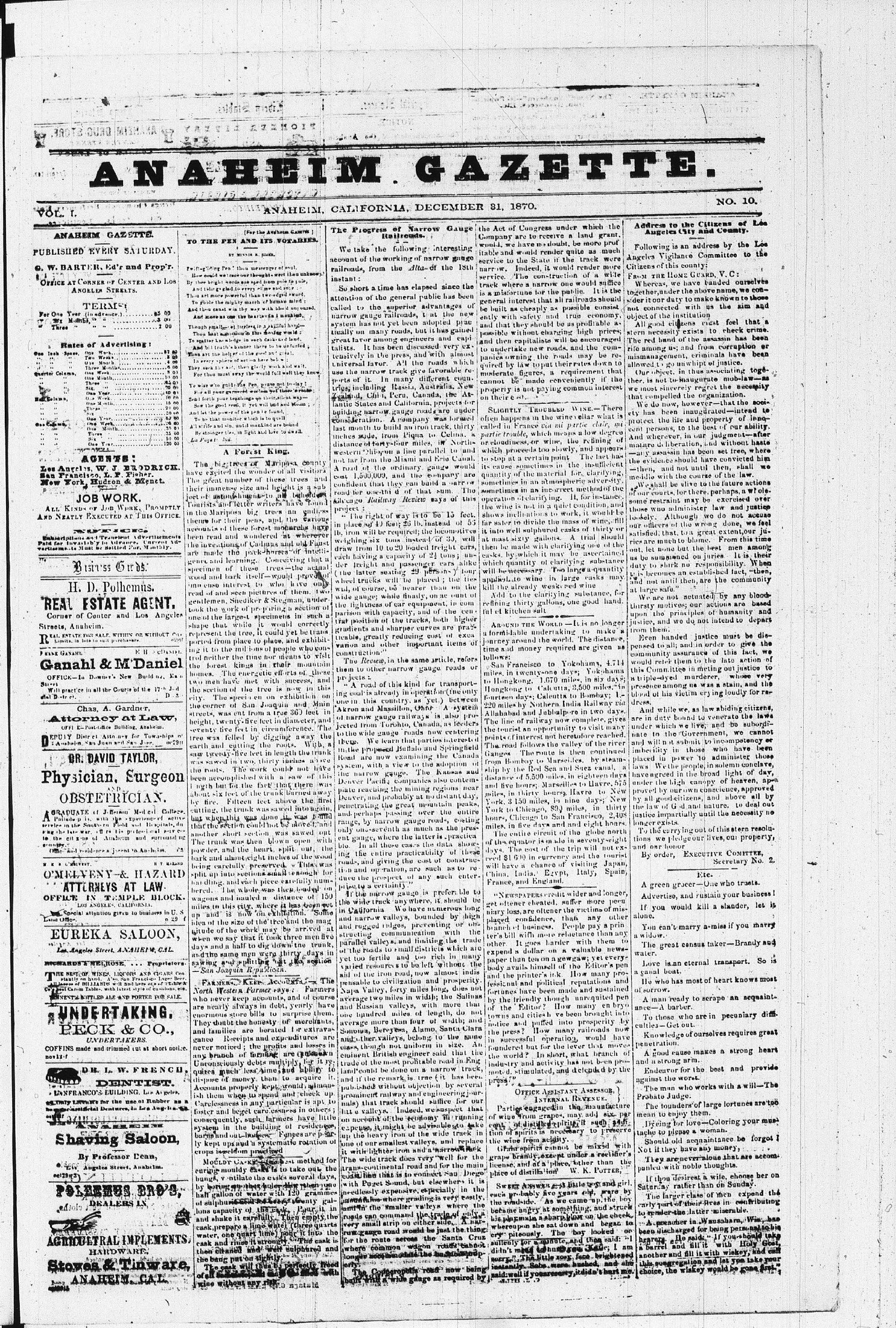
Searchable text
ANAHEIM GAZETTE.
PUBLISHED EVERY SATURDAY.
O. W. BARTER, Ed'r and Prop'r.
OFFICE AT CORNER OF CENTER AND LOS ANGELES STREETS.
TERMS:
For One Year (in advance) 85 00
Two Months 3 00
Three 2 00
Rates of Advertising:
One Inch Space, One Week 87 00
Two Weeks 8 00
One Month 4 00
Three Months 6 00
Quarter Column, One Week 8 01
One Month 10 00
Three 85 00
Six 20 00
One Year 40 01
Ball Column, One Week 10 00
One Month 15 00
Three 21 00
Six 20 00
One Year 62 00
One Column, One Week 20 00
One Month 30 01
Three 35 00
Six 50 00
One Year 120 00
AGENTS:
Los Angeles, W. J. BRODRICK.
San Francisco, L. P. Fisher.
New York, Hudson & Mennet.
[For the Anaheim Gazette]
TO THE PEN AND ITS VOTARIES.
BY MINNIE R. PLACE.
Twelfth-giving Pen! thou messenger of soul.
How could we trace our thoughts west then unknown?
By three bright words arise from pole to pole,
And this gled to every time and hour.
Thou art more powerful than two-edged sword,
To guide the mighty match of human mind!
And thou canst win thy way with blood unquired,
And move as one the hearts of mankind.
Though smallest of tribes in a skillful hand—
Thou hast permission in this modest world;
To scatter knowledge in each darkened land,
And bill truth's banner there to be unfurled;
Then art the helper of the good and great,
In every sphere of action here below;
They seek the earth, then glance work and wait.
For thou must away the world full well they know.
Ye wise who guild The Pen, pause not today!
For all your garnered wisdom yet there remains;
Send forth your teachings on their silent way—
Sow the good seed, it yet will bind and mount;
And let the power of the pen be found,
To be that monitor which is to quell.
All strife and sin, until mankind are bound,
By stronger ties, in light and love to dwell.
La Foya: Ind.
A Forest King.
The big trees of Mariiposa county have excited the wonder of all visitors.
The great number of these trees and their immense size and height is a sub-
AGENTS:
Los Angeles, W. J. BRODRICK.
San Francisco, L. F. Fisher.
New York, Hudson & Menet.
JOB WORK.
ALL KINDS OF JOB WORK, PROMPTLY AND NEATLY EXECUTED AT THIS OFFICE.
BUSINESS GROWS.
H. D. Polhemus.
REAL ESTATE AGENT.
Corner of Center and Los Angeles Streets, Anaheim.
REAL ESTATE FOR SALE, WITHIN OR WITHOUT LIMITS, in lots to suit purchasers.
FRANK GANAH.
E H. C DANIEL.
Ganahl & M'DANIEL
OFFICE—In Downey's New Building, Main Street.
Well practice in all the Courts of the 17th Judicial District.
Chas, A. Gardner,
Attorney at Law,
OFFICE—Post-office Building, Anaheim.
DEPULY DISTRICT Attorney for Townships of Anaheim, San Juan and San Jose.
DR. DAVID TAYLOR,
Physician, Surgeon AND OBSTETRICIAN.
GRADUATE OF JEFFERSON MEDICAL COLLEGE.
Philadelphia, with the experience of active services in the Southern Field and Hospitals, during the late war, offers professional service to the citizens of Anaheim and surrounding country.
OFFICE and residence adjacent to Anaheim.
O'MELVENY-& HAZARD
ATTORNEYS AT LAW.
OFFICE IN TEMPLE BLOCK.
LOS ANGELES, CALIFORNIA.
Special attention given to business in U.S. Land Office.
EUREKA SALOON.
A Forest King.
The big trees of Mariposa county have excited the wonder of all visitors. The great number of these trees and their immense size and height is a subject of astonishment to all travelers and letter writers have found in the Mariposa big trees an endless theme for their pens, and the various accounts of these forest monarchs have been read and wondered at wherever the inventions of Cadmus and old Faust are made the pack-horses of intelligence and learning. Conceiving that a specimen of these trees—the actual wood and bark itself—would prove innumerable interest to who have only read of and seen pictures of them. Two gentlemen, Snediker & Siegman, undertook the work of preparing a section of one of the largest specimens in such a shape that while it would correctly represent the tree, it could yet be transported from place to place, and exhibiting it to the millions of people who control neither the time nor means to visit the forest kings in their mountain homes. The energetic efforts of these two men have met with success, and the section of the tree is now in this city. The specimen on exhibition on the corner of San Joaquin and Main streets was sent from a tree 360 feet in height, twenty-five feet in diameter, and seventy five feet in circumference. The tree was felled by digging away the earth and cutting the roots. With a saw twenty-five feet in length the trunk was sawn in two, thirty inches above the roots. The work could not have been accomplished with a saw of this length but for the fact that there was about six feet of the trunk burned away by fire. Fifteen feet above the first cutting, the trunk was sawn into again, but when this was done it was found that the section could not be moved, and another short section was sawn out. The trunk was then blown open with powder, and the heart split out, the bark and almost eight inches of the wood being carefully preserved. This was split up into sections small enough for handling, and each piece carefully numbered. The whole was then loaded on wagons and hauled a distance of 159 miles to this city, where it has been set up and is now on exhibition. Some idea of the size of the tree may be arrived at when we say that it took three men five
O'MELVENY & HAZARD ATTORNEYS AT LAW OFFICE IN TEMPLE BLOCK, LOS ANGELES, CALIFORNIA.
Special attention given to business in U.S. Land Office.
EUREKA SALOON,
Los Angeles Street, Anaheim, Cal.
UNDERTAKING, PECK & CO., UNDERTAKERS.
COFFINS made and trimmed cut at short notice.
DR. L. W. FRENCH.
DENTIST.
LANFRANCO'S BUILDING, Los Angeles.
ANAHEIM
Shaving Saloon,
By Professor Dean,
Los Angeles Street, Anaheim.
POLEEMUS BRO'S,
DEALERS IN
AGRICULTURAL IMPLEMENTS,
HARDWARE.
Stoves & Tinware,
ANAHEIM, Cal.
EIM. GAZETT
ANAHEIM, CALIFORNIA, DECEMBER 81, 1870.
The Progress of Narrow Gauge Railroads.
We take the following interesting account of the working of narrow gauge railroads, from the Alta- of the 18th instant:
So short a time has elapsed since the attention of the general public has been called to the superior advantages of narrow gauge railroads, that the new system has not yet been adopted practically on many roads, but it has gained great favor among engineers and capitalists. It has been discussed very extensively in the press, and with almost universal favor. All the roads which use the narrow track give favorable reports of it. In many different countries, including Russia, Australia, New Zealand, Chile, Peru, Canada, the Atlantic States and California, projects for building narrow gauge roads are under consideration. A company was formed last month to build an iron track, thirty inches wide, from Piqua to Celina, a distance of forty-four miles, in Northwestern Ohio on a line parallel to and not far from the Miami and Erie Canal. A road of the ordinary gauge would cost 1,500,000, and the company are confident that they can build a narrow road for one-third of that sum. The Act of Congress under which the Company are to receive a land grant, would we have no doubt, be more profitable and would render quite as much service to the State if the track were narrow. Indeed, it would render more service. The construction of a wile track where a narrow one would suffice is a misfortune for the public. It is the general interest that all railroads should be built as cheaply as possible consistently with safety and true economy, and that they should be as profitable as possible without charging high prices; and then capitalists will be encouraged to undertake new roads, and the companies owning the roads may be required by law to put their rates down to moderate figures, a requirement that cannot be made conveniently if the property is not paying common interest on their cost.
SLIGHTLY TROUBLED WINE.—There often happens in the wine cellar what is called in France via mi partie clair, mi partie trouble, which means a low degree or cloudiness, or wine, the refining of which proceeds too slowly, and appears to stop at a certain point. The fact has its cause sometimes in the insufficient quantity of the material for clarifying, sometimes in an atmospheric adversity, sometimes in an incorrect method of the
King.
Mariposa county under of all visitors these trees and height is a sub to all beholders writers have found trees an endless and the various best monarchs have erected at wherever parks and old Forest horses of intelligence Conceiving that a tree—the actual—would prove of who have only three of them. Two & Siegman, underpacing a section of specimens in such a would correctly could yet be trans place, and exhibiting of people who consider means to visit in their mountain the efforts of these with success, and tree is now in this on exhibition on Joquin and Main a true 360 feet in feet in diameter, and circumference. The digging away the roots. With, a in length the trunk thirty inches above could not have with a saw of this rock that there was trunk burned away yet above the first was sawed into again, done it was found that not be moved, and on was sawed out the blown open with split out, the寸 inches of the wood served. This was small enough for piece carefully numbed was then loaded on a distance of 150 here it has been not an exhibition. Some tree and the mag may be arrived at book three men five
Zealand, Chile, Peru, Canada, the Atlantic States and California, projects for building narrow gauge roads are under consideration. A company was formed last month to build an iron track, thirty inches wide, from Piqua to Celina, a distance of forty-four miles, in Northwestern Ohio on a line parallel to and not far from the Miami and Erie Canal. A road of the ordinary gauge would cost 1,500,000, and the company are confident that they can build a narrow road for one-tird of that sum. The Chicago Railway Review says of this project:
"The right of way is to be 15 feet. in place of 40 feet; 25 lb. instead of 55 lb. iron will be required; the locomotives weighing six tons instead of 30, will draw from 10 to 20 loaded freight cars, each having a capacity of 24 tons; under freight and passenger cars alike (the latter seating 29 persons) four wheel trucks will be placed; the tires旷, of course, to nearer than on the wide gauge; while finally, on ac count of the tightness of car equipment, in comparison with capacity, and of the central position of the tracks, both higher gradients and sharper curves are practicable, greatly reducing cost of excavation and other important items of construction."
The Review, in the same article, refers them to other narrow gauge roads or projects.
"A road of this kind for transporting coal is already in operation (the only one in this country, as yet.) between Akron and Massillon, Ohio. A system of narrow gauge railways is also projected from Toronto, Canada, as feeders to the wide gauge roads now centering there. We learn that parties interested in the proposed Buffalo and Springfield Road are now examining the Canada system, with a view to the adoption of the narrow gauge. The Kansas and Denver Pacific companies also contemplate reaching the mining regions near Denver, and probably at no distant day, penetrating the great mountain peaks, and perhaps passing over the entire range, by narrow gauge roads, costing only one-seventh as much as the present gauge, where the latter is practicable. In all these cases the data showing the entire practicability of these roads, and giving the cost of construction and operation, are such as to reduce the prospect of any such enterprise to a certainty."
If the narrow gauge is preferable to the wide track anywhere, it should be in California. We have numerous long and narrow valleys, bounded by high and rugged ridges, preventing or obstructing communication with the property is are paying commissions on their cost.
SLIGHTLY TROUBLED WINE. There often happens in the wine cellar what is called in France via mi partie clair, mi partie trouble, which means a low degree or cloudiness, or wine, the refining of which proceeds too slowly, and appears to stop at a certain point. The fact has its cause sometimes in the insufficient quantity of the material for clarifying sometimes in an atmospheric adversity sometimes in an incorrect method of the operation of clarifying. It, for instance, the wine is not in a quiet condition, and shows inclinations to work; it would be far safer to divide the mass of wine, fill it into well sulphured casks of thirty or at most sixty gallons. A trial should then be made with clarifying one of the casks by which it may be ascertained which quantity of clarifying substance will be necessary. Too large a quantity applied to wine in large casks may kill the already weakened wine.
Add to the clarifying substance, for refining thirty gallons, one good handful of kitchen salt.
Around THE WORLD — It is no longer a formidable undertaking to make a journey around the world. The distance time and money required are given as follows:
San Francisco to Yokohama, 4.714 miles, in twenty-one days; Yokohama to Hongkong, 1.670 miles, in six days; Hongkong to Calcutta, 3.500 miles, in fourteen days; Calcutta to Bombay; 1.220 miles by Northern India Railway via Allahabad and Jubbalporo in two days. The line of railway now complete gives the tourist an opportunity to visit many points of interest not heretofore reached. The road follows the valley of the river Ganges. The route is then continued from Bombay to Marseides, by steamship by the Red Sea and Suez canal, a distance of 5.500 miles, in eighteen days and five hours; Marseilles to Havre, 575 miles, in thirty hours; Havre to New York, 3150 miles, in nine days; New York to Chicago, $9) miles, in thirty hours; Chicago to San Francisco, 2.408 miles, in five days and eight hours.
The entire circuit of the globe north of the equator is made in seventy-eight days. The cost of the trip will not exceed $1600 in currency and the tourist will have a chance of visiting Japan China India Egypt Italy Spain France and England.
NEWSPAPERS credit wider and longer get oftener cheated suffer more pecuniary loss are oftener the victims of misplaced confidence than any other branch of business. People pay a printer's bill with more reluctance than any
The narrow gauge is preferable to the wide track anywhere; it should be in California. We have numerous long and narrow valleys, bounded by high and rugged ridges, preventing or obstructing communication with the parallel valleys, and limiting the trade of the roads to small districts which are yet too fertile and too rich in many varied resources to be left without aid of the iron road, now almost indispenable to civilization and prosperity.
Napa Valley, forty miles long, does not average two miles in width; the Salinas and Russian valleys, with more than one hundred miles of length, do not average more than four of width; and Sonoma, Berenza, Alamo, Santa Clara and other valleys, belong to the same class, though not uniform in size. An engineer said that the trade of the most profitable road in England could be done on a narrow track, and if the remark is true (it has been published without objection by several prominent railway and engineering journals) that track should suffice for our butte valleys. Indeed, we suspect that on account of the economy in running expense, it might be advisable to take up the heavy iron of the wide track in one of our smallest valleys, and replace it with lighter iron and a narrow track. The wide track does very well for the transcontinental road and for the main line that is to connect San Diego with Puget Sound, but elsewhere it is needlessly expensive, especially in the areas where grading is very costly, and in the smaller valleys where the roads can command the trade of only a very small strip on either side. A narrow gauge road would be just the thing for the route across the Santa Cruz where common wagon roads cannot longer accommodate the busiest property.
The Copperpuff road now being built with a wide gauge as required by
The entire extent of the gross mileage of the equator is made in seventy-eight days. The cost of the trip will not exceed $1,600 in currency and the tourist will have a chance of visiting Japan, China, India, Egypt, Italy, Spain, France, and England.
"Newspapers credit wider and longer, get oftener cheated, suffer more pecuniary loss, are oftener the victims of misplaced confidence, than any other branch of business. People pay a printer's bill with more reluctance than any other. It goes harder with them to expend a dollar on a valuable newspaper than ten on a gewgaw; yet everybody avails himself of the Editor's pen and the printer's ink. How many professional and political reputations and fortunes have been made and sustained by the friendly though unrequited pen of the Editor? How many en bryo towns and cities have been brought into notice and puffed into prosperity by the press? How many railroads now in successful operation, would have foundered but for the lever that moves the world? In short, what branch of industry and activity has not been promoted, stimulated, and defended by the press?
OFFICE ASSISTANT ASSESSOR,
INTERNAL REVENUE.
Parties engaged in the manufacture of wine from grapes may add six per cent. of distilled spirits; if such addition of spirits is necessary to preserve the wine from acidity.
Grain spirits cannot be mixed with grape branly except under a reefer's license, and at a place, other than the place of distillation.
W. K. POTTER,
Sweet Answer: little toy and girl, each probably five years old, were by the roadside. As we came up, the boy became angry at something, and struck his plagmata a sharp blow on the check wheroupon she sat down and began to cry piteously. The boy looked on sullenly for a minute, and then said: "I didn't mean to hurt you." I am sorry. The little song face brightened instantly. Sobe man hushed, and also said: well if your merry it didn't hurt me.
Address to the Citizens of Los Angeles City and County.
Following is an address by the Los Angeles Vigilance Committee to the Citizens of this county:
FROM THE HOME GUARD, V.C:
Whereas, we have banded ourselves together under the above name, we consider it our duty to make known to those not connected with us the aim and object of the institution.
All good citizens must feel that a stern necessity exists to check crime. The red hand of the assassin has been rife among us; and from corruption or mismanagement, criminals have been allowed to go unwhipt of justice.
Our object, in thus associating together, is not to inaugurate mob-law—as we most sincerely regret the necessity that compelled the organization.
We do now, however—that the society has been inaugurated—intend to protect the life and property of innocent persons, to the best of our ability. And wherever, in our judgment—after mature deliberation, and without haste—any assassin has been set free, where the evidence should have convicted him—then, and not until then, shall we meddle with the course of the law.
We shall be alive to the future actions of our courts, for there, perhaps, a whole-
We do now, however—that the society has been inaugurated—intend to protect the life and property of innocent persons, to the best of our ability. And wherever, in our judgment—after mature deliberation, and without haste—any assassin has been set free, where the evidence should have convicted him—then, and not until then, shall we meddle with the course of the law.
We shall be alive to the future actions of our courts, for there, perhaps, a whole some restraint may be exercised over those who administer law and justice loosely. Although we do not accuse our officers of the wrong done, we feel satisfied that, to a great extent, our juries are much to blame. From this time out, let none but the best men among us be summoned on juries. It is their duty to shirk no responsibility. When it becomes an established fact, "then, and not until then, are the community at large safe."
We are not actuated by any blood-thirsty motives; our actions are based upon the principles of humanity and justice, and we do not intend to depart from them.
Even handed justice must be dispensed to all; and in order to give the community assurance of this fact, we would refer them to the late action of this Committee in meeting out justice to a triple-died murderer, whose very presence among us was a stain, and the blood of his victim crying loudly for redress.
And while we, as law abiding citizens, are in duty bound to venerate the laws under which we live, and to subordinate to the Government, we cannot and will not submit to incompetency or imbecility in those who have been placed in power to administer those laws. We the people, in solemn conclave, have agreed in the broad light of day, under the high canopy of heaven, approved by our own conscience, approved by all good citizens, and above all by the law of God and nature, to deal out justice impartially until the necessity no longer exists.
To the carrying out of this stern resolutions we pledge our lives, our property, and our honor.
By order, Executive Committee,
Secretary No. 2.
Etc.
A green grocer—One who trusts.
Advertise, and sustain your business!
If you would kill a slander, let it alone.
You can't marry a miss if you marry a widow.
Etc.
A green grocer—One who trusts.
Advertise, and sustain your business.
If you would kill a slander, let it alone.
You can't marry a miss if you marry a widow.
The great census taker—Brandy and water.
Love is an eternal transport. So is a canal boat.
He who has most of heart knows most of sorrow.
A man ready to scrap an acquaintance—A barber.
To those who are in pecuniary difficulties—Get out.
Knowledge of ourselves requires great penetration.
A good cause makes a strong heart and a strong arm.
Endeavor for the best and provide against the worst.
The man who works with a will—The Probate Judge.
The founders of large fortunes are too mean to enjoy them.
Dyeing for love—Coloring your mustache to please a woman.
Should old acquaintance be forgot I Not if they have any money;
They are never alone that are accompanied with noble thoughts.
If thou desirest a wife, choose her on Saturday rather than on Sunday.
The larger class of men expend the early part of their lives in contributing to render the latter miserable.
A preacher in Wausaharn, Win., has been discharged for being personal to his hearer. He said: "If you should take a barrel and fill it with Holy Ghost, another and fill it with wiskey, and call this congregation and let you take your choice, the wiskey would be gone first."