anaheim-gazette 1870-12-24
Scanned page
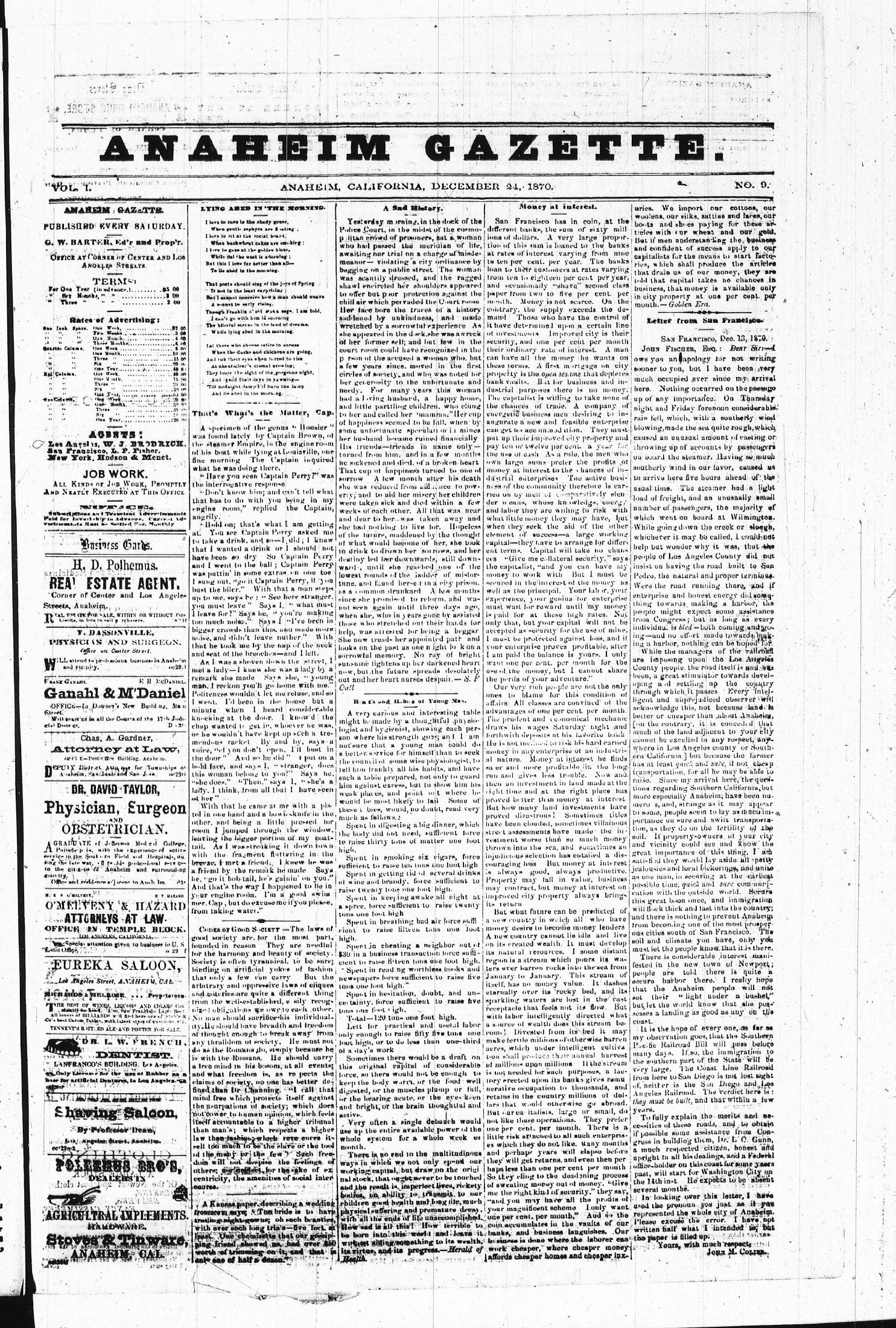
Searchable text
ANAHEIM GAZETTE.
PUBLISHED EVERY SATURDAY.
G. W. BARTER, Ed'r and Prop'r.
OFFICE AT CORNER OF CENTER AND LOS ANGELES STREETS.
TERMS:
For One Year (in advance) . $5 00
Six Months. . $3 00
Three Years. . $2 00
Rates of Advertising:
One Inch Space. One Week. $2 00
Two Weeks. Three Weeks. $3 00
One Month. Four Months. $4 00
Three Months. Five Months. $5 00
Quarter Columns. One Week. $8 00
One Month. Ten Weeks. $10 00
Three Weeks.十五 Weeks. $15 00
Six Weeks.二十 Weeks. $20 00
One Year.四十 Weeks. $40 00
Half Columns. One Week.十八 Weeks. $18 00
One Month.十九 Weeks. $19 00
Three Weeks.二十 Weeks. $20 00
Six Weeks.三十 Weeks. $30 00
One Year.四十一 Weeks. $41 00
One Columns. One Week.二十 Weeks. $20 00
One Month.三十 Weeks. $30 00
Three Weeks.十四 Weeks. $14 00
Six Weeks.十五 Weeks. $15 00
One Year.二十四 Weeks. $42 00
AGENTS:
Los Angeles, W. J. BRODRICK.
San Francisco, L. P. Fisher.
New York, Hudson & Menet.
JOB WORK.
ALL KINDS OF JOB WORK, PROMPTLY AND NEATLY EXECUTED AT THIS OFFICE.
LYING ABED IN THE MORNING.
I love to rave in the shady grove,
When gentle rephyrms are floating;
I love to sit at the social board,
When backwheat cakes are smoking;
I love to gaze at the golden blaze,
While Sol the west is adorning;
But this I love far better than all—
To lie abed in the morning.
That poet should sing of the joys of Spring
Is not in the least surprising;
But I cannot conceive how a man should weave
A mantel to early rising.
Though Franklin of old was a age, I am told,
I can't go with him in morning.
The billed scenes in the land of dreams,
While lying abed in the morning.
Let those who choose retire to noose
When the ducks and chickens are going,
And rub their eyes when forced to rise
At chaotic clear's dlamal crowing;
They house the sight of the gorgeous night,
And spend their days in yawning—
Till midnight damp if burn the lamp
And lie abed in the morning.
That's What's the Matter, Cap.
A specimen of the genus "Hoosier" was found lately by Captain Brown, of the steamer Empire, in the engine room of his boat while lying at Louisville, one fine morning The Captain inquired what he was doing there.
"Have you seen Captain Perry?" was the interrogative response.
"Don't know him; and can't tell what
AGENTS:
Los Angeles, W. J. BRODRICK.
San Francisco, L. P. Fisher.
New York, Hudson & Menet.
JOB WORK.
All kinds of Job Work, Promptly and Neatly Executed at This Office
Business Cards.
H. D. Polhemus.
REAL ESTATE AGENT.
Corner of Center and Los Angeles Streets, Anaheim.
V. DASSONVILLE,
PHYSICIAN AND SURGEON.
Office on Center Street.
WILL attend to professional business in Anaheim and vicinity.
Frank Gasahl.
E H McDaniel.
Ganahl & M'Daniel
OFFICE—In Downey's New Building, Main Street.
Will practice in all the Courts of the 17th Judicial District.
Chas. A. Gardner,
Attorney at Law,
DEPARTMENT BUILDING, Anaheim.
DR. DAVID TAYLOR,
Physician, Surgeon
AND OBSTETRICIAN.
GRADUATE of Jefferson Medical College.
Pointe de la Reine is with the experience of active service in the Southern Field and Hospitals, using the late war to realize professional service to the citizens of Anaheim and surrounding country.
O'MELVENY & HAZARD
ATTORNEYS AT LAW.
OFFICE IN TEMPLE BLOCK, LOS ANGELES, CA.
That's What's the Matter, Cap.
A specimen of the genus *Hoosier* was found lately by Captain Brown, of the steamer Empire, in the engine room of his boat while lying at Louisville, one fine morning. The Captain inquired what he was doing there.
"Have you seen Captain Perry?" was the interrogative response.
Don't know him; and can't tell what that has to do with you being in my engine room," replied the Captain, angrily.
Hold on; that's what I am getting at. You see Captain Perry asked me to take a drink, and so—I did; I knew that I wanted a drink or I should not have been so dry. So Captain Perry and I went to the ball; Captain Perry was puttin' in some extras on one toe I sung out, "go it Captain Perry, if you bust the biller." With that a man steps up to me, says he: "See here stranger, you must leave." Says I, "what must I leave for?" Says he, "you're making too much noise." Says I, "I've been in bigger crowds than this, and made more noise, and didn't leave nuther." With that he took me by the nap of the neck and seat of the breaches—and I left.
As I was a shoven down the street, I met a lady—I knew she was a lady by a remark she made. Says she, "young man. I reckon you'll go home with me." Politeness wouldn't let me refuse, and so I went. I'd been in the house but a minute when I heard considerable knocking at the door. I know'd the chap wanted to get in, whoever he was, or he wouldn't have kept up such a tremendous racket. By and by, says a voice, "if you don't open, I'll bust in the door." And so he did. I put on a bold face, and says I, "stranger, does this woman belong to you?" Says he, "she does." "Then," says I, "she's a lady. I think, from all that I have seen of her."
With that he came at me with a pistol in one hand and a bowie-skiff in the other, and being a little pressed for room I jumped through the window, leaving the bigger portion of my coat-tail. As I was streaking it down town with the fragment fluttering in the breeze, I met a friend. I knew he was a friend by the remark he made. Says he, "go it bobtail, he's gainin' on you." And that's the way I happened to be in your engine room. I'm a good swimmer. Cap, but do excuse me if you please, from taking water."
O'MELVENY & HAZARD AT LAW OFFICE IN TEMPLE BLOCK, LOS ANGELES, CALIFORNIA. Special attention given to business in U.S. Land Office.
EUREKA SALOON,
Los Angeles Street, Anaheim, Cal.
DR. L. W. FRENCH, DENTIST.
LANFRANCO'S BUILDING, Los Angeles.
Shaving Saloon,
By Professor Dean,
Los Angeles Street, Anaheim, Cal.
POLEBERRS BRO'S,
DEALERS IN
AGRICULTURAL IMPLEMENTS.
HARDWARE.
Stoves & Tinware,
ANAHEIM, Cal.
THE MORNING.
ANAHEIM, CALIFORNIA, DECEMBER 24, 1870.
A Sad History.
Yesterday morning, in the dock of the Police Court, in the midst of the cosmopolitan crowd of prisoners, sat a woman who had passed the meridian of life, awaiting her trial on a charge of misdemeanor—violating a city ordinance by begging on a public street. The woman was scantily dressed, and the ragged shawl encircled her shoulders appeared to offer but poor protection against the chill air which pervaded the Court room. Her face bore the traces of a history sadened by unkindness, and made wretched by a sorrowful experience. As she appeared in the dock, she was awreck of her former self; and but few in the court room could have recognized in the person of the accused a woman who, but a few years since, moved in the first circles of society, and who was noted for her generosity to the unfortunate and needy. For many years this woman had a loving husband, a happy home, and little partling children, who clung to her and called her "mamma." Her cup of happiness seemed to be fall, when by some unfortunate speculation it mines her husband became ruined financially. His friends—friends in name only—turned from him, and in a few months he sickened and died, of a broken heart. That cup of happiness turned to one of sorrow. A few month after his death she was reduced from alliance to poverty, and to aid her misery her children.
Money at interest.
San Francisco has in coin, at the different banks, the sum of sixty millions of dollars. A very large proportion of this sum is loaned to the banks at rates of interest varying from nine to ten per cent. per year. The banks loan to their customers at rates varying from ten to eighteen per cent per year, and occasionally "shave" second class paper from two to five per cent. per month. Money is not scarce. On the contrary, the supply exceeds the demand. Those who have the control of it have determined upon a certain line of investments. Improved city is their security, and one per cent per month their ordinary rate of interest. A man can have all the money he wants on these terms. A first mortgage on city property is the open sesame that depletes bank vaults. But for business and industrial purposes there is no money. The capitalist is willing to take none of the chances of trade. A company of energetic business men desiring to inaugurate a new and feasible enterprise can get no accommodation. They must put up their improved city property and pay ten or twelve per cent. a year for the use of cash. As a rule, the men who own large sums prefer the profits of money at interest to the chances of industrial enterprises. The active business of the community therefore is carried on by much of comparatively small
The Matter, Capgenus "Hoosier"
Captain Brown, of,
in the engine room
at Louisville, one
Captain inquired
here.
Captain Perry? was
response;
and can't tell what
you being in my
colled the Captain,
what I am getting
in Perry asked me
so—I did; I knew
ok or I should not
So Captain Perry
call; Captain Perry
extras on one toe
captain Perry, if you
with that a man steps
See here stranger.
Says I, "what must
be," you're making
says I "I've been in this,
and made more
have nuther."
With the nap of the neck
hes—and I left.
down the street, I
she was a lady by a
Says she, "young
go home with me."
let me refuse, and so
in the house but a
heard considerable
or. I know'd the
hip, whoever he was,
kept up such a treby and by, says a
open. I'll bust in
the did" I put on a
I, "stranger, does
to you?" Says he,
"says I, 'she's a
all that I have seen
e at me with a pisa bowie-skife in the
little pressed for
rough the window,
portion of my coattaking it down town
fluttering in the
od. I knew he was
say he made Says
'eas gainin' on you."
I happened to be in
I'm a good swim
use me if you please,
Homth and Habig of Young Men.
A very curious and interesting table might be made by a thoughtful physiologist and hygienist, showing each person where his strength goes; and I am not sure that a young man could do a better service for himself than to seek the council of some wise physiologist, to tell him frankly all his habits, and have such a table prepared, not only to guard him against excess, but to show him his weak places, and point out where he would be most likely to fail. Some of these bites, wound, no doubt, read very much as follows:
Spent in digesting a big dinner, which the body did not need, sufficient force to raise thirty tons of matter one foot high.
Spent in smoking six cigars, force sufficient to raise ten tons one foot high.
Spent in getting rid of several drinks of wine and brandy, force sufficient to raise twenty tons one foot high.
Spent in keeping awake all night at a spree, force sufficient to raise twenty tons one foot high.
Spent in breathing bad air force sufficient to raise fifteen tons one foot high.
The capitalist is willing to take none of the chances of trade. A company of energetic business men desiring to inaugurate a new and feasible enterprise can get no accommodation. They must put up their improved city property and pay ten or twelve per cent. a year for the use of cash. As a rule, the men who own large sums prefer the profits of money at interest to the chances of industrial enterprises. The active business of the community therefore is carried on by men of comparatively slender means, whose knowledge, energy and labor they are willing to risk with what little money they may have, but when they seek the aid of the other element of success—a large working capital—they have to arrange for different terms. Capital will take no chances "Give me collateral security," says the capitalist, "and you can have my money to work with. But I must be secured in the interest of the money as well as the principal. Your labor, your experience, your genius for enterprise must wait for reward until my money is paid for at these high rates. Not only that, but your capital will not be accepted as security for the use of mine. I must be protected against loss, and if your enterprise proves profitable, after I am paid the balance is yours. I only want one per cent. per month for the use of the money, but I cannot share the perils of your adventure."
Our very rich people are not the only ones to blame for this condition of affairs. All classes are convinced of the advantages of one per cent. per month. The prudent and economical mechanic draws his wages Saturday night and forthwith deposits at his favorite bank. He is not inclined to risk his hard earned money in any enterprise of an industrial nature. Money at interest he finds safer and more profitable in the long run and gives less trouble. Now and then an investment in land made at the right time and at the right place has proved better than money at interest. But how many land investments have proved disastrous! Sometimes titles have been clouded, sometimes villainous street assessments have made the investment worse than so much money thrown into the sea, and sometimes an injudicious selection has entailed a discouraging loss. But money at interest is always good, always productive. Property may fall in value, business may contract, but money at interest on improved city property always brings its return.
But what future can be predicted of a new country in which all who have money desire to become money lenders. A new country cannot lie idle and live
The laws of the most part, they are needful and beauty of society. Anneanical to be sure; yokes of fashion in carry. But the passive laws of cliques are a different thing. A sily recognition to each other. Office his individual breadth and freedom to break away from society. He must not, simply because he should carry room, at all events, as repeats the one has better deining. "I call that connects itself against society; which does opinion, which feels is a higher tribunal respects a higher which resounds it the slave or the tool few." Such freeze the feelings of for the sake of exquisites of social interest.
Describing a wedding the bride is to have, oh such beauties, trials—live look at it that our gossiped maid had over $50 on it, and that is descent.
Spent in smoking six cigars, force sufficient to raise ten tons one foot high.
Spent in getting rid of several drinks of wine and brandy, force sufficient to raise twenty tons one foot high.
Spent in keeping awake all night at a spree, force sufficient to raise twenty tons one foot high.
Spent in breathing bad air force sufficient to raise fifteen tons one foot high.
Spent in cheating a neighbor out of $30 in a business transaction force sufficient to raise fifteen tons one foot high.
Spent in reading worthless books and newspapers force sufficient to raise five tons one foot high.
Spent in hesitation, doubt, and uncertainty, force sufficient to raise five tons one foot high.
Total—120 tons one foot high.
Lett for practical and useful labor only enough to raise fifty-five tons one foot high, or to do less than one-third of a day's work.
Sometimes there would be a draft on this original capital of considerable force, so there would not be enough to keep the body warm, or the food well digested, or the muscles plump or full, or the hearing acute, or the eyes keen and bright, or the brain thoughtful and active.
Very often a single debauch would use up the entire available power of the whole system for a whole week or month.
There is no end to the multitudinous ways in which we not only spend our working capital, but draw on the original stock, that ought never to be touched and the result is imperfect lives, rickety bodies, no ability to transmit to our children good health and long life, much physical suffering and premature decay, with all the ends of life unaccomplished.
How sad is all this! How terrible to be born into this world and leave it without aiding something to its wealth, its virtue, and its progress.—Herald of Health
But what future can be predicted of a new country in which all who have money desire to become money lenders. A new country cannot lie idle and live on its created wealth. It must develop its natural resources. I some distant region is a stream which pours its waters over barren rocks into the sea from January to January. This stream of itself, has no money value. It dashes eternally over its rocky bed, and its sparkling waters are lost in the vast receptacle that feels not its flow. But with labor intelligently directed what a source of wealth does this stream become. Divested from its bed it may make fertile millions of otherwise barren acres, which under intelligent cultiva too shall produce their annual harvest of millions upon millions. If the stream is not needed for such purposes, a factory erected upon its banks gives remunerative occupation to thousands, and retains in the country millions of dollars that would otherwise go abroad. But our capitalists, large or small, do not like these operations. They prefer one per cent. per month. There is a little risk attached to all such enterprises which they do not like. Many months and perhaps years will elapse before they will get returns, and even then perhaps less than one per cent per month. So they elongate to the deadening process of sweating money out of money. "Give me the right kind of security," they say, "and you may have all the profits of your magnificent scheme. Lonely want one per cent. per month." And so the coin accumulates in the vaults of our banks, and business languishes. Our business is done where the laborer can work cheaper, where cheaper money affords cheaper homes and cheaper lox-
INTEREST.
in coin, at the sum of sixty millions large proportion to the banks varying from nine per cent per year. The banks rates at rates varying per cent per year, have second class five per cent. per cent. per scarce. On the other exceeds the devaluation the control upon a certain line improved city is their per cent per month of interest. A man money he wants on mortgage on city time that depletes business and in there is no money, going to take none of it. A company of men desiring to infeasible enterprise institution. They must city property and percent a year for rule, the men who order the profits of the chances of income. The active business therefore is car-commaratively silent.
URIES. We import our cottons, our woolens, our silks, satties and lace, our boots and shoes paying for these articles with our wheat and our gold. But if men understanding the business and confident of success apply to our capitalists for the means to start factories, which shall produce the articles that drain us of our money, they are told that capital takes no chances in business, that money is available only in city property at one per cent. per month. — Golden Ern.
LETTER FROM SAN FRANCISCO, Dec. 13, 1870.
JOHN FISCHER, Esq.: Dear Sir—I owe you an apology for not writing sooner to you, but I have been very much occupied ever since my arrival here. Nothing occurred on the passage up of any importance. On Thursday night and Friday forenoon considerable rain fell, which, with a southerly wind blowing, made the sea quite rough, which caused an unusual amount of casting or throwing up of accounts by passengers on board the steamer. Having so much southerly wind in our favor, caused us to arrive here five hours ahead of the usual time. The steamer had a light
here is no money,
going to take none of it.
A company of men desiring to infeasible enterprise
action. They must sell city property and
recent a year for rule, the men who
offer the profits of the chances of inventure.
The active business therefore is comparatively slim
knowledge, energy, nothing to risk with
they may have, but aid of the other
a large working arrangement for differwill take no chancial security," says
you can have my
But I must be out of the money as
Your labor, your
minus for enterprise
until my money is high rates. Not
capital will not be
for the use of mine,
against loss, and if less profitable, after
is yours. I only
after month for the
I cannot share venture."
There are not the only
this condition of
the convinced of the
per cent. per month.
Economical mechanic
saturday night and
his favorite bank
isk his hard earned
rise of an industriinterest he finds
stable in the long
trouble. Now and
in land made at the
right place has
money at interest.
Investments have
Sometimes titles
sometimes villainous
made the indso much money
and sometimes an
has entailed a dismoney at interest
always productive.
In value, business
money at interest on
city always brings
can be predicted of
which all who have
the money lenders
lie idle and live
On Thursday night and Friday forenoon considerable rain fell, which, with a southerly wind blowing, made the sea quite rough, which caused an unusual amount of casting or throwing up of accounts by passengers on board the steamer. Having so much southerly wind in our favor, caused us to arrive here five hours ahead of the usual time. The steamer had a light load of freight, and an unusually small number of passengers, the majority of which went on board at Wilmington. While going down the creek or sleugh, whichever it may be called, I could not help but wonder why it was, that the people of Los Angeles County did not insist on having the road built to San Pedro, the natural and proper terminus. Were the road running there, and if enterprise and honest energy did something towards making a harbor, the people might expect some assistance from Congress; but as long as every individual is bled—both coming and going—and no effort made towards making a harbor, nothing can be hoped for.
While the managers of the railroad are imposing upon the Los Angeles County people, the road itself is and has been, a great stimulator towards developing and settling up the country through which it passes. Every intelligent and unprejudiced observer will acknowledge this, not because land is better or easier than about Anaheim. [on the contrary, it is conceded that much of the land adjacent to your city cannot be excelled in any respect, anywhere in Los Angeles county or Southern California.] but because the farmer has at least quick and sure, if not cheap transportation, for all he may be able to raise. Since my arrival here, the questions regarding Southern California, but more especially Anaheim, have been numerous, and strange as it may appear to some, people seem to lay as much importance on sure and swift transportation, as they do on the fertility of the soil. If property-owners of your city and vicinity could see and know the great importance of this thing. I am satisfied they would lay aside all petty jealousies and local bickorings, and unite as one man, in securing at the earliest possible time, quick and sure communication with the outside world. Secure this great boon once, and immigration will thick thick and fast into the country; and there is nothing to prevent Anaheim from becoming one of the most prosperous cities south of San Francisco. The
so much money and sometimes an
entailed a dismoney at interest
always productive.
in value, business
money at interest on
city always brings
can be predicted of
which all who have
the money lenders
lie idle and live
It must develop
I some distant
which pours its waws into the sea from
This stream of
value. It dashes
rocky bed, and its
lost in the vast
not its flow. But
fully directed what
this stream becomes its bed it may
otherwise barren intelligent cultivatory annual harvest
items. If the stream
purposes, a facbanks gives remuto thousands, and
my millions of dolerwise go abroad.
large or small, do
tons. They prefer
month. There is a
all such enterprises
like. Many months
will elapse before
and even then percent per month
deadening process
out of money. "Give security," they say,
"all the profits of
some Lonly want
mouth." And so the
vaults of our
languages. Our
laborer can
are cheaper money
and cheaper linx-
soil. If property owners of your city and vicinity could see and know the great importance of this thing, I am satisfied they would lay aside all petty jealousies and local bickorings, and unite as one man, in securing at the earliest possible time, quick and sure communication with the outside world. Secure this great boon once, and immigration will flock thick and fast into the country; and there is nothing to prevent Anaheim from becoming one of the most prosperous cities south of San Francisco. The soil and climate you have, only you must let the people know that it is there.
There is considerable interest manifested in the new town of Newport; people are told there is quite a secure harbor there. I really hope that the Anaheim people will not set their "light under a bushel," but let the world know that she possesses a landing as good as any on the coast.
It is the hope of every one, as far as my observation goes, that the Southern Pacific Railroad Bill will pass before many days. If so, the immigration to the southern part of the State will be very large. The Coast Line Railroad from here to San Diego is not lost sight of, neither is the San Diego and Los Angeles Railroad. The verdict here is: they must be built, and that within a few years.
To fully explain the merits and necessities of these roads, and to obtain if possible some assistance from Congress in building them, Dr. L.C. Gunn, a much respected citizen, honest and upright in all his dealings, and a Federal office-holder on this coast for some years past, will start for Washington City on the 14th inst. He expects to be absent several months.
In looking over this letter, I have used the pronoun you just as if you represented the whole city of Anaheim. Please excuse the error. I have not written half what I intended to, but the paper is filled up.
Yours, with much respect,
Jogx M. Colina