anaheim-gazette 1870-12-17
Scanned page
Searchable text
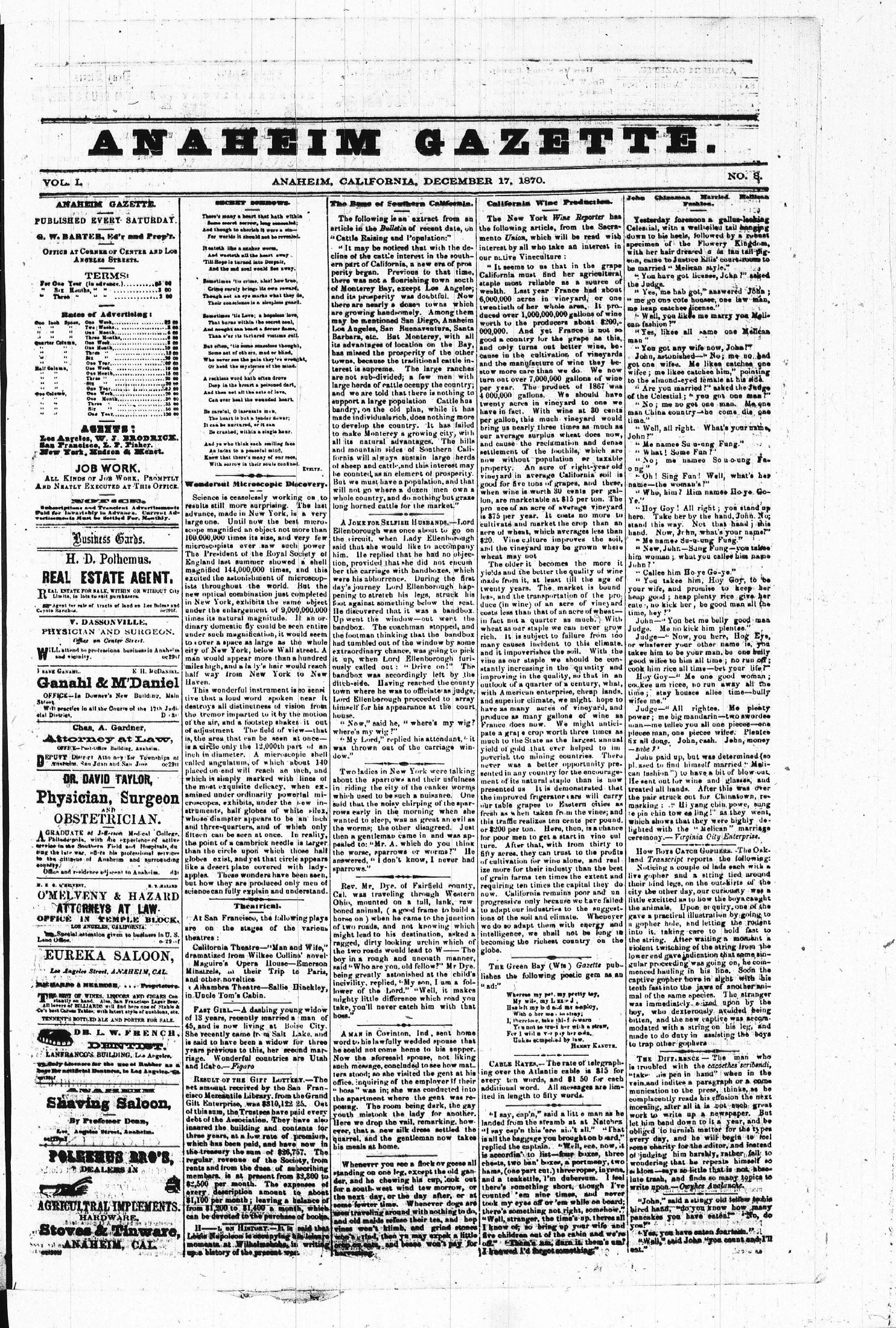
ANAHEIM GAZETTE.
PUBLISHED EVERY SATURDAY.
G. W. BARTER, Ed'r and Prop'r.
OFFICE AT CORNER OF CENTER AND LOS ANGELES STREETS.
TERMS:
For One Year (in advance.) .05 00
Six Months. .3 00
Three .2 00
Rates of Advertising:
One Inch Space, One Week. .02 00
Two Weeks. .2 00
One Month. .6 00
Three Months. .6 00
Quarter Column, One Week. .8 00
One Month. .10 00
Three .15 00
Mix .20 00
One Year. .40 00
Half Column, One Week. .10 00
One Month. .15 00
Three .20 00
Mix .20 00
One Year. .83 00
One Column, One Week. .20 00
One Month. .29 00
Three .35 00
Sig. .50 00
One Year. .120 00
AGENTS:
Los Angeles, W. J. BRODRICK.
San Francisco, L. P. Fisher.
New York, Hudson & Mcnet.
JOB WORK.
ALL KINDS OF JOB WORK, PROMPTLY AND NEATLY EXECUTED AT THIS OFFICE.
SECRET SORROW.
There's many a heart that hath within some secret sorrow, long concealed;
And though to cherish it were a sin—For worlds it should not be revealed.
It enteth like a snaker worm,
And wasteth all the heart away.
Till Hope is turned into Despair,
And the mid soul would die away.
Sometimes 'tis crime, alas how true,
Crime surely brings its own reward,
Though not an eye marks what they do,
Their conscience is a sleepless guard.
Sometimes 'tis Love; a hopeless love,
That burns within the secret soul,
And might can bear a fiercer flame,
Than s'er its tortured victims roll.
But often, 'tis some miserable thought,
Some set of others, mad or blind,
Who never see the pain they're wrought,
Or heed the mysteries of the mind.
A rockless word hath often drove
Deep in the breast a poisoned dart,
And then met all the acts of love,
Can ever heal the wounded heart.
Be careful, O insensate man,
The heart is but a tender flower;
It can be nurtured, or it can
Be crushed, within a single hour.
And ye who think each smiling face
An index to a peaceful mind,
Know that there's many of our race,
With sorrow in their souls confined.
Wonderful Microscopic Discovery.
AGENTS:
Los Angeles, W. J. BRODRICK.
San Francisco, L. P. Fisher.
New York, Hudson & Menet.
JOB WORK.
ALL KINDS OF JOB WORK, PROMPTLY AND NEATLY EXECUTED AT THIS OFFICE.
SUBSCRIPTIONS and Trademark Advertisements Paid for Invariably in Advance. Current Advertisements Must be Notified For Monthly.
Business Gards.
H. D. Polhemus.
REAL ESTATE AGENT.
REAL ESTATE FOR SALE, WITHIN OR WITHOUT CITY LIMITS, in lots to suit purchasers.
V. DASSONVILLE,
PHYSICIAN AND SURGEON.
Office on Center Street.
Will attend to professionals business in Anaheim and vicinity.
E H. McDANIEL.
Ganahl & M'Daniel
OFFICE—In Downey's New Building, Main Street.
Will practice in all the Courts of the 17th Judicial District.
Chas, A. Gardner,
Attorney at Law,
OFFICE—Post Office Building, Anaheim.
DEPARTMENT ATTORNEY FOR TOWNSHIPS OF ANAHEIM, San Juan and San Jose.
DR. DAVID TAYLOR,
Physician, Surgeon AND OBSTETRICIAN.
GRADUATE of Jefferson Medical College, Philadelphia, with the experience of active service in the Southern Field and Hospitals, during the late war, offering professional services to the citizens of Anaheim and surrounding country.
Office and residence adjacent to Anaheim.
B. E. S. O'MELVENY &
HAZARD
ATTORNEYS AT LAW.
OFFICE IN TEMPLE BLOCK, LOS ANGELES, CALIFORNIA.
Special attention given to businesses in U.S.
Wondersul Microscopic Discovery.
Science is ceaselessly working on to results still more surprising. The last advance, made in New York, is a very large one. Until now the best microscope magnified an object not more than 100,000,000 times its size, and very few microscopists ever saw such power. The President of the Royal Society of England last summer showed a shell magnified 144,000,000 times, and this excited the astonishment of microscopists throughout the world. But the new optical combination just completed in New York, exhibits the same object under the enlargement of 9,000,000,000 times its natural magnitude. It an ordinary domestic fly could be seen entire under such magnification, it would seem to cover a space as large as the whole city of New York, below Wall street. A man would appear more than a hundred miles high, and a lady's hair would reach half way from New York to New Haven.
This wonderful instrument is so sensitive that a loud word spoken near it destroys all distinctness of vision from the tremor imparted to it by the motion of the air, and a footstep shakes it out of adjustment. The field of view—that is, the area that can be seen at once—is a circle only the 12,000th part of an inch in diameter. A microscopic shell called angulatum, of which about 140 placed on end will reach an inch, and which is simply marked with lines of the most exquisite delicacy when examined under ordinarily powerful microscopes, exhibits under the new instruments, half globes of white riles, whose diameter appears to be an inch and three-quarters, and of which only fifteen can be seen at once. In reality, the point of a cambrick needle is larger than the circle upon which those half globes exist, and yet that circle appears like a desert plate covered with lady-apples. These wonders have been seen, but how they are produced only men of science can fully explain and understand.
Theatrical.
At San Francisco, the following plays are on the stages of the various theatre...
O'MELVENY & HAZARD AT LAW OFFICE IN TEMPLE BLOCK, LOS ANGELES, CALIFORNIA.
Special attention given to business in U.S. Land Office.
EUREKA SALOON,
Los Angeles Street, Anaheim, Cal.
DR. L. W. FRENCH,
DENTIST.
LANFRANCO'S BUILDING, Los Angeles.
Shaving Saloon,
By Professor Dean,
Los Angeles Street, Anaheim.
POLEENUS BRO'S,
DEALERS IN
AGRICULTURAL IMPLEMENTS.
HARDWARE.
Stoves & Tinware, Anaheim, Cal.
EIM GAZETT
ANAHEIM, CALIFORNIA, DECEMBER 17, 1870.
The Bane of Southern California.
The following is an extract from an article in the Bulletin of recent date, on "Cattle Raising and Population:"
"It may be noticed that with the decline of the cattle interest in the southern part of California, a new era of prosperity began. Previous to that time, there was not a flourishing town south of Monterey Bay, except Los Angeles; and its prosperity was doubtful. Now there are nearly a dozen towns which are growing handsomely. Among them may be mentioned San Diego, Anaheim Los Angeles, San Buenaventura, Santa Barbara, etc. But Monterey, with all its advantages of location on the Bay, has missed the prosperity of the other towns, because the traditional cattle interest is supreme. The large ranches are not sub-divided; a few men with large herds of cattle occupy the country; and we are told that there is nothing to support a large population. Cattle has bandry, on the old plan, while it has made individuals rich, does nothing more to develop the country. It has failed to make Monterey a growing city, with all its natural advantages. The hills and mountain sides of Southern California will always sustain large herds of sheep and cattle, and this interest may be counted as an element of prosperity. But we must have a population, and that will not go where a dozen men own a
California Wine Production.
The New York Wine Reporter has the following article, from the Sacramento Union, which will be read with interest by all who take an interest in our native Vineculture:
"It seems to us that in the grape California must find her agricultural staple most reliable as a source of wealth. Last year France had about 6,000,000 acres in vineyard, or one twentieth of her whole area. It produced over 1,000,000,000 gallons of wine worth to the producers about $200,-000,000. And yet France is not so good a country for the grape as this, and only turns out better wine, because in the cultivation of vineyards and the manufacture of wine they bestow more care than we do. We now turn out over 7,000,000 gallons of wine per year. The product of 1867 was 4,000,000 gallons. We should have twenty acres in vineyard to one we have in fact. With wine at 30 cents per gallon, this much vineyard would bring us nearly three times as much as our average surplus wheat does now, and cause the reclamation and dense settlement of the loothills, which are now without population or taxable property. An acre of eight-year old vineyard in average California soil is good for five tons of grapes, and these, when wine is worth 30 cents per gal-
and we are told that there is nothing to support a large population. Cattle has bandry, on the old plan, while it has made individuals rich, does nothing more to develop the country. It has failed to make Monterey a growing city, with all its natural advantages. The hills and mountain sides of Southern California will always sustain large herds of sheep and cattle, and this interest may be counted as an element of prosperity. But we must have a population, and that will not go where a dozen men own a whole country, and do nothing but graze long horned cattle for the market."
A Joke for Selfish Husbands—Lord Ellenborough was once about to go on the circuit, when Lady Ellenborough said that she would like to accompany him. He replied that he had no object, provided that she did not encumber the carriage with bandboxes, which were his abhorrence. During the first day's journey Lord Ellenborough happening to stretch his legs, struck his foot against something below the seat. He discovered that it was a bandbox. Up went the window—out went the bandbox. The coachman stopped, and the footman thinking that the bandbox had tumbled out of the window by some extraordinary chance, was going to pick it up, when Lord Ellenborough furiously called out: "Drive on!" The bandbox was accordingly left by the ditch-side. Having reached the county town where he was to officiate as judge, Lord Ellenborough proceeded to array himself for his appearance at the court house.
"Now," said he, "where's my wig? where's my wig?"
"My Lord," replied his attendant, "it was thrown out of the carriage window."
Two ladies in New York were talking about the sparrows and their usefulness in riding the city of the canker worms which used to be such nuisance. One said that the noisy chirping of the sparrows early in the morning when she wanted to sleep, was as great an evil as the worms; the other disagreed. Just then a gentleman came in and was appealed to: "Mr. A. which do you think the worse, sparrows or worms?" He answered, "I don't know, I never had sparrows."
Rev. Mr. Dye. of Fairfield county, Cal. was traveling through Western Ohio, mounted on a tall, lank, raw boned animal, (a good frame to build a horse on) when he came to the junction of two roads, and not knowing which might lead to his destination, asked a twenty acres in vineyard to one we have in fact. With wine at 30 cents per gallon, this much vineyard would bring us nearly three times as much as our average surplus wheat does now, and cause the reclamation and dense settlement of the toothills, which are now without population or taxable property. An acre of eight-year old vineyard in average California soil is good for five tons of grapes, and these, when wine is worth 30 cents per gallon, are marketable at $15 per ton. The produce of an acre of average vineyard is $75 per year. It costs no more to cultivate and market the crop than an acre of wheat, which averages less than $20. Vine culture improves the soil, and the vineyard may be grown where wheat may not.
The older it becomes the more it yields and the better the quality of wine made from it, at least till the age of twenty years. The market is bound less, and the transportation of the produce (in wine) of an acre of vineyard costs less than that of an acre of wheat—in fact not a quarter as much. With wheat as our staple we can never grow rich. It is subject to failure from too many causes incident to this climate, and it impoverishes the soil. With the vine as our staple we should be constantly increasing in the quantity and improving in the quality, so that in an outlook of a quarter of a century, what with American enterprise, cheap lands, and superior climate, we might hope to have as many acres of vineyard, and produce as many gallons of wine as France does now. We might anticipate a grape crop worth three times as much to the State as the largest annual yield of gold that ever helped to improveish the mining countries. There never was a better opportunity presented in any country for the encouragement of its natural staple than is now presented us. It is demonstrated that the improved refrigerator cars will carry our table grapes to Eastern cities as fresh as when taken from the vines; and this traffic realizes ten cents per pound or $200 per ton. Here, then, is a chance for poor men to get a start in vine culture. After that, with from thirty to fifty acres they can trust to the profits of cultivation for wine alone, and realize more for their industry than the best of grain farms ten times the extent and requiring ten times the capital they do now. California remains poor and unprogressive only because we have failed to adapt our industries to the suggestions of the soil and climate. Whenever we do so adapt them with energy and intelligence, we shall not be long in
Rev. Mr. Dye of Fairfield county, Cal. was traveling through Western Ohio, mounted on a tall lank, raw boned animal, (a good frame to build a horse on) when he came to the junction of two roads, and not knowing which might lead to his destination, asked a ragged, dirty looking urchin which of the two roads would lead to W——The boy in a rough and uncouth manner, said "Who are you, old fellow?" Mr. Dye being greatly astonished at the child's incivility, replied, "My son, I am a follower of the Lord." "Well, it makes mighty little difference which road you take, you'll never catch him with that boss."
A man in Covinton, Ind., sent home word to his lawfully wedded spouse that he could not come home to his supper. Now the aforesaid spouse, not liking such message, concluded to see how matters stood; so she visited the gent at his office. Inquiring of the employer if their "boss" was in; she was conducted into the apartment where the gent was reposing. The room being dark, the gay youth mistook the lady for another. Here we drop the vail, remarking, however, that a new silk dress settled the quarrel, and the gentleman now takes his meals at home.
Whenever you see a stock or goose all standing on one leg, except the old gander, and he chewing his cup, look out for a south-west wind taw morrow, or the next day, or the day after, or at some fewer time. Whenever dogs are now traveling around with nothing to do, and old maids refuse their tea, and hop vines won't climb, and grind stones what's grind, then ya may expak a little crop or corn, and beans won't pay for harvesting.
The Green Bay (Wis.) Gazette publishes the following poetic gem as an "ad:"
Whereas my pet, my pretty toy,
My wife, my Lazzard,
Has left my bed and my employ,
With other me a stranger;
I therefore, take this fine warm
You not to trust her with a straw,
For I will not pay her own.
Unless compelled by law.
CABLE RATES. The rate of telegraphing over the Atlantic cable is $15 for every ten words, and $150 for each additional word. All messages are limited in length to fifty words.
"I say, cap'n," said a littie man as he landed from the steamb at at Natchez "I say cap'n this 'ore ain't all." "That is all the baggage you brought on board," replied the captain. "Well, ree, now, it is accord'd to list—four boxes, three chests, two ban' boxes, a portmany, two hams, (one part cut.) three ropes, ingens, and a teakettle, I'm dubercum. I feel there's something short; though I've counted 'am nine times, and never took my eyes off or 'em while on board; there's something not right, somehow."
Well, stranger, the time's up. theres all I know of; so bring up your wife and five children out of the cabin and we're off." "There's am; darn is them's umf I knew I'd forget something."
Yesterday forenoon a gallon-looking Calestial, with a well-oiled tail hanging down to his heels, followed by a robust specimen of the Flowery Kingdom, with her hair dressed a fan tail-pigeon, came to Justice Killis' court-room to be married "Melican style."
"You have got license, John?" asked the Judge.
"Yes, me hab got," answered John; "me go one cote house, one law man, me heap catchee license."
"Well, you likee me marry you Melican fashion?"
"Yes, likee all same one Melican man."
"You got any wife now, John?"
John, astonished—"No; me no had got one wifee. Me likee catchee one wifee; me likee catchee him," pointing to the almond-eyed female at his side.
"Are you married?" asked the Judge of the Calestial; "you got one man?"
No; me no got one man. Me one man China country—he come die one time.
"Well, all right. What's your name, John?"
Me namee Suu-ung Fung."
What! Some Fun?
No; me namee Suu-ung Fung."
Oh! Sing Fun! Well, what's her name—the woman's?"
Who, him? Him namee Ho-yo Go-
We should have heard to one we wine at 30 cents in vineyard would times as much as wheat does now, nation and dense thills, which areion or taxable of eight-year old California soil isapes, and these, cents per gallon $15 per ton. The average vineyard costs no more to the crop than an averages less than proves the soil, be grown where
the more it the quality of wine till the age of market is boundation of the procrea of vineyard an acre of wheat—as much. With can never grow failure from too to this climate. So soil. With the should be con- the quantity and pay, so that in an century, what, rice, cheap lands, we might hope to of vineyard, and some of wine as we might antic- three times as the largest annual helped to im countries. There opportunity pre- for the encourage-ole than is now demonstrated that years will carry Eastern cities as from the viner; and accents per pound. then, is a chance start in vino cul from thirty to just to the profits alone, and real-esity than the best extent and capital they do sins poor and un-we have failed to the suggest-ate. Whenever with energy and not be long in
of the Celestial; "you got one man?"
"No; me no got one man. Me one man China country—be come die one time."
"Well, all right. What's your name, John?"
"Me namee Su-u-ung Fung."
"What! Some Fun?"
"No; me namee So u-o-ung Fuong"
"Oh! Sing Fun! Well, what's her name—the woman's?"
"Who, him? Him namee Ho-ye Go-Ye."
"Hoy Goy! All right; you stand up here. Take her by the hand, John. No; stand this way. Not that hand; this hand. Now, John, what's your name?"
"Me namee Su-u-ung Fung."
"Now, John—Sung Fung—you takee him woman; what you callee him name John?"
"Callee him Ho-ye Go-ye."
"You takee him, Hoy Goy, to be your wife, and promise to keep her heap good; neap plenty rice give her eaten; no kick her, be good man all the time, hey?"
John—"You bet me belly good man Judge. Me no kick him plentee."
Judge—"Now, you here, Hog Eye, or whatever your other name is, you takee him to be your man, be one belly good wife to him all time; no run off; cook him rice all time—bet your life!"
Hoy Goy—"Me one good woman; cocker am riceo, no run away all the time; stay housee allee time—bully wifee me."
Judge—"All rightee. Me plenty power; me big mandarin—two swordee man—me tellee you all one piece—one piece man, one piece wife: Plentee fix all done. John, cash. John, money—sabe?"
John paid up, but was determined (so pleased to find himself married: Malican fashion") to have a bit of blow-out. He sent out for wine and glasses, and treated all hands. After this was over the pair struck out for Chinatown, remarking: "Hi yang chin powe, sung to pin chin tow en ling!" as they went, which shows that they were highly delighted with the "Melican" marriage ceremony. — Virginia City Enterprise.
How Boys Catch Gopuers. -The Oakland Transcript reports the following:
Noticing a couple of lads each with a live gopher and a string tied around their bind legs, on the outskirts of the city the other day, our curiosity was a little excited as to how the boys caught the animals. Upon or quiry, one of the gave a practical illustration by going to a gopher hole, and letting the rodent into it. taking care to hold fast to
How Boys Catch Gopers. - The Oakland Transcript reports the following:
Noticing a couple of lads each with a live gopher and a string tied around their hind legs, on the outskirts of the city the other day, our curiosity was a little excited as to how the boys caught the animals. Upon inquiry, one of the gave a practical illustration by going to a gopher hole, and letting the rodent into it, taking care to hold fast to the string. After waiting a moment a violent twitching of the string from the lower end gave indication that some singular proceeding was going on, he commenced hauling in his line. Soon the captive gopher hove in alight with his teeth fast into the jaws of another animal of the same species. The stranger was immediately seized upon by the boy, who dexterously avoided being bitten, and the new captive was accommodated with a string on his leg, and made to do duty in assisting the boys to trap other gophers.
The Difference — The man who is troubled with the cacoethes scribendi, "take" his pen in hand" when in the rain and indites a paragraph or a communication to the press, thinks, as he complacently reads his effusion the next morning, after all it is not such great work to write up a newspaper. But let him hand down to it a year, and be obliged to furnish matter for the types every day, and he will begin to feel some charity for the editor, and instead of judging him harshly, rather fall to wondering that he repeats himself so much—may so little that is not absolute trash, and finds so many topics to write upon—Owyhee Analanche.
"John," said a stingy old teller this hired hand, "do you know how many pancakes you have eaten!" "No, do you."
"Yes, you have eaten so far."
"Wall," said John "you count and I'll eat."