anaheim-gazette 1870-12-10
Scanned page
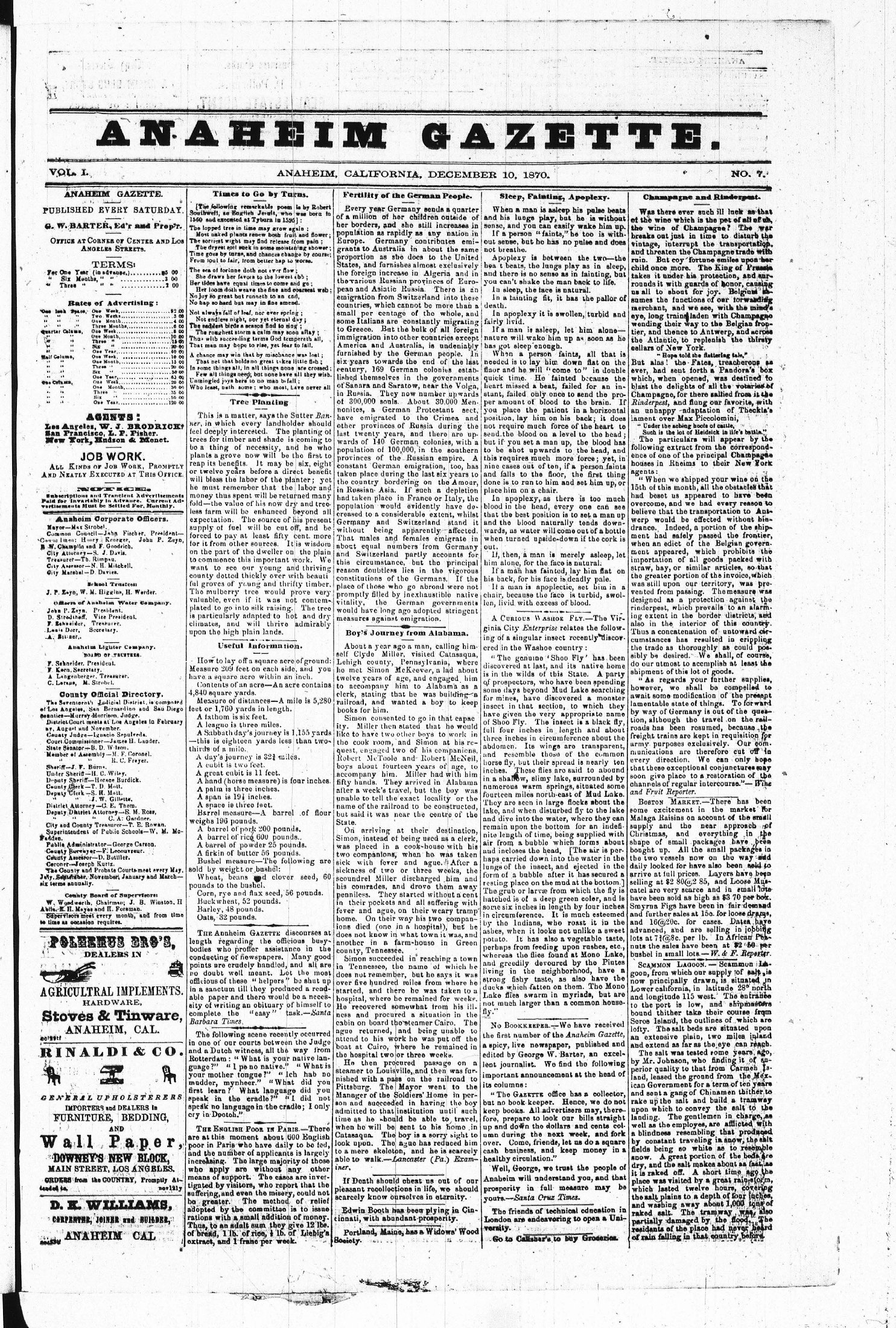
Searchable text
ANAHEIM GAZETTE.
PUBLISHED EVERY SATURDAY.
G. W. BARTER, Ed'r and Prop'r.
OFFICE AT CORNER OF CENTER AND LOS ANGELES STREETS.
TERMS:
For One Year (in advance.)... 25 00
Six Months, " " ... 3 00
Three " " ... 2 00
Rates of Advertising:
One Inch Space, One Week, $2.00
Two Weeks, 3.00
One Month, 4.00
Three Months, 6.00
Quarter Column, One Week, 8.00
One Month, 10.00
Three " " 15.00
Six " " 20.00
One Year, 40.00
Half Column, One Week, 10.00
One Month, 15.00
Three " " 20.00
Six " " 30.00
One Year, 63.00
One Week, 20.00
One Month, 30.00
Three " " 35.00
Six " " 50.00
One Year, 120.00
AGENTS:
Los Angeles, W. J. BRODRICK;
San Francisco, L. P. Fisher.
New York, Hudson & Monet.
JOB WORK.
ALL KINDS OF JOB WORK, PROMPTLY AND NEATLY EXECUTED AT THIS OFFICE.
NOTICE:
Subscribers and Transient Advertisements
Times to Go by Turns.
[The following remarkable poem is by Robert Southwell, an English Jesuit, who was born in 1560 and executed at Tyburn in 1596]:
The lopped tree in time may grow again;
Most naked plants renew both fruit and flower;
The sorrist wight may find release from pain;
The dryest soil suck in some moistening shower;
Time goes by turns, and chances change by course;
From soul to fair, from better hap to worse.
The sea of tortune doth not ever flow;
She draws her favors to the lowest abb;
Her tides have equal times to come and go;
Her loom doth weave the fine and coarse web;
No joy so great but runneth to an end,
No hap so hard but may in fine amend.
Not always fall of leaf, nor ever spring;
Not endless night, nor yet eternal day;
The saddest bird a season find to sing;
The roughest storm a calm may soon allay;
Thus with succeeding terms God tempereth all,
That man may hope to rise, yet fear to fall.
A chance may win that by mischance was lost;
That net that holds no great takes little fish;
In some things all, in all things none are crossed;
Few all things need, but none have all they wish.
Unmingled joys here to no man be fall;
Who least, bath some; who most, Have never all
Tree Planting
This is a matter says the Sutter Banner, in which every landholder should feel deeply interested. The planting of trees for timber and shade is coming to be a thing of necessity, and he who plants a grove now will be the first to reap its benefits. It may be six, eight or twelve years before a direct benefit will bless the labor of the planter; yet he must remember that the labor and money thus spent will be returned many
AGENTS:
Los Angeles, W. J. BRODRICK
San Francisco, L. P. Fisher
New York, Hudson & Menet.
JOB WORK.
ALL KINDS OF JOB WORK, PROMPTLY AND NEATLY EXECUTED AT THIS OFFICE.
NOTICE:
Subscriptions and Transient Advertisements Paid for Invariably in Advance. Current Advertisements Must be Settled For Monthly.
Anaheim Corporate Officers.
Mayor—Max Strobel.
Common Council—John Fischer, President—Connie Imman; Henry Kroneger, John P. Zeyn,
B. W. Champin and F. Goodrich.
City Attorney—S. J. Davis.
Treasurer—Th. Rimpsau.
City Assessor—N. H. Mitchell.
City Marshal—D. Davies.
School Trustees:
J. P. Zeyn, W. M. Higgins, H. Werder.
Officers of Anaheim Water Company.
John P. Zeyn, President.
D. Stradinoff, Vice President.
P. Schaider, Treasurer.
Louis Dorr, Secretary.
A. Bitner.
Anaheim Lighter Company.
BOARD OF TRUSTEES.
F. Schneider, President.
F. Korn, Secretary.
A Langenberger, Treasurer.
C. Larus, M. Strobel.
County Official Directory.
The Seventeenth Judicial District is composed of Los Angeles, San Bernardino and Sau Diego counties—Murray Morrison, Judge.
District Court meets at Los Angeles in February ay, August and November.
County Judge—Ignacio Sepulveda.
Court Commissioner—James H. Lander.
State Senator—B. D. Wilson.
Member of Assembly—M. F. Coronel.
R. C. Freyer.
Sheriff—J. F. Burns.
Under Sheriff—H. C. Wiley.
Deputy Sheriff—Horace Burdick.
County Clerk—T. D. Mott.
Deputy Clerk—S. H. Mott.
J. W. Gilletts.
District Attorney—C. E. Them.
Deputy District Attorney—E. M. Rosar.
C. A: Gardner.
City and County Treasurer—T. E. Bowan.
Superintendent of Public Schools—W. M. McPadden.
Public Administrator—George Carson.
County SurvEYer—F. Lecouvreur.
County Assessor—D. Butiller.
Coroner—Joseph Kurtz.
The County and Probate Courts meet every May, July, September, November, January and March—six terms annually.
County Board of Supervisors:
W. Woodworth, Chairman; J. B. Winston, H Abilh, K. H. Mayes and H Forsman.
Supervisors meet every month, and from time to time as occasion requires.
Tree Planting
This is a matter says the Sutter Banner, in which every landholder should feel deeply interested. The planting of trees for timber and shade is coming to be a thing of necessity, and he who plants a grove now will be the first to reap its benefits. It may be six, eight or twelve years before a direct benefit will bless the labor of the planter; yet he must remember that the labor and money thus spent will be returned many fold—the value of his now dry and treeless farm will be enhanced beyond all expectation. The source of his present supply of fuel will be cut off, and be forced to pay at least fifty cent more for it from other sources. It is wisdom on the part of the dweller on the plain to commence this important work. We want to see our young and thriving county dotted thickly over with beautiful groves of young and thrifty timber. The mulberry tree would prove very valuable, even if it was not contemplated to go into silk raising. The tree is particularly adapted to hot and dry climates, and will thrive admirably upon the high plain lands.
Useful Information.
How to lay off a square acre of ground: Measure 209 feet on each side, and you have a square acre within an inch.
Contents of an acre—An acre contains 4,840 square yards.
Measure of distances—a mile is 5,280 feet or 1,760 yards in length.
A fathom is six feet.
A league is three miles.
A Sabbath day's journey is 1,155 yards—this is eighteen yards less than two-thirds of a mile.
A day's journey is 324 miles.
A cubit is two feet.
A great cubit is 11 feet.
A hand (horse measure) is four inches.
A palm is three inches.
A span is 194 inches.
A space is three feet.
Barrel measure—a barrel of flour weighs 196 pounds.
A barrel of pork 200 pounds.
A barrel of rice 600 pounds..
A barrel of powder 25 pounds.
A firkin of butter 56 pounds.
Bushel measure—The following are sold by weight or bushel:
Wheat, beans and clover seed, 60 pounds to the bushel.
Corn, rye and flax seed, 56 pounds.
Buckwheat, 52 pounds.
Barley, 48 pounds。
Oats, 32 pounds。
POLLENUS BRO'S,
DEALERS IN
AGRICULTURAL IMPLEMENTS.
HARDWARE,
Stoves & Tinware,
ANAHEIM, CAL.
RINALDI & CO.
GENERAL UPHOLSTERERS
IMPORTERS and DEALERS in
FURNITURE, BEDDING,
AND
Wall Paper,
DOWNEY'S NEW BLOCK,
MAIN STREET, LOS ANGELES.
ORDERS from the COUNTRY, Promptly Attended in
D. K. WILLIAMS,
CARPENTER, JOINER and BUILDER,
ANAHEIM CAL.
A barrel of rice 600 pounds..
A barrel of powder 25 pounds.
A firkin of butter 56 pounds.
Bushel measure—The following are sold by weight or bushel:
Whoot, beans and clover seed, 60 pounds to the bushel.
Corn, rye and flax seed, 56 pounds.
Buckwheat, 52 pounds.
Barley, 48 pounds.
Oats, 32 pounds.
The Anaheim Gazette discourses at length regarding the officious busy-bodies who proffer assistance in the conducting of newspapers. Many good points are crudely handled, and all are no doubt well meant. Let the most officious of these "helpers" be shut up in a sanctum till they produced a readable paper and there would be a necessity of writing an obituary of himself to complete the "easy" task.—Santa Barbara Times.
The following scene recently occurred in one of our courts between the Judge and a Dutch witness, all the way from Rotterdam: "What is your native language?" "I pe no native." "What is your mother tongue?" "Ich hab no mudder, mynheer." "What did you first learn? What language did you speak in the cradle?" "I did not speak no language in the cradle; I only cry in Dootch."
The English Poor in Paris. There are at this moment about 600 English poor in Paris who have daily to be fed, and the number of applicants is largely increasing. The large majority of those who apply are without any other means of support. The cases are investigated by visitors, who report that the suffering, and even the misery, could not be greater. The method of relief adopted by the committee is to issue rations with a small addition of money. Thus, to an adult sum they give 12 lbs. of bread, 1 lb. of rice, 1 lb. of Liebig's extract, and 1 franc per week.
ANAHEIM, CALIFORNIA, DECEMBER 10, 1870.
by Turns.
able poem is by Robert
result, who was born in
return in 1596]:
may grow again;
new both fruit and flower;
and release from pain;
some moistening shower;
changes change by course;
utter hap to worse.
not ever flow;
the lowest abb;
to come and go;
the fine and coarse web;
bub to an end,
in fine amend.
ever spring;
et eternal day;
flud to sing;
him may soon allay;
neas God tempereth all,
yet fear to fail.
mischance was lost;
reat takes little fish;
things none are crossed;
none have all they wish.
man be fall;
who most, Have never all
anting
ays the Sutter Banlandholder should
l. The planting of
shade is coming to
essity, and he who
will be the first to
may be six, eight
are a direct benefit
of the planter; yet
that the labor and
will be returned many
Fertility of the German People.
Every year Germany sends a quarter
of a million of her children outside of
her borders, and she still increases in
population as rapidly as any nation in
Europe. Germany contributes emigrants to Australia in about the same
proportion as she does to the United States, and furnishes almost exclusively
the foreign increase in Algeria and in
the various Russian provinces of European and Asiatic Russia. There is an emigration from Switzerland into these countries, which cannot be more than a small per centage of the whole, and some Italians are constantly migrating to Greece. But the bulk of all foreign immigration into other countries except America and Australia, is undeniably furnished by the German people. In six years towards the end of the last century, 169 German colonies established themselves in the governments of Sanara and Saratow, near the Volga, in Russia. They now number upwards of 300,000 souls. About 30,000 Menonites, a German Protestant sect, have emigrated to the Crimea and other provinces of Russia during the last twenty years, and there are upwards of 140 German colonies, with a population of 100,000, in the southern provinces of the Russian empire. A constant German emigration, too, has taken place during the last six years to the country bordering on the Amour, in Russian Asia. If such a depletion
Sleep, Fainting, Apoplexy.
When a man is asleep his pulse beats and his lungs play, but he is without sense, and you can easily wake him up.
If a person "faints," he too is without sense, but he has no pulse and does not breathe.
Apoplexy is between the two—the heart beats, the lungs play as in sleep, and there is no sense as in fainting, but you can't shake the man back to life.
In sleep, the face is natural.
In a fainting fit, it has the pallor of death.
In apoplexy it is swollen, turbid and fairly livid.
If a man is asleep, let him alone—nature will wake him up as soon as he has got sleep enough.
When a person faints, all that is needed is to lay him down flat on the floor and he will "come to" in double quick time. He fainted because the heart missed a beat, failed for an instant, failed only once to send the proper amount of blood to the brain. If you place the patient in a horizontal position, lay him on his back; it does not require much force of the heart to send the blood on a level to the head; but if you set a man up, the blood has to be shot upwards to the head, and this requires much more force; yet, in nine cases out of ten, if a person faints and falls to the floor, the first thing done is to run to him and set him up, or place him on a chair.
Boy's Journey from Alabama.
About a year ago a man, calling himself Clyde Miller, visited Catasuqua, Lehigh county, Pennsylvania, where he met Simon McKeever, a lad about twelve years of age, and engaged him to accompany him to Alabama as a clerk, stating that he was building a railroad, and wanted a boy to keep books for him.
Simon consented to go in that capacity. Miller then stated that he would like to have two other boys to work in the cook room, and Simon at his request, engaged two of his companions, Robert McToole and Robert McNeil, boys about fourteen years of age, to accompany him. Miller had with him fifty hands. They arrived in Alabama after a week's travel, but the boy was unable to tell the exact locality or the name of the railroad to be constructed, but said it was near the centre of the State.
On arriving at their destination, Simon, instead of being used as a clerk, was placed in a cook-house with his two companions, when he was taken sick with fever and ague. After a sickness of two or three weeks, the scoundrel Miller discharged him and his comrades, and drove them away penniless. They started without a cent in their pockets and all suffering with fever and ague, on their weary tramp home. On their way his two companions died (one in a hospital), but he does not know in what town it was, and stant, failed only once to send the proper amount of blood to the brain. If you place the patient in a horizontal position, lay him on his back; it does not require much force of the heart to send the blood on a level to the head; but if you set a man up, the blood has to be shot upwards to the head, and this requires much more force; yet, in nine cases out of ten, if a person faints and falls to the floor, the first thing done is to run to him and set him up, or place him on a chair.
In apoplexy, as there is too much blood in the head, every one can see that the best position is to set a man up and the blood naturally tends downwards, as water will come out of a bottle when turned upside-down if the cork is out.
If, then, a man is merely asleep, let him alone, for the face is natural:
If a man has fainted, lay him flat on his back, for his face is deadly pale.
If a man is apoplectic, set him in a chair, because the face is turbid, swollen, livid with excess of blood.
A Curious Washoe Fly.—The Virginia City Enterprise relates the following of a singular insect recently discovered in the Washoe country:
"The genuine 'Shoo Fly' has been discovered at last, and its native home is in the wilds of this State. A party of prospectors, who have been spending some days beyond Mud Lake searching for mines, have discovered a monster insect in that section, to which they have given the very appropriate name of Shoo Fly. The insect is a black fly, full four inches in length and about three inches in circumference about the abdomen. Its wings are transparent, and resemble those of the common horse fly, but their spread is nearly ten inches. These flies are said to abound in a shallow, slimy lake, surrounded by numerous warm springs, situated some fourteen miles north-east of Mud Lake. They are seen in large flocks about the lake, and when disturbed fly to the lake and dive into the water, where they can remain upon the bottom for an indefinite length of time, being supplied with air from a bubble which forms about and incloses the head. [The air is perhaps carried down into the water in the lungs of the insect, and ejected in the form of a bubble after it has secured a resting place on the mud at the bottom.] The grub or larvae from which the fly is batched is of a deep green color, and is some six inches in length by four inches in circumference. It is much esteemed by the Indians, who roast it in the ashes, when it looks not unlike a sweet taste."
Simon, instead of being used as a clerk, was placed in a cook-house with his two companions, when he was taken sick with fever and ague. After a sickness of two or three weeks, the scoundrel Miller discharged him and his comrades, and drove them away penniless. They started without a cent in their pockets and all suffering with fever and ague, on their weary tramp home. On their way his two companions died (one in a hospital), but he does not know in what town it was, and another in a farm-house in Green county, Tennessee.
Simon succeeded in reaching a town in Tennessee, the name of which he does not remember, but he says it was over five hundred miles from where he started, and there he was taken to a hospital, where he remained for weeks. He recovered somewhat from his illness and procured a situation in the cabin on board the steamer Cairo. The ague returned, and being unable to attend to his work he was put off the boat at Cairo, where he remained in the hospital two or three weeks.
He then procured passage on a steamer to Louisville, and then was furnished with a pass on the railroad to Pittsburg. The Mayor went to the Manager of the Soldiers' Home in person and succeeded in having the boy admitted to that institution until such time as he should be able to travel, when he will be sent to his home in Catasaqua. The boy is a sorry sight to look upon. The ague has reduced him to a more skeleton, and he is scarcely able to walk.—Lancaster (Pa.) Examiner.
If Death should cheat us out of our pleasant recollections in life, we should scarcely know ourselves in eternity.
Edwin Booth has been plying in Cincinnati, with abundant prosperity.
Portland, Maine, has a Widows' Wood Society.
The air is perhaps carried down into the water in the lungs of the insect, and ejected in the form of a bubble after it has secured a resting place on the mud at the bottom. The grub or larvae from which the fly is hatched is of a deep green color, and is some six inches in length by four inches in circumference. It is much esteemed by the Indians, who roast it in the ashes, when it looks not unlike a sweet potato. It has also a vegetable taste, perhaps from feeding upon rushes, etc., whereas the flies found at Mono Lake, and greedily devoured by the Piutes living in the neighborhood, have a strong fishy taste, as also have the ducks which fatten on them. The Mono Lake flies swarm in myriads, but are not much larger than a common housefly."
No Bookkeeper.—We have received the first number of the Anaheim Gazette, a spicy, live newspaper, published and edited by George W. Barter, an excellent journalist. We find the following important announcement at the head of its columns:
"The Gazette office has a collector, but no book keeper. Hence, we do not keep books. All advertisers may therefore prepare to look our bills straight up and down the dollars and cents column during the next week, and fork over. Come, friends, let us do a square cash business, and keep money in a healthy circulation."
Well, George, we trust the people of Anaheim will understand you, and that prosperity in full measure may be yours.—Santa Cruz Times.
The friends of technical education in London are endeavoring to open a University.
Go to Callisher's to buy Grocerian.
Champagne and Rinderpest.
Was there ever such ill luck as that of the wine which is the pet of all of us, the wine of Champagne? The war breaks out just in time to disturb the vintage, interrupt the transportation, and threaten the Champagne trade with ruin. But coy fortune smiles upon her child once more. The King of Prussia takes it under his protection, and surrounds it with guards of honor, causing us all to about for joy. Belgium assumes the functions of our forwarding merchant, and we see, with the mind's eye, long trained laden with Champagne wending their way to the Belgian frontier, and thence to Antwerp, and across the Atlantic, to replenish the thristy cellars of New York.
"Hope told the flattering tale."
But alas! the Fates, treacherous as ever, had sent forth a Pandora's box which, when opened, was destined to blast the delights of all the votaries of Champagne, for there sallied from it the Rinderpest, and flung our favorite, with an unhappy adaptation of Theckla's lament over Max Piccolomini,
"Under the aching hooks of castle,
Such is the lot of Heidsick in life's battle."
The particulars will appear by the following extract from the correspondence of one of the principal Champagne houses in Rheims to their New York agents:
"When we shipped your wine on the 15th of this month, all the obstacles that had beset us appeared to have been
Champagne, for there salied from it the Rinderpest, and flung our favorite, with an unhappy adaptation of Theckla's lament over Max Piccolomini,
"Under the aching hooks of cattle,
Such is the lot of Heidsick in life's battle."
The particulars will appear by the following extract from the correspondence of one of the principal Champagne houses in Rheims to their New York agents:
"When we shipped your wine on the 15th of this month, all the obstacles that had beset us appeared to have been overcome, and we had every reason to believe that the transportation to Answer would be effected without hindrance. Indeed, a portion of the shipment had safely passed the frontier, when an edict of the Belgian government appeared, which prohibits the importation of all goods packed with straw, hay, or similar articles, so that the greater portion of the invoice, which was still upon our territory, was prevented from passing. The measure was designed as a protection against the rinderpest, which prevails to an alarming extent in the border districts, and also in the interior of this country. Thus a concatenation of untoward circumstances has resulted in crippling the trade as thoroughly as could possibly be desired. We shall, of course, do our utmost to accomplish at least the shipment of this lot of goods.
As regards your further supplies, however, we shall be compelled to await some modification of the present lamentable state of things. To forward by way of Germany is out of the question, although the travel on the railroads has been resumed, because the freight trains are kept in requisition for army purposes exclusively. Our communications are therefore cut off in every direction. We can only hope that these exceptional conjunctures may soon give place to a restoration of the channels of regular intercourse." — Wine and Fruit Reporter.
Boston Market.—There has been some excitement in the market for Malaga Raisins on account of the small supply and the near approach of Christmas, and everything in the shape of small packages have been bought up. All the small packages in the two vessels now on the way said daily looked for have also been sold to arrive at full prices. Layers have been selling at $2 80@2 85, and Loose Muscatel are very scarce and in small lots have been sold as high as $3 70 per box. Smyrna Figs have been in fair demand and further sales at 150. for loose drums, and 16@20c. for cases. Data have advanced, and are selling in jobbing lots at 73@8c per lb. In African Pharaohs
being supplied with which forms about the air is perfoe the water in the land ejected in the air it has secured a ground at the bottom.] From which the fly is green color, and is length by four inches this much esteemed roast it in the spot unlike a sweet vegetable taste, upon rushes, etc., and at Mono Lake, led by the Piutesborhood, have also have them. The Mono myriads, but are a common house-
We have received Anaheim Gazette, later, published and Bartar, an excel- mind the following event at the head of
we has a collector, Hence, we do not tisers may, there- our bills straight days and cents col- t week, and fork let us do a square keep money in a
must the people of and you, and that measure may be times.
nical education in going to open a Uni-
buy Groceries.
Christmas, and everything in the shape of small packages have been bought up. All the small packages in the two vessels now on the way and daily looked for have also been sold to arrive at full prices. Layers have been selling at $2 80@2 85, and Loose Muscatel are very scarce and in small lots have been sold as high as $3 70 per box. Smyrna Figs have been in fair demand and further sales at 150c. for loose drums, and 16@20c. for cases. Dates have advanced, and are selling in jobbing lots at 71@8c. per lb. In African Peanuts the sales have been at $2 50 per bushel in small lots. — W. & F. Reporter.
Scammon Lagoon. — Scammon Lagoon, from which our supply of salt is now principally drawn, is situated in Lower california, in latitude 28° north and longitude 115 west. The entrance to the port is low, and shipmasters bound thither take their course from Seros Island, the outlines of which are lofty. The salt beds are situated upon an extensive plain, two miles inland and extend as far as the eye can reach.
The salt was tested some years ago, by Mr. Johnson, who finding it of superior quality to that from Carmeh Island, leased the ground from the Mexican Government for a term of ten years and sent a gang of Chinamen thither to rake up the salt and build a tramway upon which to convey the salt to the landing. The gentlemen in charge, as well as the employees, are afflicted with a blindness resembling that produced by constant traveling in snow, the salt fields being so white as to resemble snow. A great portion of the beds are dry, and the salt makes about as fast as it is raked off. A short time ago the place was visited by a great rain storm, which lasted twelve hours, covering the salt plains to a depth of four inches, and washing away about 1,000 tons of raked salt. The tramway was also partially damaged by the flood. The residents of the place had never heard of rain falling in that country before.