anaheim-gazette 1870-11-05
Scanned page
Searchable text
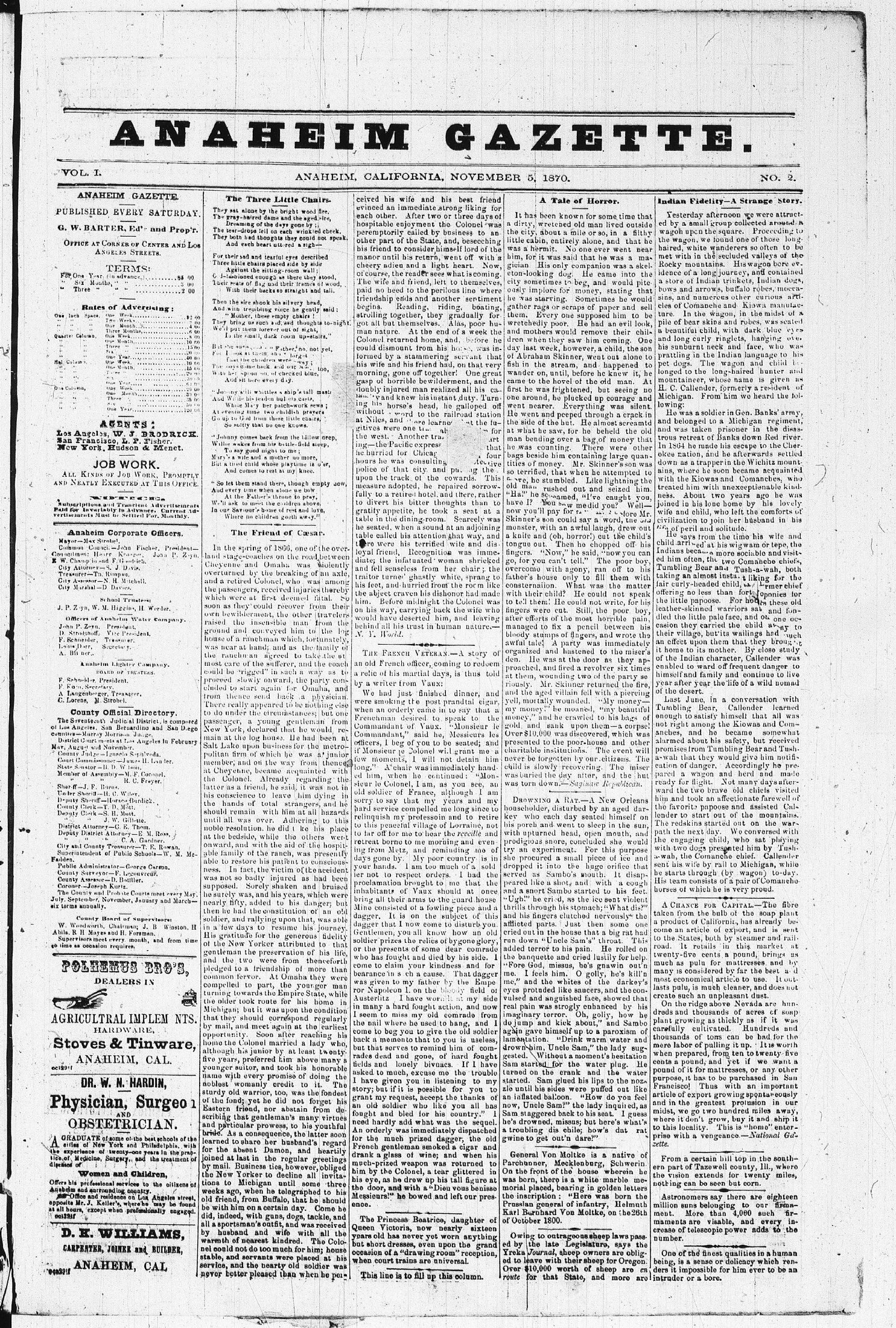
ANAHEIM GAZETTE.
PUBLISHED EVERY SATURDAY.
G. W. BARTER, Ed.' and Prop'r.
OFFICE AT CORNER OF CENTER AND LOS ANGELES STREETS.
TERMS:
For One Year (in advance) $5 00
Six Months $3 00
Three $2 00
Rates of Advertising:
One Inch Space, One Week $2 00
Two Weeks $2 00
One Month $4 00
Three Months $6 00
Quarter Column, One Week $8 00
One Month $10 00
Three $15 00
Six $20 00
One Year $40 00
Half Column, One Week $10 00
One Month $15 00
Three $20 00
Six $30 00
One Year $60 00
One Column, One Week $20 00
One Month $30 00
Three $35 00
Six $50 00
One Year $120 00
AGENTS:
Los Angeles, W. J. BRODRICK.
San Francisco, L. P. Fisher.
New York, Hudson & Menet.
JOB WORK.
ALL KINDS OF JOB WORK, PROMPTLY AND NEATLY EXECUTED AT THIS OFFICE.
The Three Little Chairs.
They sat alone by the bright wood fire,
The gray-haired dame and the aged sire,
Dreaming of the days gone by;
The tear-drops fell on each wrinkled cheek,
They both had thoughts they could not spit,
And each heart uttered a sigh—
For their sad and tearful eyes described
Three little chairs placed side by side
Against the sitting-room wall;
Old-fashioned enough as there they stood,
Their seats of flag and their frames of wood,
With their backs so straight and tall,
Then the sire shook his silvery head,
And with trembling voice he gently said,
"Mother, these empty chairs!
They bring us such sad, and thoughts to-tWe'll put them forever out of sight,
In the small, dark room up-stairs."
But she said, "Father, no, not yet,
For I look at them and forget,
That the children were away;
The boys come back and our face too,
Witness her spoon on of checked blue,
And sit here every day.
"Johnny still whittles a ship's tall mast!
And White his leaden bullets casts,
White Mary her patch-work sews;
At evening time two childish prayers
Go up to God from these little chairs,
So softly that no one knows.
"Johnny comes back from the billow deep,
Willie wakes from his battle-field sleep,
To say good night to me;
Mary's a wife and a mother no more,
But a tired child whose playtime is o'er,
And comes to rest at my knee.
"So let them stand there, though empty,
And every time when alone we bow."
AGENTS:
Los Angeles, W. J. BRODRICK.
San Francisco, L. P. Fisher.
New York, Hudson & Menet.
JOB WORK.
All kinds of Job Work, Promptly and Neatly Executed at This Office.
SUBSCRIPTIONS and Tranient Advertisements Paid for Invariably in Advance. Current Advertisements Must be Settled For Monthly.
Anaheim Corporate Officers.
Mayor—Max Strobel.
Common Council—John Fischer, President—Government: Henry Krager, John P. Zeyn.
E. W. Champin and F. Goodrich.
City Attorney—S. J. Davis.
Treasurer—Th. Rumpan.
City Assessor—N. H. Mitchell.
City Marshal—D. Davies.
School Trustees:
J. P. Zeyn, W. M. Higgins, H. Werder.
Officers of Anaheim Water Company.
John P. Zeyn, President.
D. Strothoff, Vice President.
F. Schneider, Treasurer.
Louis Dorr, Secretary.
A. Butner.
Anaheim Lighter Company.
BOARD OF TRUSTEES.
F. Schneider, President.
F. Form, Secretary.
A Langenberger, Treasurer.
C. Lorens, M. Strobel.
County Official Directory.
The Seventeenth Judicial District is composed of Los Angeles, San Bernardino and San Diego counties—Murray Morrison Judge.
District Courts at Los Angeles in February May, August and November.
County Judge—Ignacio Sepulveda.
Court Commissioner—James H. Lander.
State Senator—B. D. Wilson.
Member of Assembly—M. F. Coronel.
R. C. Freyer.
Sherriff—J. F. Burns.
Under Sheriff—H. C. Wilay.
Deputy Sheriff—Horace Burdick.
County Clerk—T. D. Matt.
Deputy Clerk—S. H. Mott.
J. W. Gillotte.
District Attorney—C. E. Thom.
Deputy District Attorney—E. M. Ross,
C. A. Gardiner.
City and County Treasurer—T. E. Rowan.
Superintendent of Public Schools—W. M. McFadden.
Public Administrator—George Carson.
County Surveyor—F. Legovreutr.
County Assessor—D. Botiller.
Coroner—Joseph Kurtz.
The County and Probate Courts meet every May July, September, November, January and March—six terms annually.
County Board of Supervisors:
W. Woodworth, Chairman; J. B Winston, H Abila; R H Mayes and H Forsman.
The Friend of Caesar.
In the spring of 1866, one of the old land stage-coaches on the road between Cheyenne and Omaha was violently overturned by the breaking of an arm and a retired Colonel, who was among the passengers, received injuries there which were at first deemed fatal soon as they could recover from their bewilderment, the other traveler raised the insensitive man from the ground and conveyed him to the house of a ranchman which fortunately was near at hand; and as the family the ranchman agreed to take the most care of the sufferer, and the co- could be "rigged" in such a way as proceed slowly onward, the party included to start again for Omaha, from thence send back a physician There really appeared to be nothing to do under the circumstances; but the passenger, a young gentleman from New York, declared that he would main at the log house. He had been Salt Lake upon business for the politician firm of which he was a junior member; and on the way from the at Cheyenne, became acquainted with the Colonel. Already regarding latter as a friend, he said, it was no his conscience to leave him dying the hands of total strangers, and should remain with him at all hazards until all was over. Adhering to noble resolution he did not ke his position at the bedside, while the others went onward, and with the aid of the hospitable family of the ranch, was present able to restore his patient to consciousness. In fact, the victim of the accident was not so badly injured as had been supposed. Sorely shaken and bruised he surely was, and his years, which were nearly fifty, added to his danger; then he had the constitution of an soldier, and rallying upon that, was a in a few days to resume his journey His gratitude for the generous fide
POLHEMUS BRO’S,
DEALERS IN
AGRICULTRAL IMPLEMENTS.
HARDWARE,
Stoves & Tinware,
ANAHEIM, CAL.
oct 291f
DR. W. N. HARDIN,
Physician, Surgeon
AND OBSTETRICIAN.
GRADUATE of some of the best schools of the cities of New York and Philadelphia, with the experience of twenty-one years in the practice of Medicine, Surgery, and the treatment of diseases of
Women and Children,
Offers his professional services to the citizens of Anaheim and surrounding country.
Office and residence on Los Angeles street, opposite Mr. J. Keller’s, where he may be found at all hours, except when professionally engaged.
D. K. WILLIAMS,
CARPENTER, JOINER and BUILDER,
ANAHEIM, CAL
HEIM GAZETE
ANAHEIM, CALIFORNIA, NOVEMBER 5, 1870.
Three Little Chairsby the bright wood fire,
dame and the aged fire,
the days gone by;
all on each wrinkled cheek,
oughts they could not speak.
heart uttered a sigh—
tearful eyes described
is placed side by side
sitting-room wall;
though as there they stood,
gund their frames of wood,
backs so straight and tall.
Look his silvery head,
long voice he gently said:
seme empty chairs!
such sad, and thoughts to-night,
forever out of sight,
dark room up-stairs."
Father, no, not yet,
and forget
children were away;
back and our sun too,
of checked blue,
every day.
Bottles a ship's tall mast;
old bullets casts;
other patch-work sews;
two childish prayers
in these little chairs,
no one knows.
Back from the billow deep,
on his battle-field sleep,
night to me;
a mother no more,
whose playtime is o'er,
rest at my knee.
And there, though empty now,
when alone we bow.
ceived his wife and his best friend
evinced an immediate strong liking for
each other. After two or three days of
hospitable enjoyment the Colonel was
peremptorily called by business to an
other part of the State, and, beseeching
his friend to consider himself lord of the
manor until his return, went off with a
cheery adieu and a light heart. Now,
of course, the reader sees what is coming.
The wife and friend, left to themselves,
paid no heed to the perilous line where
friendship ends and another sentiment
begins. Reading, riding, boating,
strolling together, they gradually for
got all but themselves. Alas, poor human nature.
At the end of a week the Colonel returned home, and, before he could dismount from his horse, was informed by a stammering servant that
his wife and his friend had, on that very morning, gone off together! One great gasp of horrible bewilderment, and the doubly injured man realized all his cativity and knew his instant duty. Turning his horse's head, he galloped off without word to the railroad station at Niles, and there learne
but the fugitives were one true abfor the west. Another training—the Pacific express that
he hurried for Chicago four
hours he was consulting
police of that city and put the
upon the track of the cowards. This measure adopted, he repaired sorrowfully to a retired hotel and there rather
A Tale of Horror.
It has been known for some time
a dirty, wretched old man lived out
the city, about a mile or so, in a
little cabin, entirely alone, and thawas a hermit. No one ever went
him, for it was said that he was an
gician. His only companion was an
eton-looking dog. He came into
city sometimes to beg, and would
only implore for money, stating
he was starving. Sometimes he w
gather rags or scraps of paper and
them. Every one supposed him t
wretchedly poor. He had an evil
and mothers would remove their
dren when they saw him coming.
day last week, however, a child, tha
of Abraham Skinner, went out alofish in the stream, and happened
wander on, until, before he knew
came to the hovel of the old man,
first he was frightened, but seeing
one around, he plucked up courage
went nearer. Everything was s
He went and peeped through a crapside of the but. He almost screeat what he saw, for he beheld thaman bending over a bag of money,
he was counting. There were
bags beside him containing large o'
titles of money. Mr. Skinner's son
so terrified, that when he attemptve, he stumbled. Like lightning
old man rushed out and seized
"Hail!" he soared.
of 1860, one of the overcities on the road between Omaha was violently the breaking of an axle,ilon, who was among received injuries thereby first deemed fatal. No old recover from their sent, the other travelers sensible man from the surveyed him to the log man which fortunately did and as the family of agreed to take the utter sufferer, and the coach" in such a way as to onward, the party congain for Omaha, and had back a physician seared to be nothing else circumstances; but one young gentleman from cared that he would re-house. He had been at business for the metro-which he was a junior the way from thence came acquainted with Already regarding the lil, he said, it was not in to leave him dying in total strangers, and he with him at all hazards ever. Adhering to this he did t ke his place while the others went with the aid of the hospithe ranch, was presently his patient to conscious-the victim of the accident injured as had been shaken and bruised his years, which were used to his danger; but constitution of an old living upon that, was able to resume his journey. For the generous fidelity back from the hallow deep, on his battle-field sleep, night to me; a mother no more, whose playtime is our rest at my knee.
Blend of Caesar.
The French Veteran.—A story of an old French officer, coming to redeem a relic of his martial days, is thus told by a writer from Vaux:
We had just finished dinner, and were smoking the post prandtal cigar, when an orderly came in to say that a Frenchman desired to speak to the Commandant of Vaux. "Monsieur le Commandant," said he, Messieurs les officers, I beg of you to be seated; and if Monsieur le Colonel will grant me a few moments, I will not detain him long." A chair was immediately handed him, when he continued: "Monsieur le Colonel, I am, as you see, an old soldier of France, although I am sorry to say that my years and my hard service compelled me long since to relinquish my professoin and to retire to this peaceful village of Lorraine, not to far off for me to hear the reveille and retreat borne to me morning and evening from Metz, and reminding me of days gone by. My poor country is in your hands. I am too much of a soldier not to respect orders. I had the proclamation brought to me that the inhabitants of Vaux should at once bring all their arms to the guard house Mine consisted of a fowling piece and a dagger. It is on the subject of this dagger that I now come to disturb you. Gentlemen, you all know how an old injury injured man realized all his car ing his horse's head, he galloped off without word to the railroad station at Niles, and there learne at the fugitives were one time ab for the west. Another trai ing—the Pacific express that he hurried for Chicago four hours he was consulting police of that city and puiging the upon the track of the cowards. This measure adopted, he repaired sorrowfully to a retired hotel, and there, rather to divert his bitter thoughts than to gratify appetite, he took a seat at a table in the dining-room. Scarcely was he seated, when a sound at an adjoining table called his attention that way, and there were his terrified wife and disloyal friend. Recognition was immediate; the infatuated woman shrieked and fell senseless from her chair; the traitor turner ghastly white, sprang to his feet, and hurried from the room like the abject craven his dishonor had made him. Before midnight the Colonel was on his way, carrying back the wife who would have deserted him, and leaving behind all his trust in human nature. N.Y.World.
DROWNING A RAT.—A New Orl householder, disturbed by an aged key who each day seated himself his porch and went to sleep in the with upturned head, open mouth, prodigious snore, concluded she wry try an experiment. For this purp she procured a small piece of ice dropped it into the huge orifice served as Sambo's mouth. It di peared like a shot, and with a co and a snort Sambo started to his f Ugh!" he cried, as the ice sent vio thrills through his stomach; "What o and his fingers clutched nervously afflicted parts. Just then some cried out in the house that a big rat
while the others went with the aid of the hospitance ranch, was presently his patient to consciousnevice the victim of the accident he injured as had been
hily shaken and bruised and his years, which were
used to his danger; but constitution of an old
bring upon that, was able to resume his journey.
for the generous fidelity taken attributed to that preservation of his life,
were from thenceforth friendship of more than
At Omaha they were smart, the younger man in the Empire State, while route for his home in New York was upon the condition it correspond regularly yet again at the earliest soon after reaching his el married a lady who, prior by at least twenty-four him above many a hundred took his honorable promise of doing the duty credit to it. The officer, too, was the fondest she did not forget his minor abstain from gentleman's many virtues rowess, to his youthful sequence, the latter soon other husband's regard Damon, and heartily the regular greetings ties, however, obliged to decline all invitation until some three he telegraphed to his Buffalo, that he should certain day. Come he guns, dogs, tackle, and outfit, and was received old wife with all the best kindred. The Colo-oo much for him; house units were placed at his hearty old soldier was based than when he per-
The Princess Beatrice, daughter of Queen Victoria, now nearly sixteen years old has never yet worn anything but short dresses, even upon the grand occasion of a "drawing room" reception, when court trains are universal.
This line is to fill up this column.
LE TTE.
Title of Horror.
known for some time that need old man lived outside a mile or so, in a filthy firely alone, and that he No one ever went near said that he was a mafly companion was a skel- dog. He came into the to beg, and would pite-for money, stating that Sometimes he would scraps of paper and sell one supposed him to be or. He had an evil look, would remove their chil- saw him coming. One however, a child, the son Skinner, went out alone to team, and happened to ill, before he knew it, he level of the old man. At tightened, but seeing no plucked up courage and Everything was silent. Keeped through a crack in but. He almost screamtd for he beheld the old over a bag of money that ing. There were other containing large quan-. Mr. Skinner's son was at when he attempted to abled. Like lightning the out and seized him.
Indian Fidelity—A Strange Story.
Yesterday afternoon we were attracted by a small group collected around a wagoh upon the square. Proceeding to the wagon, we found one of those long-haired, white wanderers so often to be met with in the secluded valleys of the Rocky mountains. His wagon bore evidence of a long journey, and contained a store of Indian trinkets, Indian dogs, bows and arrows, buffalo robes, moccasins, and numerous other curious articles of Comanche and Kiowa manufacture. In the wagon, in the midst of a pile of bear skins and robes, was seated a beautiful child, with dark blue eyes and long curly ringlets, hanging over his sunburnt neck and face, who was prattling in the Indian language to his pet dogs. The wagon and child belonged to the long-haired hunter and mountaineer, whose name is given as H. C. Callender, formerly a resident of Michigan. From him we heard the following:
He was a soldier in Gen. Banks' army, and belonged to a Michigan regiment, and was taken prisoner in the disastrous retreat of Banks down Red river. In 1864 he made his escape to the Cherokee nation, and he afterwards settled down as a trapper in the Wichita mountains, where he soon became acquainted with the Kiowas and Comanches, who treated him with unexceptionable kindness. About two years ago he was
Michigan. From him we heard the following:
He was a soldier in Gen. Banks' army, and belonged to a Michigan regiment, and was taken prisoner in the disastrous retreat of Banks down Red river. In 1864 he made his escape to the Cherokee nation, and he afterwards settled down as a trapper in the Wichitz mountains, where he soon became acquainted with the Kiowas and Comanches, who treated him with unexceptionable kindness. About two years ago he was joined in his lone home by his lovely wife and child, who left the comforts of civilization to join her husband in his life of peril and solitude.
He says from the time his wife and child arrived at his wigwam or tepe, the Indians became more sociable and visited him often, the two Comanche chiefs, Tumbling Bear and Tush-a-wah, both taking an almost instant liking for the fair curly-headed child, the former chief offering no less than forty jopones for the little papoose. For hours these old leather-skinned warriors sat and fondled the little pale face, and on one occasion they carried the child away to their village, but its wailings had such an effect upon them that they brought it home to its mother. By close study of the Indian character, Callender was enabled to ward off frequent danger to himself and family and continue to live year after year the life of a wild nomad of the desert.
Last June, in a conversation with Tumbling Bear, Callender learned enough to satisfy himself that all was not right among the Kiowas and Comanches, and he became somewhat alarmed about his safety, but received promises from Tumbling Bear and Tush-a-wah that they would give him notification of danger. Accordingly he prepared a wagon and herd and made ready for flight. Not many days afterward the two brave old chiefs visited him and took an affectionate farewell of the favorite papoose and assisted Callender to start out of the mountains. The redskins started out on the warpath the next day. We conversed with the engaging child, who sat playing with two dogs presented him by Tush-a-wah, the Comanche chief. Callender sent his wife by rail to Michigan, while he starts through (by wagon) to-day. His team consists of a pair of Comanche horses of which he is very proud.
A CHANCE FOR CAPITAL—The fibre taken from the bulb of the soap plant a product of California, has already become an article of export, and is sent to the States both by steamers and rail.
A CHANCE FOR CAPITAL.—The fibre taken from the bulb of the soap plant a product of California, has already become an article of export, and is sent to the States, both by steamer and railroad. It retails in this market at twenty-five cents a pound, brings as much as pulu for mattresses, and by many is considered by far the best and most economical article to use. It lasts pulu, is much cleaner, and does not create such an unpleasant dust.
On the ridge above Nevada are hundreds and thousands of acres of soap plant growing as thickly as if it was carefully cultivated. Hundreds and thousands of tons can be had for the mere labor of pulling it up. It is worth when prepared, from ten to twenty-five cents a pound; and yet if we want a pound of it for mattresses, or any other purpose, it has to be purchased in San Francisco! Thus with an important article of export growing spontaneously and in the greatest profusion in our midst, we go two hundred miles away, where it don't grow, buy it and ship it to this locality. This is "home" enterprise with a vengeance.—National Gazette.
From a certain bill top in the southern part of Tazewell county, Ill., where the vision extends for twenty miles, nothing can be seen but corn.
Astronomers say there are eighteen million suns belonging to our firmament. More than 4,000 such firmaments are visable, and every increase of telescopic power adds to the number.
One of the finest qualities in a human being, is a sense or delicacy which renders it impossible for him ever to be an intruder or a bore.