anaheim-bulletin 1959-04-27
Scanned page
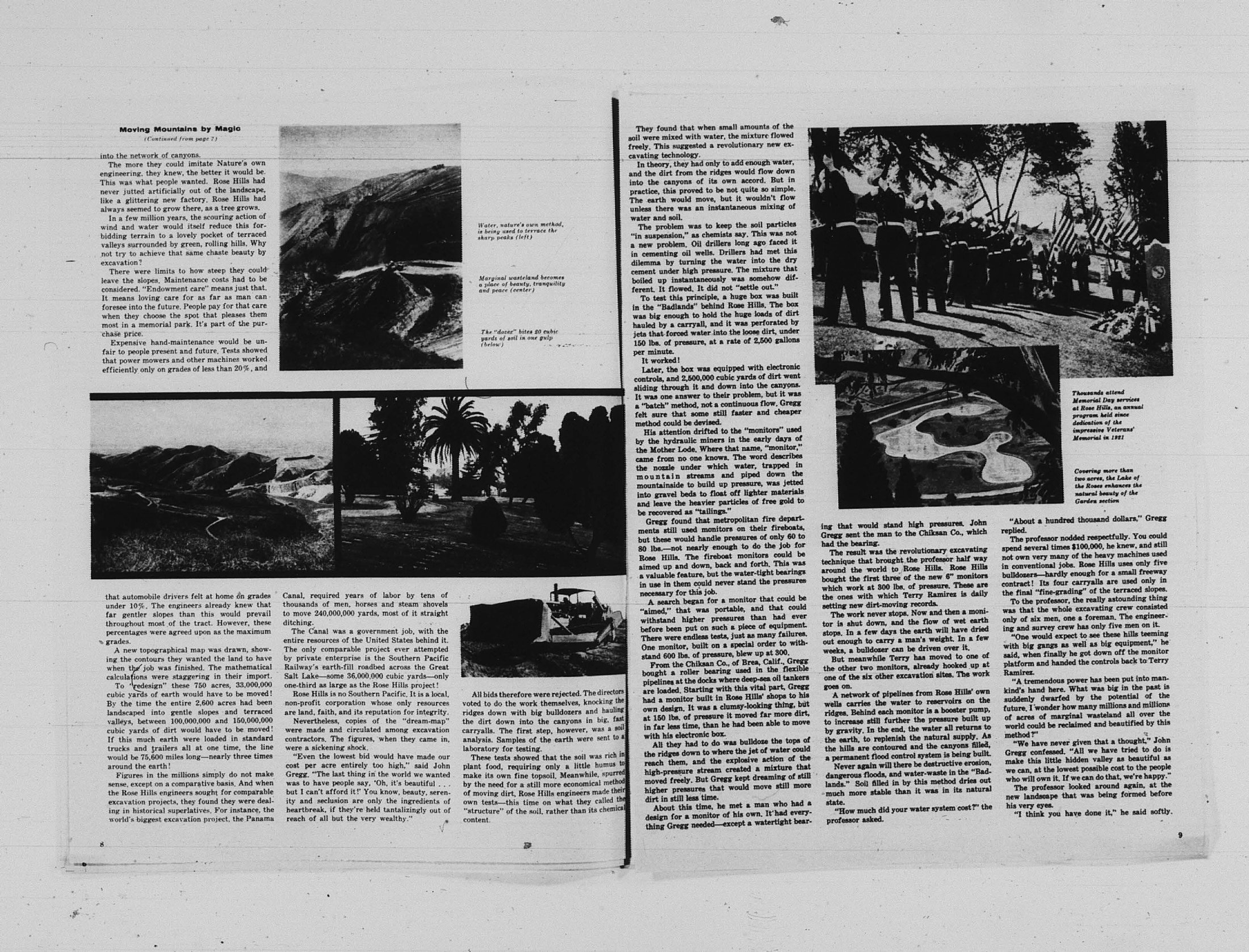
Searchable text
Moving Mountains by Magic
(Continued from page 7)
into the network of canyons.
The more they could imitate Nature's own engineering, they knew, the better it would be. This was what people wanted. Rose Hills had never jutted artificially out of the landscape, like a glittering new factory. Rose Hills had always seemed to grow there, as a tree grows.
In a few million years, the scouring action of wind and water would itself reduce this forbidding terrain to a lovely pocket of terraced valleys surrounded by green, rolling hills. Why not try to achieve that same chaste beauty by excavation?
There were limits to how steep they could leave the slopes. Maintenance costs had to be considered. "Endowment care" means just that. It means loving care for as far as man can foresee into the future. People pay for that care when they choose the spot that pleases them most in a memorial park. It's part of the purchase price.
Expensive hand-maintenance would be unfair to people present and future. Tests showed
leave the slopes. Maintenance costs had to be considered. "Endowment care" means just that. It means loving care for as far as man can foresee into the future. People pay for that care when they choose the spot that pleases them most in a memorial park. It's part of the purchase price.
Expensive hand-maintenance would be unfair to people present and future. Tests showed that power mowers and other machines worked efficiently only on grades of less than 20%, and that automobile drivers felt at home on grades under 10%. The engineers already knew that far gentler slopes than this would prevail throughout most of the tract. However, these percentages were agreed upon as the maximum grades.
A new topographical map was drawn, showing the contours they wanted the land to have when the job was finished. The mathematical
Canal, required years of labor by tens of thousands of men, horses and steam shovels to move 240,000,000 yards, most of it straight ditching.
The Canal was a government job, with the entire resources of the United States behind it. The only comparable project ever attempted by private enterprise is the Southern Pacific Railway's earth-fill roadbed across the Great
The engineers already knew that far gentler slopes than this would prevail throughout most of the tract. However, these percentages were agreed upon as the maximum grades.
A new topographical map was drawn, showing the contours they wanted the land to have when the job was finished. The mathematical calculations were staggering in their import.
To "redesign" these 750 acres, 33,000,000 cubic yards of earth would have to be moved! By the time the entire 2,600 acres had been landscaped into gentle slopes and terraced valleys, between 100,000,000 and 150,000,000 cubic yards of dirt would have to be moved! If this much earth were loaded in standard trucks and trailers all at one time, the line would be 75,600 miles long—nearly three times around the earth!
Figures in the millions simply do not make sense, except on a comparative basis. And when the Rose Hills engineers sought for comparable excavation projects, they found they were dealing in historical superlatives. For instance, the world's biggest excavation project, the Panama
The Canal was a government job, with the entire resources of the United States behind it. The only comparable project ever attempted by private enterprise is the Southern Pacific Railway's earth-fill roadbed across the Great Salt Lake—some 36,000,000 cubic yards—only one-third as large as the Rose Hills project!
Rose Hills is no Southern Pacific. It is a local, non-profit corporation whose only resources are land, faith, and its reputation for integrity.
Nevertheless, copies of the "dream-map" were made and circulated among excavation contractors. The figures, when they came in, were a sickening shock.
"Even the lowest bid would have made our cost per acre entirely too high," said John Gregg. "The last thing in the world we wanted was to have people say, 'Oh, it's beautiful ... but I can't afford it!' You know, beauty, serenity and seclusion are only the ingredients of heartbreak, if they're held tantalizingly out of reach of all but the very wealthy."
They found that when small amounts of the soil were mixed with water, the mixture flowed freely. This suggested a revolutionary new excavating technology.
In theory, they had only to add enough water, and the dirt from the ridges would flow down into the canyons of its own accord. But in practice, this proved to be not quite so simple. The earth would move, but it wouldn't flow unless there was an instantaneous mixing of water and soil.
The problem was to keep the soil particles "in suspension," as chemists say. This was not a new problem. Oil drillers long ago faced it in cementing oil wells. Drillers had met this dilemma by turning the water into the dry cement under high pressure. The mixture that boiled up instantaneously was somehow different. It flowed. It did not "settle out."
To test this principle, a huge box was built in the "Badlands" behind Rose Hills. The box was big enough to hold the huge loads of dirt hauled by a carryall, and it was perforated by jets that forced water into the loose dirt, under 150 lbs. of pressure, at a rate of 2,500 gallons per minute.
To test this principle, a huge box was built in the "Badlands" behind Rose Hills. The box was big enough to hold the huge loads of dirt hauled by a carryall, and it was perforated by jets that forced water into the loose dirt, under 150 lbs. of pressure, at a rate of 2,500 gallons per minute.
It worked!
Later, the box was equipped with electronic controls, and 2,500,000 cubic yards of dirt went sliding through it and down into the canyons. It was one answer to their problem, but it was a "batch" method, not a continuous flow. Gregg felt sure that some still faster and cheaper method could be devised.
His attention drifted to the "monitors" used by the hydraulic miners in the early days of the Mother Lode. Where that name, "monitor," came from no one knows. The word describes the nozzle under which water, trapped in mountain streams and piped down the mountainside to build up pressure, was jetted into gravel beds to float off lighter materials and leave the heavier particles of free gold to be recovered as "tailings."
Gregg found that metropolitan fire departments still used monitors on their fireboats, but these would handle pressures of only 60 to 80 lbs.—not nearly enough to do the job for Rose Hills. The fireboat monitors could be aimed up and down, back and forth. This was a valuable feature, but the water-tight bearings in use in them could never stand the pressures necessary for this job.
A search began for a monitor that could be "aimed," that was portable, and that could withstand higher pressures than had ever before been put on such a piece of equipment. There were endless tests, just as many failures. One monitor, built on a special order to withstand 600 lbs. of pressure, blew up at 300.
From the Chiksan Co., of Brea, Calif., Gregg bought a roller bearing used in the flexible boiled up instantaneously was somehow farferent. It flowed. It did not "settle out."
The result was technique that brought around the work bought the first which work at 30 the ones with setting new dirt-
The work never tor is shut down stops. In a few out enough to ca weeks, a bulldoze.
But meanwhile the other two
All bids therefore were rejected. The directors voted to do the work themselves, knocking the ridges down with big bulldozers and hauling the dirt down into the canyons in big, fast carryalls. The first step, however, was a soil analysis. Samples of the earth were sent to a laboratory for testing.
These tests showed that the soil was rich in plant food, requiring only a little humus to make its own fine topsoil. Meanwhile, spurred by the need for a still more economical method of moving dirt, Rose Hills engineers made their own tests—this time on what they called the "structure" of the soil, rather than its chemical content.
A search began for a monitor that could be "aimed," that was portable, and that could withstand higher pressures than had ever before been put on such a piece of equipment. There were endless tests, just as many failures. One monitor, built on a special order to withstand 600 lbs. of pressure, blew up at 300.
From the Chilksan Co., of Brea, Calif., Gregg bought a roller bearing used in the flexible pipelines at the docks where deep-sea oil tankers are loaded. Starting with this vital part, Gregg had a monitor built in Rose Hills' shops to his own design. It was a clumsy-looking thing, but at 150 lbs. of pressure it moved far more dirt, in far less time, than he had been able to move with his electronic box.
All they had to do was bulldoze the tops of the ridges down to where the jet of water could reach them, and the explosive action of the high-pressure stream created a mixture that moved freely. But Gregg kept dreaming of still higher pressures that would move still more dirt in still less time.
About this time, he met a man who had a design for a monitor of his own. It had everything Gregg needed—except a watertight bear-
the
ved
ter,
own
in
ple.
low
of
cles
not
d it
this
dry
that
difbuilt
box
dirt
by
nder
llons
ing that would stand high pressures. John Gregg sent the man to the Chiksan Co., which had the bearing.
The result was the revolutionary excavating technique that brought the professor half way around the world to Rose Hills. Rose Hills bought the first three of the new 6" monitors which work at 300 lbs. of pressure. These are the ones with which Terry Ramirez is daily setting new dirt-moving records.
The work never stops. Now and then a monitor is shut down, and the flow of wet earth stops. In a few days the earth will have dried out enough to carry a man's weight. In a few weeks, a bulldozer can be driven over it.
But meanwhile Terry has moved to one of the other two monitors, already hooked up at
"About a hundred thousand dollars," Gregg replied.
The professor nodded respectfully. You could spend several times $100,000, he knew, and still not own very many of the heavy machines used in conventional jobs. Rose Hills uses only five bulldozers—hardly enough for a small freeway contract! Its four carryalls are used only in the final "fine-grading" of the terraced slopes.
To the professor, the really astounding thing was that the whole excavating crew consisted only of six men, one a foreman. The engineering and survey crew has only five men on it.
"One would expect to see these hills teeming with big gangs as well as big equipment," he said, when finally he got down off the monitor platform and handed the controls back to Terry Ramirez.
The work never stops. Now and then a monitor is shut down, and the flow of wet earth stops. In a few days the earth will have dried out enough to carry a man's weight. In a few weeks, a bulldozer can be driven over it.
But meanwhile Terry has moved to one of the other two monitors, already hooked up at one of the six other excavation sites. The work goes on.
A network of pipelines from Rose Hills' own wells carries the water to reservoirs on the ridges. Behind each monitor is a booster pump, to increase still further the pressure built up by gravity. In the end, the water all returns to the earth, to replenish the natural supply. As the hills are contoured and the canyons filled, a permanent flood control system is being built.
Never again will there be destructive erosion, dangerous floods, and water-waste in the "Badlands." Soil filled in by this method dries out much more stable than it was in its natural state.
"How much did your water system cost?" the professor asked.
To the professor, the really astounding thing was that the whole excavating crew consisted only of six men, one a foreman. The engineering and survey crew has only five men on it.
"One would expect to see these hills teeming with big gangs as well as big equipment," he said, when finally he got down off the monitor platform and handed the controls back to Terry Ramirez.
"A tremendous power has been put into mankind's hand here. What was big in the past is suddenly dwarfed by the potential of the future. I wonder how many millions and millions of acres of marginal wasteland all over the world could be reclaimed and beautified by this method?"
"We have never given that a thought," John Gregg confessed. "All we have tried to do is make this little hidden valley as beautiful as we can, at the lowest possible cost to the people who will own it. If we can do that, we're happy."
The professor looked around again, at the new landscape that was being formed before his very eyes.
"I think you have done it," he said softly.