anaheim-bulletin 1959-04-27
Scanned page
Searchable text
The image is too blurry to read clearly. It appears to be a black-and-white photograph of a landscape with trees and buildings in the foreground. The focus is on the buildings, but details are not discernible due to the low resolution.
Pageant of Roses
Rose Hills Memorandum
the completion of Roses," the natural rose garden.
Covering near the garden are brick cement paths. Golden Pavilion they may obtain blooms and expire roses.
Visitors will be created by the ing more than senting 240 var
Pageant of Roses
10
The image is a black and white photograph of a rural landscape featuring a series of neatly arranged fields with varying shades of brown and green. In the background, there are rolling hills covered in dense vegetation, including trees and shrubs. The sky is overcast, suggesting a cloudy day. There are no visible people or animals in the scene. The layout is organized, with clear pathways between the fields.
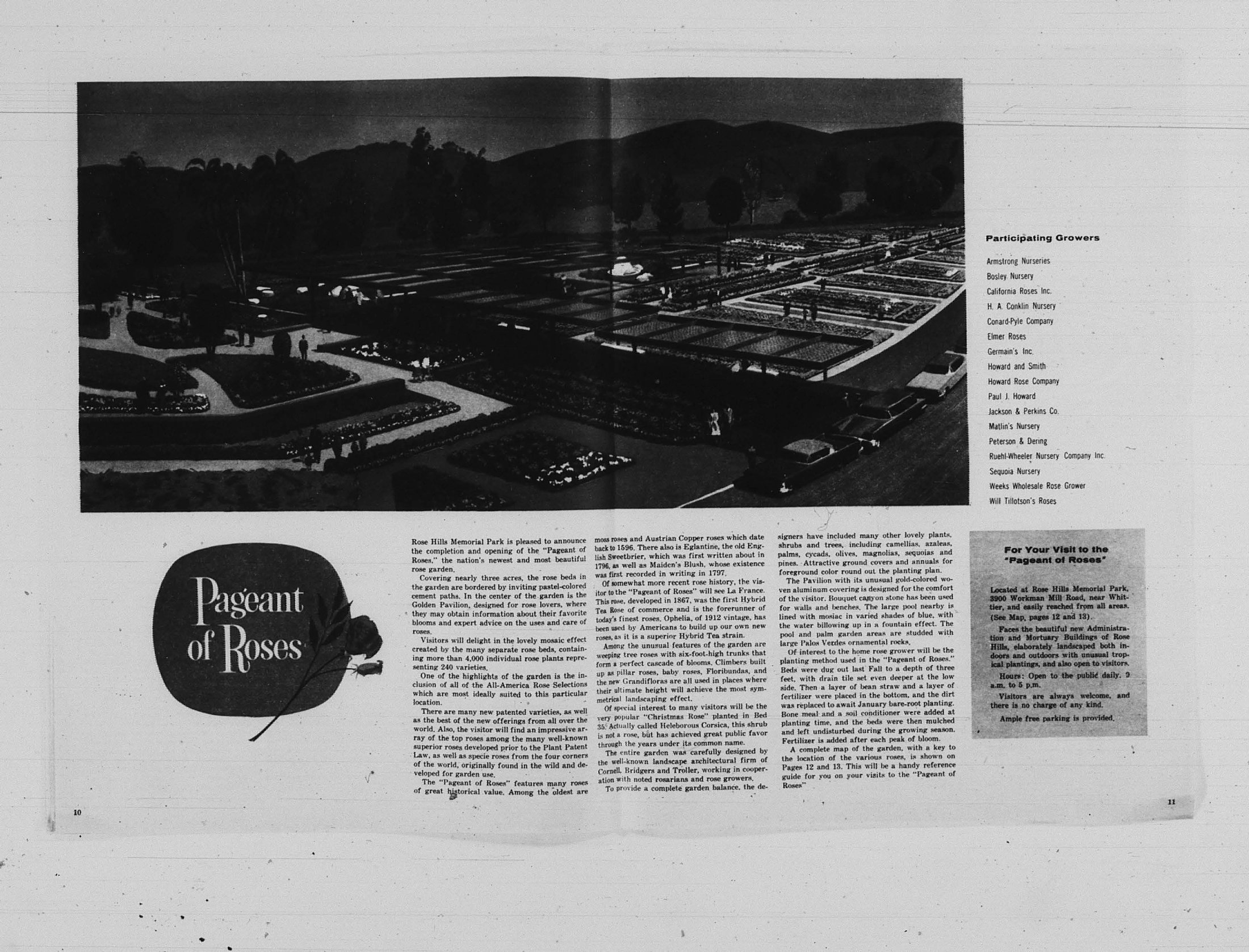
Rose Hills Memorial Park is pleased to announce the completion and opening of the "Pageant of Roses," the nation's newest and most beautiful rose garden.
Covering nearly three acres, the rose beds in the garden are bordered by inviting pastel-colored cement paths. In the center of the garden is the Golden Pavilion, designed for rose lovers, where they may obtain information about their favorite blooms and expert advice on the uses and care of roses.
Visitors will delight in the lovely mosaic effect created by the many separate rose beds, containing more than 4,000 individual rose plants representing 240 varieties.
moss roses and Austrian Copper roses which date back to 1596. There also is Eglantine, the old English Sweetbrier, which was first written about in 1796, as well as Maiden's Blush, whose existence was first recorded in writing in 1797.
Of somewhat more recent rose history, the visitor to the "Pageant of Roses" will see La France. This rose, developed in 1867, was the first Hybrid Tea Rose of commerce and is the forerunner of today's finest roses. Ophelia, of 1912 vintage, has been used by Americans to build up our own new roses, as it is a superior Hybrid Tea strain.
Among the unusual features of the garden are weeping tree roses with six-foot-high trunks that form a perfect cascade of blooms. Climbers built on pillar roses, baby roses, Floribundas, and signers have included many shrubs and trees, including palms, cycads, olives, magnolia pines. Attractive ground cover foreground color round out the
The Pavilion with its unusually venuminum covering is designed for visitors. Bouquet canyons for walls and benches. The lined with mosiac in varied shades of water billowing up in a pool and palm garden area large Palos Verdes ornamental.
Of interest to the home rose planting method used in the Beds were dug out last Fall.
Visitors will delight in the lovely mosaic effect created by the many separate rose beds, containing more than 4,000 individual rose plants representing 240 varieties.
One of the highlights of the garden is the inclusion of all of the All-America Rose Selections which are most ideally suited to this particular location.
There are many new patented varieties, as well as the best of the new offerings from all over the world. Also, the visitor will find an impressive array of the top roses among the many well-known superior roses developed prior to the Plant Patent Law, as well as specie roses from the four corners of the world, originally found in the wild and developed for garden use.
The "Pageant of Roses" features many roses of great historical value. Among the oldest are
This rose, developed in 1867, was the first Hybrid Tea Rose of commerce and is the forerunner of today's finest roses. Ophelia, of 1912 vintage, has been used by Americans to build up our own new roses, as it is a superior Hybrid Tea strain.
Among the unusual features of the garden are weeping tree roses with six-foot-high trunks that form a perfect cascade of blooms. Climbers built up as pillar roses, baby roses, Floribundas, and the new Grandifloras are all used in places where their ultimate height will achieve the most symmetrical landscaping effect.
Of special interest to many visitors will be the very popular "Christmas Rose" planted in Bed 35. Actually called Heleborous Corsica, this shrub is not a rose, but has achieved great public favor through the years under its common name.
The entire garden was carefully designed by the well-known landscape architectural firm of Cornell, Bridgers and Troller, working in cooperation with noted rosarians and rose growers.
To provide a complete garden balance, the de-
Participating Growers
Armstrong Nurseries
Bosley Nursery
California Roses Inc.
H. A. Conklin Nursery
Conard-Pyle Company
Elmer Roses
Germain's Inc.
Signers have included many other lovely plants,
shrubs and trees, including camellias, azaleas,
palms, cycads, olives, magnolias, sequoias and
vines. Attractive ground covers and annuals for
foreground color round out the planting plan.
The Pavilion with its unusual gold-colored wonen aluminum covering is designed for the comfort
of the visitor. Bouquet canyon stone has been used
for walls and benches. The large pool nearby is
lined with mosaic in varied shades of blue, with
the water billowing up in a fountain effect. The
pool and palm garden areas are studded with
large Palos Verdes ornamental rocks.
Of interest to the home rose grower will be the
planting method used in the "Pageant of Roses."
beds were dug out last Fall to a depth of three
For Your Visit to the
"Pageant of Roses"
Located at Rose Hills Memorial Park,
3900 Workman Mill Road, near Whittier, and easily reached from all areas.
(See Map, pages 12 and 13).
Faces the beautiful new Administration and Mortuary Buildings of Rose
Hills, elaborately landscaped both indoors and outdoors with unusual tropical plantings, and also open to visitors.
of the visitor. Bouquet canyon stone has been used for walls and benches. The large pool nearby is filled with mosaic in varied shades of blue, with the water billowing up in a fountain effect. The pool and palm garden areas are studded with large Palos Verdes ornamental rocks.
Of interest to the home rose grower will be the planting method used in the "Pageant of Roses." Beds were dug out last Fall to a depth of three feet, with drain tile set even deeper at the low side. Then a layer of bean straw and a layer of fertilizer were placed in the bottom, and the dirt was replaced to await January bare-root planting. Bone meal and a soil conditioner were added at planting time, and the beds were then mulched and left undisturbed during the growing season. Fertilizer is added after each peak of bloom.
A complete map of the garden, with a key to the location of the various roses, is shown on Pages 12 and 13. This will be a handy reference guide for you on your visits to the "Pageant of Roses".