anaheim-bulletin 1959-04-27
Scanned page
Searchable text
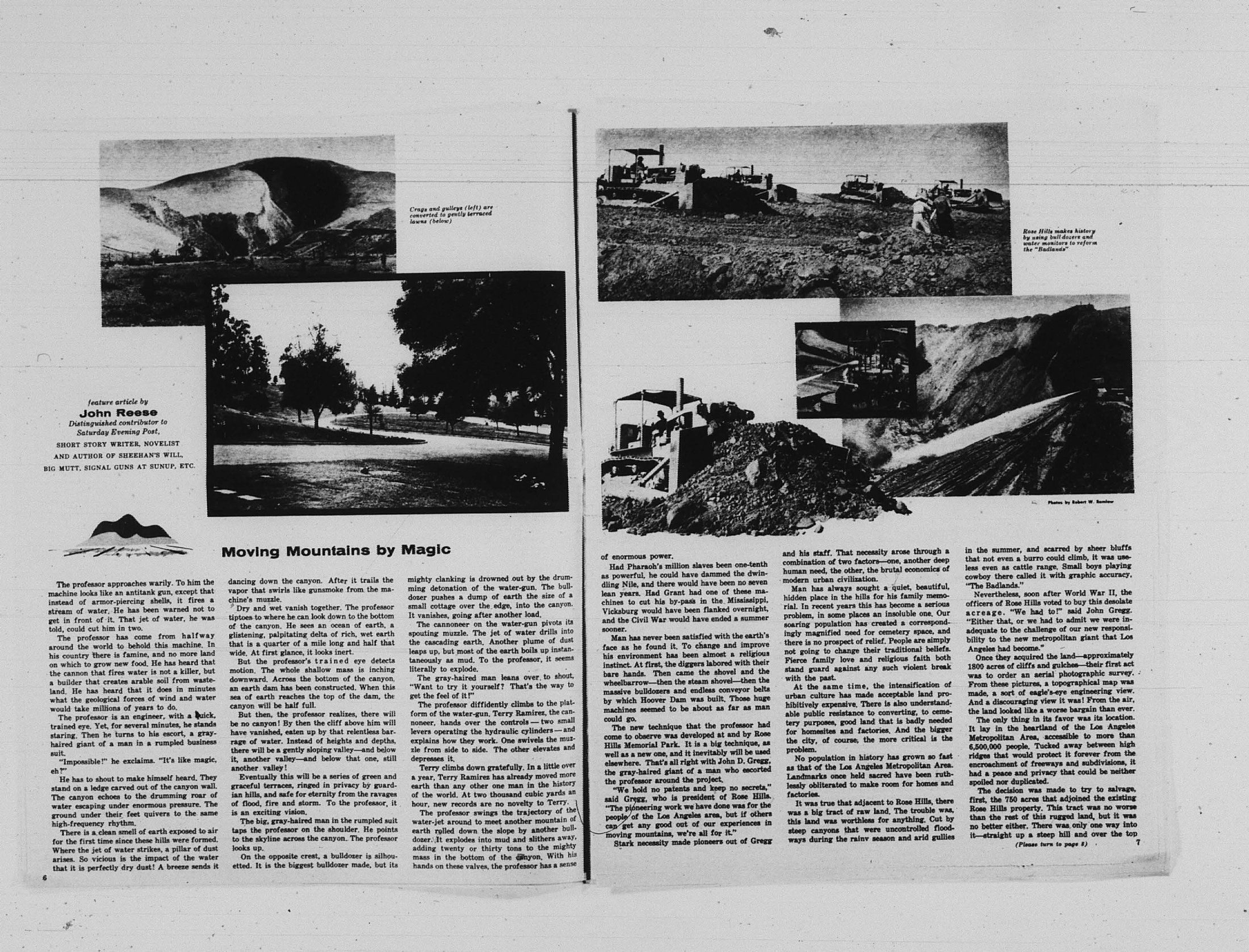
Crags and gulleys converted to gently lawns (below)
feature article by
John Reese
Distinguished contributor to
Saturday Evening Post,
SHORT STORY WRITER, NOVELIST
AND AUTHOR OF SHEEHAN'S WILL,
BIG MUTT, SIGNAL GUNS AT SUNUP, ETC.
Moving Mountains by Magic
The professor approaches warily. To him the machine looks like an antitank gun, except that instead of armor-piercing shells, it fires a stream of water. He has been warned not to get in front of it. That jet of water, he was told, could cut him in two.
The professor has come from halfway around the world to behold this machine. In his country there is famine, and no more land on which to grow new food. He has heard that the cannon that fires water is not a killer but dancing down the canyon. After it trails the vapor that swirls like gunsmoke from the machine's muzzle.
Dry and wet vanish together. The professor tiptoes to where he can look down to the bottom of the canyon. He sees an ocean of earth, a glistening, palpitating delta of rich, wet earth that is a quarter of a mile long and half that wide. At first glance, it looks inert.
But the professor's trained eye detects motion. The whole shallow mass is inching mighty clanking ming detonation dozer pushes a small cottage owl It vanishes, going.
The cannonee spouting muzzle the cascading e leaps up, but mo taneously as mu literally to expl
instead of armor-piercing shells, it fires a stream of water. He has been warned not to get in front of it. That jet of water, he was told, could cut him in two.
The professor has come from halfway around the world to behold this machine. In his country there is famine, and no more land on which to grow new food. He has heard that the cannon that fires water is not a killer, but a builder that creates arable soil from waste-land. He has heard that it does in minutes what the geological forces of wind and water would take millions of years to do.
The professor is an engineer, with a quick, trained eye. Yet, for several minutes, he stands staring. Then he turns to his escort, a gray-haired giant of a man in a rumpled business suit.
"Impossible!" he exclaims. "It's like magic, eh?"
He has to shout to make himself heard. They stand on a ledge carved out of the canyon wall. The canyon echoes to the drumming roar of water escaping under enormous pressure. The ground under their feet quivers to the same high-frequency rhythm.
There is a clean smell of earth exposed to air for the first time since these hills were formed. Where the jet of water strikes, a pillar of dust arises. So vicious is the impact of the water that it is perfectly dry dust! A breeze sends it
Dry and wet vanish together. The professor tiptoes to where he can look down to the bottom of the canyon. He sees an ocean of earth, a glistening, palpitating delta of rich, wet earth that is a quarter of a mile long and half that wide. At first glance, it looks inert.
But the professor's trained eye detects motion. The whole shallow mass is inching downward. Across the bottom of the canyon, an earth dam has been constructed. When this sea of earth reaches the top of the dam, the canyon will be half full.
But then, the professor realizes, there will be no canyon! By then the cliff above him will have vanished, eaten up by that relentless barrage of water. Instead of heights and depths, there will be a gently sloping valley—and below it, another valley—and below that one, still another valley!
Eventually this will be a series of green and graceful terraces, ringed in privacy by guardian hills, and safe for eternity from the ravages of flood, fire and storm. To the professor, it is an exciting vision.
The big, gray-haired man in the rumpled suit taps the professor on the shoulder. He points to the skyline across the canyon. The professor looks up.
On the opposite crest, a bulldozer is silhouetted. It is the biggest bulldozer made, but its chine's muzzle.
Dry and wet vanish together. The professor tiptoes to where he can look down to the bottom of the canyon. He sees an ocean of earth, a glistening, palpitating delta of rich, wet earth that is a quarter of a mile long and half that wide. At first glance, it looks inert.
But the professor's trained eye detects motion. The whole shallow mass is inching downward. Across the bottom of the canyon, an earth dam has been constructed. When this sea of earth reaches the top of the dam, the canyon will be half full.
But then, the professor realizes, there will be no canyon! By then the cliff above him will have vanished, eaten up by that relentless barrage of water. Instead of heights and depths, there will be a gently sloping valley—and below it, another valley—and below that one, still another valley!
Eventually this will be a series of green and graceful terraces, ringed in privacy by guardian hills, and safe for eternity from the ravages of flood, fire and storm. To the professor, it is an exciting vision.
The big, gray-haired man in the rumpled suit taps the professor on the shoulder. He points to the skyline across the canyon. The professor looks up.
On the opposite crest, a bulldozer is silhouetted. It is the biggest bulldozer made, but its chine's muzzle.
Dry and wet vanish together. The professor tiptoes to where he can look down to the bottom of the canyon. He sees an ocean of earth, a glistening, palpitating delta of rich, wet earth that is a quarter of a mile long and half that wide. At first glance, it looks inert.
But the professor's trained eye detects motion. The whole shallow mass is inching downward. Across the bottom of the canyon, an earth dam has been constructed. When this sea of earth reaches the top of the dam, the canyon will be half full.
But then, the professor realizes, there will be no canyon! By then the cliff above him will have vanished, eaten up by that relentless barrage of water. Instead of heights and depths, there will be a gently sloping valley—and below it, another valley—and below that one, still another valley!
Eventually this will be a series of green and graceful terraces, ringed in privacy by guardian hills, and safe for eternity from the ravages of flood, fire and storm. To the professor, it is an exciting vision.
The big, gray-haired man in the rumpled suit taps the professor on the shoulder. He points to the skyline across the canyon. The professor looks up.
On the opposite crest, a bulldozer is silhouetted. It is the biggest bulldozer made, but its chine's muzzle.
Dry and wet vanish together. The professor tiptoes to where he can look down to the bottom of the canyon. He sees an ocean of earth, a glistening, palpitating delta of rich, wet earth that is a quarter of a mile long and half that wide. At first glance, it looks inert.
But the professor's trained eye detects motion. The whole shallow mass is inching downward. Across the bottom of the canyon, an earth dam has been constructed. When this sea of earth reaches the top of the dam, the canyon will be half full.
But then, the professor realizes, there will be no canyon! By then the cliff above him will have vanished, eaten up by that relentless barrage of water. Instead of heights and depths, there will be a gently sloping valley—and below it, another valley—and below that one, still another valley!
Eventually this will be a series of green and graceful terraces, ringed in privacy by guardian hills, and safe for eternity from the ravages of flood, fire and storm. To the professor, it is an exciting vision.
The big, gray-haired man in the rumpled suit taps the professor on the shoulder. He points to the skyline across the canyon. The professor looks up.
On the opposite crest, a bulldozer is silhouetted. It is the biggest bulldozer made, but its chine's muzzle.
Dry and wet vanish together. The professor tiptoes to where he can look down to the bottom of the canyon. He sees an ocean of earth, a glistening, palpitating delta of rich, wet earth that is a quarter of a mile long and half that wide. At first glance, it looks inert.
But the professor's trained eye detects motion. The whole shallow mass is inching downward. Across the bottom of the canyon, an earth dam has been constructed. When this sea of earth reaches the top of the dam, the canyon will be half full.
But then, the professor realizes, there will be no canyon! By then the cliff above him will have vanished, eaten up by that relentless barrage of water. Instead of heights and depths, there will be a gently sloping valley—and below it, another valley—and below that one, still another valley!
Eventually this will be a series of green and graceful terraces, ringed in privacy by guardian hills, and safe for eternity from the ravages of flood, fire and storm. To the professor, it is an exciting vision.
The big, gray-haired man in the rumpled suit taps the professor on the shoulder. He points to the skyline across the canyon. The professor looks up.
On the opposite crest, a bulldozer is silhouetted. It is the biggest bulldozer made, but its chine's muzzle.
Dry and wet vanish together. The professor tiptoes to where he can look down to the bottom of the canyon. He sees an ocean of earth, a glistening, palpitating delta of rich, wet earth that is a quarter of a mile long and half that wide. At first glance, it looks inert.
But the professor's trained eye detects motion. The whole shallow mass is inching downward. Across the bottom of the canyon, an earth dam has been constructed. When this sea of earth reaches the top of the dam, the canyon will be half full.
But then, the Professor realizes there will be no canyon! By then the cliff above him will have vanished,eaten up by that relentless barrageof water.Insteadofheightsanddepthstherewillbeagentlyslopingvalley—andbelowitanothervalley—andbelowthatonestillanothervalley!
Eventually this will be a series of green and graceful terraces,ringed in privacybyguardianhills,andsafeforeternityfromtheravagesofflood,fireandstorm.Totheprofessor.itisanexcitingvision.
The big,gray-hairedmanintherumpleduitsuittapstheprofessorontheshoulder.Hewindtotheskylineacrossthecanyon.Theprofessorlooksup.
Ontheoppositecrest,abulldozerissilhouetted.它isthebiggestbulldozermadebutitschine'smuzzle.
Dryandwetvanishtogether.Theprofessortiptoestherewillbenocanyon!Bythenthecliffabovehimwillhavevanished,eatenupbythatrelentlessbarrageforwater.Insteadofheightsanddepthstherewillbeagentlyslopingvalley—andbelowitanothervalley—andbelowthatonestillanothervalley!
Eventuallythiswillbeaseriesofgreenandgracefulterraces,ringedinprivacybyguardianhills,andsafeforeternityfromtheravagesofflood,fireandstorm.Totheprofessor.itisanexcitingvision.
Thebig,gray-hairedmanintherumpleduitsuittapstheprofessorontheshoulder.Hewindtotheskylineacrossthecanyon.Theprofessorlooksup.
Ontheoppositecrest,abulldozerissilhouetted.它isthebiggestbulldozermadebutitschine'smuzzle.
Dryandwetvanishtogether.Theprofessortiptoestherewillbenocanyon!Bythenthecliffabovehimwillhavevanished,eatenupbythatrelentlessbarrageforwater.Insteadofheightsanddepthstherewillbeagentlyslopingvalley—andbelowitanothervalley—andbelowthatonestillanothervalley!
Eventuallythiswillbeaseriesofgreenandgracefulterraces,ringedinprivacybyguardianhills,andsafeforeternityfromtheravagesofflood,fireandstorm.Totheprofessor.itisanexcitingvision.
Thebig,gray-hairedmanintherumpleduitsuittapstheprofessorontheshoulder.Hewindtotheskylineacrossthecanyon.Theprofessorlooksup.
Ontheoppositecrest,abulldozerissilhouetted.它isthebiggestbulldozermadebutitschine'smuzzle.
Dryandwetvanishtogether.Theprofessortiptoestherewillbenocanyon!Bythenthecliffabovehimwillhavevanished,eatenupbythatrelentlessbarrageforwater.Insteadofheightsanddepthstherewillbeagentlyslopingvalley—andbelowitanothervalley—andbelowthatonestillanothervalley!
Eventuallythiswillbeaseriesofgreenandgracefulterraces,ringedinprivacybyguardianhills,andsafeforeternityfromtheravagesofflood,fireandstorm.Totheprofessor.itisanexcitingvision.
Thebig,gray-hairedmanintherumpleduitsuittapstheprofessorontheshoulder.Hewindtotheskylineacrossthecanyon.Theprofessorlooksup.
Ontheoppositecrest,abulldozerissilhouetted.它isthebiggestbulldozermadebutitschine'smuzzle.
Dryandwetvanishtogether.Theprofessortiptoestherewillbenocanyon!Bythenthecliffabovehimwillhavevanished,eatenupbythatrelentlessbarrageforwater.Insteadofheightsanddepthstherewillbeagentlyslopingvalley—andbelowitanothervalley—andbelowthatonestillanothervalley!
Eventuallythiswillbeaseriesofgreenandgracefulterraces,ringedinprivacybyguardianhills,andsafeforeternityfromtheravagesofflood,fireandstorm.Totheprofessor.itisanexcitingvision.
Thebig,gray-hairedmanintherumpleduitsuittapstheprofessorontheshoulder.Hewindtotheskylineacrossthecanyon.Theprofessorlooksup.
Ontheoppositecrest,abulldozerissilhouetted.它isthebiggestbulldozermadebutitschine'smuzzle.
Dryandwetvanishtogether.Theprofessortiptoestherewillbenocanyon!Bythenthecliffabovehimwillhavevanished,eatenupbythatrelentlessbarrageforwater.Insteadofheights和depthstherewillbeagentlyslopingvalley—andbelowitanothervalley—andbelowthatonestillanothervalley!
Eventuallythiswillbeaseriesofgreenandgracefulterraces,ringedinprivacybyguardianhills,andsafeforeternityfromtheravagesofflood,fireandstorm.Totheprofessor.itisanexcitingvision.
Thebig,gray-hairedmanintherumpleduitsuittapstheprofessorontheshoulder.Hewindtotheskylineacrossthecanyon.Theprofessorlooksup.
Ontheoppositecrest,abulldozerissilhouetted.它isthebiggestbulldozermadebutitschine'smuzzle.
Dryandwetvanishtogether.Theprofessortiptoestherewillbenocanyon!Bythenthecliffabovehimwillhavevanished,eatenupbythatrelentlessbarrageforwater.Insteadofheights和depthstherewillbeagentlyslopingvalley—andbelowitanothervalley—andbelowthatonestillanothervalley!
Eventuallythiswillbeaseriesofgreenandgracefulterraces,ringedinprivacybyguardianhills,andsafeforeternityfromtheravagesofflood,fireandstorm.Totheprofessor.itisanexcitingvision.
Thebig,gray-hairedmanintherumpleduitsuittapstheprofessorontheshoulder.Hewindtotheskylineacrossthecanyon.Theprofessorlooksup.
Ontheoppositecrest,abulldozerissilhouetted.它isthebiggestbulldozermadebutitschine'smuzzle.
Dryandwetvanishtogether.Theprofessortiptoestherewillbenocanyon!Bythenthecliffabovehimwillhavevanished,eatenupbythatrelentlessbarrageforwater.Insteadofheights和depthstherewillbeagentlyslopingvalley—andbelowitanothervalley—andbelowthatonestillanothervalley!
Eventuallythiswillbea系列ofgreen和 graceful terraces,ringed in privacybyguardianhills,and safe for eternity from theravages.of flood.fire and storm.To.the professor.it is an exciting vision.
Terry climbs a year ago.
Earth rollled over any world.
A hour new record.
Mass in boots on hands.
6
Crags and gulleys (left) are converted to gently terraced lawns (below)
mighty clanking is drowned out by the drumming detonation of the water-gun. The buldozer pushes a dump of earth the size of a
small cottage over the edge, into the canyon.
It vanishes, going after another load.
The cannoneer on the water-gun pivots its
spouting muzzle. The jet of water drills into
the cascading earth. Another plume of dust
leaps up, but most of the earth boils up instantaneously as mud. To the professor, it seems
literally to explode.
of enormous power.
Had Pharaoh's million slaves been one-tenth
as powerful, he could have dammed the dwindling Nile, and there would have been no seven lean years. Had Grant had one of these machines to cut his by-pass in the Mississippi, Vicksburg would have been flanked overnight,
and the Civil War would have ended a summer sooner.
Man has never been satisfied with the earth's
face as he found it. To change and improve
his environment has been almost a religious
instinct. At first, the diggers labored with their
hand and his staff. That necessitates
combination of two factors—human need, the other, the modern urban civilization.
Man has always sought hidden place in the hills for
rial. In recent years this haproblem, in some places an
soaring population has creingly magnified need for cothere is no prospect of relief.
not going to change their
Fierce family love and restand guard against any
professor the bottom
earth, a
get earth
half that
detects inching
canyon,
then this
lam, the
here will
him will
less barld depths,
and below
one, still
green and
by guarde ravages
professor, it
ampled suit
He points
professor
his silhoute, but its
dozer pushes a dump of earth the size of a small cottage over the edge, into the canyon.
It vanishes, going after another load.
The cannoneer on the water-gun pivots its spouting muzzle. The jet of water drills into the cascading earth. Another plume of dust leaps up, but most of the earth boils up instantaneously as mud. To the professor, it seems literally to explode.
The gray-haired man leans over to shout,
"Want to try it yourself? That's the way to get the feel of it!"
The professor diffidently climbs to the platform of the water-gun. Terry Ramirez, the cannoneer, hands over the controls—two small levers operating the hydraulic cylinders—and explains how they work. One swivels the muzzle from side to side. The other elevates and depresses it.
Terry climbs down gratefully. In a little over a year, Terry Ramirez has already moved more earth than any other one man in the history of the world. At two thousand cubic yards an hour, new records are no novelty to Terry.
The professor swings the trajectory of the water-jet around to meet another mountain of earth rolled down the slope by another bulldozer. It explodes into mud and slithers away, adding twenty or thirty tons to the mighty mass in the bottom of the canyon. With his hands on these valves, the professor has a sense
chines to cut his by-pass in the Mississippi, Vicksburg would have been flanked overnight, and the Civil War would have ended a summer sooner.
Man has never been satisfied with the earth's face as he found it. To change and improve his environment has been almost a religious instinct. At first, the diggers labored with their bare hands. Then came the shovel and the wheelbarrow—then the steam shovel—then the massive bulldozers and endless conveyor belts by which Hoover Dam was built. Those huge machines seemed to be about as far as man could go.
The new technique that the professor had come to observe was developed at and by Rose Hills Memorial Park. It is a big technique, as well as a new one, and it inevitably will be used elsewhere. That’s all right with John D. Gregg, the gray-haired giant of a man who escorted the professor around the project.
"We hold no patents and keep no secrets," said Gregg, who is president of Rose Hills.
"The pioneering work we have done was for the people of the Los Angeles area, but if others can get any good out of our experiences in moving mountains, we're all for it."
Stark necessity made pioneers out of Gregg
Rose Hills makes history by using bull dozers and water monitors to reform the "Badlands"
and his staff. That necessity arose through a combination of two factors—one, another deep human need, the other, the brutal economics of modern urban civilization.
Man has always sought a quiet, beautiful, hidden place in the hills for his family memorial. In recent years this has become a serious problem, in some places an insoluble one. Our soaring population has created a correspondingly magnified need for cemetery space, and there is no prospect of relief. People are simply not going to change their traditional beliefs. Fierce family love and religious faith both stand guard against any such violent break in the summer, and scarred by sheer bluffs that not even a burro could climb, it was useless even as cattle range. Small boys playing cowboy there called it with graphic accuracy, "The Badlands."
Nevertheless, soon after World War II, the officers of Rose Hills voted to buy this desolate acreage. "We had to!" said John Gregg. "Either that, or we had to admit we were inadequate to the challenge of our new responsibility to the new metropolitan giant that Los Angeles had become."
Once they acquired the land—approximately 1800 acres of cliffs and gulches—their first act
In recent years this has become a serious problem, in some places an insoluble one. Our soaring population has created a correspondingly magnified need for cemetery space, and there is no prospect of relief. People are simply not going to change their traditional beliefs. Pierce family love and religious faith both stand guard against any such violent break with the past.
At the same time, the intensification of urban culture has made acceptable land prohibitively expensive. There is also understandable public resistance to converting, to cemetery purposes, good land that is badly needed for homesites and factories. And the bigger the city, of course, the more critical is the problem.
No population in history has grown so fast as that of the Los Angeles Metropolitan Area. Landmarks once held sacred have been ruthlessly obliterated to make room for homes and factories.
It was true that adjacent to Rose Hills, there was a big tract of raw land. The trouble was, this land was worthless for anything. Cut by steep canyons that were uncontrolled floodways during the rainv season and arid gullies officers of Rose Hills voted to buy this desolate acreage. "We had to!" said John Gregg. "Either that, or we had to admit we were inadequate to the challenge of our new responsibility to the new metropolitan giant that Los Angeles had become."
Once they acquired the land—approximately 1800 acres of cliffs and gulches—their first act was to order an aerial photographic survey. From these pictures, a topographical map was made, a sort of eagle's-eye engineering view. And a discouraging view it was! From the air, the land looked like a worse bargain than ever.
The only thing in its favor was its location. It lay in the heartland of the Los Angeles Metropolitan Area, accessible to more than 6,500,000 people. Tucked away between high ridges that would protect it forever from the encroachment of freeways and subdivisions, it had a peace and privacy that could be neither spoiled nor duplicated.
The decision was made to try to salvage, first, the 750 acres that adjoined the existing Rose Hills property. This tract was no worse than the rest of this rugged land, but it was no better either. There was only one way into it—straight up a steep hill and over the top
(Please turn to page 8)