oc-plain-dealer 1922-06-27
Scanned page
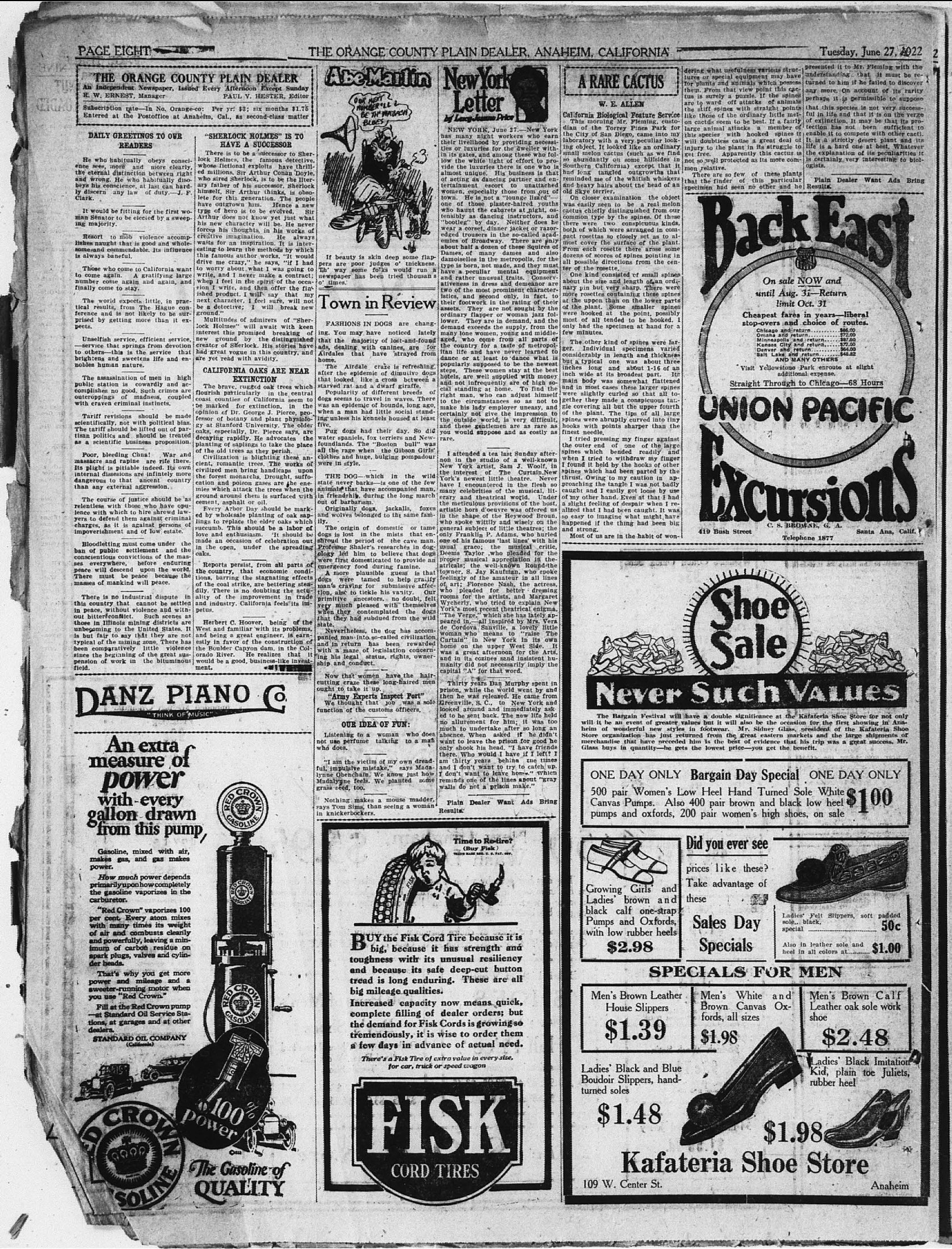
Searchable text
DAILY GREETINGS TO OUR READERS
He who habitually obeys conscience sees, more and more clearly, the eternal distinction between right and wrong. He who habitually disobeys his conscience, at last can hardly discern any law of duty.—J. F. Clark.
It would be fitting for the first woman Senator to be elected by a sweeping majority.
Resort to mob violence accomplishes naught that is good and wholesome and commendable. Its influence is always baneful.
Those who come to California want to come again. A gratifying large number come again and again, and finally come to stay.
The world expects little, in practical results, from The Hague conference and is not likely to be surprised by getting more than it expects.
Unselfish service, efficient service, —service that springs from devotion to others—this is the service that brightens and sweetens life and ennobles human nature.
The assassination of men in high public station is cowardly and accomplishes no good. Such crimes are outroppings of madness, coupled with craven criminal instincts.
Tariff revisions should be made scientifically, not with political bias. The tariff should be lifted out of partisan politics and should be treated as a scientific business proposition.
Poor, bleeding China! War and massacre and rapine are rife there.
"SHERLOCK HOLMES" IS TO HAVE A SUCCESSOR
There is to be a successor to Sherlock Holmes, the famous detective, whose fictional exploits have thrilled millions. Sir Arthur Conan Doyle, who sired Sherlock, is to be the literary father of his successor. Sherlock himself, Sir Arthur thinks, is obsolete for this generation. The people have outgrown him. Hence a new type of hero is to be evolved. Sir Arthur does not know yet just what his new character will be. He never forces his thoughts, in his works of creative imagination. He always waits for an inspiration. It is interesting to learn the methods by which this famous author works. "It would drive me crazy," he says, "if I had to worry about what I was going to write, and I never make a contract; when I feel in the spirit of the occasion I write, and then offer the finished product. I will say that my next character, I feel sure, will not be a detective; I will break new ground."
Multitudes of admirers of "Sherlock Holmes" will await with keen interest this promised breaking of new ground by the distinguished creator of Sherlock. His stories have had great vogue in this country, and are yet read with avidity.
CALIFORNIA OAKS ARE NEAR EXTINCTION
The brave, rugged oak trees which flourish particularly in the central coast counties of California seem to be marked for extinction, in the opinion of Dr. George J. Pierce, professor of botany and plant physiology at Stanford University. The older oaks, especially, Dr. Pierce says, are decaying rapidly. He advocates the planting of saplings to take the place of the old trees as they perish.
Civilization is blighting these ancient, romantic trees. The works of If beauty persists are p Th' way se newspaper o' times.
FASHIONING. You may that the mads, dealing Airdales th home.
The Air after the epilogue starved rat.
Popularity dogs seems was an epidemic when a man ing unless he five.
Pug dogs water spain foundlands all the rage clothes and were in style.
The assassination of men in high public station is cowardly and accomplishes no good. Such crimes are outcoppings of madness, coupled with craven criminal instincts.
Tariff revisions should be made scientifically, not with political bias. The tariff should be lifted out of partisan politics and should be treated as a scientific business proposition.
Poor, bleeding China! War and massacre and rapine are rife there. Its plight is pitiful indeed. Its own internal dissections are infinitely more dangerous to that ancient country than any external aggression.
The course of justice should be as relentless with those who have opulence with which to hire shrewd lawyers to defend them against criminal charges, as it is against persons of impoverishment and of low estate.
Bloodletting must come under the ban of public settlement and the conscientious convictions of the masses everywhere, before enduring peace will descend upon the world. There must be peace because the masses of mankind will peace.
There is no industrial dispute in this country that cannot be settled in peace, without violence and without bitter conflict. Such scenes as those in Illinois mining districts are unbeginning to the United States. It is but fair to say that they are not typical of the mining zone. There has been comparatively little violence since the beginning of the great suspension of work in the bituminous field.
CALIFORNIA OAKS ARE NEAR EXTINCTION
The brave, rugged oak trees which flourish particularly in the central coast counties of California seem to be marked for extinction, in the opinion of Dr. George J. Pierce, professor of botany and plant physiology at Stanford University. The older oaks, especially, Dr. Pierce says, are decaying rapidly. He advocates the planting of saplings to take the place of the old trees as they perish.
Civilization is blighting these ancient, romantic trees. The works of civilized men bring handicaps upon the forest monarchs. Drought, suffocation and poison gases are the enemies which attack the trees when the ground around them is surfaced with cement, asphalt or oil.
Every Arbor Day should be marked by wholesale planting of oak saplings to replace the elder oaks which succumb. This should be a labor of love and enthusiasm. It should be made an occasion of celebration out in the open, under the spreading oaks.
Reports persist, from all parts of the country, that economic conditions, barring the stagnating effects of the coal strike, are bettering steadily. There is no doubting the actuality of the improvement in trade and industry. California feels its impetus.
Herbert C. Hoover, being of the West and familiar with its problems, and being a great engineer, is earnestly in favor of the construction of the Boulder Capyon dam, in the Colorado River. He realizes that it would be a good, business-like investment.
DANZ PIANO CO.
"THINK OF MUSIC"
An extra measure of power with every gallon drawn from this pump,
Gasoline, mixed with air, makes gas, and gas makes power.
How much power depends
with every gallon drawn from this pump
Gasoline, mixed with air, makes gas, and gas makes power.
How much power depends primarily upon how completely the gasoline vaporizes in the carburetor.
"Red Crown" vaporizes 100 per cent. Every atom mixes with many times its weight of air and combusts cleanly and powerfully, leaving a minimum of carbon residue on spark plugs, valves and cylinder heads.
That's why you get more power and mileage and a sweeter-running motor when you use "Red Crown."
Fill at the Red Crown pump—at Standard Oil Service Stations, at garages and at other dealers.
STANDARD OIL COMPANY
(California)
100% Power
The Gasoline of Quality
THE ORANGE COUNTY PLAIN DEALER, ANAHEIM, CALIFORNIA
IF beauty is skin deep some flappers are poor judges o' trunckness. Th' way some folks would run a newspaper has been tried thousands o' times.
Town in Review
FASHIONS IN DOGS are changing. You may have noticed lately that the majority of lost-and-found ads, dealing with canines, are for Airdales that have strayed from home.
The Airdale craze is refreshing, after the epidemic of dimutive dogs that looked like a cross between a starved rat and a dwarf giraffe.
Popularity of different breeds of dogs seems to travel in waves. There was an epidemic of hounds, long ago, when a man had little social standing unless his kennels housed at least five.
Pug dogs had their day. So did water spaniels, fox terriers and Newfoundlands. The "Boston bull" was all the rage when the Gibson Girls' clothes and huge, bulging pompadour were in style.
NEW YORK, June 27.—New York has many night workers who earn their livelihood by providing necessities or luxuries for the dweller within its gates, and among these who follow the white light of effort to provide the luxuries there is one who is almost unique. His business is that of acting as dancing partner and entertainment escort to unattached women, especially those from out of town. He is not a "lounge lizard"—one of those plaster-haired youths who haunt the cabarets at night, ostensibly as dancing instructors, and "bootleg" by day. Neither does he wear a corset, dinner jacket or razor-edged trousers in the so-called academies of Broadway. There are only about half a dozen of these Squires of Dames, of many dames and also damoiselles in the metropolis, for the type is born, not made, and they must have a peculiar mental equipment and rather unusual traits. Conservativeness in dress and demeanor are two of the most prominent characteristics, and second only, in fact, to their footwork in the rating of their assets. They are not sought by the ordinary flapper or woman jazz follower. They are in demand, and the demand exceeds the supply, from the many lone women, young and middle-aged, who come from all parts of the country for a taste of metropolitan life and have never learned to dance or at least to dance what is popularly supposed to be the newest steps. These women stay at the best hotels, are well supplied with money and not infrequently are of high social standing at home. To find the right man, who can adjust himself to the circumstances so as not to make his lady employer uneasy, and certainly not give the impression to the outside world, is very difficult, and these gentlemen are as rare as you would suppose and as costly as rare.
I attended a tea last Sunday afternoon in the studio of a well-known New artist Sam Woolfe in A RARE CACTUS
W. E. ALLEN
California Biological Feature Service
This morning Mr. Fleming, custodian of the Torrey Pines Park for the City of San Diego, came into my laboratory with a very peculiar looking object. It looked like an ordinal small melon cactus (such as we find so abundantly on some hillsides in Southern California) except that it had long tangled outgrowths that reminded me of the whitish whisker and heavy hairs about the head of the old Skye terrier.
On closer examination the object was easily seen to be a real melon cactus chiefly distinguished from our common type by the spines. Of the three there were two conspicuous kinds both of which were arranged in coats rosettes so closely set as to most cover the surface of the plant. From each rosette there arose some dozens of scores of spines pointing at all possible directions from the center of the rosette.
One kind consisted of small spins about the size and length of an ornary pin but very sharp. There were more rosettes containing these spins at the uppern than on the lower part of the plant. Some smaller spins were hooked at the point, possibly most of all tended to be hooked, only had the specimen at hand for few minutes.
The other kind of spines were larger. Individual specimens vary considerably in length and thickness but a typical one was about this inches long and about 1-16 of an inch wide at its broadest part.
My main body was somewhat flattened and in most cases these larger spines were slightly curled so that all they together they made a conspicuous tail glee covering all but the upper four of the plant. The tips of all large spines were abruptly curved into tiny hooks with points sharper than the finest needle.
I tried pressing my finger against the outer end of one of the large spines which bended readily as when I tried to withdraw my finger I found it held by the hooks of other
The Airdate craze is refreshing after the epidemic of diminuitive dogs that looked like a cross between a starved rat and a dwarf giraffe.
Popularity of different breeds of dogs seems to travel in waves. There was an epidemic of hounds, long ago, when a man had little social standing unless his kennels housed at least five.
Pug dogs had their day. So did water spaniels, fox terriers and Newfoundlands. The "Boston bull" was all the rage when the Gibson Girls' clothes and huge, bulging pompadour were in style.
THE DOG—which in the wild state never barks—is one of the few animals that have accompanied man, in friendship, during the long march out of barbarism.
Originally dogs, jackalls, foxes and wolves belonged to the same family.
The origin of domestic or tame dogs is lost in the mists that enshrined the period of the cave man. Professor Shaler's researches in dogology led him to believe that dogs were first domesticated to provide an emergency food during famine.
A more plausible guess is that dogs were tamed to help graft man's craving for submissive affection, also to tickle his vanity. Our primitive ancestors, no doubt, felt very much pleased with themselves when they contemplated the dogs that they had subdued from the wild state.
Nevertheless, the dog has accompanied man into so-called civilization and in return has been rewarded with a maze of legislation concerning his legal status, rights, ownership and conduct.
Now that women have the haircutting craze these long-haired men ought to take it up.
"Army Experts Inspect Port"
We thought that job was a sole function of the customs officers.
OUR IDEA OF FUN:
Listening to a woman who does not use perfume talking to a man who does.
"I am the victim of my own dreadful, impulsive mistake," says Madalynne Obenchain. We know just how Madalynne feels. We planted some grass seed, too.
Nothing makes a mouse madder, says Tom Sims, than seeing a woman in knickerbockers.
I attended a tea last Sunday afternoon in the studio of a well-known New York artist, Sam J. Woolf, in the interest of The Curtain. New York's newest little theatre. Never have I encountered in the flesh so many celebrities of the musical, literary and theatrical world. Under the meticulous provisions of the host, artistic hors d'oeuvre was offered us in the shape of the Heywood Broun, who spoke wittily and wisely on the general subject of little theatres; the only Franklin P. Adams, who hurled one of his famous 'last lines' with his usual grace; the musical critic, Deems Taylor, who pleaded for the proper musical appreciation in theatricals; the well-known Round-the-towner, S. Jay Kaufman, who spoke feelingly of the amateur in all lines of art; Florence Nash, the actress, who pleaded for better dressing rooms for the artists, and Margaret Wycherly, who tried to explain New York's most recent theatrical enigma, "The Verge," which she has lately appeared in—all inspired by Mrs. Vera de Cordova, Sanville, a lovely little woman who means to "raise The Curtain" in New York in its own home on the upper West Side. It was a great afternoon for the Arts, and in its cozines sand insistent humanity did not necessarily imply the capital "A" for that word.
Thirty years Dan Murphy spent in prison, while the world went by and then he was released. He came from Greenville, S. C., to New York and looked around and immediately asked to be sent back. The new life held no allurement for him; it was too much to undertake after so long an absence. When asked if he didn't want to leave the prison for good he only shook his head. "I have friends there. Who would I have if I left? I am thirty years behine the times and I don't want to try to catch up. I don't want to leave home." Which reminds one of the lines about "gray walls do not a prison make."
Plain Dealer Want Ads Bring Results.
Time to Refire?
(Buy Fisk)
BUY the Fisk Cord Tire because it is big, because it has strength and toughness with its unusual resiliency and because its safe deep-cut button tread is long enduring. These are all big mileage qualities.
Increased capacity now means quick, complete filling of dealer orders; but the demand for Fisk Cords is growing so tremendously, it is wise to order them a few days in advance of actual need.
There's a Fisk Tire of extra value in every size, for car, truck or speed wagon
FISK
CORD TIRES
CALIFORNIA Tuesday, June 27, 1922
WARE CACTUS
W. E. ALLEN
Biological Feature Service
nuring Mr. Fleming, custone Torrey Pines Park for
San Diego, came into my
with a very peculiar lookIt looked like an ordinary
cactus (such as we find
ntly on some hillsides in
California) except that it
tangled outgrowths that
one of the whitish whiskers
hairs about the head of an
carrier.
or examination the object
seen to be a real melon
finitely distinguished from our
pe by the spines. Of these
two conspicuous kinds,
which were arranged in commas so closely set as to althe surface of the plant.
Rosette there arose some
scores of spines pointing in
directions from the cenrosette.
I consisted of small spines
size and length of an ordabut very sharp. There were
sites containing these spines
more than on the lower parts
at. Some smaller spines
died at the point, possibly
tended to be hooked. I
the specimen at hand for a
res.
The kind of spines were larindividual specimens varied
by length and thickness
one was about three
and about 1-16 of an
insect its broadest part. It
was somewhat flattened
cases these larger spines
curled so that all tomely made a conspicuous tagall but the upper fourth
ent. The tips of all large
abruptly curved into tiny
points sharper than the
leave.
pressing my finger against
end of one of the large
which bended readily and
to withdraw my finger
held by the hook of other
dering what usefulness various structures or special equipment may have
for plants and animals which possess them. From that view point this cactus is surely a puzzle. If the spines are to ward off attacks of animals the stiff spines with straight points like those of the ordinary little meion cactus seem to be best. If a fairly large animal attacks a member of this species with hooked spines it will doubtless cause a great deal of injury to the plant in its struggle to get free. Apparently this cactus is not so well protected as its more common relative.
There are so few of these plants that the finder of this particular specimen had seen no other and he presented it to Mr. Fleming with the understanding that it must be returned to him if he failed to discover any more. On account of its rarity perhaps it is permissible to suppose that this species is not very successful in life and that it is on the verge of extinction. It may be that its protection has not been sufficient to enable it to compete with other cacti. It is a strictly desert plant and its life is a hard one at best. Whatever the explanation of its peculiarities it is certainly very interesting to biologists.
Plain Dealer Want Ads Bring Results.
Back East
On sale NOW and
until Aug. 31—Return
limit Oct. 31
Cheapest fares in years—liberal stop-overs and choice of routes.
Chicago and return.....$86.00
Omaha and return.....$72.00
Minneapolis and return.....$87.50
Kansas City and return.....$72.00
Denver and return.....$64.00
Balt Lake and return.....$48.82
AND MANY OTHER
Visit Yellowstone Park enroute at slight additional expense.
Straight Through to Chicago—68 Hours
UNION PACIFIC
UNION PACIFIC
Excursions
C. S. BROWNE, G. A.
419 Bush Street
Santa Ana, Calif.
Telephone 1877
Shoe Sale
Never Such Values
The Bargain Festival will have a double significance at the Kafateria Shoe Store for not only it be an event of greater values but it will also be the occasion for the first showing in Ana- of wonderful new styles in footwear. Mr. Sidney Glass, president of the Kafateria Shoe organization has just returned from the great eastern markets and the large shipments of handlise that have preceded him is the best of evidence that his trip was a great success. Mr. buys in quantity—he gets the lowest price—you get the benefit.
ONE DAY ONLY Bargain Day Special ONE DAY ONLY
100 pair Women's Low Heel Hand Turned Sole White Canvas Pumps. Also 400 pair brown and black low heel pumps and oxfords, 200 pair women's high shoes, on sale
Did you ever see
prices like these?
400 pair Women's Low Heel Hand Turned Sole White Canvas Pumps. Also 400 pair brown and black low heel pumps and oxford, 200 pair women's high shoes, on sale
Did you ever see prices like these? Take advantage of these
Sales Day Specials
Ladies' Felt Slippers, soft padded sole., black,
special ... $50c
Also in leather sole and heel in all colors at... $1.00
SPECIALS FOR MEN
Men's Brown Leather House Slippers
$1.39
Men's White and Brown Canvas Oxford, all sizes
$1.98
Men's Brown Calf Leather oak sole work shoe
$2.48
Ladies' Black and Blue Adoir Slippers, hand-heed soles
$1.48
Ladies' Black Imitation Kid, plain toe Juliets, rubber heel
$1.98
Kafateria Shoe Store
O W. Center St.
Anaheim