oc-plain-dealer 1922-04-29
Scanned page
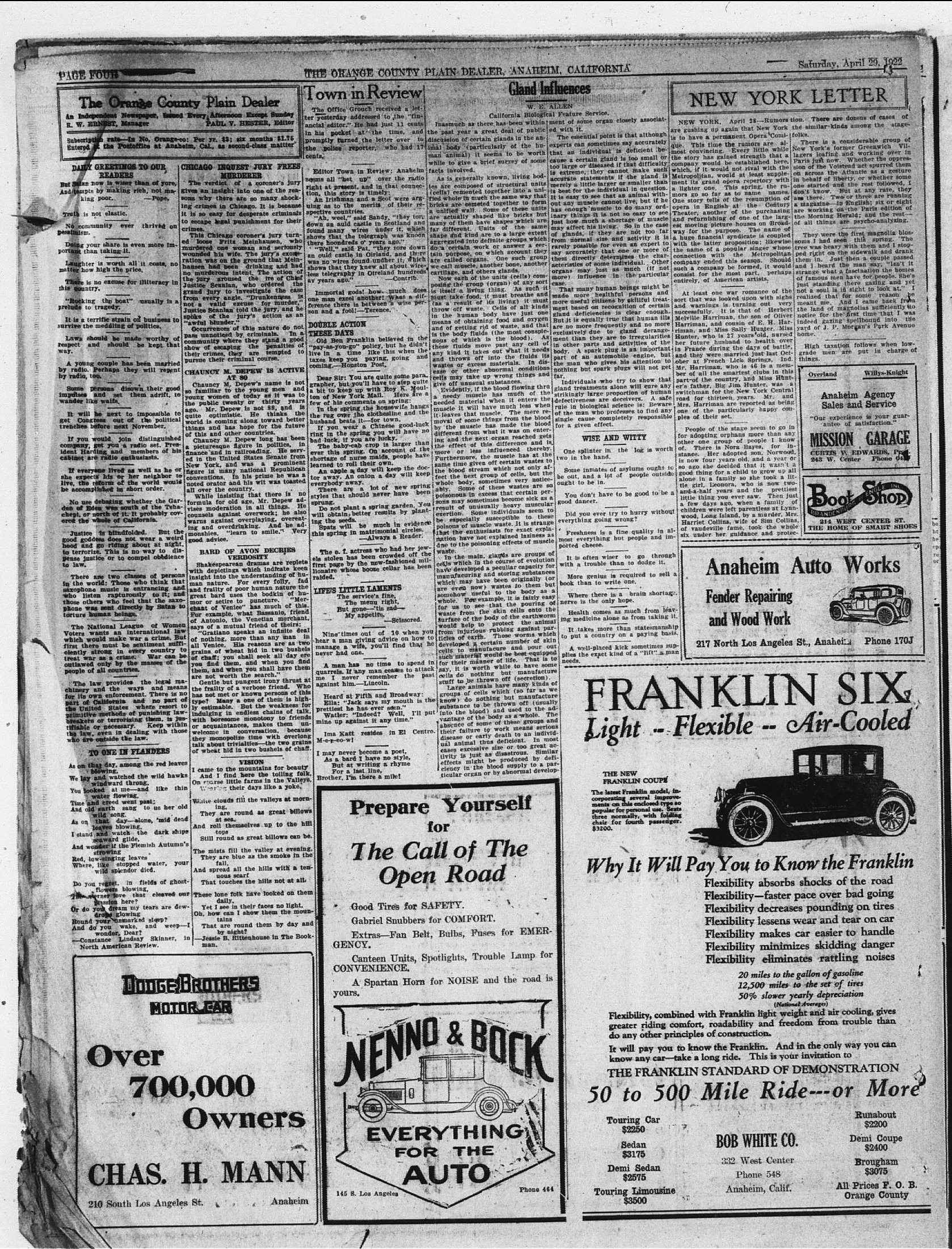
Searchable text
The Orange County Plain Dealer
An Independent Newspaper, Issued Every Afternoon Except Sunday
R. W. ERNEST, Manager
PAUL V. HESTER, Editor
Subscription rate—In No. Orange-co: Per yr. $3; six months $1.75
Entered at the Postoffice at Anaheim, Cal., as second-class matter
DAILY GREETINGS TO OUR READERS
But Susan now is wiser than of yore,
And tempts by making rich, not making poor.
Pope,
Truth is not elastic.
No community ever thrived on pessimism.
Doing your share is even more important than taking it.
Laughter is worth all it costs, no matter how high the price.
There is no excuse for illiteracy in this country.
"Rocking the boat" usually is a prelude to tragedy.
It is a terrific strain of business to survive the meddling of politics.
Laws should be made worthy of respect and should be kept that way.
A young couple has been married by radio. Perhaps they will repent by radio, too.
Some persons disown their good impulses and set them adrift, to wander like waifs.
It will be next to impossible to get Congress out of the political trenches before next November.
If you would join distinguished company, get you a radio set. President Harding and members of his cabinet are radio enthusiasts.
CHICAGO INQUEST JURY FREES MURDERER
The verdict of a coroner's jury gives an insight into one of the reasons why there are so many shocking crimes in Chicago. It is because it is so easy for desperate criminals to escape legal punishment for their crimes.
This Chicago coroner's jury turned loose Fritz Meinhausen, who murdered one woman and seriously wounded his wife. The jury's exoneration was on the ground that Meinhausen had been drinking and had no murderous intent. The action of the jury groused the irre of Chief Justice Scanlan, who ordered the grand jury to investigate the case from every angle. "Drunkenness is not a valid excuse for murder," Justice Scanlan told the jury, and he spoke of the jury's action as an "awful blunder."
Occurrences of this nature do not pass unnoticed by criminals. In a community where they stand a good show of escaping the penalties of their crimes, they are tempted to pursue their criminal course.
CHAUNCY M. DEPEW IS ACTIVE AT 80
Chaucy M. Depew's name is not so familiar to the young men and young women of today as it was to the public twenty or thirty years ago. Mr. Depew is not 88, and is quite optimistic. He thinks the world is coming along toward better things and has hope for the future of this and other countries.
Chaucy M. Depew long has been a picturesque figure in politics, in finance and in railroading. He served in the United States Senate from New York, and was a prominent Editor Town
neems all "het right at present tion, this story An Irishman using as to the spective country "Ah, weel," down an auid o found many w shows that the there hoondred "Well," said an ould castle was no wires fo shows that they less telegraphy ay years ago."
Immortal go one man excel fference there l son and a fool
DOUBLE ACTION THESE DAYS
Old Ben Frie "pay-as-you-go live in a time taxes keep you coming." Hour
Dear Sir: You grapher, but you a bit to keep ton of New Yew few of his com In the spring the rug over j husband beats If you wear ring in the sp bad luck, if yo The baby-creever this spring shortage of nu learned to ro
by radio. Perhaps they will repent by radio, too.
Some persons disown their good impulses and set them adrift, to wander like waits.
It will be next to impossible to get Congress out of the political trenches before next November.
If you would join distinguished company, get you a radio set. President Harding and members of his cabinet are radio enthusiasts.
If everyone lived as well as he or she expects his or her neighbor to live, the reform of the world would be accomplished in short order.
No use debating whether the Garden of Eden was south of the Tehachepi, or north of it. It probably covered the whole of California.
Justice is blindfolded. But the good goddess does not wear a weird hood and go riding about at night, to terrorize. This is no way to dispense justice or to compel obblience to law.
There are two classes of persons in the world: Those who think that saxophone music is entrancing and who listen rapturously to it; and those others who feel that the saxophone was sent directly by Satan to torture human beings.
The National League of Women Voters wants an international law which would make war a crime. But first there must be sentiment sufficiently strong in every country to treat war as a crime. War can be outlawed only by the masses of the people of all countries.
The law provides the legal machinery and the ways and means for its own enforcement. There is no part of California and no part of the United States where resort to primitive methods of punishing law-breakers or terrorizing them, is justifiable or necessary. Keep within the law, even in dealing with those who are outside the law.
TO ONE IN PLANDERS
As on that day, among the red leaves blowing,
We lay and watched the wild hawks windward throng.
You looked at me—and like thin water flowing.
Time and creed went past;
And old earth sang to us her old wild song.
As on that day—alone, 'mid dead leaves blowing.
I stand and watch the dark ships seaward glide.
And wonder if the Flemish Autumn's strowing
Red, low-slinging leaves
Where, like stopped water, your wild splendor died.
CHAUNCY M. DEPEW IS ACTIVE AT 80
Chauncy M. Depew's name is not so familiar to the young men and young women of today as it was to the public twenty or thirty years ago. Mr. Depew is not 88, and is quite optimistic. He thinks the world is coming along toward better things and has hope for the future of this and other countries.
Chauncy M. Depew long has been a picturesque figure in politics, in finance and in railroading. He served in the United States Senate from New York, and was a prominent figure in many national Republican conventions. In his prime he was a noted orator and his wit was toasted all over the country.
While insisting that there is no formula for old age, Mr. Depew advises moderation in all things. He counsels against overwork; he also warns against overplaying, overeating and overdrinking. And he admonshies, "learn to smile." Very good advice.
BARD OF AVON DECRIES VERBOSITY
Shakespearean dramas are replete with depictings which indicate keen insight into the understanding of human nature. For every folly, fad and frailty of poor human nature the great bard uses the bodkin of humor or setire to puncture. "Merchant of Venice" has much of this. For example, what Bassanio, friend of Antonio, the Venetian merchant, says of a mutual friend of theirs:
"Gratiano speaks an infinite deal of nothing, more than any man in all Venice. His reasons are as two grains of wheat hid in two bushels of chaff; you shall seek all day ere you find them, and when you find them, and when you shall have them are not worth the search."
Gentle but pungent irony thrust at the frailty of a verbose friend. Who has not met or known persons of this type? Many a one of them is highly estimable. But the weakness for indulging in endless chains of talk, with boresome monotony to friends or acquaintances, makes them unwelcome in conversation, because they monopolize time with overlong talk about trivialities—the two grains of wheat hid in two bushels of chaff.
VISION
I came to the mountains for beauty
And I find here the tolling folk,
On sparse little farms in the Valleys,
Wearing their days like a yoke.
White clouds fill the valleys at morning.
They are round as great billows at sea.
And roll themselves up to the hill tops
Still round as great billows can be.
The mists fill the valley at evening.
They are blue as the smoke in the fall.
And spread all the hills with a tenuous scarf
That touches the hills not at all.
Dear Sir: You grapher, but you a bit to keep tenon of New Year few of his comIn the spring the rug over husband beats.
If you wear ring in the spad bad luck, if you
The baby-cr ever this spri shortage of nu learned to roll.
An apple tor away. An everybody awake.
There are styles that sh sprung.
Do not plan will obtain, be ing the seeds.
Spats will this spring in
The o.f. ac els stolen hast first page by lionaire whose raided.
LIFE'S LITTLE
The s
But g
My
Nine times hear a man manage a w never had o
A man has quarrels. If me I never against him.
Heard at Ella: "Jac prettiest he Watler: "mine up aga
Ima Katt M-e-p-eo-wl
I may never As a bard But at For a Brother, I'm
You looked at me—and like thin water flowing,
Time and creed went past;
And old earth sang to us her old wild song.
As on that day—alone, 'mid dead leaves blowing,
I stand and watch the dark ships seaward glide,
And wonder if the Flemish Autumn's strowing
Red, low-singing leaves
Where, like stopped water, your wild splendor died.
Do you regret, in fields of ghost-flowers blowing,
Theerner love that cleaved our mission here?
Or do you dream my tears are dewdrops glowing
Round your unmarked sleep?
And do you wake, and weep—I wonder, Dear?
—Constance Lindsay Skinner, in North American Review.
DODGE BROTHERS
MOTOR CAR
Over
700,000
Owners
CHAS. H. MANN
210 South Los Angeles St. Anaheim
Town in Review
The Office Grouch received a letter yesterday addressed to the "financial editor." He had just 11 cents in his pocket at the time, and promptly turned the letter over to the police reporter, who had 17 cents.
Editor Town in Review: Anaheim seems all "het up" over the radio right at present, and in that connection, this story is timely:
An Irishman and a Scot were arguing as to the merits of their respective countries.
"Ah, weel," said Sandy, "they tore down an old castle in Scotland and found many wires under it, which shows that the telegraph was known there hooddens of years ago."
"Well," said Pat, "they tore down an old castle in Orland, and there was no wires found under it, which shows that they knew all about wireless telegraphy in Oireland hundreds av years ago."
Contrib.
Immortal gods! how much does one man excel another! What a difference there is between a wise person and a fool!—Terence.
DOUBLE ACTION THESE DAYS
Old Ben Franklin believed in the "pay-as-you-go" policy, but he didn't live in a time like this when the taxes keep you paying, going and coming.—Houston Post.
Dear Sir: You are quite some paraphraser, but you'll have to step quite a bit to keep up with Roy K. Moulton of New York Mall. Here are a few of his comments on spring:
In the spring the housewife hangs the rug over the clothesline and the husband beats it—for town.
If you wear a Chinese good-luck ring in the spring you will have no bad luck, if you are lucky.
The baby-cab crop is larger than ever this spring. On account of the shortage of nurse malds, people have learned to roll their own.
Gland Influences
W. E. ALLEN
California Biological Feature Service.
Inasmuch as there has been within the past year a great deal of public discussion of certain glands in the animal body (particularly of the human animal) it seems to be worth while to give a brief survey of some facts involved.
As is generally known, living bodies are composed of structural units (cells) cemented together into a unified whole in much the same way that bricks are cemented together to form a unified wall. Some of these units are actually shaped like bricks but many of them have shapes which are far different. Units of the same shape and kind are to a large extent aggregated into definite groups which do a certain work or answer a certain purpose, on which account they are called organs. One such group we call muscle, another bone, another cartilage, and others glands.
Now each of the units (cells) compose the group (organ) of any sort is itself a living thing. As such it must take food; it must breathe and (as a result of its living) it must throw off waste. Cells of all kinds in the human body have just one means of obtaining food and oxygen and of getting rid of waste, and that is the body fluids (the most conspicuous of which is the blood). As these fluids move past any cell of any kind it takes out what it needs and throws off into the fluids its wastes or excess materials. In disease or other abnormal conditions cells may take up wrong things and give off unusual substances.
Evidently, if the blood flowing through a needy muscle has much of the needed material when it enters the muscle it will have much less when it leaves that muscle. The mere removal of some things from the blood by the muscle has made the blood different from what it was on entering and the next organ reached gets the effect of this difference and is more or less influenced thereby. Furthermore, the muscle has at the same time given off certain wastes to
That many human beings might be made more healthful persons and more useful citizens by skillful treatment based on recognition of certain gland deficiencies is clear enough. But it is equally true that human lills are no more frequently and no more exclusively due to gland derangement than they are to irregularities in other parts and activities of the body. A spark plug is an important part of an automobile engine, but the man who gives his attention to nothing but spark plugs will not get far.
Individuals who try to show that gland treatments alone will cure any strikingly large proportion of human defectiveness are deceivers. A safe rule in biological science is: Beware of the man who professes to find any single cause completely responsible for a given effect.
WISE AND WITTY
One splinter in the log is worth two in the hand.
Dear Sir: You are quite some para-grapher, but you'll have to step quite a bit to keep up with Roy K. Moulton of New York Mall. Here are a few of his comments on spring:
In the spring the housewife hangs the rug over the clotheline and the husband beats it—for town.
If you wear a Chinese good-luck ring in the spring you will have no bad luck, if you are lucky.
The baby-cab crop is larger than ever this spring. On account of the shortage of nurse malds, people have learned to roll their own.
An apple a day will keep the doctor away. An onion a day will keep everybody away.
There are a lot of new spring styles that should never have been sprung.
Do not plant a spring garden. You will obtain better results by planting the seeds.
Spats will be much in evidence this spring in matrimonial circles.
The o. f. actress who had her jewels stolen has been crowded off the first page by the new-fashioned millionaire whose booze cellar has been raided.
LIFE'S LITTLE LAMENTS
The service's fine,
The menu right,
But gone—"tis sad—
My appetite.
Scissored.
Nine times out of 10 when you hear a man giving advice on how to manage a wife, you'll find that he never had one.
A man has no time to spend in quarrels. If any man ceases to attack me I never remember the past against him.—Lincoln.
Heard at Fifth and Broadway:
Ella: "Jack says my mouth is the prettiest he has ever seen."
Watler: "Indeed? Well, I'll put mine up against it any time."
Ima Katt resides in El Centro. M-e-r-e-o-w!
I may never become a poet.
As a bard I have no style,
But at writing a rhyme
For a last line,
Brother, I'm there a mile!
In the main, glands are groups of cells which in the course of evolution have developed a peculiar capacity for manufacturing and storing substances which may have been originally (or even now) wastes to them but somehow useful to the body as a whole. For example, it is fairly easy for us to see that the pouring of waste from the skin cells onto the surface of the body of the earthworm would help to protect the animal from injurious rubbing against particles of earth. Those worms develop a certain number of skin cells to manufacture and pour out such material would be best equipped for their manner of life. That is to say, it is worth while to have some cells do nothing but manufacture stuff to be thrown off (secretion).
Large animals have many kinds of groups of cells which (so far as we know) do nothing but manufacture substance to be thrown off (usually into the blood) and used to the advantage of the body as a whole. The absence of some of these groups and their failure to work means serious disease or early death to an individual animal thus deficient. In most cases excessive size or too great activity is just as disastrous. Similar effects might be produced by deficiency in the blood supply to a particular organ or by abnormal development or other abnormal conditions cells may take up wrong things and give off unusual substances.
Evidently, if the blood flowing through a needy muscle has much of the needed material when it enters the muscle it will have much less when it leaves that muscle. The mere removal of some things from the blood by the muscle has made the blood different from what it was on entering and the next organ reached gets the effect of this difference and is more or less influenced thereby. Furthermore, the muscle has at the same time given off certain wastes to the blood stream which not only affect the next group of cells, but the whole body, sometimes very noticeably. Some of these wastes are so poisonous in excess that certain persons may sometimes become sick as a result of unusually heavy muscular exertion. Some individuals seem to be especially susceptible to these poisons of muscle waste. It is strange that the enthusiasts for exact explanation have not explained laziness as due to the poisoning effects of muscle waste.
In the main, glands are groups of cells which in the course of evolution have developed a peculiar capacity for manufacturing and storing substances which may have been originally (or even now) wastes to them but somehow useful to the body as a whole. For example, it is fairly easy for us to see that the pouring of waste from the skin cells onto the surface of the body of the earthworm would help to protect the animal from injurious rubbing against particles of earth. Those worms develop a certain number of skin cells to manufacture and pour out such material would be best equipped for their manner of life. That is to say, it is worth while to have some cells do nothing but manufacture stuff to be thrown off (secretion).
Large animals have many kinds of groups of cells which (so far as we know) do nothing but manufacture substance to be thrown off (usually into the blood) and used to the advantage of the body as a whole. The absence of some of these groups and their failure to work means serious disease or early death to an individual animal thus deficient. In most cases excessive size or too great activity is just as disastrous. Similar effects might be produced by deficiency in the blood supply to a particular organ or by abnormal development or other abnormal conditions cells may take up wrong things and give off unusual substances.
Evidently, if the blood flowing through a needy muscle has much of the needed material when it enters the muscle it will have much less when it leaves that muscle. The mere removal of some things from the blood by the muscle has made the blood different from what it was on entering and the next organ reached gets the effect of this difference and is more or less influenced thereby. Furthermore, the muscle has at the same time given off certain wastes to the blood stream which not only affect the next group of cells, but the whole body, sometimes very noticeably. Some of these wastes are so poisonous in excess that certain persons may sometimes become sick as a result of unusually heavy muscular exertion. Some individuals seem to be especially susceptible to these poisons of muscle waste. It is strange that the enthusiasts for exact explanation have not explained laziness as due to the poisoning effects of muscle waste.
In the main, glands are groups of cells which in the course of evolution have developed a peculiar capacity for manufacturing and storing substances which may have been originally (or even now) wastes to them but somehow useful to the body as a whole. For example, it is fairly easy for us to see that the pouring of waste from the skin cells onto the surface of the body of the earthworm would help to protect the animal from injurious rubbing against particles of earth. Those worms develop a certain number of skin cells to manufacture and pour out such material would be best equipped for their manner of life. That is to say, it is worthwhile to have some cells do nothing but manufacture stuff to be thrown off (secretion).
Large animals have many kinds of groups of cells which (so far as we know) do nothing but manufacture substance to be thrown off (usually into the blood) and used to the advantage of the body as a whole. The absence of some of these groups and their failure to work means serious disease or early death to an individual animal thus deficient. In most cases excessive size or too great activity is just as disastrous. Similar effects might be produced by deficiency in the blood supply to a particular organ or by abnormal development or other abnormal conditions cells may take up wrong things and give off unusual substances.
Evidently, if the blood flowing through a needy muscle has much of the needed material when it enters the muscle it will have much less when it leaves that muscle. The mere removal of some things from the blood by the muscle has made the blood different from what it was on entering and the next organ reached gets the effect of this difference and is more or less influenced thereby. Furthermore, the muscle has at the same time given off certain wastes to the blood stream which not only affect the next group of cells, but the whole body, sometimes very noticeably. Some of these wastes are so poisonous in excess that certain persons may sometimes become sick as a result of unusually heavy muscular exertion. Some individuals seem to be especially susceptible to these poisons of muscle waste. It is strange that the enthusiasts for exact explanation have not explained laziness as due to the poisoning effects of muscle waste.
In the main, glands are groups of cells which in the course of evolution have developed a peculiar capacity for manufacturing and storing substances which may have been originally (or even now) wastes to them but somehow useful to the body as a whole. For example, it is fairly easy for us to see that the pouring of waste from the skin cells onto the surface of the body of the earthworm would help to protect the animal from injurious rubbing against particles of earth. Those worms develop a certain number of skin cells to manufacture and pour out such material would be best equipped for their manner of life. That is to say, it is worthwhile to have some cells do nothing but manufacture stuff to be thrown off (secretion).
Large animals have many kinds of groups of cells which (so far as we know) do nothing but manufacture substance to be thrown off (usually into the blood) and used to the advantage of the body as a whole. The absence of some of these groups and their failure to work means serious disease or early death to an individual animal thus deficient. In most cases excessive size or too great activity is just as disastrous. Similar effects might be produced by deficiency in the blood supply to a particular organ or by abnormal development or other abnormal conditions cells may take up wrong things and give off unusual substances.
Evidently, if the blood flowing through a needy muscle has much of the needed material when it enters the muscle it will have much less when it leaves that muscle. The mere removal of some things from the blood by the muscle has made the blood different from what it was on entering and the next organ reached gets the effect of this difference and is more or less influenced thereby. Furthermore, the muscle has at the same time given off certain wastes to the blood stream which not only affect the next group of cells, but the whole body, sometimes very noticeably. Some of these wastes are so poisonous in excess that certain persons may sometimes become sick as a result of unusually heavy muscular exertion. Some individuals seem to be especially susceptible to these poisons of muscle waste. It is strange that the enthusiasts for exact explanation have not explained laziness as due to the poisoning effects of muscle waste.
In the main, glands are groups of cells which in the course of evolution have developed a peculiar capacity for manufacturing and storing substances which may have been originally (or even now) wastes to them but somehow useful to the body as a whole. For example, it is fairly easy for us to see that the pouring of waste from the skin cells onto the surface of the body ofthe earthworm would help to protect the animal from injurious rubbing against particles of earth. Those worms develop a certain number of skin cells to manufacture and pour out such material would be best equipped for their manner of life. That is to say, it is worthwhile to have some cells do nothing but manufacture stuff to be thrown off (secretion).
Large animals have many kinds of groups of cells which (so far as we know) do nothing but manufacture substance to be thrown off (usually into the blood) and used to the advantage of the body as a whole. The absence of some of these groups and their failure to work means serious disease or early death to an individual animal thus deficient. In most cases excessive size or too great activity is just as disastrous. Similar effects might be produced by deficiency in the blood supply to a particular organ or by abnormal development or other abnormal conditions cells may take up wrong things and give off unusual substances.
Evidently, if the blood flowing through a needy muscle has much of the needed material when it enters the muscle it will have much less when it leaves that muscle. The mere removal of some things from the blood by the muscle has made the blood different from what it was on entering and the next organ reached gets the effect of this difference and is more or less influenced thereby. Furthermore, the muscle has at the same time given off certain wastes tothe blood stream which not only affectthe next groupofcellsbutthewholebody,sometimesverynoticeably.Someofthesewastesaresopoisonousinexcessthatcertainpersonsmaynotsimplybecome sickasaresultofunusuallyheavymuscularexertion.Someindividualssemelittlewastebecauseoverlongtwograinsofchaffbecauseoverlongtwograinsofchaffbecauseoverlongtwograinsofchaffbecauseoverlongtwograinsofchaffbecauseoverlongtwograinsofchaffbecauseoverlongtwograinsofchaffbecauseoverlongtwograinsofchaffbecauseoverlongtwograinsofchaffbecauseoverlongtwograinsofchaffbecauseoverlongtwograinsofchaffbecauseoverlongtwograinsofchaffbecauseoverlongtwograinsofchaffbecauseoverlongtwograinsofchaffbecauseoverlongtwograinsofchaff becauseoverlongtwograinsofchaffbecauseoverlongtwograinsofchaffbecauseoverlongtwograinsofchaffbecauseoverlongtwograinsofchaffbecauseoverlongtwograinsofchaffbecauseoverlongtwograinsofchaffbecauseoverlongtwograinsofchaffbecauseoverlongtwograinsofchaffbecauseoverlongtwograinsofchaff becauseoverlongtwograinsofchaff becauseoverlongtwograinsofchaff becauseoverlongtwograinsofchaff becauseoverlongtwograinsofchaff becauseoverlongtwograinsofchaff becauseoverlong twograinsofchaff becauseoverlong twograinsofchaff becauseoverlong twograinsofchaff becauseoverlong twograinsofchaff becauseoverlong twograinsofchaff becauseoverlong twograinsofchaff becauseoverlong twograinsofchaff becauseoverlong twograinsofchaff becauseoverlong twograinsofchaff becauseoverlong twograinsofchaff becauseoverlong twograinsofchaff becauseover long twograinsofchaff becauseover long twograinsofchaff becauseover long twograinsofchaff becauseover long twograinsofchaff becauseover long twograinsofchaff becauseover long twograinsofchaf becauseover long twograinsofchaf becauseover long twograinsofchaf becauseover long twograinsofchaf becauseover long twograinsofchaf becauseover long twograinsOfchaf becauseover long twograinsOfchaf becauseover long twograinsOfchaf becauseover long twograinsOfchaf becauseover long twograinsOfchaf becauseover long twograINSOfchaf becauseover long two graINSOf chaf because over long two graINSOf chaf because over long two graINSOf chaf because over long two graINSOf chaf because over long two graINSOf chaf because over long two graINSOf chaf because over long two graINSOf chaf because over long two graINSOf chaf because over long two graINSOf chaf because over long two graINSOf chaf because over long Two graINSOf chaf BecauseOverLongTwo graINSOf chaf BecauseOverLongTwo graINSOf chaf BecauseOverLongTwo graINSOf chaf BecauseOverLongTwo graINSOf chaf BecauseOverLongTwo graINSOf chaf BecauseOverLongTwo graINSOf chaf BecauseOverLongTwo graINSOf chaf BecauseOverLongTwo graINSOf chaf BecauseOverLongTwo graINSOf chaf BecauseOverLongTwo graINSOf chaf BecauseOverLongTwo graINSOf chaf BecauseOver Long Two graINS Of chaf Because Over Long Two graINS Of chaf Because Over Long Two graINS Of chaf Because Over Long Two graINS Of chaf Because Over Long Two graINS Of chaf Because Over Long Two graINS Of chaf Because Over Long Two graINS Of chaf Because Over Long Two graINS Of chaf Because Over Long Two graINS Of chaf Because Over Long Two graINS Of chaf Because Over Long Two graINS Of chaf Because Over Long Two GraINsOf ChAF BecauseOverLongTwo graINsOf ChAF BecauseOverLongTwo graINsOf ChAF BecauseOverLongTwo graINsOf ChAF BecauseOverLongTwo graINsOf ChAF BecauseOverLongTwo graINsOf ChAF BecauseOverLongTwo graINsOf ChAF BecauseOverLongTwo graINsOf ChAF BecauseOverLongTwo graINsOf ChAF BecauseOverLongTwo graINsOf ChAF BecauseOver Long Two GraINs Of ChAF Because Over Long Two GraINs Of ChAF Because Over Long Two GraINs Of ChAF Because Over Long Two GraINs Of ChAF Because Over Long Two GraINs Of ChAF Because Over Long Two GraINs Of ChAF Because Over Long Two GraINs Of ChAF Because Over Long Two GraINs Of ChAF Because Over Long Two GraINs Of ChAF Because Over Long Two GraINs Of ChAF Because Over Long Two GraINs Of CHAF BecauseOverLongTwo graINsOf CHAFBecauseOverLongTwo graINsOf CHAFBecauseOverLongTwo graINsOf CHAFBecauseOverLongTwo graINsOf CHAFBecauseOverLongTwo graINsOf CHAFBecauseOverLongTwo graINsOf CHAFBecauseOverLongTwo graINsOf CHAFBecauseOverLongTwo graINsOf CHAFBecauseOverLongTwo graINsOf CHAFBecauseOverLongTwo graINsOF CHAFBecauseOverLongTwo graINsOF CHAFBecauseOverLongTwo graINsOF CHAFBecauseOverLongTwo graINsOF CHAFBecauseOverLongTwo graINsOF CHAFBecauseOverLongTwo graINsOF CHAFBecauseOverLongTwo graINsOF CHAFBecauseOverLongTwo graINsOF CHAFBecauseOverLongTwo graINsOF CHAFBecauseOverLongTwo graINsOF CHAFBecauseOverLongTwo grave IN s OF CH AF BecauseOverLongTwo grave IN s OF CH AF BecauseOverLongTwo grave IN s OF CH AF BecauseOverLongTwo grave IN s OF CH AF BecauseOverLongTwo grave IN s OF CH AF BecauseOverLongTwo grave IN s OF CH AF BecauseOverLongTwo grave IN s OF CH AF BecauseOverLongTwo grave IN s OF CH AF BecauseOverLongTwo grave IN s OF CH AF BecauseOverLongTwo grave IN s OF CH AF BecauseOverLongTwo grave IN s OF CH AF BecauseOverLONG2 grave IN s OF CH AF BecauseOverLONG2 grave IN s OF CH AF BecauseOverLONG2 grave IN s OF CH AF BecauseOverLONG2 grave IN s OF CH AF BecauseOverLONG2 grave IN s OF CH AF BecauseOverLONG2 grave IN s OF CH AF BecauseOverLONG2 grave IN s OF CH AF BecauseOverLONG2 grave IN s OF CH AF BecauseOverLONG2 grave IN s OF CH AF BecauseOverLONG2 grave IN s OF CH AF BecauseOverLONG2 grave IN s OFCH AF BecauseOverLONG2 grave IN s OFCH AF BecauseOverLONG2 grave IN s OFCH AF BecauseOverLONG2 grave IN s OFCH AF BecauseOverLONG2 grave IN s OFCH AF BecauseOverLONG2 grave IN s OFCH AF BecauseOverLONG2 grave IN s OFCH AF BecauseOverLONG2 grave IN s OFCH AF BecauseOverLONG2 grave IN s OFCH AF BecauseOverLONG2 grave IN s OFCH AFBecauseOverLONG2 grave IN s OFCH AFBecauseOverLONG2 grave IN s OFCH AFBecauseOverLONG2 grave IN s OFCH AFBecauseOverLONG2 grave IN s OFCH AFBecauseOverLONG2 grave IN s OFCH AFBecauseOverLONG2 grave IN s OFCH AFBecauseOverLONG2 grave IN s OFCH AFBecauseOverLONG2 grave IN s OFCH AFBecauseOverLONG2 grave IN s OFCH AFBecause OverLONG2 grave IN s OFCH AFBecause OverLONG2 grave IN s OFCH AFBecause OverLONG2 grave IN s OFCH AFBecause OverLONG2 grave IN s OFCH AFBecause OverLONG2 grave IN s OFCH AFBecause OverLONG2 grave IN s OFCH AFBecause OverLONG2 grave IN s OFCH AFBecause OverLONG2 grave IN s OFCH AFBecause OverLONG2 grave IN s OFCH AFBecause Over LONG2 grave IN s OFCH AFBecause Over LONG2 grave IN s OFCH AFBecause Over LONG2 grave IN s OFCH AFBecause Over LONG2 grave IN s OFCH AFBecause Over LONG2 grave IN s OFCH AFBecause Over LONG2 grave IN s OFCH AFBecause Over LONG2 grave IN s OFCH AFBecause Over LONG2 grave IN s_OFCH AFBecause Over LONG2 grave IN s_OFCH AFBecause Over LONG2 grave IN s_OFCH AFBecause Over LONG2 grave IN s_OFCH AFBecause Over LONG2 grave IN s_OFCH AFBecause Over LONG2 grave IN s_OFCH AFBecause Over LONG2 grave IN s_OFCH AFBecause Over LONG2 grave IN S_OFCH AFBecause Over LONG2 grave IN S_OFCH AFBecause Over LONG2 grave IN S_OFCH AFBecause Over LONG2 grave IN S_OFCH AFBecause Over LONG2 grave IN S_OFCH AFBecause Over LONG2 grave IN S_OFCH AFBecause Over LONG2 grave IN S_OFCH AFBecause Over LONG2 grave IN S_OFCH AfBeautiful folk tale Valley yoke
At morn-
at billows
at hill
at evening
atoke in thie
at night
at evening
atoke in thie
at night
at evening
atoke in thie
at night
at evening
atoke in thie
at night
at evening
atoke in thie
at night
at evening
atoke in thie
at night
at evening
atoke in thie
at night
at evening
atoke in thie
at night
at evening
atoke in thie
at night
at evening
atoke in thie
at night
at evening
atoke in thie
at night
at beautyful folk tale Valley yoke
At morn-
At morn-
At morn-
At morn-
At morn-
At morn-
At morn-
At morn-
At morn-
At morn-
At morn-
At morn-
At morn-
At morn-
At morn-
At morn-
At morn-
At morn-
At morn-
At morn-
At morn-
At morn-
At morn-
At morn-
At morn-
At morn-
At morn-
At morn-
At morn-
At morn-
At morn-
At morn-
At morn-
At morn-
At morn-
At morn-
At morn-
At morn-
At morn-
At morn-
At morn-
At morn-
At morn-
At morn-
At morn-
At mornAt mornAt mrnAt mnrnAt mnrnAt mnrnAt mnrnAt mnrnAt mnrnAt mnrnAt mnrnAt mnrnAt mnrnAt mnrnAt mnrnAt mnrnAt mnrnAt mnrnAt mnrnAt mnrnAt mnrnAt mnrnAt mnrnAt mnrnAt mnrnAt mnrnAt mnrnAt mnrnAt mnrnAt mnrnAt mnrnAt mnrnAt mnrnAt mnrnAt mnrnAt mnrnAt mnrnAt mnrnAt mnrnAt mnrnAt mnrnAt mnrnAt mnrnAt mnrnAt mnrnAt mnrnAt mnrnAt mnrnAt mnrnAt mnrnAt mnrnATmnRN
ATmnRN
ATmnRN
ATmnRN
ATmnRN
ATmnRN
ATmnRN
ATmnRN
ATmnRN
ATmnRN
ATmnRN
ATmnRN
ATmnRN
ATmnRN
ATmnRN
ATmnRN
ATmnRN
ATmnRN
ATmnRN
ATmnRN
ATmnRN
ATmnRN
ATmnRN
ATmnRN
ATmnRN
ATmnRN
ATmnRN
ATmnRN
ATmnRN
ATmnRN
ATmnRN
ATmnRN
ATmnRN
ATmnRN
ATmnRN
ATmnRN
ATmnRN
ATmnRN
ATmnRN
ATmnRN
ATmnRN
ATmnRN
ATmnRN
ATmnRN
ATmnRN
ATmnRN
ATmnRN
ATmnRN
ATmnRN
ATmnRN
ATmnRN
ATmnRN
ATmnRN
ATmnRN
ATmnRN
ATmnRN
ATmnRN
ATmnRN
ATmnRN
ATmnRN
ATmnRN
ATmnRN
ATmnRN
ATmnRN
ATmnRN
ATmnRN
ATmnRN
ATmnRN
ATmnRN
ATmnRNA
ATnmRNA
ATnmRNA
ATnmRNA
ATnmRNA
ATnmRNA
ATnmRNA
ATnmRNA
ATnmRNA
ATnmRNA
ATnmRNA
ATnmRNA
ATnmRNA
ATnmRNA
ATnmRNA
ATnmRNA
ATnmRNA
ATnmRNA
ATnmRNA
ATnmRNA
ATnmRNA
ATnmRNA
ATnmRNA
ATnmRNA
ATnmRNA
ATnmRNA
ATnmRNA
ATnmRNA
ATnmRNA
ATnmRNA
ATnmRNA
ATnmRNA
ATnmRNA
ATnmRNA
ATnmRNA
ATnmRNA
ATnmRNA
ATnmRNA
ATnmRNA
ATnmRNA
ATnmRNA
ATnmRNA
ATnmRNA
ATnmRNA
ATnmRNA
ATnmRNA
ATnmRNA
ATnmRNA
ATnmRNA
ATnmRNA
ATnmRNA
AT nmRn
AT nmRn
AT nmRn
AT nmRn
AT nmRn
AT nmRn
AT nmRn
AT nmRn
AT nmRn
AT nmRn
AT nmRn
AT nmRn
AT nmRn
AT nmRn
AT nmRn
AT nmRn
AT nmRn
AT nmRn
AT nmRn
AT nmRn
ATTmRn
ATTmRn
ATTmRn
ATTmRn
ATTmRn
ATTmRn
ATTmRn
ATTmRn
ATTmRn
ATTmRn
ATTmRn
ATTmRn
ATTmRn
ATTmRn
ATTmRn
ATTmRn
ATTmRn
ATTmRn
ATTmRn
ATTmRn
ATTmRn
ATTmRn
ATTmRn
ATTmRn
ATTmRn
ATTmRn
ATTmRn
ATTmRn
ATTmRn
ATTmRn
ATTmRn
ATTmRn
ATTmRn
ATTmRn
ATTmRn
ATTmRn
ATTmRn
ATTmRn
ATTmRn
ATTm Rn
ATTm Rn
ATTm Rn
ATTm Rn
ATTm Rn
ATTm Rn
ATTm Rn
ATTm Rn
ATTm Rn
ATTm Rn
ATTm Rn
ATTm Rn
ATTm Rn
ATTm Rn
ATTm Rn
ATTm Rn
ATTm R
Prepare Yourself
for
The Call of The
Open Road
Good Tires for SAFETY.
Gabriel Snubbers for COMFORT.
Extras—Fan Belt, Bulbs, Fuses for EMERGENCY.
Canteen Units, Spotlights, Trouble Lamp for CONVENIENCE.
A Spartan Horn for NOISE and the road is yours.
NENNO & BOCK
EVERYTHING
FOR THE
AUTO
145 S. Los Angeles
Phone 464
NEW YORK, April 28—Rumors. There are dozens of cases of the similar kinds among the stage-folks.
There is a considerable group of New York's former Greenwich Village loafing and working over in Paris just now. Whether the oppression of the Volstead act spurred them on across the Atlantic as a gesture in behalf of liberty, or whether some one started and the rest followed, I don't know. But at any rate, they are there. Two or three are running a magazine—in English; six or eight are working on the Paris edition of the Morning Herald; and the rest—of all things are psycho-analyzing.
They were the first magnolia blossoms I had seen this spring. The tree was heavy with them and I stopped right on the sidewalk and drank them in. Just then a couple passed and I heard the man say, "I can't it strange what a fascination the homes of famous men have for people. She's just standing there gazing and yet not a soul is in sight to look at." I realized that for some reason he meant me. And I came back from the land of magnolias sufficiently to notice for the first time that I was indeed gazing spellbound into the yard of J. P. Morgan's Park Avenue home.
High taxation follows when low-grade men are put in charge of things.
At least one war romance of the sort that was looked upon with sighs and warnings is turning out very successfully. It is that of Herbert Melville Harriman, the son of Oliver Harriman, and cousin of E. H. Harriman, and Miss Sally Hunter. Miss Hunter, who is 27 years old, nursed her future husband to health over in France during the days of battle, and they were married just last October at French Lick Springs. Ind. Mr. Harriman, who is 46 is a member of all the smartest clubs in this part-of the country, and Miss Hunter's father, Big Jim Hunter, was a switchman for the New York Central road for thirteen years. Mr. and Mrs. Harriman are reported as being one of the particularly happy couples of their set.
People of the stage seem to go in for adopting orphans more than any other one group of people I know of. There is Nora Bayes, for instance. Her adopted son, Norwood, is now four years old, and a year or so she decided that it wasn't a
who try to show that
ents alone will cure any
age proportion of human
are deceivers. A safe
geical science is: Beware
who professes to find any
completely responsible
affect.
E AND WITTY
er in the log is worth
and.
ates of asylums ought to
a lot of people outside
in.
have to be good to be a
ever try to hurry without
going wrong?
is a fine quality in althing but people and imse.
wiser to go through
ble than to dodge it.
ius is required to sell a
to write one.
here is a brain shortage.
e only hope.
omes as much from leavalone as from taking it.
more than statesmanship
country on a paying basis.
laced kick sometimes supact kind of a "lift" man
People of the stage seem to go in for adopting orphans more than any other one group of people I know of. There is Nora Bayes, for instance. Her adopted son, Norwood, is now four years old, and a year or so ago she decided that it wasn't a good thing for a child to grow up all alone in a family so she took a little girl, Leonora, who is now two-and-a-half years and the prettiest little thing you ever saw. Then just a few days ago, when a family of children were left parentless at Lynnwood, Long Island, by a murder, Mrs. Harriet Collins, wife of Sim Collins, of vaudeville fame, took the whole six under her guidance and protec-
Overland Willys-Knight
Anaheim Agency
Sales and Service
"Our experience is your guarantee of satisfaction."
MISSION GARAGE
CURTIS W. EDWARDS, Pro243 W. Center Phone 011
Boot Shop
BRANDENBURG FENDLE INC.
214 WEST CENTER ST.
THE HOME OF SMART SHOES
Anaheim Auto Works
Fender Repairing
and Wood Work
217 North Los Angeles St., Anaheim Phone 170J
FRANKLIN SIX
Light -- Flexible -- Air-Cooled
THE NEW
FRANKLIN COUPE
the latest Franklin model, incorporating several improvements on this enclosed type so
popular for personal use. Seats
free normally, with folding
hate for fourth passenger.
3200.
Why It Will Pay You to Know the Franklin
Flexibility absorbs shocks of the road
Why It Will Pay You to Know the Franklin
Flexibility absorbs shocks of the road
Flexibility—faster pace over bad going
Flexibility decreases pounding on tires
Flexibility lessens wear and tear on car
Flexibility makes car easier to handle
Flexibility minimizes skidding danger
Flexibility eliminates rattling noises
20 miles to the gallon of gasoline
12,500 miles to the set of tires
50% slower yearly depreciation
(National Averages)
Flexibility, combined with Franklin light weight and air cooling, gives greater riding comfort, roadability and freedom from trouble than do any other principles of construction.
It will pay you to know the Franklin. And in the only way you can know any car—take a long ride. This is your invitation to THE FRANKLIN STANDARD OF DEMONSTRATION
50 to 500 Mile Ride---or More
Touring Car $2250
Runabout $2200
Sedan $3175
Demi Coupe $2400
Demi Sedan $2575
Brougham $3075
Touring Limousine $3500
Anaheim, Calif.
All Prices F. O. B.
Orange County