oc-plain-dealer 1921-06-01
Scanned page
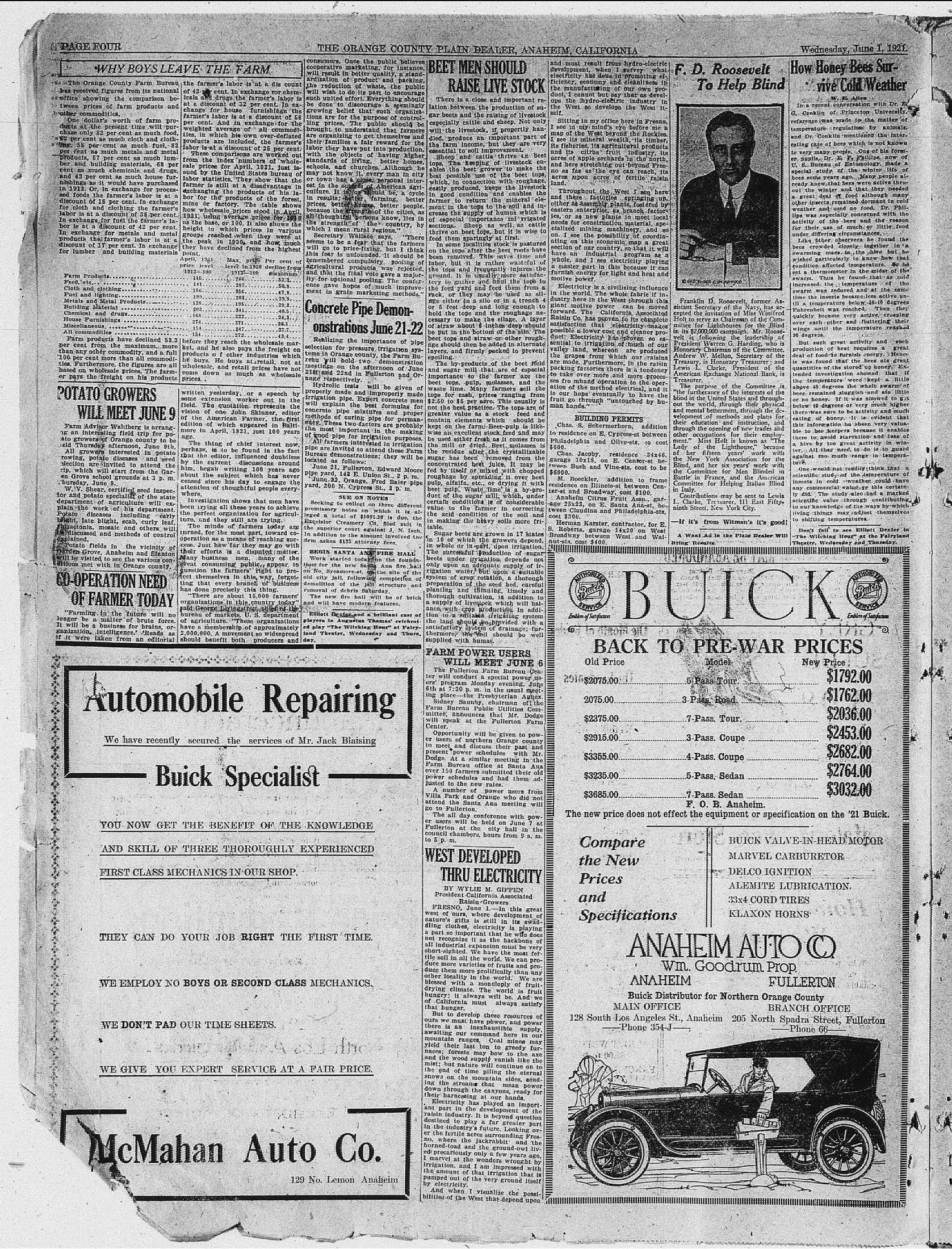
Searchable text
WHY BOYS LEAVE THE FARM
The Orange County Farm Bureau has received figures from its national office showing the comparison between prices of farm products and other commodities.
One dollar's worth of farm products at the present time will purchase only 82 per cent as much food, 52 per cent as much cloth and clothing, 58 per cent as much fuel, 83 per cent as much metals and metal products, 57 per cent as much lumber and building materials, 68 per cent as much chemicals and drugs, and 42 per cent as much house furnishings as it would have purchased in 1913. Or, in exchange for processed foods the farmer's labor is at a discount of 18 per cent. In exchange for cloth and clothing the farmer's labor is at a discount of 38 per cent. In exchange for fuel the farmer's labor is at a discount of 42 per cent. In exchange for metals and metal products the farmer's labor is at a discount of 17 per cent. In exchange for lumber and building materials.
Farm products have declined 53.3 per cent from the maximum, more than any other commodity, and a full 100 per cent more than all commodities. Furthermore, the figures are all based on wholesale prices. The farmer pays the freight on his products before they reach the wholesale market, and he also pays the freight on products of other industries which he buys. He buys at retail, not at wholesale, and retail prices have not come down as much as wholesale prices.
POTATO GROWERS WILL MEET JUNE 9
Farm Advisor Wahlberg is arranging an interesting field trip for potato growers of Orange county to be held Thursday afternoon, June 9th.
All growers interested in potato rowing, potato diseases and seed selection are invited to attend the farmer's labor is at a discount of 43 per cent. In exchange for chemicals and drugs the farmer's labor is at a discount of 32 per cent. In exchange for house furnishings the farmer's labor is at a discount of 58 per cent. And in exchange for the weighted average of all commodities, in which his own over-delated products are included, the farmer's labor is at a discount of 25 per cent.
These comparisons are worked out from the index numbers of wholesale prices for April, 1921, just issued by the United States bureau of labor statistics. They show that the farmer is still at a disadvantage in exchanging the products of his labor for the products of the forest, mine or factory. The table shows how wholesale prices stood in April, 1921, using average prices for 1913 as the base, or 100. It also shows the height to which prices in various groups reached when they were at the peak in 1920, and how much they have declined from the highest point.
April, 1921 Max. price Per cent of price level level in 1820 decline from 1913-100 maximum
Farm Products... 116...246...52.3
Feed, etc... 141...287...50.8
Cloth and clothing... 186...356...47.8
Fuel and lighting... 199...284...29.9
Metals and Metal Products... 128...195...29.2
Building Material... 203...341...40.5
Chemical and drugs... 168...222...24.3
House Furnishings... 274...371...26.1
Miscellaneous... 154...247...37.7
All commodities... 154...272...43.4
POTATO GROWERS WILL MEET JUNE 9
Farm Advisor Wahlberg is arranging an interesting field trip for potato growers of Orange county to be held Thursday afternoon, June 9th.
All growers interested in potato rowing, potato diseases and seed selection are invited to attend the farmer's labor is at a discount of 43 per cent. In exchange for chemicals and drugs the farmer's labor is at a discount of 32 per cent. In exchange for house furnishings the farmer's labor is at a discount of 58 per cent. And in exchange for all commodities, in which his own over-delated products are included, the farmer's labor is at a discount of 25 per cent.
These comparisons are worked out from the index numbers of wholesale prices for April, 1921, just issued by the United States bureau of labor statistics. They show that the farmer is still at a disadvantage in exchanging the products of his labor for the products of the forest, mine or factory. The table shows how wholesale prices stood in April, 1921, using average prices for 1913 as the base, or 100. It also shows the height to which prices in various groups reached when they were at the peak in 1920, and how much they have declined from the highest point.
POTATO GROWERS WILL MEET JUNE 9
Farm Advisor Wahlberg is arranging an interesting field trip for potato growers of Orange county to be held Thursday afternoon, June 9th.
All growers interested in potato rowing, potato diseases and seed selection are invited to attend the farmer's labor is at a discount of 43 per cent. In exchange for chemicals and drugs the farmer's labor is at a discount of 32 per cent. In exchange for house furnishings the farmer's labor is at a discount of 58 per cent. And in exchange for all commodities, in which his own over-delated products are included, the farmer's labor is at a discount of 25 per cent.
These comparisons are worked out from the index numbers of wholesale prices for April, 1921, just issued by the United States bureau of labor statistics. They show that the farmer is still at a disadvantage in exchanging the products of his labor for the products of the forest, mine or factory. The table shows how wholesale prices stood in April, 1921, using average prices for 1913 as the base, or 100. It also shows the height to which prices in various groups reached when they were at the peak in 1920, and how much they have declined from the highest point.
POTATO GROWERS WILL MEET JUNE 9
Farm Advisor Wahlberg is arranging an interesting field trip for potato growers of Orange county to be held Thursday afternoon, June 9th.
All growers interested in potato rowing, potato diseases and seed selection are invited to attend the farmer's labor is at a discount of 43 per cent. In exchange for chemicals and drugs the farmer's labor is at a discount of 32 per cent. In exchange for house furnishings the farmer's labor is at a discount of 58 per cent. And in exchange for all commodities, in which his own over-delated products are included, the farmer's labor is at a discount of 25 per cent.
These comparisons are worked out from the index numbers of wholesale prices for April, 1921, just issued by the United States bureau of labor statistics. They show that the farmer is still at a disadvantage in exchanging the products of his labor for the products of the forest, mine or factory. The table shows how wholesale prices stood in April, 1921, using average prices for 1913 as the base, or 100. It also shows the height to which prices in various groups reached when they were at the peak in 1920, and how much they have declined from the highest point.
POTATO GROWERS WILL MEET JUNE 9
Farm Advisor Wahlberg is arranging an interesting field trip for potato growers of Orange county to be held Thursday afternoon, June 9th.
All growers interested in potato rowing, potato diseases and seed selection are invited to attend the farmer's labor is at a discount of 43 per cent. In exchange for chemicals and drugs the farmer's labor is at a discount of 32 percent. In exchange for house furnishings the farmer's labor is at a discount of 58 per cent. And in exchange for all commodities, in which his own over-delated products are included, the farmer's labor is at a discount of 25 per cent.
These comparisons are worked out from the index numbers of wholesale prices for April, 1921, just issued by the United States bureau of labor statistics. They show that the farmer is still at a disadvantage in exchanging the products of his labor for the products of the forest, mine or factory. The table shows how wholesale prices stood in April, 1921, using average prices for 1913 as the base, or 100. It also shows the height to which prices in various groups reached when they were at the peak in 1920, and how much they have declined from the highest point.
POTATO GROWERS WILL MEET JUNE 9
Farm Advisor Wahlberg is arranging an interesting field trip for potato growers of Orange county to be held Thursday afternoon, June 9th.
All growers interested in potato rowing, potato diseases and seed selection are invited to attend the farmer's labor is at a discount of 43 per cent. In exchange for chemicals and drugs the farmer's labor is at a discount of 32 percent. In exchange for house furnishings the farmer's labor is at a discount of 58 per cent. And in exchange for all commodities, in which his own over-delated products are included, the farmer's labor is at a discount of 25 per cent.
These comparisons are worked out from the index numbers of wholesale prices for April, 1921, just issued by the United States bureau of labor statistics. They show that the farmer is still at a disadvantage in exchanging the products of his labor for the products of the forest, mine or factory. The table shows how wholesale prices stood in April, 1921, using average prices for 1913 as the base, or 100. It also shows the height to which prices in various groups reached when they were at the peak in 1920, and how much they have declined from the highest point.
POTATO GROWERS WILL MEET JUNE 9
Farm Advisor Wahlberg is arranging an interesting field trip for potato growers of Orange county to be held Thursday afternoon, June 9th.
All growers interested in potato rowing, potato diseases and seed selection are invited to attend the farmer's labor is at a discount of 43 per cent. In exchange for chemicals and drugs the farmer's labor is at a discount of 32 percent. In exchange for house furnishings the farmer's labor is at a discount of 58 per cent. And in exchange for all commodities, in which his own over-delated products are included, the farmer's labor is at a discount of 25 per cent.
These comparisons are worked out from the index numbers of wholesale prices for April, 1921, just issued by the United States bureau of labor statistics. They show that the farmer is still at a disadvantage in exchanging the products of his labor for the products of the forest, mine or factory. The table shows how wholesale prices stood in April, 1921, using average prices for 1913 as the base, or 100. It also shows the height to which prices in various groups reached when they were at the peak in 1920, and how much they have declined from the highest point.
POTATO GROWERS WILL MEET JUNE 9
Farm Advisor Wahlberg is arranging an interesting field trip for potato growers of Orange county to be held Thursday afternoon, June 9th.
All growers interested in potato rowing, potato diseases and seed selection are invited to attend the farmer's labor is at a discount of 43 per cent. In exchange for chemicals and drugs the farmer's labor is at a discount of 32 percent. In exchange for house furnishings the farmer's labor is at a discount of 58 per cent. And in exchange for all commodities, in which his own over-delated products are included, the farmer's labor is at a discount of 25 per cent.
These comparisons are worked out from the index numbers of wholesale prices for April, 1921, just issued by the United States bureau of labor statistics. They show that the farmer is still at a disadvantage in exchanging the products of his labor for the products of the forest, mine or factory. The table shows how wholesale prices stood in April, 1921, using average prices for 1913 as the base, or 100. It also shows the height to which prices in various groups reached when they were at the peak in 1920, and how much they have declined from the highest point.
POTATO GROWERS WILL MEET JUNE 9
Farm Advisor Wahlberg is arranging an interesting field trip for potato growers of Orange county to be held Thursday afternoon, June 9th.
All growers interested in potato rowing, potato diseases and seed selection are invited to attend the farmer's labor is at a discount of 43 per cent. In exchange for chemicals and drugs the farmer's labor is at a discount of 32 percent. In exchange for house furnishings the farmer's labor is at a discount of 58 per cent. And in exchange for all commodities, in which his own over-delated products are included, the farmer's labor is at a discount of 25 per cent.
These comparisons are worked out from the index numbers of wholesale prices for April, 1921, just issued by the United States bureau of labor statistics. They show that the farmer is still at a disadvantage in exchanging the products of his labor for the products of the forest, mine or factory. The table shows how wholesale prices stood in April,1921,using average prices for
POTATO GROWERS
WILL MEET JUNE 9
Farm Advisor Wahlberg is arranging an interesting field trip for potato growers of Orange county to be held Thursday afternoon, June 9th.
All growers interested in potato rowing, potato diseases and seed selection are invited to attend the trip, which will start from the Garden Grove school grounds at 1 p.m. Thursday, June 9.
W. V. Shear, certified seed inspector and potato specialist of the state department of agriculture will explain the work of his department.
Potato diseases including early blight, late blight, scab, curly leaf, fluzagtonia, mosaic and others will be discussed and methods of control explained.
Potato fields in the vicinity of Garden Grove, Anaheim and Stanton will be visited to see the various conditions met with in Orange county.
CO-OPERATION NEED OF FARMER TODAY
"Farming in the future will no longer be a matter of brute force. It will be a business for brains, organization, intelligence." Roads as if it were taken from an editorial written yesterday, or a speech by some extension worker out in the field. The quotation represents the vision of one John Skinner, editor of the American Farmer, the first edition of which appeared in Baltimore in April, 1821, just 100 years ago.
The thing of chief interest now, perhaps, is to be found in the fact that the editor, influenced doubtless by the current discussions around him, began writing 100 years ago about the subject which has never ceased since his day to engage the attention of thoughtful people everywhere.
Investigation shows that men have been trying all these years to achieve the perfect organization for agriculture, and they still are trying.
The minds of farmers today are turned, for the most part, toward cooperation as a means of reaching success. Just how far they may go with their efforts is a disputed matter. Many business men, many of the great consuming public, appear to question the farmers' right to protect themselves in this way, forgetting that every branch of business has done precisely this thing.
“There are about 15,000 farmers' organizations in this country today,” said George Livingston, chief of the bureau of markets, U.S. department of agriculture. "These organizations have a membership of approximately 2,000,000. A movement so widespread should benefit both producers and automobiles."
We have recently secured the services of Mr. Jack Blank.
BUICK SPECIALIST
YOU NOW GET THE BENEFIT OF THE KNOWLEDGE AND SKILL OF THREE THOROUGHLY EXPERIENCES FIRST CLASS MECHANICS IN OUR SHOP.
YOU NOW GET THE BENEFIT OF THE KNOWLED
AND SKILL OF THREE THOROUGHLY EXPERIENC
FIRST CLASS MECHANICS IN OUR SHOP.
THEY CAN DO YOUR JOB RIGHT THE FIRST TI
WE EMPLOY NO BOYS OR SECOND CLASS MECHAN
WE DON'T PAD OUR TIME SHEETS.
WE GIVE YOU EXPERT SERVICE AT A FAIR PR
McMahan Auto C
129 No. Lemon
THE ORANGE COUNTY PLAIN DEALER, ANAHEIM, CALIFORNIA
consumers. Once the public believes cooperative marketing, for instance, will result in better quality, a standardization of product and packing, the reduction of waste, the public will wish to do its part to encourage such united effort. Everything should be done to discourage a seemingly growing belief that such organizations are for the purpose of controlling prices. The public should be brought to understand that farmers are organizing to get themselves and their families a fair reward for the labor they have put into production, with the objects of having higher standards of living, better homes, schools, and churches. Although he may not know it, every man in city or town has a close personal interest in the success of American agriculture. It is so should be, a cycle in results; butter, farming, better prices, better homes, better people, because the strength of the cities, as all thoughtful persons know, lies in the strength of the country, by which I mean rural regions.
Secretary Wallace says, "There seems to be a fear that the farmers will go to price-fixing, but I think this fear is unfounded. It should be remembered compulsory pooling of agricultural products was rejected, and that the final vote gave a majority for optional pooling. The conference gave hopes of much improvement in grain marketing methods."
Concrete Pipe Demonstrations June 21-22
Realizing the importance of pipe selection for pressure irrigation systems in Orange county, the Farm Bureau will hold two demonstration meetings on the afternoon of June 21st and 22nd in Fullerton and Orange respectively.
Hydrolic tests will be given of properly made and improperly made irrigation pipe. Expert concrete men will explain the best formulas for concrete pipe mixtures and proper methods of curing pipe for permanency. These two factors are probably the most important in the making of good pipe for irrigation purposes.
All farmers interested in irrigation pipe are invited to attend these Farm Bureau demonstrations; they will be located as follows:
June 21-22
BEET MEN SHOULD RAISE LIVE STOCK
There is a close and important relation between the production of sugar beets and the raising of livestock especially cattle and sheep. Not only will the livestock, if properly handled, produce an important part of the farm income, but they are very essential to soil improvement.
Sheep and cattle thrive on beet tops. The keeping of livestock enables the beet grower to make the best possible use of the beet tops, which, in connection with roughage, easily produced, keeps the livestock in good condition and enables the farmer to return the mineral element in the tops to the soil and increase the supply of humus which is of especial importance in irrigated sections. Sheep as well as cattle thrive on beet tops, but it is wise to feed them sparingly at first.
In some localities stock is pastured on the tops after the beet roots have been removed. This saves time and labor, but it is rather wasteful of the tops and frequently injures the ground. It is usually more satisfactory to gather and hull the tops to the feed yard and feed them from a rack, or they may be used as silage either in a silo or in a trench or 5 feet deep and long enough to hold the tops and the roughage necessary to make the silage. A layer of straw about 6 inches deep should be put in the bottom of the silo. The beet tops and straw or other roughage should then be added in alternate layers, and firmly packed to prevent spoiling.
The by-products of the beet field and sugar mill that are of especial importance to the farmer are the beet tops, pulp, molasses and the waste lime. Many farmers sell the tops for cash, prices ranging from $2.50 to $5 per acre. This usually is not the best practice. The tops are of greater value as a stock feed and contain elements which should be kept on the farm. Beet-pulp is likewise an excellent stock feed and may be used either fresh as it comes from the mill or dried. Beet molasses is the residue after the crystallizable sugar has been removed from the concentrated beet juice. It may be and must result from hydro-electric development when I survey what electricity has done in promoting efficiency, economy and cleanliness in the manufacturing of our own product. I cannot but say that as develops the hydro-electric industry in the West so develops the West itself.
Sitting in my office here in Fresno, I see in my mind's eye before me a map of the West beyond the Rockies. I see its mineral wealth, its timber, its fisheries, its agricultural products and its citrus fruit industry, its acres of apple orchards in the north, and here stretching out beyond Fresno as far as we can reach, its acres upon acres of fertile raisin land.
Throughout the West I see here and there factories springing up, either as assembly plants, fostered by eastern enterprise, as branch factories, or as new plants to meet local needs for construction material, specialized mining machinery, and so on. I see the possibility of coordinating on this economic map a great section of our country, so that it will have an industrial program as a whole, and I see electricity playing a master part in this because it can furnish energy for light and heat and motive power.
Electricity is a civilizing influence in the world. The whole fabric if industry here in the West through this giant motive power can be moved forward. The California Associated Raisin Co. has proven to its complete satisfaction that electricity makes possible a lower cost and cleaner product. Electricity has proven so essential to irrigation of much of our valley land, whereon we produce the grapes from which our raisins are made. Furthermore, in the raisin packing factories there is a tendency to take over more and more processes fro m mand operation to the operation of the method electrical, and it is our hope eventually to have the fruit go through "untouched by human hands."
BUILDING PERMITS
Chas. S. Schermerhorn, addition to residence on E. Cypress-st between Philadelphia and Olly-sts, cost $600.
Chas. Jacoby, residence 34x46, garage 10x18, on E. Center-st between Bush and Winterside.
Hydraulic tests will be given of properly made and improperly made irrigation pipe. Expert concrete men will explain the best formulas for concrete pipe mixtures and proper methods of curing pipe for permanency. These two factors are probably the most important in the making of good pipe for irrigation purposes.
All farmers interested in irrigation pipe are invited to attend these Farm Bureau demonstrations; they will be located as follows:
June 21, Fullerton, Edward Moore pipe yard, 143 E. Union St., 2 p.m.
June 22, Orange, Fred Baier pipe yard, 200 N. Cypress St., 2 p.m.
SUE ON NOTES
Seeking to collect on three different promissory notes on which it is alleged a total of $1091.20 is due, the Excelsior Creamery Co. filed suit in the superior court against J. N. Isch. In addition to the amount involved the firm asks $125 attorney fees.
BEGIN SANTA ANI FIRE HALL
Work started today on the foundations for the new Santa Ana fire hall on No. Sycamore-st. on the site of the old city jail, following completion of demolition of the jail structure and removal of debris Saturday.
The new fire hall will be of brick and will have modern features.
Elliott Dexter and a brilliant cast of players in Augustus Thomas' celebrated play "The Witching Hour" at Fairyland Theatre, Wednesday and Thursday.
FARM POWER USERS
WILL MEET JUNE 6
The Fullerton Farm Bureau Center will conduct a special power users' program Monday evening, June 6th at 7:30 p.m. in the usual meeting place—the Presbyterian Annex.
Sidney Saunby, chairman of the Farm Bureau Public Utilities Committee, announces that Mr. Dodge will speak at the Fullerton Farm Center.
Opportunity will be given to power users of northern Orange county to meet and discuss their past and present power schedules with Mr. Dodge. At a similar meeting in the Farm Bureau office at Santa Ana over 150 farmers submitted their old power schedules and had them adjusted to the new rates.
A number of power users from Villa Park and Orange who did not attend the Santa Ana meeting will go to Fullerton.
The all day conference with power users will be held on June 7 at Fullerton at the city hall in the council chambers, hours from 9 a.m. to 5 p.m.
WEST DEVELOPED THRU ELECTRICITY
packing factories there is a tendency to take over more and more processes fro mand operation to the operation of the method electrical, and it is our hope eventually to have the fruit go through "untouched by human hands."
BUILDING PERMITS
Chas. S. Schermerhorn, addition to residence on E. Cypress-st between Philadelphia and Olive-sts, cost $600.
Chas. Jacoby, residence 34x46, garage 10x18, on E. Center-st between Bush and Vine-sts, cost to be $6000.
M. Boeckler, addition to frame residence on Illinois-st between Center-st and Broadway, cost $100.
Anaheim Citrus Fruit Assan., garage 25x23, on E. Santa Ana-st, between Claudina and Philadelphia-sts, cost $200.
Herman Karster, contractor, for E. S. Roberts, garage 14x20 on West Broadway between West and Walnut-sts, cost $400.
WEST DEVELOPED THRU ELECTRICITY
BY WYLIE M. GIFFEN
President California Associated Raisin-Growers
FRESNO, June 1.—In this great west of ours, where development of nature's gifts is still in its swaddling clothes, electricity is playing a part so important that he who does not recognize it as the backbone of all industrial expansion must be very short-sighted. We have the most fertile soil in all the world. We can produce more varieties of fruits and produce them more prolifically than any other locality in the world. We are blessed with a monoloply of fruit-drying climate. The world is fruit hungry; it always will be. And we of California must always satisfy that hunger.
But to develop these resources of ours we must have power, and power there is an inexhaustible supply, awaiting our command here in our mountain ranges. Coal mines may yield their last ton to greedy furnaces; forests may bow to the axe and the wood supply vanish like the mist; but nature will continue on to the end of time pilling the eternal snows on the mountain sides, sending the streams that mean power down through the canyons, ready for their harnessing at our hands.
Electricity has played an important part in the development of the raisin industry. It is beyond question destined to play a far greater part in the industry's future. Looking over the fertile acres surrounding Fresno, where the jackrabbit and the horned-toad and the ground-owl lived precariously only a few years ago, I marvel at the wonders wrought by irrigation, and I am impressed with the amount of that irrigation that is pumped out of the very ground itself by electricity.
And when I visualize the possibilities of the West that depend upon
F. D. Roosevelt To Help Blind
Franklin D. Roosevelt, former Assistant Secretary of the Navy, has accepted the invitation of Miss Winifred Holt to serve as Chairman of the Committee for Lighthouses for the Blind in its $2,000,000 campaign. Mr. Roosevelt is following the leadership of President Warren G. Harding, who is Honorary Chairman of the Committee. Andrew W. Mellon, Secretary of the Treasury, is Honorary Treasurer; and Lewis L. Clarke, President of the American Exchange National Bank, is Treasurer.
The purpose of the Committee is "the furtherance of the interests of the blind in the United States and throughout the world, through their physical and mental betterment, through the development of methods and plans for their education and instruction, and through the opening of new trades and other occupations for their employment." Miss Holt is known as "The Lady of the Lighthouse," because of her fifteen years' work with the New York Association for the Blind and her six years' work with
How Honey Bees Survive Cold Weather
In a recent conversation with Dr. E. G. Conklin of Princeton University, reference was made to the matter of temperature regulation by animals, and Dr. Conklin mentioned the interesting case of bees which is not known to very many people. One of his former pupils, Dr. E. F. Phillips, now of U.S. Bureau of Entomology, made a special study of the winter life of bees some years ago. Many people already knew that bees were active throughout the winter and that they needed a great deal of food although many other insects remained dormant in cold weather and used no food. Dr. Phillips was especially concerned with the activity of the bees and the reason for their use of much or little food under differing circumstances.
Like other observers he found the bees crowded closely together in a swarmed mass in the hive but he wished particularly to know how that condition affected temperature. So he set a thermometer in the midst of the swarm. Thus he found that as cold increased, the temperature of the swarm was reduced and at the same time the insects became less active until a temperature below 38-40 degrees Fahrenheit was reached. Then they quickly became very active, creeping over each other and fluttering their wings until the temperature reached 90 degrees.
But such great activity and such production of heat requires a great deal of food to furnish energy. Hence is found that the bees ate great quantities of the stored up honey. Extended investigation showed that if the temperature were kept a little above 40 degrees the whole swarm of bees remained sluggish and ate little or no honey. If it was allowed to get below 40 degrees or very higher there was sure to be activity and much eating of honey. It is evident that this information has been very valuable to bee keepers because it enables them to avoid starvation and loss of a hive by too great activity in winter. All they need to do is to guard against too much range in temperature.
THERMERHORN, addition
E. Cypress-st between
Ollve-sts, cost $100.
RESIDENCE 34x46.
ON E. Center-st bed Vine-sts, cost to be
addition to frame
Minis-st between Centadway, cost $1420 on West
weton West and Wal100.
THE PURPOSE OF THE COMMITtee is "the furtherance of the interests of the blind in the United States and through out the world, through their physical and mental betterment, through the development of methods and plans for their education and instruction, and through the opening of new trades and other occupations for their employment." Miss Holt is known as "The Lady of the Lighthouse," because of her fifteen years' work with the New York Association for the Blind, and her six years' work with the Committee for Men Blinded in Battle in France, and the American Committee for Helping Italian Blind in Italy.
Contributions may be sent to Lewis L. Clarke, Treasurer, 111 East Fifty-ninth Street, New York City.
—If it's from Witman's it's good!
A Want Ad in the Plain Dealer Will Bring Results.
BACK TO PRE-WAR PRICES
Real Price Model New Price
75.00 5-Pass Tour $1792.00
75.00 3-Pass Road $1762.00
75.00 7-Pass Tour $2036.00
15.00 3-Pass Coupe $2453.00
55.00 4-Pass Coupe $2682.00
235.00 5-Pass Sedan $2764.00
85.00 7-Pass Sedan $3032.00
F. O. B. Anaheim.
New price does not effect the equipment or specification on the '21 Buick.
BUICK VALVE-IN-HEAD MOTOR
MARVEL CARBURETOR
DELCO IGNITION
BUICK VALVE-IN-HEAD MOTOR
MARVEL CARBURETOR
DELCO IGNITION
ALEMITE LUBRICATION.
33x4 CORD TIRES
KLAXON HORNS
ANAHEIM AUTO CO
Wm. Goodrum Prop.
ANAHEIM FULLERTON
Buick Distributor for Northern Orange County
MAIN OFFICE BRANCH OFFICE
South Los Angeles St., Anaheim 205 North Spadra Street, Fullerton
Phone 354-J Phone 66