anaheim-gazette 1964-10-14
Scanned page
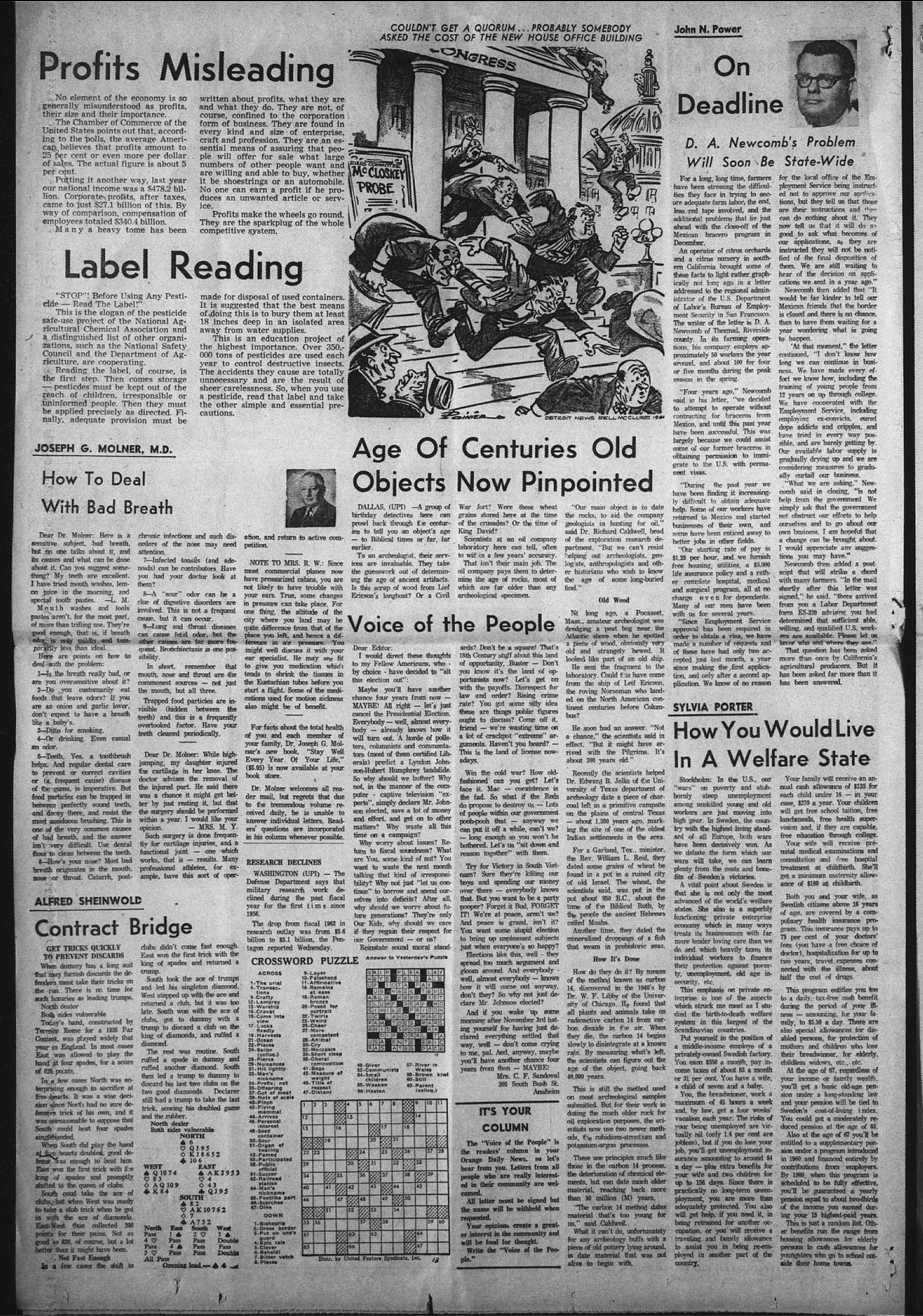
Searchable text
Profits Misleading
No element of the economy is so generally misunderstood as profits, their size and their importance.
The Chamber of Commerce of the United States points out that, according to the polls, the average American believes that profits amount to 25 per cent or even more per dollar of sales. The actual figure is about 5 per cent.
Putting it another way, last year our national income was a $478.2 billion. Corporate profits, after taxes, came to just $27.1 billion of this. By way of comparison, compensation of employees totaled $340.4 billion.
Many a heavy tome has been written about profits, what they are and what they do. They are not, of course, confined to the corporation form of business. They are found in every kind and size of enterprise, craft and profession. They are an essential means of assuring that people will offer for sale what large numbers of other people want and are willing and able to buy, whether it be shoestrings or an automobile. No one can earn a profit if he produces an unwanted article or service.
Profits make the wheels go round. They are the sparkplug of the whole competitive system.
Label Reading
"STOP!"! Before Using Any Pesticide — Read The Label!"
This is the slogan of the pesticide safe-use project of the National Agricultural Chemical Association and a distinguished list of other organizations, such as the National Safety Council and the Department of Agriculture, are cooperating.
Reading the label, of course, is the first step. Then comes storage — pesticides must be kept out of the reach of children, irresponsible or uninformed people. Then they must be applied precisely as directed. Finally, adequate provision must be made for disposal of used containers.
It is suggested that the best means of doing this is to bury them at least 18 inches deep in an isolated area away from water supplies.
This is an education project of the highest importance. Over 350,000 tons of pesticides are used each year to control destructive insects. The accidents they cause are totally unnecessary and are the result of sheer carelessness. So, when you use a pesticide, read that label and take the other simple and essential precautions.
JOSEPH G. MOLNER, M.D.
How To Deal
JOSEPH G. MOLNER, M.D.
How To Deal With Bad Breath
Dear Dr. Molner: Here is a sensitive subject, bad breath, but no one talks about it, and its causes and what can be done about it. Can you suggest something? My teeth are excellent. I have tried mouth washes, lemon juice in the morning, and special tooth pastes. —L. M.
Mouth washes and tools pastes aren't for the most part, of more than trifling use. They're good enough, that is, if breath odor is only mildly and temporarily less than ideal.
Here are points on how to deal with the problem:
1- Is the breath really bad, or are you oversensitive about it?
2- Do you customarily eat foods that leave odors? If you are an onion and garlic lover, don't expect to have a breath like a baby's.
3- Ditto for smoking.
4- Or drinking. Even casual an odor.
5- Teeth. Yes, a toothbrush helps. And regular dental care to prevent or correct cavities or (a frequent cause) disease of the gums, is imperative. But food particles can be trapped in between perfectly sound teeth, and decay there, and resist the most assiduous brushing. This is one of the very common causes of bad breath, and the answer isn't very difficult. Use dental floss to clean between the teeth.
6- How's your nose? Most bad breath originates in the mouth, nose or throat. Catarrh, post-chronic infections and such disorders of the nose may need attention.
7- Infected tonsils (and adenoids) can be contributors. Have you had your doctor look at them?
8- A "sour" odor can be a clue of digestive disorders are involved. This is not a frequent cause, but it can occur.
9- Lung and throat diseases can cause fetid odor, but the other causes are far more frequent. Bronchiectasis is one possibility.
In short, remember that mouth, nose and throat are the commonest sources — not just the mouth, but all three.
Trapped food particles are invisible (hidden between the teeth) and this is a frequently overlooked factor. Have your teeth cleaned periodically.
Dear Dr. Molner: While high-jumping, my daughter injured the cartilage in her knee. The doctor advises the removal of the injured part. He said there was a chance it might get better by just resting it, but that the surgery should be performed within a year. I would like your opinion.
Such surgery is done frequently for cartilage injuries, and a functional joint — one which works, that is — results. Many professional athletes, for example, have this sort of operation, and return to active competition.
NOTE TO MRS. R. W.: Since most commercial planes now have pressurized cabins, you are not likely to have trouble with your ears. True, some changes in pressure can take place. For one thing, the altitude of the city where you land may be quite difference from that of the place you left, and hence a difference in air pressure. You might well discuss it with your ear specialist. He may see fit to give you medication which tends to shrink the tissues in the Eustachian tubes before you start a flight. Some of the medications used for motion sickness also might be of benefit.
For facts about the total health of you and each member of your family, Dr. Joseph G. Molnar's new book, "Stay Well Every Year Of Your Life," ($5.95) is now available at your book store.
Dr. Molner welcomes all reader mail, but regrets that due to the tremendous volume received daily, he is unable to answer individual letters. Readers' questions are incorporated in his column whenever possible.
RESEARCH DECLINES
WASHINGTON (UPI) — The Defense Department says that military research work declined during the past fiscal year for the first time since 1956.
The drop from fiscal 1963 in pesticides must be kept out of the reach of children, irresponsible or uninformed people. Then they must be applied precisely as directed. Finally, adequate provision must be made.
JOSEPH G. MOLNER, M.D.
How To Deal With Bad Breath
Dear Dr. Molner: Here is a sensitive subject, bad breath, but no one talks about it, and its causes and what can be done about it. Can you suggest something? My teeth are excellent. I have tried mouth washes, lemon juice in the morning, and special tooth pastes. —L. M.
Mouth washes and tools pastes aren't for the most part, of more than trifling use. They're good enough, that is, if breath odor is only mildly and temporarily less than ideal.
Here are points on how to deal with the problem:
1- Is the breath really bad, or are you oversensitive about it?
2- Do you customarily eat foods that leave odors? If you are an onion and garlic lover, don't expect to have a breath like a baby's.
3- Ditto for smoking.
4- Or drinking. Even casual an odor.
5- Teeth. Yes, a toothbrush helps. And regular dental care to prevent or correct cavities or (a frequent cause) disease of the gums, is imperative. But food particles can be trapped in between perfectly sound teeth, and decay there, and resist the most assiduous brushing. This is one of the very common causes of bad breath, and the answer isn't very difficult. Use dental floss to clean between the teeth.
6- How's your nose? Most bad breath originates in the mouth, nose or throat. Catarrh, post-chronic infections and such disorders of the nose may need attention.
7- Infected tonsils (and adenoids) can be contributors. Have you had your doctor look at them?
8- A "sour" odor can be a clue of digestive disorders are involved. This is not a frequent cause, but it can occur.
9- Lung and throat diseases can cause fetid odor, but the other causes are far more frequent. Bronchiectasis is one possibility.
In short, remember that mouth, nose and throat are the commonest sources — not just the mouth, but all three.
Trapped food particles are invisible (hidden between the teeth) and this is a frequently overlooked factor. Have your teeth cleaned periodically.
Dear Dr. Molner: While high-jumping, my daughter injured the cartilage in her knee. The doctor advises the removal of the injured part. He said there was a chance it might get better by just resting it, but that the surgery should be performed within a year. I would like your opinion.
Such surgery is done frequently for cartilage injuries, and a functional joint — one which works, that is — results. Many professional athletes, for example, have this sort of operative.
NOTE TO MRS. R. W.: Since most commercial planes now have pressurized cabins, you are not likely to have trouble with your ears. True, some changes in pressure can take place. For one thing, the altitude of the city where you land may be quite difference from that of the place you left, and hence a difference in air pressure. You might well discuss it with your ear specialist. He may see fit to give you medication which tends to shrink the tissues in the Eustachian tubes before you start a flight. Some of the medications used for motion sickness also might be of benefit.
For facts about the total health of you and each member of your family, Dr. Joseph G. Molnar's new book, "Stay Well Every Year Of Your Life," ($5.95) is now available at your book store.
Dr. Molner welcomes all reader mail, but regrets that due to the tremendous volume received daily, he is unable to answer individual letters. Readers' questions are incorporated in his column whenever possible.
RESEARCH DECLINES
WASHINGTON (UPI) — The Defense Department says that military research work declined during the past fiscal year for the first time since 1956.
The drop from fiscal 1963 in pesticides must be kept out of the reach of children, irresponsible or uninformed people. Then they must be applied precisely as directed. Finally, adequate provision must be made.
JOSEPH G. MOLNER, M.D.
How To Deal With Bad Breath
Dear Dr. Molner: Here is a sensitive subject, bad breath, but no one talks about it, and its causes and what can be done about it. Can you suggest something? My teeth are excellent. I have tried mouth washes, lemon juice in the morning, and special tooth pastes. —L. M.
Mouth washes and tools pastes aren't for the most part, of more than trifling use. They're good enough, that is, if breath odor is only mildly and temporarily less than ideal.
Here are points on how to deal with the problem:
1- Is the breath really bad, or are you oversensitive about it?
2- Do you customarily eat foods that leave odors? If you are an onion and garlic lover, don't expect to have a breath like a baby's.
3- Ditto for smoking.
4- Or drinking. Even casual an odor.
5- Teeth. Yes, a toothbrush helps. And regular dental care to prevent or correct cavities or (a frequent cause) disease of the gums, is imperative. But food particles can be trapped in between perfectly sound teeth, and decay there, and resist the most assiduous brushing. This is one of the very common causes of bad breath, and the answer isn't very difficult. Use dental floss to clean between the teeth.
6- How's your nose? Most bad breath originates in the mouth, nose or throat. Catarrh, post-chronic infections and such disorders of the nose may need attention.
7- Infected tonsils (and adenoids) can be contributors. Have you had your doctor look at them?
8- A "sour" odor can be a clue of digestive disorders are involved. This is not a frequent cause, but it can occur.
9- Lung and throat diseases can cause fetid odor, but the other causes are far more frequent. Bronchiectasis is one possibility.
In short, remember that mouth, nose and throat are the commonest sources — not just just the mouth, but all three.
Trapped food particles are invisible (hidden between the teeth) and this is a frequently overlooked factor. Have your teeth cleaned periodically.
Dear Dr. Molner: While high-jumping, my daughter injured the cartilage in her knee. The doctor advises the removal of the injured part. He said there was a chance it might get better by just resting it, but that the surgery should be performed within a year. I would like your opinion.
Such surgery is done frequently for cartilage injuries, and a functional joint — one which works, that is — results. Many professional athletes, for example, have this sort of operative.
NOTE TO MRS. R. W.: Since most commercial planes now have pressurized cabins, you are not likely to have trouble with your ears. True, some changes in pressure can take place. For one thing, the altitude of the city where you land may be quite difference from that of the place you left, and hence a difference in air pressure. You might well discuss it with your ear specialist. He may see fit to give you medication which tends to shrink the tissues in the Eustachian tubes before you start a flight. Some of the medications used for motion sickness also might be of benefit.
For facts about the total health of you and each member of your family, Dr. Joseph G. Molnar's new book, "Stay Well Every Year Of Your Life," ($5.95) is now available at your book store.
Dr. Molner welcomes all reader mail, but regrets that due to the tremendous volume received daily, he is unable to answer individual letters. Readers' questions are incorporated in his column whenever possible.
RESEARCH DECLINES
WASHINGTON (UPI) — The Defense Department says that military research work declined during the past fiscal year for the first time since 1956.
The drop from fiscal 1963 in pesticides must be kept out of the reach of children, irresponsible or uninformed people. Then they must be applied precisely as directed. Finally, adequate provision must be made.
JOSEPH G. MOLNER, M.D.
How To Deal With Bad Breath
Dear Dr. Molner: Here is a sensitive subject,bad breath,but no one talks about it,and its causes和what can be done about it.Can you suggest something?My teeth are excellent.I have tried mouth washes,lemon juice in the morning,and special tooth pastes.—L.M.
Mouth washes和tools pastes aren't forthemostpartofnecessarysoundteeth,anddecaythere,andresistthemostassiduousbrushingThisisoneoftheverycommoncausesofbadbreath,andtheanswerisnotverydifficult.Usethreepartsofnecessarysoundteeth,anddecaythere,andresistthemostassiduousbrushingThisisoneoftheverycommoncausesofbadbreath,andtheanswerisnotverydifficult.Usethreepartsofnecessarysoundteeth,anddecaythere,andresistthemostassiduousbrushingThisisoneoftheverycommoncausesofbadbreath,andtheanswerisnotverydifficult.Usethreepartsofnecessarysoundteeth,anddecaythere,andresistthemostassiduousbrushingThisisoneoftheverycommoncausesofbadbreath,andtheanswerisnotverydifficult.Usethreepartsofnecessarysoundteeth,anddecaythere,andresistthemostassiduousbrushingThisisoneoftheverycommoncausesofbadbreath,andtheanswerisnotverydifficult.Usethreepartsofnecessarysoundteeth,anddecaythere,andresistthemostassiduousbrushingThisisoneoftheverycommoncausesofbadbreath,andtheanswerisnotverydifficult.Usethreepartsofnecessarysoundteeth,anddecaythere,andresistthemostassiduousbrushingThisisoneoftheverycommoncausesofbadbreath,andtheanswerisnotverydifficult.Usethreepartsofnecessarysoundteeth,anddecaythere,andresistthemostassiduousbrushingThisisoneoftheverycommoncausesofbadbreath,andtheanswerisnotverydifficult.Usethreepartsofnecessarysoundteeth,anddecaythere,andresistthemostassiduousbrushingThisisoneoftheverycommoncausesofbadbreath,andtheanswerisnotverydifficult.Usethreepartsofnecessarysoundteeth,anddecaythere,andresistthemostassiduousbrushingThisisoneoftheverycommoncausesofbadbreath,andtheanswerisnotverydifficult.Usethreepartsofnecessarysoundteeth,anddecaythere,andresistthemostassiduousbrushingThisisoneoftheverycommoncausesofbadbreath,andtheanswerisnotverydifficult.Usethreepartsofnecessarysoundteeth,anddecaythere,andresistthemostassiduousbrushingThisisoneoftheverycommoncausesofbadbreath,andtheanswerisnotverydifficult.Usethreepartsofnecessarysoundteeth,anddecaythere,andresistthemostassiduousbrushingThisisoneoftheverycommoncausesofbadbreath,andtheanswerisnotverydifficult.Usethreepartsofnecessarysoundteeth,anddecaythere,andresistthemostassiduousbrushingThisisoneoftheverycommoncausesofbadbreath,andtheanswerisnotverydifficult.Usethreepartsofnecessarysoundteeth,anddecaythere,andresistthemostassiduousbrushingThisisoneoftheverycommoncausesofbadbreath,andtheanswerisnotverydifficult.Usethreepartsofnecessarysoundteeth,anddecaythere,andresistthemostassiduousbrushingThisisoneoftheverycommoncausesofbadbreath,andtheanswerisnotverydifficult.Usethreepartsofnecessarysoundteeth,anddecaythere,andresistthemostassiduousbrushingThisisoneoftheverycommoncausesofbadbreath,和theanswerisnotverydifficult.Usethreepartsofnecessarysoundteeth,和decaythere,和resistthemostassiduousbrushingThisisoneoftheverycommoncausesofbadbreath,和theanswerisnotverydifficult.Usethreepartsofnecessarysoundteeth,和decaythere,和resistthemostassiduousbrushingThisisoneoftheverycommoncausesOfbadbreath,和theanswerisnotverydifficult.UsethreepartsofnecessarysoundteETH,和decaythere,和resistthemostassiduousbrushingThisisoneoftheverycommoncausesOfbadbreath,和theanswerisnotverydifficult.UsethreepartsofnecessarysoundTEETH,和decaythere,和resistthemostassiduousbrushingThisisoneoftheverycommoncausesOfbadbreath,和theanswerisnotverydifficult.UsethreepartsofnecessarysoundTEETH,和decaythere,和resistthemostassiduousbrushingThisisoneoftheverycommoncausesOfbadbreath,和theanswerisnotverydifficult.UsethreepartsofnecessarysoundTEETH,和decaythere,和resistthemostassiduousbrushingThisisoneOFbadbreath,和THEanswerIsNotEveryTimeSince1956.TheDropFromFiscal1963InTheColumnWheneverPossible.AlfredSHEINWOLD
ALFRED SHEINWOLD
Contract Bridge
GET TRICKS QUICKLY TO PREVENT DISCARDS
When dummy has a long suit that may furnish discards the defenders must take their tricks on the run. There is no time for such luxuries as leading trumps. North dealer Both sides vulnerable Today's hand, constructed by Terence Reese for a 1938 Par Contest, was played widely that year in England. In most cases East was allowed to play the hand at four spades, for a score of 620 points.
In a few cases North was enterprising enough to sacrifice at five hearts. It was a wise decision since Norf had no sure defensive trick of his own, and it was unreasonable to suppose that South could beat four spades single-faced.
When South did play the hand at five hearts doubled, good defense was enough to beat him. East won the first trick with the king of spades and promptly shifted to the queen of clubs.
South could take the ace of clubs, but when West was ready to take a club trick when he got in with the ace of diamonds. East-West thus collected 200 points for their pains. Not as good as 620, of course, but a lot better than it might have been.
Not Fast Enough
In a few cases the shift to clubs didn't come fast enough. East won the first trick with the king of spades and returned a trump.
South took the ace of trumps and led his singleton diamond. West stepped up with the ace and returned a club, but it was too late. South won with the ace of clubs, got to dummy with a trump to discard a club on the king of diamonds, and ruffed a diamond.
The rest was routine. South ruffed a spade in dummy and ruffed another diamond. South then led a trump to dummy to discard his last two clubs on the two good diamonds. Declarer still had a trump to take the last trick, scoring his doubled game and the rubber.
North dealer Both sides vulnerable
NORTH
♠ 6
♥ QJ95
◊ KJ8652
♦ 106
WEST
♠ Q1074
♥ 83
◊ AQ109
♦ K84
EAST
♠ AKJ953
♥ 4
◊ AQ109
♦ K84
SOUTH
♠ 82
♥ AK10762
♦ 7
♥ A732
North East South West Pass 1 2 3 4 Pass Pass Double Pass 4 Pass Pass Double All Pass
Opening lead — MRS. M. Y.
Such surgery is done frequently for cartilage injuries, and a functional joint — one which works, that is — results. Many professional athletes, for example, have this sort of operative questions are incorporated in his column whenever possible.
RESEARCH DECLINES
WASHINGTON (UPI) — The Defense Department says that military research work declined during the past fiscal year for the first time since 1956.
The drop from fiscal 1963 in research outlay was from $5.6 billion to $5.1 billion, the Pentagon reported Wednesday.
CROSSWORD PUZZLE
ACROSS
1. The urial
2. Affirmative
3. Remains at ease
4. Roman bronze
5. Crafty
6. Lamprey
7. Worship
8. Cravat
9. Come into gear
10. Looks fixedly
11. Harvests
12. Ocean
13. Places
14. Sailor (collar.)
15. Pierce
16. Nuisances
17. Hit lightly
18. Man's nickname
19. Prefx: not Offspring
20. Cut-out neat
21. Note of scale
22. Flying mammal
23. Arrives
24. Personal interest
25. Seed container
26. Organ of hearing
27. Participated
28. Public official
29. Succor
30. Railroad station
31. Marine nickname
32. Scorches
33. Dine
DOWN
1. Bishoprie
2. Dress border
3. Put them one's guard
4. Epic tale
5. Clever
6. Beholdt vetch
7. Places
COULDN'T GET A QUORUM...PROBABLY SOMEBODY ASKED THE COST OF THE NEW HOUSE OFFICE BUILDING
Age Of Centuries Old Objects Now Pinpointed
Age Of Centuries Old Objects Now Pinpointed
DALLAS, (UPI) — A group of birthday detectives here can prowl back through the centuries to tell you an object's age — to Biblical times or far, far earlier.
To an archeologist, their services are invaluable. They take the guesswork out of determining the age of ancient artifacts. Is this scrap of wood from Leif Ericson's longboat? Or a Civil War fort? Were these wheat grains stored here at the time of the crusades? Or the time of King David?
Scientists at an oil company laboratory here can tell, often to within a few years' accuracy. That isn't their main job. The oil company pays them to determine the age of rocks, most of which are far older than any archeological specimen.
"Our main object is to find the rocks, to aid the geologists in hunting for old objects. But we can't help out archeologists, historians who wish to know the age of some long-built find."
Old Wood
Nt long ago, a Pocas Mass., amateur archeologist dredging a peat bog near Atlantic shore when he spotted a piece of wood, obviously old and strangely hewed, looked like part of an old ship.
He sent the fragment to laboratory. Could it have come from the ship of Leif Ericson the roving Norseman who lived on the North American continent centuries before Columbus?
He soon had an answer. "A chance," the scientists said effect. "But it might have rived with the Pilgrims, about 300 years old."
Recently the scientists he Dr. Edward B. Jelks of the university of Texas department archeology date a piece of coal left in a primitive camp on the plains of central Texas — about 1,500 years ago, mining the site of one of the oldest Indian settlements in the area.
For a Garland, Tex., mines the Rev. William L. Reid, dated some grains of wheat found in a pot in a ruined old Israel. The wheat, scientists said, was put in pot about 850 B.C., about time of the Biblical Ruth, the people ancient Hebrews called Moabs.
Another time they dated...
ARCH DECLINES
WINGTON (UPI) — The Department says that research work deserves the past fiscal for the first time since crop from fiscal 1963 in outlay was from $5.6 to $5.1 billion, the Pen-reported Wednesday.
SSWORD PUZZLE
Answer to Yesterday's Puzzle
GRIP PLEA LAY
NETS BELS ALE
UP IOTA PAY
US NESS TEDS
ABLB KEBED RET
SLUMP DEAF MO
SMILE PRISON
UC LAND TRACE
RAM TOES MARS
ENID SMOG RA
DIP ORAL TA
USA ENTE ERIC RAS ATES DACE
9-Layer
10-Falsehood
11-Affirmative
12-Remains at ease
18-Roman bronze
20-Posed for portrait
22-Twirls
22-Windy
27-Cherer
27-More competent
28-Animal
30-Cry
32-Moccasin
34-Bluest sleep
38-Choral composition
41-Begs
43-Measure of weight
45-Title of Dispatched meat of scale
49-Oiver
52-Communists
54-Small children
59-Brown kiwl
60-Still
65-Weaken
63-Parent (colloq.)
1 2 3 4 5 6 7 8 9 10 11
12 13 14 15 16 17 18
22 23 24 25 26 27 28
29 30 31 32 33
34 35 36 37 38 39
40 41 42 43 44 45
46 47 48 49 50
51 52 53 54
55 56 57 58 59 60
61 62 63 64 65
Distr. by United Feature Syndicate, Inc.
IT'S YOUR COLUMN
The "Voice of the People" is the readers' column in your Orange Daily News, so let's hear from you. Letters from all people who are really interested in their community are welcomed.
All letter must be signed but the name will be withheld when requested.
Your opinions create a greater interest in the community and will be food for thought.
Write the "Voice of the People."
For a Garland, Tex., mimic the Rev. William L. Reid, dated some grains of wheat found in a pot in a ruined old Israel. The wheat, scientists said, was put in pot about $50 B.C., about time of the Biblical Ruth, the people the ancient Hebrew called Moabs.
Another time, they dated mineralized droppings of an animal that swam in prehistoric sea.
How It's Doed
How do they do it? By making all plants and animals take radioactive carbon 14 from a bon dioxide in the air. They die, the carbon 14 breaks slowly to disintegrate at a rate. By measuring what's in the scientists can figure out age of the object, going over 40,000 years.
This is still the method used on most archeological samples submitted. But for their work dating the much older rock oil exploration purposes, the entists now use two newer methods, rubidium-stromtium-potassium-argon processes.
These use principles much those in the carbon 14 process the deterioration of chemicals, but can date much more than 50 million (M) years.
"The carbon 14 method of material that's too young us," said Caldwell.
What it can't do, unfortunate for any archeology buffs who piece of old pottery lying around is date material that was alive to begin with.
John N. Power
On Deadline
D. A. Newcomb's Problem
Will Soon Be State-Wide
For a long, long time, farmers have been stressing the difficulties they face in trying to secure adequate farm labor, the endless red tape involved, and the additional problems that lie just ahead with the close-off of the Mexican bracero program in December.
An operator of citrus orchards and a citrus nursery in southern California brought some of these facts to light rather graphically not long ago in a letter addressed to the regional administrator of the U.S. Department of Labor's Bureau of Employment Security in San Francisco. The writer of the letter is D. A. Newcomb of Thermal, Riverside county. In its farming operations, his company employs approximately 50 workers the year around, and about 100 for four or five months during the peak season in the spring.
"Four years ago," Newcomb said in his letter, "we decided to attempt to operate without contracting for braceros from Mexico, and until this past year have been successful. This was largely because we could assist some of our former braceros in obtaining permission to immigrate to the U.S. with permanent visas.
"During the past year we for the local office of the Employment Service being instructed not to approve our applications, but they tell us that those are their instructions and they can do nothing about it. They now tell us that it will do no good to ask what becomes of our applications, as they are instructed they will not be notified of the final disposition of them. We are still waiting to hear of the decision on applications we sent in a year ago."
Newcomb then added that "It would be far kinder to tell our Mexican friends that the border is closed and there is no chance, than to have them waiting for a year wondering what is going to happen.
'At that moment,' the letter continued, "I don't know how long we can continue in business. We have made every effort we know how, including the training of young people from 12 years on up through college. We have cooperated with the Employment Service, including employing ex-convicts, cured dope addicts and cripples, and have tried in every way possible, and are barely getting by. Our available labor supply is gradually drying up and we are considering measures to gradually curtail our business.
'What we are asking.' Newcomb said in closing, "it not
Old Pointed
Our main object is to date rocks, to aid the company logists in hunting for oil," Dr. Richard Caldwell, head of the exploration research department. "But we can't resist going out archeologists, geologists, anthropologists and other historians who wish to know age of some long-buried rocks."
Old Wood
In long ago, a Pocasset, amateur archeologist was digging a peat bog near the ocean shore when he spotted a piece of wood, obviously very old and strangely bewed. It looked like part of an old ship. He sent the fragment to the laboratory. Could it have come on the ship of Leif Ericsson, proving Norseman who landed on the North American continent centuries before Columbus?
Recently the scientists helped Edward B. Jelks of the University of Texas department of geology date a piece of charred left in a primitive campsite in the plains of central Texas about 1,500 years ago, marking the site of one of the oldest man settlements in the area.
For a Garland, Tex., minister, Rev. William L. Reid, they had some grains of wheat be added in a pot in a ruined city Old Israel. The wheat, the cornists said, was put in the about 850 B.C., about the time of the Biblical Ruth, by people the ancient Hebrews used Moabs.
Four years ago," Newcomb said in his letter, "we decided to attempt to operate without contracting for braceros from Mexico, and until this past year have been successful. This was largely because we could assist some of our former braceros in obtaining permission to immigrate to the U.S. with permanent visas.
"During the past year we have been finding it increasingly difficult to obtain adequate help. Some of our workers have returned to Mexico and started businesses of their own, and some have been enticed away to better jobs in other fields.
"Our starting rate of pay is $1.25 per hour, and we furnish free housing, utilities, a $5,000 life insurance policy and a rather complete hospital, medical and surgical program, all at no charge even for dependents. Many of our men have been with us for several years.
"Since Employment Service approval has been required in order to obtain a visa, we have made a number of requests and of these have had only two accepted just last month, a year since making the first application, and only after a second application. We know of no reason"
SYLVIA PORTER
How You Would Live In A Welfare State
Stockholm: In the U.S., our "wars" on poverty and stubbornly steep unemployment among unskilled young and old workers are just moving into high gear. In Sweden, the country with the highest living standard of all Europe, both wars have been decisively won. As we debate the form which our wars will take, we can learn plenty from the costs and benefits of Sweden's victories.
A vital point about Sweden is that she is not only the most advanced of the world's welfare states. She also is a superbly functioning private enterprise economy which in many ways training of young people from 12 years on up through college. We have cooperated with the Employment Service, including employing ex-convicts, cured dope addicts and cripples, and have tried in every way possible, and are barely getting by. Our available labor supply is gradually drying up and we are considering measures to gradually curtail our business.
"What we are asking," Newcomb said in closing, "is not help from the government We simply ask that the government not obstruct our efforts to help ourselves and to go about our own business. I am hopeful that a change can be brought about. I would appreciate any suggestions you may have."
Newcomb then added a postscript that will strike a chord with many farmers. "In the mail shortly after this letter was signed," he said. "there arrived from you a Labor Department form ES-320 advising you had determined that sufficient able, willing, and qualified U.S. workers are available. Please let us know who and where they are."
That question has been asked more than once by California's agricultural producers. But it has been asked far more than it has been answered.
Your family will receive an annual cash allowance of $135 for each child under 16 — in your case, $270 a year. Your children will get free school tuition, free lunchmeals, free health supervision and, if they are capable, free education through college.
Your wife will receive prenatal medical examinations and consultation and free hospital treatment at childbirth. She'll get a minimum maternity allowance of $180 at childbirth.
Both you and your wife, as Swedish citizens above 16 years of age, are covered by a compulsory health insurance program. This insurance pays up to
How It's Done
How do they do it? By means of the method known as carbon discovered in the 1940's by W. F. Libby of the University of Chicago. H₂ found that plants and animals take on coactive carbon 14 from carbon dioxide in the air. When die, the carbon 14 begins slowly to disintegrate at a known rate. By measuring what's left, scientists can figure out the age of the object, going back 100 years.
This is still the method used most archeological samplesmitted. But for their work in finding the much older rock for exploration purposes, the scientists now use two newer methods: rubidium-strontium andassium-argon processes.
These use principles much like those in the carbon 14 process, deterioration of chemical elements, but can date much older material, reaching back more than 50 million (M) years.
The carbon 14 method dates material that's too young for it said Caldwell.
What it can't do, unfortunately any archeology buffs with a degree of old pottery lying around, date material that was not able to begin with.
With the highest living standard of all Europe, both wars have been decisively won. As we debate the form which our wars will take, we can learn plenty from the costs and benefits of Sweden's victories.
A vital point about Sweden is that she is not only the most advanced of the world's welfare states. She also is a superbly functioning private enterprise economy which in many ways treats its businessmen with far more tender loving care than we do and which heavily taxes its individual workers to finance their protection against poverty, unemployment, old age insecurity, etc.
This emphasis on private enterprise is one of the aspects which struck me most as I studied the birth-to-death welfare system in this largest of the Scandinavian countries.
Put yourself in the position of a middle-income employee of a privately-owned Swedish factory. You earn $350 a month, pay income taxes of about 83 a month or 31 per cent. You have a wife, a child of seven and a baby.
You, the breadwinner, work a maximum of 45 hours a week and, by law, get a four weeks' vacation each year. The risks of your being unemployed are virtually nil (only 1.4 per cent are jobless), but if you do lose your job, you'll get unemployment insurance amounting to around $4 a day — plus extra benefits for your wife and two children for up to 156 days. Since there is practically no long-term unemployment, you are more than adequately protected. You also will get help, if you need it, in being retrained for another occupation, or you will receive a traveling and family allowance to assist you in being re-employed in another part of the country.
This program entitles you too to a daily, tax-free cash benefit during the period of your illness — amounting, for your family, to $5.50 a day. There are also special allowances for disabled persons, for protection of mothers and children who lose their breadwinner, for elderly, childless widows, etc., etc.
At the age of 67, regardless of your income or family wealth, you'll get a basic old-age pension under a long-standing law and your pension will be tied to Sweden's cost-of-living index. You could get a moderately reduced pension at the age of 63.
Also at the age of 67 you'll be entitled to a supplementary pension under a program introduced in 1960 and financed entirely by contributions from employers. By 1980, when this program is scheduled to be fully effective, you'll be guaranteed a yearly pension equal to about two-thirds of the income you earned during your 15 highest-paid years.
This is just a random list. Other benefits run the range from housing allowances for elderly persons to cash allowances for youngsters who go to school outside their home towns.