anaheim-gazette 1964-08-19
Scanned page
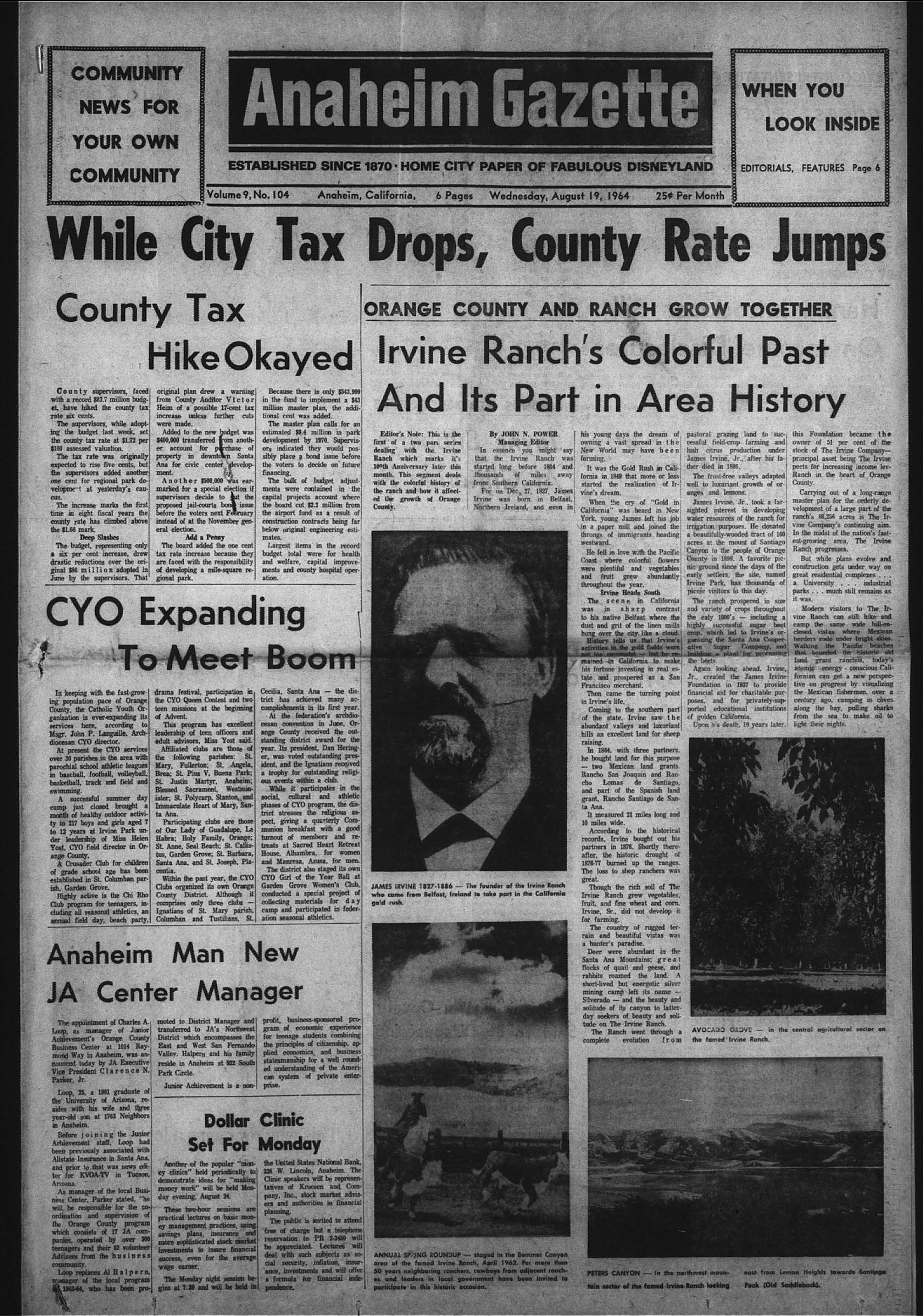
Searchable text
COMMUNITY
NEWS FOR
YOUR OWN
COMMUNITY
Anah
ESTABLISHED SINCE
Volume 9, No. 104 Anah
While City Tax
County Tax
Hike Okayeo
County supervisors, faced with a record $83.7 million budget, have hiked the county tax rate six cents.
The supervisors, while adopting the budget last week, set the county tax rate at $1.72 per $100 assessed valuation.
The tax rate was originally expected to rise five cents, but the supervisors added another one cent for regional park development at yesterday's cau-
original plan drew a warning from County Auditor Victor Heim of a possible 17-cent tax increase unless further cuts were made.
Added to the new budget was $400,000 transferred from another account for purchase of property in downtown Santa Ana for civic center development.
Another $500,000 was earned for a special election if
Because there is only $5 in the fund to implement million master plan, the total cent was added.
The master plan calls for estimated $9.4 million in development by 1970. Supervisors indicated they would sibly place a bond issue by the voters to decide on financing.
The bulk of budget amounts were contained in
County supervisors, faced with a record $3.7 million budget, have hiked the county tax rate six cents.
The supervisors, while adopting the budget last week, set the county tax rate at $1.72 per $100 assessed valuation.
The tax rate was originally expected to rise five cents, but the supervisors added another one cent for regional park development at yesterday's caucus.
The increase marks the first time in eight fiscal years the county rate has climbed above the $1.66 mark.
Deep Slashes
The budget, representing only a six per cent increase, drew drastic reductions over the original $86 million adopted in June by the supervisors. That original plan drew a warning from County Auditor Victor Heim of a possible 17-cent tax increase unless further cuts were made.
Added to the new budget was $400,000 transferred from another account for purchase of property in downtown Santa Ana for civic center development.
Another $500,000 was earmarked for a special election if supervisors decide to put the proposed jail-courts bond issue before the voters next February instead of at the November general election.
Add a Penny
The board added the one cent tax rate increase because they are faced with the responsibility of developing a mile-square regional park.
CYO Expanding To Meet Boom
In keeping with the fast-growing population pace of Orange County, the Catholic Youth Organization is ever-expanding its services here, according to Msgr. John P. Languille, Archdiocesan CYO director.
At present the CYO services over 30 parishes in the area with parochial school athletic leagues in baseball, football, volleyball, basketball, track and field and swimming.
A successful summer day camp just closed brought a month of healthy outdoor activity to 217 boys and girls aged 7 to 12 years at Irvine Park under leadership of Miss Helen Yost, CYO field director in Orange County.
A Crusader Club for children of grade school age has been established in St. Columban parish, Garden Grove.
Highly active is the Chi Rho Club program for teenagers, including all seasonal athletics, an annual field day, beach party, drama festival, participation in the CYO Queen Contest and two teen missions at the beginning of Advent.
This program has excellent leadership of teen officers and adult advisors, Miss Yost said.
Affiliated clubs are those of the following parishes: St. Mary, Fullerton; St. Angela, Brea; St. Pius V. Buena Park; St. Justin Martyr, Anabeim; Blessed Sacrament, Westminster; St. Polycarp, Stanton, and Immaculate Heart of Mary, Santa Ana.
Participating clubs are those of Our Lady of Guadalupe, La Habra; Holy Family, Orange; St. Anne, Seal Beach; St. Callistus, Garden Grove; St. Barbara, Santa Ana, and St. Joseph, Placentia.
Within the past year, the CYO Clubs organized its own Orange County District. Although it comprises only three clubs — Ignatians of St. Mary parish, Columban and Tustilians, St. Cecilia, Santa Ana — the district has achieved many compliments in its first year. Its president, Dan Heerer, was voted outstanding ident, and the Ignatians receive a trophy for outstanding rous events within a club.
While it participates in social, cultural and ethnic phases of CYO program, the trict stresses the religious pect, giving a quarterly munion breakfast with a turnout of members and treats at Sacred Heart Re- House, Alhambra, for ww and Manresa, Azusa, for ww.
The district also staged its CYO Girl of the Year Bay Garden Grove Women's conducted a special project collecting materials for camp and participated in tation seasonal athletics.
Anaheim Man New JA Center Manager
The appointment of Charles A. Loop, as manager of Junior Achievement's Orange County Business Center at 1014 Raymond Way in Anaheim, was announced today by JA Executive Vice President Clarence N. Parker, Jr.
Loop, 25, a 1961 graduate of the University of Arizona, resides with his wife and three year-old son at 1763 Neighbors in Anaheim.
Before joining the Junior Achievement staff, Loop had been previously associated with Allstate Insurance in Santa Ana, and prior to that was news editor for KVOA-TV in Tucson, Arizona.
As manager of the local Business Center, Parker stated, "he will be responsible for the coordination and supervision of the Orange County program which consists of 17 JA companies, operated by over 300 teenagers and their 52 volunteer Advisers from the business community.
Loop replaces Al Halpern, manager of the local program at 1963-64, who has been pro-moted to District Manager and transferred to JA’s Northwest District which encompasses the East and West San Fernando Valley. Halpern and his family reside in Anaheim at 922 South Park Circle.
Junior Achievement is a non-profit, business-sponsored program of economic expertise for teenage students combating the principles of citizenship, plied economics, and businessmanship for a well-rounded understanding of the American system of private prince.
Dollar Clinic Set For Monday
Another of the popular "money clinics" held periodically to demonstrate ideas for "making money work" will be held Monday evening, August 24.
These two-hour sessions are practical lectures on basic money management practices, using savings plans, insurance and more sophisticated stock market investments to insure financial success, even for the average wage earner.
The Monday night session begins at 7:30 and will be held in the United States National Library W. Lincoln, Anaheim. Clinic speakers will be representatives of Kroesen and pany, Inc., stock market traders and authorities in finance planning.
The public is invited to a free of charge but a tele-reservation to PR 2-3450 be appreciated. Lectures deal with such subjects as social security, inflation,ance, investments and will a formula for financial pendence.
Anaheim Gazette
PUBLISHED SINCE 1870 • HOME CITY PAPER OF FABULOUS DISCUSSION
104 Anaheim, California, 6 Pages Wednesday, August 19, 1964
Tax Drops, County Orange County and Ranch Irvine Ranch's Co And Its Part in A
Editor's Note: This is the first of a two part series dealing with the Irvine Ranch which marks it's 100th Anniversary later this month. This segment deals with the colorful history of the ranch and how it affect
By JOHN N. POWER Managing Editor
In essence you might say that the Irvine Ranch was started long before 1804 and thousands of miles away from Southern California.
His young days the day owning a vast spread New World may have forming.
It was the Gold Rush formia in 1849 that more started the realization
Editor's Note: This is the first of a two part series dealing with the Irvine Ranch which marks its 100th Anniversary later this month. This segment deals with the colorful history of the ranch and how it affected the growth of Orange County.
By JOHN N. POWER
Managing Editor
In essence you might say that the Irvine Ranch was started long before 1864 and thousands of miles away from Southern California.
For on Dec. 27, 1827, James Irvine was born in Belfast, Northern Ireland, and even in his young days the day he owned a vast spread of New World may have formed.
It was the Gold Rush formia in 1849 that more started the realization of vine's dream.
When the cry of "California" was heard in York, young James left in a paper mill and joined throngs of immigrants westward.
He fell in love with the Coast where colorful were plentiful and vines and fruit grew all throughout the year.
Irvine Heads Soon
The scene in Oak was in sharp contrast to his native Belfast where dust and grit of the lime hung over the city likeHistory tells us that activities in the gold field not too successful — but mained in California his fortune investing in state and prospered at Francisco merchant.
Then came the turn in Irvine's life.
Coming to the south of the state, Irvine is abundant valleys and hills an excellent land raising.
In 1864, with three he bought land for this — two Mexican lands, Rancho San Joaquin and cho Lomas de and part of the Spanish grant, Rancho Santiago ta Ana.
It measured 21 miles by 10 miles wide.
According to the records, Irvine bought partners in 1876. Short after, the historic drive 1876-77 burned up the The loss to sheep ranch great.
Though the rich soil Irvine Ranch grew fruit, and fine wheat at Irvine, Sr., did not d for farming.
The country of ruin
JAMES IRVINE 1827-1886 — The founder of the Irvine Ranch who came from Belfast, Ireland to take part in the California gold rush.
ANNUAL SPRING ROUNDUP — staged in the Bommer Canyon area of the famed Irvine Ranch, April 1962. For more than 50 years neighboring ranchers, cowboys from adjacent ranches and leaders in local government have been invited to participate in this historic occasion.
ZETTE
ULOUS DISNEYLAND
September 19, 1964 25¢ Per Month
WHEN YOU LOOK INSIDE
EDITORIALS, FEATURES Page 6
County Rate Jumps
RANCH GROW TOGETHER
It's Colorful Past in Area History
his young days the dream of owning a vast spread in the New World may have been forming.
It was the Gold Rush in California in 1849 that more or less started the realization of irrigation.
pastoral grazing land to successful field-crop farming and lush citrus production under James Irvine, Jr., after his father died in 1886.
The frost-free valleys adapted well to luxuriant growth of orchards.
this Foundation became the owner of 51 per cent of the stock of The Irvine Company—principal asset being The Irvine peets for increasing income lev- Ranch in the heart of Orange County.
his young days the dream of owning a vast spread in the New World may have been forming.
It was the Gold Rush in California in 1849 that more or less started the realization of Irvine's dream.
When the cry of "Gold in York, young James left his job in a paper mill and joined the throngs of immigrants heading westward.
He fell in love with the Pacific Coast where colorful flowers were plentiful and vegetables and fruit grew abundantly throughout the year.
Irvine Heads South
The scene in California was in sharp contrast to his native Belfast where the dust and grit of the linen mills hung over the city like a cloud.
History tells us that Irvine's activities in the gold fields were not too successful — but he remained in California to make his fortune investing in real estate and prospered as a San Francisco merchant.
Then came the turning point in Irvine's life.
Coming to the southern part of the state, Irvine saw the abundant valleys and luxuriant hills an excellent land for sheep raising.
In 1864, with three partners, he bought land for this purpose — two Mexican land grants. Rancho San Joaquin and Rancho Lomas de Santiago, and part of the Spanish land grant, Rancho Santiago de Santa Ana.
It measured 21 miles long and 10 miles wide.
According to the historical records, Irvine bought out his partners in 1876. Shortly thereafter, the historic drought of 1876-77 burned up the ranges. The loss to shep ranchers was great.
Though the rich soil of The Irvine Ranch grew vegetables, fruit, and fine wheat and corn, Irvine, Sr., did not develop it for farming.
The country of rugged terrestrial grazing land to successful field-crop farming and lush citrus production under James Irvine, Jr., after his father died in 1886.
The frost-free valleys adapted well to luxurious growth of oranges and lemons.
James Irvine, Jr., took a far-sighted interest in developing water resources of the ranch for irrigation purposes. He donated a beautifully-wooded tract of 160 acres at the mount of Santiago Canyon to the people of Orange County in 1898. A favorite picnic ground since the days of the early settlers, the site, named Irvine Park, has thousands of picnic visitors to this day.
The ranch prospered in size and variety of crops throughout the early 1900s — including a highly successful sugar beet crop, which led to Irvine's organizing the Santa Ana Cooperative Sugar Company, and building a plant for processing the beets.
Again looking ahead, Irvine, Jr., created the James Irvine Foundation in 1937 to provide financial aid for charitable purposes, and for privately-supported educational institutions of golden California.
Upon his death, 19 years later,
this Foundation became the owner of 51 per cent of the stock of The Irvine Company—principal asset being The Irvine pects for increasing income lev-Ranch in the heart of Orange County.
Carrying out of a long-range master plan for the orderly development of a large part of the ranch's 88,256 acres is The Irvine Company's continuing aim. In the midst of the nation's fastest-growing area, The Irvine Ranch progresses.
But while plans evolve and construction gets under way on great residential complexes ... a University ... industrial parks ... much still remains as it was.
Modern visitors to The Irvine Ranch can still hike and camp the same wide hill-enclosed vistas where Mexican herders rode under bright skies. Walking the Pacific beaches that bounded the historic old land grant ranchos, today's atomic energy-conscious California can get a new perspective on progress by visualizing the Mexican fishermen, over a century ago, camping in coves along the bay, pulling sharks from the sea to make oil to light their nights.
According to the historical records, Irvine bought out his partners in 1876. Shortly thereafter, the historic drought of 1876-77 burned up the ranges. The loss to sheep ranchers was great.
Though the rich soil of The Irvine Ranch grew vegetables, fruit, and fine wheat and corn, Irvine, Sr., did not develop it for farming.
The country of rugged terrain and beautiful vistas was a hunter's paradise.
Deer were abundant in the Santa Ana Mountains; great flocks of quail and geese, and rabbits roamed the land. A short-lived but energetic silver mining camp left its name — Silverado — and the beauty and solitude of its canyon to latter-day seekers of beauty and solitude on The Irvine Ranch.
The Ranch went through a complete evolution from
AVOCADO GROVE — in the central agricultural sector on the famed Irvine Ranch.
PETERS CANYON — In the northwest mountain sector of the famed Irvine Ranch looking east from Lemon Heights towards Santiago Peak (Old Saddleback).