anaheim-gazette 1963-01-02
Scanned page
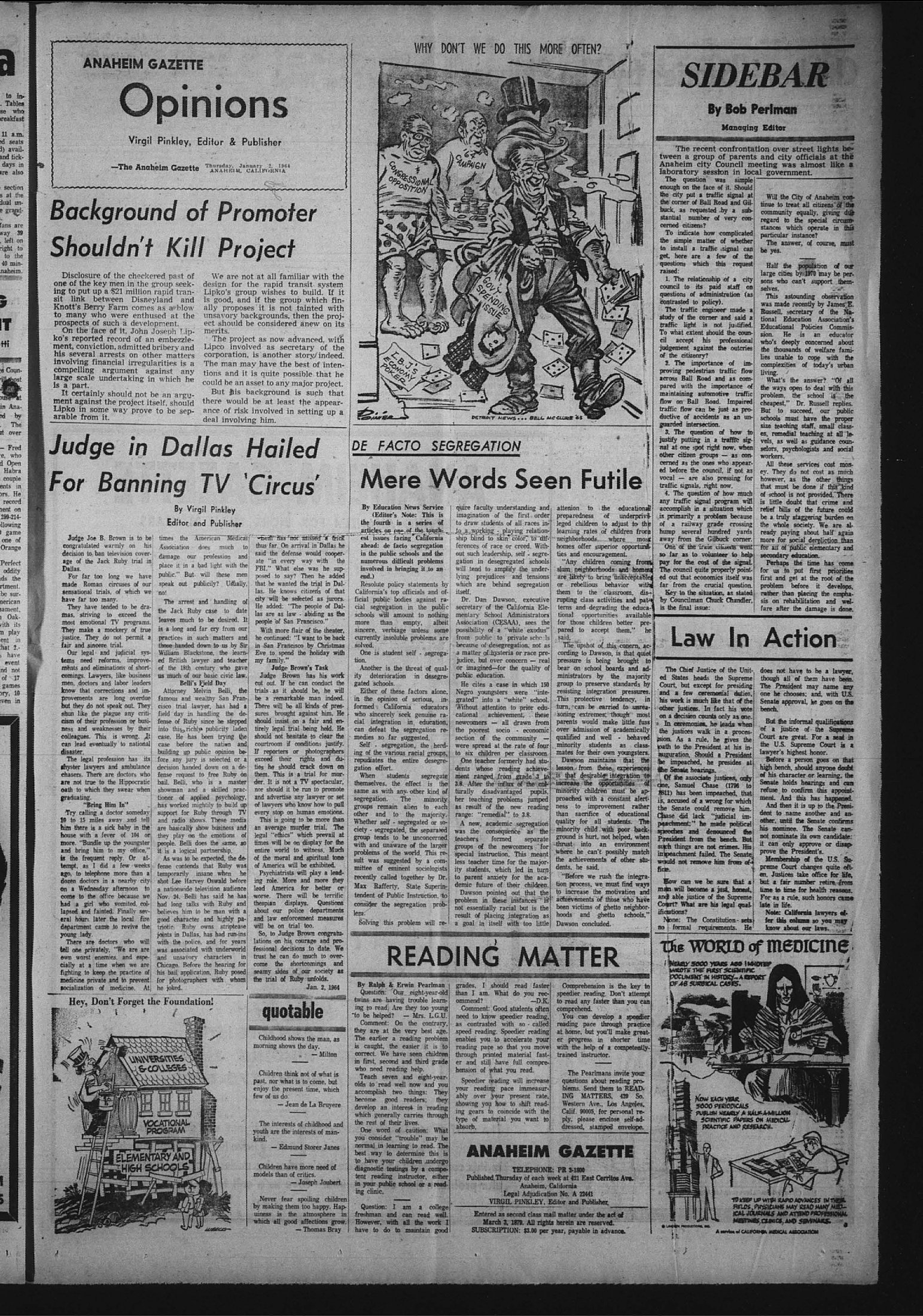
Searchable text
ANAHEIM GAZETTE
Opinions
Virgil Pinkley, Editor & Publisher
—The Anaheim Gazette Thursday, January 2, 1964 ANAHEIM, CALIFORNIA
Background of Promoter Shouldn't Kill Project
Disclosure of the checkered past of one of the key men in the group seeking to put up a $21 million rapid transit link between Disneyland and Knott's Berry Farm comes as a blow to many who were enthused at the prospects of such a development.
On the face of it, John Joseph Lipko's reported record of an embezzlement, conviction, admitted bribery and his several arrests on other matters involving financial irregularities is a compelling argument against any large scale undertaking in which he is a part.
It certainly should not be an argument against the project itself, should Lipko in some way prove to be separable from it.
We are not at all familiar with the design for the rapid transit system Lipko's group wishes to build. If it is good, and if the group which finally proposes it is not tainted with unsavory backgrounds, then the project should be considered anew on its merits.
The project as now advanced, with Lipco involved as secretary of the corporation, is another story indeed. The man may have the best of intentions and it is quite possible that he could be an asset to any major project.
But his background is such that there would be at least the appearance of risk involved in setting up a deal involving him.
Judge in Dallas Hailed For Banning TV 'Circus'
Judge in Dallas Hailed
For Banning TV 'Circus'
By Virgil Pinkley
Editor and Publisher
Judge Joe B. Brown is to be congratulated warmly on his decision to ban television coverage of the Jack Ruby trial in Dallas.
For far too long we have made Roman circuses of our sensational trials, of which we have far too many.
They have tended to be dramas, striving to exceed the most emotional TV programs. They make a mockery of true justice. They do not permit a fair and sincere trial.
Our legal and judicial systems need reforms, improvements and eliminations of shortcomings. Lawyers, like business men, doctors and labor leaders know that corrections and improvements are long overdue but they do not speak out. They eunen like the plague any criticism of their profession or business and weaknesses by their colleagues. This is wrong. It can lead eventually to national disaster.
The legal profession has its shyster lawyers and ambulance chasers. There are doctors who are not true to the Hippocratic oath to which they swear when graduating.
"Bring Him In"
Try calling a doctor someday 10 to 15 miles away and tell him there is a sick baby in the house with a fever of 194 or more. "Bundle up the youngster and bring him to my office," is the frequent reply. Or attempt, as I did a few weeks ago, to telephone more than a dozen doctors in a nearby city on a Wednesday afternoon to come to the office because we had a girl who vomited, collapsed and fainted. Finally several hours later the local fire department came to revive the times the American Medical Association does much to damage our profession and place it in a bad light with the public." But will these men speak out publicly? Usually, not!
The arrest and handling of the Jack Ruby case to date leaves much to be desired. It is a long and far cry from our practices in such matters and those handed down to us by Sir William Blackstone, the learned British lawyer and teacher of the 18th century who gave us much of our basic civic law.
Belli's Field Day
Attorney Melvin Belli, the famous and wealthy San Francisco trial lawyer, has had a field day in handling the defense of Ruby since he stepped into this richly public laden case. He has been trying the case before the nation and building up public opinion before any jury is selected or a decision handed down on a defense request to free Ruby on bail. Belli, who is a master showman and a skilled practitioner of applied psychology, has worked mightily to build up support for Ruby through TV and radio shows. These media are basically show business and they play on the emotions of people. Belli does the same, so it is a logical partnership.
As was to be expected, the defense contends that Ruby was temporarily insane when he shot Lee Harvey Oswald before a nationwide television audience Nov. 24. Belli has said he has had long talks with Ruby and believes him to be man with a good character and highly patriotic. Ruby owns striptease.
Balli has not missed a trick thus far. On arrival in Dallas he said the defense would cooperate "in every way with the FBI." What else was he supposed to say? Then he added that he wanted the trial in Dallas. He knows citizens of that city will be selected as jurors. He added: "The people of Dallas are as law - abiding as the people of San Francisco."
With more flair of the theater, he continued: "I want to be back in San Francisco by Christmas Eve to spend the holiday with my family."
Judge Brown's Task
Judge Brown has his work cut out. If he can conduct the trials as it should be, he will be a remarkable man indeed. There will be all kinds of pressures brought against him. He should insist on a fair and entirely legal trial being held. He should not hesitate to clear the courtroom if conditions justify. If reporters or photographers exceed their rights and duties he should crack down on them. This is a trial for murder. It is not a TV spectacular, nor should it be run to promote and advertise any lawyer or set of lawyers who know how to pull every stop on human emotions.
This is going to be more than an average murder trial. The legal "ethics" which prevail at times will be on display for the entire world to witness. Much of the moral and spiritual tone of America will be exhibited.
Psychiatrists will play a leading role. More and more they lead America for better or worse. There will be terrific therapist displays. Questions about our police departments and law enforcement measures will be on trial too.
him there is a sick baby in the house with a fever of 104 or more. "Bundle up the youngster and bring him to my office," is the frequent reply. Or attempt, as I did a few weeks ago, to telephone more than a dozen doctors in a nearby city on a Wednesday afternoon to come to the office because we had a girl who vomited, collapsed and fainted. Finally several hours later the local fire department came to revive the young lady.
There are doctors who will tell one privately, "We are are own worst enemies, and especially at a time when we are fighting to keep the practice of medicine private and to prevent socialization of medicine. At
Hey, Don't Forget the Foundation!
UNIVERSITIES & COLLEGES
VOCATIONAL PROGRAM
ELEMENTARY AND HIGH SCHOOLS
quotable
Childhood shows the man, as morning shows the day.
— Milton
Children think not of what is past, nor what is to come, but enjoy the present time, which few of us do.
— Jean de La Bruyere
The interests of childhood and youth are the interests of mankind.
— Edmund Storer Janes
Children have more need of models than of critics.
— Joseph Joubert
Never fear spoiling children by making them too happy. Hapuiness is the atmosphere in which all good affections grow.
— Thomas Bray
WHY DON'T WE DO THIS MORE OFTEN?
CONGRESSIONAL
OPPOSITION
CAMPAIGN
GOVERNMENT
SPENDING
ISSUE
I.B.J'S
ECONOMY
POKER
DETRIOIT NEWS... BELL McCLURE '63
DE FACTO SEGREGATION
Mere Words Seen Futile
DE FACTO SEGREGATION
Mere Words Seen Futile
By Education News Service
(Editor's Note: This is the fourth in a series of articles on one of the toughest issues facing California ahead: de facto segregation in the public schools and the numerous difficult problems involved in bringing it to an end.
Resolute policy statements by California's top officials and official public bodies against racial segregation in the public schools will amount to nothing more than empty, albeit sincere, verbiage unless some currently insoluble problems are solved.
One is student self-segregation.
Another is the threat of quality deterioration in desegregated schools.
Either of these factors alone, in the opinion of serious, informed California educators who sincerely seek genuine racial integration in education, can defeat the segregation remedies so far suggested.
Self-segregation, the herding of various racial groups, repudiates the entire desegregation effort.
When students segregate themselves, the effect is the same as with any other kind of segregation. The minority groups remain alien to each other and to the majority. Whether self-segregated or society-segregated, the separated group tends to be unconcerned with and unaware of the larger problems of the world. This result was suggested by a committee of eminent sociologists recently called together by Dr. Max Rafferty. State Superintendent of Public Instruction, to consider the segregation problem.
Solving this problem will require faculty understanding and imagination of the first order to draw students of all races into a working-playing relationship blind to skin color, to differences of race or creed. Without such leadership, self-segregation in desegregated schools will tend to amplify the underlying prejudices and tensions which are behind segregation itself.
Dr. Dan Dawson, executive secretary of the California Elementary School Administrators Association (CESAA), sees the possibility of a "white exodus" from public to private schools because of desegregation, not as a matter of hysteria or race prejudice, but over concern — real or imagined—for the quality of public education.
He cites a case in which 150 Negro youngsters were "integrated" into a "white" school. Without attention to prior educational achievement, these newcomers — all drawn from the poorest socio-economic section of the community — were spread at the rate of four to six children per classroom.
One teacher formerly had students whose reading achievement ranged from grade 3 to 3.8. After the influx of the culturally disadvantaged pupils, her teaching problems jumped as result of the new reading range: "remedial" to 3.8.
A new, academic segregation was the consequence as the teachers formed separate groups of the newcomers for special instruction. This meant less teacher time for the majority students, which led in turn to parent anxiety for the academic future of their children.
Dawson pointed out that the problem in these instances is not essentially racial but is the result of placing integration as a goal in itself with too little attention to the educational preparedness of underprivileged children to adjust to the learning rates of children from neighborhoods where most homes offer superior opportunities and encouragement.
"Any children coming from slum neighborhoods and homes are likely to bring unacceptable or rebellious behavior with them to the classroom, disrupting class activities and patterns and degrading the educational opportunities available for those children better prepared to accept them," he said.
The upshot of this concern, according to Dawson, is that quiet pressure is being brought to bear on school boards and administrators by the majority group to preserve standards by resisting integration pressures. This protective tendency, in turn, can be carried to unreasoning extremes; though most parents would make little fuss over admission of academically qualified and well-behaved minority students as classmates for their own youngsters.
Dawson maintains that the lesson from these experiences is that desirable integration to increase the opportunities of minority children must be approached with a constant alertness to improvement rather than sacrifice of educational quality for all students. The minority child with poor background is hurt, not helped, when thrust into an environment where he can't possibly match the achievements of other students, he said.
"Before we rush the integration process, we must find ways to increase the motivation and achievements of those who have been victims of ghetto neighborhoods and ghetto schools," Dawson concluded.
READING MATTER
By Ralph & Erwin Pearlman
Question: Our eight-year-old twins are having trouble learning to read. Are they too young to be helped? — Mrs. L.G.U.
Comment: On the contrary, they are at the very best age. The earlier a reading problem is caught, the easier it is to correct. We have seen children in first, second and third grade who need reading help.
Teach seven and eight-year-olds to read well now and you accomplish two things: They become good readers; they develop an interest in reading which generally carries through the rest of their lives.
One word of caution: What you consider "trouble" may be normal in learning to read. The best way to determine this is to have your children undergo diagnostic testings by a competent reading instructor, either in your public school or a reading clinic.
Question: I am a college freshman and can read well. However, with all the work I have to do to maintain good grades, I should read faster than I am. What do you recommend?
Comment: Good students often need to know speedier reading, as contrasted with so-called speed reading. Speedier reading enables you to accelerate your reading pace so that you move through printed material faster and still have full comprehension of what you read.
Speedier reading will increase your reading pace immeasurably over your present rate, showing how you to shift reading gears to coincide with the type of material you want to absorb.
Comprehension is the key to speedier reading. Don't attempt to read any faster than you can comprehend.
You can develop a speedier reading pace through practice at home, but you'll make greater progress in shorter time with the help of a competently-trained instructor.
The Pearlmans invite your questions about reading problems. Send them to READING MATTERS, 429 So. Western Ave., Los Angeles, Calif. 90005, for personal reply, please enclose self-addressed, stamped envelope.
ANAHEIM GAZETTE
TELEPHONE: PR 2-1800
Published Thursday of each week at 421 East Cerritos Ave.
Anaheim, California
Legal Adjudication No. A 22441
VIRGIL PINKLEY, Editor and Publisher
Entered as second class mail matter under the act of March 3, 1879. All rights herein are reserved.
SUBSCRIPTION: $3.00 per year, payable in advance.
SIDEBAR
By Bob Perlman
Managing Editor
The recent confrontation over street lights between a group of parents and city officials at the Anaheim city Council meeting was almost like a laboratory session in local government.
The question was simple enough on the face of it. Should the city put a traffic signal at the corner of Ball Road and Gilbuck, as requested by a substantial number of very concerned citizens?
To indicate how complicated the simple matter of whether to install a traffic signal can get, here are a few of the questions which this request raised:
1. The relationship of a city council to its paid staff on questions of administration (as contrasted to policy).
2. The traffic engineer made a study of the corner and said a traffic light is not justified. To what extent should the council accept his professional judgement against the outcries of the citizenry?
3. The importance of improving pedestrian traffic flow across Ball Road and as compared with the importance of maintaining automotive traffic flow on Ball Road. Impaired traffic flow can be just as productive of accidents as an unguarded intersection.
4. The question of how to justify putting in a traffic signal at one spot right now, when other citizen groups — as concerned as the ones who appeared before the council, if not as vocal — are also pressing for traffic signals, right now.
Will the City of Anaheim continue to treat all citizens of the community equally, giving due regard to the special circumstances which operate in this particular instance?
The answer, of course, must be yes.
Half the population of our large cities by 1970 may be persons who can't support themselves.
This astounding observation was made recently by James E. Russell, secretary of the National Education Association's Educational Policies Commission. He is an educator who's deeply concerned about the thousands of welfare families unable to cope with the complexities of today's urban living.
What's the answer? "Of all the ways open to deal with this problem, the school is the cheapest," Dr. Russell replies. But to succeed, our public schools must have the proper size teaching staff, small classes, remedial teaching at all levels, as well as guidance counselors, psychologists and social workers.
All these services cost money. They do not cost as much however, as the other things that must be done if this kind
Futile
to the educational
density of underprivilechildren to adjust to the
rates of children from
wroths where most
offer superior opportunil and encouragement.
children coming from
neighborhoods and homes
likely to bring unacceptable
bellious behavior with
the classroom, disclass activities and patand degrading the educaopportunities available
se children better preto accept them," he
happshot of this concern, acto Dawson, is that quiet
be is being brought to
school boards and addators by the majority
to preserve standards by
integration pressures.
protective tendency, in
can be carried to unreextremes; though most
would make little fuss
mission of academically
and well behaved
students as classfor their own youngsters.
on maintains that the
from these experiences
desirable integration to
the opportunities of
you children must be appied with a constant alertto improvement rather
acrifice of educational
for all students. The
child with poor backis hurt, not helped, when
into an environment
one can't possibly match
achievements of other stute said.
we rush the integracess, we must find ways
base the motivation and
ments of those who have
claims of ghetto neighborand ghetto schools,"
concluded.
Law In Action
The Chief Justice of the Uniced States heads the Supreme Court, but except for presiding and a few ceremonial duties,
his work is much like that of the other justices. In fact his vote on a decision counts only as one.
In ceremonies, he leads when the justices walk in a procession. As a rule, he gives the path to the President at his inauguration. Should a President be impeached, he presides at the Senate hearings.
Of the associate justices, only one, Samuel Chase (1796 to 1811) has been impeached, that is, accused of a wrong for which the Senate could remove him. Chase did lack "judicial impeachment;" he made political speeches and denounced the President from the bench. But such things are not crimes. His impeachment failed. The Senate would not remove him from office.
How can we be sure that a man will become a just, honest, and able justice of the Supreme Court? What are his legal qualifications?
None: The Constitution sets no formal requirements. He does not have to be a lawyer, though all of them have been. The President may name any one he chooses; and, with U.S. Senate approval, he goes on the bench.
But the informal qualifications of a justice of the Supreme Court are great. For a seat in the U.S. Supreme Court is a lawyer's highest honor.
Before a person goes on that high bench, should anyone doubt of his character or learning, the Senate holds hearings and can refuse to confirm this appointment. And this has happened.
And then it is up to the President to name another and another, until the Senate confirms his nominee. The Senate cannot nominate its own candidate; it can only approve or disapprove the President's.
Membership of the U.S. Supreme Court changes quite often. Justices take office for life, but a fair number retire from time to time for health reasons. For as a rule, such honors came late in life.
Note: California lawyers offer this column so you may know about our laws.
The WORLD of MEDICINE
NEARLY 5000 YEARS AGO I WRITE THE FIRST SCIENTIFIC DOCUMENT IN HISTORY--A REPORT OF 48 SURBICAL CASES.
NOW EACH YEAR 5000 PERIODICALS PUBLISH NEARLY A KALIP-A-MILLION SCIENTIFIC PAPERS ON MEDICAL PRACTICE AND RESEARCH.
TO KEEP UP WITH RAPID ADVANCES IN THEIR RELOS, PHYSICIANS MAY READ MANY MEDICAL JOURNALS AND ATTEND PROFESSIONAL MEETINGS, CLINICS, AND SEMINARS.
A service of CALIFORNIA MEDICAL ASSOCIATION