anaheim-gazette 1961-10-26
Scanned page
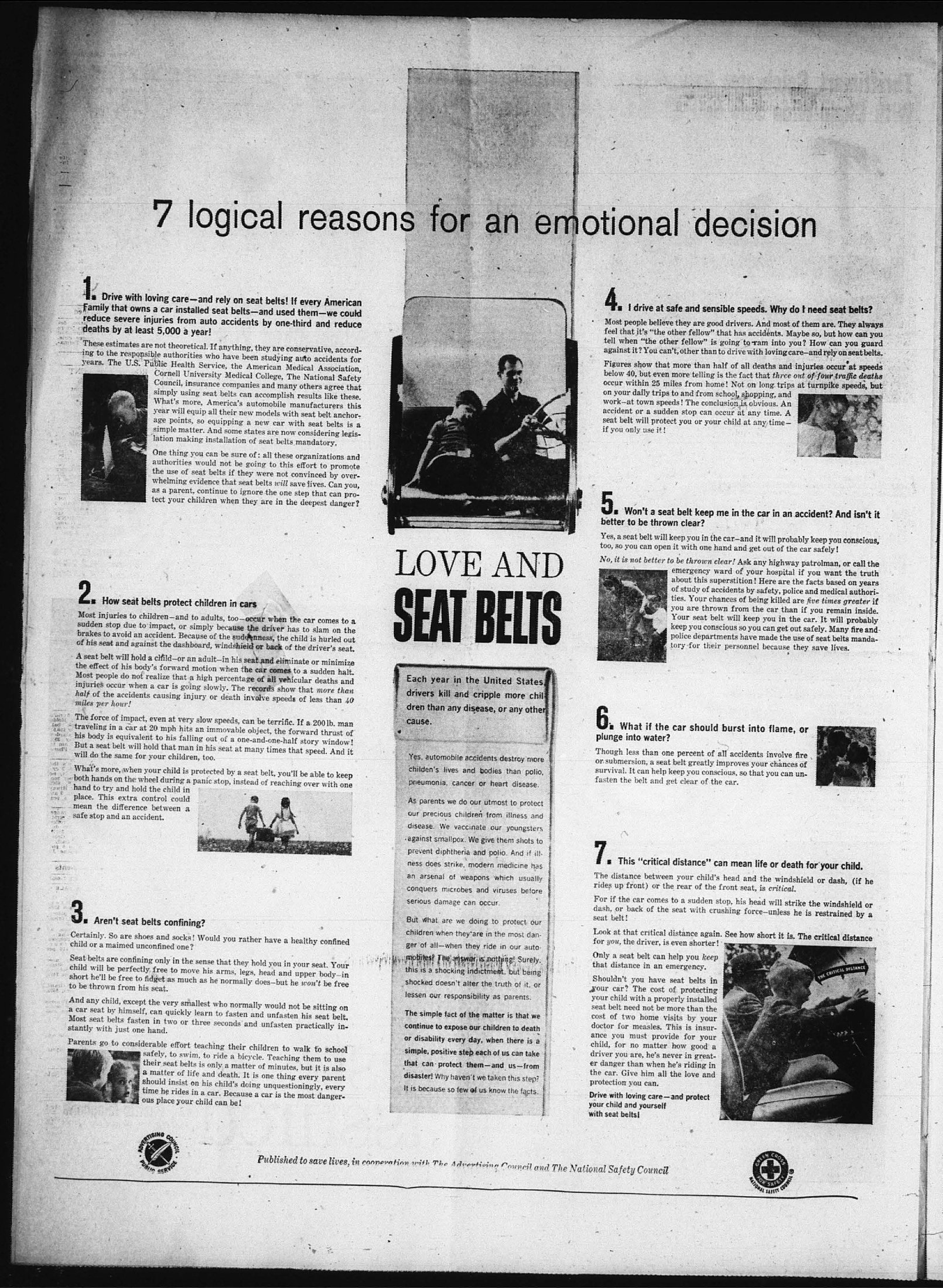
Searchable text
7 logical reasons
1. Drive with loving care—and rely on seat belts! If every American family that owns a car installed seat belts—and used them—we could reduce severe injuries from auto accidents by one-third and reduce deaths by at least 5,000 a year!
These estimates are not theoretical. If anything, they are conservative, according to the responsible authorities who have been studying auto accidents for years. The U.S. Public Health Service, the American Medical Association, Cornell University Medical College, The National Safety Council, insurance companies and many others agree that simply using seat belts can accomplish results like the What's more, America's automobile manufacturers this year will equip all their new models with seat belt anchorage points, so equipping a new car with seat belts is simple matter. And some states are now considering legislation making installation of seat belts mandatory.
One thing you can be sure of: all these organizations and authorities would not be going to this effort to promote the use of seat belts if they were not convinced by overwhelming evidence that
2. How seat belts protect children in cars
Most injuries to children—and to adults, too—occur when the car comes to a sudden stop due to impact, or simply because the driver has to slam on the brakes to avoid an accident. Because of the suddenness, the child is hurled out of his seat and against the dashboard, windshield or back of the driver's seat.
A seat belt will hold a child—or an adult—in his seat and eliminate or minimize the effect of his body's forward motion when the car comes to a sudden halt. Most people do not realize that a high percentage of all vehicular deaths and injuries occur when a car is going slowly. The records show that more than half of the accidents causing injury or death involve speeds of less than 40 miles per hour!
The force of impact, even at very slow speeds, can be terrific. If a 200 lb. man traveling in a car at 20 mph hits an immovable object, the forward thrust of his body is equivalent to his falling out of a one-and-one-half story window. But a seat belt will hold that man in his seat at many times that speed. And it will do the same for your children, too.
What’s more, when your child is protected by a seat belt, you’ll be able to keep both hands on the wheel during a panic stop, instead of reaching over with one hand to try and hold the child in place. This extra control could mean the difference between a safe stop and an accident.
3. Aren't seat belts confining?
Certainly. So are shoes and socks! Would you rather have a healthy confined child or a maimed unconfined one?
Seat belts are confining only in the sense that they hold you in your seat. Your child will be perfectly free to move his arms, legs, head and upper body—in short he'll be free to fidget as much as he normally does—but he won't be free to be thrown from his seat.
And any child, except the very smallest who normally would not be sitting on a car seat by himself, can quickly learn to fasten and unfasten his seat belt. Most seat belts fasten in two or three seconds and unfasten practically instantly with just one hand.
Parents go to considerable effort teaching their children to walk to school safely, to swim, to ride a bicycle. Teaching them to use their seat belts is only a matter of minutes, but it is also a matter of life and death. It is one thing every parent should insist on his child's doing unquestioningly, every time he rides in a car. Because a car is the most dangerous place your child can be!
Published to save lives,
all reasons for an emotional
4. I drive at
Most people believe
feel that it’s “the
tell when “the other
against it? You can
Figures show that
below 40, but even
occur within 25 m
on your daily trip
work—at town spe
accident or a sudd
seat belt will prot
if you only use it!
LOVE AND
SEAT BELTS
Each year in the United States, drivers kill and cripple more children than any disease, or any other cause.
Yes, automobile accidents destroy more children's lives and bodies than polio, pneumonia, cancer or heart disease.
As parents we do our utmost to protect our precious children from illness and disease. We vaccinate our youngsters against smallpox. We give them shots to prevent diphtheria and polio. And if illness does strike, modern medicine has an arsenal of weapons which usually conquers microbes and viruses before serious damage can occur.
our precious children from illness and disease. We vaccinate our youngsters against smallpox. We give them shots to prevent diphtheria and polio. And if illness does strike, modern medicine has an arsenal of weapons which usually conquers microbes and viruses before serious damage can occur.
But what are we doing to protect our children when they are in the most danger of all—when they ride in our automobiles? The answer is nothing! Surely, this is a shocking indictment, but being shocked doesn't alter the truth of it, or lessen our responsibility as parents.
The simple fact of the matter is that we continue to expose our children to death or disability every day, when there is a simple, positive step each of us can take that can protect them—and us—from disaster! Why haven't we taken this step? It is because so few of us know the facts.
7. This "critical"
The distance between rides up front) or the
For if the car comes dash, or back of the seat belt!
Look at that critical for you, the driver, in
Only a seat belt can that distance in an
Shouldn't you have your car? The cost your child with a pro se belt need not be cost of two home v doctor for measles. Tance you must provide child, for no matter driver you are, he's n er danger than when the car. Give him all protection you can.
Drive with loving care—your child and yourself with seat belts!
4. I drive at safe and sensible speeds. Why do I need seat belts?
Most people believe they are good drivers. And most of them are. They always feel that it's "the other fellow" that has accidents. Maybe so, but how can you tell when "the other fellow" is going to ram into you? How can you guard against it? You can't, other than to drive with loving care—and rely on seat belts.
Figures show that more than half of all deaths and injuries occur at speeds below 40, but even more telling is the fact that three out of four traffic deaths occur within 25 miles from home! Not on long trips at turnpike speeds, but on your daily trips to and from school, shopping, and work—at town speeds! The conclusion is obvious. An accident or a sudden stop can occur at any time. A seat belt will protect you or your child at any time—if you only use it!
occur within 25 miles from home! Not on long trips at turnpike speeds, but
on your daily trips to and from school, shopping, and
work—at town speeds! The conclusion is obvious. An
accident or a sudden stop can occur at any time. A
seat belt will protect you or your child at any time—
if you only use it!
5. Won’t a seat belt keep me in the car in an accident? And isn’t it
better to be thrown clear?
Yes, a seat belt will keep you in the car—and it will probably keep you conscious,
too, so you can open it with one hand and get out of the car safely!
No, it is not better to be thrown clear! Ask any highway patrolman, or call the
emergency ward of your hospital if you want the truth
about this superstition! Here are the facts based on years
of study of accidents by safety, police and medical authorities. Your chances of being killed are five times greater if
you are thrown from the car than if you remain inside.
Your seat belt will keep you in the car. It will probably
keep you conscious so you can get out safely. Many fire and
police departments have made the use of seat belts mandatory for their personnel because they save lives.
6. What if the car should burst into flame, or plunge into water?
Though less than one percent of all accidents involve fire
or submersion, a seat belt greatly improves your chances of survival. It can help keep you conscious, so that you can unfasten the belt and get clear of the car.
7. This “critical distance” can mean life or death for your child.
The distance between your child’s head and the windshield or dash, (if he rides up front) or the rear of the front seat, is critical.
For if the car comes to a sudden stop, his head will strike the windshield or dash, or back of the seat with crushing force.
7. This "critical distance" can mean life or death for your child.
The distance between your child's head and the windshield or dash, (if he rides up front) or the rear of the front seat, is critical.
For if the car comes to a sudden stop, his head will strike the windshield or dash, or back of the seat with crushing force—unless he is restrained by a seat belt!
Look at that critical distance again. See how short it is. The critical distance for you, the driver, is even shorter!
Only a seat belt can help you keep that distance in an emergency.
Shouldn't you have seat belts in your car? The cost of protecting your child with a properly installed seat belt need not be more than the cost of two home visits by your doctor for measles. This is insurance you must provide for your child, for no matter how good a driver you are, he's never in greater danger than when he's riding in the car. Give him all the love and protection you can.
Drive with loving care—and protect your child and yourself with seat belts!