anaheim-gazette 1959-03-26
Scanned page
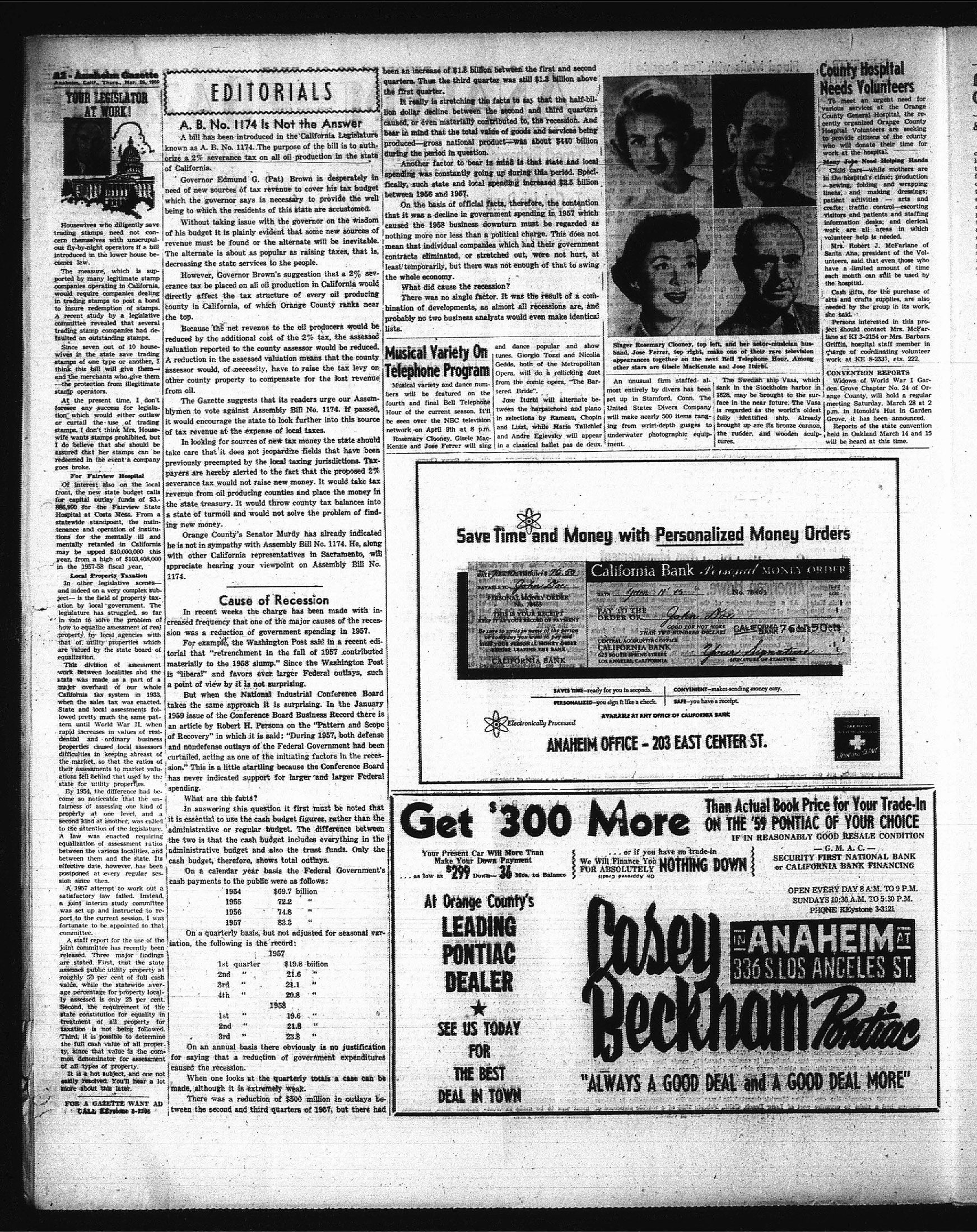
Searchable text
A2 - Anheims Gazette
Anheim, Calif., Thurs., Mar. 26, 1900
YOUR LEGISLATOR AT WORK!
Housewives who diligently save trading stamps need not concern themselves with unscrupulous fly-by-night operators if a bill introduced in the lower house becomes law.
The measure, which is supported by many legitimate stamp companies operating in California, would require companies dealing in trading stamps to post a bond to insure redemption of stamps. A recent study by a legislative committee revealed that several trading stamp companies had defaulted on outstanding stamps.
Since seven out of 10 housewives in the state save trading stamps of one type or another, I think this bill will give them—and the merchants who, give them—the protection from illegitimate stamp operators.
At the present time, I don't foresee any success for legislation which would either outlaw or curtail the use of trading stamps. I don't think Mrs. Housewife wants stamps prohibited, but I do believe that she should be assured that her stamps can be reformed in the guantity company.
EDITORIALS
A. B. No. 1174 Is Not the Answer
A bill has been introduced in the California Legislature known as A. B. No. 1174. The purpose of the bill is to authorize a 2% severance tax on all oil production in the state of California.
Governor Edmund G. (Pat) Brown is desperately need of new sources of tax revenue to cover his tax budget which the governor says is necessary to provide the being to which the residents of this state are accustomed.
Without taking issue with the governor on the wise of his budget it is plainly evident that some new source revenue must be found or the alternate will be inevitable. The alternate is about as popular as raising taxes, that decreasing the state services to the people.
However, Governor Brown's suggestion that a 2% erance tax be placed on all oil production in California would directly affect the tax structure of every oil producer county in California, of which Orange County ranks at the top.
Because the net revenue to the oil producers would reduced by the additional cost of the 2% tax, the assessment reported to the county assessor would be reduced. A reduction in the assessed valuation means that the county assessor would, of necessity, have to raise the tax levy other county property to compensate for the lost revenue from oil.
The Gazette suggests that its readers urge our Assblymen to vote against Assembly Bill No. 1174. If passed it would encourage the state to look further into this so-called tax revenue at the expense of local taxes.
In looking for sources of new tax money the state shaltake care that it does not jeopardize fields that have
At the present time, I don't foresee any success for legislation which would either outlaw or curtail the use of trading stamps. I don't think Mrs. Housewife wants stamps prohibited, but I do believe that she should be assured that her stamps can be redeemed in the event a company goes broke.
For Fairview Hospital
Of interest also on the local front, the new state budget calls for capital outlay funds of $3,886,900 for the Fairview State Hospital at Costa Mesa. From a statewide standpoint, the maintenance and operation of institutions for the mentally ill and mentally retarded in California may be upped $10,000,000 this year, from a high of $103,408,000 in the 1957-58 fiscal year.
Local Property Taxation
In other legislative scenes—and indeed on a very complex subject—is the field of property taxation by local government. The legislature has struggled, so far in vain to solve the problem of how to equalize assessment of real property by local agencies with that of utility properties which are valued by the state board of equalization.
This division of assessment work between localities and the state was made as a part of a major overhaul of our whole California tax system in 1933 when the sales tax was enacted. State and local assessments followed pretty much the same pattern until World War II when rapid increases in values of residential and ordinary business properties caused local assessors difficulties in keeping abreast of the market, so that the ratios of their assessments to market valuations fell behind that used by the state for utility properties.
By 1954, the difference had become so noticeable that the unfairness of assessing one kind of property at one level, and a second kind at another, was called to the attention of the legislature. A law was enacted requiring equalization of assessment ratios between the various localities, and between them and the state. Its effective date, however, has been
Cause of Recession
In recent weeks the charge has been made with creased frequency that one of the major causes of the recession was a reduction of government spending in 1957.
For example, the Washington Post said in a recent editorial that "retrenchment in the fall of 1957 contributed materially to the 1958 slump." Since the Washington Post is "liberal" and favors ever larger Federal outlays, it is a point of view by it is not surprising.
But when the National Industrial Conference takes the same approach it is surprising. In the January 1959 issue of the Conference Board Business Record an article by Robert H. Persons on the "Pattern and Recovery" in which it is said: "During 1957, both depreciation and nondefense outlays of the Federal Government had curtailed, acting as one of the initiating factors in the recession." This is a little startling because the Conference Board has never indicated support for larger and larger spending.
What are the facts?
In answering this question it first must be noted it is essential to use the cash budget figures, rather than administrative or regular budget. The difference between the two is that the cash budget includes everything in administrative budget and also the trust funds. Only cash budget, therefore, shows total outlays.
ations fell behind that used by the state for utility properties.
By 1954, the difference had become so noticeable that the unfairness of assessing one kind of property at one level, and a second kind at another, was called to the attention of the legislature. A law was enacted requiring equalization of assessment ratios between the various localities, and between them and the state. Its effective date, however, has been postponed at every regular session since then.
A 1957 attempt to work out a satisfactory law failed. Instead, a joint interim study committee was set up and instructed to report to the current session. I was fortunate to be appointed to that committee.
A staff report for the use of the joint committee has recently been released. Three major findings are stated. First, that the state assesses public utility property at roughly 50 per cent of full cash value, while the statewide average percentage for property locally assessed is only 25 per cent. Second, the requirement of the state constitution for equality in treatment of all property for taxation is not being followed. Third, it is possible to determine the full cash value of all property, since that value is the common denominator for assessment of all types of property.
It is a hot subject, and one not easily resolved. You'll hear a lot more about this later.
FOR A GAZETTE WANT AD
CALL E-2206
has never indicated support for larger and larger spending.
What are the facts?
In answering this question it first must be noted it is essential to use the cash budget figures, rather than administrative or regular budget. The difference between the two is that the cash budget includes everything in administrative budget and also the trust funds. Only cash budget, therefore, shows total outlays.
On a calendar year basis the Federal Government cash payments to the public were as follows:
1954 $69.7 billion
1955 72.2 "
1956 74.8 "
1957 83.3 "
On a quarterly basis, but not adjusted for seasonality, the following is the record:
1957
1st quarter $19.8 billion
2nd " 21.6 "
3rd " 21.1 "
4th " 20.8 "
1958
1st " 19.6 "
2nd " 21.8 "
3rd " 23.8 "
On an annual basis there obviously is no justifiability for saying that a reduction of government expenditure caused the recession.
When one looks at the quarterly totals a case can made, although it is extremely weak.
There was a reduction of $500 million in outlay between the second and third quarters of 1957, but there
NOT the Answer
the California Legislature
pose of the bill is to authil production in the state
Brown is desperately in
due to cover his tax budget
necessary to provide the well
this state are accustomed.
The governor on the wisdom
that some new sources of
external will be inevitable.
as raising taxes, that is,
the people.
Suggestion that a 2% sevduction in California would
be of every oil producing
range County ranks near
The oil producers would be
the 2% tax, the assessed
assessor would be reduced.
Union means that the county
to raise the tax levy on
state for the lost revenue
Readers urge our AssemBill No. 1174. If passed,
look further into this source
local taxes.
Tax money the state should
size fields that have been
been an increase of $1.8 billion between the first and second quarters. Thus the third quarter was still $1.8 billion above the first quarter.
It really is stretching the facts to say that the half-billion dollar decline between the second and third quarters caused, or even materially contributed to, the recession. And bear in mind that the total value of goods and services being produced—gross national product—was about $440 billion during the period in question.
Another factor to bear in mind is that state and local spending was constantly going up during this period. Specifically, such state and local spending increased $2.5 billion between 1956 and 1957.
On the basis of official facts, therefore, the contention that it was a decline in government spending in 1957 which caused the 1958 business downturn must be regarded as nothing more nor less than a political charge. This does not mean that individual companies which had their government contracts eliminated, or stretched out, were not hurt, at least temporarily, but there was not enough of that to swing the whole economy.
What did cause the recession?
There was no single factor. It was the result of a combination of developments, as almost all recessions are, and probably no two business analysts would even make identical lists.
Musical Variety On Telephone Program
Musical variety and dance numbers will be featured on the fourth and final Bell Telephone Hour of the current season. It'll be seen over the NBC television network on April 9th at 8 p.m.
Rosemary Clooney, Gisele MacKenzie and Jose Ferrer will sing and dance popular and show tunes. Giorgio Tozzi and Nicola Gedda, both of the Metropolitan Opera, will do a rollicking duet from the comic opera, "The Bartered Bride".
Jose Iturbi will alternate between the harpsichord and piano in selections by Rameau, Chopin and Liszt, while Maria Tallchief and Andre Eglevsky will appear in a classical ballet pas de deux.
An unusual firm staff most entirely by divers hailed up in Stamford, Connecticut United States Divers Co., will make nearly 500 items ing from wrist-depth guar-underwater photographic im-ment.
Telephone Program
Musical variety and dance numbers will be featured on the fourth and final Bell Telephone Hour of the current season. It'll be seen over the NBC television network on April 9th at 8 p.m.
Rosemary Clooney, Giselle MacKenzie and Jose Ferrer will sing
Save Time and Money with Person
California Bank
PAYABLE TO John Dew
PERSONAL MONEY ORDER No. 79463
THIS IS YOUR RECEIPT
KEEP IT AS YOUR RECORD OF PAYMENT
Be sure to write in name of the person or company you want to pay and highlight your personal money order before leaving the bank.
CALIFORNIA BANK
SAVES TIME—ready for you in seconds.
CONVENIED
PERSONALIZED—you sign it like a check.
SAFE—AVAILABLE AT ANY OFFICE OF CALIFORNIA BANK
ANAHEIM OFFICE – 203 EAST
Get $300 More
Your Present Car Will More Than Make Your Down Payment
or if you have no We Will Finance You FOR ABSOLITELY NOTHING
Get $300 More
Your Present Car Will More Than
Make Your Down Payment
as low as $299 Down—36 Mon. on Balance
At Orange County's
LEADING
PONTIAC
DEALER
SEE US TODAY
FOR
THE BEST
DEAL IN TOWN
Case Beck
"ALWAYS A GOO
County Hospital Needs Volunteers
To meet an urgent need for various services at the Orange County General Hospital, the recently organized Orange County Hospital Volunteers are seeking to provide citizens of the county who will donate their time for work at the hospital.
Many John Need Helping Hands
Child care—while mothers are in the hospital's clinic; production—sewing, folding and wrapping linens, and making dressings; patient activities — arts and crafts; traffic control—escorting visitors and patients and staffing information desks; and clerical work are all areas in which volunteer help is needed.
Mrs. Robert J. McFarlane of Santa Ana, president of the Volunteers, said that even those who have a limited amount of time each month can still be used by the hospital.
Cash gifts, for the purchase of arts and crafts supplies, are also needed by the group in its work, she said.
Persons interested in this project should contact Mrs. McFarlane at KI 3-2154 or Mrs. Barbara Griffin, hospital staff member in charge of coordinating volunteer work at KE 8-2331, etx. 222.
CONVENTION REPORTS
Widows of World War I Garden Grove Chapter No. 24 of Orange County, will hold a regular meeting Saturday, March 28 at 2 p.m. in Honold's Hut in Garden Grove, it has been announced.
Reports of the state convention held in Oakland March 14 and 15 will be heard at this time.
An unusual firm staffed almost entirely by divers has been set up in Stamford, Conn. The United States Divers Company will make nearly 500 items ranging from wrist-depth guages to underwater photographic equipment.
The Swedish ship Vasa, which sank in the Stockholm harbor in 1628, may be brought to the surface in the near future. The Vasa is regarded as the world's oldest fully identified ship. Already brought up are its bronze cannon, the rudder, and wooden sculptures.
CONVENTION REPORTS
Widows of World War I Garden Grove Chapter No. 24 of Orange County, will hold a regular meeting Saturday, March 28 at 2 p.m. in Honold's Hut in Garden Grove, it has been announced.
Reports of the state convention held in Oakland March 14 and 15 will be heard at this time.
with Personalized Money Orders
California Bank Personal Money Order
No. 78463
GOOD FOR NOT MORE THAN TWO HUNDRED DOLLARS
CALIFORNIA BANK 76 dollars 50 cents
REAL ACCOUNTING OFFICE
CALIFORNIA BANK
SOUTH SPRING STREET
ANGELES, CALIFORNIA
SIGNATURE OF REMITTER
you in seconds.
CONVENIENT—makes sending money easy.
sign it like a check.
SAFE—you have a receipt.
AVAILABLE AT ANY OFFICE OF CALIFORNIA BANK
OFFICE – 203 EAST CENTER ST.
Aore Than Actual Book Price for Your Trade-In ON THE '59 PONTIAC OF YOUR CHOICE IF IN REASONABLY GOOD RESALE CONDITION
or if you have no trade-in
Finance You NOTHING DOWN
G. M. A. C.
SECURITY FIRST NATIONAL BANK or CALIFORNIA BANK FINANCING
More Than Actual Book Price for Your Trade-In ON THE '59 PONTIAC OF YOUR CHOICE IF IN REASONABLY GOOD RESALE CONDITION
— G. M. A. C. — SECURITY FIRST NATIONAL BANK or CALIFORNIA BANK FINANCING
OPEN EVERY DAY 8 A.M. TO 9 P.M.
SUNDAYS 10:30 A.M. TO 5:30 P.M.
PHONE KEystone 3-3121
Casey Beckham Pontiac
WAYS A GOOD DEAL and A GOOD DEAL MORE"