anaheim-gazette 1952-09-15
Scanned page
Searchable text
8 Anaheim Gazette MONDAY, SEPTEMBER 15, 1950 ANAHEIM, CALIFORNIA
Here's how oil we
Here's how oil was from shore out un
HERE'S THE BACKGROUND
The richness of the oil sands at Huntington Beach caused violently intense competition among drilling operations in the 1920's.
When some wells began reaching out from shore into the tidelands, the Attorney General of California filed for an injunction against further drilling because of the legal status of off-shore wells.
In 1938, the State Lands Act was adopted in order to prevent drainage of state oil by private interests. All oil companies were invited to submit bids for the tideland operations on a sliding-scale royalty basis (the more oil, the higher the royalty to the state), and the Southwest Exploration Company emerged as the successful bidder.
The problems were many, as the science of controlled directional drilling was in its infancy. Techniques and equipment developed in this operation have attracted world-wide interest, not only in the oil industry but among the millions of people who drive by the location every year.
HOW A WELL IS SLANTED
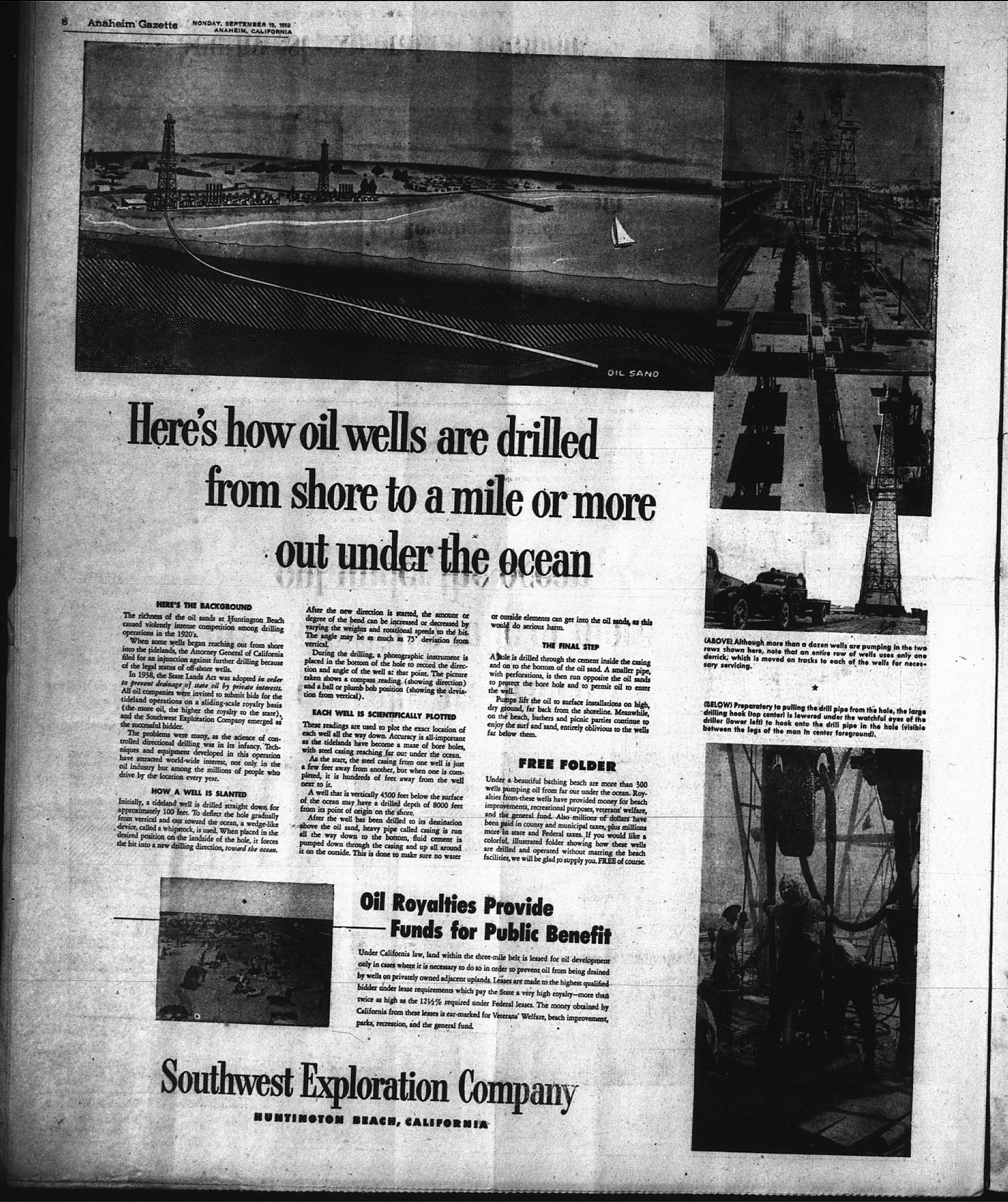
Initially, a tideland well is drilled straight down for approximately 100 feet. To deflect the hole gradually from vertical and out toward the ocean, a wedge-like device, called a whipstock, is used. When placed in the desired position on the landside of the hole, it forces the bit into a new drilling direction toward the ocean.
After the new direction degree of the bend can vary the weights and The angle may be as vertical.
During the drilling, placed in the bottom orientation and angle of the taken shows a compass and a ball or plumb bob tion from vertical).
EACH WELL IS SO
These readings are used each well all the way down as the tidelands have been with steel casing reachin
As the start, the steel a few feet away from an pleted, it is hundreds o next to it.
A well that is vertically of the ocean may have from its point of origin
After the well has been above the oil sand, heav all the way down to the pumped down through
have attracted world-wide interest, not only in the oil industry but among the millions of people who drive by the location every year.
HOW A WELL IS SLANTED
Initially, a tideland well is drilled straight down for approximately 100 feet. To deflect the hole gradually from vertical and out toward the ocean, a wedge-like device, called a whipstock, is used. When placed in the desired position on the landside of the hole, it forces the bit into a new drilling direction, toward the ocean.
Southwest Exploration
HUNTINGTON BEA
oil wells are drilled
oil wells are drilled
shore to a mile or more
ut under the ocean
After the new direction is started, the amount or degree of the bend can be increased or decreased by varying the weights and rotational speeds to the bit. The angle may be as much as 75° deviation from vertical.
During the drilling, a photographic instrument is placed in the bottom of the hole to record the direction and angle of the well at that point. The picture taken shows a compass reading (showing direction) and a ball or plumb bob position (showing deviation from vertical).
EACH WELL IS SCIENTIFICALLY PLOTTED
These readings are used to plot the exact location of each well all the way down. Accuracy is all-important as the tidallands have become a maze of bore holes, with steel casing reaching far out under the ocean.
As the start, the steel casing from one well is just a few feet away from another, but when one is completed, it is hundreds of feet away from the well next to it.
A well that is vertically 4500 feet below the surface of the ocean may have a drilled depth of 8000 feet from its point of origin on the shore.
After the well has been drilled to its destination above the oil sand, heavy pipe called casing is run all the way down to the bottom, fluid cement is pumped down through the casing and up all around or outside elements can get into the oil sands, as this would do serious harm.
THE FINAL STEP
A hole is drilled through the cement inside the casing and on to the bottom of the oil sand. A smaller pipe, with perforations, is then run opposite the oil sands to protect the bore hole and to permit oil to enter the well.
Pumps lift the oil to surface installations on high, dry ground, far back from the shoreline. Meanwhile, on the beach, bathers and picnic parties continue to enjoy the surf and sand, entirely oblivious to the wells far below them.
FREE FOLDER
Under a beautiful bathing beach are more than 300 wells pumping oil from far out under the ocean. Royalties from these wells have provided money for beach improvements, recreational purposes, veterans' welfare, and the general fund. Also millions of dollars have been paid in county and municipal taxes, plus millions more in state and Federal taxes. If you would like a colorful, illustrated folder showing how these wells are drilled and opened
As the start, the steel casing from one well is just a few feet away from another, but when one is completed, it is hundreds of feet away from the well next to it.
A well that is vertically 4500 feet below the surface of the ocean may have a drilled depth of 8000 feet from its point of origin on the shore.
After the well has been drilled to its destination above the oil sand, heavy pipe called casing is run all the way down to the bottom, fluid cement is pumped down through the casing and up all around it on the outside. This is done to make sure no water
FREE FOLDER
Under a beautiful bathing beach are more than 300 wells pumping oil from far out under the ocean. Royalties from these wells have provided money for beach improvements, recreational purposes, veterans' welfare, and the general fund. Also millions of dollars have been paid in county and municipal taxes, plus millions more in state and Federal taxes. If you would like a colorful, illustrated folder showing how these wells are drilled and operated without marring the beach facilities, we will be glad to supply you. FREE of course.
Oil Royalties Provide Funds for Public Benefit
Under California law, land within the three-mile belt is leased for oil development only in cases where it is necessary to do so in order to prevent oil from being drained by wells on privately owned adjacent uplands. Leases are made to the highest qualified bidder under lease requirements which pay the State a very high royalty—more than twice as high as the 12½% required under Federal leases. The money obtained by California from these leases is ear-marked for Veterans' Welfare, beach improvement, parks, recreation, and the general fund.
Exploration Company
HINGTON BEACH, CALIFORNIA
SANO
(ABOVE) Although more than a dozen wells are pumping in the two rows shown here, note that an entire row of wells uses only one derrick, which is moved on tracks to each of the wells for necessary servicing.
(BELOW) Preparatory to pulling the drill pipe from the hole, the large drilling hook (top center) is lowered under the watchful eyes of the driller (lower left) to hook onto the drill pipe in the hole (visible between the legs of the man in center foreground).
300
Roybeach
alfare,
have
millions
ike a
wells
each
curse.