anaheim-gazette 1952-05-06
Scanned page
Searchable text
5 Anaheim Gazette TUESDAY, MAY 6, 1908 ANAHEIM, CALIFORNIA
Just Another
But an Important Milepost W
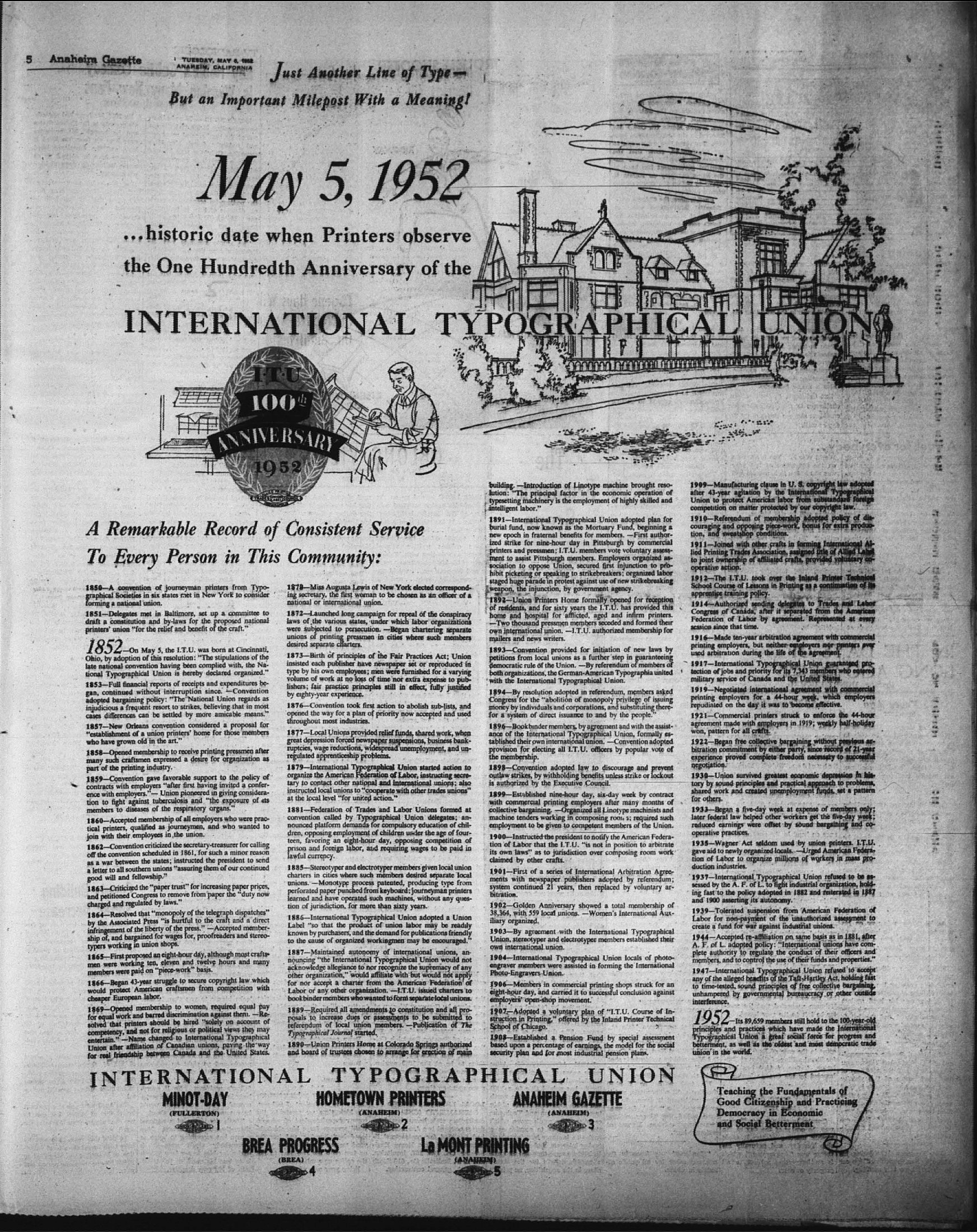
May 5,
...historic date when Print
the One Hundredth Annive
INTERNATION
ITU
100th
ANNIVERSARY
A Remarkable Record of Consistent To Every Person in This Community
1850—A convention of journeyman printers from Typographical Societies in six states met in New York to consider forming a national union.
1851—Delegates met in Baltimore, set up a committee to draft a constitution and by-laws for the proposed national printers' union "for the relief and benefit of the craft."
1852—On May 5, the I.T.U. was born at Cincinnati, Ohio, by adoption of this resolution: "The stipulations of the late national convention having been complied with, the National Typographical Union is hereby declared organized."
1853—Full financial reports of receipts and expenditures began, continued without interruption since. Convention adopted bargaining policy: "The National Union regards as injudicious a frequent resort to strikes, believing that in most cases differences can be settled by more amicable means."
1857—New Orleans convention considered a proposal for "establishment of a union printers' home for those members who have grown old in the art."
1858—Opened membership to receive printing pressmen after many such craftsmen expressed a desire for organization as part of the printing industry.
1859—Convention gave favorable support to the policy of contracts with employers "after first having invited a conference with employers." — Union pioneered in giving consideration to fight against tuberculosis and "the exposure of its members to diseases of the respiratory organs."
1860—Accepted membership of all employers who were practical printers, qualified as journeymen, and who wanted to join with their employees in the union.
1862—Convention criticized the secretary-treasurer for calling off the convention scheduled in 1861, for such a minor reason as a war between the states; instructed the president to send a letter to all southern unions "assuring them of our continued secretary, the first work national or international law."
1872—Launched long career laws of the various states were subjected to persecution unions of printing presses desired separate charters.
1873—Birth of principles insisted each publisher had type by his own employees volume of work at no loss lishers; fair practice印刷 by eighty-year experience.
1876—Convention took f opened the way for a plan throughout most industries.
1877—Local Unions provide great depression forced new rupties, wage reductions, regulated apprenticeship p
1879—International Type organize the American Federation to contact other natives instructed local unions to attend at the local level "for unity"
1881—Federation of Trade convention called by Ty-nounced platform demand dren, opposing employment teen, favoring an eight-hour prison and foreign labor, lawful currency.
1885—Stereotyper and ele-
1859—Convention gave favorable support to the policy of contracts with employers "after first having invited a conference with employers." — Union pioneered in giving consideration to fight against tuberculosis and "the exposure of its members to diseases of the respiratory organs."
1860—Accepted membership of all employers who were practical printers, qualified as journeymen, and who wanted to join with their employees in the union.
1862—Convention criticized the secretary-treasurer for calling off the convention scheduled in 1861, for such a minor reason as a war between the states; instructed the president to send a letter to all southern unions "assuring them of our continued good will and fellowship."
1863—Criticized the "paper trust" for increasing paper prices, and petitioned Congress to remove from paper the "duty now charged and regulated by laws."
1864—Resolved that "monopoly of the telegraph dispatches" by the Associated Press "is hurtful to the craft and a direct infringement of the liberty of the press." — Accepted membership of, and bargained for wages for, proofreaders and stereotypers working in union shops.
1865—First proposed an eight-hour day, although most craftsmen were working ten, eleven and twelve hours and many members were paid on "piece-work" basis.
1866—Began 43-year struggle to secure copyright law which would protect American craftsmen from competition with cheaper European labor.
1869—Opened membership to women, required equal pay for equal work and barred discrimination against them. — Resolved that printers should be hired "solely on account of competency, and not for religious or political views they may entertain." — Name changed to International Typographical Union after affiliation of Canadian unions, paying the way for real friendship between Canada and the United States.
INTERNATIONAL TYPE
MINOT-DAY
(FULLERTON)
HOMETO
BREA PROGRESS
(BREA)
must Another Line of Type—
Milepost With a Meaning!
May 5, 1952
then Printers observe
th Anniversary of the
NATIONAL TYPOGRAPHIC
Consistent Service Community:
1878—Miss Augusta Lewis of New York elected corresponding secretary, the first woman to be chosen as an officer of a national or international union.
1872—Launched long campaign for repeal of the conspiracy laws of the various states, under which labor organizations were subjected to persecution. Began chartering separate unions of printing pressmen in cities where such members desired separate charters.
1873—Birth of principles of the Fair Practices Act; Union insisted each publisher have newspaper set or reproduced in type by his own employees; men were furnished for a varying volume of work at no loss of time nor extra expense to publishers; fair practice principles still in effect, fully justified by eighty-year experience.
1876—Convention took first action to abolish sub-lists, and opened the way for a plan of priority now accepted and used throughout most industries.
1877—Local Unions provided relief funds, shared work, when great depression forced newspaper suspensions, business bankruptcy, wage reductions, widespread unemployment, and unregulated apprenticeship problems.
1879—International Typographical Union started action to organize the American Federation of Labor, instructing secretary to contact other national and international unions; also instructed local unions to "cooperate with other trades unions" at the local level "for united action."
1881—Federation of Trades and Labor Unions formed at convention called by Typographical Union delegates; announced platform demands for compulsory education of children, opposing employment of children under the age of fourteen, favoring an eight-hour day, opposing competition of prison and foreign labor, and requiring wages to be paid in lawful currency.
1885—Stereotyper and electrotyper members given local union building. —Introduction of Linotype machine brought resolution: "The principal factor in the economic operation of typesetting machinery is the employment of highly skilled and intelligent labor."
1891—International Typographical Union adopted plan for burial fund, now known as the Mortuary Fund, beginning a new epoch in fraternal benefits for members. —First authorized strike for nine-hour day in Pittsburgh by commercial printers and pressmen; I.T.U. members vote voluntary assessment to assist Pittsburgh members. Employers organized association to oppose Union, secured first injunction to prohibit picketing or speaking to strikebreakers; organized labor staged huge parade in protest against use of new strikebreaking weapon, the injunction, by government agency.
1892—Union Printers Home formally opened for reception of residents, and for sixty years the I.T.U. has provided this home and hospital for afflicted, aged and infirm printers. —Two thousand pressmen members seceded and formed their own international union. —I.T.U. authorized membership for mailers and news writers.
1893—Convention provided for initiation of new laws by petitions from local unions as a further step in guaranteeing democratic rule of the Union. —By referendum of members of both organizations, the German-American Typographia united with the International Typographical Union.
1894—By resolution adopted in referendum, members asked Congress for the "abolition of monopoly privilege of issuing money by individuals and corporations, and substituting therefor a system of direct issuance to and by the people."
1896—Bookbinder members, by agreement and with the assistance of the International Typographical Union, formally established their own international union. —Convention adopted provision for electing all I.T.U. officers by popular vote of the membership.
1898—Convention adopted law to discourage and prevent outlaw strikes, by withholding benefits unless strike or lockout is authorized by the Executive Council.
1899—Established nine-hour day, six-day week by contract with commercial printing employers after many months of collective bargaining. —Organized all Linotype machinists and machine tenders working in composing rooms; required such employment to be given to competent members of the Union.
1900—Instructed the president to notify the American Federation of Labor that the I.T.U. "is not in position to arbitrate its own laws" as to jurisdiction over composing room work claimed by other crafts.
organize the American Federation of Labor, instructing secretary to contact other national and international unions; also instructed local unions to "cooperate with other trades unions" at the local level "for united action."
1881—Federation of Trades and Labor Unions formed at convention called by Typographical Union delegates; announced platform demands for compulsory education of children, opposing employment of children under the age of fourteen, favoring an eight-hour day, opposing competition of prison and foreign labor, and requiring wages to be paid in lawful currency.
1885—Stereotyper and electrotyper members given local union charters in cities where such members desired separate local unions. Monotype process patented, producing type from perforated paper punched from keyboard; journeyman printers learned and have operated such machines, without any question of jurisdiction, for more than sixty years.
1886—International Typographical Union adopted a Union Label "so that the product of union labor may be readily known by purchasers, and the demand for publications friendly to the cause of organized workingmen may be encouraged."
1887—Maintained autonomy of international unions, announcing "the International Typographical Union would not acknowledge allegiance to nor recognize the supremacy of any other organization," would affiliate with but would not apply for nor accept a charter from the American Federation of Labor or any other organization. I.T.U. issued charters to bookbinder members who wanted to form separate local unions.
1889—Required all amendments to constitution and all proposals to increase dues or assessments to be submitted to referendum of local union members. Publication of The Typographical Journal started.
1890—Union Printers Home at Colorado Springs authorized and board of trustees chosen to arrange for erection of main outlaw strikes, by withholding benefits unless strike or lockout is authorized by the Executive Council.
1899—Established nine-hour day, six-day week by contract with commercial printing employers after many months of collective bargaining. Organized all Linotype machinists and machine tenders working in composing room; required such employment to be given to competent members of the Union.
1900—Instructed the president to notify the American Federation of Labor that the I.T.U. "is not in position to arbitrate its own laws" as to jurisdiction over composing room work claimed by other crafts.
1901—First of a series of International Arbitration Agreements with newspaper publishers adopted by referendum; system continued 21 years, then replaced by voluntary arbitration.
1902—Golden Anniversary showed a total membership of 38,364, with 559 local unions. Women's International Auxiliary organized.
1903—By agreement with the International Typographical Union, stereotyper and electrotyper members established their own international union.
1904—International Typographical Union locals of photo-engraver members were assisted in forming the International Photo-Engravers Union.
1906—Members in commercial printing shops struck for an eight-hour day, and carried it to successful conclusion against employers' open-shop movement.
1907—Adopted a voluntary plan of "I.T.U. Course of Instruction in Printing," offered by the Inland Printer Technical School of Chicago.
1908—Established a Pension Fund by special assessment based upon a percentage of earnings, the model for the social security plan and for most industrial pension plans.
PHICAL UNION
machine brought resonomic operation of
of highly skilled and
on adopted plan for
by Fund, beginning a
by commercial
note voluntary assesslayers organized as
injunction to promers; organized labor
of new strikebreaking
agency.
opened for reception
U. has provided this
and infirm printers.
dled and formed their
ized membership for
on of new laws by
step in guaranteeing
undum of members of
Typographia united
union.
hum, members asked
privilege of issuing
and substituting thereby the people."
ent and with the assistUnion, formally esConvention adopted
by popular vote of
courage and prevent
less strike or lockout
day week by contract
many months of
totype machinists and
rooms; required such
members of the Union.
the American Federaposition to arbitrate
imposing room work
1909—Manufacturing clause in U. S. copyright law adopted after 43-year agitation by the International Typographical Union to protect American labor from substandard foreign competition on matter protected by our copyright law.
1910—Referendum of membership adopted policy of discouraging and opposing piece-work, bonus for extra production, and sweatshop conditions.
1911—Joined with other crafts in forming International Allied Printing Trades Association, assigned title of Allied Label to joint ownership of affiliated crafts, provided voluntary cooperative action.
1912—The I.T.U. took over the Inland Printer Technical School Course of Lessons in Printing as a continuation of its apprentice training policy.
1914—Authorized sending delegates to Trades and Labor Congress of Canada, after it separated from the American Federation of Labor by agreement. Represented at every session since that time.
1916—Made ten-year arbitration agreement with commercial printing employers, but neither employers nor printers ever used arbitration during the life of the agreement.
1917—International Typographical Union guaranteed protection of jobs and priority for its 7,343 members who entered military service of Canada and the United States.
1919—Negotiated international agreement with commercial printing employers for a 44-hour week, which employers repudiated on the day it was to become effective.
1921—Commercial printers struck to enforce the 44-hour agreement made with employers in 1919; weekly half-holiday won, pattern for all crafts.
1922—Began free collective bargaining without previous arbitration commitment by either party, since record of 21-year experience proved complete freedom necessary to successful negotiation.
1930—Union survived greatest economic depression in history by sound principles and practical approach to problems, shared work and created unemployment funds, set a pattern for others.
1933—Began a five-day week at expense of members only; later federal law helped other workers get the five-day week; reduced earnings were offset by sound bargaining and cooperative practices.
1935—Wagner Act seldom used by union printers. I.T.U. gave aid to newly organized locals. —Urged American Federation of Labor to organize millions of workers in mass production industries.
1930—Union survived greatest economic depression in history by sound principles and practical approach to problems, shared work and created unemployment funds, set a pattern for others.
1933—Began a five-day week at expense of members only; later federal law helped other workers get the five-day week; reduced earnings were offset by sound bargaining and cooperative practices.
1935—Wagner Act seldom used by union printers. I.T.U. gave aid to newly organized locals. —Urged American Federation of Labor to organize millions of workers in mass production industries.
1937—International Typographical Union refused to be assessed by the A.F. of L. to fight industrial organization, holding fast to the policy adopted in 1882 and reiterated in 1887 and 1900 asserting its autonomy.
1939—Tolerated suspension from American Federation of Labor for non-payment of the unauthorized assessment to create a fund for war against industrial unions.
1944—Accepted re-affiliation on same basis as in 1881, after A.F. of L. adopted policy: "International unions have complete authority to regulate the conduct of their officers and members, and to control the use of their funds and properties."
1947—International Typographical Union refused to accept any of the alleged beaches of the Taft-Hartley Act, holding fast to time-tested, sound principles of free collective bargaining, unhampered by governmental bureaucracy or other outside interference.
1952—Its 89,659 members still hold to the 100-year-old principles and practices which have made the International Typographical Union a great social force for progress and betterment, as well as the oldest and most democratic trade union in the world.
Teaching the Fundamentals of Good Citizenship and Practicing Democracy in Economic and Social Betterment