anaheim-gazette 1952-04-30
Scanned page
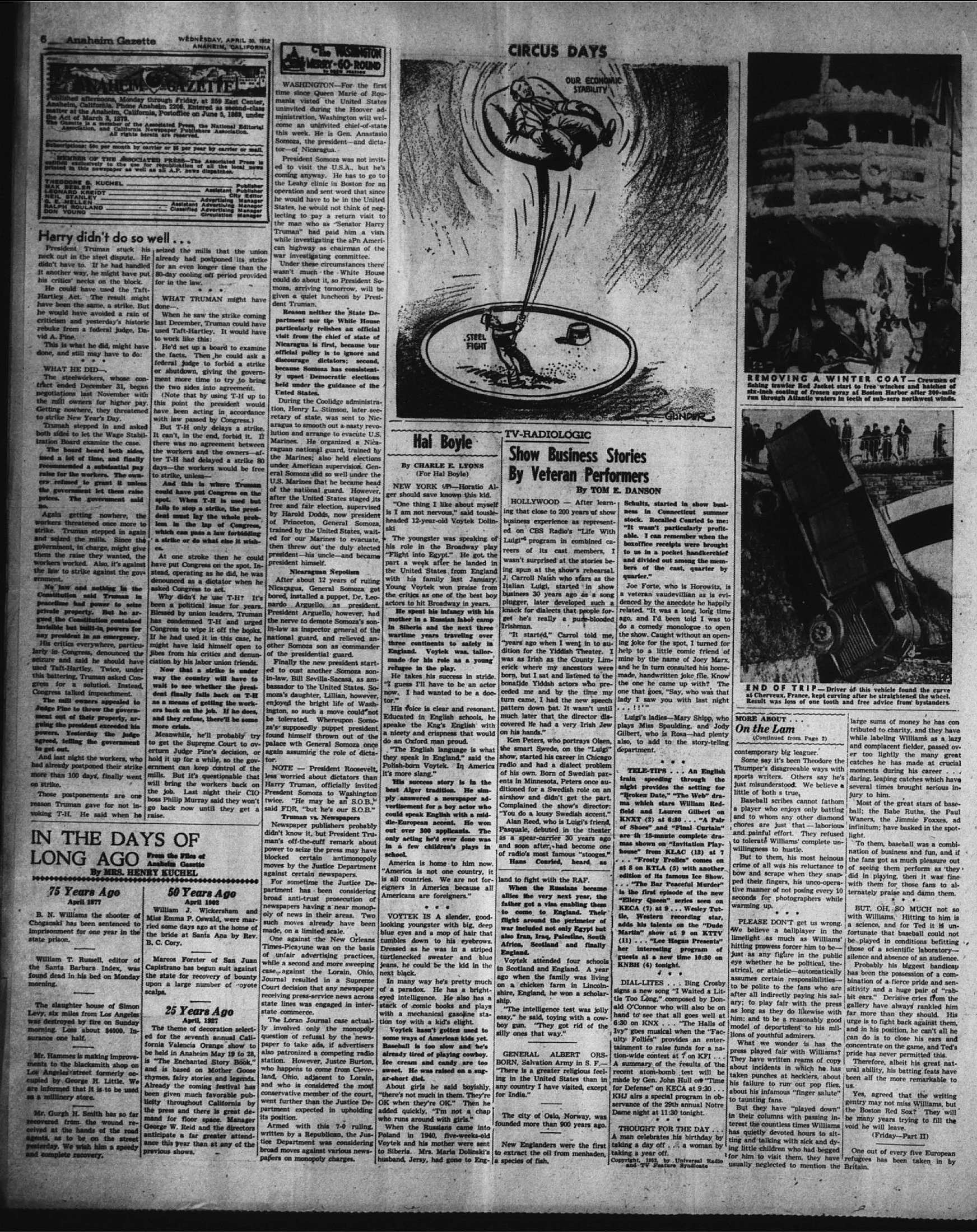
Searchable text
Harry didn't do so well...
President Truman stuck his neck out in the steel dispute. He didn't have to. If he had handled it another way, he might have put his critics' necks on the block.
He could have used the Taft-Hartley Act. The result might have been the same, a strike. But he would have avoided a rain of criticism and yesterday's historic rebuke from a federal judge, David A. Pine.
This is what he did, might have done, and still may have to do:
WHAT HE DID—
The steelworkers, whose contract ended December 31, began negotiations last November with the mill owners for higher pay. Getting nowhere, they threatened to strike New Year's Day.
Trumah stepped in and asked both sides to let the Wage Stabilization Board examine the case.
The board heard both sides, used a lot of time, and finally seized the mills that the union already had postponed its strike for an even longer time than the 80-day cooling off period provided for in the law.
WHAT TRUMAN might have done—
When he saw the strike coming last December, Truman could have used Taft-Hartley. It would have to work like this:
He'd set up a board to examine the facts. Then he could ask a federal judge to forbid a strike or shutdown, giving the government more time to try to bring the two sides into agreement.
(Note that by using T-H up to this point the president would have been acting in accordance with law passed by Congress.)
But T-H only delays a strike. It can't, in the end, forbid it. If there was no agreement between the workers and the owners—after T-H had delivered a strike—WASHINGTON—For the time since Queen Marie of mania visted the United States uninvited during the Hoover administration, Washington would come an uninvited chief-counting week. He is Gen. Antoinette Somoza, the president—andator—of Nicaragua.
President Somoza was not ed to visit the U.S.A., but coming anyway. He has to leave the Leahy clinic in Boston operation and sent word that he would have to be in the States, he would not think of lecting to pay a return visit to the man who as "Senator Truman" had paid him a while investigating the aPnA can highway as chairman of war investigating committee.
Under these circumstances wasn't much the White House could do about it, so President Somoza, arriving tomorrow, would given a quiet luncheon byudent Truman.
Reason neither the State department nor the White House particularly relishes an official visit from the chief of state Nicaragua is first, because official policy is to ignore discourage dictators; see because Somoza has consistently upset Democratic elections held under the guidance of United States.
During the Coolidge administration, Henry L. Stimson, later retiring of state, was sent to Nicaragua to smooth out a nasty lution and arrange to evacuate Marines. He organized a raguan national guard, trained the Marines; also held elec-
WHAT HE DID—
The steelworkers, whose contract ended December 31, began negotiations last November with the mill owners for higher pay. Getting nowhere, they threatened to strike New Year's Day.
Trumah stepped in and asked both sides to let the Wage Stabilization Board examine the case.
The board heard both sides, used a lot of time, and finally recommended a substantial pay raise for the workers. The owners refused to grant it unless the government let them raise prices. The government said no.
Again getting nowhere, the workers threatened once more to strike. Truman stepped in again and seized the mills. Since the government, in charge, might give them the raise they wanted, the workers worked. Also, it's against the law to strike against the government.
No law and nothing in the Constitution said Truman in peacetime had power to seize private property. But he argued the Constitution contained invisible but built-in powers for any president in an emergency.
His critics everywhere, particularly in Congress, denounced the seizure and said he should have used Taft-Hartley. Twice, under this battering, Truman asked Congress for a solution. Instead, Congress talked impeachment.
The mill owners appealed to Judge Pine to throw the government out of their property, arguing the president exceeded his powers. Yesterday the judge agreed, telling the government to get out.
And last night the workers, who had already postponed their strike more than 100 days, finally went on strike.
Those postponements are one reason Truman gave for not invoking T-H. He said when he federal judge to forbid a strike or shutdown, giving the government more time to try to bring the two sides into agreement.
(Note that by using T-H up to this point the president would have been acting in accordance with law passed by Congress.)
But T-H only delays a strike. It can't, in the end, forbid it. If there was no agreement between the workers and the owners—after T-H had delayed a strike 80 days—the workers would be free to strike, unless—
And this is where Truman could have put Congress on the spot. When T-H is used but falls to stop a strike, the president must lay the whole problem in the lap of Congress, which can pass a law forbidding a strike or do what else it wishes.
At one stroke then he could have put Congress on the spot. Instead, operating as he did, he was denounced as a dictator when he asked Congress to act.
Why didn't he use T-H? It's been a political issue for years. Blessed by union leaders, Truman has condemned T-H and urged Congress to wipe it off the books. If he had used it in this case, he might have laid himself open to jibes from his critics and denunciation by his labor union friends.
Now that a strike is under way the country will have to wait to see whether the president finally falls back on T-H as a means of getting the workers back on the job. If he does, and they refuse, there'll be some more crisis.
Meanwhile, he'll probably try to get the Supreme Court to overturn Judge Pine's decision, or hold it up for a while, so the government can keep control of the mills. But it's questionable that will bring the workers back on the job. Last night their CIO boss Philip Murray said they won't go back now until they get a raise.
IN THE DAYS OF LONG AGO
From the Files of Anabeim Gazette
During the Coolidge administration, Henry L. Stimson, later retary of state, was sent to aragua to smooth out a nasty lution and arrange to evacuate Marines. He organized a raguan national guard, trained the Marines; also held elec- under American supervision. General Somoza did so well under U.S. Marines that he became one of the national guard. How after the United States stage free and fair election, supervise by Harold Dodds, now pres- of Princeton, General Somoza trained by the United States, w-ed for our Marines to evacu- then threw out' the duly ele- president—his uncle—and been president himself.
Nicaraguan Nepotism
After about 12 years of rite Nicaragua, General Somoza bored, installed a puppet, Dr. nardo Arguello, as presi- President Arguello, however, the nerve to demote Somoza's in-law as inspector general of national guard, and relieved other Somoza son as commander of the presidential guard.
Finally the new president se- ed to oust another Somoza in-law, Bill Sevilla-Sacasa, as bassador to the United States. Somoza's daughter, Lillian, how- enjoyed the bright life of Wington, so such a move could be tolerated. Whereupon Soma's supposedly puppet presi- found himself thrown out of palace with General Somoza again assuming the role of diar.
NOTE — President Roosevelt less worried about dictators than Harry Truman, officially invi- President Somoza to Washington twice. "He may be an S.O., said FDR," "but he's our S.O."
Truman vs. Newspapers
Newspaper publishers probab- didn't know it, but President T- man's off-the-cuff remark al- power to seize the press may h blocked certain antimonop- moves by the Justice Department because Somoza has consist- ly upset Democratic electi- held under the guidance of United States.
Truman stepped in and asked both sides, used a lot of time, and finally recommended a substantial pay raise for the workers. The owners refused to grant it unless the government let them raise prices. The government said no.
Again getting nowhere, the workers threatened once more to strike. Truman stepped in again and seized the mills. Since the government, in charge, might give them the raise they wanted, the workers worked. Also, it's against the law to strike against the government.
No law and nothing in the Constitution said Truman in peacetime had power to seize private property. But he argued the Constitution contained invisible but built-in powers for any president in an emergency.
His critics everywhere, particularly in Congress, denounced the seizure and said he should have used Taft-Hartley. Twice, under this battering, Truman asked Congress for a solution. Instead, Congress talked impeachment.
The mill owners appealed to Judge Pine to throw the government out of their property, arguing the president exceeded his powers. Yesterday the judge agreed, telling the government to get out.
And last night the workers, who had already postponed their strike more than 100 days, finally went on strike.
Those postponements are one reason Truman gave for not invoking T-H. He said when he
IN THE DAYS OF
LONG AGO
From the Files of Anaheim Gazette
By MRS. HENRY KUCHEL
75 Years Ago
April 1877
B. N. Williams the shooter of Choganski has been sentenced to imprisonment for one year in the state prison.
William T. Russell, editor of the Santa Barbara Index, was found dead in his bed on Monday morning.
The slaughter house of Simon Levy, six miles from Los Angeles was destroyed by fire on Sunday morning. Loss about $4000. Insurance one half.
Mr. Hammes is making improvements to the blacksmith shop on Los Angeles street formerly occupied by George H. Little. We are informed that it is to be used as a millinery store.
Mr. Gurgh H. Smith has so far recovered from the wound received at the hands of the road agents, as to be on the street yesterday. We wish him a speedy and complete recovery.
50 Years Ago
April 1902
William J. Wickersham and Miss Emma P. Oswald, were married some days ago at the home of the bride at Santa Ana by Rev. B. C. Cory.
Marcos Forster of San Juan Capistrano has begun suit against the state for recovery of bounty upon a large number ofoyote scalps.
25 Years Ago
April, 1927
The theme of decoration selected for the seventh annual California Valencia Orange show to be held in Anaheim May 19 to 28, is "The Enchanted Story Book," and is based on Mother Goose rhymes, fairy stories and legends. Already the coming festival has been given much favorable publicity throughout California by the press and there is great demand for floor space. Manager George W. Reid and the directors anticipate a far greater attendance this year than at any of the previous shows.
Newspaper publishers probed didn't know it, but President T. Man's off-the-cuff remark also power to seize the press may have blocked certain antimonopoly moves by the Justice Department against certain newspapers.
For sometime the Justice Department has been considered broad anti-trust prosecution of newspapers having a near monolity of news in their areas. Such moves already have been made, on a limited scale.
One against the New Orleans Times-Picayune was on the basis of unfair advertising practice while a second and more sweep case against the Lorain, Ohio Journal resulted in a Supreme Court decision that any newspaper receiving press-service news across state lines was engaged in interstate commerce.
The Loran Journal case actually involved only the monopoly question of refusal by the newspaper to take ads, if advertised also patronized a competing rail station. However, Justice Burke who happens to come from Cleveland, Ohio, adjacent to Lorain, and who is considered the most conservative member of the court went further than the Justice Department expected in upholding its position.
Armed with this 7-0 ruling written by a Republican, the Justice Department was considering broad moves against various newspapers on monopoly charges.
WASHINGTON—For the first time since Queen Marie of Roumania visited the United States invited during the Hoover administration, Washington will welcome an uninvited chief-of-state week. He is Gen. Anastasio Somoza, the president—and dictator—of Nicaragua.
President Somoza was not invited to visit the U.S.A., but he's coming anyway. He has to go to Leahy clinic in Boston for an operation and sent word that since would have to be in the United States, he would not think of neging to pay a return visit to man who as "Senator Harry Sohman" had paid him a visit investigating the aPn Ameri-highway as chairman of the investigating committee.
Under these circumstances there isn't much the White House did about it, so President Soha, arriving tomorrow, will be on a quiet luncheon by Presi-Truman.
Reason neither the State Deartment nor the White House particularly relishes an official from the chief of state of Nicaragua is first, because our special policy is to ignore and courage dictators; second, cause Somoza has consistent-coupset Democratic elections under the guidance of the United States.
During the Coolidge administra-tion Henry L. Stimson, later secretary of state, was sent to Nic-aqua to smooth out a nasty revolu-man and arrange to evacuate U.S. ones. He organized a Nica-an national guard, trained by Marines; also held elections
CIRCUS DAYS
OUR ECONOMIC STABILITY
STEEL FIGHT
Hal Boyle
TV-RADIOLOGIC
Show Business Stories
Hal Boyle
By CHARLE E. LYONS
(For Hal Boyle)
NEW YORK (E)—Horatio Alger should save known this kid.
"One thing I like about myself is I am not nervous," said tousle-headed 12-year-old Voytek Dolinski.
The youngster was speaking of his role in the Broadway play "Flight into Egypt." He got the part a week after he landed in the United States from England with his family last January. Young Voytek won praise from the critics as one of the best boy actors to hit Broadway in years.
He spent his infancy with his mother in a Russian labor camp in Siberia and the next three wartime years traveling over three continents to safety in England. Voytek was tailor-made for his role as a young refugee in the play.
He takes his success in stride. "I guess I'll have to be an actor now. I had wanted to be a doctor."
His voice is clear and resonant. Educated in English schools, he speaks the Kng's English with a nicety and crispness that would do an Oxford man proud.
"The English language is what they speak in England," said the Polish-born Voytek. In America it's more slang.
His success story is in the best Alger tradition. He simply answered a newspaper advertisement for a boy actor who could speak English with a middle-European accent. He won out over 300 applicants. The only acting he'd ever done was in a few children's plays in school.
America is home to him now.
TV-RADIOLOGIC
Show Business Stories
By Veteran Performers
By TOM E. DANSON
HOLLYWOOD — After learning that close to 200 years of show business experience as represented on CBS Radio's "Life With Luigi" program in combined careers of its cast members, I wasn't surprised at the stories being spun at the show's rehearsal. J. Carroll Naish who stars as the Italian Luigi, started in show business 30 years ago as a song plugger, later developed such a knack for dialects that people forget he's really a pure-blooded Irishman.
"It started," Carrol told me, "years ago when I went in to audition for the Yiddish Theater. I was as Irish as the County Limerick where my ancestors were born, but I sat and listened to the bonafide Yiddsh actors who preceded me and by the time my turn came, I had the new speech pattern down pat. It wasn't until much later that the director discovered he had a very Irish Jew on his hands."
Ken Peters, who portrays Olsen, the smart Swede, on the "Luigi" show, started his career in Chicago radio and had a dialect problem of his own. Born of Swedish parents in Minnesota, Peters once auditioned for a Swedish role on an airshow and didn't get the part. Complained the show's director: "You do a lousy Swedish accent."
Alan Reed, who is Luigi's friend, Pasquale, debuted in the theater as a spear-carrier 30 years ago and soon after, had become one of radio's most famous "stooges."
Hans Conried, heard as Schultz, started in news in Connecticut stock. Recalled Conrad "It wasn't particular able. I can remember boxoffice receipts we to us in a pocket book and divided out among bers of the cast, quarter."
Joe Forte, who is a veteran vaudevillian denced by the anecdote related. "It was a long ago, and I'd been to do a comedy monologue the show. Caught with joke for the spot, help to a little comine by the name of and he in turn consulted made, handwritten joke the one he came up one that goes, "Say, w lady I saw you with...!!!""
Luigi's ladies—Mary plays Miss Spaulding Gilbert, who is Rosa—also to add to the department.
TELE-TIPS ... A train speeding through night provides the sound "Broken Date," "Thema which stars Willfield and Lauren KnXT (2) at 6:30 ... of Shoes" and "Finale are th 15-minute commas shown on 'Invita house' from KLAC ... Frosty Frolics" at 8 on KTLA (5) with
His success story is in the best Alger tradition. He simply answered a newspaper advertisement for a boy actor who could speak English with a middle-European accent. He won out over 300 applicants. The only acting he'd ever done was in a few children's plays in school.
America is home to him now. "America is not one country, it is all countries. We are not foreigners in America because all Americans are foreigners."
VOYTEK IS A slender, good-looking youngster with big, deep blue eyes and a mop of hair that tumbles down to his eyebrows. Dressed as he was in a striped turtlenecked sweater and blue jeans, he could be the kid in the next black.
In many ways he's pretty much of a paradox. He has a bright-eyed intelligence. He also has a stack of comic books and plays with a mechanical gasoline station toy with a kid's elight.
Voytek hasn't gotten used to some ways of American kids yet. Baseball is too slow and he's already tired of playing cowboy. Ice cream and candy are too sweet. He was raised on a sugar-short diet.
About girls he said boyishly, "there's not much in them. They're OK when they're OK." Then he added quickly, "I'm not a chap who runs around with girls."
When the Russians came into Poland in 1940, five-weeks-old Voytek and his mother were sent to Siberia. Mrs. Maria Dolinski's husband, Jersy, had gone to England to fight with the RAF.
When the Russians became allies the very next year, the father got a visa enabling them to come to England. Their flight around the perimeter of war included not only Egypt but also Iran, Iraq, Palestine, South Africa, Scotland and finally England.
Voytek attended four schools in Scotland and England. A year ago when the family was living on a chicken farm in Lincolnshire, England, he won a scholarship.
"The intelligence test was jolly easy," he said, toying with a cowboy gun. "They got rid of the silly ones that way."
GENERAL ALBERT ORS-BORN, Salvation Army in S. F.—"There is a greater religious feeling in the United States than in any country I have visited, except for India."
The city of Oslo, Norway, was founded more than 900 years ago.
New Englanders were the first to extract the oil from menhaden, a species of fish.
train speeding three night provides the s "Broken Date," "The ma which stars Will field and Lauren O KNXT (2) at 6:30 . . . of Shoes" and "Final are th 15-minute com mas shown on 'Invita house' from KLAC . . . "Frosty Frolics" at 8 on KTLA (5) with edition of its famous . . . "The Bar Peaceful is the first episode o "Ellery Queen" series KECA (7) at 9 . . . Witle, Western record adds his talents on the Martin" show at 9 (11) . . . "Lee Hogan her interesting pro guests at a new time KNBH (4) tonight.
DIAL-LITES . . . B signs a new song "I Was Tale Too Long," composed ald O'Connor who will hand to see that all go 6:30 on KNX . . . "The Ivy" goes musical whenulty Follies" provides entertainment to raise fund-tion-wide contest at 7 o A summary of the result recent atom-bomb test made by Gen. John Hull for Defense" on KECA and KHJ airs a special program servance of the 29th anniversary Dame night at 11:30 ton
THOUGHT FOR THE A man celebrates his birthday taking a day off . . . a v taking a year off.
Copyright, 1962, by Univer- and TV Feature Syn
REMOVING A WINTER COAT—Crewmen of fishing trawler Red Jacket start to free winches and hatches of six-inch coating of frozen spray af Boston Harbor after 200-mile run through Atlantic waters in teeth of sub-zero northwest winds.
STORIES OF FORMERS
E. DANSON
Schultz, started in show business in Connecticut summer stock. Recalled Couried to me: "It wasn't particularly profitable. I can remember when the boxoffice receipts were brought to us in a pocket handkerchief and divided out among the members of the cast, quarter by quarter."
Joe Forte, who is Horowitz, is a veteran vaudevillian as is evidenced by the anecdote he happily related. "It was a long, long time ago, and I'd been told I was to do a comedy monologue to open the show. Caught without an opening joke for the spot, I turned for help to a little comic friend of mine by the name of Joey Marx, and he in turn consulted his homemade, handwritten joke file. Know the one he came up with? The one that goes, 'Say, who was that lady I saw you with last night...!!'"
Luigi's ladies—Mary Shipp, who plays Miss Spaulding, and Jody Gilbert, who is Rosa—had plenty also, to add to the story-telling department.
TELE-TIPS . . . An English train speeding through the night provides the setting for "Broken Date," "The Web" drama which stars William Redfield and Lauren Gilbert on KNXT (2) at 6:30 . . . "A Pair of Shoes" and "Final Curtain" are th 15-minute complete dramas shown on "Invitation Playhouse" from KLAC (13) at 7 . . . "Frosty Frolics" comes on at 8 on KTLA (5) with another
REMOVING A WINTER COAT—Crewmen of fishing trawler Red Jacket start to free winches and hatches of six-inch coating of frozen spray at Boston Harbor after 200-mile run through Atlantic waters in teeth of sub-zero northwest winds.
END OF TRIP—Driver of this vehicle found the curve at Cherveux, France, kept curving after he straightened the wheel. Result was loss of one tooth and free advice from bystanders.
MORE ABOUT ... On the Lam
(Continued from Page 2)
contemporary big leaguer.
Some say it's been Theodore the Thumper's disagreeable ways with sports writers. Others say he's just misunderstood. We believe a little of both s true.
Baseball scribes cannot fathom a player who enjoys only batting and to whom any other diamond chores are just that—laborious and painful effort. They refused to tolerate Williams' complete unwillingness to hustle.
But to them, his most heinous crime of all was his reluctance to large sums of money he has contributed to charity, and they have while labeling Williams as a lazy and complacent fielder, passed over too lightly the many great catches he has made at crucial moments during his career . . . daring, leaping catches which have several times brought serious injury to him.
Most of the great stars of baseball; the Babe Ruths, the Paul Waners, the Jimmie Foxxes, ad infinitum; have basked in the spotlight.
To them, baseball was a combination of business and fun, and if the fans got as much pleasure out of seeing them perform as they
train speeding through the night provides the setting for "Broken Date," "The Web" drama which stars William Redfield and Lauren Gilbert on KNXT (2) at 6:30. "A Pair of Shoes" and "Final Curtain" are in 15-minute complete dramas shown on "Invitation Playhouse" from KLAC (13) at 7. "Frosty Frolics" comes on at 8 on KTLA (5) with another edition of its famous Ice Show. "The Bar Peaceful Murder" is the first episode of the new "Ellery Queen" series seen on KECA (7) at 9. Wesley Tuttle, Western recording star, adds his talents on the "Dude Martin" show at 9 on KTTV (11). "Lee Hogan Presents" her interesting program of guests at a new time 10:30 on KNBH (4) tonight.
DIAL-LITES . . . Bing Crosby signs a new song "I Waited a Little Too Long," composed by Donald O'Connor who will also be on hand to see that all goes well at 6:30 on KNX . . . "The Halls of Ivy" goes musical when the "Faculty Follies" provides an entertainment to raise funds for a nation-wide contest at 7 on KFI . . .
A summary of the results of the recent atom-bomb test will be made by Gen. John Hull or "Time for Defense" on KECA at 9:30. KHJ airs a special program in observance of the 29th annual Notre Dame night at 11:30 tonight.
THOUGHT FOR THE DAY . . .
A man celebrates his birthday by taking a day off . . . a woman by taking a year off.
Copyright, 1952, by Universal Radio and TV Feature Syndicate
Baseball scribes cannot fathom a player who enjoys only batting and to whom any other diamond chores are just that—laborious and painful effort. They refused to tolerate Williams' complete unwillingness to hustle.
But to them, his most heinous crime of all was his reluctance to bow and scrape when they snapped their fingers, his unco-operative manner of not posing every 10 seconds for photographers while warming up.
PLEASE DON'T get us wrong. We believe a ballplayer in the limelight as much as Williams' hitting prowess forcer him to be—just as any figure in the public eye whether he be political, theatrical, or athletic—automatically assumes certain responsibilities—to be polite to the fans who are after all indirectly paying his salary; to play fair with the press as long as they do likewise with him; and to be a reasonably good model of deportment to his millions of youthful admirers.
What we wonder is has the press played fair with Williams? They have written reams of copy about incidents in which he has taken punches at hecklers, about his failure to run out pop flies, about his infamous "finger salute" to taunting fans.
But they have "played down" in their columns with passing interest the countless times Williams has quietly devoted hours to sitting and talking with sick and dying little children who had begged for him to visit them, they have usually neglected to mention the daring, leaping catches which have several times brought serious injury to him.
Most of the great stars of baseball; the Babe Ruths, the Paul Waners, the Jimmie Foxxes, ad infinitum; have basked in the spotlight.
To them, baseball was a combination of business and fun, and if the fans got as much pleasure out of seeing them perform as they did in playing, then it was fine with them for those fans to alternately praise and damn them.
BUT, OH, SO MUCH not so with Williams. Hitting to him is a science, and for Ted it is fortunate that baseball could not be played in conditions befitting those of a scientific laboratory—silence and absence of an audience.
Probably his biggest handicap has been the possession of a combination of a fierce pride and sensitivity and a huge pair of "rabbit ears." Derisive cries from the gallery have always rankled him far more than they should. His urge is to fight back against them, and in his position, he can't all he can do is to close his ears and concentrate on the game, and Ted's pride has never permitted this.
Therefore, albeit his great natural ability, his batting feats have been all the more remarkable to us.
Yes, agreed that the writing gentry may not miss Williams, but the Boston Red Sox? They will be many years trying to fill the void he will leave.
(Friday—Part II)
One out of every five European refugees has been taken in by Britain.