anaheim-gazette 1951-08-13
Scanned page
Searchable text
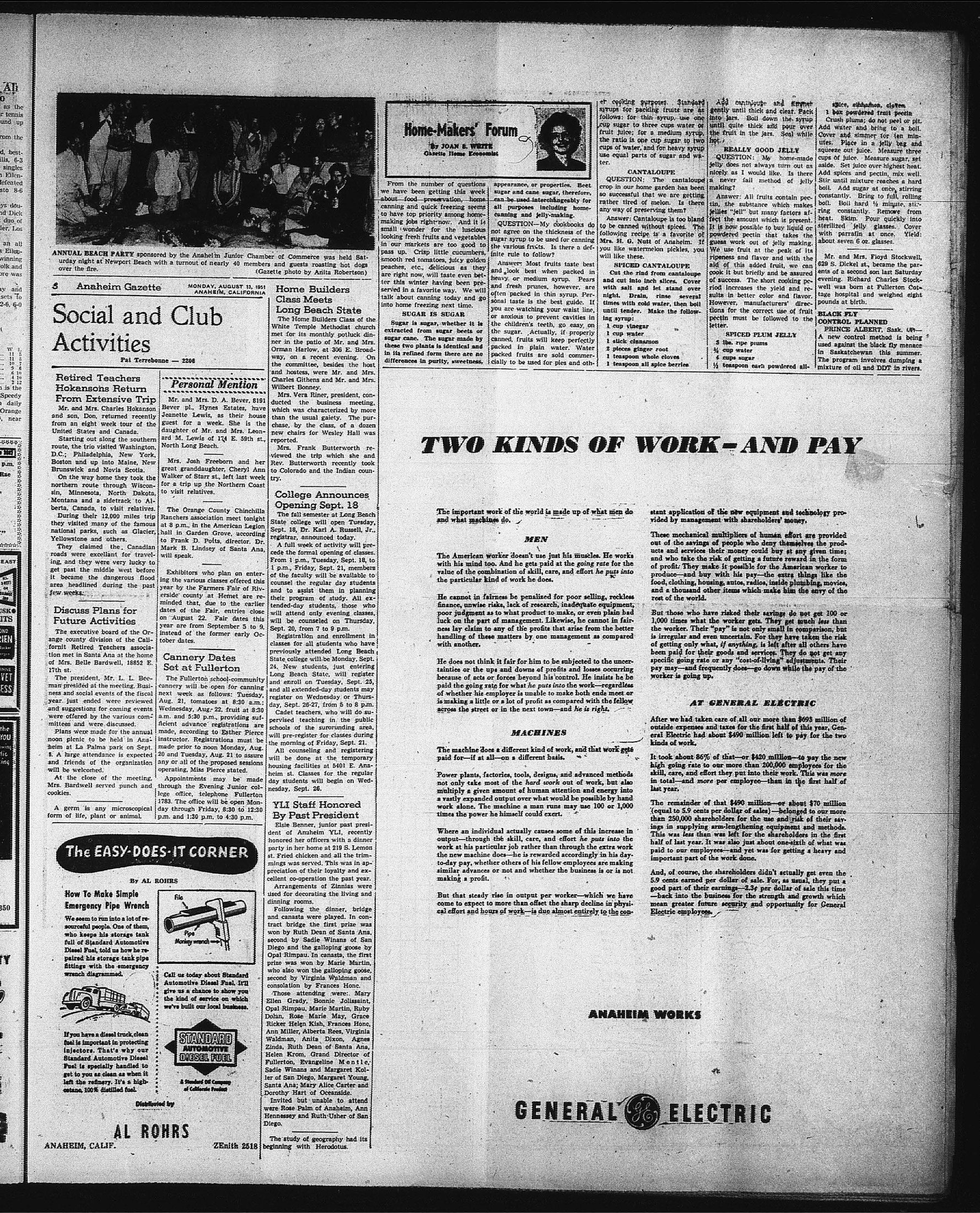
ANNUAL BEACH PARTY sponsored by the Anaheim Junior Chamber of Commerce was held Saturday night at Newport Beach with a turnout of nearly 40 members and guests roasting hot dogs over the fire.
Anaheim Gazette
MONDAY, AUGUST 13, 1951
ANAHEIM, CALIFORNIA
Social and Club Activities
Pat Terrebonne — 2206
Retired Teachers Hokansons Return From Extensive Trip
Mr. and Mrs. Charles Hokanson and son, Don, returned recently from an eight week tour of the United States and Canada.
Starting out along the southern route, the trio visited Washington, DC.
Personal Mention
Mr. and Mrs. D. A. Bever, 8191 Bever pl., Hynes Estates, have Jeanette Lewis, as their house guest for a week. She is the daughter of Mr. and Mrs. Leonard M. Lewis of 174 E. 59th st., North Long Beach.
Home Builders Class Meets Long Beach State
The Home Builders Class of White Temple Methodist church met for its monthly potluck dinner in the patio of Mr. and M. Orman Harlow, at 306 E. Broadway, on a recent evening. The committee, besides the hostess, were Mr. and M. Charles Githens and Mr. and M. Wilbert Bonney.
Mrs. Vera Riner, president, conducted the business meeting which was characterized by more than the usual gaiety. The pachase, by the class, of a dozen new chairs for Wesley Hall was reported.
Mrs. Frank Butterworth
Retired Teachers Hokansons Return From Extensive Trip
Mr. and Mrs. Charles Hokanson and son, Don, returned recently from an eight week tour of the United States and Canada.
Starting out along the southern route, the trio visited Washington, D.C.; Philadelphia, New York, Boston and up into Maine, New Brunswick and Novia Scotia.
On the way home they took the northern route through Wisconsin, Minnesota, North Dakota, Montana and a sidetrack to Alberta, Canada, to visit relatives.
During their 12,000 miles trip they visited many of the famous national parks, such as Glacier, Yellowstone and others.
They claimed the Canadian roads were excellent for traveling, and they were very lucky to get past the middle west before it became the dangerous flood area headlined during the past few weeks.
Discuss Plans for Future Activities
The executive board of the Orange county division of the California Retired Teachers association met in Santa Ana at the home of Mrs. Belle Bardwell, 18852 E. 17th st.
The president, Mr. L. L. Beeman presided at the meeting. Business and social events of the fiscal year just ended were reviewed and suggestions for coming events were offered by the various committees and were discussed.
Plans were made for the annual noon picnic to be held in Anaheim at La Palma park on Sept. 8. A large attendance is expected and friends of the organization will be welcomed.
At the close of the meeting, Mrs. Bardwell served punch and cookies.
A germ is any microscopical form of life, plant or animal.
Personal Mention
Mr. and Mrs. D. A. Beever, 8191 Bever pl., Hynes Estates, have Jeanette Lewis, as their house guest for a week. She is the daughter of Mr. and Mrs. Leonard M. Lewis of 174 E. 59th st., North Long Beach.
Mrs. Josh Freeborn and her great granddaughter, Cheryl Ann Walker of Starr st., left last week for a trip up the Northern Coast to visit relatives.
The Orange County Chinchilla Ranchers association meet tonight at 8 p.m., in the American Legion hall in Garden Grove, according to Frank D. Polts, director. Dr. Mark B. Lindsey of Santa Ana, will speak.
Exhibitors who plan on entering the various classes offered this year by the Farmers Fair of Riverside county at Hemet are reminded that, due to the earlier dates of the Fair, entries close on August 22. Fair dates this year are from September 5 to 9, instead of the former early October dates.
Cannery Dates Set at Fullerton
The Fullerton school-community cannery will be open for canning next week as follows: Tuesday, Aug. 21, tomatoes at 8:30 a.m.; Wednesday, Aug.-22, fruit at 8:30 a.m. and 5:30 p.m., providing sufficient advance registrations are made, according to Esther Pierce instructor. Registrations must be made prior to noon Monday, Aug. 20 and Tuesday, Aug. 21 to assure any or all of the proposed sessions operating, Miss Pierce stated.
Appointments may be made through the Evening Junior college office, telephone Fullerton 1783. The office will be open Monday through Friday, 8:30 to 12:30 p.m. and 1:30 p.m. to 4:30 p.m.
College Announces Opening Sept. 18
The fall semester at Long Beach State college will open Tuesday Sept. 18, Dr. Karl A. Russell, registrar, announced today.
A full week of activity will cease the formal opening of classes From 1 p.m., Tuesday, Sept. 18, 1 p.m., Friday, Sept. 21, member of the faculty will be available counsel the regular day student and to assist them in planning their program of study. All tended-day students, those will attend only evening classes will be counseled on Thursday Sept. 20, from 7 to 9 p.m.
Registration and enrollment classes for all students who have previously attended Long Beach State college will be Monday, Sept. 24. New students, just enter Long Beach State, will register on Wednesday or Thursday Sept. 26-27, from 5 to 8 p.m.
Cadet teachers, who will do pervious teaching in the public schools of the surorounding area will pre-register for classes during the morning of Friday, Sept. 21.
All counseling and registration will be done at the temporary housing facilities at 5401 E. Anaheim st. Classes for the regular day students will begin on Wednesday Sept. 26.
YLI Staff Honored By Past President
Elsie Benner, junior past president of Anaheim YLI, recent honored her officers with a dinner party in her home at 219 S. Lemont st. Fried chicken and all the trimmings
The EASY-DOES-IT CORNER
By AL ROHRS
How To Make Simple Emergency Pipe Wrench
We seem to run into a lot of resourceful people. One of them, who keeps his storage tank full of Standard Automotive Diesel Fuel, told us how he repaired his storage tank pipe fittings with the emergency wrench diagrammed.
If you have a diesel truck, clean fuel is important in protecting injectors. That's why our Standard Automotive Diesel Fuel is specially handled to get to you as clean as when it left the refinery. It's a high-costane, 100% distilled fuel.
Call us today about Standard Automotive Diesel Fuel. It'll give us a chance to show you the kind of service on which we've built our local business.
STANDARD AUTOMOTIVE DIESEL FUEL
A Standard Oil Company of California Product
Distributed by
AL ROHRS
ANAHEIM, CALIF.
ZEnith 2518
Home-Makers' Forum
By JOAN S. WHITE
Oggette Home Economist
From the number of questions we have been getting this week about food preservation, home canning and quick freezing seems to have top priority among homemaking jobs right now. And it is small wonder for the luscious looking fresh fruits and vegetables in our markets are too good to pass up. Crisp little cucumbers, smooth red tomatoes, juicy golden peaches, etc., delicious as they are right now, will taste even better this winter having been preserved in a favorite way. We will talk about canning today and go into home freezing next time.
SUGAR IS SUGAR
Sugar is sugar, whether it is extracted from sugar beets or sugar cane. The sugar made by these two plants is identical and in its refined form there are no differences in purity, sweetness, appearance, or properties. Beet sugar and cane sugar, therefore, can be used interchangeably for all purposes including home-canning and jelly-making.
QUESTION—My cookbooks do not agree on the thickness of the sugar syrup to be used for canning the various fruits. Is there a definite rule to follow?
Answer: Most fruits taste best and look best when packed in heavy, or medium syrup. Pears and fresh prunes, however, are often packed in thin syrup. Personal taste is the best guide. If you are watching your waist line, or anxious to prevent cavities in the children's teeth, go easy, on the sugar. Actually, if properly canned, fruits will keep perfectly packed in plain water. Water packed fruits are sold commercially to be used for pies and oth-
CANTALOUPE
QUESTION: The cantaloupe crop in our home garden has been so successful that we are getting rather tired of melon. Is there any way of preserving them?
Answer: Cantaloupe is too hard to be canned without spices. Following recipe is a favorite Mrs. H. G. Nutt of Anaheim. You like watermelon pickles, will like these.
SPICED CANTALOUPE
Cut the rind from cantaloupe and cut into inch slices. Cover with salt and let stand overnight. Drain, rinse several times with cold water, then bake until tender. Make the following syrup:
1 cup vinegar
1 cup water
1 stick clamamon
2 pieces ginger root
1 teaspoon whole cloves
1 teaspoon all spice berries
TWO KINDS OF WORK
The important work of the world is made up of what men do and what machines do.
MEN
The American worker doesn't use just his muscles. He works with his mind too. And he gets paid at the going rate for the value of the combination of skill, care, and effort he puts into the particular kind of work he does.
He cannot in fairness be penalized for poor selling, reckless finance, unwise risks, lack of research, inadequate equipment, poor judgment as to what product to make, or even plain bad luck on the part of management. Likewise, he cannot in fairness lay claim to any of the profits that arise from the better handling of these matters by one management as compared with another.
He does not think it fair for him to be subjected to the uncertainties or the ups and downs of profits and losses occurring because of acts or forces beyond his control. He insists he be paid the going rate for what he puts into the work—regardless of whether his employer is unable to make both ends meet or is making a little or a lot of profit as compared with the fellow across the street or in the next town—and he is right.
MACHINES
The machine does a different kind of work, and that work gets paid for—if at all—on a different basis.
Power plants, factories, tools, designs, and advanced methods not only take most of the hard work out of work, but also multiply a given amount of human attention and energy into a vastly expanded output over what would be possible by hand work alone. The machine a man runs may use 100 or 1,000 times the power he himself could exert.
Where an individual actually causes some of this increase in output—through the skill, care, and effort he puts into the work at his particular job rather than through the extra work the new machine does—he is rewarded accordingly in his day-
Power plants, factories, tools, designs, and advanced methods not only take most of the hard work out of work, but also multiply a given amount of human attention and energy into a vastly expanded output over what would be possible by hand work alone. The machine a man runs may use 100 or 1,000 times the power he himself could exert.
Where an individual actually causes some of this increase in output—through the skill, care, and effort he puts into the work at his particular job rather than through the extra work the new machine does—he is rewarded accordingly in his day-to-day pay, whether others of his fellow employees are making similar advances or not and whether the business is or is not making a profit.
But that steady rise in output per worker—which we have come to expect to more than offset the sharp decline in physical effort and hours of work—is due almost entirely to the con-
ANAHEIM WORK
GENERAL EL
COOKING PURPOSES. Standard doses for packing fruits are as follows: for thin syrup, use one sugar to three cups water or juice; for a medium syrup, ratio is one cup sugar to two of water, and for heavy syrup equal parts of sugar and water.
CANTALOUPE
QUESTION: The cantaloupe in our home garden has been successful that we are getting tired of melon. Is there away of preserving them?
Answer: Cantaloupe is too bland canned without spices. The wing recipe is a favorite of H. G. Nutt of Anaheim. If like watermelon pickles, you like these.
SPICED CANTALOUPE
But the rind from cantaloupe cut into inch slices. Cover in salt and let stand over it. Drain, rinse several times with cold water, then boil till tender. Make the follow-syrup:
cup vinegar
cup water
stick clamamon
pieces ginger root
teaspoon whole cloves
teaspoon all spice berries
Add cantaloupe and simmer gently until thick and clear. Pack into jars. Boil down the syrup until quite thick and pour over the fruit in the jars. Seal while hot.
REALLY GOOD JELLY
QUESTION: My home-made jelly does not always turn out as nicely as I would like. Is there a never fail method of jelly making?
Answer: All fruits contain pectin, the substance which makes jellies "jell" but many factors affect the amount which is present. It is now possible to buy liquid or powdered pectin that takes the guess work out of jelly making. We use fruit at the peak of its ripeness and flavor and with the aid of this added fruit, we can cook it but briefly and be assured of success. The short cooking period increases the yield and results in better color and flavor. However, manufacturers' directions for the correct use of fruit pectin must be followed to the letter.
SPICED PLUM JELLY
3 lbs. ripe plums
½ cup water
4 cups sugar
½ teaspoon each powdered all-
spice, althamon, cloven
1 box powdered fruit pectin
Crush plums; do not peel or pit. Add water and bring to a boil. Cover and simmer for ten minutes. Place in a jelly bag and squeeze out juice. Measure three cups of juice. Measure sugar, set aside. Set juice over highest heat. Add spices and pectin, mix well. Stir until mixture reaches a hard boil. Add sugar at once, stirring constantly. Bring to full, rolling boll. Boil hard ½ minute, stirring constantly. Remove from heat. Skim. Pour quickly into sterilized jelly glasses. Cover with parrafin at once. Yield: about seven 6 oz. glasses.
Mr. and Mrs. Floyd Stockwell,
629 S. Dickel st., became the parents of a second son last Saturday evening. Richard Charles Stockwell was born at Fullerton Cottage hospital and weighed eight pounds at birth.
BLACK FLY
CONTROL PLANNED
PRINCE ALBERT, Sask. (P)—A new control method is being used against the black fly menace in Saskatchewan this summer. The program involves dumping a mixture of oil and DDT in rivers.
OF WORK- AND PAY
stant application of the new equipment and technology provided by management with shareholders' money.
These mechanical multipliers of human effort are provided out of the savings of people who deny themselves the products and services their money could buy at any given time; and who take the risk of getting a future reward in the form of profit. They make it possible for the American worker to produce—and buy with his pay—the extra things like the food, clothing, housing, autos, radios, inside plumbing, movies, and a thousand other items which make him the envy of the rest of the world.
But those who have risked their savings do not get 100 or 1,000 times what the worker gets. They get much less than the worker. Their "pay" is not only small in comparison, but is irregular and even uncertain. For they have taken the risk of getting only what, if anything, is left after all others have been paid for their goods and services. They do not get any specific going rate or any "cost-of-living" adjustments. Their pay may—and frequently does—go down while the pay of the worker is going up.
AT GENERAL ELECTRIC
After we had taken care of all our more than $693 million of outside expenses and taxes for the first half of this year, General Electric had about $490 million left to pay for the two kinds of work.
It took about 86% of that—or $420 million—to pay the new high going rate to our more than 200,000 employees for the skill, care, and effort they put into their work. This was more in total—and more per employee—than in the first half of last year.
The remainder of that $490 million—or about $70 million (equal to 5.9 cents per dollar of sales)—belonged to our more than 250,000 shareholders for the use and risk of their savings in supplying arm-lengthening equipment and methods. This was less than was left for the shareholders in the first half of last year. It was also just about one-sixth of what was paid to our employees—and yet was for getting a heavy and
high going rate to our more than 200,000 employees for the skill, care, and effort they put into their work. This was more in total—and more per employee—than in the first half of last year.
The remainder of that $490 million—or about $70 million (equal to 5.9 cents per dollar of sales)—belonged to our more than 250,000 shareholders for the use and risk of their savings in supplying arm-lengthening equipment and methods. This was less than was left for the shareholders in the first half of last year. It was also just about one-sixth of what was paid to our employees—and yet was for getting a heavy and important part of the work done.
And, of course, the shareholders didn't actually get even the 5.9 cents earned per dollar of sale. For, as usual, they put a good part of their earnings—2.3¢ per dollar of sale this time—back into the business for the strength and growth which mean greater future security and opportunity for General Electric employees.