anaheim-gazette 1951-02-23
Scanned page
Searchable text
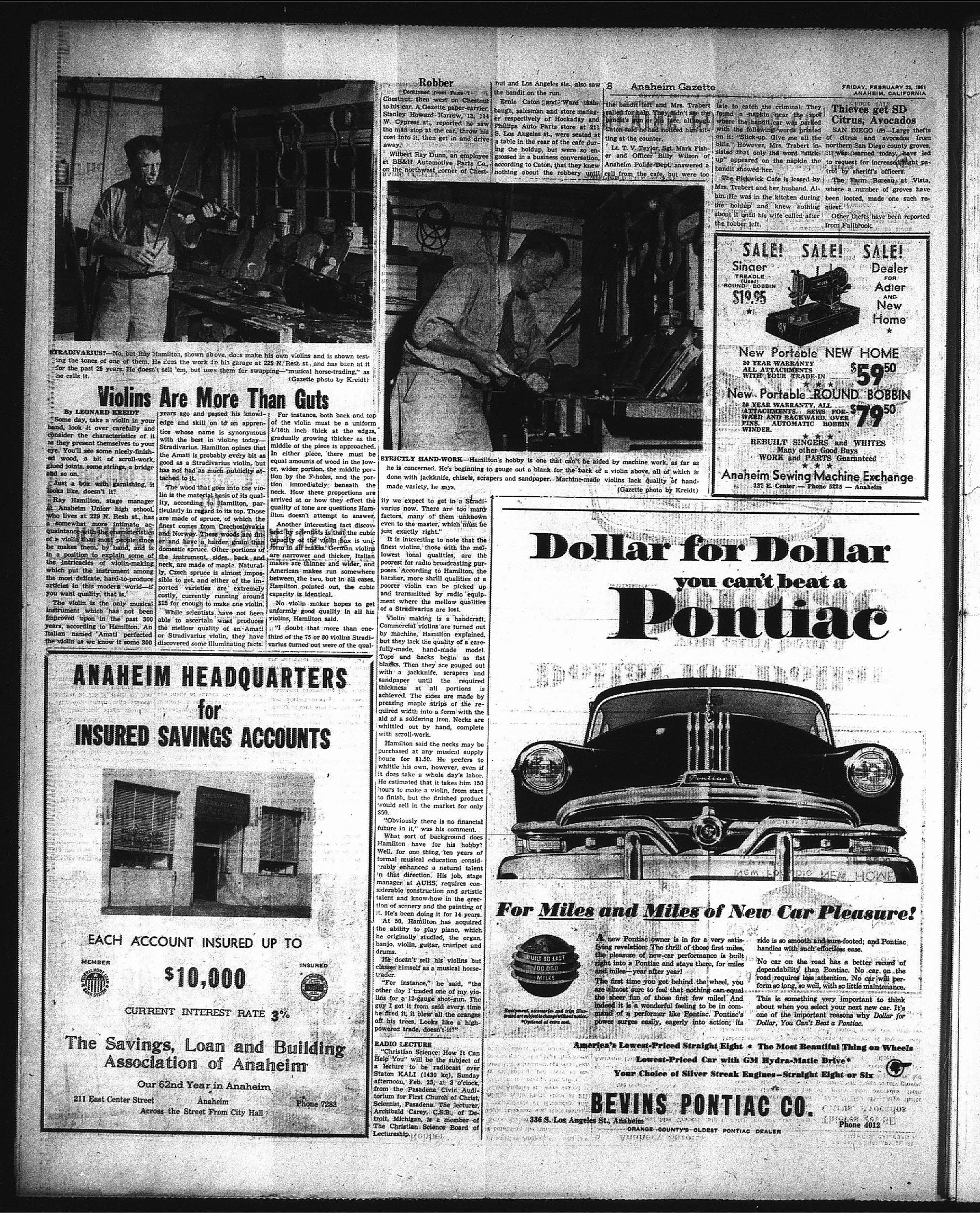
STRADIVARIUS?—No, but Ray Hamilton, shown above, does make his own violins and is shown testing the tones of one of them. He does the work in his garage at 229 N. Resh st., and has been at it for the past 25 years. He doesn't sell 'em, but uses them for swapping—"musical horse-trading," as he calls it.
Violins Are More Than Guts
By LEONARD KREIDT
Some day, take a violin in your hand, look it over carefully and consider the characteristics of it as they present themselves to your eye. You'll see some nicely-finish years ago and passed his knowledge and skill on to an apprentice whose name is synonymous with the best in violins today—Stradivarius. Hamilton opines that
For instance, both back and of the violin must be a uniface 1/16th inch thick at the edge gradually growing thicker as middle of the piece is approach
Violins Are More Than Guts
By LEONARD KREIDT
Some day, take a violin in your hand, look it over carefully and consider the characteristics of it as they present themselves to your eye. You'll see some nicely-finished wood, a bit of scroll-work, glued joints, some strings, a bridge and so on.
Just a box with garnishing, it looks like, doesn't it?
Ray Hamilton, stage manager at Anaheim Union high school, who lives at 229 N. Resh st., has a somewhat more intimate acquaintance with the characteristics of a violin than most people since he makes them, by hand, and is in a position to explain some of the intricacies of violin-making which put the instrument among the most delicate, hard-to-produce articles in this modern world—if you want quality, that is.
The violin is the only musical instrument which has not been improved upon in the past 300 years, according to Hamilton. An Italian named Amati perfected the violin as we know it some 300 years ago and passed his knowledge and skill on to an apprentice whose name is synonymous with the best in violins today—Stradivarius. Hamilton opines that the Amati is probably every bit as good as a Stradivarius violin, but has not had as much publicity attached to it.
The wood that goes into the violin is the material basis of its quality, according to Hamilton, particularly in regard to its top. Those are made of spruce, of which the finest comes from Czechoslovakia and Norway. These woods are finer and have a harder grain than domestic spruce. Other portions of the instrument, sides, back and neck, are made of maple. Naturally, Czech spruce is almost impossible to get, and either of the imported varieties are extremely costly, currently running around $25 for enough to make one violin.
While scientists have not been able to ascertain what produces the mellow quality of an Amati or Stradivarius violin, they have discovered some illuminating facts.
For instance, both back and front of the violin must be a uniform 1/16th inch thick at the edge gradually growing thicker as middle of the piece approaches. In either piece, there must be equal amounts of wood in the lower, wider portion, the middle portion by the F-holes, and theITION immediately beneath the neck. How these proportions arrived at or how they effect the quality of tone are questions Hamilton doesn't attempt to answer.
Another interesting fact discovered by scientists is that the cuvacity of the violin box is unformal in all makes. German violins are narrower and thicker, Italian makes are thinner and wider, American makes run somewhat between the two, but in all cases Hamilton pointed out, the cuvacity is identical.
No violin maker hopes to uniformly good quality in all violins, Hamilton said.
"I doubt that more than one third of the 75 or 80 violins Strauss turned out were of the quintessential type."
ANAHEIM HEADQUARTERS
for
INSURED SAVINGS ACCOUNTS
EACH ACCOUNT INSURED UP TO
$10,000
CURRENT INTEREST RATE 3%
The Savings, Loan and Building Association of Anaheim
Our 62nd Year in Anaheim
211 East Center Street Anaheim Phone 7283
Across the Street From City Hall
Robber
Continued from Page 1
Chestnut, then west on Chestnut to his car. A Gazette paper-carrier, Stanley Howard Harrow, 13, 114 W. Cypress st., reported he saw the man stop at the car, throw his coat into it, then get in and drive away.
Wilbert Ray Dunn, an employee at BB&H Automotive Paris Co., on the northwest corner of Chestnut and Los Angeles sts., also saw the bandit on the run.
Ernie Caton and Ward Ashbaugh, salesman and store manager respectively of Hockaday and Phillips Auto Parts store at 211 S. Los Angeles st., were seated at a table in the rear of the cafe during the holdup, but were so engrossed in a business conversation, according to Caton, that they knew nothing about the robbery until
8 Anaheim Gathe bandit left and Mrs. T. called for help. They didn’t surrender its gun or his face, although Caton said he had noticed him sitting at the counter.
Lt. T. V. Taylor, Sgt. Marker and Officer Billy Wilson Anaheim Police Dept. answered call from the cafe but were...
Guts
instance, both back and top
the violin must be a uniform
inch thick at the edges,
ally growing thicker as the
e of the piece is approached.
other piece, there must be
amounts of wood in the lowder portion, the middle porboy the F-holes, and the porimmediately beneath the
How these proportions are
and or how they effect the
y of tone are questions Hamdoesn't attempt to answer.
other interesting fact discovery scientists is that the cubic
ity of the violin box is uninial all makes. German violins
arrower and thicker, Italian
violins are thinner and wider, and
can make run somewhere
when the two, but in all cases,
ton pointed out, the cubic
ity is identical.
violin maker hopes to get
only good quality in all his
Hamilton said.
I doubt that more than oneof the 75 or 80 violins Straditurned out were of the qual-
STRICTLY HAND-WORK—Hamilton's hobby is one that can't be aided by machine work, as far
he is concerned. He's beginning to gouge out a blank for the back of a violin above, all of which he done with jackknife, chisels, scrapers and sandpaper. Machine-made violins lack quality of hand-made variety, he says.
(Gazette photo by Kreidt)
quality we expect to get in a Stradivarius now. There are too many factors, many of them unknown even to the master, which must be just exactly right."
It is interesting to note that the finest violins, those with the mellowest tonal qualities, are the poorest for radio broadcasting purposes. According to Hamilton, the harshier, more shrill qualities of a poorer violin can be picked up and transmitted by radio equipment where the mellow qualities of a Stradivarius are lost.
Violin making is a handicraft. Commercial violins are turned out by machine, Hamilton explained, but they lack the quality of a carefully-made, hand-made model. Tops and backs begin as flat blanks. Then they are gouged out with a jackknife, scrapers and sandpaper until the required thickness at all portions is achieved. The sides are made by pressing maple strips of the required width into a form with the aid of a soldering iron. Necks are whittled out by hand, complete with scroll-work.
Hamilton said the necks may be purchased at any musical supply house for $1.50. He prefers to whittle his own, however, even if it does take a whole day's labor. He estimated that it takes him 150 hours to make a violin, from start to finish, but the finished product would sell in the market for only $50.
"Obviously there is no financial future in it," was his comment.
What sort of background does Hamilton have for his hobby? Well, for one thing, ten years of
Obviously there is no financial future in it," was his comment.
What sort of background does Hamilton have for his hobby? Well, for one thing, ten years of formal musical education considerably enhanced a natural talent in that direction. His job, stage manager at AUHS, requires considerable construction and artistic talent and know-how in the erection of scenery and the painting of it. He's been doing it for 14 years.
At 50, Hamilton has acquired the ability to play piano, which he originally studied, the organ, banjo, violin, guitar, trumpet and drums.
He doesn't sell his violins but classes himself as a musical horse-trader.
"For instance," he said, "the other day I traded one of my violins for a 12-gauge shot-gun. The guy I got it from said every time he fired it, it blew all the oranges off his trees. Looks like a high-powered trade, doesn't it?"
RADIO LECTURE
"Christian Science: How It Can Help You" will be the subject of a lecture to be radiocast over Staton KALI (1430 kc), Sunday afternoon, Feb. 25, at 3 o'clock, from the Pasadena Civic Auditorium for First Church of Christ, Scientist, Pasadena. The lecturer, Archibald Carey, C.S.B., of Detroit, Michigan, is a member of The Christian Science Board of Lectureship.
Anaheim Gazette
FRIDAY, FEBRUARY 23, 1951
ANAHEIM, CALIFORNIA
bandit left and Mrs. Trabert led for help. They didn’t see the bandit’s gun or his face, although he said he had noticed him sitting at the counter.
T. V. Taylor, Sgt. Mark Fish and Officer Billy Wilson of Anaheim Police Dept. answered a call from the cafe but were too late to catch the criminal. They found a napkin near the spot where the bandit car was parked with the following words printed on it: “Stick-up. Give me all the bills.” However, Mrs. Trabert insisted that only the word “stick-up” appeared on the napkin the bandit showed her.
The Pickwick Cafe is leased by Mrs. Trabert and her husband, Albin. He was in the kitchen during the holdup and knew nothing about it until his wife called after the robber left.
Thieves get SD Citrus, Avocados
SAN DIEGO (AP)—Large thefts of citrus and avocados from northern San Diego county groves, it was learned today, have led to request for increased night patrol by sheriff’s officers.
The Farm Bureau at Vista, where a number of groves have been looted, made one such request.
Other thefts have been reported from Fallbrook.
SALE! SALE! SALE!
Singer
TREADLE
(Used)
ROUND BOBBIN
$19.95
Dealer
FOR Adier AND New Home
New Portable NEW HOME
20 YEAR WARRANTY
ALL ATTACHMENTS
WITH YOUR TRADE-IN ..... $59.50
New Portable ROUND BOBBIN
20 YEAR WARRANTY, ALL ATTACHMENTS.
SEWS FOR-WARD AND BACKWARD. OVER PINS.
AUTOMATIC BOBBIN WINDER.
REBUILT SINGERS and WHITES
Many other Good Buys
20 YEAR WARRANTY
ALL ATTACHMENTS
WITH YOUR TRADE-IN ... $59.50
New Portable ROUND BOBBIN
20 YEAR WARRANTY, ALL
ATTACHMENTS. SEWS FORWARD AND BACKWARD. OVER
PINS. AUTOMATIC BOBBIN
WINDER.
REBUILT SINGERS and WHITES
Many other Good Buys
WORK and PARTS Guaranteed
Anaheim Sewing Machine Exchange
127 E. Center — Phone 5225 — Anaheim
Dollar for Dollar
you can't beat a Pontiac
and Miles of New Car Pleasure!
New Pontiac owner is in for a very satisfactory revelation: The thrill of those first miles, pleasure of new-car performance is built into a Pontiac and stays there, for miles miles—year after year!
First time you get behind the wheel, you most sure to feel that nothing can equal her fun of those first few miles! And it is a wonderful feeling to be in com- of a performer like Pontiac. Pontiac's surges easily, eagerly into action; its ride is so smooth and sure-footed; and Pontiac handles with such effortless ease.
No car on the road has a better record of dependability than Pontiac. No car on the road requires less attention. No car will perform so long, so well, with so little maintenance.
This is something very important to think about when you select your next new car. It's one of the important reasons why Dollar for Dollar, You Can't Beat a Pontiac.
Lowest-Priced Straight Eight • The Most Beautiful Thing on Wheels
Lowest-Priced Car with GM Hydra-Matic Drive*
Your Choice of Silver Streak Engines—Straight Eight or Six
EVINS PONTIAC CO.
Anaheim
ORANGE COUNTY'S OLDEST PONTIAC DEALER
Phone 4012