anaheim-gazette 1950-07-19
Scanned page
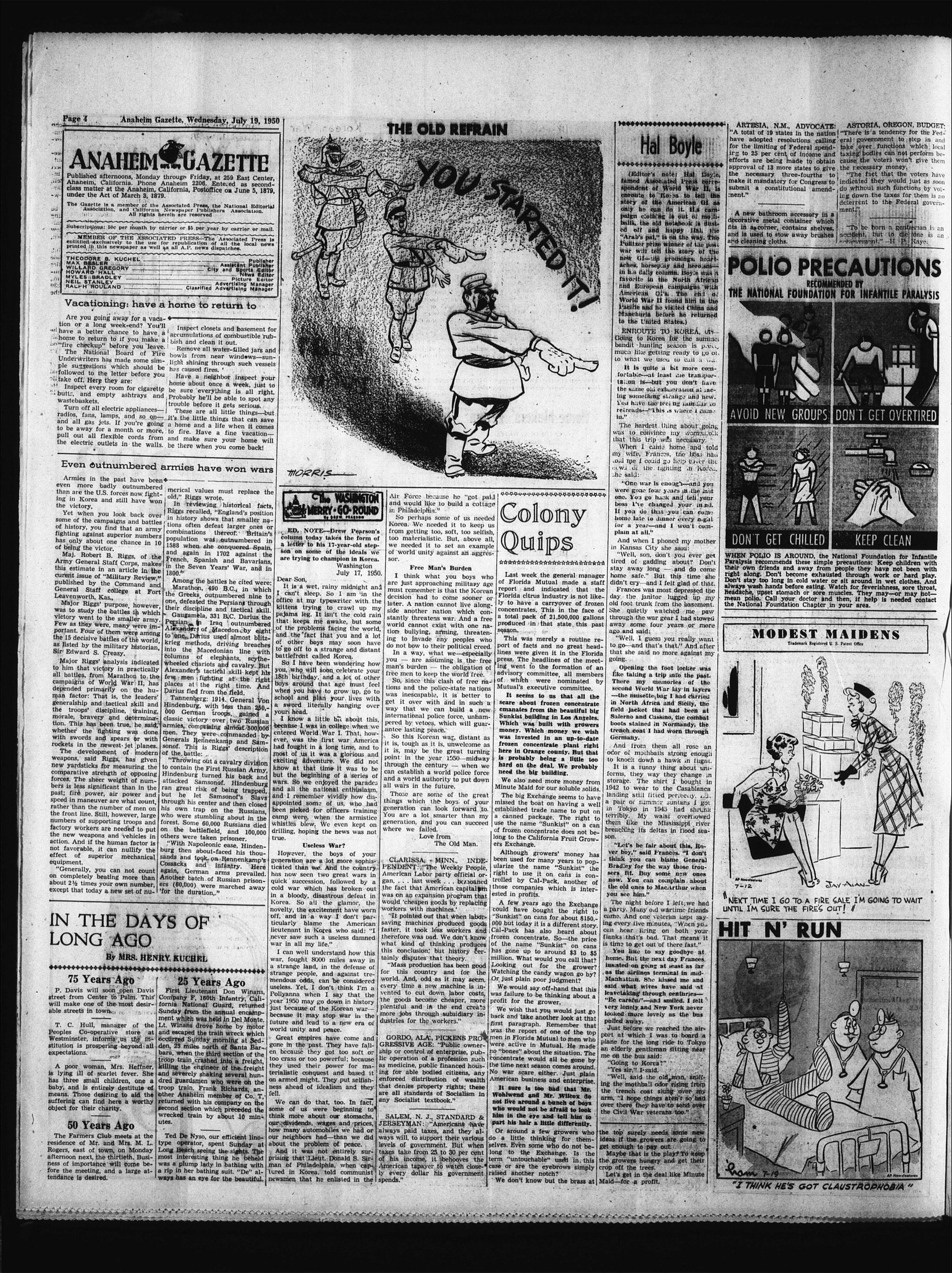
Searchable text
ANAHEIM GAZETTE
Published afternoons, Monday through Friday, at 259 East Center,
Ananeim, California. Phone Anaheim 2206. Entered as second-class matter at the Anaheim, California, Postoffice on June 5, 1879,
under the Act of March 3, 1879.
The Gazette is a member of the Associated Press, the National Editorial Association, and California Newspaper Publishers Association. All rights herein are reserved.
Subscriptions: 50¢ per month by carrier or $5 per year by carrier or mail.
MEMBER OF THE ASSOCIATED PRESS—The Associated Press is entitled exclusively to the use for republication of all the local news printed in this newspaper as well as all A.P. news dispatches.
THEODORE B. KUCHEL Publisher
MAX BESLER Assistant Publisher
WILLARD GREGORY City and Sports Editor
HOWARD HALL News Editor
MYLES BRADLEY Picture Editor
NEIL STANLEY Advertising Manager
RALPH ROULAND Classified Advertising Manager
Vacationing: have a home to return to
Are you going away for a vacation or a long week-end? You'll have a better chance to have a home to return to if you make a "fire checkup" before you leave.
The National Board of Fire Underwriters has made some simple suggestions which should be followed to the letter before you take off. Here they are:
Inspect every room for cigarette butts, and empty ashtrays and wastebaskets.
Turn off all electric appliances—radios, fans, lamps, and so on—and all gas jets. If you're going to be away for a month or more, pull out all flexible cords from the electric outlets in the walls.
Inspect closets and basement for accumulations of combustible rubbish and clean it out.
Remove all water-filled jars and bowls from near windows—sunlight shining through such vessels has caused fires.
Have a neighbor inspect your home about once a week, just to be sure everything is all right. Probably he'll be able to spot any trouble before it gets serious.
These are all little things—but it's the little things that can save a home and a life when it comes to fire. Have a fine vacation—and make sure your home will be there when you come back!
Even outnumbered armies have won wars
Even outnumbered armies have won wars
Armies in the past have been even more badly outnumbered than are the U.S. forces now fighting in Korea and still have won the victory.
Yet when you look back over some of the campaigns and battles of history, you find that an army fighting against superior numbers has only about one chance in 10 of being the victor.
Maj. Robert B. Riggs, of the Army General Staff Corps, makes this estimate in an article in the current issue of "Military Review," published by the Command and General Staff college at Fort Leavenworth, Kas.
Major Riggs' purpose, however, was to study the battles in which victory went to the smaller army. Few as they were, many were important. Four of them were among the 15 decisive battles of the world, as listed by the military historian, Sir Edward S. Creasy.
Major Riggs' analysis indicated to him that victory in practically all battles, from Marathon to the campaigns of World War II, has depended primarily on the human factor: That is, the leaders' generalship and tactical skill and the troops' discipline, training, morale, bravery and determination. This has been true, he said, whether the fighting was done with swords and spears or with rockets in the newest jet planes.
The development of modern weapons, said Riggs, has given new yardsticks for measuring the comparative strength of opposing forces. The sheer weight of numbers is less significant than in the past; fire power, air power and speed in maneuver are what count, rather than the number of men on the front line. Still, however, large numbers of supporting troops and factory workers are needed to put the new weapons and vehicles in action. And if the human factor is not favorable, it can nullify the effect of superior mechanical equipment.
"Generally, you can not count on completely beating more than about 2½ times your own number, except that today a new set of numerical values must replace the old," Riggs wrote.
In reviewing historical facts, Riggs recalled, "England's position in history shows that smaller nations often defeat larger ones or combinations thereof. Britain's population was outnumbered in 1588 when she conquered Spain, and again in 1702 against the French, Spanish and Bavarians, in the Seven Years' War, and in 1800."
Among the battles he cited were:
Marathon, 490 B.C., in which the Greeks, outnumbered nine to one, defeated the Persians through their discipline and tactical skill.
Gaugamela, 331 B.C. Darius the Persian in Iraq outnumbered Alexander of Macedon by eight to one. Darius used almost blitzkrieg methods, driving breaches into the Macedonian line with columns of elephants, scythe-wheeled chariots and cavalry. But Alexander's tactical skill kept his few men fighting at the right places at the right time. And Darius fled from the field.
Tannenberg: 1914. General Von Hindenburg, with less than 250,-000 German troops, gained a classic victory over two Russian armies, comprising almost 500,000 men. They were commanded by Generals Rennenkamp and Samsof. This is Riggs' description of the battle:
"Throwing out a cavalry division to contain the First Russian Army, Hindenburg turned his back and attacked Samsonof. Hindenburg ran great risk of being trapped, but he let Samsonof's Slavs through his center and then closed his own trap on the Russians, who were stumbling about in the forest. Some 60,000 Russians died on the battlefield, and 100,000 others were taken prisoner.
"With Napoleonic ease, Hindenburg then about-faced his thousands and took on Rennenkamp's Cossacks and infantry. Here again, German arms prevailed. Another batch of Russian prisoners (60,000) were marched away 'for the duration,'"
Dear Son,
It is a wet, rainy midnight I can't sleep. So I am office at my typewriter with kittens trying to crawl pajama leg. It isn't the order that keeps me awake, but of the problems facing them and the fact that you are of other boys may soon go off to a strange and battlefront called Korea.
So I have been wondering you, who will soon celebrate 18th birthday, and a lot of boys around that age may when you have to grow up school and plan your life live a sword literally hanging your head.
I know a little bit about because I was in college when entered World War I. Th ever, was the first war I had fought in a long time most of us it was a glorious exciting adventure. We know at that time it was but the beginning of a sea wars. So we enjoyed the part and all the national enthiltion I remember vividly had appointed some of us, we been picked for officers to camp were, when the art whistles blew. We even knew drilling, hoping the news was true.
Useless War?
However, the boys of generation are a lot more ticated than we. And the c has now seen two great quick succession, followed cold war which has broken in a bloody, disastrous def
IN THE DAYS OF LONG AGO
By MRS. HENRY KUCHEL
75 Years Ago
P. Davis will soon open Davis street from Center to Palm. This will make one of the most desirable streets in town.
T. C. Hull, manager of the Peoples Co-operative store at Westminster, informs us the institution is prospering beyond all expectations.
A poor woman, Mrs. Heffner, is lying ill of scarlet fever. She has three small children, one a baby, and is entirely destitute of means. Those desiring to aid the suffering can find here a worthy object for their charity.
50 Years Ago
The Farmers Club meets at the residence of Mr. and Mrs. M. L. Rogers, east of town, on Monday afternoon next, the thirtieth. Business of importance will come before the meeting, and a large attendance is desired.
25 Years Ago
First Lieutenant Don Winans, Company F, 160th Infantry, California National Guard, returned Sunday from the annual encampment which was held in Del Monte. Lt. Winans drove home by motor and escaped the train wreck which occurred Sunday morning at Sedden, 25 miles north of Santa Barbara, when the third section of the troop train crashed into a freight, killing the engineer of the freight and severely shaking several hundred guardsmen who were on the troop train. Frank Richards, another Anaheim member of Co. T., returned with his company on the second section which preceded the wrecked train by about 10 minutes.
Ted De Nyso, our efficient lino-type operator, spent Sunday at Long Beach seeing the sights. The most interesting thing he beheld was a plump lady in bathing with a rip in her bathing suit. "De" always has an eye for the beautiful.
THE OLD REFRAIN
YOU STARTED IT!
Hal E
(Editor's note
famed Associate
spondent of World
enroute to Korea
story of the A
only he can do
palign clothing in
balls, the old no
ed off and ha
"Arab's pat," is o
Pulitzer prize win
war will tell th
new GI—his gre
aches, horseplay
in his daily colum
favorite in the
and European ca
American GI's.
World War II for
Pacific and he visit
Manchuria before
to the United Sta
ENROUTE TO
Goling to Korea for
bandit hunting se
much like getting
to what we useu
It is quite a b
fortable—at least
tation is—but you
the same old exhau
ing something stra
You have the feel
retreads—"This is
in."
The hardest thing
was to convince n
that this trip was
When I came h
my wife, Frances,
old me I could go
news of the tight
ED. NOTE—Drew Pearson's column today takes the form of a letter to his 17-year-old stepson on some of the ideals we are trying to champion in Korea.
Washington July 17, 1950.
Dear Son,
It is a wet, rainy midnight and can't sleep. So I am in the office at my typewriter with the littens trying to crawl up my ajama leg. It isn't the cold rain that keeps me awake, but some of the problems facing the world, and the fact that you and a lot of other boys may soon have go off to a strange and distant battlefront called Korea.
So I have been wondering how you, who will soon celebrate your 8th birthday, and a lot of other boys around that age must feel when you have to grow up, go to school and plan your lives with a sword literally hanging over your head.
I know a little bit about this, because I was in college when we entered World War I. That, however, was the first war America had fought in a long time, and to cost of us it was a glorious and exciting adventure. We did not now at that time it was to be at the beginning of a series of wars. So we enjoyed the parades and all the national enthusiasm. And I remember vividly how disappointed some of us, who had been picked for officers training camp were, when the armistice stifles blew. We even kept on filling, hoping the news was not une.
Useless War?
However, the boys of your generation are a lot more sophisticated than we. And the country is now seen two great wars inICK succession, followed by a cold war which has broken out in bloody, disastrous defeat in
Air Force because he "got paid and would like to build a cottage in Philadelphia."
So perhaps some of us needed Korea. We needed it to keep us from getting too, soft, too selfish, too materialistic. But, above all, we needed it to set an example of world unity against an aggressor.
Free Man's Burden
I think what you boys who are just approaching military age must remember is that the Korean decision had to come sooner or later. A nation cannot live alongside another nation which constantly threatens war. And a free world cannot exist with one nation bullying, arming, threatening to invade any peoples who do not bow to their political creed.
In a way, what we—especially you—are assuming is the free man's burden—the obligation of free men to keep the world free.
So, since this clash of free nations and the police-state nations was inescapable, it is better to get it over with and in such a way that we can build a new international police force, unhampered by vetoes, which will guarantee lasting peace.
So this Korean war, distant as it is, tough as it is, unwelcome as it is, may be the great turning point in the year 1950—midway through the century — when we can establish a world police force and a world authority to put down all wars in the future.
Those are some of the great things which the boys of your generation can look forward to. You are a lot smarter than my generation, and you can succeed where we failed.
Love from
The Old Man.
CLARISSA, MINN., INDEPENDENT: "The Weekly People, American Labor party official organ... last week... bemoaned the fact that American capitalism was on an expansion program that
Colony Quips
Last week the general manager of Florida Mutual made a staff report and indicated that the Florida citrus industry is not likely to have a carryover of frozen concentrates. This in the face of a total pack of 21,500,000 gallons produced in that state this past season.
This was merely a routine report of facts and no great headlines were given it in the Florida press. The headlines of the meeting went to the formation of an advisory committee, all members of which were nominated by Mutual's executive committee.
It seems to us that all the scare about frozen concentrate emanates from the beautiful big Sunkist building in Los Angeles. Which was built with growers money. Which money we wish was invested in an up-to-date frozen concentrate plant right here in Orange county. But that is probably being a little too hard on the deal. We probably need the big building.
We also need more money from Minute Maid for our soluble solids.
The big Exchange seems to have missed the boat on having a well established trade name to put on a canned package. The right to use the name "Sunkist" on a can of frozen concentrate does not belong to the California Fruit Growers Exchange.
Although growers' money has been used for many years to popularize the name "Sunkist" the right to use it on canns is controlled by Cal-Pack, another of those companies which is interested in profits.
One war is enough were gone four years one. You go back to boss I've changed. If you do that you home late to dinner for a year—and I plain at all."
And when I phone in Kansas City she "Well, son, don't tired of gadding stay away long — home safe." But they didn't cry—and I fell.
Frances was most day the janitor lust old foot trunk from her She quietly watched through the war gear away some four ye ago and said:
"Well, I guess you to go—and that's that she said no more going.
Opening the foot like taking a trip up There my memory second World War —the musette bag I in North Africa and field jacket that hit Salerno and Cassino, boots stained in Noi trench coat I had we Germany.
And from them odor of mothballs still knock down a haunt.
It is a funny thing forms, they way the storage. The shirt I 1942 to wear to the landing still fitted pea pair of summer suit in Tokyo in 1945 terribly. My waist them like the Miss Breaching its deltas in son.
"Let's be fair about ver boy," said France think you can blame Bradley for the way sers fit. Buy some now. You can comp the old ones to Mac you see him."
Useless War?
However, the boys of your generation are a lot more sophisticated than we. And the country is now seen two great wars in quick succession, followed by a cold war which has broken out in bloody, disastrous defeat in Korea. So all the glamor, the velvety, the excitement have worn off, and in a way I don't particularly blame the Americanutenant in Korea who said: "I never saw such a useless damned war in all my life."
I can well understand how this war, fought 8000 miles away in strange land, in the defense of orange people, and against treasonous odds, can be considered less. Yet, I don't think I'm aalyanna when I say that the war 1950 may go down in history because of the Korean war—because it may stop war in the future and lead to a new era of world unity and peace.
Great empires have come and gone in the past. They have fallen because they got too soft or crass or too powerful; because they used their power for malalistic conquest and based it armed might. They put selfishness ahead of idealism and they were do that, too. In fact, one of us were beginning to talk more about our stomachs, dividends, wages and prices, many automobiles we had or neighbors had—than we did out the problem of peace.
And it was not entirely surprising that Lieut. Donald S. Siren of Philadelphia, when caped in Korea, told communist men that he enlisted in the things which the boys of your generation can look forward to. You are a lot smarter than my generation, and you can succeed where we failed.
Love from
The Old Man.
CLARISSA, MINN., INDEPENDENT: "The Weekly People, American Labor party official organ, . . . last week . . . beenoaned the fact that American capitalism was on an expansion program that would 'cheapen goods by replacing workers with machines.'
"It pointed out that when labor-saving machines produced goods faster, it took less workers and therefore was bad. We don't know what kind of thinking produces this conclusion; but history certainly disputes that theory.
"Mass production has been good for this country and for the world. And, odd as it may seem, every time a new machine is invented to cut down labor costs, the goods become cheaper, more plentiful and in the end create more jobs through subsidiary industries for the workers."
GORDO, ALA., PICKENS PROGRESSIVE AGE: "Public ownership or control of enterprise, public operation of a profession such as medicine, public financed housing for able bodied citizens, any enforced distribution of wealth that denies property rights; these are all standards of Socialism in any Socialist textbook."
SALEM, N. J., STANDARD & JERSEYMAN: "Americans have always paid taxes, and they always will, to support their various levels of government. But when taxes take from 25 to 30 per cent of his income, it behooves the American tapayer to watch closely every dollar his government spends."
Although growers' money has been used for many years to popularize the name "Sunkist" the right to use it on cans is controlled by Cal-Pack, another of those companies which is interested in profits.
A few years ago the Exchange could have bought the right to "Sunkist" on cans for about $150,-000 but today it is a different story. Cal-Pack has also heard about frozen concentrate. So—the price of the name "Sunkist" on cans has gone up to around $3 to $5 million. What would you call that? Looking out for the grower? Watching the candy wagon go by? Or just plain poor judgment?
We would say off-hand that this was failure to be thinking about a profit for the grower.
We wish that you would just go back and take another look at that first paragraph. Remember that was the report of one of the top men in Florida Mutual to men who were active in Mutual. He made no "bones" about the situation. The concentrate would all be gone by the time next season comes around. No war scare either. Just plain American business and enterprise.
It sure is too bad that Mr. Wohlwend and Mr. Willcox do not live around a bunch of boys who would not be afraid to look him in the eye and tell him to part his hair a little differently.
Or around a few growers who do a little thinking for themselves. Even some who do not belong to the Exchange. Is the term "untouchable" used in this case or are the eyebrows simply raised another notch?
We don't know but the brass at a pair of summer suites in Tokyo in 1945 terribly. My waist them like the Mississippi breaching its deltas in son.
"Let's be fair about over boy," said Francis think you can blame Bradley for the way you sers fit. Buy some now. You can compete the old ones to MacArthur you see him."
The night before I left a party. Many old war came. And one veteran ing every five minutes, he can hear firing on his flanks that's bad. That is time to get out of tha
You like to say go home. But the next day insisted on going at it as the airlines terminus Manhattan. She kissed said what wives have leavetaking through on "Be careful!" and smiled very lonely and New York looked more lovely than pulled away.
Just before we reach port at which I was the plane for the long ride an elderly gentleman sa me on the bus said:
"Going to Korea?"
"Yes sir," I said.
"Well, said the old ing the mothball odor in the trench coat slung arm, "I hope things are over there they have to the Civil War veterans."
the top surely needs ideas if the growers are get enough to pay out.
Maybe that is the play the growers hungry and crop off the trees.
Let's get in the deal li Maid—for a profit.
Hal Boyle
(Editor's note: Hal Boyle, famed Associated Press correspondent of World War II, is enroute to Korea to tell the story of the American GI as only he can do it. His campaign clothing is out of stock, the old notebook is dusted off and happy inhaling "Arab's pat," is on the way. The Pulitzer prize winner of the past war will tell the story of the new GI—his grouses, heartaches, horseplay and heroism—in his daily column. Boyle was a favorite in the North African and European campaigns with American GI's. The end of World War II found him in the Pacific and he visited China and Manchuria before he returned to the United States.
ENROUTE TO KOREA, (U)—Golling to Korea for the summer bandit-hunting season is pretty much like getting ready to go on to what we used to call a war.
It is quite a bit more comfortable—at least the transportation is—but you don't have the same old exhilaration at seeing something strange and new. You have the feeling familiar to retreads—"This is where I came in."
The hardest thing about going was to convince my womenfolk that this trip was necessary.
When I came home and told my wife, Frances, the boss had told me I could go help cover the news of the fighting in Korea, she said:
ARTESIA, N.M., ADVOCATE:
"A total of 19 states in the nation have adopted resolutions calling for the limiting of Federal spending to 25 per cent of income and efforts are being made to obtain approval of 13 more states to give the necessary three-fourths to make it mandatory for Congress to submit a constitutional amendment."
A new bathroom accessory in a decorative metal container which fits in a corner, contains shelves, and is used to stow away brushes and cleaning cloths.
ASTORIA, OREGON, BUDGET:
"There is a tendency for the Federal government to step in and take over functions which local taxing bodies cannot perform because the voters won't give them the necessary money.
"The fact that the voters have indicated they would just as soon do without such functions by voting down the taxes for them is no deterrent to the Federal government."
"To be born a gentleman is an accident, but to die one is an achievement."—H. P. Kaye.
POLIO PRECAUTIONS
RECOMMENDED BY
THE NATIONAL FOUNDATION FOR INFANTILE PARALYSIS
AVOID NEW GROUPS
DON'T GET OVERTIRED
The hardest thing about going was to convince my womenfolk that this trip was necessary.
When I came home and told my wife, Frances, the boss had told me I could go help cover the news of the fighting in Korea, she said:
"One war is enough—and you were gone four years in the last one. You go back and tell your boss I've changed your mind. If you do that you can come home late to dinner every night for a year—and I won't complain at all."
And when I phoned my mother in Kansas City she said:
"Well, son, don't you ever get tired of gadding about? Don't stay away long — and do come home safe." But this time she didn't cry—and I felt glad of that.
Frances was most depressed the day the janitor lugged up my old foot trunk from the basement. She quietly watched me paw through the war gear I had stowed away some four years or more ago and said:
"Well, I guess you really want to go—and that's that." And after that she said no more against my going.
Opening the foot locker was like taking a trip into the past. There my memories of the second World War lay in layers—the musette bag I had carried in North Africa and Sicily, the field jacket that had been at Salerno and Cassino, the combat boots stained in Normandy, the trench coat I had worn through Germany.
And from them all rose an odor of mothballs strong enough to knock down a hawk in flight.
It is a funny thing about uniforms, they way they change in storage. The shirt I bought in 1942 to wear to the Casablanca landing still fitted perfectly. But a pair of summer suntans I got in Tokyo in 1945 had shrunk terribly. My waist overflowed them like the Mississippi river breaching its deltas in flood season.
"Let's be fair about this, Rover boy," said Frances. "I don't think you can blame General Bradley for the way those trousers fit. Buy some new ones now. You can complain about the old ones to MacArthur when you see him."
WHEN POLIO IS AROUND, the National Foundation for Infantile Paralysis recommends these simple precautions: Keep children with their own friends and away from people they have not been with right along. Don't become exhausted through work or hard play. Don't stay too long in cold water or sit around in wet clothes. And always wash hands before eating. Watch for feverishness, sore throat, headache, upset stomach or sore muscles. They may—or may not—mean polio. Call your doctor and then, if help is needed contact the National Foundation Chapter in your area.
MODEST MAIDENS
Trademark Registered U.S. Patent Office
"Let's be fair about this, Rover boy," said Frances. "I don't think you can blame General Bradley for the way those trousers fit. Buy some new ones now. You can complain about the old ones to MacArthur when you see him."
The night before I left, we had a party. Many old wartime friends came. And one veteran kept saying every five minutes, "When you can hear firing on both your flanks that's bad. That means it is time to get out of there fast."
You like to say goodbye at home. But the next day Frances insisted on going at least as far as the airlines terminal in mid-Manhattan. She kissed me and said what wives have said at leavetaking through centuries—"Be careful"—and smiled. I felt very lonely and New York never looked more lovely as the bus pulled away.
Just before we reached the airport at which I was to board a plane for the long ride to Tokyo an elderly gentleman sitting near me on the bus said:
"Going to Korea?"
"Yes sir," I said.
"Well, said the old man, sniffing the mothball odor rising from the trench coat slung over my arm, 'I hope things aren't so bad over there they have to send over the Civil War veterans too.'"
the top surely needs some new ideas if the growers are going to get enough to pay out.
Maybe that is the play: To keep the growers hungry and get their crop off the trees.
Let's get in the deal like Minute Maid—for a profit.
"I THINK HE'S GOT CLAUSTROPHOBIA."